Playing the Indian Card

Showing posts with label Russia. Show all posts

Monday, June 16, 2025

Mene, Mene, Tekel, Upharsin


Things that seem epochal seem to be happening all at once, as I type, as though we are witnessing the hand of Providence. I may be speaking too soon, but rumours are growing of an economic collapse and a change in power in China. And to a more “pro-Western” regime.

What seems especially uncanny, and implausible, are reports of a sudden demographic collapse, of empty villages in the countryside, and of strangely empty streets in major cities. How can millions of people just disappear suddenly?

Possibly much work and purchasing has gone online, as it has, after all, in North America. Possibly an economic collapse means people do not have money to go out and spend, or work to get to. Possibly the government is harassing those who venture out, fearing any concentration of people might become an anti-government demonstration or a riot.

But counter to this last hypothesis, reports are that the extensive Chinese network of security cameras has been cut off. Surely not what they want to do if they fear unrest. A power shortage?

Whatever the case, it seems that something big is happening in China. And any thing big happening in China is big for the whole world.

Meantime, there is the apocalypse in Iran. Israel is suddenly, in lightning strikes,  wiping out much of Iran’s military capabilities and creating chaos in the regime. Rumours are that many top leaders have flown out to Russia or Pakistan. 

If true, this is what happens when a regime is about to collapse. The Iranian regime has for many years not had any popular support. The military was vital to hold the people down through fear. Now the military is in disarray, and shown to be weak. Iranians  may seize the opportunity to rise up. Iranian friends in Canada are cheering on the Israeli attacks. There is an organized opposition abroad; as there was when the Shah fell. Then, they successfully flew in to take charge and restore order. It may happen again now. Losing a war or some reckless military adventure is a common trigger for autocratic governments to fall. 

That’s two of the three strongest anti-Western regimes.

And then there is the third leg of the triple alliance, Russia.

Russia and Putin have also just gotten a big shock, with the Ukrainian drone attacks deep into Russia. It was actually eerily similar to the Israeli attack on Iran, happening almost simultaneously, as though the same mastermind was behind both. If not God, perhaps the USA? 

It took out a significant part of Russia’s strategic abilities; and it brought the war to the common people back in Moscow. Not good for popular support, I imagine. 

Online commentators also say Russia, having now lost a million casualties, is finding it hard to replace lost manpower. They may be losing this war of attrition.

At first glance, this looks improbable. Surely Ukraine has a greater manpower problem, with a much smaller population. They’ve been fighting just as long. And a greater materiel problem: their economy is smaller, and their factories have been under attack far longer.

But the argument goes that, in order to gain ground, the Russians have been using human wave attacks, in a war which heavily favours the defense. The Ukrainians, by staying mostly on the defensive, have been able to take advantage of this. Perhaps the optics were bad, but it was the smart move. Let the other side run straight into the machine guns. 

As for materiel, Ukraine still has all of the EU, and beyond, to draw on.

Rumours online are that all this recent attack puts Putin on shaky ground; a palace coup seems possible. As with Iran, a failed military adventure is the most common trigger for the fall of an autocratic regime. 

Of course, this has all been said before, the imminent fall of Putin has been widely predicted, ever since the initial Russian invasion, supposed to take three days, was repulsed. He has shown great resilience. But even a cat has only nine lives. This recent mass drone attack, and the detonation under the Crimean bridge, does look like a possible tipping point. Like the Tet offensive was for the US in Vietnam—the frustration and sense of failure is that much greater once having started to feel victory was at last within view. It must be psychologically devastating.

With Israel’s attack on Iran, Putin has probably lost his main source of drones with which to respond to Ukraine. There are suddenly leaks that Russia and China no longer see one another as allies—consistent with the rumours that China is about to turn pro-Western. It makes sense; China has unresolved historical grievances and border disputes with Russia, and not with the USA or the West. 

So Putin too might soon and suddenly fall.

If any one of these three regimes goes, the other two are more vulnerable. We’re talking dominoes. And China, the biggest and most important of the three, seems to be a pretty sure thing.

What will the world look like if all three dominoes are down?

Hugely enhanced prestige for the US and the West. 

Surely lesser regimes like Cuba, Venezuela, or North Korea, who have been anti-Western, will also fall or convert. Partly for lost financial backing; partly for lost prestige; partly from spreading revolutionary fervour. 

More importantly, the anti-Western elites within the West will be relatively discredited: the multicult groups running Canada, France, the UK, Germany, Australia, and the EU broadly. Already in process, their fall may be turbocharged. The superiority of the Western way will have been emphatically illustrated.

Hugely enhanced prestige for Donald Trump. FWIW. Cue AI to carve a niche on Mount Rushmore. Maybe with an assist from Musk’s Boring Company.

This may be bad for peace in the Middle East. Hostility towards and fear of Iran has tended to drive Gulf States into cooperation with Israel and the US; this incentive will now be gone. 

However, a number of terrorist groups, including Hamas, Hezbollah, and the Houthis, will have lost their funding. The current forever wars will cease. Certainly, this should end the conflict in Gaza. Without this hot conflict between Israel and fellow Arabs, the other Arab states may feel better able to sign on to the Abraham Accords.

I see a day peace will come to the Middle East. It once seemed impossible for peace to come to Ireland, too. Then it did. 

With Putin gone, Russian matters are unpredictable. But on balance, it would seem that, with the relative loss of strategic capabilities, a more bellicose leadership would have nowhere to go from here—just carrying on just the same. So if you see a problem, why reinforce failure? The obvious possible change is to try for peace. Even to end Russia’s dreams of standing apart from and against the West. That gives you a chance to declare a kind of victory. After all, culturally, Russia is Europe. Division is artificial. Pure self-interest suggests integration. It is only a childish national pride that makes Russia want to fight and seek empire.

One happy consequence of the end of the regimes in Iran and China could be a revival of Christianity. The CCP has discredited atheism in China; the Ayatollahs have discredited Islamism in Iran. Rumours are of a large number of Christian conversions as it is; although such conversions are more or less illegal in both states. With the lid off, this may grow; this may blow. And the vitality of Christianity in these influential nations, in turn, may also hasten revival in the older Christian lands; a revival that already seems to be starting. When the Iron Curtain fell, Pope John Paul II and Polish Christianity brought a new enthusiasm to Catholicism.

And Christianity is the backbone and foundation of Western culture. Is a Renaissance about to begin?


Wednesday, June 28, 2023

What about Lukashenko?


There was, we must assume, some secret deal between Putin and Prigozhin. We do not know what it was. Part of it was probably making Putin’s portion in the deal look better in public than in reality: Putin would need this to stay in power, and would probably trade off other things for it.

But what about Lukashenko, who brokered the deal?

He has agreed to let an alien armed force, possibly up to 25,000 strong, relocate to his territory. That looks risky. What is in it for him?

Perhaps, seeing Putin fading, he is turning to Prigozhin as backup in case of popular revolt. Best to have foreign troops: they are less inhibited about shooting local civilians.

He does risk Prigozhin seizing power in Belarus. No doubt he is counting on the Russian’s focus remaining on Moscow, the bigger prize.

But even if so, Prigozhin might do better at taking Moscow if he combined his own force with the army of Belarus.

Perhaps then, rather than risk this, Lukashenko has actually agreed to join forces voluntarily with Prigozhin at some point in this venture. A promise to do so may have been what clinched the deal: Prigozhin could have gone in immediately with the force he had at hand, or waited to go in later with the Belarussian army at his side.

From Prigozhin’s point of view, Belarus is conveniently close to Moscow. He can martial here and wait his moment.

For Putin, the deal might have been worth making, even knowing this aspect of it, to allow him to organize his exit, with guarantees from Lukashenko and Prigozhin for his personal safety and security and a comfortable retirement. And who knows? Given a little more time, circumstances might also turn in his favour.

We shall see.


Thursday, September 22, 2022

Silver Linings Shining Through


I have felt for some time, intuitively, that we are on the cusp of something this fall; that the old order is passing away. Not just fading, but about to collapse. 

I see more signs of this in the day’s news.

Things are getting hot in Iran. The trigger was the death of a young woman in police custody.

One would not normally expect such an event to lead to mass protests; a lot of young people have died suddenly and mysteriously of late. That it has shows the people of Iran were tinder waiting for a match. This might be the end of that oligarchic regime.

In response to Putin’s mobilization of, at last report, one million conscripts, there is also turmoil in the streets of Russia. There are reports of long lineups at the borders, and overbooked flights out. This might be the end of that oligarchy as well.

American generals interviewed seem to agree that this call up sounds like desperation, that it is unlikely to turn things around in Ukraine, but carries huge domestic risks.

If the people are in the streets in Russia and Iran, and especially if one of those governments goes down, it is likely in this globalized world for the protests to spread. The next likely candidate is China, where people have been growing restive and economically desperate.

In Canada, the Twitter hashtag #TrudeauMustGo is becoming a phenomenon reminiscent of the Freedom Convoy. It seems to have caught on with the public, with over half a million Canadians at last count joining in. They—we--post a short bio and demand Trudeau’s resignation for calling us misogynists, racists, and the like.

If only half a million is not enough to turn out a government, Canadians value their social peace and quiet. If the message gets out that a large body of their fellow citizens are outraged by Trudeau, and they all have friendly, human faces, the likely conclusion in the minds of the Canadian majority is that, for social peace, Trudeau must indeed go. The unrest is not the fault of some deplorable “fringe minority.” These are ordinary, honest neighbours.

One of them is even Trudeau's half-brother.

I feel that things are moving fast. The government of Canada may also be gone soon. Nanos says recent polls show the NDP sucking support from the Liberals, This gives the Dippers a motive to pull the plug on the minority government. They can increase their seat total. At the same time, a closer split between Liberals and NDP is likely to throw seats to the Conservatives.

Whether or not it is clear to you, no doubt the universe is unfolding as it should.


Wednesday, September 14, 2022

What If Russia Cracks?


More tentatively good news: the attack by Azerbaijan on Armenia.

Not that this is good in itself. 

But the subtext is that Armenia is a Russian client state. Now that Russia is preoccupied in Ukraine, it is pulling resources from other areas, and its weakness is exposed. Other restive areas may similarly be emboldened. This could push the Russian regime towards general collapse. It could also overturn several other unsavory regimes.

The regimes in Kazakhistan, Belarus, and Syria all recently faced civil unrest that probably have overthrown the government had Russia not sent in troops. This might appear to many there as the ideal moment to try again, or launch a new offensive. Georgia might try to retake breakaway territory Russia seized from them.

Other vulnerable Russian client states: Mongolia, Tajikistan, Kyrgyzstan, Uzbekistan, Transnistria.

Within the Russian Federation, there are 22 “republics,” ethnically distinct from Russia, which might seize the chance to split off. Often they are ethically linked to a neighboring country, which might be happy to assist in this process. Or, for that matter, invade.

We may be watching a snowball starting downhill.

While for a time things might get chaotic, the result might be major gains for liberal democracy. And a unified Europe stretching to the Urals.


Thursday, July 07, 2022

The Invisible Empire


I understand that Russian popular propaganda is more often targeted against the British than against the Americans.

This might seem odd, since either militarily or economically, the Americans are stronger.

But Russia is run by the secret service, and long has been. I remember talking years ago with a well-educated Russian émigré who had Marxist sympathies, and probably once moved in high circles. He expressed with grudging admiration the opinion that nobody could touch the British civil service for efficient bureaucratic control.

I suspect the Russians think the British MI5 is worth more than all the American factories and armaments. And perhaps they are right.

I also suspect that the Russians believe that, for all the USA’s strength on paper, they can be managed. Largely due to their incompetence at intrigue. The Russians probably figure they can control key people. Notably including Hillary Clinton and Joe Biden. The evidence of this is more or less in plain sight, on Hunter Biden’s laptop, and in Hillary Clinton’s storage of all her government files on a private Ukrainian server. The claims from the very same people that Trump was a Russian asset, or that Tulsi Gabbard is, were classic examples of misdirection.

I suspect China is playing the same game. Why wouldn’t they? Biden just began selling off the US strategic oil reserve, at a time of growing international tensions—and sending some of it to China. It is hard to account for some of the things he does with mere incompetence. It looks like deliberate sabotage.

Other Western governments seem to be doing self-destructive things. Notably Canada’s. Might other politicians be owned?

We know the current elite is selfish, and look to their own interests instead of the general welfare. So why wouldn’t they?

Britain may be relatively immune for a variety of reasons. Long experience at espionage, for one. The remarkable ability of the English to conceal their true feelings, making them ideal spies. Global contacts thanks to the old empire. And a surviving tradition of personal honour and duty; the code of the old ruling class.


Friday, March 04, 2022

The Russian Tragedy


Vlad the Inhaler.

There is discussion of whether Vladimir Putin has gone mad. Having previously been cautious, he is suddenly acting recklessly. When he entertains guests, he has them sit far away from him. Macron in France says he has changed. Marco Rubio, reflecting US intelligence, says he has changed.

Of course he has gone mad. In a predictable way.

It’s called hubris.

Most national leaders are prone to hubris; the mental problem we often these days call “narcissism.” They start out with an unreasonably high evaluation of their own abilities and their own importance to the universe. This drives them to seek power, and often to attain it, by whatever means necessary. If they achieve power, this is of course validates their opinion of their own self-worth. If they hold power for a long time, they are liable over time to indulge this tendency more and more, moving further away from reality and viewing themselves as god-like. For this reason, whenever a Roman general was given a triumph, a slave beside him was instructed to keep whispering in his ear, “remember, you are mortal.” 

As hubris grows, and to the extent that their rule is autocratic, it becomes less and less advisable to bring the king bad news. He is liable to fly into a “narcissistic rage” and blame the messenger. So the monarch grows less well-informed of the real situation, and more convinced of his delusions. He is bound to overestimate his own and his nation’s power. We saw this in Saddam Hussein: he convinced the Americans and the world that he had weapons of mass destruction, because he was convinced he had weapons of mass destruction, and acted accordingly.

For this reason, medieval and Renaissance kings had court jesters, who had special license to mock.

Without any window on the real world, the king will also inevitably become paranoid. If you are so important, everything that happens must be about you. And he is at least half-aware that he is regularly being lied to. He can trust no one.

The end is inevitable: it is the end of every Greek tragedy. The king will overreach, and bring the polis down around his ears.

Today, Putin. Tomorrow, perhaps Xi.


Tuesday, March 01, 2022

Report from Someone I Know in Russia


So, well, I am in Russia at the moment. I'm half Russian, I have friends in Ukraine who have been hiding in their basements for the past few days. I just saw a video of a huge explosion that happened in the middle of Freedom Square in Kharkiv this morning, and I remember celebrating New Year with my best friend there a few years ago... People are being killed. Babies born in subway stations. Ukrainians were just getting back on their feet and enjoying a slowly improving quality of life only to be shot in the back by their brothers.

Russian economy is collapsing. Our protestors are being arrested, our journalists are being told not to call this a war and our people are not allowed to help Ukraine (for example, by donating) under threat of being thrown into jail for 12 to 20 years for treason. It's not a war, according to Russian propaganda, it's a "special military operation to free Ukraine from Nazis." "Civilians are not being killed," except they are. Putin is going to lose, he knows it, and he is threatening nuclear war. We don't know if he's bluffing. Personally, I think he's deranged. Literally. And that's the scariest part.

I have bought a box of field rations and packed two backpacks with essentials just in case. I'm considering temporarily relocating to a smaller town a few hours away from here, because if Putin does press the button (God I hope not), and Russia is going to be bombed in response, the city I'm in is the third target.

I have no words for what's happening. I'm horrified. My entire world is upside down. I feel 20 years older than I was a week ago. My plans for my future, all of that is cancelled.


Friday, February 25, 2022

The War in the Desert Far Away


Many are saying that the Ukraine is not our problem; that Canada should stay out.

Unfortunately, it is our problem. To stay out is the stance of the evil weak, allowing the woman to be raped in the stairwell, so long as she is a stranger. 

Collective security protects us all; its failure is a threat to us all.

What is happening is unambiguous. Russia has invaded a neighbouring country. Even Russia is not pretending otherwise.

Canada can do little by itself, and perhaps little in combination with others, but we are obliged to do what we sensibly can.


Thursday, February 24, 2022

Options for NATO

 So now we have a big war.

American and NATO cannot afford to do too much. It is only too likely, if they get heavily committed in Ukraine, that China will seize the opportunity to take Taiwan. Indeed, I suspect this may be the plan, organized jointly by Russia and China.

But if NATO does too little, its reliability as an ally will be badly tarnished.

Sanctions have never worked to deter Russia before. Short of committing troops on the ground, can NATO do much else?

Perhaps something in the realm of cyberwar. I do not know how good Western capabilities are. The bad news is that Russia certainly has capabilities here too. 

Other thoughts:

1. Rush small arms to the Ukraine in huge numbers. Get guns, grenades, and ammunition in the hands of as many Ukrainians as possible. Set Russia up for a long guerilla war. Ukrainians have a history of doing this.

2. Offer immediate NATO membership to Moldova and rush in NATO troops. This will at least punish Russia for the invasion, and have symbolic value.

3. In strictly military terms, it would not be costly to blockade and even seize the Kaliningrad area of Russia, which is surrounded by NATO countries. NATO troops are already in the area. This could probably done fast enough to be a fait accompli before Russia could react. It could be held as a trade-off for Russia vacating Ukraine.

Of course, invading part of Russia risks world war. But Putin is risking world war already. We have a game of chicken here. If it is always Russia escalating, and the West de-escalating, Russia always wins.

4. Close the Dardanelles to Russian shipping. Because the strait is so narrow, it would take very little to do so. Turkey is a NATO member.

5. Close the Baltic to Russian shipping. Again, it would take little to do so from Denmark, another NATO member.

6. Close the Sea of Japan to Russian shipping. This would be harder, but there are pinch points at Pusan-Fukuoka and Hokkaido. The combined Japanese, South Korean, and US Navies might manage it while being close enough to swiftly redeploy to Taiwan if necessary.

7. Invade Syria and take out Russia’s Assad client regime. Tit for tat—they invade a Western ally, the West invades their ally. They pull out of Ukraine, the West pulls out of Syria. The West is pretty sick of Middle Eastern wars, but it would not need that much redeployment to take out Syria, from Turkey, Israel, and Iraq.

One serious complicating factor is European dependence on Russian oil. I don’t know how big a problem that would be. Maybe prohibitive.


Tuesday, July 26, 2016

Welcome Russia!


A rather odd circumstance--checking the stats for this blog just yesterday, I discover that I now have a huge audience in Russia. I have over one hundred times more readers in Russia than I do from Canada, even though Canadian affairs are the usual focus of the blog.

Canada is only my fifth largest audience. Immediately following Russia, although at only one tenth the audience, is --- Mauritius. That, too, is pretty remarkable, considering the total population of Mauritius.

It goes without saying, I suppose, that I have done nothing to promote this blog in Russia or Mauritius.

In fact, I have done nothing to promote this blog anywhere.

Thanks, readers!


Saturday, December 20, 2014

Evil May Not Be Banal, But It Is Certainly Dumb

Vladimir Putin now seems to have made a bad miscalculation in invading the Ukraine. Fracking is now rapidly driving down oil prices, taking away both his political leverage and his income. Because he has alienated almost everybody, there will be no bailout package, unless perhaps from China. Because everyone knows this, the run on the currency and the economy is that much more terrible.

Did anyone else notice that his face looked very puffy in his recent press conference? I suspect Putin's health is suffering from the stress. He must know his head is on the block.

But how was he so stupid as to get himself into this situation? It's not as though the effects of fracking were not inevitable and predictable a few years ago. Yet he chose to alienate everyone at just the wrong moment.

In related news, fracking is probably also why Cuba and the US are suddenly reopening relations. The lower oil price is killing Venezuelan government finances, already in grievous shape. Venezuela had been subsidizing Cuba, saving it from a desperate fate after the collapse of its Soviet sponsors. Now Venezuela in turn is forced to stop doing this. So Cuba is probably obliged to make some deal the US before the bottom falls out, in hopes of ending the embargo and boosting their economy. Perhaps even for the sake of having a basket for their case to fall into. The shocking thing is that Obama got so little in the negotiations at this point.

Iran will surely soon also show the strain. Just at a time they too have alienated everyone with their nuclear programme.

At the same time, cheaper oil is bound to boost the US, first of all, and the developed West generally.

It seems almost like supernatural aid, doesn't it? God suddenly drops a miracle in the US's lap, like when the Berlin Wall suddenly fell.

That may be so, but a simpler explanation is simply that evil, and evil people, are also necessarily stupid. Because they are stupid, they are always playing the short game, unable to calculate things very far forward, so that over time they are guaranteed to lose. An obvious example was Saddam's fight to the death in Iraq to protect a stockpile of weapons of mass destruction that it turned out he mostly did not have. He probably genuinely believed he had them. Dictators who rule by fear and corruption necessarily become sourrounded by people who will never tell them the truth, but only what they think they want to hear, and what they think will be to their own personal benefit.

North Korea's cyber attack on Sony falls into the same category: “B” for “boneheaded.” For no material gain, they have revealed their current cyber sabotage capabilities and alerted the US public to the threat. This guarantees that Western defences will be good and solid if and when it really matters to North Korea. And rather than blow their cover while accomplishinng nothing, they have probably accomplished the very thing they wanted to prevent. Virtually everyone in the West is now dying to see “The Interview,” it has had the best free publicity campaign a movie could ever get, and even if Sony is too crazy to release it on DVD, North Korea has effectively laid down a challenge to all hackers everywhere to ensure that it is indeed widely seen by any means necessary.

Long-term, does North Korea believe it can really win a hackers' war against the US?

Clearly, there is no long-term thinking involved.

Everywhere and always, the devil has the tactical advantage. Everywhere and always, St. Michael and the angels have the strategic advantage.

Sunday, May 04, 2014

What to Do about Putin


Language map of the Ukraine.

The US and EU probably could stop Putin now if they have the will. But if they do not, he may become much harder to stop later.

Recall that in the days of the Arab Spring, and following the last Russian presidential election, there were also huge street protests in Moscow. Putin’s rule was and remains shaky. This is one reason why he is doing what he is doing in the Ukraine. If he keeps pulling off impressive coups for Russia’s national prestige, and defeats of the Western powers, he holds on to and solidifies power. On the other hand, at this relatively early stage, one sharp setback could finish him. He is gambling for high stakes.


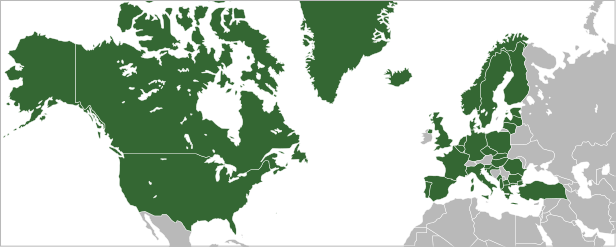
NATO--current membership.


If NATO were to call his bluff by immediately admitting Ukraine and Georgia to the alliance, it would probably be enough. At worst, it would mean a war with Russia that NATO, at this point, should be able to win.

Friday, April 25, 2014

The Gathering Storm?

What does this tell you?

I fear this piece by Michael Totten might be a case of whistling past the graveyard. Even though he admits that Putin is free to “slice and dice” the Ukraine if he wishes.

It rings false to me that Putin would be held back from invading the Ukraine because it would take him half a million men to “invade and occupy it.” After all, the Soviet Union previously controlled Ukraine, as did Imperial Russia before it, and it certainly did not cost them a half-million troops. Of course Putin is not going to invade Poland, at least not for the foreseeable future. He can't get to it, unless he invades and occupies either the Ukraine or Belarus first. But that's a bit of a red herring. Isn't it alarming enough if he takes the Ukraine and Belarus?

Totten argues that Putin does not want to take eastern Ukraine, because it would cost him his ability to influence the rest of the Ukraine. This seems tautological: if the rest of the Ukraine accepts this logic, he has already lost his ability to influence them. So he must be ready to take eastern Ukraine if his bluff is called. Moreover, the same logic ought to have prevented Hitler from taking the Sudetenland—and it obviously did not. Ukraine is poor, so he should not want it? By that logic, Russia would never have built its Czarist empire; nor would the rest of the European powers have built theirs. Nor, for that matter, would the US be in Puerto Rico. It rests on the assumption that Putin, if in possession of the Ukraine or parts of it, would feel honour bound to provide them with a standard of living comparable to that of the rest of the Russian Federation. Why would he?

Only months ago, I was scoffing at all the journalism referring to haunting similiarities between the present state of the world and that a hundred years ago at the advent of the First World War. The similarities seemed to me tenuous; it was just a ploy to sell books or articles commemorating the anniversary.

But now, suddenly, the world looks very much like the world on the advent of the Second, not the First, World War.

The First World is exhausted from the effort of winning the Cold War, 24 years ago, just as the First World was exhausted from the effort of winning the First World War, 21 years previously, in 1939. They do not want to believe it could happen all over again. As a result, they are in the mood for appeasement.

But the loser, not satisfied with the result, is naturally more eager to renew the struggle. It is hard for a people to accept a sudden demotion from world power to world's biggest loser. It is natural to demand a recount or a rematch. It is natural to believe that the first result must have been a mistake. Perhaps they were done in by a fifth column; perhaps they quit too soon. A rematch surely will not end the same way, and is very much worth risking.

The First World, overconfident from their win, is ready to concede to the loser at first. What harm can it really cause to let him back in to the Rhineland, or to bite off a piece or two of Georgia? After all, the division of Austria and Germany, or Russia and the Crimea, is artificial, isn't it? It's not as if the Germans are a realistic threat any more. Or the Russians.

But besides making the aggressor stronger with each of these concessions, it also makes him bolder.

Historically, Russia has been reasonably cautious about its expansionism. Putin may know when to stop, before he provokes a larger conflict.

Or at least, unlike Hitler, to wait until he has the forces to win that larger conflict. He is building the Russian Armed Forces at quite a good clip.

That's a calculation the First World will have to keep in mind.

And what does this have to do with the price of eggs in China?

Of course, China is a complicating factor. Just like Japan in the Second World War, they have a huge incentive to encourage Russia, to leave them with a freer hand to rise in the Far East. Iran could be a third partner, in the role of Italy, taking advantage of a larger conflict to expand its influence in the Middle East.

Given the situation, everyone in NATO should be boosting their defence budgets. Instead, in he face of a long recession, everyone is cutting them, just as before WWII, in the face of the Great Depression.

US military spending year over year.


Wednesday, August 27, 2008

The Smoking Kalishnikov?

Michael Totten offers some insight into how the Russo-Georgian War really started. He too claims it was all a setup by Russia.

Personally, I think this account has to be true, at least in its basic elements. To suppose that Georgia started the fighting by moving into South Ossetia defies common sense--no sane Georgian could have thought Georgia had the might to settle the matter by force of arms. It is as bizarre as Hitler's claim that Poland started the Second World War by attacking a German radio transmitter.

Saturday, August 23, 2008

Did Russia Invade Georgia, or Did Vladimir Putin?

A chilling analysis of what is going on in Russia and Georgia here.


Russia's actions seem very risky. For example, if it is true that Poland's new missile defense is aimed at rogue states like Iran, and cannot really be used to stop Russian missiles, as really does seem to be the case, why is Russia issuing bellicose threats? And why have they revived bomber sorties over the Alaskan coast? Wouldn't it be wiser for them to quietly take their “winnings” in Georgia; and let the US and NATO blow off a little steam and save some face?

Instead, it seems as though Russia is deliberately increasing tensions, deliberately trying to upset the West.

Why is Russia prepared to take such a risk? And why this sudden move to a confrontational style?

It could be that it is not really Russia's interests that matter here, but Vladimir Putin's.

That's what has changed recently, after all: Putin's internal status. He is no longer president. And, although he chose his own successor, that does not mean he is content playing second fiddle, as prime minister. What if Medvedev turns out to be his own man?

He was forced to step down by constitutional term limits. Perhaps Putin calculates that, by shaking things up and creating international tensions, he will improve his position. The apparatus and the public may be more open, in an emergency atmosphere, to de facto or even constitutional changes in the name of strong leadership.

From his personal point of view, then, these risks might be worth taking.

He does seem to be deliberately identifying himself personally with the action in Georgia. He seems to be positioning himself as the bad cop to Medvedev's good cop in international negotiations—if it is not, indeed, a case of two leaders pursuing independent foreign policies.

At best, if the bluff and bluster goes well, he will take the credit for the increase in Russian power and prestige. At worst, he still gains power, even if at Russia's expense.

He is, though, taking a big risk with Russia's and the world's future. I think a lot of people are sleepwalking or whistling “Volga Boatman” over the last few days, not realizing how significant this is: a unilateral invasion of a neighbouring sovereign state. It could lead to general war, and a war between states stacked high with nuclear weapons.

Can states blunder into devastating wars so blindly, because of political calculations back home?

Yes they can. It happened to Japan in World War II. Rival factions kept upping the ante for political reasons, presenting rival governments with faits accompli. Had anyone thought first of what was good for Japan, they would never have attacked China, much less the USA.