

I am not posting this story here. I am posting a link to it on SubStack. This is my clever ploy to get you to subscribe to me--for free!-- over there.

Catholic comments on the passing parade.


 Posts
All Comments
Posts
All Comments

I am not posting this story here. I am posting a link to it on SubStack. This is my clever ploy to get you to subscribe to me--for free!-- over there.

Thomas Merton wrote, “Pride makes us artificial. Humility makes us genuine.”
A sort of robotic artificiality indeed seems characteristic of narcissists. Their smile is mechanical, as if pasted on; or it is a smirk, a sort of half-smile. Scott Adams says there is something about the eyes not smiling with the mouth that gives away insincerity.
They cannot be spontaneous, because they do not dare lose control. For this reason, they cannot have a sense of humour. Humour requires letting go. They do not understand it, and so will laugh inappropriately. They are just mimicking what they see and hear others do, without feeling it. The one thing they might find funny is watching other people in pain, mental or physical. Someone slipping on a banana peel.
Can narcissism be cured? Psychiatry says no. I have always been loath to believe this: can anyone be beyond redemption? I compared it with alcoholism: breaking an addiction is hard, but not impossible. People do. Surely one can also break an addiction to pride?
But there is indeed a point at which one is, in Christian teaching, beyond redemption: Hell is forever. If you die in mortal sin, and descend, there is no possibility of redemption beyond that point. “Abandon all hope, ye who enter here.” Like it or not, that is the clear Biblical teaching.
Doesn’t this match our experiences with narcissism? At a certain point, to wit, the point of confirmed narcissism, it would not matter if one had an infinite stretch of time, one is never going to pull out of this. Like Lucifer’s choice of self over God: Satan is not one day going to be redeemed.
An addiction to self is after all far more encompassing than an addiction to some single pleasure or vice. To invest your very identity in your vice means breaking the addiction looks impossible. There is no one there, outside of the vice itself, to break it. You have no other identity. Your soul has been devoured.
That is why the narcissist seems zombie-like, an NPC.
It may be going too far, however, to say ambulatory narcissism is yet incurable. Why would God allow the narcissist to stay alive, and doing harm to others, past this point? It makes more sense to assume that the point at which the narcissism is absolutely incurable is the moment God will step in and send to Hell. So long as there is the slightest chance for the narc to turn, God will give them that chance.
But well before this point, the change might require a miracle. It may be beyond human agency, and so of course the psychiatrists cannot do it. Neither can any well-meaning relative.

As we have established that Spiegelman’s Maus is a portrait of narcissism/hubris/pride, it becomes instructive. It explains a great deal.
Art is inept at handiwork; the reason is because, as a child, his father criticised his every attempt. Vladek rubs this in by demanding Art come and help him with some repair. It is not enough when Art offers to pay for a tradesman.
Narcissists make terrible teachers. Their vested interest is always in being better than their pupil. So their interest is in preventing learning.
This is an important reason why I believe the business of evaluation must be separated from that of teaching. Narcissists will be drawn to the teaching profession by the opportunity to evaluate and to be the centre of attention. Taking this away from them is one way to keep narcissists out of the profession, where otherwise they have an ideal chance to bully. Making the teacher the evaluator is asking for trouble.
Art explains that he went into graphic arts and cartooning because it was the one activity where he was confident his father would not follow. Only there could he be free.
This is also why Franz Kafka went into writing—because he knew his abusive father would never read them. So only there could he be free.
Narcissists have no eye for art nor ear for fiction. They dare not step outside themselves far enough to experience the suspension of disbelief necessary to appreciate art. If they ever do read a story or watch a movie, they will want something painfully sentimental. Big-eyed kittens; a dying child; it is like being deaf and only hearing especially loud noises.
This is no doubt why Jesus spoke in parables. It meant the pigs could not see and trample the pearls.
And this is no doubt why writers and artists almost always seem to come from abusive childhoods. Hemingway said this was the one prerequisite for a writer.
Note how Vladek seems obsessed over his will. A normal person would just write it up once, and be done. By his own admission he keeps changing it. He repeats to Artie that Mala is after it, yet he wants to leave it all to him. What does he say to Mala? He is using it as a bribe to keep himself the centre of attention.
At the end of Maus I, Vladek reveals that he burned all his wife’s memoirs. And immediately after admitting this, he explains that they were written for Art. “I wish my son, when he grows up, he will be interested in this.” A twisting of the knife.
A narcissist has no family loyalties. He will try to disrupt any family loyalties other than to him. He will readily betray both wife and son.
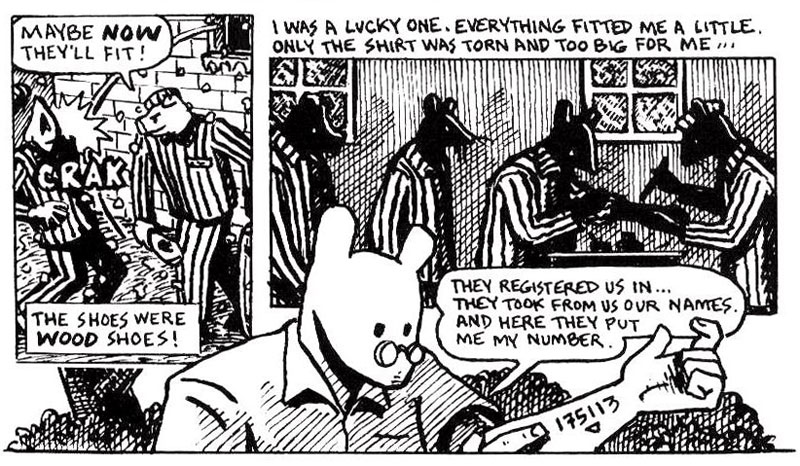
Maus and Maus II are not about the Holocaust. This is a good example of how most people miss the point of creative writing as of parables. John Lewis and his publishers sought to cash in on Maus, and did, with a cheap imitation, March and March II, giving Lewis’s personal account of the civil rights movement. But it was missing the essence of Maus. They had no idea.
Maus is a
character study of Vladek Spiegelman.
Anything we
hear about the Holocaust is entirely through his eyes. And he is not driven,
like Elie Wiesel in Night, by a sense of mission to tell us about the
Holocaust. He is resistant to talking about it. He would rather talk about his romantic
conquests. And he burns his wife’s painstaking accounts of it. This is not the
action of a truth-teller.
Vladek is a
peculiar character. Most obviously, he is parsimonious to a comic extent. One
might imagine this came from his experience in the camps.
But he is
not consistently parsimonious. He scolds his second wife, Mala, for using a
wire coat hanger, the parsimonious choice, instead of a wooden one, to hang up
his son’s coat.
Then he secretly
throws his son’s coat in the garbage. Hardly parsimonious.
Granted, in
the first instance, it is his son’s loss, not his own. But then he must give
his son his own old coat.
The real
motive behind his parsimony is not to save money or conserve; it is to keep
those around him constantly on edge, and subject to criticism whatever they do.
If not being parsimonious works better every now and then, parsimony must be
sacrificed to the higher objective. The point was to give Mala or Art that acid
feeling in the pit of their stomach, and to delight in awareness that he is
making them feel bad.
Spiegelman’s
Vladek is a perceptive portrait of just what someone who has given in to the
vice of pride, aka hubris, aka narcissism, is like. Vladek is the type of
Hitler; and a study of the type.
One
characteristic of the narcissist or vice-bound is a comically two-dimensional
predictability. They form the humours of the comic stage. Narcissists act like NPCs.
Vladek’s general frugality is of that order.
Vladek appears
first in the tale to warn his son as a child that there is no such thing as a
friend. Hitler’s starting point in Mein Kampf: it is the natural Darwinian
order that everyone just looks out for themselves. For individuals and for races,
it is survival of the fittest. And this is the creed of the narcissist: it is
them against the world.
Moving to
the present, Artie goes to visit his father, and his father’s first two
sentences on seeing him after two years are complaints: first, that he is late,
and second, that he did not being his wife. Whatever Artie does, Vladek will
find reason to complain.
And he is
the same with second wife Mala, complaining about the wooden hanger. Or the
chicken is too dry.
The hanger
complaint has a second function: it is meant to sow division between mother and
child. The narcissist will always foment conflict within the family. It is a
control thing.
When Artie
asks Vladek to “start with Mom. Tell me how you met,” Vladek tells him instead about
how all the women chased him, and he had another girlfriend who desperately
wanted to marry him and was better looking than Artie’s mother. Anja, Artie’s
mother, was nothing to look at, and supposedly had a nervous disorder. She was,
as far as he is concerned, lucky to have him.
This is not
the way a father should talk about his child’s mother. Again, he is sowing
division within the family.
He then obliquely
criticizes Anja as a communist, who betrayed a friend to a three-month prison
term. It might be true; but even if so why tell it unprompted? The point of
this story seem to be to belittle the other parent in the eyes of the child.
Artie
catches his father then in a lie at least of omission—a warning to us as
audience that he is an unreliable narrator.
Doing the math, Artie realizes that Anja, his mother, must have already
been pregnant when they married. This raises the possibility that it was a
forced marriage; his father may have been playing around, heedless of the women’s
interests, and gotten caught.
Those who
give in to the sin of pride are also likely to give in to the sin of lust. As
well as that of avarice, and so forth.
Caught out
on this, Vladek tried to distract by throwing shade on Artie. He accuses him of
being premature: this looks like an ad hoc projection, not a truth. Then he
claims the doctor had to break his arm to extract him, and that, as a child, that
he often raised his arm in a “Heil Hitler” salute.
This does
not sound plausible. Does a diffuclut birth ever require the breaking of an
arm? Does the breaking of an arm ever cause involuntary movements for months or
years after? Narcissists when caught out can say almost anything. They can seem
to be momentarily delusional, as M. Scott Peck has observed.
That Vladek
is rattled at this moment is demonstrated by his spilling all the pills he has
been counting carefully.
He credits
himself with bringing Anja back from post-partum depression with his gentle and
loving care for her in a Czechoslovakia sanitarium.
Does this
sound like the Vladek we can ourselves observe?
More
likely, seeing how he behaves with his second wife and his son, he drove Anja
to the nervous breakdown. Then, rather than let her escape his grip, and
possibly have pleasant experiences without him, he grabbed the opportunity to go
with her to the posh sanitarium instead of tending to his work. As a result, by
his own account, he never got his new factory insured; it was robbed, and they
lost everything.
It is surely
actually unusual for sanitarium patients to be accompanied by “Someone they
trust.” Few can afford such a thing; and it is surely considered bad for their
recovery. The idea of the sanatoriums was to get away from their daily life, which
is apparently troubling them, not to bring some of it with them.
He tells
about the factory being robbed, presumably, because he thinks it reflects badly
on Anja. Look at the trouble her mental illness caused! Look at how I suffered
because of her!
And though
he probably believes it himself—narcissists are expert at self-delusion-- “I
did not have time to have it insured before we left” does not sound plausible.
Had time been the issue, he could have had his father-in-law insure it for him
while he was away. He was simply irresponsible; too irresponsible to think of
such things. And, as narcissists always do, he finds a scapegoat.
There is
much more, but this post is eating up too much time. I may continue later.
But the predictable
effect of having a hubristic spouse or parent is, of course, to drive the rest
of the family, especially his designated scapegoats, into depression. In Vladek’s
case, his first wife commits suicide, soon after his son is released from a
psychiatric hospital.
And, of course,
he blames his son to all the relatives for this; while his son blames his
mother for this. For whatever perverse psychological reason, nobody ever dares blame
the narcissist. That feels too dangerous.
On top of
it all, his mother having just committed suicide, and his father blaming him,
Artie at twenty is also expected to console his father, who makes himself again
the centre of attention with his dramatic expressions of grief.
The narcissist,
when distraught, must take it out on his scapegoat. If not venting his anger on
them, he will be venting his sorrow. It amounts to the same thing: the emotions
of the narcissist become the family’s problem. It is up to them to do something
about it.
This is the
root of all “depression” and much, perhaps most “mental illness”: victimization
by a narcissist in the family.
Maus lays
it out plainly, and most people refuse to see it.

Looking for discussion questions online for a class on MacBeth, I came on this, in paraphrase: if MacBeth is the villain of the play, who is the hero? Is it Banquo, or MacDuff?
False premise. Looking for heroes and villains makes sense in the main them of the tale is man versus man. But that is one of several, traditionally seven, possibilities. Tragedies are not man versus man; they are always man versus fate, or man versus God/the gods, which is the same thing. Witness the Three Witches in MacBeth—the Three Fates.
There can be villains in tragedy—Iago—but usually the case is unclear. Often deliberately unclear, so as not to obscure the main conflict. Given the notion of hubris, technically, the same main character is both hero and villain. And more villain than hero in the end. He is always responsible for his own fate.
This made it occur to me that I too have been misreading King Lear. I had always taken Regan and Goneril as the villains. They treat their father so disrespectfully, right? In contrast to the good and dutiful Cordelia. “Sharper than a serpent’s tooth it is to have a thankless child,” as Lear laments, and all that.
Still, it always struck me as a little confusing that Shakespeare has Lear at first unreasonably favour Cordelia, before then unreasonably favouring Regan and Goneril.
“I loved her most, and thought to set my rest…”
His favouritism is apparently notorious, and it is his fatal flaw. The play begins by pointing it out:
“I thought the king had more affected the Duke of Albany than Cornwall.”
He didn’t have to invent that, were he trying to affirm Lear’s claim. It is not so clearly a case of favoured children being ungrateful; for most of their lives, Regan and Goneril were apparently less favoured.
And Shakespeare shows the same pattern in Gloucester’s family. Edgar was first favoured, then Edmund.
This makes Regan and Goneril’s treatment of their father seem more reasonable; even if they are flatterers, and opportunists. Their sin is refusing to allow their father a standing army. No responsible government should allow a standing, independent army. It is axiomatic that, to keep the peace, the government claims a monopoly on force.
This is all the more important since we and they know Lear’s judgement is unreliable and capricious. He might at any time, in some fit of anger, rise up and start a civil war. Governments exist to prevent just this sort of thing.
Wise of them, therefore, to agree on one common front to handle Lear. Lear might otherwise throw his weight at any moment on one or the other side of an evenly divided country, giving those who want insurrection an ideal opportunity.
"You see how full of changes his age is; the observation we have made of it hath not been little: he always loved our sister most; and with what poor judgment he hath now cast her off appears too grossly."
Regan and Goneril are unsympathetic characters, no doubt, but, in the mold of the classic tragic hero, Lear is responsible for his own troubles.
It is his own pride and rage, and not his two daughters, who drive him out onto the heath:
"REGAN: For his particular, I'll receive him gladly, but not one follower.
GONERI: So am I purposed."
 |
| Ashley Biden. |
Apparently a diary of Joe Biden’s daughter Ashley Biden has surfaced, and reveals he showered with her as a child. This, in her own estimation, caused her to develop an addiction to sex.
Another piece of the narcissist puzzle. Biden is a classic narcissist. The narcissist puts the greatest worth on satisfying their desires. As a result, they are highly likely to indulge in sexual activities that violate norms. In fact, aside from the pleasure derived, this reinforces their sense of superiority: the rules do not apply to them. This often means incest: their own child is highly available, highly vulnerable, and in their control. And this completes their control.
 |
| Vlad the Inhaler. |
There is discussion of whether Vladimir Putin has gone mad. Having previously been cautious, he is suddenly acting recklessly. When he entertains guests, he has them sit far away from him. Macron in France says he has changed. Marco Rubio, reflecting US intelligence, says he has changed.
Of course he has gone mad. In a predictable way.
It’s called hubris.
Most national leaders are prone to hubris; the mental problem we often these days call “narcissism.” They start out with an unreasonably high evaluation of their own abilities and their own importance to the universe. This drives them to seek power, and often to attain it, by whatever means necessary. If they achieve power, this is of course validates their opinion of their own self-worth. If they hold power for a long time, they are liable over time to indulge this tendency more and more, moving further away from reality and viewing themselves as god-like. For this reason, whenever a Roman general was given a triumph, a slave beside him was instructed to keep whispering in his ear, “remember, you are mortal.”
As hubris grows, and to the extent that their rule is autocratic, it becomes less and less advisable to bring the king bad news. He is liable to fly into a “narcissistic rage” and blame the messenger. So the monarch grows less well-informed of the real situation, and more convinced of his delusions. He is bound to overestimate his own and his nation’s power. We saw this in Saddam Hussein: he convinced the Americans and the world that he had weapons of mass destruction, because he was convinced he had weapons of mass destruction, and acted accordingly.
For this reason, medieval and Renaissance kings had court jesters, who had special license to mock.
Without any window on the real world, the king will also inevitably become paranoid. If you are so important, everything that happens must be about you. And he is at least half-aware that he is regularly being lied to. He can trust no one.
The end is inevitable: it is the end of every Greek tragedy. The king will overreach, and bring the polis down around his ears.
Today, Putin. Tomorrow, perhaps Xi.
 |
| Waterhouse, "Lamia"; an image of the narcissist type |
Over the last few weeks, I have been in email correspondence with the mother of a man diagnosed as schizophrenic. She declared that she had cured him. The cure consisted of playing music through headphones into just one ear. She claimed to have helped hundreds in the same way.
Oddly, however, she also spoke of her son as still schizophrenic, of having cured him repeatedly, and of his sometimes cursing her or her husband. It sounds as though the “cure” was temporary and symptomatic. “Cure” may have been an exaggeration.
I’m not sure she has actually demonstrated anything beyond the traditional wisdom that music has charms that calm the savage breast. An observation at least as old as Orpheus and the Bible.
But I think I may have seen here something of the family dynamic that leads to schizophrenia.
Seemingly unaware of the ancient observation about music, the lady was certain she had made a scientific breakthrough on the order of Harvey discovering the circulation of blood—she literally used this comparison. She had demonstrated that schizophrenia, and mental illness generally, was actually a hearing problem. It was caused by a physiological defect in the right ear. As a result of this, the brain becomes unbalanced, out of sync. The right brain becomes dominant over the left. By playing music in only one ear, she had rebalanced the two hemispheres.
This sounded odd; beginning with what looked like a naively literal interpretation of mental illness as being “mentally unbalanced.” I pointed out to her that other than handedness, there was no demonstrated scientific basis for the left-brain, right-brain distinction. She promptly responded that she was not concluding this from anyone else’s work, this is something she had personally discovered.
As we engaged in further discussion, I realized that she conceived no distinction between “mind” and “brain.” When I suggested that the one thing was a physical entity you could hold in your hand, and the other was not, she seemed to simply ignore the point, and went right back to identifying them, without explanation. It was as though she were mentally blocking any contrary suggestion.
We had a parallel discussion of the distinction between “behavior” and “experience” or “thought.” She consistently referred to all as “behavior.” When I argued the difference, using a computer analogy, it did not seem to register. She did not respond, and continued calling it all behavior. I could not get her to acknowledge the difference between “mental” or “metaphysical” and “physical” either. Nor could she recognize a possible distinction between “physical” and “real.” After being queried on this, with reference to Berkeley, she used the terms interchangeably, as if in defiance: where I had written “physical,” she quoted me as writing “real.”
This looked semi-intentional. At some level, she understood the distinction, but she refused to acknowledge it.
This seemed to make her a total materialist. Yet, surprisingly, she claimed to be an unchurched Christian, who believed in a soul and an afterlife.
Then, in another context, she lamented that her husband was currently so depressed he thought he was going to die.
(Odd—why hadn’t she used her listening therapy to cure him? Or had it failed?)
I pointed out, hoping to ease her presumed concern over her husband, that death is not necessarily a bad thing for a Christian. She responded that in his case, he was also expecting “the worst possible outcome”—nonexistence.
Very odd—claiming to believe in an afterlife, and a Christian afterlife, yet even in the context of a Christian afterlife, the concept of hell does not come to her mind as conceivable. For surely that is worse than nonexistence.
She was superficially perfectly lucid, and congenial, indeed, conspicuously socially skilled. Charming--or, more accurately, manipulative. She could probably have given a casual acquaintance a good impression of herself at a cocktail party.
But whether or not her son was mad, it was clear if one listened carefully, and probed, that in literal terms, she was as mad as a hatter.
She was an example of what Fleiss called “ambulatory psychosis,” or M. Scott Peck called “ambulatory schizophrenia.” Both are alternate terms for what we call narcissism. And both Fleiss and Peck maintain that this character type in a parent leads to mental illness in a child. As it seems to have done here.
These are people who seem at least reasonably sane to the world around, and respectable, while actually holding delusional views about themselves and the world. They think of themselves as godlike, and will fabricate imaginary narratives to reinforce this impression, both to themselves and others. Yet it is their children, rather than themselves, who turn up at the psychiatrist’s office. They will never go to see a psychiatrist because, of course, they cannot be mentally ill. It must be everyone else. If and as their child, growing up, sees inconsistencies in their claims about themselves and the world, the child is forced into the role of mental illness, of mental problem. For being too sane.
In her own mind, this woman was convinced she was a scientist as great as Harvey. Descartes and Berkeley were obvious idiots compared to her. It emerged, as each of these subjects came up in discussion, that she had significant academic background in English literature, psychology, and philosophy. When the Iowa Writing Workshop came up, it turned out that her husband was a graduate, and her daughter worked for that university. Possibly true, but a pileup of coincidences.
My speculative observations:
The narcissist type—I prefer the term “hubristic,” but as exemplified here--is an absolute materialist, but also believes in an immortal soul. How is this possible? Because they believe that THEY have an immortal soul; but actually, nobody else does. Everyone else is a bundle of unconscious behaviours.
They must believe they are immortal, being their own gods; but will not accept the possibility of divine punishment. There can be no question of them ever having acted immorally. Others do, of course, but since they are automatons, it is not their fault.
If they cannot plausibly make a boast about themselves, they may boast of association with someone else who is great. Otherwise, everyone else is worthy of scorn. This is the genesis of the co-dependent Echo type of narcissist. While describing all her close relatives as insane, this woman also claimed her father was a great scientist who designed essential parts of the first Canadian nuclear reactor.
Her first instinct was to run anyone else down, but she would flip to the exact opposite when it seemed useful. This has often been commented on in narcissists: their reaction to everyone is either adulation or devaluation, and most often, in relationships, first the one, in order to entrap, then the other.
I deeply pity her son. She is, as are narcissists generally, a vampire feeding on his substance.
 |
| Not Icarus, but the same old story. |
The current general pogrom against conservative voices is nothing I would have predicted. On the face of it, people on the left seem to be acting not just irrationally, but against their own self-interest.
Take Nancy Pelosi and the House Democrats launching articles of impeachment against Trump. There are only eleven days left in his term, at this writing. It is improbable that the process could be completed before his last day of office. If it were, what is the urgency of having him step down a day or two earlier? And in the meantime, tying up the US Government to do so? At a time of general crisis?
If the measure passed the House, moreover, it would take a two-thirds majority in the Senate to have him removed. Since the Senate is 50% Republican, there seems no chance of that. So Pelosi is tying up the machinery of government for nothing.
If he were impeached and removed, this would apparently bar Trump from running again. But if this is Pelosi’s hope, it makes no sense on another level. When Trump was nominated in 2016, I thought the Republicans were making a mistake: Trump was a loose cannon, and many of their other possible candidates looked stronger electorally. The fact that Trump could not cleanly beat Biden bears me out: Biden was hardly a strong candidate. Again, the Democrats seemed suicidal in picking him, against the will of their own supporters and despite his obvious cognitive decline. If Pelosi were to prevent Trump from running again, this looks as likely as not to be a gift to the Republicans: they can now nominate a candidate with wider appeal, without alienating the Trumpists.
In the meantime, Pelosi is doing a thorough job of alienating Trump supporters from the Democratic Party. As is Joe Biden. Instead of calling for reconciliation, as any sane politician would do, they are demonizing anyone who supported Trump. This is significant, and an obvious case of self-harm, because many of them were Democrats before Trump came along.
It looks like a shotgun blast to the face. It looks like attempted suicide.
It looks the same to me with regard to the censorship by Silicon Valley. Especially Jack Dorsey, who seems to have been the most aggressive. Twitter is a limited platform that, before Trump came along, looked as though it were dying. Trump’s love of tweeting has made it the place to be; one third of all their subscribers are following Trump. Throwing Trump off is like refusing to serve at least one third of their customers. It is alienating at least half of their potential customers, the half who voted for Trump. It is forcing the action to a rival platform, which is then almost certain to eclipse Twitter.
The same case can be made for all the other social media platforms censoring conservative voices: they are shutting out and alienating half their potential audience, and opening up a huge advantage for any competitor. Why would they be doing this?
Are they forced to it by the demands of advertisers, who do not want their ads run next to controversial content? No: there is no parallel drive to censor the left; it would be trivial to set algorithms to let advertisers steer clear of political speech case-by-case; and advertisers are not involved in the case of Patreon, or Amazon’s cloud services, and others who have been joining in the censorship.
Major advertisers themselves seem to have gone “woke” in self-destructive ways: like Gillette paying huge sums to deliberately insult men.
The “mainstream media” are also on an apparent path to self-destruction. Fox News, with their right-wing slant, was consistently beating CNN, MSNBC, and the old networks in the ratings. CNN’s response? To go further left. Then Fox News, too, seemed to veer left, and Drudge Report. And their audience was handed over, as if deliberately, to upstarts like OAN, Newsmax, Citizen Free Press, and so forth.
The large established tech firms are obviously aware that they are threatening their own businesses with their political stance. They are actively colluding to prevent this from happening: targeting upstarts like Parler, or SubscribeStar in restraint of trade. In doing so, however, they are in violation of anti-trust laws, and obviously risk bringing down legal action against themselves.
And any such attempts are, in the new world of the Internet age, like whack-a-mole. There are too many people out there with access to cameras, microphones, and, in effect, printing presses now.
My guess is that “they” are showing the terminal stages of what the Greeks called hubris, and we call narcissism. “They” meaning, in general, the educated and economic elite of our culture. The gang we used to call the yuppies. Having gotten away with a lot, and knowing they have gotten away with it, their conscience, in part, drives them to it. There is in every serial killer an unconscious craving for justice. The tension of a guilty conscience becomes over time unbearable; they will keep acting more erratically and uncompromisingly until at last someone catches them, or calls them out. If necessary, they will leave notes with clues for the police.
When it happens, when at last they are caught, they will sleep like a baby.

