|
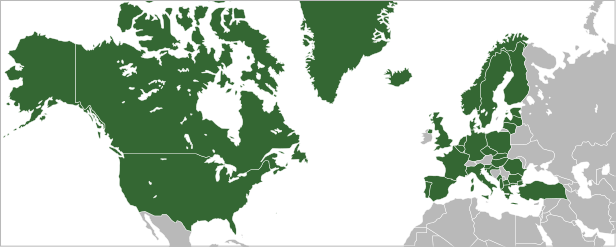
| What does this tell you? |
I fear
this piece by Michael Totten might be a case of whistling past the graveyard. Even though he admits that Putin is free to “slice and dice” the Ukraine if he wishes.
It rings false to me that Putin would be held back from invading the Ukraine because it would take him half a million men to “invade and occupy it.” After all, the Soviet Union previously controlled Ukraine, as did Imperial Russia before it, and it certainly did not cost them a half-million troops. Of course Putin is not going to invade Poland, at least not for the foreseeable future. He can't get to it, unless he invades and occupies either the Ukraine or Belarus first. But that's a bit of a red herring. Isn't it alarming enough if he takes the Ukraine and Belarus?
Totten argues that Putin does not want to take eastern Ukraine, because it would cost him his ability to influence the rest of the Ukraine. This seems tautological: if the rest of the Ukraine accepts this logic, he has already lost his ability to influence them. So he must be ready to take eastern Ukraine if his bluff is called. Moreover, the same logic ought to have prevented Hitler from taking the Sudetenland—and it obviously did not. Ukraine is poor, so he should not want it? By that logic, Russia would never have built its Czarist empire; nor would the rest of the European powers have built theirs. Nor, for that matter, would the US be in Puerto Rico. It rests on the assumption that Putin, if in possession of the Ukraine or parts of it, would feel honour bound to provide them with a standard of living comparable to that of the rest of the Russian Federation. Why would he?
Only months ago, I was scoffing at all the journalism referring to haunting similiarities between the present state of the world and that a hundred years ago at the advent of the First World War. The similarities seemed to me tenuous; it was just a ploy to sell books or articles commemorating the anniversary.
But now, suddenly, the world looks very much like the world on the advent of the Second, not the First, World War.
The First World is exhausted from the effort of winning the Cold War, 24 years ago, just as the First World was exhausted from the effort of winning the First World War, 21 years previously, in 1939. They do not want to believe it could happen all over again. As a result, they are in the mood for appeasement.
But the loser, not satisfied with the result, is naturally more eager to renew the struggle. It is hard for a people to accept a sudden demotion from world power to world's biggest loser. It is natural to demand a recount or a rematch. It is natural to believe that the first result must have been a mistake. Perhaps they were done in by a fifth column; perhaps they quit too soon. A rematch surely will not end the same way, and is very much worth risking.
The First World, overconfident from their win, is ready to concede to the loser at first. What harm can it really cause to let him back in to the Rhineland, or to bite off a piece or two of Georgia? After all, the division of Austria and Germany, or Russia and the Crimea, is artificial, isn't it? It's not as if the Germans are a realistic threat any more. Or the Russians.
But besides making the aggressor stronger with each of these concessions, it also makes him bolder.
Historically, Russia has been reasonably cautious about its expansionism. Putin may know when to stop, before he provokes a larger conflict.
Or at least, unlike Hitler, to wait until he has the forces to win that larger conflict. He is building the Russian Armed Forces at quite a good clip.
That's a calculation the First World will have to keep in mind.
 |
| And what does this have to do with the price of eggs in China? |
Of course, China is a complicating factor. Just like Japan in the Second World War, they have a huge incentive to encourage Russia, to leave them with a freer hand to rise in the Far East. Iran could be a third partner, in the role of Italy, taking advantage of a larger conflict to expand its influence in the Middle East.
Given the situation, everyone in NATO should be boosting their defence budgets. Instead, in he face of a long recession, everyone is cutting them, just as before WWII, in the face of the Great Depression.
 |
US military spending year over year.
|




 Posts
Posts