Playing the Indian Card

Tuesday, September 23, 2014

Three Steps to a Stable Middle East


Although Americans are back in the skies over Iraq and Syria, Barack Obama is obviously profoundly reluctant to commit land forces to the Middle East. Americans have had enough of war for now.

Very well, if the US does not want to be involved, there are other ways of quieting the region and eliminating terrorist breeding grounds. What we need is a system of mandates like those of the old League of Nations, giving designated countries a limited right and responsibility to keep peace and order in a given jurisdiction.

1. Give Egypt a UN mandate over Libya.

Egypt has 82 million people and an armed forces that did rather well in the 1973 Yom Kippur War. Libya is only 7 million. They sought to unite as recently as the 1970s. The Egyptian Army ought to be up to the task.

2. Give Turkey a UN mandate over Syria.

Syria used to be part of the Ottoman Empire. Turkey has a large, modern armed forces and is in the mood for prestige these days. Giving them free rein in Syria could be a quid pro quo for keeping them out of Iraq while arming the Kurds there.

3. Give the GCC and Jordan a UN mandate over Iraq.

The King of Iraq, now deposed, was a member of the same Hashemite royal family as the King of Jordan. Monarchies work best in the Arab Middle East. They also work best in countries that are ethnically divided, like Iraq. The GCC is among other things a union of Arab monarchies. They are obvious backers for a reinstatement of the Iraqi royal family. It is also to their advantage to restore Iraq as a friendly buffer against their traditional enemy, Iran.

Monday, September 22, 2014

Errors about Christianity


Not Jesus Christ

One of the most common misunderstandings of Christianity is that it demands belief without reason—“blind faith.” This is “fideism.” For Catholics, it is heresy.

Martin Luther is to blame for this. He wrote, among other things, that “Reason is the greatest enemy that faith has.” Please don’t ask me to defend him on this. Martin Luther is not the final authority for Christianity. Not even most Protestants agree with him on this.

Pope Pius X, in order to stamp out this “modernist” heresy, required all clergy to affirm that “God... can be known with certainty by the natural light of reason... his existence can be demonstrated...” The Catechism of the Catholic Church says “human reason is, strictly speaking, truly capable by its own natural power and light of attaining a true and certain knowledge of the one personal God.” No “faith,” in the sense of a belief in something in the absence of reason or evidence, is required of Catholics. If you in fact believe in anything without reason or evidence, you are a heretic. “Faith in God” means trust in God, not the mere conviction that he exists.

Related to this first misunderstanding is the odd assumption by many that there is no proof of God’s existence. Some will even go so far as to say there is “no evidence” for God. As a matter of plain fact, there are dozens of well-known philosophical proofs of God’s existence. Some of them are given in brief here. Over the history of Western philosophy, there is probably nothing else demonstrated with more certainty than the existence of God--including the existence of the physical world, or the existence of you.

The next common misunderstanding of Christianity is that it holds that all non-Christians (or all non-members of each given denomination) will go to hell. Apparently some Southern Baptists do believe this—I believe the idea comes from Calvin. I leave it to them to defend their claim. For Catholics, however, if you believe whatever you believe sincerely, and you have made every effort to seek the truth, you cannot be faulted. Of course, there is a heavy presupposition that this will lead you to Catholicism. Given that Catholicism is truth, and truth is readily accessible to human reason, it is a strange thing to be sincerely seeking the truth and not to arrive at it. This is referred to as “invincible ignorance.”

The next common misunderstanding is that Christians worship a different God than Muslims. God is, according to the Oxford dictionary “the creator and ruler of the universe and source of all moral authority; the supreme being.” By definition, there cannot be more than one supreme being. Webster’s has: “the perfect and all-powerful spirit or being that is worshipped … as the one who created and rules the universe.” There can be, by definition, only one perfect, all-powerful being. In the words of the Catechism of the Catholic Church: “God is unique; there is only one God: The Christian faith confesses that God is one in nature, substance, and essence.” Therefore, there can be no question of choosing God A over God B to be your God; the notion is nonsensical. God is by definition unique. The most that might be said is that Muslims and Christians have a somewhat different understanding of God.

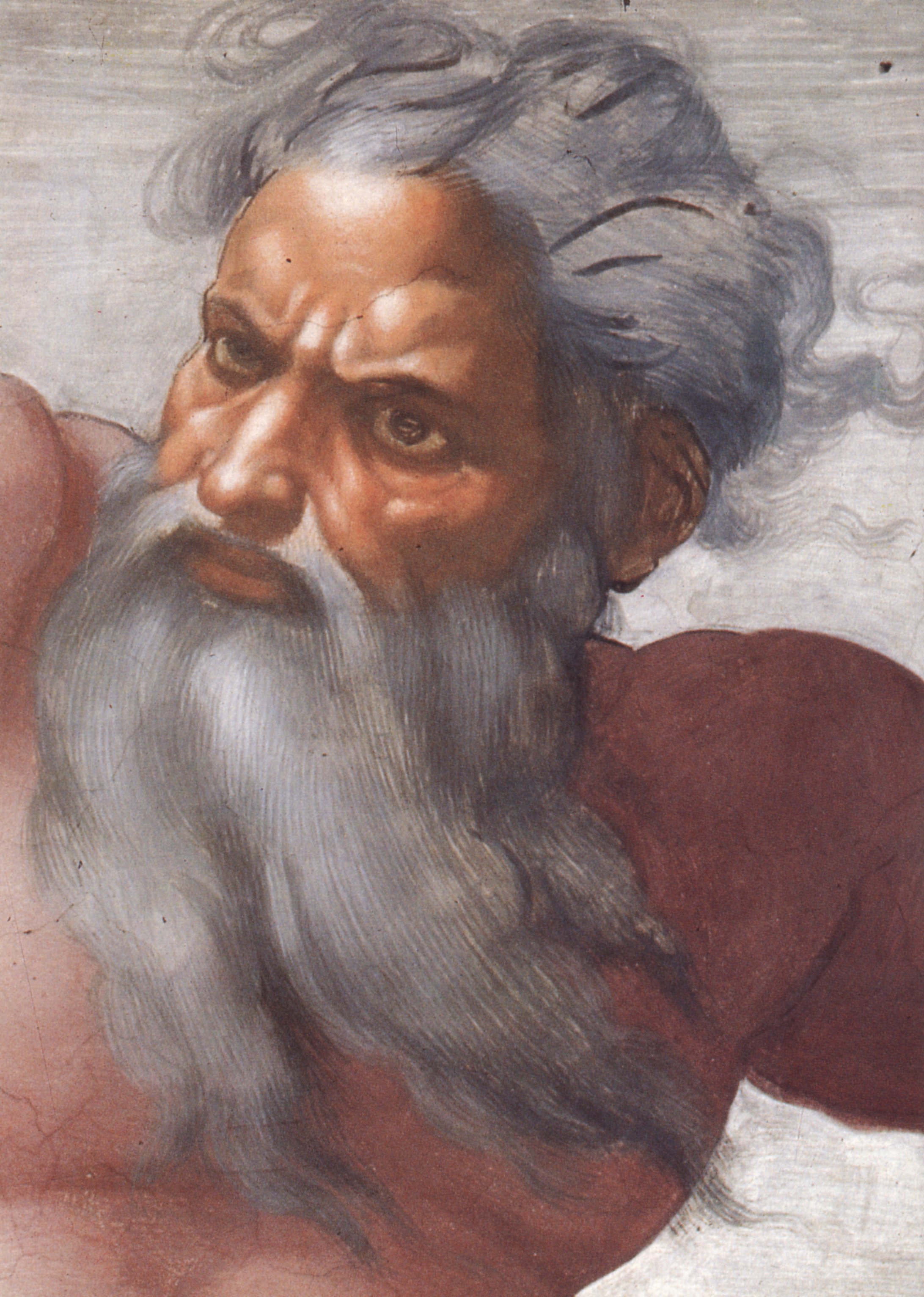
Michelangelo's idea of God the Father.

The next common misunderstanding is that Christians worship a “sky father.” Lord knows where this came from: perhaps from Freud. It is true that God is sometimes depicted, as in the creation of Adam on the Sistine Chapel ceiling, as an old man in a cloud. But one visit to a Catholic Church would prove that this is not the most common representation of the divine. That would be the image of Jesus, a youngish Jewish man. This is the way in which God chose to reveal himself to us, in the incarnation. The two other standard depictions, as the Father and as the Holy Spirit, are a good deal less common. In the case of God the Father, of course, the clouds are purely metaphoric; no Christian believes he lives in the sky, any more than they believe he is their literal father.

The next common misunderstanding is that Christians think that sin is all about sex. This is pure projection on the part of pagans. No, Adam and Eve's sin in the Garden of Eden was not sex. No, the Immaculate Conception does not mean being born without sex.

One wonders how so many can get the teachings of Christianity so wrong. It is hard to believe it is not deliberate misrepresentation.

Friday, September 19, 2014

Scotland Ends the American Revolution


I did not expect yesterday's Scottish vote to go for independence. But it was hard not to feel that the English deserved that result. It would have only been the last domino in a process begun over 200 years ago, a truly epic example of historical obstinacy: the English refusal to accept the idea of federation. Which is to say, I fear, the English refusal to accept that other men are the equals of Englishmen.

Had England accepted a federal parliament in the early 1770s, the United States would still be run from London. The cry of “no taxation without representation” could never have been raised. And, when the Americans immediately formed a federation among themselves, can anyone doubt that this was the model for what they had sought within the empire?

Yet that same obvious mistake was made, again and again, with every one of England's colonies. As a democracy herself, she could not deny democracy to her colonies. The hypocrisy was too plain. Yet self-government without federation was necessarily and automatically independence.

And so all the colonies slipped their moorings, even though many of them, certainly including Canada and the West Indies, never really wanted independence, and would have always preferred federation. Throughout the nineteenth century, Ireland could have been satisfied with Home Rule; in the end, England essentially rejected any ties whatsoever rather than allow this. Why? Surely only because it would have implied Irish equality with the English.

To make the whole thing more pathetic, almost as soon as England had gotten itself rid of the last of its colonies, it accepted federation within Europe, as part of the EU. Having thrown away the chance to be the center of a world federation, it then, finding itself weak alone, agreed to be on the periphery of a smaller regional federation. And they still had to live through the humiliation of the Scottish vote. Has there ever been worse folly?

It is probably now far too late to rescue what was lost. On the other hand, the promises made to Scotland during the current referendum campaign finally, 250 years later, offer the foundations for a British federal system. One essential ingredient, now at last proposed, is for England to have its own separate parliament—involving the crucial acknowledgement that England is one among equals.

One can wistfully imagine that, with this federation of England, Wales, Scotland, and Northern Ireland constitutionally established, and with Britain's more or less inevitable exit from the European Community, it might yet be possible for a larger federation to be built, involving some of the rest of the “Anglosphere”/Commonwealth. It would be to everyone's benefit: free trade and the free movement of peoples, not to mention a military force capable of keeping some order in the world.

Here are the populations of the “Commonwealth Realms”--the nations which have preserved the allegiance to the British monarchy. This is a reasonable indication of their closeness to the mother country.

England: 53 million
Wales: 3 million
Scotland: 5 million
Northern Ireland: 2 Million
Canada: 35 million
Australia: 23 million
New Zealand: 5 million
Jamaica: 3 million
West Indies: 1 million
Papua New Guinea: 7 million
Oceania: 1 million

So here we might theoretically form a new federation of 138 million people, more than twice Britain's current size, including two of the world's ten largest economies. Even if the capital did not end up being in London, this would certainly increase the prestige of English-speaking culture.

Other reasonable candidates for joining:

USA: 314 million
Ireland: 5 million
Philippines: 98 million
Singapore: 5 million
Puerto Rico: 4 million
Guyana: 1 million
Trinidad: 1 million

We now have a possible federation of 566 million. Certainly the world's most powerful nation for some time to come. Although of a certainty the centre of balance would shift to America.

That might, on the other hand, be good for the English soul. It is only English intransigence that has prevented it from being the reality for the past two hundred years.

Wednesday, September 17, 2014

Did Darwin Destroy Western Civilization?


Western civ has been acting suicidal for some time. It is vital to figure out why this is so, so it can be stopped. As of a few years ago, I thought I knew: it was the sense of futility brought on by the mass dyings of the First World War.

But in this centenary year, the First World War has been getting more attention, and I realize now I was wrong. The First World War, first, was not futile: Kaiser Willie's Germany was well on the way to Nazism already. And, second, the sense of civilizational death began before the war. Not just in Germany's racist notions, but in the arts: Marinetti's nihilist/fascist Futurist Manifesto appeared in 1909; Stravinsky's modernist Rites of Spring was first performed in 1913; Picasso had gone all cubist by 1907. The trauma that felled Europe must have come before the war. Virginia Woolf apparently felt it already in December 1910.

A facinating article in The New Criterion argues that it came with the aesthetic sensibility that gave us kitsch. Nazism, for example, was all kitsch; and kitsch is immoral art. Sounds right. Kitsch is not just aesthetically, but morally offensive: kitsch is art that lies. It denies the realities of the world in favour of an escapist vision that seems more pleasant: puppies with big velvet eyes, sad-faced clowns, smoke from happy chimneys, trees full of pink and blue flowers. This is, not coincidentally, the people's lot as presented by any totalitarian state.

Kitsch also denies real emotion in favour of sentimentality. And, as Carl Jung once said, awkwardly but accurately, sentimentality is a superstructure concealing brutality. Sentimentality masks a lack of real emotion. Hitler was great with animals and children.

And where did kitsch come from? Seems obvious: the movement called “aestheticism” at the turn of the century. This movement, originally in the high arts, wanted to divorce art from any other considerations: “art for art's sake.” So art had nothing to do with either morality or reality. Or real emotions.

By the way, that sounds a lot like New Age, doesn't it? It also sounds like most "religious" art, sadly: the plaster saints without a blemish.

Could all the horrible consequences of the 20th century, the slow and horrible suicide of Western civiloization, really have come from an artistic movement?

I think it could, and maybe it did. Art is that important.

But where did aestheticism in turn come from? Where did the urge come from to turn away from the real world, shut down our real emotions, and ignore morality? I think the timing fits: it was Darwin. Just as Darwin was the obvious and direct progenitor of the German Imperial/Nazi race theories. Darwin's view of the world was and still is too horrible to look at directly; yet people accepted it in their hearts as true. It is a world of devour or be devoured, where everything else is random.

Unfortunate for us all if Darwin was right.

In the meantime, for all our sakes, we need to reconnect religion with art, and art with religion.

The Ultimate Band


Here’s the exercise: I’m putting together the ideal band in heaven. That means members can be past their prime or dead. It naturally tends to reflect my own personal tastes; your results may differ.

At lead guitar, I want Mark Knopfler. I grant that Eric Clapton is a better guitarist, and so is Jimi Hendrix. Hendrix though is essentially a solo performer; he is too big for a band. And Clapton belongs in the blues, and the rest of this band does not end up pulling in that direction. Knopfler is ideal because he does not take over; he is laid back in his style. He also has a truly wonderful voice, and great songwriting talent.

At rhythm guitar, I want Willie Nelson. With due respect, anyone competent can play rhythm guitar, but Willie Nelson’s voice is unique. He’s good at harmony and backup, so he works well in a band. He’s good enough on guitar to do a second lead if the song calls for it.

At bass, I put Stephen Stills. Paul McCartney is a better bassist and a better vocalist, but he does not really fit here because his songwriting style does not mesh with the rest of the group. It is too pop flavoured, and this group ends up looking kind of country. I really like Stills’ sense of funkiness, which is the essential trait for a bassist. He brings the added advantage of a good voice for harmonies and the talents of a multi-instrumentalist. Having a multi-instrumentalist keeps things from getting stale.

At drums, I want Levon Helm. The main thing in a drummer, I think, is someone who is not going to showboat. That’s not what drumming is for. So anyone competent will do. But Helm also brings a great country voice, and the talents of another multi-instrumentalist.

At keyboards, I want Norah Jones. I want her mostly for her unique voice, but it is also great to have keyboards, the most versatile of all instruments, and it gives her something to do when she is not lead vocalist. Norah’s voice goes particularly well with Willie Nelson’s; the inflection is quite similar. They are the two best country voices around, in my opinion.

I want Alison Krauss on violin. I strongly believe in having the sound of a violin, the most expressive of all instruments, and Alison Krauss’s voice is perfect for the high, pure feminine sounds, I hope contrasting well with Jones’s lower register.

What this band still lacks is a vocal belter in the lower register; everybody here has a laid back quality. In country, there is definitely something missing if you cannot cover the lower register strongly. We need someone who can also play an instrument, because with so many great voices, any pure vocalist is liable to find himself underemployed. Johnny Cash comes to mind; but I have a better idea. I think Johnny is a solo act. Too much personality. I propose, as lead singer and third guitar, the great Stan Rogers. We know he is great as a choral singer. He also brings, of course, magnificent songwriting talent.

Monday, August 25, 2014

The New Broadsheets


I am currently reading a lot of Canadian history. It reminds me of how much newspapering and journalism has changed, in my own lifetime. How much it has declined.

In the old days, right up to the generation just before my own, newspapering was a working class occupation. Nobody in the newsroom had a degree of any kind. Peter Gzowski did, a B.A., and was thought of as a real egghead as a result.

This was a very good arrangement for several reasons. Probably most importantly, it meant that journalizing was by its nature anti-establishment. You got the unofficial view, a contrast from the view you got from the government, the schools, the professions, the academy. Which is the reason for having a fourth estate.

Second, people got into newspapering, and rose in the trade, because they wrote well. This is not something that can be taught. And because they had an interesting, unconventional turn of mind—that’s what news is, the interesting and the unexpected. Again, this is not something that can be taught.

Third, under this system, journalism was an outlet for very bright working class kids, who otherwise have nowhere to go and no chance to make good.

Contemporary journalism, as in “the mainstream media” or “the legacy media” has lost its way and is no longer worth watching or reading, because none of this is any longer the case. Back in about the 1960s, newspapermen decided to join the establishment, and become a “profession.” This just does not work. If they are just going to parrot the establishment view, there is no longer any reason to read a newspaper or to watch the news. Worse, by requiring j-school instead of sinking or swimming on the job, we have ended up with a lot of journalists who have no ability to write and no nose for news. And we have priced the job beyond the means of those bright working class kids.

From this perspective, all the “new media” are really doing is restoring journalism as it always was: a non-establishment, ordinary-citizen voice.

It seems to me no coincidence that the very best Canadian political blogs, Kathy Shaidle’s Five Feet of Fury and Kate McMillan’s Small Dead Animals, are both put out by working-class women. I am not working class by any definition I can think of, but that is certainly what I want to read. There is no reason to read what you already know.

Sunday, August 17, 2014

Job Loss

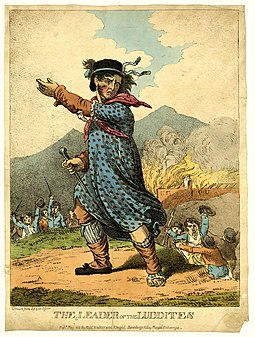
Ned Ludd.

A lot of people are worried about job loss with increasing computerization. And yes, for sure, there will be job loss.Just as there was in the Industrial Revolution: a few jobs lost. An exponentially larger number of new jobs gained.

Why? Because, when things get easier to make, they become cheaper to make. More people can buy them. Therefore, you make more. Therefore, more, not fewer jobs. That now one man can make ten shirts a day, whereas before, he could only make one, will be a problem only if the total number of shirts manufactured remains the same. Which is extremely unlikely if suddenly shirts cost only ten dollars, when before they cost a hundred.

Our awareness of this has been terribly distorted by Marxist doctrine. Marx predicted that, with industrialization, the “proletariat,” the class of urban factory workers, would grow and grow until it included nearly everyone, while they became poorer and poorer. Meanwhile, the wealth would concentrate in the hands of a very few “grand bourgeoisie” or rich capitalists.

This theory was, of course, embraced by the ruling classes, because it warned against a threat to their rule. Marx was the original reactionary. The original counter-revolutionary.

History has not turned out that way at all. Marx missed the mark, disproving his theory. The proletariat has instead grown richer, and, in developed countries, smaller. In the meantime, rich capitalists have almost completely disappeared, replaced by publicly-held corporations. There is much less disparity in wealth now than at the beginning of the Insutrial Revolution, when the bottom class was literally starving, while the top class thought working for a living, indeed doing anything for money, was beneath contempt.

Faced with this stark disproof of something in which they've invested a lot of their own das capital, a lot of folks, notably the ruling classes, just elide or falsify the facts; so that we get a distorted Dickensian history. Kind of like our perspective on the Dark Ages--dark mostly because nobody wants to look at them.

In the Industrial Revolution, it was the very poorest who most quickly and obviously benefitted. It took less skill and training to run a mechanical loom than it once did to make cloth by hand. The men who flooded into the factories might not have had a great life, but it was a lot better than that of the typical rural agricultural labourer. Which almost everybody was before the good old IR.

We see the same today. Already, the information revolution has generated a huge number of new jobs for the very poorest of the poor. In Asia. Where to some folks they don't count.

Ah, but the Luddites would say, and did, that there was and will be job loss for the skilled tradesman. The special skills needed by the town tinsmith or weaver no longer had any value after the Industrial Revolution, being readily replaced by unskilled labour and machine. That is true, and we will probably see something like this again, in clerical work and some of the professions. We already have. When I was going to university, I worked summers, nights, and weekends as a posting clerk in banks, and ran the telephone switchboard in hotels. Both jobs are now gone.

But what really happened to the skilled tradesmen of the Industrial Revolution? Did they end up working the mechanical looms?

Perhaps some did. But where do you think that new class of rich capitalists came from?

They were generally these skilled tradesmen—always a small number of men. In order to set up and supervise a factory, the budding capitalist first had to know intimately himself how the product was made. He set the factory up, then moved to the front office and left the actual machine operations to unskilled others.

Was that so terrible a fate?

The folks most likely to suffer are those who are parasitical on the system. The ones who are getting by without adding any real value.

You will probably recognize them. They're the ones who are still pushing Marx.

Wednesday, August 13, 2014

Robin Williams


Everybody is blogging about Robin Williams. His death was a great shock to a great many. One thinks of the poem “Richard Corey.” He was rich, famous, and adored. If his life wasn't worth living, what can it mean?

It was pretty obvious from the beginning of his career that he had a certain manic energy. Manic—as in manic depressive. So there's that.

However, one would still think that, at his age, and having made so much money, at worst he could have withdrawn from the world for as long as was necessary, or even permanently, to find serenity.

But in fact, he could not. And this is what killed Robin Williams. He was in serious financial trouble.

So how could someone whose movies grossed more than three billion dollars end up at 63 in serious financial trouble? Surely he must have gambled it all away in Vegas or something?

No; he did not. All it took was two divorces.

Given the alimony he was liable for, he was in the position of having to work as hard as hecould just to hold off bankruptcy. This forced him to take roles that he did not want, and inevitably, he just was not as good in them. But then, as his star faded as a result, meeting those payments became harder and harder.

He was on a treadmill he could not escape; except by this means. And this is not a rare thing among rich and famous men. John Cleese is apparently on the same treadmill for the same reason. Gordon Lightfoot has declared that, at his age, he cannot afford to become involved with any new women.

Something is very wrong here. We are enslaving and destroying men--especially the best and the brightest.

Given that woman are free to work and have their own careers, there is no excuse for alimony. If a divorced spouse is still receiving some portion of the other spouse's income, this should be only for services continuing to be performed. And as for dividing marital property, why should the value of a woman's housework rise and fall based on the value of the man's work outside the home? Traditional housework should have a fixed value. The woman's (or lower earner's) share in any divorce settlement should be based on having actually performed this function, and this fixed value, plus the other party's ability to pay. Settlements should accordingly be capped. At about what a live-in maid could earn over the period of the marriage.

As for child support, of course, it is not fair for one party to have the benefit of the children's presence, while the other party has only the bills. Whoever pays child support should, as a matter of simple justice, have full custody of the children.

Enough men have died that we ought to notice what is going on. The suicide rate for men is about four times what it is for women in the US. And that is without counting mysterious traffic accidents, probably the easiest way for men to kill themselves. The suicide rate is accelerating, especially for middle-aged men.

Sunday, August 10, 2014

Three Options for the Americans in Iraq


A fascinating article, for two reasons. First, because it lays out well some of the problems with the three options it cites. Second, because it omits one obvious option.

In case you missed it, the obvious but unmentioned option is to send in troops. The proverbial "boots on the ground."

This is of course what it would take, and it would be far easier and less legally problematic to do so now than it was back in '03 or so.

Why do you suppose this is not even mentioned?

I presume it is politically impossible. But it is a bit sinister to not even mention it.

There are also other unmentioned options...

Friday, August 08, 2014

The Best Thing for the Middle East


A case might be made here for a larger crown.

The Middle East is mess. A lot of people are upset with the US and NATO for not going in and helping the poor people of Syria. It's such a mess. A lot of the same people are upset with the US and NATO for going in and getting rid of Ghaddafi. Leaving such a mess. Not to mention with Bush going in and taking out Saddam, leaving the mess of ISIS there now.

Wait a minute, though. What would you have the US and NATO do?

The problem with nasty dictatorships is that they destroy all elements of civil society. They do this, because any separate organizations could become rival power centres and challenge their rule. They want an absolutely free hand, or what's a totalitarian supposed to do? It's in the job description.

That means that, when they fall, there is nobody and nothing in a position to replace them. And you have a mess.

So, the rest of us have three options here, and only three options, when they start to shoot their own people:

1. Go in, take out the dictator, and try to set up a civil society before we leave. That's Iraq.
2. Go in, take out the dictator, and leave, letting the chips fall where they may. That's Libya.
3. Do nothing, and leave matters to work themselves out. That's Syria.

The West is catching all kinds of criticism for each of these. In other words, they are being blamed no matter what they do.

For my money, number 2 is the best option available. All three end in a mess, but in 1, the West gets blamed for the chaos, while in 3, the West gets blamed for the dictator. The West still gets blamed for the chaos in 2, but it is less convincing, and certainly costs less.

The one institution that dictators in the Middle East do not dare to shut down, because it is too culturally ingrained, is the mosque. As a result, all organized opposition must develop a quasi-religious character, or at least a religious disguise. So, when a dictator goes, almost the only option to replace him ends up being the so-called “religious extremists” (a serious misnomer—these guys aren't very religious at all). This is why democracy doesn't work here. There are only two organized groups: the army, and the mosque. Neither is democratic in nature.

So how do you get to a healthy civil society in the Middle East?

History tells us that there is really only one way: monarchy.

The matter is partially obscured, because many nations have chucked the monarchy since achieving democracy, but it has almost always been necessary to have a monarchy in order to get a democracy in the first place. This is of course true of Canada, Britain, Australia, and the rest of the Commonwealth. It is true, recently, of Spain. It is also true, despite the national mythology, of the US: they got their democratic institutions when they were still colonies. It is true of Japan—under Hirohito; and of Italy. Germany achieved it without a king, but under long foreign military occupation. It is also true of France. Despite the revolution and all that, stable democracy came under Napoleon III, the hereditary Emperor.

With rare exceptions like Henry VIII, monarchies are not totalitarian. One reason is because you do not become the leader in a monarchy through personal ambition. On average, the average monarch will have only the average drive for personal power. Accordingly, there is so desire in the typical monarch to destroy civil society. Or, should suitable institutions arise, to hang on to power for the sake of power.

Like other citizens, they are mostly inclined to do whatever seems best for the nation. Nor do they have the same incentive as a dictator to loot the country's treasury: given the hereditary principle, they have every reason to want to leave the country in the best possible condition for the sake of their children.

Saudi Arabia and the UAE have oil. Iraq and Iran have oil. Which governments have made better use of the resource?

Fortunately for the Middle East, it does include some monarchies.

Thursday, August 07, 2014

Prince Condla

Once upon a time in Ireland there was a handsome prince. His name was Condla, if you need to know. He was a good prince and a good son, and his father King Conn felt that all was well regarding the succession.

Then one day, Prince Condla and King Conn were walking in the hills. At once, a woman of supernatural beauty appeared, but only to Condla. She handed him an apple from the Land of Youth, and told him she was waiting for him there. In the Land of Youth, she said, there was no fighting, no death, and no evil.

King Conn could not see the woman; but he did hear the voice, and the apple was a verifiable fact. Condla put it by his bedside, and, over the months, it never showed any signs of decay.

Over the same months, Prince Condla grew more and more melancholy. He could not forget the beautiful woman. He could find no peace until he joined her in the Land of Youth.

And this, children, is the true story of what we call “depression,” or at least one strain of it.

There is much wisdom in fairy tales. They are the real psychology, and far more reliable than the modern "scientific" discipline.

Friday, August 01, 2014

Did Marshall McLuhan See This?

For your consideration: could this unobtrusive home intruder mean the ultimate death of all mankind?.

Just back for a stroll through my Filipino summer neighbourhood. It is a delight—everywhere, families out playing with their children.

I think I may have hit on why there has been such a collapse in the birthrate in the industrialized world—and, increasingly, in the developing world as well.

It is not the cost of college, though one thinks it ought to be. In Germany and Sweden, college is free, and they have it worse than most.

It is not the availability of old age security. As someone has worked out, in the Third World, without it, the old folks continue to be worth more in income to the family than they cost until quite late in life.

It is not feminism. Feminism is weakest in Japan, and their demographic collapse is legend.

I think it's TV.

We might forget it now, since we don't have them any more, but watching my neighbours, it is borne in to me that kids have a lot of entertainment value. Once upon a time, that mattered, because we did not have all that many other things to do once we came home from work in the evenings.

And exactly the same has happened to other things that were once good entertainment. Church attendance. Membership in voluntary associations: the Masons, the Elks. Bowling leagues. Playing cards. Botticelli. TV killed it all, by offering massive free entertainment at home.

Of course, computers and the internet are only making it worse.

TV showed up in the postwar years, right along with the baby boom, but it only reached 90% of US homes in 1962. And it took at least as long for there to be enough worthwhile stuff for adults to watch.

The baby boom ended, by common calculation, four years later.

Tuesday, July 29, 2014

Some Common Sense on Homosexuality

A good piece here, making a few important points:

1. homosexuality is a dangerous practice
2. bullying is not about gays in particular
3. homosexuality is often (maybe always) due to sexual molestation when young
4. people really can go from gay to straight. In fact, most "gays" do.


Therese Casgrain

To the manor born.

A lot of people seem to be upset about Therese Casgrain being taken off the $50 bill, and about an award formerly given in her name being renamed The Prime Minister's Award.

I think the shocking thing was that she was on the $50 previously, and that public moneys were being given in her name.

Who was Therese Casgrain? A politician, and a lobbyist. I dislike the Canadian practice of honouring past politicians with public money generally: it is divisive. Most countries don't. But if you must, you should at least choose someone from the relatively distant past, who held a relatively important post. A prime minister, say, at a bare minimum. Then you can make a stab at balancing it politically.

But Therese Casgrain, as a politician, despite seven tries, was never elected to any public office. And she died only in 1981.

By that standard, if there is to be any political balance here, there must be millions of former politicians who must also be so honoured. For which, of course, we do not have the tax dollars available.

Imagine how it would feel for a dedicated conservative politically to find himself given the “Therese Casgrain Award.” The name itself would diminish the honour, as it would imply that he endorsed her ideas. Including things like nuclear disarmament and the nationalization of key industries. All very well if the award is given by a private foundation. But should public money be used in this context? If it is, it implies that the Canadian taxpayer also endorses all these things. If he/she did, why was Casgrain never elected?

Or do our masters know better than we do?

Honouring a lobbyist is even more troubling. There have been thousands, millions of lobbyists, lobbying for thousands of special interest groups. To honour any of them and not all the others is to violate the fundamental doctrine that all Canadians are equal.

You want to argue that, in this context, “women's rights” is special? Then you are arguing that women are special. So much for equal rights.

Therese Casgrain is a poor choice, too, if you are trying to make out the bogus case that women have ever been an oppressed group. She was the daughter of a British knight who married rich. She never had to work a day in her life. I should be so oppressed.

Nor was she particularly successful in her career as a lobbyist. Under her supposed leadership, women got the right to vote in Quebec in--1940. It seems entirely probable, given that record, that Casgrain had a net negative effect as a lobbyist.

The government's solution is more honourable: call the volunteer award “The Prime Minister's Award.” Then at least over time it is politically neutral.

Though it would certainly be better to call it “The Governor-General's Award” and leave politics out of it entirely.

Sunday, July 20, 2014

Plague Blankets


You've probably heard all that about the European plan to wipe out the Indians of North America by handing out blankets infected with smallpox. Genocide, clearly genocide.

Yes, it seems it did happen. Once. At the siege of Fort Pitt, General Amherst at least suggested the idea. But I've seen claims it was used in Newfoundland to wipe out the Beothuks, by General Custer on the plains, and just about everywhere else. It just keeps coming up. The false impression is that there was some kind of general policy to do this. And every light-skinned person is guilty.

But hey, did you know that the English actually did use smallpox against the Americans during the American War of Independence? General Howe's idea. They deliberately infected thousands of American civilians, then released them behind Continental Army lines.

A much bigger deal than Fort Pitt.

And yet, when did you last hear of this one?

Conclusion: a dead Indian is worth more than a dead European.

Here's another one: much has been made in recent revisionist history of the claim that there was some slavery (a little) in Canada too, before it was abolished throughout the British Empire in 1833. So Canadians should feel some guilt towards blacks too, right? Worse, because we've been trying all along to cover it up. Self-righteous crackers. Never mind that Upper Canada was one of the first jurisdictions anywhere to pass actual laws against slavery. Never mind that Canada offered freedom for decades to any US blacks who could make it through the Underground Railroad. That's just whitewash. Whitewash.

But just a minute. Did you know that most of the slavery in Canada was practiced by Canadian Indians? Did they mention that bit? It was part of the traditional Indian culture; everywhere. The sainted Joseph Brant, mighty loyalist and leader of the Mohawks, kept 40 black slaves. Probably the largest slaveholder anywhere in Canada.

No offense, guys. But it's just possible people with pale skin are not quite the devils they've been painted as, and people of other colors are not universally morally superior.

Friday, July 18, 2014

Women are Increasingly Unhappy

It's only justice, but how could they not have seen this coming? It was obvious from the beginning of feminism that this was the way it would go: single, too old now to have kids, lonely, exhausted, and bitterly disappointed.

A few thinngs the article does not say: in every "underdeveloped" country and culture, women are significantly happier than men. It is only where feminism has taken hold that women are less happy than men.

And this has absolutely nothing to do with sharing the workload at home. That is less likely to happen in less developed countries. Less work does not make you happier. Notice that the happiest people now are men with senior management positions. I doubt most senior managers have a lot of free time.

Perhaps the real problem here is that we, and modern women in particular, have lost all sense of what life is about.


Saturday, July 12, 2014

Whatever Happened to Northern Ireland?

If present trends continue, Northern Ireland will have a Catholic majority as of January or February, 2016. This upcoming demographic deadline has a lot to do with the current peace in Ulster: the Unionists have realized they have no option but to moderate and seek allies. (And a sumilar deadline faces Israel).

According to the Good Friday Agreement which acheived the current peace in Northern Ireland, reunification of the North with the Irish Republic must occur if and when majorities in both North and South vote for it.

This might now actually happen, and rather soon.

Add this to the legal possibility that Scotland might declare independence as a result of the upcoming referendum, or some future one.

Will Britain be reduced to the United Kingdom of England and Wales? Can Britain live with this?

I think such an event might be one more factor encouraging the creation of a formal anglosphere, in which England, Scotland, and Ireland reassociate as equals within a larger comity including some or all of Canada, the US, Australia, New Zealand, India, Singapore, and some of the Caribbean islands.

Wednesday, July 09, 2014

John Stuart Mill on Education


Before state schools were introduced, John Stuart Mill saw clearly why they were a bad idea:

A general State education is a mere contrivance for molding people to be exactly like one another, and the mold in which it casts them is that which pleases the predominant power in the government, whether this be a monarch, a priesthood, an aristocracy, or the majority of the existing generation.
In proportion as it is efficient and successful, it establishes a despotism over the mind, leading by natural tendency to one over the body. An education established and controlled by the State should only exist, if it exist at all, as one among many competing experiments carried on for the purpose of example and stimulus, to keep the others up to a certain standard of excellence.
In other words, school vouchers. Mill suggests these be backed up with standardized tests from government in certain designated essential skills:
The instrument for enforcing the law could be no other than public examinations, extending to all children, and beginning at an early age. An age might be fixed at which every child must be examined, to ascertain if he (or she) is able to read. .... Once in every year the examination should be renewed, with a gradually extending range of subjects, so as to make the universal acquisition, and what is more, retention, of a certain minimum of general knowledge, virtually compulsory. Beyond that minimum, there should be voluntary examinations for all subjects, at which all who come up to a certain standard of proficiency might claim a certificate.
He then turns to the professions--and sees immediately the danger of government certification here:
The examinations, however, in the higher branches of knowledge should be entirely voluntary. It would be giving too dangerous power to governments, were they allowed to exclude any one from professions, even from the profession of teacher, for alleged deficiency of qualifications. Degrees, or other public certificates of scientific or professional acquirements, should be given to all who present themselves for examination, but such certificates should confer no advantage over competitors, other than the weight which may be attached to their testimony by public opinion.
In other words, nobody should be prevented by law from setting themselves up as or from employment as a pharmacist, or an engineer, or a lawyer, or anything else. Such restraint of trade leads inevitably, as it has led, to self-interested cartels with no regard for the public interest.

It is that simple--it is all predictable. If we have nevertheless ended up with compulsory public schools and government-regulated professions, it can only be because this was the deliberate intent. Those in power wanted to protect a ruling class, and to impose conformity on the rest of us.

This, according to Mill, is not tolerable in a free society.


Monday, June 30, 2014

The Truth Will Out

It's just that it seems to take 40 to 70 year on average for it to happen. Far from fast enough to avoid terrible injustices.

Thursday, June 26, 2014

Government Unions

"Through their strong unions, workers and peasants destroy their oppresors." Azerbaijan, 1920s.

“People of the same trade seldom meet together,” Adam Smith famously wrote, “even for merriment and diversion, but the conversation ends in a conspiracy against the public, or in some contrivance to raise prices.” He goes on to say that this cannot, as a practical matter, be prevented. But it is why we have laws against collusion and cartels in business.

But we not see that people of the same trade includes employees. We do not see it, simply because our stereotyped idea of a unionized worker is of somebody poor, although that has not been true for several generations. In other words, any union is ultimately, by its nature, a business cartel, a conspiracy against the public. While we cannot perhaps prevent this from ever happening, we ought certainly not to be passing laws assisting the process.

In the private sector, fortunately, the problem is self-limiting. If the employees of one firm unionize, it forces the prices up, the firm simply becomes non-competitive, and goes out of business. Along with the union.

Unions quickly discovered, therefore, that in order to survive they had to organize and operate across an entire industry sector. At this point, there can be no pretense that their adversary is some imaginary too-rich capitalist making “excess profits”; it is the consuming public. It is everybody not in the union.

And that worked well enough for the unions for a time. It has come a cropper, though, through growing international trade. Unless the union is global as well as industry-wide, consumers can simply seek the products they need at lower prices offshore. So far, unions have not managed to organize world-wide; although of course they are trying to fight “free trade” for this reason.

Hence the disappearance of entire industry sectors from across the developed world. This is not an entirely bad thing; it gives a chance for the poor world to develop. And with the progress of globalization, we can trace the decline of unions everywhere in the manufacturing sector, where they began. Most unionized workers today are in government. There is a reason for that.

There have been two places where it is harder to go offshore. One is personal services. So the developed world has retained its edge in the “service sector.” And the professional associations—unions for service workers--are still having a field day. But they too are beginning to feel the bite. Improved technology has made offshoring more feasible here too. We have seen the rise of call centres, offshore accounting, “medical tourism.” Information technology is cutting into their cartels as well: “citizen journalism” and homeschooling, for example. I wouldn't give them that much longer on the gravy train.

The one place where the cartel works best is government. Here there is no free market, no consumer choice, apart, in democracies, from elections every four years or so. Here, then, is the one place unions can most flourish, and can continue to flourish against all comers. Whenever the union enters into “negotiations” with their bosses, it is really people of the same trade on either side of the table. As Adam Smith pointed out, there is only one way this will go.

For exactly the same reason, here is one place unions should be aggressively prevented. There is almost nothing but conscience to stop them from soaking the rest of society for everything they want, down to the socks and underwear. And this, growing and avaricious government, as Ibn Khaldun pointed out six hundred years ago, is what invariably causes the fall of civilizations.

I have recently read two pieces convincingly arguing that, quite apart from any White House direction, the current American IRS scandal is a more or less inevitable consequence of the unionization of the public service. Unionize the guys with their hands on the levers of power, and they will begin operating in class self-interest. It is obviously against their class self-interest for tax-slashing groups to come into government. Therefore, they will work together to prevent this.

You unionize government workers, and you are creating a ruling class.

Granted, it is not a hereditary ruling class, although there are obvious growing tendencies in that direction. There is sometimes, though not that often, open competition for government jobs, as opposed to hiring relatives and friends. But it would actually be better if government positions were hereditary: then there would be some incentive to leave the living carcass for the next generation. Now, the incentive is for this generation to milk the system for all it can before they pass on, for their inheritors will be strangers.

It was only in the 1960s that government workers were permitted to unionize in North America. I think it is time to chalk that one up as one of the historic bad ideas. Government workers should not be allowed to unionize, and should not be allowed to strike. Their pay should be pegged as a percentage of private sector pay.

If it is not too late. The sad truth is that, by now, as Tim Hudak can attest, anyone running on a platform of cutting government or cutting government salaries is facing into a stiff headwind. The entire machinery of government, in addition to the campaign contributions of all the highly-paid government workers, will be working against them.

Tuesday, June 24, 2014

The IRS Targeting Scandal

Isn't that a vulture on the right?

Never mind the details and the smoking guns. Regardless of anything else we learn from here on in, it is clear that the American IRS has become a partisan political organization. This is a clear and present danger to American democracy. Something must be done.

I propose that Congress legislate rolling terminations. Starting at the highest management level, each level of management gets terminated every six months until we reach the level of ordinary employees. Starting tomorrow, with the agency head. Their replacements would have to come from outside the IRS. Over a relatively short time, the personnel of the agency would be replaced, and presumably the poison would be rooted out. If nothing else, the process would serve as a warning to new hires and to those working at other agencies that becoming partisan carries risks.

I would build in a proviso that the process can be halted for individuals or for the agency as a whole if and when any employees are able to provide investigators with valuable information regarding the real culprits in the targeting scandal.


Monday, June 23, 2014

The Irish Mass Grave


You may have read an AP story a couple of weeks ago about a mass grave of unbaptised infants in a septic tank outside a Catholic home for unwed mothers in Ireland.

Don't miss the correction. It seems the death rate for infants at the home was par for the course for Ireland at the time, the children were baptised, and no mass grave has actually been found, in a septic tank or elsewhere.

The Catholic Church ought to be able to sue for libel.

Sunday, June 22, 2014

What to Do about Iraq

Current map of the military situation in Iraq. Good guys shown in blue.

It seems to many that the US has no good choices now in Iraq. That the sacrifices of the last ten years by the US military are in vain. Many say it was a mistake to go in in the first place; things are now worse than if the US had stayed out back in '03. When Dick Cheney went on Fox News to say Obama had gotten it all wrong, Megan Kelly countered that he too, seemed to have gotten it all wrong. Even the right, in other words, sees no good options now.

A pro-Iranian Iraqi government is fighting an Al Qaeda affiliate, who is in turn fighting the military dictatorship of Hafez Assad, accused of crimes against humanity. So whom does the US want to win? Why? Go flip a coin. If, on the other hand, the US stays out, won't Iran move in? Or Turkey? How will the Kurds feel about that?

I disagree. There are good guys in this fight, and they ought to be defended. And not just the Kurds.

I believed at the time that it was right for the US to go in to Iraq, and I still think it so. They had to go in; Saddam was flouting the ceasefire terms. (The Weapons of Mass Destruction were not the crucial issue,) They screwed up in trying at the same time to turn Iraq into a liberal democracy. In my defense, I thought this second bit was a bad, naïve, idea at the time. You cannot impose a democracy on a people, any more than you can square a circle.

I also believe it is not too late to save the situation. The US really does have allies on the ground in Iraq and the Levant. They are less aware of this than they should be, because of the same blind spot about democracy that led to their mistken attempt at nation-building in Iraq. Their allies are Jordan, Saudi Arabia, Qatar, and the rest of the Gulf Cooperation Council. All have all been staunch allies, moderate voices, responsible influences in the region, and models of stability in the midst of chaos. They are involved: Jordan, Saudi Arabia, and Kuwait all have borders with Iraq. Jordan is practically surrounded by the conflict, swamped with refugees.

The US has a responsibility to them, ought to listen to them in this crisis, and, moreover, ought to look to them as models for what might work in Iraq. The US should still be funnelling their military and financial help to them, and seeking their counsel, to ensure that their allies in the region remain strong, and to ensure that said US assets are used wisely.

Which brings me to what I thought the US should have done in Iraq in the first place: restore the Iraqi monarchy, then get out. When you have a nation of many factions, like Iraq, you almost need a monarch as a unifying symbol, as there is no national self-consciousness to do this. Consider Jordan: like Iraq, a very mixed country, but stable. Monarchies are demonstrably more responsible and less corrupt than republics, short of a fully functioning liberal democracy. It is in the vested interest of the ruling family to foster growth and development, for the sake of their own children and grandchildren, instead of pillaging the treasury, as a dictator will, while he can. And Iraq had a legitimate, still-existing ruling house that could have been tapped.

Is it too late? I don't see why.

Thursday, June 19, 2014

Stufffed Shirts and Red Skins

Guess I don't have to worry about violating copyright...

A federal court has, subject to appeal, voided the Washington Redskins' trade marks on the premise that the team name is a pejorative towards American Indians.

This is a big problem, and a bad law. First, there is no plausible reason for such a law. No business owner is intentionally going to name his product with a pejorative. It is quite obviously bad for business to say your product is sh*t.

It goes without saying, then, that “Redskins” was not considered a pejorative when the Washington team was originally named, in 1933; otherwise the name would not have been chosen, because it would be suicidal. A quick check of the 1913 edition of Webster's confirms this: no hint that the term is pejorative. Now the team has invested hugely in making it an identifiable brand, the third-most valuable brand in the NFL. Bad enough if changing popular usage has twisted the term over time so that it has become an insult: then the management faces the difficult choice whether to jettison the name and lose all that investment, all that fan history and fan loyalty, or tough it out with a name that has become a liability through no fault of their own. But it is unconscionable if they are not even allowed that choice, but have the name taken from them by the government without compensation.

And has “redskin” even been used pejoratively by any significant section of the population? If so, I for one have not noticed it. Isn't the problem rather that American Indians have been portrayed in many books and movies in a relatively unflattering light, as the villains of the piece, prone to massacre and pillage, as, in a word, savages, and these movies and books happen to use the term “redskins”?

If so, this is remarkably bad news as well for the Minnesota Vikings; and simply equity requires that both team trade marks be voided at the same time.

But hold off a moment. There are other sports teams whose names genuinely are used by large portions of the population, right now, here, today, as insults. Their situation, therefore, ought to be even more clear-cut, and their rights should be cancelled and their property seized before anyone thinks of going after the poor Redskins.

I think, in the first place, of the Dallas Cowboys.

Most times, if you call someone a “cowboy,” you do not mean this as a compliment. When America joined World War Two, Hitler scoffed at their army as “cowboy soldiers.” In British English, a “cowboy” is a workman who has done a shoddy job. Cambridge simply defines “cowboy” as “dishonest person.”

And surely cowboys, though a small, vulnerable minority, are an identifiable group?

And then there are the New York Yankees. They certainly ought to have no right to their own name. In most of the world today, “Yankee” is an insult—think “Yankee, Go Home.” The Urban Dictionary defines it thus: “The word is a derogatory term used to describe Americans.” It is even an insult throughout most of the US South. Heck, arguably even in the US North. One need only cite the title of the famous musical: “Damn Yankees.” Does that sound pejorative, or doesn't it?

So why all this fuss directed only at the poor old Washington Redskins? Isn't this, plainly, discrimination against redskins?

Wednesday, June 18, 2014

Canadian Heroes

The Canadian government, in preparation for the 150th anniversary of Confederation in 2017, has commissioned a study to discover Canadians' greatest heroes from the years since Confederation.

The results have been pretty lame, mostly politicians: Pierre Trudeau, Lester Pearson, Tommy Douglas, Jack Layton, Sir John A. Macdonald, Terry Fox, David Suzuki, Wayne Gretzky, Chris Hadfield, Romeo Dallaire.

Predictably, there has been a public outcry about there being no women on the list. As if it is the responsibility of the rest of us (that is, men) to ensure that women have made an outstanding contribution. If everything is the responsibility of men, though, you can see why there are no heroines on the list. You don't get to be a hero without taking responsibility for your own acts.

But apart from this, it is an uninspiring list. Recent politicians are an intrinsically lousy choice for national heroes: they are partisan, not national, figures. And can always be suspected of pure self-interest. Canada is peculiar in its fondness for politicians. Almost nobody else puts heads of government (as opposed to heads of state) on their bank notes. Most nations feature great artists, composers, or writers.

Suzuki, too, is a divisive figure, who has done nothing remotely heroic; nothing that did not further his own career.

We can certainly do better. Canada has a lot of real heroes—I'd venture to say that we have produced more true heroes, per generation and per capita, than most other countries. Why do we not celebrate them?

Part of the problem, no doubt, is that we are awfully ignorant of our own history. For everyone on the list except Sir John A., the CBC's respondents seem to be relying on living memory.

But isn't there a tautology here? The government should be, and is here trying to, promote a Canadian sense of history. Perhaps they are going about it the wrong way. Perhaps, instead of asking the man in the street, they should be asking historians.

May I offer a few more Canadian heroes, whom I think more worthy of remembrance in 2017 than most of those on the list? Note the rules of engagement: these must be only post-Confederation. And my own rule: they must not be divisive figures.

You want women? Catherine Doherty, Lucy Maud Montgomery, Ma Murray, Rose Prince, Alice Munro. Montgomery virtually founded our national literature; Munro has the Nobel Prize. I deliberately omit the usual reference to the Famous Five: divisive, purely self-interested, and proponents of notably bad ideas like eugenics and temperance.

War heroes? Georges Vanier, Billy Bishop, Bill Barker, Raymond Collishaw, Roy Brown, Charles Fox, Thomas Prince.

Sports heroes? Too many! Gretzky, sure, but also Ned Hanlan, Maurice Richard, Bobby Orr, Joe Malone, Frank McGee, Patrick Roy, Howie Morenz, and on and on. Better to stick with those already dead, jut in case someone turns out to be OJ Simpson or Oscar Pistorius.

Literary heroes: Thomas D'Arcy McGee (also political, but I think a unifying figure), Stephen Leacock, Robert W. Service, Emile Nelligan, Thomas Chandler Haliburton, Northrop Frye.

Not to mention, among those hard to classify: “Wild Goose” Jack Miner. Francis Scofield (ask the Koreans). Oliver Avison. St. Andre Bessette. Timothy Eaton. Marshall McLuhan. William Kurelek.

Not to mention scientists and inventors! Alexander Graham Bell, Hans Selye, Sir Sandford Fleming, and so on.


Perhaps you have your own.

Tuesday, June 17, 2014

A Post for Fathers' Day

Romney Redux


You may have heard it here first, or maybe not: Romney is running. There is a tweet going around claiming inside knowledge to that effect. And it tallies with his recent prominence in the media. I believe he will.

He should. For reasons noted here before. A lot of people feel remorse now for voting the other way last time, and would welcome the chance at redemption. After Obama, there will be a thirst for raw competence, for a steady hand at the wheel. Romney gives that sense more than anyone else who comes to mind. And having lost once helps: Romney's greatest liability has been that he seemed too perfect, as if he had never had to break a sweat over anything. Now he looks more human.

He needs more foreign policy chops. But that is true of any of his likely competitors as well. (I'm sticking with my prediction that Hillary Clinton will not be the Democratic nominee, but even if she is, her involvement with the Obama foreign policy will be a liability, not an asset.) He needs to get out in public talking about foreign policy right now--and that is exactly what he is doing.

Friday, June 13, 2014

Depression and Psychiatry

Probasbly the worst thing you can do, if you happen to  be depressed, is to go and see a psychiatrist. Depression is most fundamentally a feeling that the world as you experience it makes no sense. It is a loss of meaning. And the strongest point the psychiatrist is going to put to you, his fiercely held article of faith, is that, yes, your suffering is meaningless. 

Thursday, June 12, 2014

Iraq

Does anyone else find this incredible? Just over the wire from the Daily Telegraph in the UK:

"12.10 Iraq's parliament has failed to reach a quorum, officials told AFP, preventing it from voting on a request to announce a state of emergency to deal with the major jihadist offensive.

A senior government official told AFP only 128 of 325 MPs attended, and another official confirmed a quorum was not reached."

I begin to believe ISIS is simply filling a vacuum, that Iraq has no effective government. The insurgents took both Mosul and Tikrit within 24 hours, didn't they? 

At this rate, soldiers are just throwing their weapons away and blending in to the crowd as soon as the ISIS units appear. And they are moving almost as fast as the highways can carry them. And it looks as if the politicians in Baghdad, too, do not want to be easy to find when this is over.

What will the result look like? I assume the Kurds can hold their territory. I expect the Shia in southern Iraq may choose to rely on Iranian intervention to defend them from the Sunni ISIS.

This will not, for the US, be a happy conclusion to their adventure in Iraq.

Tuesday, June 10, 2014

The Beothuk Genocide

Demasduit.
No doubt you have heard of the sad fate of the Beothuks, the pre-European inhabitants of Newfoundland. (Well, maybe not pre-Viking). They apparently became extinct as an ethnic group early in the 19th century. This is often trotted out as a guilt trip for European-Canadians.

It should not be. As I read the history, Europeans did their level best for the Beothuks. From 1769, anyone killing a Beothuk was legally guilty of murder, just as if they had killed another European. (And before that, there was precious little law in Newfoundland of any sort). The Newfoundland authorities tried their best on several occasions to befriend the Beothuks, which approaches the Beothuks always rebuffed, sometimes bloodily. But befriending the Beothuks made sense for pure self-interest: the English had no interest in the land, only the fisheries, and would have been delighted to set up a fur trade. It would also, had they understood, have been in the interests of the Beothuks. Such a trade had made Indians further south, such as the Iroquois or Cree, enormously wealthy and powerful.

The Beothuk may have been the same people as the Skraelings, whose implacable hostility forced the Vikings to abandon their Newfoundland settlements in the eleventh century.

The problem seems to have been the Beothuks’ own extreme xenophobia. An island people, they could not deal with the idea that outsiders, meaning any people they had not previously known, were human. This meant a permanent state of war with all comers, the Mikmaqs and Innu as well as the Europeans, despite anyone else’s best efforts to make friends. When the Beothuk woman Demasduit was brought to St. John’s, the governor, hoping to achieve good relations, sent her home laden with gifts. But she warned that, having spoken with the Europeans, she would never be accepted back into her tribe.

The number of Beothuks was probably always small—estimates range from 500 to 3,000 in total at their height. It does not take that great a catastrophe to wipe out that many people over a matter of generations. When the Europeans appeared, the Beothuks chose to retreat inland rather than have to deal with the outsiders, even though at this point the latter only used the shore in summers to dry their catch. This cut the Beothuks off from the fishery, probably their prime food source up to that time. They switched to caribou, but soon hunted them out. Weakened by hunger, they became prey to tuberculosis. The lack of food also caused them to become more aggressive towards the Mikmaqs and Europeans, in hopes of conquering hunting territory or at least seizing food stocks. In this, they were put at something of a disadvantage by their steadfast refusal to adopt firearms. Presumably guns were too foreign a thing to be acceptable.

In these circumstances, some may have been killed by Mikmaqs or by rogue Europeans. But this was not the real story. This was a footnote.

Shanawdithit, last known living Beothuk.


Friday, June 06, 2014

The Bergdahl Affair


The Obama administration's handling of the Bergdahl affair is, to my mind, historic. It will be in the history books. It is the defining moment of Obama's presidency. It is so obviously wrong in so many ways. How could it have happened? Doesn't Obama have advisors?

Two thoughts. First, this illustrates a point David Frum made about George Bush. It is not enough to have good advisors. You will always have conflicting advice, and advice does not come in little packages saying “good” and “bad.” You need to know it when you see it. There is no substitute for a wise and knowledgeable leader.

Second thought: reputedly, Obama has long claimed to be smarter than any of his advisors. He may well think so. If so, as he finds himself increasingly in political difficulties, over Obamacare, the VA, and so on, his instincts may have been to blame his advisors, and rely less and less over time on anyone else's advice. 

The apparent deepening incompetence of the Obama administration may be the result. It would not be the first time hubris has led to a tragic outcome.