





 Posts


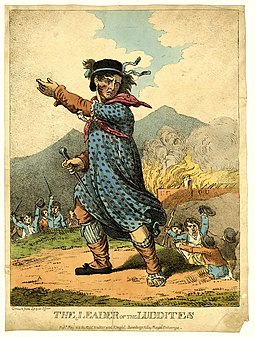 |
| Ned Ludd. |
A lot of people are worried about job loss with increasing computerization. And yes, for sure, there will be job loss.Just as there was in the Industrial Revolution: a few jobs lost. An exponentially larger number of new jobs gained.
Why? Because, when things get easier to make, they become cheaper to make. More people can buy them. Therefore, you make more. Therefore, more, not fewer jobs. That now one man can make ten shirts a day, whereas before, he could only make one, will be a problem only if the total number of shirts manufactured remains the same. Which is extremely unlikely if suddenly shirts cost only ten dollars, when before they cost a hundred.
Our awareness of this has been terribly distorted by Marxist doctrine. Marx predicted that, with industrialization, the “proletariat,” the class of urban factory workers, would grow and grow until it included nearly everyone, while they became poorer and poorer. Meanwhile, the wealth would concentrate in the hands of a very few “grand bourgeoisie” or rich capitalists.
This theory was, of course, embraced by the ruling classes, because it warned against a threat to their rule. Marx was the original reactionary. The original counter-revolutionary.
History has not turned out that way at all. Marx missed the mark, disproving his theory. The proletariat has instead grown richer, and, in developed countries, smaller. In the meantime, rich capitalists have almost completely disappeared, replaced by publicly-held corporations. There is much less disparity in wealth now than at the beginning of the Insutrial Revolution, when the bottom class was literally starving, while the top class thought working for a living, indeed doing anything for money, was beneath contempt.
Faced with this stark disproof of something in which they've invested a lot of their own das capital, a lot of folks, notably the ruling classes, just elide or falsify the facts; so that we get a distorted Dickensian history. Kind of like our perspective on the Dark Ages--dark mostly because nobody wants to look at them.
In the Industrial Revolution, it was the very poorest who most quickly and obviously benefitted. It took less skill and training to run a mechanical loom than it once did to make cloth by hand. The men who flooded into the factories might not have had a great life, but it was a lot better than that of the typical rural agricultural labourer. Which almost everybody was before the good old IR.
We see the same today. Already, the information revolution has generated a huge number of new jobs for the very poorest of the poor. In Asia. Where to some folks they don't count.
Ah, but the Luddites would say, and did, that there was and will be job loss for the skilled tradesman. The special skills needed by the town tinsmith or weaver no longer had any value after the Industrial Revolution, being readily replaced by unskilled labour and machine. That is true, and we will probably see something like this again, in clerical work and some of the professions. We already have. When I was going to university, I worked summers, nights, and weekends as a posting clerk in banks, and ran the telephone switchboard in hotels. Both jobs are now gone.
But what really happened to the skilled tradesmen of the Industrial Revolution? Did they end up working the mechanical looms?
Perhaps some did. But where do you think that new class of rich capitalists came from?
They were generally these skilled tradesmen—always a small number of men. In order to set up and supervise a factory, the budding capitalist first had to know intimately himself how the product was made. He set the factory up, then moved to the front office and left the actual machine operations to unskilled others.
Was that so terrible a fate?
The folks most likely to suffer are those who are parasitical on the system. The ones who are getting by without adding any real value.
You will probably recognize them. They're the ones who are still pushing Marx.

