If for any reason you cannot find the paperback version of Playing the Indian Card at your favourite bookstore or online retailer, please ask them to carry it. Protest and picket the store entrance if necessary.
In 1909, there was a serious proposal to build a monument to the American Indian in New York Harbour, fifteen feet higher than the Statue of Liberty. It was serious enough that construction began; with much public support. It ultimately fizzled out when WWI came, causing a bronze shortage.
I mention this because it shows how fallacious the idea is that American Indians have been historically discriminated against. The truth is the exact reverse: they have always been idealized and idolized. But this has not been good for them. It is rather like what happens when you spoil a child: they become dependent.
It is true that, in the US, encroaching settlement made their traditional way of life obsolete. This has never been true in Canada—only a small fraction of the actual land mass or hunting area has ever been settled. But even in the case of the US, they face a common dilemma: there is no call for coopers or blacksmiths or telegraph operators any more either. One retrains.
Watched Night at the Museum (2006) yesterday with the kids. A bit late for a movie review, but it was new to me. The film featured Sacajawea as a fairly major character. She is represented, as usual, as the guide for the Lewis and Clark expedition. Another character is writing a thesis about her, and describes her in these terms. Her celebrated tracking ability is then used to find the villains.
This is historically false. It is a pity that children are being taught this fake history at the movies; but they probably get the same fake history in the schools. Sacajawea did not guide Lewis and Clark; she was hired as an interpreter. On a couple of occasions, she had personal knowledge of the landscape that was helpful to the expedition, but this was not a regular thing. Yet the classic depictions have her with her arm outstretched, pointing the way.
This is a matter of the noble savage archetype. The idea is that the Indians, being “indigenous,” must have special knowledge of the landscape. After all, they are part of the land.
Being nomadic, they did move around a lot; and so they naturally would have some. But this has been exaggerated.
A similar case is that of the memorial to the War of 1812 on Parliament Hill in Ottawa. It shows an Indian figure with his finger outstretched, pointing the way to the British soldiers and the Canadian militiamen.
In this case, the “Indian guide” concept sells the Indians short. They were not guides to British troops or Canadian volunteers in that war; they were major combatants.
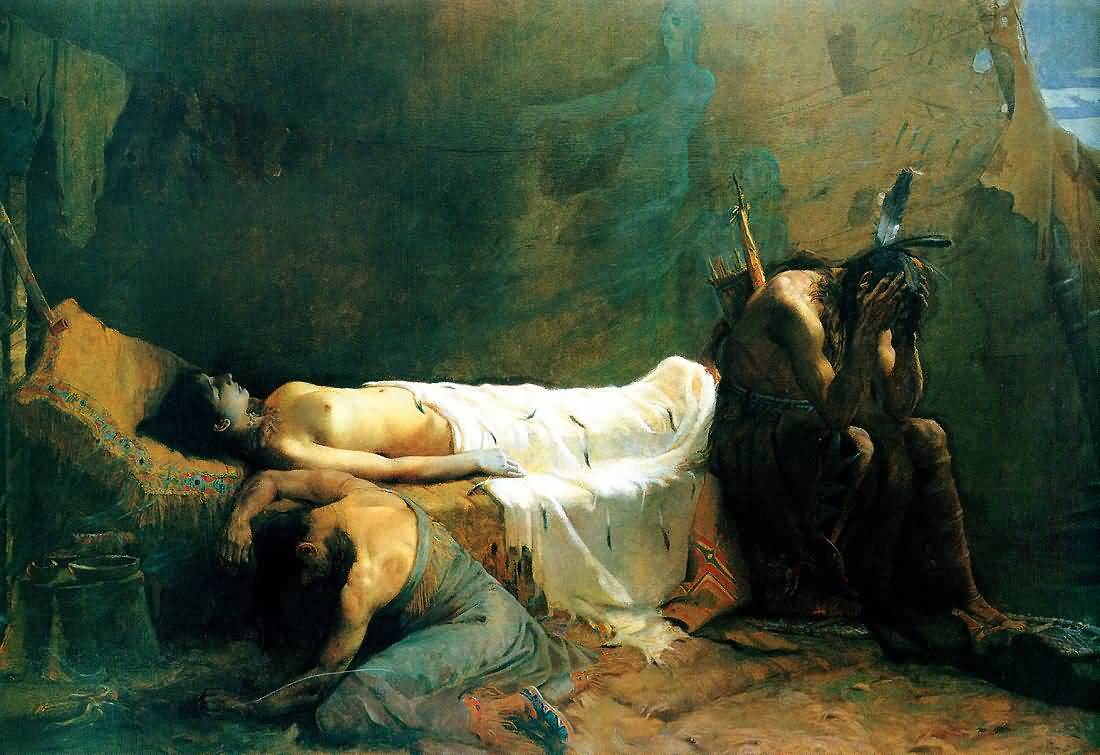
Longfellow's Minnehana, dying poetically and clothed more or less as nature made her
In the 2016 American League playoff series, the Toronto Blue Jays faced the Cleveland Indians. Inevitably, a Canadian aboriginal activist appealed to the Canadian and Ontario Human Rights commissions to prohibit use of the visitor’s team name in Canada. Nor were they to to wear their uniforms, display their logo, or show their mascot. All were offensive to First Nations.
In support of the proposed ban, a “meme” hustled around the Internet holding that Indians as a team name was offensive just as it would be offensive to call a team "The New York Jews," or "The San Francisco Chinamen." So why should “The Cleveland Indians” be different?
Why, indeed? And why indeed is it different from the Minnesota Vikings, the Boston Celtics, the New York Knicks, the New York Yankees, the Montreal Canadiens, the Vancouver Canucks, or the Notre Dame Fighting Irish?
Teams everywhere want to name themselves after Indians. We have the Edmonton Eskimos, the Atlanta Braves, the Chicago Blackhawks, the Kansas City Chiefs, the Washington Redskins, the Florida State Seminoles, and so on. Even teams in Europe have used Indian names. The Exeter Chiefs play rugby. The Malmo Redhawks play hockey in Sweden. Yet nobody anywhere seems to have ever wanted to name a team after Jews or Chinese.
Pure business, folks. If you name a team the Indians, people like and want to support it. If you name a team the Jews or the Chinamen, people do not. You lose money.
In other words, there is a general popular prejudice against the Jews or Chinese, at least as athletes, but in favour of the Indians.
The surest proof that a group is not being discriminated against, is that it is used as the name of a sports team. People want to cheer it.
The Canadian aboriginal activist was not acting against discrimination. He was pulling rank.
This, of course, flies in the face of the common preconception. Every right thinker thinks Indians have been oppressed throughout history. Haven’t they always been discriminated against? Haven’t they been despised, spat upon, forced off their land, looked down upon as “bloodthirsty savages,” at least until recent, more enlightened times? Wasn’t the only good Indian once a dead Indian?
Nope. This is all a beautiful myth. As C.L. Sonnichsen puts it, not quite felicitously, “If the Apache is a gentleman of distinguished culture, the white man is a savage” (C.L. Sonnichsen, From Hopalong to Hud [College Station: Texas A&M University Press, 1978], p. 65). He misuses the term “savage”--he means moral evil. If you believe in the myth of the “noble savage,” you must automatically believe that civilized man is evil. If the state of nature is a state of grace, it follows that all evil comes with civilization. The former assumption requires the latter. So it must be true that civilization is oppressive of the natural man. The Indian must have been hard done by.
Accordingly, without citing any actual evidence, the “TV Tropes” web site, for example, explains as given that “In the era of the ‘Revisionist Western,’ (the era in which we find ourselves) fiction often attempts to provide a more diverse and historically accurate view of violence by and against Native Americans.” The prior norm, then, was ahistorically anti-Indian.
“Before the movies added sound,” this account continues, “the Native Americans in films were stereotyped. They were always shown with scowls, while wearing war paint, showing that they were ready to kill at any time, or that they were less than the whites and that the Indians had need to be helped with everything having to do with the white way of life” (ibid).
Hmm. But does that sound like Tonto as you remember him?
At left: bloodthirsty savage.
Didn’t we all grow up with the righteous Tonto, hearing about how Pocahontas saved the life of what’s-his-name—the European is a lesser player in the legend? How the Pilgrims and the friendly local Indians celebrated the first Thanksgiving? How the Indians showed the incompetent Europeans how to survive in this strange new world? How Sacajawea skillfully guided Lewis and Clark across the Northwest? How Tiger Lily, the Indian princess, was a true and loyal friend (and love interest) to Peter Pan?
How bloodthirsty was all that?
Has somebody here been smoking Jimson Weed?
There certainly seems to be a stereotype, but not the one claimed. A rather more noble one.
More sophisticated analyses go so far as to admit that there are two standard portraits of the North American aborigine: not just the “bloodthirsty savage,” but also the “noble savage.” Both, however, the wise will understand, are equally wrong. Lacy Cotton writes of “the swinging pendulum of popular opinion concerning American Natives, and how that opinion always reached for one extreme or the other” (Lacy Noel Cotton, “American Indian Stereotypes in Early Western Literature and the Lasting Influence on American Culture,” MA thesis, Baylor, 2008, p. 37).
That sounds terribly balanced and enlightened, doesn’t it?
However, it ought to count for something, and seems not to, that the “noble savage” is commonly the Indian encountered in fiction, whereas the so-called “bloodthirsty savage” is the one most often found in eyewitness accounts.
In other words, only one of them is a literary stereotype.
And it isn’t the prejudicial one.
The idea is that Western civilization, being evil and greedy, has invented a slander against the Indians in order to steal their land. Think of the villain Ratcliffe in Disney’s Pocahontas, digging the beach for gold.
Hence indeed the whole idea that the “whites” stole the Indian land. It must be so. It is a necessary part of the Edenic noble savage myth that somebody took Eden away. Along with the idea that the Indians were particularly connected to the land.
Never mind that the white settlers never had any practical need to steal land from the Indians, whose numbers had already been dramatically reduced by disease. Never mind that there is still adequate uncultivated land around Attawapiskat and any point north to continue the traditional Indian way of life, if anyone were mad enough to want to.
Hence the strange untrue assertion that in the past, our ancestors despised the Indians, but now, we are more enlightened. A rejection of “civilization” is a rejection of tradition. That is what civilization is. A rejection of tradition is a rejection of the supposed wisdom of our ancestors, in favour of the spontaneous desires of the present time. If savages are better off, civilization is evil. If civilization is evil, our civilized ancestors are evil, or their counsel is. We, on the other hand, being at least potentially in and of the moment, if we learn the trick of being here now, can make some personal claim to natural spontaneity and following our own instincts. We enlightened are on the side of the Indians.
Keats put it plainly in his romantic ballad, “La Belle Dame Sans Merci.” The narrator’s fantasy of unrestricted romantic love is arrested by an interfering conscience personified as:
“pale kings and princes too,
Pale warriors, death-pale were they all;”
Hughes, La Belle Dame Sans Merci
The voices of social propriety—our ancestors—the dead.
I saw pale kings and princes too,
Pale warriors, death-pale were they all;
They cried—‘La Belle Dame sans Merci
Hath thee in thrall!’
I saw their starved lips in the gloam,
With horrid warning gapèd wide,
And I awoke and found me here,
On the cold hill’s side.
Some may object that the aboriginals themselves have and had a great respect for the wisdom of their ancestors. Indeed they did—they too, like most men everywhere, saw the critical value of civilization. They were themselves not romantics, and would have had no time for such mad ideas. But as a practical matter they were crippled in this by the lack of any form of writing. Their knowledge of their own traditions, and their ability to build on them, was limited to living memory.
Indian princess
Related as well to the noble savage archetype—indeed, its epitome--is the cult of the beautiful Indian princess: Pocahontas, Sacajawea, Tiger Lily, Leonard Cohen’s Kateri Tekakwitha, Land O’Lakes butter, and so on. The Indian princess is the Belle Dame Sans Merci, image of, in the end, free love. She is found also in Kore, Persephone, the innocent daughter of Mother Nature. She is the possibility of unbridled raw romantic passion, emotion without pale reason, including and symbolized by carnal union, without the restraints imposed by polite society. Adam and Eve before the fig leaves.
The weird legend that the residential schools were harmful to the Indian children also functions as part of the same myth: the schools were, symbolically, the imposition of evil civilization on these pure children of the forest, these Indian innocents and virginal maidens. The white man is Pluto, god of the underworld, rich, selfish, and cruel; the residential school is his kingdom of Hades, to which the virginal maiden is abducted.
In 1911, just as today, just as every day, everyone “knew” that the discovery of the nobility of savages was some recent revelation. In a 1911 copy of The Dallas Morning News, the Associated Press gives a favorable review of a book contemporary to its time, titled The Indian Book by William John-Hopkins. AP praises the book for its “multi-layered view of the Mandan Indians,” stating that “the author makes the simple life of these primitive people vividly human, and the child forms a sympathetic and humane conception of this vanishing race, altogether different from his usual picture of the paint-daubed scalper” (Cotton, p. 41).
But this “usual picture” seems always to have been quite unusual. One could argue that the noble savage myth is even older than Persephone, is as old as the oldest sustained narrative known, The Epic of Gilgamesh: Enkidu, Gilgamesh’s BFF, is a wild man of the forests who comes to rescue mankind from, it seems, excessive governance.
To the Greeks, in turn, noble savagery evoked a lost “Golden Age.”
In the Golden Age, according to Hesiod, men
“lived like gods without sorrow of heart, remote and free from toil and grief: miserable age rested not on them; but with legs and arms never failing they made merry with feasting beyond the reach of all devils. When they died, it was as though they were overcome with sleep, and they had all good things; for the fruitful earth unforced bare them fruit abundantly and without stint. They dwelt in ease and peace.”
In India, the Mahabharata nurses the same cosmic fantasy:
“Men neither bought nor sold; there were no poor and no rich; there was no need to labour, because all that men required was obtained by the power of will; the chief virtue was the abandonment of all worldly desires. The Krita Yuga was without disease; there was no lessening with the years; there was no hatred or vanity, or evil thought whatsoever; no sorrow, no fear. All mankind could attain to supreme blessedness.”
The myth of the noble savage is every man’s yearning for a simpler life in the midst of the restraining requirements of existence with others. We each indulge it, spontaneously, when we feel nostalgia for our youth, a supposedly happier time. That’s how many of us remember childhood. But it is unlikely to be true of real history
All of life was once a garden
Alexander Pope wrote in his "Essay on Man" (1734):
Lo, the poor Indian! whose untutor'd mind
Sees God in clouds, or hears him in the wind;
His soul proud Science never taught to stray
Far as the solar walk or milky way;
Yet simple Nature to his hope has giv'n,
Behind the cloud-topp'd hill, a humbler heav'n;
Some safer world in depth of woods embrac'd,
Some happier island in the wat'ry waste,
Where slaves once more their native land behold,
No fiends torment, no Christians thirst for gold!
To be, contents his natural desire;
He asks no angel's wing, no seraph's fire:
But thinks, admitted to that equal sky,
His faithful dog shall bear him company.
This was the most famous take on the American Indian in all of English literature in the 18th century.
And here we plainly see the noble savage as the dominant view, well before the Romantics. While Pope, a Catholic, does understand the Indian as lacking important knowledge, the latter lives where “No fiends torment, no Christians thirst for gold! [shades of Pluto, of Disney’s Ratcliffe]/To be, contents his natural desire.”
Crane: Persephone and Pluto
This, unfortunately, we know from missionary accounts to be untrue: Mr. Indian was very much tormented by fiends, and very much valued trinkets. But it fits with the Garden of Eden myth of a Golden Age of man.
It also reveals, properly enough, how very patronizing and condescending the “noble savage” idea really is towards Indians. Innocence is not itself a virtue, any more than ignorance is. It is simply a state of never having exercised free will.
On the French side, importantly for Canadian perceptions, there is Rousseau, also of the 18th century, the great proponent of the state of nature, and before him Montaigne. “He [Rousseau] explained that all men when in the state of nature were essentially good, with untainted intuitions and inclinations. But to be civilized was to be corrupted and made unhappy by experiences in society. Gaining knowledge through tuitions enforced unnatural behavior on the natural man and removed him from his more natural, and therefore good, inclinations.” “American Indians, then, became an ultimate example of man uncorrupted and unfettered by civilization, a concept that countered the beliefs surrounding original sin and reinforced that all men were, at their core, good” (Lacy Cotton, op cit., p. 30).
One might add Freudianism to the noble savage mix. Civilization, according to Dr, Freud, represses our natural instincts, and repression of our natural instincts ultimately causes us to go mad. Therefore – free sex is a moral right. Civilization is the nexus of evil.
One can see the attractions to the argument, quite independent from its possible truthfulness. Everybody, in the abstract, would prefer to follow their first instincts if they could. The only problem is everyone else doing likewise.
Feminism, too, drinks deep of this traditional joy juice of the Kickapoo: all tradition, all established social norms, are of the evil patriarchy, aka Pluto, established to oppress women, who themselves represent unblemished nature. All Indian princesses, all of them. Therefore – free sex is a moral right. Civilization is the nexus of evil.
One can see again why church-run residential schools get targeted as the chief villain in the piece. They teach original sin! They deny our primordial innocence! They oppose free sex!
Now let us pass to the specifically North American tradition.
The Transcendentalists, American Romantics, of course embraced the idea of original innocence. “This could be related to Emerson’s encouragement to seek the Aboriginal Self in his essay ‘Self Reliance.’ This self supposedly existed inside all men and listened not to the tuitions taught by society, but to the natural instincts of the soul” (Cotton, op cit., p, 30).
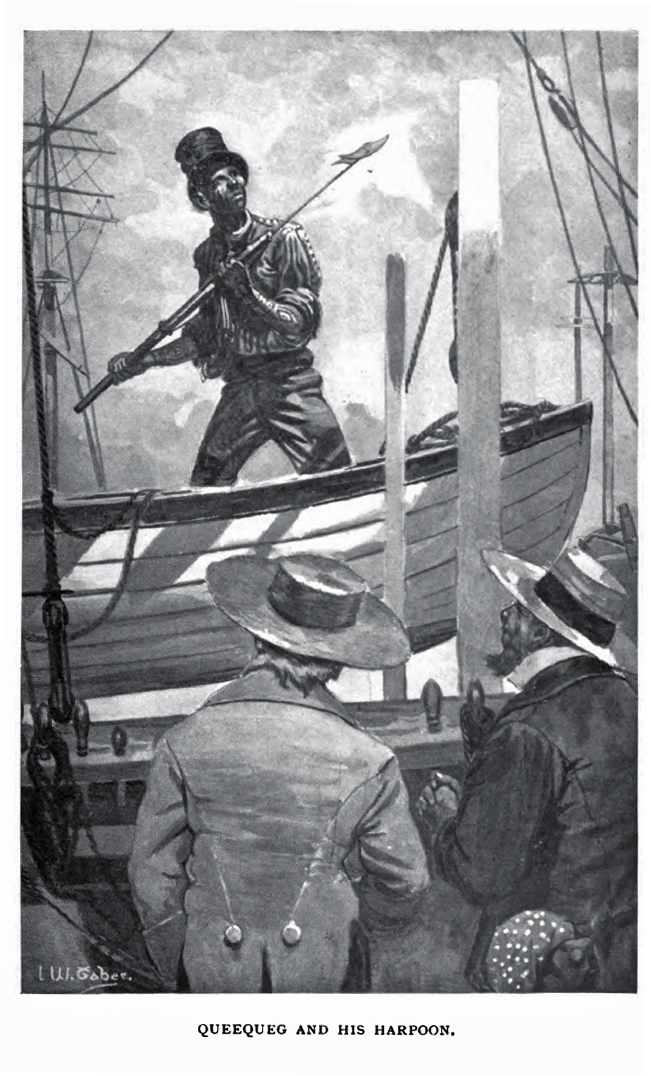
“The American Indian has since been idealized in this fashion throughout history,” notes Cotton, “and most notably in literature during the nineteenth century, including in James Fenimore Cooper’s Leatherstocking Tales, with its noble descriptions of chief Chingachgook and his son Uncas, Herman Melville’s Moby Dick, featuring Queequeg, and Daniel Defoe’s Robinson Crusoe, containing Crusoe‘s companion, Friday” (Cotton, op cit., p. 30). Not to mention Tonto, Chief Bromden in One Flew Over the Cuckoo’s Nest, Chief Dan George in Little Big Man, or Nobody in the recent Jarmusch film Dead Man.
Queequeg
In plain English, Indians have been traditionally venerated in the American, Canadian, and European mind, so long as that mind finds itself in a parlour. They are not now, and have never been, discriminated against; the discrimination has always been in their favour. While black Americans for many years wanted nothing so much as an end to segregation, and to fit in to the mainstream society, Indians saw the same proposal, offered to themselves, as an alarming loss of status.
So, no doubt, would the Queen of England.
If they have nevertheless been at times described as bloodthirsty savages, this can more easily explained not by prejudice, but by the fact that they were, at times, bloodthirsty savages.
Here are some European-invented “bloodthirsty savages” for you:
“Slowly the ship comes in, nearer and nearer the little wharf. Now, with a heavy swash of water and a boom, she touches; out jump her sailors to fasten her ropes.
But hark! what noise is that? It is the Indian war-whoop. And see! down rush the Indians themselves, yelling and brandishing their tomahawks. In an instant they have boarded the vessel. Down into the hold they go, yelling and whooping at every step.
The terrified sailors stand back aghast. Out they come again, lugging with them their heavy chests of tea.
Still they yell and whoop; and over go the chests into the dark water below.
And now, when every chest is gone, suddenly the Indians grow very quiet; they come off from the deck; and, orderly, take their stand upon the wharf; then do we see that they were not Indians at all. They were only men of Boston disguised.
This then was the Boston tea-party, which took place in Boston Harbor on the evening of December 16, 1773. (Pratt, Mara L., American History Stories, Volume II, 1908, pp. 30-31).
Many of us have heard the tale, of the first stirrings of the American War of Independence.
But did you ever wonder why the disaffected colonials dressed up as Indians?
For the same reason the Cleveland baseball club does.
Americans in general, and Canadians just as much, far from seeing the Indians as a despicable underclass of horrible others, have always wanted to identify themselves with them. The Europeans were the bad guys. As for we colonials, nobody here but us innocent, freedom-loving Indians.
Donald Grinde and Bruce Johansen, in their book, Exemplar of Liberty: Native America and the Evolution of Democracy, devote an entire chapter to analyzing why the Sons of Liberty used Mohawk disguise. “The Mohawk image,” they conclude, “was emerging as a revolutionary symbol of liberty in the new land, long before Uncle Sam came along. The resort to Indian guise was not seen only in Boston, but at similar protests up and down the Atlantic coast. One unit of the Sons of Liberty called themselves the ‘Mohawk River Indians.’” Mock Indians burned the British ship Gaspee in June of 1772. Some anti-British proclamations distributed by the patriotic groups were signed “The Mohawks.” (Grinde, Donald A.; Johansen, Bruce E [1991] Exemplar of Liberty: Native America and the Evolution of Democracy).
Bloodthirsty savages
Notice the eagle on the Great Seal of the United States—arguably an Indian symbol. And note the arrows he holds in his left talon. Is it Indian inspired? I don’t know: flip a coin. Wait—isn’t that an old Indian-head penny? No, my mistake. It’s an Indian-head nickel.
In October 1988, the U.S. Congress passed Concurrent Resolution 331, to formally recognize the influence of the Iroquois Constitution (the Great Law of Peace) upon the American Constitution and Bill of Rights. This seems highly dubious; if you actually read accounts of the (oral) Iroquois Constitution, it is hard to find anything in it that resembles the US Constitution. But it seems to be something everyone wants to believe. It makes Americans, symbolically, the descendants of the Indians.
Hence, symbolically, American “freedom,” freedom from the commands of Keats’ pale kings and princes, from the baggage of the “Old World.” The British are the oppressive Europeans, the Americans the free and brave Indians.
Canadians, of course, traditionally disagree. Americans north of 49 are the oppressive Europeans. Canadians are the true successors to the Indians. Were we not the allies of Tecumseh and Joseph Brant? Did we not give sanctuary to Sitting Bull? If we live in the West, do we not consider Louis Riel our spiritual father? If we live in the Quebec, did we not grow up with tales of the lovely Indian maiden Kateri Tekakwitha?
Devotional image of St. Kateri Tekakwitha
There are two great American founding myths. Both intimately involve native people. One is the story of the first Thanksgiving, of union and amity between the new settlers and the native people, the natives passing on their wisdom. The other is the story of Pocahontas.
Here it is from a nineteenth-century children’s history book:
“Two large stones were placed in front of Powhatan and Smith was pinioned, dragged to the stones, and his head placed upon them, while the warriors who were to carry out the sentence brandished their clubs for the fatal blow. One of the daughters of Powhatan, named Matoa, or Pocahontas, sixteen or eighteen years old, sprang from her father's side, clasped Smith in her arms, and laid her head upon his. Powhatan, savage as he was, and full of anger against the English, melted at the sight. He ordered that the prisoner should be released, and sent him with a message of friendship to Jamestown. (Mann, Henry, The Land We Live In: The Story of Our Country, 1896).
And from the early twentieth century:
“A few days afterward, Captain Smith was brought before Powhatan and his braves. A big stone was brought and laid on the ground in the chief's wigwam. Powhatan again sat on his throne of furs, and his warriors stood round in a circle. They looked fierce in their war paint. They were eager for the white man's death. The prisoner's arms were tied behind him. His head was laid on the stone. An Indian brave stood ready with his war club. The club was raised to strike. A scream was heard, and in rushed Pocahontas and threw herself on the captive.
‘Kill me,’ she cried, ‘kill me, but you shall not kill him.’
The Indian did not dare to strike. He would have killed his chief's beloved daughter. The heart of the Indian chief was touched. Of all his children, he loved her best.” (Blaisdell, Albert E., and Francis K. Ball, The Child's Book of American History, Boston: Little, Brown, and Company 1923 , p. 32-3).
There is slim evidence that the scene actually happened. But it is cherished, because it says something important about the natural man, or natural woman: that she is innately good, that her most basic instinct is love. Trouble only comes with growing up.
We want that to be true. It reflects well on all of us. The archetype of the Indian princess, the Pocahontas myth, represents this hope.
Ever since, it has been a mark of nobility in Virginia to claim direct descent from Pocahontas. Charles Dudley Warner, writing in 1881, speaks of "the natural pride of the descendants of this dusky princess who have been ennobled by the smallest rivulet of her red blood" (The Story of Pocahantas). Two American first ladies have claimed such descent: Edith (Woodrow) Wilson and Nancy Reagan.
In North America, in short, to be Indian is to be nobility. Johnny Cash and Jessica Alba were publicly disappointed to discover they had no Indian blood, contrary to their family traditions. Elvis always insisted he did.
In Canada, this eternal desire to assume Indian identity is well-represented recently by John Ralston Saul’s essays arguing that Canada is ultimately a “Metis nation.” “Canada’s founding rationale and ongoing purpose in the world is to serve as a bulwark against the American steamroller of technology, capitalism and individualism” (Andrew Potter, “Are We a Metis Nation?” Literary Review of Canada, April, 2009). We hosers are the noble savages; the Americans represent the evils of plutocratic civilization. Saul argues that the “single greatest failure of the Canadian experiment, so far, has been our inability to normalize—that is, to internalize consciously— the First Nations as the senior founding pillar of our civilization.” To Saul, “single-payer health care, environmental protectionism, peacekeeping, soft power diplomacy, even the egalitarian elements of the Charter of Rights and Freedoms—these all supposedly bear the unmistakable stamp of aboriginal ideas and influences.” All the great virtues of the Canadian personality are owed to the country’s Métis character, and so our “desire for harmony and balance, our preference for diversity, inclusion and complexity, our renewed interest in egalitarianism—all are emanations of our aboriginal soul” (LRC).
Remarkable how like the Americans we are in our founding myth. Odd that we evolved to so many opposite conclusions about our Indian heritage. To Americans, being Indian means rugged individualism and personal freedom. To Saul, it means communitarianism, keeping everyone equal, and individualism is from the polluting civilization.
Put an Indian face on it, and any ideology at all sounds more plausible.
Sacagawea intrepidly guiding Lewis and Clark
Sacagawea is the second great American historical myth of the aboriginal princess. She gets to be on the dollar coin, after all – rather like the Queen in Canada. Although she is of course not the first Indian to feature on the coinage. She is commonly credited with guiding Lewis and Clark to the Pacific.
This is almost certainly not true. According to the expedition’s records, she gave directions in only a few instances. Her principal value to the expedition was probably her mere presence, because it suggested to the various native groups the peaceful intent of the expedition.
Nevertheless, her part has been lionized and widely commemorated because it fits with the desired American archetype of the good-hearted and wise Indian princess, especially as a founder figure.
The myth has continued to play out throughout American literature.
The first really popular American novel had an Indian in its title: James Fenimore Cooper’s Last of the Mohicans, 1826. And the eponymous Indian was certainly of the noble savage tribe—literally a noble in Indian terms, the son of a chief and last of his noble line.
"Uncas ... clearly demonstrates a noble and chivalrous nature toward Cora Munro, his unrequited love” writes William Starna. “He dies stoically and with honor at the hands of Magua after Cora is killed by another Huron" (William A. Starna, “Cooper's Indians: A Critique,” [SUNY Oneonta] Originally published in James Fenimore Cooper: His Country and His Art, Papers from the 1979 Conference at State University College of New York, Oneonta and Cooperstown. George A. Test, editor, pp. 63-76).
Nor is Last of the Mohicans Cooper’s only tale of a noble savage. “James Fenimore Cooper was well known,” writes Lacy Cotton, “for his sympathetic opinion of Native Americans in his writing” (op cit., p. 65).
“Cooper's The Pioneers (1823), ... is set in the twilight of rural 18th century central New York where the frontier has now moved West beyond them; the beautiful wilderness replaced by orderly farms. Cooper's ‘civilization,’ however, is prone to irrational, sinful destruction of nature. The townsfolk's slaughter of the wild animals is well beyond any safety or economic justification. In one scene, the hero character of Natty Bumppo, whose legendary wilderness skills and attitudes were honed through his intimate contact with nature and Indians, is appalled at their employment of a cannon to bring down a massive flock of migrating pigeons. Bumppo criticizes the ‘wasty ways’ of so-called civilization and says it's a sin to kill more than one can eat. Meanwhile, the noble Indians struggle to understand and accept the ‘order’ imposed on them in the form of strict hunting laws.”
Unlike his hero Natty Bumppo, Cooper had little intimate contact with nature or Indians. This no doubt helped his characterization immeasurably.
“Chingachgook is first introduced (in the arrangement of the book order) in The Deerslayer (1841) as Natty Bumppo‘s traveling companion and adopted brother. His presence is representative of nature, and natural living, and he is often contrasted against the actions of other white characters like Harry March. One of the most poignant scenes in the novel takes place in chapter thirty-two, where Natty Bumppo stands between two trails, that to the garrison, and that to the village of the Delawares. Waiting in one direction are Chingachgook and Hist-Oh!-Hist, and in the other, Judith, Captain Warley, and the settlement troops. Natty Bumppo is faced with the choice of moving on into the wilderness with the Indians or devoting himself to Judith and leading a domestic, civilized life with her. Ultimately, he chooses to go with Chingachgook and Hist-Oh!Hist, metaphorically rejecting white civilization and choosing the life of the Noble Savage for himself as well” (Cotton, p. 43-44).
This is the ultimate American road less travelled. The “Last Mohican” of the book title may not, in the end, be Uncas. For Natty Bumppo too is a Mohican. He is Uncas’s adopted uncle, brother of Chingachgook, and he has symbolically chosen the Indian way of life. The “Last of the Mohicans, the inheritor of the Indian ways, may as well be understood to be the American frontiersman. The cowboy.
The cowboy was never the enemy of the Indian. He was his cultural descendant and adopted brother. Both literary stock characters stood for a primitive freedom against encroaching settlement. Both must be understood, following the Eden convention, as people of the lost golden age, always riding off into the sunset, always the last of their kind, or even already extinct, beings of a more wonderful past. The Old West is almost dead, and it always was. Innocence by its nature, like virginity, like childhood, must be under dire threat. We grow up. Damn.
The noble savage has remained at the noble and savage heart of American literature. In 1826, actor Edwin Forrest took out an advertisement in the New York Critic newspaper offering $500 “to the author of the best tragedy, in five acts, of which the hero … shall be an aboriginal of this country.” The winner was Metamora; or the Last of the Wampanoags. It became the first great American stage sensation.
Washington Irving was another loyal fan of the Noble Savage. In “The Trait of the Indian Character,” 1819-20, he wrote,
“The current opinion of the Indian character, …., is too apt to be formed from the miserable hordes which infest the frontiers and hang on the skirts of the settlements. These are too commonly composed of degenerate beings, corrupted and enfeebled by the vices of society without being benefited by its civilization…. Poverty, repining and hopeless poverty, a canker of the mind unknown in savage life, corrodes their spirits and blights every free and noble quality of their natures.”
Noble—nature. Note the inevitable juxtaposition.
“How different was their state,” he continues, “while yet the undisputed lords of the soil! Their wants were few, and the means of gratification within their reach. They saw everyone around them sharing the same lot, enduring the same hardships, feeding on the same aliments, arrayed in the same rude garments. No roof then rose but was open to the homeless stranger; no smoke curled among the trees but he was welcome to sit down by its fire and join the hunter in his repast. ‘For,’ says an old historian of New England, ‘their life is so void of care, and they are so loving also that they make use of those things they enjoy as common goods, and are therein so compassionate that rather than one should starve through want, they would starve all; thus they pass their time merrily, not regarding our pomp, but are better content with their own, which some men esteem so meanly of.’ Such were the Indians while in the pride and energy of their primitive natures they resembled those wild plants which thrive best in the shades of the forest but shrink from the hand of cultivation and perish beneath the influence of the sun.”
Cruel civilization crushes these innocent blossoms of the forest.
Note too that Irving presents this, in 1819, as the modern revisionist view of the Indians. Yet he is able to quote the same view already from an “old historian.” Being new is part of the myth, not the reality.
In a sense, however, Irving at least is right; the period before his own was dominated by the “captivity narrative,” which usually documented Indian cruelty to European captives. But there is a crucial difference: the authors of the original captivity narratives were writing from personal experience. Irving had little firsthand knowledge of actual Indians. His Indians were literary Indians, and literary Indians have always been noble savages.
Longfellow's Minnehaha: Another Indian Princess
To be fair, there was also a backlash to Irving’s and Cooper’s depiction of the native American. Some then still had experience of real Indians living outside the settled lands. This backlash was the far less well-remembered novel Nick of the Woods, published in 1837 by Robert Bird. Its Indians were indeed more savage than noble, at least in the eyes of Bird’s protagonist. However, this was hardly an established motif of the time: rather, according to his preface, Bird wrote the book in rebuttal of Cooper.
“At the period when Nick of the Woods was written,” Bird explains, “the genius of Chateaubriand and of Cooper had thrown a poetical illusion over the Indian character; and the red men were presented—almost stereotyped in the popular mind—as the embodiments of grand and tender sentiment—a new style of the beau-ideal—brave, gentle, loving, refined, honourable, romantic personages—nature's nobles, the chivalry of the forest.”
Bird was not trying to malign Indians, but simply to present a more realistic portrait. “It may be submitted that such are not the lineaments of the race—that they never were the lineaments of any race existing in an uncivilised state—indeed, could not be—and that such conceptions as Atala and Uncas are beautiful unrealities and fictions merely, as imaginary and contrary to nature as the shepherd swains of the old pastoral school of rhyme and romance; at all events, that one does not find beings of this class, or any thing in the slightest degree resembling them, among the tribes now known to travellers and legislators.”
“The Indian is doubtless a gentleman,” Bird allows; “but he is a gentleman who wears a very dirty shirt, and lives a very miserable life, having nothing to employ him or keep him alive except the pleasures of the chase and of the scalp-hunt—which we dignify with the name of war. The writer differed from his critical friends, and from many philanthropists, in believing the Indian to be capable—perfectly capable, where restraint assists the work of friendly instruction—of civilisation: the Choctaws and Cherokees, and the ancient Mexicans and Peruvians, prove it; but, in his natural barbaric state, he is a barbarian—and it is not possible he could be anything else. The purposes of the author, in his book, confined him to real Indians. He drew them as, in his judgment, they existed—and as, according to all observation, they still exist wherever not softened by cultivation,—ignorant, violent, debased, brutal; he drew them, too, as they appeared, and still appear, in war—or the scalp-hunt—when all the worst deformities of the savage temperament receive their strongest and fiercest development.”
Bird was quickly condemned for this assertion and this depiction at the time, and has been condemned for it ever since. This may be why he is far less well-remembered than Irving or Cooper. His preface goes on to say: “Having, therefore, no other, and certainly no worse, desire than to make his delineations in this regard as correct and true to nature as he could, it was with no little surprise he found himself taken to account by some of the critical gentry, on the charge of entertaining the inhumane design of influencing the passions of his countrymen against the remnant of an unfortunate race, with a view of excusing the wrongs done to it by the whites, if not of actually hastening the period of that ‘final destruction’ which it pleases so many men, against all probability, if not against all possibility, to predict as a certain future event.”
This idea of the Indian’s inevitable final disappearance, of course, has not happened: Bird, and not Cooper or Irving, has proven more prescient here. The idea of the inevitable passing of the Indian is, in the end, an aspect of the noble savage myth. Eden and the Golden Age, like childhood, must by their nature be lost forever in order to be truly romantic and real to the imagination; just as Swift’s Lilliput or Brobdingnag must not be found on any conventional charts. The noble savagists cannot, in the end, as Bird rightly saw, allow the Indian into the modern world. They must forever be picturesquely dying, or already dead.
Bird does not say that Indians are evil, but rather draws a fictional portrait of a man who does. A not-uncommon sentiment, Bird says, among those who had dealt with real wild Indians before the cruel influence of civilization blasted these innocent forest flowers. “No one conversant with the history of border affairs,” Bird writes, “can fail to recollect some one or more instances of solitary men, bereaved fathers or orphaned sons, the sole survivors, sometimes, of exterminated households, who remained only to devote themselves to lives of vengeance; and ‘Indian-hating’ (which implied the fullest indulgence of a rancorous animosity no blood could appease) was so far from being an uncommon passion in some particular districts, that it was thought to have infected, occasionally, persons, otherwise of good repute, who ranged the woods, intent on private adventures, which they were careful to conceal from the public eye.”
“The author remembers,” the author continues, “in the published journal of an old traveller … who visited the region of the upper Ohio towards the close of the last century, an observation on this subject, which made too deep an impression to be easily forgotten. It was stated, as the consequence of the Indian atrocities, that such were the extent and depth of the vindictive feeling throughout the community, that it was suspected in some cases to have reached men whose faith was opposed to warfare and bloodshed.”
Bird himself did not believe that Indians were in any way inferior or depraved. They simply behaved as their unfortunate condition, a war of all against all, required of them. It was the Romantics, he insisted, who saw Indians as inferior, as bestial.
Nevertheless, this seems to have been a rare and futile kick against the pricks already by the early nineteenth century.
Like the first widely popular play, the first musical score published in America was about Indians, and presented from the Indian perspective: “The Death Song of an Indian Chief,” released in March 1791 in the Massachusetts Magazine (Cotton, op cit., p. 5).
It was always, after all, the proper business of Indians to be romantically dying.
“Romanticizing the Indian dominated western fiction and poetry between 1800 and 1830,” writes Cotton. “Titles such as Frontier Maid; or, the Fall of Wyoming (1819); Logan, an Indian Tale (1821); The Land of Powhatten (1821); and Ontwa, Son of the Forest (1822), all portrayed dramatically idealized Indians that fit into the Noble Savage definition. …. By 1830 the theater was dominated by ‘Indian’ plays, that heavily featured the Noble Savage motif. … [O]n stage in 1893 was Belasco and Fyles‘s play, ‘The Girl I Left Behind Me,’ which victimized innocent Indians at the hands of corrupt white culture” (Cotton, p. 6). Or rather, portrayed Indians as victimized at the hands of corrupt white culture.
So too among Canadian writers. Adam Kidd, in 1830 Montreal, wrote the long poem, “The Huron Chief,” featuring the lines
Undisturbed as the wild deer that strays o’er the mountain,
Or lily that sleeps in its calm liquid bed,
In that arbour of green, by the gush of the fountain,
Oft, oft has my Huron there pillowed his head.
But the hand of the white man has brought desolation —
Duncan Campbell Scott, Confederation poet, is often criticized for showing traditional Indian life as difficult; he was with the Bureau of Indian Affairs, and knew something of real Indians. Nevertheless, his poetry shows the marks of the Noble Savage myth. In “On the Way to the Mission,” he tells the story of a lone Indian shot dead by Europeans, the “whitemen servants of greed,” in order to steal his sled-load of furs.
Pauline Johnson recites
And then there are Grey Owl, Pauline Johnson, and Emily Carr, aka “Klee Wyck.” Johnson claimed to be a native princess, and recited in Indian dress. Farley Mowat made his literary reputation with People of the Deer (1952), about the Inuit. It was sympathetic to the native people, highly critical of the government, the Hudson’s Bay Company, and Western civilization generally. “It’s the story,” explains Craig MacBride in the Toronto Review of Books, “of white people disrupting and ruining Indigenous culture” (March 15, 2013). Marketable. Unfortunately, there are charges that Mowat made most of his stuff up.
In Canada, claiming to be Indian or an adopted Indian has plainly always been a good career move in the arts.
Throughout the nineteenth, and into the twentieth, centuries, one of the most popular forms of entertainment throughout North America was the Indian medicine show. Indians, again, were shown to the rubes in a completely favourable light. The success of the enterprise depended, after all, on the general prejudice that Indians could not tell a lie. Accordingly, if they said a patent nostrum worked, it must work. “The Noble Savage‘s determining features,” notes Cotton in another context, “included a harmony with nature coupled with a moral innocence and inability to lie” (Cotton, p. 30).
We see the same prejudice in the naive acceptance by the Canadian courts of Indian “oral tradition” as of equal weight with written and signed treaties. We see it in the acceptance of “victim” statements without any further corroborating evidence by the Truth and Reconciliation Commission. If an Indian says it, it must be true.
Were little white children once taught to see the Indians as bloodthirsty savages? Here is how an Ontario school history book of 1879 introduces them: "They were bold and cunning, generous to their friends, but bitterly revengeful to their foes. There were, however, some great chiefs among them, who were noted for their love of the people, their honesty, and their kindness to enemies (Jeffers, J. Frith, History of Canada, 1879, p, 4). Said chiefs are not identified; we are left to speculate.
Of course, Canadian kids did once play that notoriously racist old game of cowboys and Indians. But consider: in order for it to work, roughly half of the kids must always have wanted to be Indians.
Nor were literary cowboys and Indians enemies by nature: they were brothers, like Uncas and Natty Bumppo, like Tonto and the Lone Ranger. If cowboys sometimes fought with Indians, this was the Indian way. Just as cowboys fought with cowboys, in their shoot-outs, and Indians fought with Indians, the Iroquois with the Huron, the Cree with the Blackfoot, the Huron with the Mohicans. It was the inevitable logic of life beyond police patrol and government control, and it was, in fictional form, as fun as any Tom and Jerry cartoon. The cowboy was the European Indian—the free man, the wanderer, living by his own code of honour outside the law.
The traditional image of the cowboy, and the original Western, began with dime novels in the second half of the 19th century. And the dime novels themselves began with tales of Indians. Only later did the cowboy emerge as a subject of similar interest to the same readership.
The first dime novel ever was Malaeska, the Indian Wife of a White Hunter (1860). Its vision of Indian life, as first presented to the reader, is plainly romantic:
“wigwams might be seen through a vista in the wood. One or two were built even on the edge of the clearing; the grass was much trampled around them, and three or four half-naked Indian children lay rolling upon it, laughing, shouting, and flinging up their limbs in the pleasant morning air. One young Indian woman was also frolicking among them, tossing an infant in her arms, caroling and playing with it. Her laugh was musical as a bird song, and as she darted to and fro, now into the forest and then out into the sunshine, her long hair glowed like the wing of a raven, and her motion was graceful as an untamed gazelle. They could see that the child, too, was very beautiful, even from the distance” (p. 10).
Like an untamed gazelle: Malaeska is the familiar archetype of the innocent and good-hearted Indian princess, representing an imagined purity of nature. “[H]er untutored heart, rich in its natural affections, had no aim, no object, but what centered in the love she bore her white husband. The feelings which in civilized life are scattered over a thousand objects, were, in her bosom, centered in one single being; he supplied the place of all the high aspirations – of all the passions and sentiments which are fostered into strength by society” (p. 31-32). Pure of heart, in other words; here as the story progresses ruined by contact with the evil Europeans and their civilized prejudices.
The same motif is soon reprised in The Frontier Angel (1861), its topic an Indian maiden’s “suffering and devotion.” This was followed in turn by King Barnaby or The Maidens of the Forest: A Romance of the Micmacs (1861). Oonomoo the Huron came in 1862, plus a romance, Ahmo’s Plot, or The Governor’s Indian Child, based on the premise that Count Frontenac took an Indian wife, the daughter, of course, of a chief. Laughing Eyes, in 1863, reverses the stock situation; it has a European maiden falling in love with an Indian prince. Mahaska, the Indian Princess tells the continuing story of Frontenac’s supposed half-Indian daughter, her mother having died “of a broken heart, as we see forest birds perish in their cages.”
Obviously, the fallout from the residential schools was not the first time we conceived the idea that exposure to European civilization was harmful to native people.
The Indian Princess was soon succeeded, logically enough, by The Indian Queen, purportedly the story of Mahaska become the Queen of the Senecas. In 1869, Border Avengers, or The White Prophetess of the Delawares, announced an upcoming series on Wenona, the Giant Chief of St. Regis, including Silent Slayer, or The Maid of Montreal, and Despard the Spy, or the Fall of Montreal. Despard, a European, was the villain. Wenona, of course, a Mohawk, was the hero.
Over time, the frontier of romance, to remain plausible, had to move west. The Lone Chief or the Trappers of the Saskatchewan (1873) tells of Chief Blackbird. It is a tale that “awakens our warmest admiration”; its heroine is a “strangely beautiful” Cree girl. This was quickly followed by Old Bear Paw the Trapper King, or The Love of a Blackfoot Queen.
Indian princesses everywhere populated the West. Virginally.
Buck Taylor
In 1887, Henry Nash Smith, Beadle Dime Novels editor, hit upon the idea of the cowboy hero to add to the now-traditional Indian. He published a fictionalized biography of the real star of Buffalo Bill’s Wild West Show, Buck Taylor (William Levi Taylor). The literary Taylor, the original cowboy, reveals his true lineage in his origin story: he is first captured by the Comanches, then eventually freed by an Indian friend. It is like a second birth, as an adopted Indian, in the mold of Natty Bumppo.
And the cowboy, in turn, is the essential image, at home and abroad, of the American character. He is the American hero.
The Wild West Show as popular entertainment followed more or less the same evolution: the first Wild West shows, organized by artist George Catlin to tour the US and Europe, featured only Indians. Buffalo Bill Cody hit upon the idea of adding “cowboys,” Europeans who lived on the frontier and adopted many of the Indian ways, to the shows. While the Indians were spectacle enough in themselves, by doing this, he could add displays of trick shooting, horsemanship, roping, and other talents more easily found among the pool of European-Americans. Visiting Europe, the “cowboys” made a point of sleeping outdoors, like the Indian performers. They were, after all, children of nature.
In novels, the Western genre truly came into its own with the full-length yarns of Zane Grey. And, like his predecessors, Grey was a faithful acolyte of the noble savage. "His respectful treatment of Indians,” boasts the Zane Grey West Society web page, “was ahead of its time."
Yep. Always was, always is.
Among other treatments, Grey wrote The Vanishing American, obviously sympathetic to the eternally dying Indians.
“In his 1910 novel, Heritage of the Desert,” similarly, “Grey idealizes the Navajo people, particularly the Chief Eschtah” (Cotton, p. 47).
“This pattern of victimizing [sic] the Noble Savage continues in Grey’s novel, The Rainbow Trail (1915). In this story, yet another female Indian named Glen Naspa is seduced and assaulted by a white missionary” (Cotton, p. 48). The Vanishing American, similarly, features “lecherous and greedy ministers” who “oppose noble and good Indians that honor the nation by participating in World War I” (Cotton, p. 51).
Sound familiar? The missionary is the inevitable fall guy in the noble savage myth, because he introduces the idea of original sin.
In the same novel, “Shefford... discovers [an] Indian woman in her home, having died in childbirth, and his guilt over the tragedy leads him to feel something of the white man’s burden of crime toward the Indian weighing upon his soul.” “Grey,” Cotton adds, “was not the only author to use this method of victimizing [sic] an Indian woman and orchestrating her death as a metaphor for the ruthless cruelty of white culture” (Cotton, p. 49).
“The roots of this imagery,” Cotton goes on, “can be traced back as far as the 1890s, when David Belasco and Franklin Fyles wrote the play “The Girl I Left Behind Me.” This story of an Indian uprising involves a maiden named Fawn Afraid, whose involvement with white culture ultimately leads to her death” (Cotton, p. 49).
“Fawn Afraid”? You have to love it.
But Cotton is significantly wrong here. The imagery of the innocent Indian maiden being destroyed by contact with white culture is not from some play in the nineteenth century. It is an essential element of the Indian princess myth, going back to Greek mythology and Kore/Persephone. We have already seen it many times.
The popularity of the cowboy novel has, of course, spread beyond North America. When the Americans occupied Germany at the end of World War II, they were amused to find the Germans entirely wrapped up in the romance of the old frontier—as they largely remain today.
This is mostly due to Karl May, probably the most popular novelist in the German language, who specialized in “Western” stories.
But note that on May’s frontier, as in the early dime novels, the central hero is an Indian, not a cowboy: Minnetou, the “wise chief of the Apaches.” “Old Shatterhand,” the cowboy figure, is like Bumppo or the Lone Ranger his “blood brother.”
According to Anthony Grafton, writing in the New Republic, May always depicted Native Americans as “innocent victims of white law-breakers.” He had much that was unflattering to say about Jews, the Irish, the Chinese, blacks, and Armenians; but never about Native Americans.
Why were Indians special? “His readers longed to escape from an industrialized capitalist society,” writes Grafton, “an escape which May offered” (Grafton, “Mein Buch,” The New Republic, December, 2008). The noble savage, exactly.
Grafton points out that Karl May and his Western adventures were special favourites of Adolf Hitler. “Hitler later recommended the books to his generals and had special editions distributed to soldiers at the front, praising Winnetou as an example of ‘tactical finesse and circumspection’" (Grafton, op cit.). “The fate of Native Americans in the United States was used during the world wars for anti-American propaganda,” writes Frederic Morton in the New York Times. “The National Socialists in particular tried to use May's popularity and his work for their purposes” (Morton, Tales Of The Grand Teutons: Karl May Among The Indians. The New York Times, 4 January 1987).
This should not surprise us. The cult of the noble savage always had Nazi-esque overtones. Like Nazism, it was a cult of nature and the natural man. Like Nazism, it believed in a mystic oneness of the “volk” with the ancestral land and the landscape. Foreigners were not welcome. Like the Nazis, it believed in the value of racial and cultural “purity.” The evil forces of “cosmopolitanism” were simply transferred by the Nazis from May’s encroaching European plutocrats to the capitalist, cosmopolitan Jews.
But what about the movies? What about Hollywood? Surely here, at least, the racist stereotype of the bloodthirsty Indian descending on the helpless wagon train ruled supreme? As we have read, “One of the main problems with the earlier Westerns is that they painted the Native Americans into the stereotypical savage who was only out to rape, pillage, and murder the white man” (Clay Upton, Stereotyping Indians in Film, http://clioseye.sfasu.edu/Archives/Main%20Archives/Stereotyping%20Indians%20in%20Film%20(Upton).htm). Up until “Little Big Man,” or “Dances With Wolves,” wasn’t the story always at the very least told from the point of view of the white man?
Anyone is free to believe that. So long as they have never seen a Western.
The very first Western movie with a narrative that featured Indians is told from the supposed Indian perspective: "The Red Man's View," 1909, by D.W. Griffith. According to a review of the day, the film is about "the helpless Indian race as it has been forced to recede before the advancing white, ... full of poetic sentiment" (NY Mirror, Thomas Cripps, Hollywood's High Noon: Moviemaking and Society Before Television, JHU Press, 1997, p. 27).
Make no mistake: white people are the villains, and D.W. Griffith is rarely ambiguous about such things. They repeatedly drive the Indians off their land and, of course, abduct a poor defenseless Indian princess.
Pocahontas, 1910
A classic treatment of the prototypical Pocahontas appeared in 1910, and a second version in 1911. In 1912 came “The Heart of an Indian Maiden” (YouTube: https://youtu.be/-kVKKEEiJR0) and “The Invaders”-- said invaders, of course, being the Europeans. In the latter movie, according to IMDB, "the U.S. Army and the Indians sign a peace treaty. However, a group of surveyors trespass on the Indians' land and violate the treaty. The army refuses to listen to the Indians' complaints, and the surveyors are killed by the Indians."
Also in 1912 came “A Temporary Truce”: “three malicious drunks have just killed an Indian, solely to amuse themselves. When Jim abducts the prospector's wife, and takes her to a remote place, he soon afterwards encounters a party of angry braves seeking revenge" (IMDB).
Yes, you see fights between cowboys and Indians—but the cowboys are always to blame.
D.W. Griffith’s “The Battle of Elderbush Gulch” (1913) (Internet Archive, https://archive.org/details/TheBattleOfElderbushGulch) is sometimes cited as an example of the contrary, bloodthirsty savage image of Indians. But their offense in the film is not that great. They try to eat a couple of dogs, hungry and not knowing this is taboo among whites, and are shot dead for it. A battle ensues.
Who here is being portrayed as bloodthirsty?
One might expect that a film called “The Indian Wars Refought,” filmed with the cooperation of the US government, might offer a more balanced account, if not an outright tribute to the US Army.
We will never know. The film was suppressed, claims Wikipedia, by the US government, and all copies disappeared. Reputedly, this was because it turned out to be too awkwardly pro-Indian and anti-US government, during a period of wartime censorship (IMDB; Larry Langman, Larry, American Film Cycles: The Silent Era. Greenwood Publishing Group [1998]).
In 1922, Canada produced what is commonly cited as the first ever feature-length documentary film. That would be “Nanook of the North,” a sympathetic portrayal of the life of an Inuit hunter. Roger Ebert calls it “alone in its stark regard for the courage and ingenuity of its heroes" (Ebert, Roger [2005-09-25] "Nanook of the North [1922]," Chicago Sun Times). Another “revisionist” view of aboriginal Canada; as they all are.
“They Died With Their Boots On,” 1941, again tells the story of the Indian Wars, culminating in the Battle of Little Big Horn. But, again, white men are clearly blamed: “The battle against Chief Crazy Horse is portrayed as a crooked deal between politicians and a corporation that wants the land Custer promised to the Indians.” “A letter left behind by Custer, now considered his dying declaration, names the culprits and absolves the Native Americans of all responsibility; Custer has won his final campaign.” (Wikipedia) It has to be so; if the Indians were guilty of anything, it would not be a satisfactory ending in the eyes of an American audience.
Of course, many may argue that this is simply telling it like it was—that the whites are fully responsible for the Indian wars, fought to take the Indian land. But was this true? Indians, after all, were always fighting one another. Why would they always make an exception of the white men?
“Sitting Bull,” 1954, was the first Western in CinemaScope. Again it was filmed from the Indian point of view. “When the white man wins,” the cinematic Sitting Bull complains, “you call it a victory; when the Indian wins, you call it a massacre.” This seems the eternal lament of the Hollywood Indian; but there never seems to have been a prior time during which everyone called the one a victory, or the other a massacre. It is simply part of the Noble Savage myth.
And then we had “Little Big Man”…
It is always possible, I suppose, that some day, someone actually will make an anti-Indian movie. Or write an anti-Indian novel.
Disney's animated musical romance Pocahontas is of course not academically sound history. Everybody knows that, right? On the other hand, it is no doubt an accurate measure of what the average modern Canadian actually believes, or is supposed to believe, about Indian culture. If they did not believe it before, having all seen Pocahontas, they probably believe it now. That is what propaganda is for.
It worked so well it was all done again, in blueface, as “Avatar,” and again broke the box office.
Pocahontas the movie sets the scene at its opening by firmly contrasting European and Indian cultural values. The English seamen, boarding their ship at the London docks, all sing of discovering gold in the New World—life success is material wealth. They place this concern above trivialities like ethics or brotherly love.
“I'm gonna get a pile of gold, build me a big house...
and if any Indian tries to stop me, I'll blast him.”
As soon as they land at Virginia, and before they attend to such trifling matters as building shelter or planting crops, they bring out the spades and start tearing apart the landscape.
Does this make sense? Aren't the Europeans acting like fools?
“Why, of course,” explains the villainous Governor Ratcliffe. “Let's not forget what the Spanish found when they came to the New World. Gold! Mountains of it! Why, for years they've been ravaging the New World of its most precious resources… But now it's our turn!”
Not subtle. But after all, they are cartoons.
The film then cuts away to Pocahontas's Powhatan tribe, living their peaceful daily lives in the as-yet-undiscovered Virginia countryside. They sing in chorus:
“Seasons go and seasons come.
Bring the corn and bear the fruit.
By the waters sweet and clean
Where the mighty sturgeon lives.
Plant the squash and reap the bean.
All the Earth our mother gives.
Oh, great spirit, hear our song!
Help us keep the ancient ways.
Keep the sacred fire strong;
Walk in balance all our days.”
Indian culture, unlike European, clearly believes in valuing the environment. The Earth is our mother; we do not dig up thre landscape. Our water is clean, and full of unmolested fish, and this is important to us. Why else would we have no factories? We keep to the balance of nature. Nature, of course, having a balance, rather like the scales of Justice. But Europeans, the blackguards, in stark contrast, an Indian shaman says at the council fire--or rather the fire itself shows it, to demonstrate its objective truth-- Europeans all “prowl the Earth like ravenous wolves… consuming everything in their path.” Not the good guys then--or The Three Little Pigs was only a damnable lie.
Later, Pocahontas accuses John Smith in song of believing, like all Europeans, that “The Earth is just a dead thing you can claim.”
Which, of course, it is. Gaea hypothesis to the contrary. But not hard to tell whose side you ought to be on, kids. Dead things are yucky.
And not at all a racist thing to say about Europeans, of course, because an Indian says it. Free pass.
Pocahontas, in contrast, being Indian, is friend to all the little forest creatures. Her buddies and boon companions are a raccoon and a hummingbird. She keeps regular council with a willow tree. It seems terrribly unlikely she would ever, for example, kill a living being.
And even the rocks and river are alive.
Hard to say what she eats.
Yes, we all know of the Indian love for nature and the land; it is what being Indian is all about. In popular culture it is a given. It is indeed the very basis on which we see Indians as having a continuing interest, rather like perpetual ownership, in the land, despite having legally quit their ''aboriginal claim” for due compensation one or several centuries ago. After all, they understand themselves to have a fiduciary responsibility to nature. To any Indian, the land is sacred. You cannot change that. Open a new mine within ninety kilometers of Attawapiskat, and, morally at least, you owe them compensation. As well as compensation to Fort Albany and Kaschewan First Nations, somewhat farther away.
Not, of course, that Indians care about money.
The Indian respect for nature is, of course, also a longstanding thing. It is the ancient tradition, as old as the sun and the stars, with us from the beginning of time. It comes with being “aboriginal.” After all, otherwise, why would being “aboriginal” be important? It means you belong to the land, and, by subtle corollary, it to you.
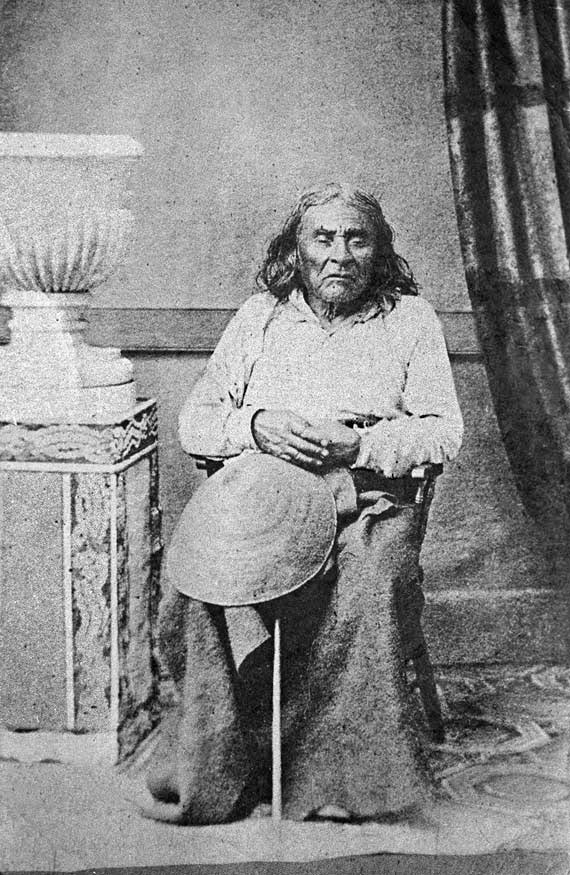
So, to make his ecological point, in his 1992 book Earth in the Balance, the celebrated Nobel laureate Al Gore quotes the speech of Squamish chief Seattle to US government representatives back in 1854. Aboriginal people are the established and known authorities on stewardship of natural resources. The same speech has also been quoted, to the same purpose, in Environment Canada's 1990 “Green Plan.” It was read publicly at the original Earth Day.
Chief Seattle, conservationist
Here is the common abridged version. It is helpful to remember the standard First Nations view.
"The President in Washington sends word that he wishes to buy our land. But how can you buy or sell the sky? The land? The idea is strange to us. If we do not own the freshness of the air and the sparkle of the water, how can you buy them?
[So there you have it—any sale of Indian land is only nominal. They still own it. Forever. And it is all Indian land.]
Every part of the earth is sacred to my people. Every shining pine needle, every sandy shore, every mist in the dark woods, every meadow, every humming insect. All are holy in the memory and experience of my people.
We know the sap which courses through the trees as we know the blood that courses through our veins. We are part of the earth and it is part of us. The perfumed flowers are our sisters. The bear, the deer, the great eagle, these are our brothers. The rocky crests, the dew in the meadow, the body heat of the pony, and man all belong to the same family.
The shining water that moves in the streams and rivers is not just water, but the blood of our ancestors. If we sell you our land, you must remember that it is sacred. Each glossy reflection in the clear waters of the lakes tells of events and memories in the life of my people. The water's murmur is the voice of my father's father.
The rivers are our brothers. They quench our thirst. They carry our canoes and feed our children. So you must give the rivers the kindness that you would give any brother.
If we sell you our land, remember that the air is precious to us, that the air shares its spirit with all the life that it supports. The wind that gave our grandfather his first breath also received his last sigh. The wind also gives our children the spirit of life. So if we sell our land, you must keep it apart and sacred, as a place where man can go to taste the wind that is sweetened by the meadow flowers.
[Prescient of him. He calls already, back in 1854, for national parks.]
Will you teach your children what we have taught our children? That the earth is our mother? What befalls the earth befalls all the sons of the earth.
[Say—I guess this should be taught in schools.]
This we know: the earth does not belong to man, man belongs to the earth. All things are connected like the blood that unites us all. Man did not weave the web of life, he is merely a strand in it. Whatever he does to the web, he does to himself.
One thing we know: our God is also your God. The earth is precious to him and to harm the earth is to heap contempt on its creator.
Your destiny is a mystery to us. What will happen when the buffalo are all slaughtered? The wild horses tamed? What will happen when the secret corners of the forest are heavy with the scent of many men and the view of the ripe hills is blotted with talking wires? Where will the thicket be? Gone! Where will the eagle be? Gone! And what is it to say goodbye to the swift pony and then hunt? The end of living and the beginning of survival.
[Always a lot of buffalo then around Seattle, on the Pacific Coast. The first transcontinental telegraph line was strung in 1861, seven years after Seattle spoke. He must have seen the plans.]
When the last red man has vanished with this wilderness, and his memory is only the shadow of a cloud moving across the prairie, will these shores and forests still be here? Will there be any of the spirit of my people left?
We love this earth as a newborn loves its mother's heartbeat. So, if we sell you our land, love it as we have loved it. Care for it, as we have cared for it. Hold in your mind the memory of the land as it is when you receive it. Preserve the land for all children, and love it, as God loves us.
As we are part of the land, you too are part of the land. This earth is precious to us. It is also precious to you.
One thing we know - there is only one God. No man, be he Red man or White man, can be apart. We are all brothers after all."
A stirring instance, surely, of the legendary Indian skill in oratory. It puts a human face on nature. And that human face is Indian.
One can also see here where the Indian world shown in Disney's Pocahontas came from—almost all in the words of this one brief passage. Even fairly incidental imagery. “Every humming insect”? Okay, that doesn't work. Little girls might find bugs creepy. But “humming”? Let's make it a hummingbird. “We know the sap that courses through the trees like we know the blood that flows through our veins”? Okay, have her talk to a willow tree as it if is her grandmother. It worked for Dorothy. The wind received our grandfather's last sigh? So, have Pocahontas's father say her mother's voice is always in the wind. “The bear, the deer, the eagle, are our brothers”? That almost sings. We're doing a musical. There has to be a song in that.
Awesome historical research.
There is much more evidence, in popular culture, of the Indian concern for nature and the land. In 1971, when the charity organization “Keep America Beautiful” wanted to put a human face on the value of picking up after yourself, they turned to “Iron Eyes Cody,” frequently Hollywood's go-to Indian actor, to shed tears on camera over littered paper. It became one of the best-known public service ads of all time.
The message was clear: every time you thoughtlessly litter, you make an Indian cry.
Nobody wants to make an Indian cry.
Did someone say something about guardian angels?
Well, every trope has to start somewhere, doesn't it?
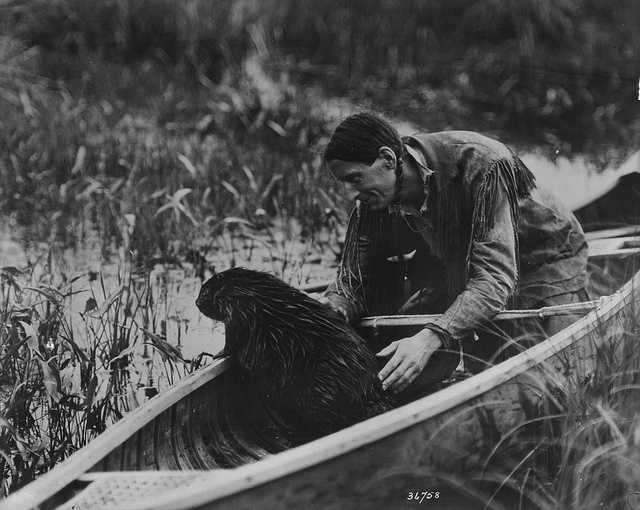
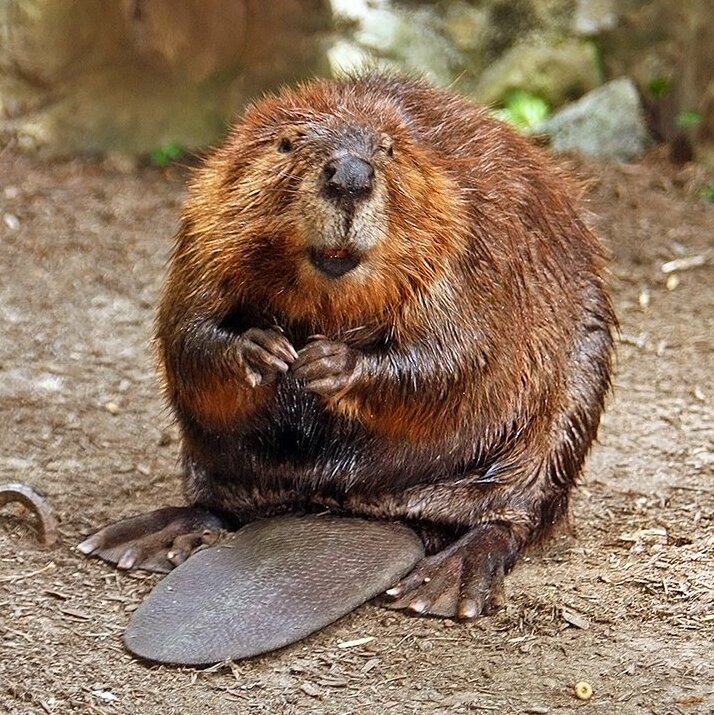
And then there was the celebrated early Canadian conservationist, Grey Owl. Grey Owl, as he himself eloquently advertised to the world, was an Indian, or rather, in our modern classification system, Métis, who took up the cause of preservation of the threatened beaver. He became internationally famous for it. He later expanded his concerns to include nature preservation generally, and took up free residence in Prince Albert National Park. As if he were himself a bit of nature. Back in the early 1930s, he called for people to remember, very much in the spirit of Chief Seattle, that “you belong to nature, and not it to you.”
Somebody is stealing somebody's material.
Archie Belaney and meal ticket
Perhaps you have heard of Grey Owl. And perhaps you have realized the problem with all of these examples of Indian environmental advocacy: none of them came from actual Indians.
Grey Owl was not Métis, though he always publicly pretended to be. He was an Englishman, born Archie Belaney, who ran away to Canada in his youth, like Robert W. Service, for romance and adventure. He was much more influenced by the English romantic poets than by anything found in Indian culture. He begins his first book, The Men of the Last Frontier, the one that made him famous, with a passage of Byronic poetry in praise of nature. His prose is lush in the romantic style. He commonly uses even the very term “romantic,” to describe the Canadian wilderness:
This then is the Canada that lies back of your civilization, the wild, fierce land ... where Romance holds sway as it did when Canada was one vast hunting ground. This is the last stronghold of the Red Gods, the heritage of the born adventurer. ... it can become a land of wild, romantic beauty and adventure.
Up beyond the wavering line of the Last Frontier lies ... a rich treasure-house, ... transformed by the cosmic sorcery of the infinite into a land of magic glades and spirit-haunted lakes, of undiscovered fortunes, and sunset dreams come true.
This is the face of Nature, unchanged since it left the hands of its Maker, a soundless, endless river, flowing forever onward in the perpetual cycle which is the immutable law of the universe” (Men of the Last Frontier, pp. 43-44).
Disney's Pocahontas, clearly, would feel right at home.
As would most children.
We all retain, whatever our age, a bit of the small wondering child within us. This wild romantic Canada must all have sounded terribly good to that little boy growing up in settled, prim, utterly proper England. Almost like a childhood dream that could come true. He almost says as much as that.
It would, of course, and did, have the same appeal to those who were still children on that day of publication, or those unlucky children who had inadvertently grown to adulthood in Montreal, or London, or Toronto, or New York.
To Indians, born there? Maybe not so much. To them, perhaps, just another bloody day at the office.
Belaney was also either clever, or lucky, to hit upon the beaver as his original mascot. He said it was a sacred animals to the Indians. It was not. But it was sacred to Canadians, the national symbol. Kill a beaver, and you are by sympathetic magic killing Canada.
Good marketing.
As for “Iron-Eyes Cody,” the much-beloved Indian icon who shed tears over dropped paper-- in 1996, his sister revealed that he had been born Espera Oscar de Corti in Louisiana, son of Sicilian immigrants.
Perhaps, at least, they came from the untamed west of Sicily. Or maybe lived near a cigar store.
There are one or two morals to be taken here, before we move on. Obviously, there is no overall discrimination or prejudice against Indians. Quite the opposite: a number of con men have found it profitable to pretend to be Indians; to put themselves in Indian paint. The rest of us are prone, it seems, to always give Indians the benefit of the doubt, to assume the pure-heartedness of their motives and the sincerity of their speech.
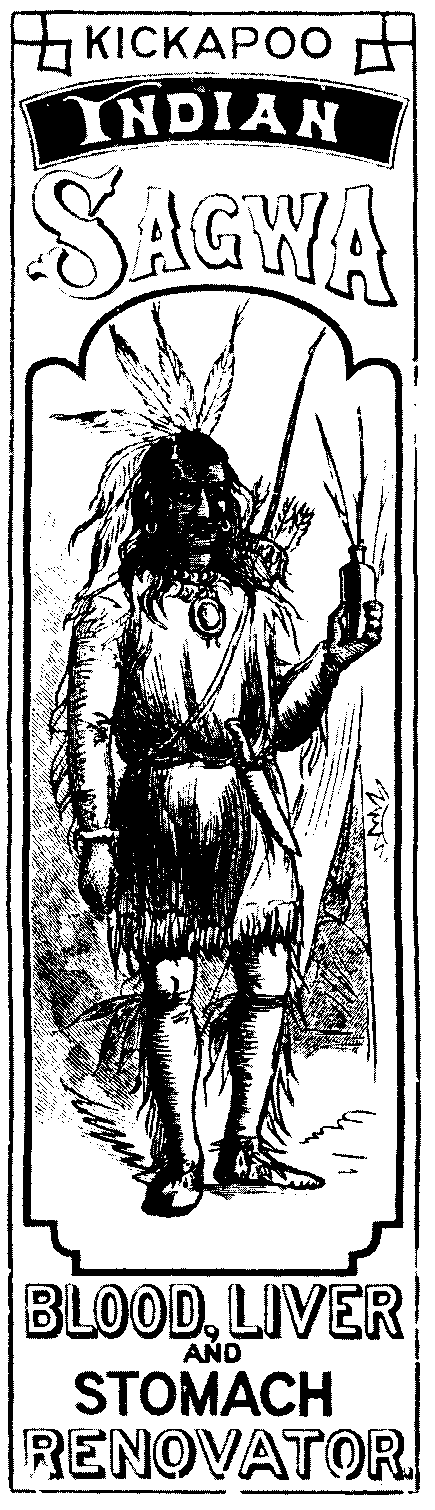
Ask the Kickapoo Medicine Company. Having assumed the challenge of selling actual snake oil, they hit upon the idea of declaring themselves Indian, and hiring Indian pitchmen. They became the dominant patent medicine firm in nineteenth century America. Until they were wiped out in the early twentieth century by the advent of food and drug laws.
Would Indian speak with forked tongue?
If they haven't already, somebody should try this with used cars.
It is all apparently a bit of a burden to real Indians. Kimberly Tallbear, who actually is Indian, unlike, say, Ward Churchill or Elizabeth Warren, writes:
“Too often non-Indians have been disappointed by my contemporary manner of dress and my inability to spout mystical-sounding ecological wisdom” (Kimberly Tallbear, “Shepard Krech's The Ecological Indian: One Indian's Perspective”).
It is impossible in real life to measure up to the Hollywood preconception.
Who knew? It turns out Pocahontas is a cartoon.
Then there is the mighty Chief Seattle. Chief Seattle, at least, was a real Indian, and possibly even a real chief. Though perhaps not a reliable spokesman for traditional Indian spiritual values, having been himself a Catholic. Which makes his reported assertion that “our God and your God are the same” a bit trivial and self-evident.
But then, Seattle never spoke those words. The speech was composed by a Texas scriptwriter named Ted Perry, for a 1972 television film funded by the Southern Baptists. It was made to advocate current Southern Baptist views, not traditional Indian views, on the environment.
Were they similar? God knows. The God we apparently share with the Southern Baptists.
Good thing we have written sources we can go back to and check. If all we had were oral traditions, like those of the Indians, we would all firmly believe Chief Seattle actually said these things, and nobody would ever know differently. We would probably all accept that they are a fair precis of the ancient Indian faith. Even Indians commonly think so. I found it reproduced in total on a native web site.
As to the real Chief Seattle's real concerns on the point of negotiating a treaty with the US government, it seems he was all for it. His main motive seems to have been getting the US Army there to protect him and his people from enemy tribes to the north.
More in the spirit of Thomas Hobbes than of Albert Gore.
Gery Owl's original ecological cause, noted just now, was the fate of the beaver, as it existed outside the Canadian coinage. In its service, he tells the romantic and moving history of the fur trade. Indeed, he calls it “one of the most romantic phases in the development of the North American Continent” (Men of the Last Frontier, p. 144). Romantic: high praise indeed, coming from Grey Owl.
“Attracted by the rich spoils of the trade, other companies [other, that is, than the HBC] sprang up. Jealousies ensued, and pitched battles between the trappers of rival factions were a common occurrence. Men fought, murdered, starved and froze to death, took perilous trips into unknown wildernesses, and braved the horrors of Indian warfare, lured on by the rich returns of the beaver trade.
“Men foreswore one another, cheated, murdered, robbed, and lied to gain possession of bales of these pelts, which could not have been more ardently fought for had each hair on them been composed of gold.
“The Indians, meanwhile, incensed at the wholesale slaughter of their sacred animal, inflamed by the sight of large bands of men fighting for something that belonged to none of them, took pay from either side, and swooped down on outgoing caravans, annihilating them utterly, and burning peltries valued at hundreds of thousands of dollars. Often, glad of a chance to strike a blow at the beaver man, the common enemy, they showed a proper regard for symmetry by also destroying the other party that had hired them, thus restoring the balance of Nature” (pp. 144-145).
Ah, the balance of nature! And Belaney's—sorry, Grey Owl's—avaricious Europeans sound marvellously similar to Disney's cartoon Governor Ratcliffe. The Indians, meantime, were nobly concerned with the preservation of the Earth, their mother, and the proverbial, if entirely mythical, “balance of nature.” "Walk in balance all our days"-- that's the ticket!
In the real world, however, the Europeans employed by the fur trading companies did not trap any beaver. The Europeans were primarily the fur traders. They bought the pelts with European manufactured goods.
Apparently, someone else was doing the trapping. Someone who must have had a burning desire for European manufactured goods. And saw them as worth more than a few beaver.
The two great trading companies, it is true, the Hudson's Bay Company and the North West Company, sometimes came to blows over the trade. It is just possible to make out in Grey Owl's narrative traces of the Pemmican War. It lasted, all told, nine years; twenty-two people got killed at the Battle of Seven Oaks. The conflict, however, was not between rival European trappers, and not over beaver pelts. It was between fur traders and farmers, over access to pemmican. The fur traders were mostly Métis, not European. Métis—or Indian, as Grey Owl would have put it. Just as Grey Owl represented himself to be.
Battle of Seven Oaks
The two companies then amalgamated, in 1821, ending the strife. A bit before Grey Owl's time.
And while there was some conflict for a time between the Métis of the North West Company and the Scottish settlers sponsored by Lord Selkirk's Hudson's Bay, it was dwarfed by earlier apocalyptic wars between Indian groups over the castor canadensis trade. We have mentioned before the Beaver Wars, which raged across most of America east of the Mississippi, and in which a fair number of Indian “nations” were thoroughly ethnically cleansed from the landscape. Fought over trapping grounds and trade routes for the commerce in beaver pelts. With the Europeans mostly innocent bystanders.
In the real, physical, non-cartoon world that the bulk of us inhabit, it has generally been Europeans like Belaney who have spent troubled hours on beaver conservation, or conservation of any other kind. Already in 1635, disturbed by the devastations to the beaver population from the skin trade, Father LeJeune of the Jesuits at Quebec proposes a solution. The French government should offer some incentive to encourage the Indians to settle down to farming. Then, among other benefits, LeJeune says, “Beavers will greatly multiply. These animals are more prolific than our sheep in France, the females bearing as many as five or six every year; but, when the Savages find a lodge of them, they kill all, great and small, male and female. There is danger that they will finally exterminate the species in this Region, as has happened among the Hurons, who have not a single Beaver” (Relations 8, p. 55).
To Europeans, a simple, sensible conservation measure, and conservation makes simple sense: a government regulation requiring the trapping only of adult males.
Energetic hunting of the beaver by the Mohawks had already led by 1640 to the virtual disappearance of the lovable rodent in their traditional lands, the Hudson and Mohawk Valley. Fortunately for the Mohawk, if unfortunately for the beaver, that tribe found itself the closest Indian group to the Dutch trading posts. As a direct consequence, the Mohawks with their new Dutch firearms turned to conquering all of their neighbours who still had beaver to trap. The Cree, spreading from their original lands adjacent to the first Hudson's Bay Company posts, waged a similar war across the Northwest.
All this fuss about ME?
The beaver population has since been restored. Thanks to intervention by Canadian governments, largely as Father LeJeune suggested.
Had they wanted to, the Indians themselves would have been unable to save the beaver. Government intervention would not have been possible. They had no effective government.
We see here a perfect model of “the tragedy of the commons.” When nobody owns a thing, it is in nobody's interest to conserve it. Even if every Indian in Canada individually wanted the beaver preserved, reducing their own take of this resource probably only meant handing it to their enemies. The more so since diverse Indian groups commonly hunted through the same lands. And were at constant, total war.
If real Indians ever really did share the conservationist views of Archie Belaney, Espera de Corti, Ted Perry, and Al Gore, they have good reason to celebrate the arrival of the Europeans.
Of course, it could be argued that, without a ready market for beaver furs among European haberdashers, the original pressure on the beaver population would never have occurred. Okay, fair enough. I guess by the same token, we are now thoughtlessly exploiting China by buying their cheap manufactured goods. Not to mention Germany or Japan, by buying their cars. But why is it that, by exchanging tools for furs, the Europeans were exploiting Indians, but by exchanging furs for tools, the Indians were not exploiting Europeans?
It works, actually, only if you assume that Indians have no free will. But then, it follows, it stands to reason, if they are a part of nature. Do elk or moose or beaver have free will?
Perhaps, actually, the common view of Indians as “one with nature” or “close to nature” is not all that flattering. Darned good justification for colonialism and government paternalism, though.
Nor, even if Europeans can be blamed for once-low beaver populations, are beavers the only resource that could be damaged by this “tragedy of the commons.” Firstly, if the Indfians wanted Europeans manufactured goods, they were going to find something, anything, that the Europeans wanted, in order to trade for them. If it hadn't been the beaver, it would have been saskatoon berries, elk leather, or something else. Same problem. And the same problem applies, in principle, to any and all resources in the Americans, pre-contact as much as post-contact. Simply because the Indians had no government.
Giant ground sloth attempting to climb a tree.
To demonstrate, we might back up a step. Recall that, just like other Canadians, the Indians were originally from somewhere else. Up to about 12,000 years ago, by the common current estimates, there were no humans past Alaska in the Americas. In those days, the fossil record tells us, the Americas were about as rich in diverse animal life as the Calgary Zoo. The forests and plains hosted giant ground sloths, six times bigger than a man; armadillos the size of automobiles: lions, sabre-tooth tigers, and Florida cave bears; cheetahs, mammoths, mastodons, elephants, camels, giant water rats, even large buzzard-like birds with four metre wing spans. But, within a thousand years of man's arrival, all had disappeared.
Rush hour, Don Valley Parkway, Monday morning, 12000 BC
Most probably, they were hunted out. A bit too visible and a bit too visibly tasty. Almost every large mammal over two continents.
Conservation? What is this conservation of which you speak?
Meantime, at Portage and Main...
Of course, the buffalo did survive. Granted, there used to be a larger cousin; he was hunted out. But, when the white man first came to the Great Plains, he witnessed vast herds of buffalo (aka, for no very good reason but to show your supposed great learning, “bison”) easily a million strong, blackening the landscape for as far as the eye could see.
Horace Greeley writes, in 1859, on return from his trip west, “What strikes the stranger with most amazement is their immense numbers. I know a million is a great many, but I am confident we saw that number yesterday. Certainly, all we saw could not have stood on ten square miles of ground. Often, the country for miles on either hand seemed quite black with them” (An Overland Journey from New York to San Francisco in the Summer of 1859, 1860).
Within a few decades, they were almost gone. At the lowest point, around 1900, perhaps 500 survived.
Caitlin, "After the Buffalo Chase"
And this is usually blamed on the white men.
However, although the toll taken by white hunters was terrible, it was, in the words of one researcher, only the “coup de grace.” Fur traders, white and Indian, shipped 1,278,359 hides east annually at the peak of the industry, in 1872. There were an estimated 30 million buffalo, and undisturbed, a buffalo herd grows 20% per year (Andrew Isenberg, “Introduction,” in E. Douglas Branch, The Hunting of the Buffalo, University of Nebraska Press, Lincoln, Nebraska, 1962, p. xiii). This could not by itself have been the crucial factor.
Without European involvement in the hunt, the final buffalo would have given up the ghost in about 1920 (“Historians Revisit Slaughter on the Plains,” By JIM ROBBINS, NY Times, November 16, 1999). Instead, because Europeans became involved, we still have buffalo. Or bison, for that matter. In growing numbers.
As to their decline, we cannot be certain what the critical factor was. Quite possibly it had to do with the coming of the pony and the gun; newfangled Western technology, but mostly in Indian hands. It may also have had to do with the typical boom and bust cycle of always unbalanced nature. Charles Mann notes that, when De Soto toured the American Southeast in the early sixteenth century, he saw no buffalo (1491: New Revelations of the Americas Before Columbus, Knopf, 2005). Later visitors saw them there in large numbers. It might be that, in the centuries between Columbus and the settlement of Columbus Ohio, there was a buffalo population boom, due perhaps to unusually good weather, perhaps to global warming, perhaps to a sudden decline in predator numbers—i.e., the Indians, decimated by the smallpox epidemics. The subsquent decline of the buffalo may have been, at least in part, a return to the usual norm. Rapid expansion of the herds lured many Indian groups west for easy living. Most of the tribes of the Plains, the Blackfoot, Assiniboine, and Plains Cree, seem to be newcomers. As always happens, the predators overshot the mark, and prey numbers declined swiftly.
Behold the balance of nature. Dizzy yet?
"The Last of the Canadian Buffalo," 1900
Whatever really happened to the buffalo in the latter nineteenth century, the traditional Indian bison hunt does not stand as a model of conservationist principles. As any tourist knows who has visited Head-Smashed-In Buffalo Jump, the preferred technique was to stampede an entire herd over a cliff. Necessarily, inevitably, the Indians being nomadic and unable to store much food, there was great wastage. Reputedly, in some cases, faced with such abundance, some Indian groups did not clean their plates. They would at times cut out only the tongues, buffalo tongue being a special delicacy, and leave the rest of the carcasses to simply rot.
Early European visitors often commented on the wastefulness of the native practice. It offended their conservationist sensibilities.
“Many European observers were struck by gourmandizing as well as by what struck them as subsequent 'profligacy' or 'indolence.' At times, Indians used everything. But on occasions they did not, and the observers remarked upon 'putrified carcasses,' animals left untouched, or Indians who took only 'the best parts of the meat.'“ (Shepard Krech, “Buffalo Tales: The Near-Extermination of the American Bison,” National Humanities Center, http://nationalhumanitiescenter.org/tserve/nattrans/ntecoindian/essays/buffalo.htm).
Lewis and Clark report such a buffalo hunt, from the days before the Plains nations had firearms at their disposal. Blame the two explorers for the creative spelling and grammar. Americans are like that.
“Today we passed on the Stard. [starboard] side the remains of a vast many mangled carcases of Buffalow which had been driven over a precipice of 120 feet by the Indians and perished; the water appeared to have washed away a part of this immence pile of slaughter and still their remained the fragments of at least a hundred carcases they created a most horrid stench. In this manner the Indians of the Missouri distroy vast herds of buffaloe at a stroke; …” (Lewis and Clark, May 29, 1805).
Actually, they don't "jump" so much as fall like a sack of wet bricks.
And then there are the trees. The embraceable trees. Grandmother Willow and the gang.
Real Indians apparently would be less likely to talk to them, or to hug them, than to burn them down to cinders.
“Many people believe that the first English to settle North America,” the trade publication Fire Management Today, who are the sort of people who ought to know, summarizes, “found an ancient, impenetrable wilderness stretching uninterrupted from the shores of the Atlantic to the banks of the Mississippi. The popular view of a pristine wilderness inhabited by American Indians who left no trace on the land is rooted in the Romantic notion of 'the forest primeval' promoted by such poets as Henry Wadsworth Longfellow. The Romantic view entered the early conservation movement through the writings of Henry David Thoreau and others (Williams 1999). ... [T]here is '... some truth to one researcher’s claim that most of the forests seen by the first settlers in America were in their first generation after one or another kind of major disturbance' (Raup 1967).” (60:3, Summer, 2000. sidebar; unattributed).
Indians commonly set woods on fire, if it suited them. This was a convenient, if wasteful, hunting technique. Any wildlife would flee the flames, and could be easily picked off by waiting hunters. “Indians burned large areas,” Fire Management Today explains, “to force deer, elk, and bison into small unburned areas for easier hunting. Fire was also used to drive game over cliffs or into impoundments, narrow chutes, and rivers or lakes where the animals could be easily killed.” Flames were used to drive the buffalo off the cliffs. “Some tribes used a surround or circle fire to force rabbits and other game into small areas “ (Gerald W. Williams, “Introduction to Aboriginal Fire Use in North America,” Fire Management Today, 60:3, Summer, 2000).
Remington. Indians setting fire. Maybe just to get the light right for a painting.
Burning down the forest might also make it easier to gather wild berries or other edibles. So why not? For the most part, you can't eat a tree. “[T]hey burned patches where flame could help them extract some resource— camas, deer, huckleberries, maize” ( Stephen J. Pyne, “Where Have All the Fires Gone?” Fire Management Today, 60:3, Summer, 2000).
Burning down the trees might also deprive an enemy of their hunting grounds. All's fair in the Indian code of war.
Pyne summarizes: “much burning resulted from malice, play, war, accident, escapes, and sheer fire littering. The land was peppered with human-inspired embers” (Stephen J. Pyne, “Where Have All the Fires Gone?” Fire Management Today, 60:3, Summer, 2000).
Once again, it all met with a certain European disapproval. Alexander Ross, a Scottish settler and retired fur trader at Red River in the first half of the nineteenth century, complains in print of the wasteful use of natural resources by his Métis neighbours. They will, he says, occupy any unused land, log it out, and, once the timber is gone, simply move on to the next plot. “Thus,” Ross laments, “the upper and best wooded part of the settlement has been entirely ruined, and rendered treeless” (Ross, The Red River Settlement, London, 1856, p. 199).
Further west, “White settlers, according to Langston, 'hated the fires that swept through the mountains, and usually saw the Indian burning practices as threatening the open pine [pinus ponderosa] forests they loved.' “ (Gerald W. Williams, “Reintroducing Indian-Type Fires: Implications for Land Management,” Fire Management Today, 60:3, Summer, 2000, p. 40).
“Wherever Europeans went,” says Williams, “they generally stopped the Indians from burning, ... Ironically, more forest exists today in some parts of North America than when the Europeans first arrived. As Pyne (1982) observed, 'The Great American Forest may be more a product of [European] settlement than a victim of it'” (ibid.).
As with trees, buffalo, and beaver, so with any other resource. When the Jesuits arrived at Huronia in the early seventeenth century, they reported it stripped of all game. The Huron diet was accordingly almost all vegetarian, augmented by what fish they might catch or buy dried from the Algonquins.
As to Pocahontas's animal friends, the Indians generally did keep dogs, if not raccoons and hummingbirds, as pets. But again, their treatment of them often seemed inhumane to the Europeans.
Fr. Biard describes a Mi'kmaq funeral ceremony, held, as was common, with the subject still alive. “The farewell and the mourning are finished by the slaughter of dogs, that the dying man may have forerunners in the other world.” (Jesuit Relations 2, p. 15). The French Jesuit demanded that this stop. “... I told him that … the slaughter of the dogs, ... displeased me very much” (p. 17).
French poodles, even then, probably had a better life.
All this unfortunately paints the Indians as very far from proper ecologists or environmentalists, by modern Canadian standards. Indeed they were, but let's be fair. Even if they held fine conservationist sentiments, and even aside from the aforementioned tragedy of the commons, it is best to remember that ecology, contrary to popular belief, is an indulgence attractive and even available only to materially highly developed societies.
Icon of Sixties icon Buckminster Fuller
Long ago, as an undergraduate at Queen's, I attended a lecture by Buckminster Fuller. Being an actual Sixties icon, like most actual Sixties icons, he had no truck nor trade with the Sixties mentality. He explained to the audience that technological development is by itself and by definition the best conservation. To improve your technology is to accomplish more with fewer resources. As civilization develops, we take out some of this advantage in greater population; some of it in greater material comfort; and some of it as an investment in the future, by reducing our use of some natural resource. Not a lot of whale oil in the streetlamps these days. Settle down to farm instead of hunt, and, like a charm, the same land that once could support one person can now support one hundred. Or, one percent of it can support one person, and ninety-nine percent of it be returned to verdant wilderness, if that is what we prefer.
Living at subsistence level concentrates one's mind mightily on the present day and on only the most essential needs. One is not putting anything in the environmental bank. One is less inclined to the luxury of holding a given landscape intact and apart, as Ted Perry would say, for purely aesthetic purposes. Nature indeed; can one eat nature? Can one wear it against the cold? Such finer concerns come only with growing wealth. Get rich, and you can maybe afford to keep a deer park just for walking through.
Then again, in expecting Indians to worship “nature,” are we not projecting an entirely European pseudophilosophical concept? Is it likely to have meant much of anything to them without having read the Romantic and Transcendentalist poets? Indeed, does it really mean much of anything anyway? Have any other cultures anywhere really ever had a similar concept? I recall a Japanese friend in graduate school who regularly equated the English word “nature” with the supposed English cognate “chaos.”
Not quite the politically correct view.
Nokomis, the Earth Goddess, descending from the full moon. Nice, but not Indian. Victorian.
Peter Coates, trying to nail down a consistent meaning of the English word “nature,” cites five rather different senses, commonly confused:
1 – nature as a particular set of physical places, notably those parts of the world more or less unmodified by people.
This is the meaning used in the phrase “unspoiled nature.” It is what Parks Canada tends to like. It involves, of course, the notion that people, by their presence, “spoil” things. Hard to say whether this idea might spontaneously occur to another culture, or why, or why it would be entertained with favour. If you create a new wilderness national park, and ban all people from it, and then a tree falls, does it make a sound?
2 – nature as all physical places and things, including those touched and untouched by people.
Nature in this sense more or less equates with the word “environment”; albeit only if properly used, which it usually is not. It is what is meant by the older term for science, “natural philosophy.” This does not mean pondering virgin forests, but the postulated world, whatever it may be, perceived through the five senses.
3 – nature as force or entity with almost religious qualities. This meaning is captured in the phrase ‘mother nature’ or the ‘laws of nature’ which cause certain things to happen.
I'd delete that “almost.” This is where the supposed “balance of nature,” for example, comes in. Not to mention the modern ecological movement more or less as a whole. In other words, “nature” is “supernatural,” nature includes or is whatever is not natural.
By now, surely it gets hard to see any underlying coherence.
4 – nature as an essence, for example in the phrase “human nature” to explain certain behaviours.
Here “nature” is whatever is not touched by reason and, more importantly, free will; whatever is not, in other words, voluntary. Kind of like homosexuality, in the current PC dogma.
5 – nature as the opposite of culture, so that it is everything that has nothing to do with humans.
Sort of like Scarborough, Ontario.
(definitions from Peter Coates, Nature: Western Attitudes Since Ancient Times, Polity Press, Cambridge, 1998, pp 3–10.)
The beauties of nature.
Is that too confusing? Too confusing, surely, to expect the same rather arbitrary congeries of concepts to occur independently, and be widely embraced, by pre-contact Indians.
Let's try again. Mortimer J. Adler makes his own stab at defining the concept “nature” in his book The Great Ideas. Adler has no known ideological axe to grind here. He is trying to accomplish something like a dictionary of ideas, an accurate and clear presentation of how the term has actually been used by The Great Thinkers of the Western Tradition.
Adler, too, finds multiple, interwoven meanings. “Common to all meanings,” however, he suggests, “is the notion that the natural is that which man's doing or making has not altered or enlarged” (p. 561).
Okay; so are Indians more natural in this sense? Problem: to say so is really saying they are less human. Might sound good to a certain sort of modern European Canadian, but might not have naturally—to coin a phrase—occurred to pre-contact aboriginals. Or, if you take it another way, it simply says that Indian culture, Indian civilization, accomplished little. Indians as a group then were indolent. Not flattering, unless you happen to worship nature in Coates's third sense, as something holy and not to be touched by filthy human hands.
Adler then suggests that “nature is commonly contrasted to 'culture' or 'civilization.'” True enough; but you see what you've done there? To say that the Indians are more natural is to say that they lack culture or civilization. That too somehow does not sound flattering. I'm inclined to agree that it is a fair point; but then, anyone who praises the Indians for “respecting nature” and then objects to calling them “uncivilized” or “savages” is being inconsistent, self-contradictory, insincere, and/or just playing a game with words.
Again, not incidentally, Adler points out that to see “nature,” as the absence of man, as a significant or awfully meaningful thing automatically requires you to see man as radically different from nature: “Only on the supposition that man is by nature rational and free do those human works which are the products of reason or the consequences of free choice seem to stand in sharp contrast to all other natural existences and effects of natural causes” (p. 561). Otherwise the distinction seems trivial. If the distinction is trivial, preserving nature can hardly be of any importance.
Sioux Indians on tour in Dresden, Germany
Therefore, if the Indians from their own perspective were indeed deeply involved with nature, or worshipped it, or otherwise even thought all that much about it, that automatically means that they saw themselves as radically apart from nature. More so than Europeans.
In other words, no human being can actually be, by definition, subjectively “at one with nature,” or “in tune with nature” in any subjective sense. One can only see another human being, not oneself, as being “at one with nature,” or “in tune with nature.” And only because you see them not as a separate conscious subject, but as an object. A thing, not a person.
Somewhat insulting to a real Indian.
Again, if nature stands in distinction to reason and free will, to whatever extent Indians are more “natural” than Europeans, that means they are less rational and have less free will. Picturesque, perhaps, like an animal in the zoo, but would you want your daughter to marry one?
Yet that would at least explain why the Europeans, and not the Indians, are responsible for the decline of the beaver population.
All clear now? To call Indians children of nature or the original environmentalists is not just patently wrong; it is patently racist and insulting.
It almost makes you want to run out and burn down a tree.
But what then are we to make of Indian culture? If its basic values are not ecological, what are they? And why do we Westerners have this funny concept “nature,” with which we demean another ethnicity?
Note, with Adler, that in another common definition, “the world of nature is the system or order of the objects of sense” (Adler, op. cit., p. 562). “Nature,” he adds, “is also the realm of time, space, and causality” (p. 562). Hence, as Coates says in his definition two, “nature” is the proper object of study of the physical sciences; it is the physical world. “The natural or theoretical sciences do not extend to what Kant calls the 'supersensible' or the 'noumenal' order—the world of things lying outside the range of sense-experience” (p. 562).
Yet again, then, if the Indians are “natural,” it simply means they are objects of the senses, mere material objects, with no independent consciousness. Or at best, if you want to be really nice, if they merely “worship nature,” they are grossly materialistic.
Never mind. However insulting the concept is to Indians, that is secondary to the fact that it is simply incoherent.
If Europeans are vitally concerned with “nature,” and real Indians do not seem to be, this is probably just an indication that Indians are sensible, and Europeans, at least of a romantic, environmentalist, bent of mind, are not.
Indians being romantic and at one with nature. Bierstadt, 1862
Let us take the base meanings of the concept “nature” (not just the word; you could substitute “ecology,” or “environment,” and probably several other terms, as commonly used) as being two. That's about as simple as we can make it. Firstly, “nature” is the physical world, the world perceived by the five senses. Secondly, it is whatever is outside the command of the human will. From these two, which at first glance almost seem to be logically connected, all others, at least relevant to speaking of Indian culture as opposed to sexual orientation, are derived. There are still a few problems: don't animals have some sort of free will? Not knowing the Garden of Eden story, what's so special about free will anyway? So it is still unlikely to have occurred independently to Indians.
But never mind. Whether or not it ever occurred to Indians, it did occur to European-Canadians, some of whom may even be reading this. So perhaps we need to deal with the issue.
Given this juxtaposition of ideas, one is too easily and too commonly left with the fallacy of a false alternative: everything that exists must be either physical, or under control of the free will of the human observer.
This is obviously wrong. Many experienced things do not fit in to either category. To cite one trivial example, other sentient beings: other humans. I have great difficulty, for example, in controlling others by the sheer naked force of my will.
Okay, imagine they are all just objects. Even so, you have a problem. Are emotions, like love or anger, forms of will, or physical things? Neither, of course. You might have limited control over emotions; but then, you have limited control over the physical world too, in about the same sense. How about abstract universals: good and evil, the laws of mathematics (as opposed to number as a physical quality), the laws of science, the laws of logic. Are these things we simply willed into being, and can change? Are they things we see? What about the imagination, the shadowy world we experience in novels or in dreams?
And so forth and so on. There are more things in heaven and earth, Horatio, than are dreamed of in your philosophy.
If you happened to be an Indian greeting Thoreau at first contact, you might understand a great deal about recent Western thinking by keeping this basic confusion in mind. From it, one can easily deduce the modern Western philosophy of materialism: after all, all that exists is the material and free will. That simply states it. One can derive all of the social sciences: only the scientific observer is sentient, and other people have no real free will. Their behaviours are in principle predictable. One can derive the Freudian dogma of the “subconscious”--a rather self-contradictory attempt to accommodate the experience of the dream world, which uncannily does not fit into either category, material or willed. Indeed, perhaps one can derive the classic Western forms or concepts of insanity: thinking you can control things with your will that you cannot really control, as in megalomania; or thinking imaginary things are physical objects, as in schizophrenia. One can also derive much, or perhaps all, modern atheism: if you cannot see a thing, it does not exist. Therefore, there is no God, there are no angels, and no devils. If angels there are, how many can dance on the head of a pin?
Then comes the romantic turn, giving us “nature” in all its magical wonderfulness, the legitimate object of mass worship it is today. Rediscovering these things that are neither free will nor perceived with the eye, and emphatically realizing that they are real, where do you put them in your categorization of all reality?
Roantic nature: Cole, "The Savage State" 1836
Given the growing prestige of “natural philosophy,” back when the first romantics were writing, the choice seems fairly obvious. Both then and in the Sixties, of course, human free will and reason was also under a bit of a cloud in the West, given the tumult of the French Revolution, a tumult spread soon across all Europe by Napoleon, and the tumult of the nuclear threat and unending Cold War. Everything loose that could move went over to nature.
Accordingly, romantics tended and tend to invest “nature” with any and all of these unrelated qualities. To the romantics, nature includes the imagination. There is no knowing what Hansel and Gretel might come upon in those woods. Nature includes the emotions, so it is our “mother”: the Gaea hypothesis. Love is now somehow the same as sex. As nature now includes any consciousness not our own, if we have intimations of immortality, or of some greater order in the universe, nature becomes our surrogate divine. The material is the spiritual.
It is amazing with what qualities, given only a little effort, one can suffuse a graven calf.
Pity, perhaps, the Indians could not join us in this worship.
Wandering romantic tribe in state of nature.
Now, given that they were not romantics or worshippers of nature, what did Indians really believe about the trees, the beaver, the mosquitoes, and the lovely Canadian landscapes seen by the Group of Seven? What were their feelings or concerns in this regard?
The Jesuits, of course, especially strained to know; for philosophy was their stock and trade. They were here to engage the Indians in a philosophical conversation.
Father LeJeune gives us his understanding of the Indian concept of the soul:
“[T]he Savages persuade themselves that not only men and other animals, but also all other things, are endowed with souls, and that all the souls are immortal; they imagine the souls as shadows of the animate objects; never having heard of anything purely spiritual, they represent the soul of man as a dark and sombre image, or as a shadow of the man himself, attributing to it feet, hands, a mouth, a head, and all the other parts of the human body. “ (Relations 7, pp. 173-5).
So far, so Pocahontasy. Disney would agree. It does sound, at first hearing, like a sort of “worship” of “nature”: all things, not just men, and with the possible exception of straight European males, are endowed with souls.
But we may be jumping to conclusions to find this constitutes a significantly greater “respect” for nature. It could be just a matter-of-fact perception. I believe that Donald Trump has a spiritual form, is even a conscious being. Still, I do not feel personally inclined to worship him.
And would the Indians recognize all these ensouled things as some sort of coherent unity, “nature”?
To the Jesuits, of course, living before the English romantic poets, it all sounded instead rather materialistic. The poor Indians seem never to have heard of anything spiritual. Souls with feet and hands? Isn't this just a childish confusion of the spiritual with the material world? Indeed, told of the Supreme Being, the Indians would laugh and respond almost like modern atheists: how can they possibly believe in something they cannot see?
But one should notice a contradiction here. Can they see the souls of beaver, or of trees? Necessarily not, unless they have some senses we don't have. The same Jesuits report of the same Indians, “During the night, a woman who had gone out, returned, terribly frightened, crying out that she had heard the Manitou, or devil. At once all the camp was in a state of alarm, and every one, filled with fear, maintained a profound silence. I asked the cause of this fright, for I had not heard what the woman had said; eca titou, eca titou, they told me, Manitou,' Keep still, keep still, it is the devil.' " (Father LeJeune, Relations 7, p. 83).
Can you see or hear the devil? Can the Indians?
Yes and no—here is where the cultural confusion begins. And in the same sense, you can indeed see the spiritual as well as the material forms of the beaver and the tree. You can “see” any and either in the imagination—literally, the “imaging faculty.” Simply see the imagination as it truly is, a thing not under the control of our will. Therefore, the things we perceive with the imagination exist independently, since they are independent of our will. And we can see them or hear them, in our dreams. The Indians could not believe in the Christian God because they could not picture him in their minds, at least not at that early point. They believed that beaver and trees, on the other hand, had spiritual forms because they demonstrably did: you too can readily imagine a beaver or a tree. So there they are. What you see in such a case is a spiritual beaver, or a spiritual tree, not a physical one.
To understand this way of thinking, it is first utterly essential that you disabuse yourself of the arbitrary prejudice, if you have it, that “imaginary” means “not real.” It does not. That is a debatable issue. To the Indians, the imagined was real, and the physical world was not. To us, ordinarily, it is the opposite.
Spelunking Plato's Cave
If this all sounds odd or unfamiliar or even stark mad, one has simply not read Plato, the founder, most aver, of all of Western philosophy. Plato held that the only reason we can recognize a beaver as a beaver when we see one, and know that it is not a tree, is because the bucktoothed rodent corresponds to an “ideal form” of a beaver that pre-exists somewhere in our mind. That ideal of a beaver, then, to either Plato or a Mohawk, is the real beaver. The transient beaver we see is only an individual, imperfect, temporary reflection of it.
The whole thing is so obvious to Plato that, when he first refers to the idea in his dialogues, he does not bother to explain or justify it. He takes it as a given. He never argues it clearly; it is more or less intuitively so.
And this, I submit, is the position of most human cultures or societies that have ever existed: the forms in the imagination are real. The physical world, less so. It is an entirely reasonable, if not obvious, way of looking at the world. We experience mental things directly. We experience physical things only indirectly, through the intermediary of the senses. Who's to say they correspond to any underlying reality?
We would get a lot closer to understanding the traditional Indian view, then, if, instead of trying to make them into Romantic naturalists, we understood them as Platonic idealists.
So Indians did very much believe in things they could not see—see, that is, with the physical eye. In extremis, they believed only in things they saw in the imagination. They did not trust in the physical world, except as a secondary reflection, like seeing your distorted face mirrored in the ripples of a stream.
If there is one thing about traditional Indian culture that seems definite and undeniable, to which all actual witnesses attest, it is that the Indians put great stock in dreams. Champlain reports: “they believe that all their dreams are true; and, in fact, there are many who say that they have had visions and dreams about matters which actually come to pass or will do so“ (Champlain, Voyages, Vol. 2, Ch. 4). Father Brebeuf concurs: “dreams, above all, have here great credit” (Jesuit Relations 8, p. 119. Francis Parkman writes “Dreams were to the Indian a universal oracle” (The Jesuits in North America, p. 55).
Father Jouvency gives specifics: “What each boy sees in his dreams, when his reason begins to develop, is to him thereafter a deity, whether it be a dog, a bear, or a bird. They often derive their principles of life and action from dreams; as, for example, if they dream that any person ought to be killed, they do not rest until they I have caught the man by stealth and slain him” (Jesuit Relations 1, p. 285).
In other words, dreams, which is to say, the world perceived by the imagination, had greater reality than the physical world. The real world was that seen in dreams, by the imagination. The physical or material world was only its reflection.
Some ideal forms. But perhaps not entirely Platonic.
In dreams, of course, souls do indeed have hands and legs. But they are not, for that, material.
The Indians explained to Brebeuf and LeJeune, "souls are not like us, they do not see at all during the day, and see very clearly at night; their day is in the darkness of the night, and their night in the light of the day" (Relations 6, p. 177). In other words, the soul wakes when the body is asleep. It is only fully awake when dreaming.
This is also no doubt why, by universal Indian custom, the traditional tales, the myths, are not to be told in summer months, but only during winter—in the dark part of the year, when the visible world is less present.
And how else make sense of the Indian creation stories, those on the lines of “how the camel got its hump,”or “how the leopard got its spots”? The Abenaki, for example, held that Glooscap, the creator and culture hero, once asked the woodchuck for the hairs on its belly, from which he wove a magical sack.
And this is why, they conclude, woodchucks have bare bellies.
This makes no sense, of course, if they are speaking of any individual woodchuck. How could what one did affect all others? But it makes perfect sense if we speak here of the imagined woodchuck, the ideal form from which we recognize every individual woodchuck; in Jungian terms, the woodchuck archetype. What is true of the archetypal woodchuck must then be true of each individual woodchuck, to the extent that they are woodchucks.
The Indians patiently explain to Father LeJeune that “all animals, of every species, have an elder brother, who is, as it were, the source and origin of all individuals, and this elder brother is wonderfully great and powerful” (Relations 6, p. 159). Parkman speaks of this animal ancestor as “its progenitor or king, who is supposed to exist somewhere, prodigious in size, though in shape and nature like his subjects” (The Jesuits in North America in the Seventeenth Century, p. 42).
This amounts to a pretty clear statement of Platonic idealism. To say “ancestor,” or “elder brother,” or “king,” is the obvious way, absent some shared technical jargon, to describe an archetype. The ideal is related to the physical rather as a father is related to a child, or a king to his subjects. Having all the powers of the imagination, the archetype has all the powers you can imagine. In a dream, a beaver can be any size, can survive any wound, can and properly does live forever.
“If any one, when asleep,” reports Father LeJeune, “sees the elder or progenitor of some animals, he will have a fortunate chase; if he sees the elder of the Beavers, he will take Beavers; if he sees the elder of the Elks, he will take Elks, possessing the juniors through the favor of their senior whom he has seen in the dream. I asked them where these elder brothers were. 'We are not sure,' they answered me, 'but we think the elders of the birds are in the sky, and that the elders of the other animals are in the water.'" (p. 157).
Plato, explaining where his ideal forms reside, says something quite similar. They exist apart from us, like something in physical space, but do not exist anywhere in physical space. Air and water are obvious physical symbols of the non-physical. They offer a minimum of physical attributes, what Aquinas calls “accidents”: lacking form, lacking colour, lacking size, lacking number, lacking if air any apparent mass or weight, transparent, invisible.
The Indians, therefore, were the very farthest thing from nature worshippers. They did not even believe that nature was real. They did not worship rocks because they believed they had spirits; they worshipped spirits, and barely saw the rock.
Nor would they see much point in conservation. It is not as if the beaver or the buffalo could ever cease to be. Do dream forms or memories ever die? Ideal forms are immortal. What is more, as long as anyone ever continued to imagine beaver or bison, presumably, their physical reflections would continue to follow as well. If someone dreamt of a beaver, next day, a beaver would appear. Even if none did, it is not as if there were no more beaver. The real beaver continued forever to be.
It is and has always been the Europeans or “whites,” the inventors of the concept, who have deep faith and respect for nature. Western culture is almost the only culture that accepts the physical world as entirely real. Let alone being the only culture that believes God expresses himself through the physical creation. Making it important, if not sacred, and a worthy object of study and of conservation. Hence the West, and not the American Indians, invented science, most technology, and, perhaps less fortunately, ecology and environmentalism.
Of course, if you do not believe the material world is real, you are not going to devote the greater part of your time and hard work to improving your material conditions. It would be a waste of a life. One very good reason why Indian culture was undeveloped, and why Indians have always been so materially poor.
One can also here begin to understand the unfortunate Indian craving for psychotropic substances of all sorts. If the internal, mental life, the life of the imagination, is the real life, the effects of a good acid trip would be at least as valuable as, for us European-Canadians, a quick all-expenses-paid flight to Las Vegas or Disneyland.
And speaking then again of Disney, this means that Pocahontas the movie, in its contrast between Western and native Indian values, gets everything just about reversed. The English sailors, on embarkation, indulge in obvious fantasies about the New Word: the streets are paved with gold, or at least the strand is.
“On the beaches of Virginny
There's diamonds like debris
There silver rivers flow and gold
You pick right off a tree.
With a nugget for my Winnie
And another one for me.”
That is not a description of the physical world. That is a dream image. That is a classic fantasy.
Gold is, in turn, not significant as a material resource. It is a symbol, a marker or exchange for material wealth. It is an ideal form, an archetype.
The Europeans, if so interested in gold, are interested in symbols and dreams. The Indians, on the other hand, are supposedly interested in sturgeon. In purely physical things.
Odd, then, that Cartier was able to interest them in trading for nothing more than shiny bits of broken glass. Or that Peter Stuyvesant was reputedly able to buy Manhattan for a few glass beads and trinkets.
To the materialist real Europeans, these seemed things of little real value, in comparison to real palpable land that might be farmed or built on. To the Indians, because these beads and bits of glass were rare, colourful, and seemed to shine some kind of internal light, they were delightful symbols or markers of wealth. Worth far more than a few dead acres of dirt.
Pocahonts does not get this aspect of Indian culture. Berating Captain Smith for being an ignorant European, she sings,
“You can own the Earth and still
All you'll own is earth until
You can paint
With all the colours
Of the wind”
Fair criticism. The beauty of art matters. Not a terribly coherent complaint, perhaps, if the Indians themselves prefer untrammeled nature. But never mind. Just where, pray tell, are all the great examples of Indian pre-contact painting? And what are all those odd things hanging in the Louvre, the Prado, and the Vatican Museums, over in uncultured Europe?
Precisely because the Indians lived in their imagination, they presumably saw no value in expressing the spirit in physical, material terms; in colours on a canvas. They never developed visual arts in the Western sense. Besides, Pocahontas's question assumes that art follows and represents nature, as if the Earth comes first. A very European idea. To real Indians, the vice would be versa. You don't take the Earth and paint it, or paint a picture of it. The paints or picture produce the Earth as a byproduct. Nature holds the mirror up to art.
Indiansplaining.
Perhaps most ironically, Pocahontas concludes, lecturing the foolish Englishman on proper appreciation of cultural differences:
“You think the only people who are people
Are the people who look and think like you
But if you walk the footsteps of a stranger
You'll learn things you never knew you never knew”
Yet who do you think would probably have more experience of dealing with strangers and their ways, a young girl living in a small rural village, or an experienced English seaman who has, the film has already established, “seen hundreds of new worlds”?
And does saying this sound as though cartoon Pocahontas herself has taken the trouble to see the possible differences between her experiences and Smith's? Isn't there some rich irony here?
For that matter, have the screenwriters who composed these lines taken any conspicuous trouble to understand true Indian culture?
But never mind. There's always money to be made in ennobling savages.





 Posts
Posts


.jpg)