Playing the Indian Card

Showing posts with label demographics. Show all posts

Friday, October 31, 2025

Saturday, August 30, 2025

Depopulation Solutions


Things are getting ugly with mass immigration, legal and illegal. Natives are beginning to push back. People begin to feel their own governments are against them. Are they trying to replace their own population? Will Britain or France cease to exist?

The chief reason governments are doing this is, apparently, the growing crisis of depopulation. Government pension schemes are projected to go bankrupt without an infusion of younger workers to support the old. Depopulation means a shrinking economy. Mass immigration was meant to solve this. 

Now it seems to have been a mistake.

So what can governments do?

It may turn out to be a chimera. Elon Musk warns that within the near future, most jobs will be replaced by robotics and AI. We will not need a large population to keep the gears turning. And he predicts enough natural abundance that everyone will be able to live well without working. So no need for more people. No need to worry about social security.

Other scientists predict that, within the foreseeable future, we will find a cure for old age itself. People living longer will mean fewer children are needed to keep the population stable or growing. And these are healthy extra years, not needing to be pensioned.

Government interventions based on projected future crises usually make matters worse. When I was graduating high school, our biology teacher insisted we all read The Population Bomb, which warned us that by the 1980s the world would be starving due to overpopulation. Not underpopulation. Governments like China’s wheeled into action with draconian measures making our current crisis worse.

 The one thing we should not do is spend a lot of taxpayer money on proposed solutions that expand the role of government. Yet the usual suggestions are things like free day care, longer parental leave, or paying people to have children. Making post-secondary education free might look like a useful suggestion—it would reduce the cost of having children. But this has been tried, for example in Germany, and does not seem to make a difference.

Here are some cost-free steps we could take.

First, recriminalize abortion. This seems obvious. Were it not urgently needed for moral reasons, the last thing we should be doing in the circumstances is killing babies.

Second, ban or at least restrict contraceptives. This would of course be unpopular, but would cost nothing and obviously address the problem. 

Third, limit the division of assets at divorce, alimony and child support. A woman ending her marriage ought not to get paid more than another women for the same work, only because her partner earned more. Equal pay for equal work. This would reduce the risk of marriage for successful and wealthy men (or women), the sort who could otherwise afford to have more children.

Fourth, when a marriage breaks up, or a child is born, whoever pays child support gets custody of the child. This seems a no-brainer, and requires the minimum of state intervention. Without this stipulation, any man who marries or even has sex risks slavery. A huge disincentive.

Fifth, ban all programs requiring equal pay for women. Men traditionally got paid more than women not because of discrimination, but because they were assumed to be supporting a family. Nor was this philanthropy for the employer: a married breadwinner was going to be more stable and committed to their job. But this also promoted marriage and the ability to have and raise more children. This would cost the government nothing, and boost the economy at the same time.

Finally, a less practical suggestion; but perhaps the most effective. I think of an old Bob Dylan song, in which President Kennedy asks Bob, “What does it take to make the country grow?” And Dylan answers, “My friend John, Brigitte Bardot. Anita Ekberg. Sophia Loren.” 

Conversely, Scott Adams notes recent surveys report that American are having less sex. And he asks, could this be related to the obesity epidemic?

Sex makes babies. Being sexually attractive promotes sex.

The problem may resolve itself with new treatments for obesity, like Ozempic. 

But beyond this, how about restricting immigration to young, attractive foreign women? This would be an obvious enticement for MGTOW to change their minds. It is women who produce babies. And this way, each baby would at least be half-native, and a mixed family would preserve the local traditions. So much for the fear of becoming extinct as a culture.

If it’s a population emergency, we’re going to have to do it. We men are going to have to suck it up and take one for the team.

Or maybe two or three.


Saturday, February 20, 2016

The World is Getting More Religious


Not all here is convincing-- a lot is given without supporting data-- but a useful corrective to the mainline Protestant perspective you commonly hear, which suggests that religiousity is collapsing. Because mainline Protestantism is .


Tuesday, September 22, 2015

The Decline and Fall of Everyone


Not the way it usually works.

Contrary to what you commonly hear, social Darwinism, the idea that survival of the fittest applies to human nations and cultures, was no perversion of Darwin's original theory. Darwin himself was the first social Darwinist. It was the subject of his later book The Descent of Man. Leading pretty directly to the First and Second World Wars.

In Descent, Darwin makes the interesting observation that, when cultures are no longer, for one reason or another, competitive in the evolutionary struggle, they are not necessarily defeated militarily by some neighbouring tribe. They often seem instead to simply lay down and die. Darwin cites a Mr. Sproat, who observed the Native Indians of Vancouver Island, over time, become “bewildered and dull by the new life around them; they lose the motives for exertion, and get no new ones in their place.” (Darwin, p. 542). That sounds, indeed, like what has happened to native cultures in North America generally.

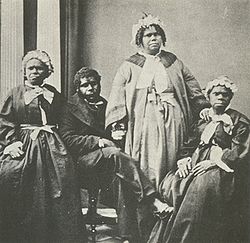
Soon, fertility declines. Darwin tracks the rapid fall in the number of Tasmanian aboriginals. Far from being exterminated by the Europeans, according to Darwin, the Tasmanian government took every effort to keep them going. Nevertheless, the native islanders seem to have simply stopped reproducing. “At the time when only nine women were left at Oyster Cove, … only two had ever borne children: and these two had together produced only three children” (p. 548). Among the Maoris of New Zealand, similarly, Darwin quotes figures that, in 1844, there was one child for every 2.57 adults; in 1858, only 14 years later, there was one child for every 3.27 adults. In Hawaii, after contact with the Europeans, fertility fell to “half a child for every married couple in the whole island” (p. 552).

Last four Tasmanian aborigines, 1860.

I don't think these examples bear out Darwin's theories; they suggest a spiritual instead of a material cause for the rise and fall of nations. Do animal species die out from ennui? But they are of interest in showing how depression works, and that it is primarily a loss of meaning. A culture or an individual, coming into contact with a new culture, is automatically challenged in their prior assumptions. If that new culture is different enough, and seems to offer plainly superior results in some fields, this is necessarily powerfully so. Everything seems, to the individual in the less developed culture, to become pointless, as all the old signposts and destinations seem disproven. This, I suspect, is what African cultures refer to as “loss of soul.”

Hence the shock and depression in these cases almost entirely hits the aboriginal, not the European, culture.

The same effect, not incidentally, can be achieved by surrounding an individual with consistent lies, which challenge his own common sense and experience, as happens in a dysfunctional family. It can happen on a broader, social level when a culture for whatever reason departs generally from common sense and common experience, with or without any outside pressures upon it.

The culture or the individual is then caught between a spiritual Scylla and Charybdis. He dares not leap nor stay behind. There is the same sense of purposelessness as with the “lazy Indians,” or for that matter, the “lazy negroes,” like a car that cannot get into any gear. Hence the lack of interest in sex, which is really a lack of interest in procreation and childrearing. To have a child is a vote that the future will be better, not worse, than the present.

First point: the reality that these things happen disproves the idea of cultural relativism. All cultures are not equal, or culture shock would be more evenly distributed. Second point: such things are not the superior culture's fault. Time to get rid of notions of “cultural imperialism” and “cultural genocide.” Third point: there is a cure to depression, and it is to make the leap.

In other words, broadly, the residential schools were the right idea, and our current drive to resegregate and revive aboriginal cultures will only prolong the problem.

It is also interesting to see that the clearest symptom of this problem on a cultural level is a decline in fertility rates.

We have such a decline, of course, currently across the West. Our culture generally has strayed too far from common sense and common experience. If it does not correct itself, it will die, as did these others.

But who will replace it? Fertility rates have fallen even more disastrously in East Asia. And they are falling in South Asia (i.e., India). And in the Middle East. In Russia, they have long been alarmingly low. So much for possible competing civilizations. In fact, fertility rates seem to be falling just about everywhere.

All of this is actually prompted by an article from David P. Goldman, “Spengler,” on the demographics of modern Iran. Fertility there has fallen from 7 children per woman in 1979 to 1.6 in 2012. This is a bigger decline than has ever been seen before in a large, developed country.

Clearly, there is something very wrong with the spiritual climate, and there are as yet no solutions in sight.


Saturday, July 12, 2014

Whatever Happened to Northern Ireland?

If present trends continue, Northern Ireland will have a Catholic majority as of January or February, 2016. This upcoming demographic deadline has a lot to do with the current peace in Ulster: the Unionists have realized they have no option but to moderate and seek allies. (And a sumilar deadline faces Israel).

According to the Good Friday Agreement which acheived the current peace in Northern Ireland, reunification of the North with the Irish Republic must occur if and when majorities in both North and South vote for it.

This might now actually happen, and rather soon.

Add this to the legal possibility that Scotland might declare independence as a result of the upcoming referendum, or some future one.

Will Britain be reduced to the United Kingdom of England and Wales? Can Britain live with this?

I think such an event might be one more factor encouraging the creation of a formal anglosphere, in which England, Scotland, and Ireland reassociate as equals within a larger comity including some or all of Canada, the US, Australia, New Zealand, India, Singapore, and some of the Caribbean islands.

Tuesday, January 15, 2013

Demographic Doom and How to Stop It


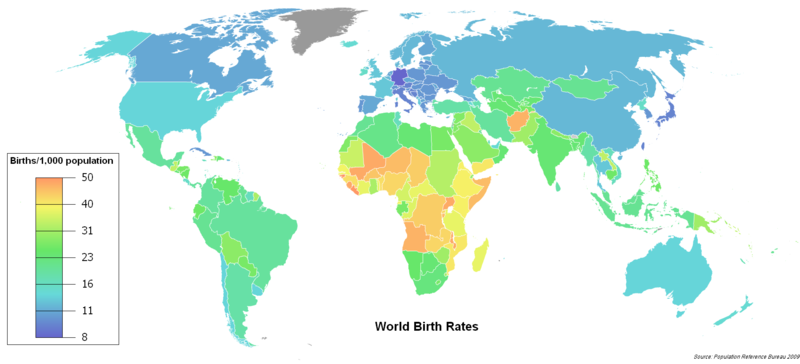
World Birth Rates, 2008, Wikipedia. Blue is bad.

Demographically speaking, and leaving aside all other issues, Western Civ is committing suicide. We have almost stopped making babies.

What is to be done? Some argue that, on the basis of all past history, we are already past the point of no return. But there are some obvious steps that might be taken. Most of them are steps that should be taken on grounds of human rights, equality, or humaneness in any case.

First, and most obviously, make abortion illegal. In the US, for example, this would boost the number of births by about 30%. Besides, of course, the matter of a right to life. Almost solves the problem by itself.


Number and rate of abortions in US to 2005. Wikipedia.

But we also have fewer marriages than we used to and a less stable family life. Without these, children are less likely and less advisable; a man, in particular, could find himself with huge liabilities and nothing but loneliness to show for it. Even if born, children from non-intact families are not going to get as promising a sendoff in life.

To support marriage, the first and most obvious step is to make adultery illegal. Indeed, we probably should make all sex outside of marriage illegal. As it everywhere used to be, until quite recently. We need to end no-fault divorce; if we do not, marriage is an unenforceable contract, and in an unenforceable contract, the innocent parties are always the ones who suffer. We need to outline the responsibilities of husband and wife under this contract, so that neither can be held to ransom; and these responsibilities must be fair and balanced. Sort of like they were in traditional marriage. If individuals want to enter into alternative agreements by mutual consent, fine.

We need to reform laws on child custody; at present, the wife always gets the children and the house, and the husband always gets the bills. This is obviously unjust, and an obvious disincentive to men to ever marry. It borders on the classic definition of slavery.

What would be fair? Either, whoever pays the bills gets to decide custody—“user pays,” natural justice—or the Muslim practice, in which the mother automatically gets custody up to a certain age, and the father after that age. Say seven--the traditional age of reason.

"Affirmative action," aka systemic discrimination, besides being inherently unjust, is also harmful to the family specifically. We know, for example, that the supposed “pay gap” between men and women is really a marriage gap. Without affirmative action, employers gave family breadwinners higher pay than either single men or women. This made good sense for the employer—married, single-paycheque workers are more reliable, more inclined to take orders, can put in more hours, and are more committed to staying on. We need to end all affirmative action programs to permit this to return. As with all discrimination, it must and will end as soon as government gets off the field. A free market ensures this.

The oppression of women by patriarchy in the traditional marriage. "Married life," 1918.

It should be obvious by now, if it wasn’t from the start, that the greatest cause of the demographic decline of the West is, in a word, feminism. By its nature, it is destructive to family life and to the interests of children; leaving aside entirely the interests of men. Because of this, it is detrimental to the overall interests of society, to the greatest good to the greatest number, even if it has been advantageous to women in particular (itself a debatable question). Yet the proponents of this doctrine have been heavily subsidized by public money all along. This is madness, as well as being obviously unjust. Public money should be pulled from all feminist organizations, and at the same time from all other special interest groups lobbying for one particular segment of the population. Any time the government funds such groups, it is discriminatory.

For my part, I would also want to pull all public money from the social sciences, with the possible exception of economics. The social sciences by their nature seem to always become no more nor less than lobbying groups for this or that special interest; and they generate no real knowledge.

We also need to deregulate daily family life. At present, the web of complex, illogical, and unpredictable regulations makes having a child a serious legal liability. Child seats, bicycle helmets, bans on spanking, social workers pulling children because their parents smoke or belong to the wrong political party. Getting rid of social workers is a start—removing public money from the social sciences would mean the government hires no social workers. But most of these regulations also should go. Parents may or may not love their children, but they are far more likely to love them than the state is. Giving advice should logically be the limit of the state’s involvement; if funds permit, giving out free car seats, bicycle helmets, or nutritional lunches to the poor. And help for runaways.

Finally, some parents may be deterred from having children because of the growing costs of, and growing need for, higher education. This does not actually seem to be a major factor—Germany has free post-secondary education, and its birth rate is still cratering. But it also makes sense on grounds of sheer equality and of ensuring that the nation maximizes its productive potential. Post-secondary education should be fully covered by vouchers at public expense, at least for the brightest students.

Might this be too expensive? No. First because you can limit the number of vouchers to match the funds available, and second because the increased earning potential over a lifetime of those students who receive the vouchers should more than return the public investment in future taxes.

Is any of this going to get done? Probably not. No politician dares to go against the desires of organized interest groups for the sake of the common good. If he does, he is most often weeded out at the next election, lacking election funding and volunteers and facing bad press.

It would take a moral revolution first. 

Sunday, November 25, 2012

No Demographic Doom

Isn't this what I've been saying? The Canadian Conservatives can be a model for the American Republicans. There is no reason for the right to fear the immigrant vote.

In other news, someone has pointed out that the Republicans are actually doing better nationwide in state legislatures than at any time since the 1920s. So much for demographic doom.

Wednesday, September 19, 2012

The Demographic Death of Islam


World fetrility rates in 2012, according to Wikipedia and the CIA World Factbook. Note that Iran and Algeria are already in the lowest category.

I am amazed to learn from David Goldman, aka Spengler, that the demographic cliff that faces the developed world and China is also hitting the Muslim Middle East. I thought they were one region that was immune. Just the reverse. He writes that “the Muslim world is on the brink of the fastest population decline in recorded history.”

By the end of this century, Spengler notes, the working population of Western Europe will fall by two fifths, i.e., 40%. The least fertile countries could fall by 60%, i.e., be down to 40% of their current population. Eastern Europe and East Asia will fall by two thirds, 67%. Imagine China with only 33% of its current population--smaller than the US. This is a good deal bigger than the effects of the Black Death.

The US, on the other hand, will grow by 25% over the same period, if present trends continue. Besides having a higher birth rate, the US economy, US culture, and the US political system have the drawing power and the capacity to assimilate immigrants indefinitely, even if the rest of the world is in demographic decline. Canada has similar advantages, but for the weather.

This is a big reason why I think it is wrong to write off the US as “in decline.” Demographically, it looks instead as though its strength will grow against all likely comers. And demographics are the clearest indicator, I think, of who is heading up and who is heading down. The first sign of despair is no longer wanting children; the first sign of hope is wanting them. Moreover, people are the only true source of wealth.

In this context, it is ominous to note that the Muslim birth rate is apparently falling faster than anyone’s.

The Muslim world is not a rising threat to anyone. The Muslim world is not poised to take over; they have their hands full and more than full merely preserving what they have, especially once their strong position in terms of natural resources (oil) inevitably begins to fade. "Islamism" is perhaps a rear-guard action.

Sunday, December 05, 2010

How to Turn Around the Demographics Toboggan

Okay, so surely everyone by now knows that the entire developed world faces a crisis: depopulation. If nothing is done, entire nations will not just enter terminal decline, but actually disappear as nations, within the foreseeable future.

Remember "No dogs or Chinese?" "No Irish allowed"? No children allowed--real sign. 


Massive immigration has been broadly proposed as a solution. But, as we are beginning to see, massive immigration presents its own problems. It can change the fundamental character of the nation—it's Italy, Jim, but not Italy as we know it. Since immigrants too seem to stop breeding pretty quickly once they immigrate, the levels of immigration needed to keep the thing going economically become massive. And we are seeing the tendency not to have children spreading to less developed countries as well—we might even face a prospect, not too far down the road, of running out of possible immigrants.

Some argue that it is too late to stop this. Historically, such declines have never been reversed. Europe, Japan, and perhaps North America are simply doomed.

But there are a few things we could try. Draconian measures, to be sure, but it does look as though draconian measures are called for.

Great sums of money are not available for this project. As a nation begins to shrink in the numbers of employed labourers, necessarily, government revenues also decline. Proposals must therefore be more or less cost-free.


Here's another.


A program:

  1. Immigrant labour could be of one sex only. This ensures that the economy has the benefit of their labour and taxes to feed the system, but they and their culture do not take over. Many will no doubt eventually return home as a result, saving social security costs. Those who stay will need to fully integrate through marriage.

    And need I point out that, if this is our plan, the preferable sex to allow entry is women? Women are the sex most needed for breeding, the breeding bottleneck. The number of children each man can have is virtually unlimited, but each woman can only have a set number of children.

Limiting immigration to only one sex used to be standard practice for many countries; and for exactly the situation the developed world is now facing, the danger of being culturally overwhelmed. Limiting it to females makes much more sense today than it did in the days when women were not as significant a part of the out-of-home workforce.

Let's also take the next logical step and limit immigration to women of childbearing age.

  1. We could legalize polygamy (but not polyandry). This makes sense in itself, but even more sense in combination with point 1, above. This way men can, if they choose, and are financially able, have more children than one woman can provide. Women, no matter how many husbands they have, are limited to about the same number of children. One man with ten wives can easily account for as many children as ten men with ten wives.

Underpopulated areas—desert areas—have commonly used just this solution in the past.

Feminists will object to the apparent sex bias here—and perhaps also in point 1 above. Let's assume they are right. Nevertheless, such measures can be justified by the overriding need for a nation's survival, “such limits as can be reasonably justified in a free and democratic society.” In any case, it would be a form of justice, since our public policies have heavily and openly favoured females for the past fifty years or so; they can stand fifty years of the opposite. The more so since it looks very much as though it was precisely the policies demanded by feminism that got us into this fix in the first place.

  1. Ban abortion and birth control. A no-brainer, surely. If this is arguably beyond the legitimate rights of the state, on some presumed “right to privacy,” banning abortion, at least, certainly isn't. And the state surely should not be in the business of promoting birth control, through sex ed classes or otherwise.

  1. Make all education free but not mandatory, including tertiary education (that is, college, university, and grad school). This will eliminate one significant financial disincentives to having children: the costs of sending them to college. At the same time, the greater costs of subsidizing post-secondary education could be balanced out by the reduced costs for less than universal primary and secondary education, making the proposal more or less cost-neutral.

The obvious problem with this proposal is that it allows some families not to send their kids to school.

Will some families short-change their kids? For sure. But, as a general principle, it is presumably better to be born and be poor than to never be born. And parents can be most often counted on to treat their children better than the state will, because a lot of instincts are in play—the principle of subsidiarity.

The availability of free adult ed later will allow talented and motivated folks, if necessary, to make up by themselves in adulthood some of the deficiencies in their upbringing. The increasing availability of online education should also help with all this—lowering the cost of education for the government, and making it more readily available to those who also work.

Apart from its value in encouraging people to have kids, this approach is necessary for the sake of human dignity and freedom. So long as school is mandatory, it becomes a tool for social indoctrination. It infringes on the rights of the parents to follow their own consciences, and it infringes on the right of the children to freedom of thought and of association. When we require the same of adults—compulsory attendance at an institution—we first have to prove them guilty of some crime.

Allowing this freedom may in turn, for many prospective parents, be a deciding factor in having children.

  1. If we make all sex outside marriage punishable, this not only protects marriage, by discouraging adultery, but encourages people to get married.

    Many will argue that allowing the state to regulate sexual behaviour is an invasion of privacy. It is not, so long as sex has to do with procreation. For so long as sex involves procreation, there are more people involved in the act than the two in the room.

  1. End all “affirmative action” programs on grounds of sex. Studies suggest that, without affirmative action, men are not paid more than women, proportionate to their education and experience. Rather, married men are paid more for the same work than are unmarried men or women, helping them support a family. Nor is this a deliberate subsidy for families: married men are more stable in their jobs, will commit more time to them, and so are of more value to an employer. Affirmative action therefore works not to equalize pay between men and women, but to discourage marriage and childbearing and to keep kids poor. Besides being against the economy's, hence everyone's, best interests.

  1. Make homosexual sex illegal. While this may not be a significant factor, it may be; the science is out. If homosexuality is at least partly voluntary, prohibiting homosexual sex will drive at least some people instead into heterosexual relationships that can produce children. And so long as there are some who are, self-admittedly, “bi-sexual,” making homosexual sex illegal will push them in the right direction.

Note that homosexual sex, in this case, would be in no better and no worse position than heterosexual sex outside marriage. The matter must be specified separately, however, because of the new option of “homosexual marriage.” Simply repeal it, and there is no need for a separate statute against homosexual sex.

  1. Abolish child labour laws.

    If children can work and earn money, even if their life is arguably not ideal, they have economic value. Is it better to have to work for a living, or not to live at all? And if work is so terrible, why are feminists demanding it?

Facing a lower overall cost, parents are more likely to have kids. Will the kids be abused and worked to death? This is intrinsically unlikely, since humans are born with paternal and maternal instincts. But even if they lack this, have no shame, and are driven only by narrow self-interest, their self-interest dictates that parents take good care of the health of a family breadwinner.

There is also the issue of a right to work: children may want to work, and have the dignity of earning and spending their own money. Lots find it a gas to have a paper route or to try their hand at a lemonade stand. If so, it is unjust to deny them this.

  1. De-regulate parenthood and childhood. Each new law or regulation requiring something of a parent—car seats, bicycle helmets, seat belts, and so on-- is a disincentive to have kids. Yet these restrictions and regulations have been rapidly multiplying. One suspects they have become a popular way for society to punish “breeders.” As before, parents should be trusted before the state or an inflexible law to decide what's best. They won't, of course, always.

  1. If there is to be immigration, immigrants should be selected on the basis of compatibility with the majority culture. This is not racism; this is just common sense, and necessary in order to preserve that culture. We accept and understand this when it comes to language. But just as those who already speak English well are most likely to assimilate to an English-speaking culture, so too, those who are already Christian are most likely to assimilate to a majority-Christian culture. Those from functioning democracies ought also to have preference in immigrating to a democracy, those familiar with common law in their home countries to a country that follows English common law, those familiar with a cold climate to countries like Canada with a cold climate, and so on. No consideration should be given to DNA or skin colour, but we have thrown out a lot of babies with that bath water.

Forgive me for being politically incorrect. You noticed, didn't you?