Playing the Indian Card

Showing posts with label Social Darwinism. Show all posts

Friday, March 15, 2019

Silencing the Guns of August


A lesser breed.

What would have happened if the First World War had not?

A fascinating speculation, because the First World War seems to have wrecked so much. All the magical princesses and dukes in their satin finery; Yeats’s “ceremony of innocence.” One can imagine that all was well in Western civ until it happened, and Western civ has never recovered. Beauty itself seems to have died then. Our confidence in the good and the true.

Fascinating as well because there is a general sense that it was far from inevitable, that it broke out more or less by blunder.

So what would have happened?

I find that in the end I cannot imagine anything being much different. Or rather, I really cannot imagine it never happening. It actually was, I suspect, no blunder, no mistake, and  not evitable. The problem began with Charles Darwin, back in 1859.

The war was started by Germany, make no mistake, and if it had not come to war this time, Germany was going to make a war within a few years somehow. I see no peaceful trajectory for a prewar Germany; barring what God did to Sodom and Gomorrah. Germany had done very well for itself with a series of European wars in the later nineteenth century, with Denmark, then Austria, then France, and they were cocked and ready to try for the big one: hegemony. They had rattled sabres to the verge of general war several times in the years leading up to 1914. They were going to keep doing so until it came to that.

It is fashionable these days to insist that it was all started blindly by the system of rival alliances. Nobody wanted it, but nobody could stop it once this machinery was set in motion.

Not believable. The intent and value of alliances was to prevent war, to make it less likely, not to make it more likely. Even the Triple Alliance, the stronger of the two, was purely defensive in nature.

Literally, treaty obligations did not cause the war. There was nothing mechanical about it. Russia had no treaty obligation to defend Serbia in case of war. Even if they had, Germany declared war on Russia, not the other way around. Treaty obligations did not require Germany to do this. Russia had not attacked Austria-Hungary, and had not declared war.

Once Germany and Austria had declared war on Russia, treaty obligations still did not oblige France to go to war on Russia’s behalf. The Entente between them was not a formal defensive treaty. Even had it secretly required action by the French, this was a moot point--since it was Germany who declared war on France, not vice versa. And this was obviously not required by any treaty signed by Germany with anyone. This was a conscious strategic decision.


Germany did, on the other hand, go to war with Belgium in open violation of treaty obligations.

The only major power that actually did declare war because of treaty obligations was Great Britain, based on the old (1839) defensive treaty with Belgium. The same one Germany had violated.

In other words, the system of mutual defense treaties did not cause the war. Instead, a stronger set of public alliances before the war, a clearer deterrent, might have prevented it. Would Austria have gone in to Serbia had they known this would draw in Russia and France? Almost surely not. Would Germany have invaded Belgium if they knew this would bring in the UK?

When Austria-Hungary sent its ultimatum after the assassination of Archduke Franz Ferdinand, Serbia, far from being belligerent, acceded to all but one of a set of outrageous demands. They went as far as they could this side of surrendering their sovereignty. Austria was plainly set on war regardless. Given how militarily shaky Austria was on its own, this demonstrates the powerful influence of Germany in the background.

Kaiser Wilhelm reputedly expressed disappointment at Serbia's response to t he Austrian ultimatum. “A great moral victory for Vienna," he wrote. "But with it every pretext for war falls to the ground.” Austria got what they wanted; he did not. He wanted a big war. 

By his own evaluation, moreover, this means Austria and Germany went to war without a decent pretext. One might want to put the blame on Austria—but Austria might have expected only a local war. And Austria had what it wanted without war. It was still Germany that made it general, by declaring war on Russia.

And this seems to have been preordained. When the German ambassador visited the Russian Foreign Ministry to present the declaration of war, he actually gave two separate written memos. The first declared war because Russia had not responded to the German ultimatum to immediately demobilize. The second declared war because the Russian response was deemed inadequate.

In other words, the declaration of war seems to have been decided in advance, regardless of the Russian response.

"The Crucified Canadian"; a famous German war atrocity of the time, now often disputed. Here features in a poster from the Philippines.

Social Darwinism was no doubt a factor across Europe. But this was especially so in Germany. This was pointed to by Rudyard Kipling in 1897. In his poem “The Recessional.” He wrote:

If, drunk with sight of power, we loose
Wild tongues that have not Thee in awe,
Such boastings as the Gentiles use,
Or lesser breeds without the Law—
Lord God of Hosts, be with us yet,
Lest we forget—lest we forget! 
For heathen heart that puts her trust
In reeking tube and iron shard,
All valiant dust that builds on dust,
And guarding calls not Thee to guard,
For frantic boast and foolish word—
Thy Mercy on Thy People, Lord!
Kipling was apparently referring to the Germans, and their atheistic pseudo-scientific “master race” ideology. “Reeking tube and iron shard” as resident idols rules out just about anyone else. It was probably generally understood at the time. Hitler and the Nazis did not suddenly invent this stuff in the 1930s. How could they? It goes back clearly at least to Nietzsche and his ideas about a “master morality” and a “slave morality.”

When war began, there was considerable popular resistance in the UK to getting involved. Witness later events in Ireland. This was also obviously true of the US. Notoriously in Canadian terms, this was so in Quebec. No jingoism, no militarism, no notions of a master race, no Social Darwinism, among the democracies.

In France, it was the same story. As the Serbian crisis unfolded, pacifist demonstrations against war easily outnumbered nationalist demonstrations against Austria or Germany.

Visible support for war was stronger in the monarchies of Austria and Russia. This might only have had to do with a relative lack of free speech and of the right to protest. But neither could match Germany here. In Germany, contemporary witnesses reported real popular enthusiasm for a fight. Hermann Hesse, from Switzerland, wrote in the German press expressing alarm over the warmongering and anti-foreign attitude that he witnessed: “Friends, not in these tones!” 

German execution of leading civilians of Blegny, Belgium.


There were many reports of German atrocities in Belgium at the start of the war. These are often now dismissed as mostly British propaganda. But Vernon Kellogg, neutral American present during the German invasion—presumably a detached observer—was alarmed by the Social Darwinist philosophy he heard espoused by Germans he encountered.

“Initially a pacifist, Kellogg dined with the officers of the German Supreme Command. He became shocked by the grotesque Social Darwinist motivation for the German war machine - the creed of survival of the fittest based on violent and fatal competitive struggle is the Gospel of the German intellectuals.” (Wikipedia).

Kellogg sounded the general alarm in his book Headquarters Nights.

It is commonly said that the Treaty of Versailles assigned full war guilt to Germany; and that this was a major cause of the Second World War in turn. This is not quite true. The treaty spoke of German “aggression,” but not war guilt per se. And this was diplomatic boilerplate. Almost identical phrasing was put in the peace treaties with Austria or the Ottomans or Bulgaria. It was required to justify reparations.

Interestingly, in no other nation did the general population make much of it, or read it as assigning overall guilt. Everyone else indeed took it as boilerplate. Why the difference in Germany?

A clear case of “methinks the lady doth protest too much.” The extreme German reaction betrayed awareness of being in the wrong. This is typical of someone with a guilty conscience, when they are not prepared to reform. They tend to react hysterically when someone points out their guilt.

Italy had an alliance with both Germany and Austria, requiring them to come to their aid if they were attacked by Russia. Italy did not come to their aid. In taking this position, Italy declared their opinion that Germany and Austria were the aggressors.

Britain and the US, both neutrals at the start of the war, both also separately concluded that Germany was the aggressor, and chose sides accordingly. 

US enlistment poster

That looks close to a consensus by neutral parties.

One can be cynical and suppose that this charge of German aggression was a cover for simply acting in their own best interest. But Britain, the US, and Italy were all functioning democracies, to a far greater extent than Germany, Austria-Hungary and the Ottoman Empire. There was a limit to the amount of deceit they could get away with; they needed to worry about public opinion. Their general public had to buy it as well.

Why, in the face of the evidence, does everybody seem so keen to deny German war guilt?

I think it is a typical case of a general human tendency to deny the existence of evil. We want, absurdly, to insist that, if Hitler was evil, he was uniquely evil, and single-handedly responsible for everything in Nazi Germany. He was, we are told, a “madman.”

That is obviously ridiculous. Were he at any point clearly mad, those around him would have stopped obeying his orders. Nor did the vast majority of what happened in Nazi Germany depend on any kind of explicit orders from Hitler.

Perhaps it is too frightening for us to admit that a large proportion of any population, even a majority, can indeed choose to be evil. Perhaps it is frightening because it requires us to examine our own motives and acts—might we, too, be doing evil? Much safer to keep whistling past that graveyard.


Tuesday, September 22, 2015

The Decline and Fall of Everyone


Not the way it usually works.

Contrary to what you commonly hear, social Darwinism, the idea that survival of the fittest applies to human nations and cultures, was no perversion of Darwin's original theory. Darwin himself was the first social Darwinist. It was the subject of his later book The Descent of Man. Leading pretty directly to the First and Second World Wars.

In Descent, Darwin makes the interesting observation that, when cultures are no longer, for one reason or another, competitive in the evolutionary struggle, they are not necessarily defeated militarily by some neighbouring tribe. They often seem instead to simply lay down and die. Darwin cites a Mr. Sproat, who observed the Native Indians of Vancouver Island, over time, become “bewildered and dull by the new life around them; they lose the motives for exertion, and get no new ones in their place.” (Darwin, p. 542). That sounds, indeed, like what has happened to native cultures in North America generally.

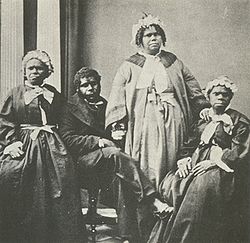
Soon, fertility declines. Darwin tracks the rapid fall in the number of Tasmanian aboriginals. Far from being exterminated by the Europeans, according to Darwin, the Tasmanian government took every effort to keep them going. Nevertheless, the native islanders seem to have simply stopped reproducing. “At the time when only nine women were left at Oyster Cove, … only two had ever borne children: and these two had together produced only three children” (p. 548). Among the Maoris of New Zealand, similarly, Darwin quotes figures that, in 1844, there was one child for every 2.57 adults; in 1858, only 14 years later, there was one child for every 3.27 adults. In Hawaii, after contact with the Europeans, fertility fell to “half a child for every married couple in the whole island” (p. 552).

Last four Tasmanian aborigines, 1860.

I don't think these examples bear out Darwin's theories; they suggest a spiritual instead of a material cause for the rise and fall of nations. Do animal species die out from ennui? But they are of interest in showing how depression works, and that it is primarily a loss of meaning. A culture or an individual, coming into contact with a new culture, is automatically challenged in their prior assumptions. If that new culture is different enough, and seems to offer plainly superior results in some fields, this is necessarily powerfully so. Everything seems, to the individual in the less developed culture, to become pointless, as all the old signposts and destinations seem disproven. This, I suspect, is what African cultures refer to as “loss of soul.”

Hence the shock and depression in these cases almost entirely hits the aboriginal, not the European, culture.

The same effect, not incidentally, can be achieved by surrounding an individual with consistent lies, which challenge his own common sense and experience, as happens in a dysfunctional family. It can happen on a broader, social level when a culture for whatever reason departs generally from common sense and common experience, with or without any outside pressures upon it.

The culture or the individual is then caught between a spiritual Scylla and Charybdis. He dares not leap nor stay behind. There is the same sense of purposelessness as with the “lazy Indians,” or for that matter, the “lazy negroes,” like a car that cannot get into any gear. Hence the lack of interest in sex, which is really a lack of interest in procreation and childrearing. To have a child is a vote that the future will be better, not worse, than the present.

First point: the reality that these things happen disproves the idea of cultural relativism. All cultures are not equal, or culture shock would be more evenly distributed. Second point: such things are not the superior culture's fault. Time to get rid of notions of “cultural imperialism” and “cultural genocide.” Third point: there is a cure to depression, and it is to make the leap.

In other words, broadly, the residential schools were the right idea, and our current drive to resegregate and revive aboriginal cultures will only prolong the problem.

It is also interesting to see that the clearest symptom of this problem on a cultural level is a decline in fertility rates.

We have such a decline, of course, currently across the West. Our culture generally has strayed too far from common sense and common experience. If it does not correct itself, it will die, as did these others.

But who will replace it? Fertility rates have fallen even more disastrously in East Asia. And they are falling in South Asia (i.e., India). And in the Middle East. In Russia, they have long been alarmingly low. So much for possible competing civilizations. In fact, fertility rates seem to be falling just about everywhere.

All of this is actually prompted by an article from David P. Goldman, “Spengler,” on the demographics of modern Iran. Fertility there has fallen from 7 children per woman in 1979 to 1.6 in 2012. This is a bigger decline than has ever been seen before in a large, developed country.

Clearly, there is something very wrong with the spiritual climate, and there are as yet no solutions in sight.


Tuesday, December 01, 2009

Darwin and Mein Kampf

Among the lies we are all taught in school is that bit about “Social Darwinism.” You remember it, don't you? As we were solemnly taught, the late nineteenth and early twentieth centuries were cursed with an unfortunate pseudo-scientific misapplication of Darwin's Theory of Evolution, the idea that humans and human societies continue to develop along the lines of natural selection. But of course, this is wrong, right? Evolutionary pressures no longer apply in human society, right?

In fact, it is not a misapplication at all. It is an integral part of the original theory, as argued by Darwin himself. In The Descent of Man, Darwin claimed in so many words that “social qualities” were acquired through natural selection, in a competion of tribe against tribe, race against race, natio n against nation.

Darwin accordingly asserted with the perfect scientific objectivity of history's greatest biologist that the “western nations of Europe ... immeasurably surpass their former savage progenitors and stand at the summit of civilization.” He also assumed that “at some future period, not very distant ... the civilized races of man will almost certainly exterminate and replace throughout the world the savage races.”

A rather brutal concept of Empire, surely. Obviously, for Darwin himself, evolutionary pressures continued. But the picture was a bit more complicated than it might first appear. As a Briton, Darwin was no doubt at least a bit concerned by the thought that victory was not always to the most civilized per se, but to the fittest. Civilization had its obvious benefits, but it could be carried too far—in fact, Darwin argued explicitly against allowing evolutionary pressures to cease to apply to human society, on the grounds that any human society that permitted this would eventually be doomed.

“If we do not prevent the reckless, the vicious and otherwise inferior members of society from increasing at a quicker rate than the better class of men,” he warned, “the nation will retrograde.” A younger, more vital, less principled nation might supplant it. Continued advancement required that human beings “must remain subject to a severe struggle.”

The fact of Darwin's own “social Darwinism” has been suppressed, of course; as well as his arguments for it, which unfortunately seem to meet in advance the arguments against natural selection applying in human society: if they do not for one society, so much the worse for it in the end!

This, of course, is because it is only too obvious that Darwin's theory leads directly to the Nazi and Fascist theories of racism, amorality, and the virtues of war and conquest. Everything they asserted, believed, and did, follows directly from Darwin. Germany, Italy and Japan saw themselves as just the sort of young and vital nations to take out the old, “decadent,” “plutocratic” England and France in the evolutionary struggle. Hitler's “Kampf,” as in “Mein Kampf,” was a Darwinian reference. The future belonged to them, of a scientific certainty—unless, that is, they let the Slavs develop far enough to jump them from behind.

Hence an obvious problem for the powers that be: it would seem that either a) Hitler was right, or b) Darwin was wrong, and not just about Social Darwinism, but Darwinism itself. Not wanting to accept either contention, they have essentially suppressed the issue, looked away, chucked the relevant evidence as much as possible down the memory hole.

It was, for example, not because of some fervent belief in a literalist interpretation of Genesis that William Jennings Bryan fought Clarence Darrow over the teaching of evolution in the Scopes “monkey trial.” Bryan, after all, was a politician, not a preacher. He feared that the general acceptance of Darwin's views would destroy liberalism, not Christian fundamentalism—though Bryan quite rightly understood that liberalism depended on a Judeo-Christian foundation.

And Bryan was proved dramatically right, within just a few years.

Unfortunately, the attempt to simply suppress and ignore the issue inevitably leads to the same deductions from Darwin being made all over again, over time. Elements resurface in such movements as feminism, postmodernism, and the new atheism; given enough time, on this path, a full-blown rerun of Nazism is probably inevitable.

But there is another way to look at it. Arguably, World War II itself tended to disprove Darwin. Certainly, there were too many variables to make the experiment truly valid, but Hitler and his allies did everything Darwin suggested they should, and the result went decisively against them.

More broadly, Darwin's fears about the future decay of developed “decadent” nations in which more or less everybody survives and breeds have been proved wrong in an important way. In the absence of survival pressures, the more so with modern social security and health care, according to Darwin, each subsequent generation in the most developed countries ought to be a little less intelligent, and a little less physically able, than the last. “The rich get richer and the poor get children.”

Yet what has actually been happening? Leaving aside the performance of schools, which has apparently been generally declining for independent reasons, we discover that the average IQ, in the most developed countries, has been increasing in recent times by about three percentage points each generation. Meantime, Olympic and other sports records have been falling at regular intervals over the past hundred years, most often to athletes from more developed countries.

This is the opposite of what Darwin's theory predicts. Without natural selection, this general tendency towards physical and mental improvement (i.e., survivability) of the species and the tribe ought to have stopped, then reversed. Darwin's theory, and Darwinian evolution, the idea of “natural selection of random mutations” has thus been demonstrated not to be predictive. In proper scientific terms, it has been proved false.

These data argue instead for an intelligent design: an evolution that is not random, and is not powered by a struggle of all against all.