
This is not a tenable position. See our SubStack post.
Thursday, July 16, 2026
Monday, December 23, 2024
The Two Kinds of People
There are, in this world, two kinds of people: those who accept the existence of God, and those who try to deny it. Never the twain shall meet; these are perfectly incompatible views, like humans and zombies. The instant you accept the existence of the absolute, it is necessarily of absolute importance. Those who do not see it are, at charitable best, insane. They are not in the conversation.
Deniers, similarly, cannot tolerate believers. Ultimately, the existence of God is certain and accessible to reason. To deny God is therefore to turn from God, to dodge the truth.
People turn from God because they are conscious of doing wrong, or want to do wrong. They don’t want to accept the existence of divine justice. They want to get away with it; like Adam and Eve hiding in the bushes. Religion is a “religious dictatorship.” Anyone who asserts the existence of God, genuinely claims to believe it, is a threat to them, and must be shut down. Churches burned, Christmas markets attacked.
The most obvious tactic is to infiltrate any convenient religious body themselves, and seek to subvert it. This is the Pharisee gambit; they are common in every religion. I became all too familiar with them studying religion in grad school. Within the department, you gained approval by saying the most outrageously skeptical and irreligious thing. The sincerely religious were mocked as ignorant.
I thank God I escaped that. But it was not easy. Most higher education is cult-like.
Sunday, June 16, 2024
Religion vs. Spirituality
These days, many people claim to be “spiritual but not religious.” What do they mean by that? It is an inherently vague claim, as though they are hiding something. However, this list of distinctions recently popped up in my Facebook feed:
Religion vs Spirituality
• Religion: worships God. • Spirituality: encourages oneness with God.
• Religion: God is outside of you. • Spirituality: God is within you.
• Religion: separates people who have different beliefs. • Spirituality: unites people regardless of their beliefs.
• Religion: teaches people to be afraid of hell. • Spirituality: teaches people to create heaven on Earth.
• Religion: based on fear and restriction. • Spirituality: based on love and freedom.
• Religion: feels like being a single drop in the ocean. • Spirituality: feels like being the entire ocean in a single drop.
• Religion: based on others' experience. • Spirituality: based on your personal experience.
This makes clear how sinister “spirituality” is.
Taking the points in turn:
“Oneness with God” can mean either of two things: dissolving selfhood in the divine oneness, as Buddhists hope to do; or deciding one is God. A later item on this list makes clear which is meant here: the Buddhist concept is of being a single drop lost in the ocean. The “spirituality” concept is that you are the ocean. This is the sin of hubris, which we sometimes today less properly call narcissism. “I am the entire ocean of being. No one else exists.”
Hubris leads to bad things.
The second point in our list is about the same. Christianity stresses that God is present within your soul or consciousness: Jesus knocks at the door of your heart. “The kingdom of heaven is within.” The distinction must be that to the spiritual, God is encompassed by your ego and your will, “within” in this more complete sense. God is you.
The third point is correct that religion “separates people who have different beliefs.” It unites people around common beliefs; but necessarily, so long as there is not one world religion, it excludes from this unity others who do not share those beliefs, to the extent that they do not. But spirituality not more unifying. It is everyone having their own unique beliefs. It is all alienation, lacking any unifying function. What happens when two people both believe they are God, and disagree? One must eliminate the other.
The fourth point claims that religion ‘teaches people to be afraid of hell.” According to religion, this is conceptually false. Everyone has a conscience; which is to say, everyone fears hell. Religion does not instill that. Every culture assumes the cosmos is ultimately just, and there is payback for immoral actions. The eastern faiths speak of karma; the pagan Greeks said even the gods are subject to Dike, cosmic justice, and the Erinyes will pursue an evildoer. Hell is universal, and pre-exists religion.
Religion emerges to offer escape from it.
To blame religion for hell is like blaming your doctor for illness, and supposing you can avoid it by not seeing him.
Spirituality, point four goes on to say, seeks to “create heaven on earth.” Trying to do this has led historically to unimaginable atrocities. This is the Holodimir; this is the Great Leap Forward; this is the Nazi quest for the superman; this is the Killing Fields. In Biblical terms, this is the Tower of Babel and this is the antichrist.
It sounds like a worthy goal. Why does it always go wrong?
Karl Marx’s favourite aphorism, according to intimates, was Mephistopheles’s line from Faust: “everything that exists deserves to be destroyed.” This is where millenarianism seems to lead. One looks at what exists, sees its imperfections, sees it does not fulfill one’s deepest desires, and so one must destroy it.
Point five: it is not entirely false to say that religion is based on “fear and restrictions.” The fear of God is the beginning of wisdom, the Bible says, and the word “religion” means restriction, “binding.” Admitting that God exists and is not us indeed imposes obligations: to seek and honour truth, to treat others with respect, to be humble and to admit our own limitations. Religions also generally impose ritual obligations. Where’s the fun in that?
The “freedom” spirituality offers is freedom from this: freedom from the need to honour truth, to treat others with respect, or to admit our limitations. Which is to say, it offers narcissism.
This is not real freedom. One quickly becomes a slave to one’s desires, all of which are incipent addictions. More alcohol, each time less satisfying. More sex, each time less satisfying. More power, each time less satisfying. True freedom is the freedom to follow one’s conscience. This is what religion offers.
To say spirituality is based on love is a lie. “I am the ocean; nobody else exists” is the opposite of love. Christianity, on the other hand, is explicitly based on love, and on the proposition that “God is love.”
Love is not a transitory feeling, and not sex. Love is not what one feels towards a well-cooked piece of meat. True love is seeking the best for the other, which means a set of obligations towards the other. “If you love me, keep my commandments.” This is what spirituality rejects.
I am not sure what to make of the final claim, that religion is based on others’ experience. This denies the central tenet of Judaism, Christianity, and devotional Hinduism that we must each have a personal relationship with God. And it denies the central tenet of Buddhism, that theory is irrelevant, it is all about the personal experience of enlightenment. So what is meant here?
That religion builds on the experience of others. It offers tested techniques for achieving and sustaining that personal experience of the sacred, spiritual world. To reject that is equivalent to rejecting science or education, in favour of working it all out for yourself. What is the benefit?
Unless, of course, you are God. And can simply decree reality to be whatever you want. Gravity exists only at your sufferance.
My advice: if anyone tells you they are “spiritual, but not religious,” back away slowly, and stay away.
Thursday, July 22, 2021
Requiem for the Sixties
The 1960s was a good idea that went terribly wrong; or at least, there was a good movement underlying it, that then over time got flooded out by a bad one.
As I saw it then and see it now, the Sixties were a rebellion against the materialism of modern society; behaviourism, demands for conformity, the growth of government and big business control; the rat race. This was headed in a spiritual direction, and ought to have ended in a religious revival. I really expected that to happen. The folk songs were religious, at the start of the decade; everyone was interested in Zen, TM, Eastern Religions. LSD was “mind expanding.” The Byrds publicly converted to Christianity, although no one seemed to notice. Bob Dylan publicly converted to Christianity. Jack Kerouac introduced us all to Zen, and declared himself a Jesuit general. George Harrison went Hindu. The “cults” appeared: the Hare Krishnas, the Children of God, the “Jesus freaks.” I saw it happening; it was starting to snowball.
Politics was there, but secondary. The main thing was to end the war and make drugs legal. That, and civil rights for blacks. But these are libertarian concerns; libertarianism is currently considered on the right. And perhaps was then as well. Kerouac claimed to support Taft; Dylan claimed to support Goldwater. Jerry Brown got hippie support, but this is because he embraced libertarianism: “small is beautiful.” Eugene McCarthy got hippie support, but on the single issue of ending the war.
There was a Marxist strand too—Marcuse and the New Left—but that was more something you heard about from Europe. That was no more politically mainstream within the hippie movement than “hip capitalism.”
Why did it all go weird? Why were the cults shut down? Why did it all get identified with Marxism, “political correctness,” big tech, and a resurgent demand for censorship, materialism, and conformity?
At the time, we blamed the “yuppies”; who toyed with the spiritual ideas, but ended up selling out. But the real poison, I suspect, was sex. What we used to call “The Pill” was a poisoned pill.
Perhaps some future generation will do better. Or perhaps such things cannot be left to the young, whose natural urges are so strong.
Friday, February 07, 2020
The Death of Christianity Foreseen
![]() |
| A dying Pentecostal church in Mexico |
Rather, he seems to be consoling himself with the thought that everyone is going down with all hands, not just his own church. So it is not as though they might be doing anything wrong.
But I think saying “the agnostics are winning” is deeply misleading. Worldwide, atheism and “agnosticism” is on the decline. In North America, the real growth is in “spiritual but not religious.” I expect the reader has heard this phrase often, as I have.
The only way to make that oxymoron coherent, it seems to me, is to read it as “religious in principle but not affiliated.”
Xerxes notes that megachurches still grow exponentially, but then they commonly decline when a particular pastor dies. This seems to illustrate the principle: people want religion, but no longer have brand loyalty.
The first obvious reason why this is so is that people increasingly think about religion like consumers. Partly, they have a greater range of choices, living more and more in larger urban centres. Partly, they have fewer existing family and social ties making them feel committed to a particular ecclesiastical community.
Another reason, it seems to me, although Xerxes is eager to deny it, is that mainstream denominations and clergy have lost their own faith, and so have little on offer. When you hear all the same things at church as you hear on TV or at the mall, why go to church?
Another reason, I suspect, is that, with growing prosperity and so growing sense of privilege, many people are less inclined to submit to a moral code of any kind. They want a purely “feel-good” religion that does not require anything of them. Moving from church to church tends to preserve that option—of not being bound by anything.
I see this in the growing interest in Eastern religions, or “New Age.” You just pick and choose what sounds pleasant, and leave whenever it gets hard.
The lower rate of Sunday attendance, I think, also involves a separate issue. There are just a lot more options for what to do with your free time today than there once were. Back in the day, listening to a good sermon was the high point of a Toronto weekend, and the best were summarized in the Monday papers. Year by year, more options have become available, while the quality of church services has barely changed in any way—with, at times, the exception of this or that megachurch. Of course attendance will have gone down. We have seen a similar decline in attendance at social clubs of all kinds, voluntary associations, bowling alleys, movie theatres. You name it. When I was a kid, the most fun was to go out and play scrub baseball until the sun went down. I can’t get my own kids to put down their tablets long enough.
But Xerxes is also wrong to maintain that all Protestant churches are declining.
“And don’t protest that congregations in Texas or Arizona still have packed pews and booming Sunday schools. They’re also declining. They just lag 40 years behind the Canadian experience, 70 years behind the U.K. and Europe.”
The basic assumption here is flawed: that the US and Canada are following a European trend, but lagging far behind. Since the Second World War, the US has been culturally dominant: while there are smaller waves that have moved in the opposite direction, most things start in California. This seems like much too big a wave to be moving in the opposite direction. And it seems wildly improbable for any cultural wave, in these days, to lag as much as seventy years in moving from continent to continent.
Rather, I think Europe and North America diverge here because Europe was profoundly dispirited by the two World Wars, and lost their cultural confidence in a way the US and Canada, far less affected, did not. Hence the more aggressive abandonment of the old cultural verities there—the entire continent seems to have been trying to commit suicide since 1918.
But even with the overall decline of Christianity in Europe, worldwide, the growth of Christianity is explosive. Pentecostalism, in particular, is growing, and even in North America, both Pentecostalism and officially “nondenominational” congregations are growing. It is only the Protestant mainstream that is in decline.
Friday, June 10, 2016
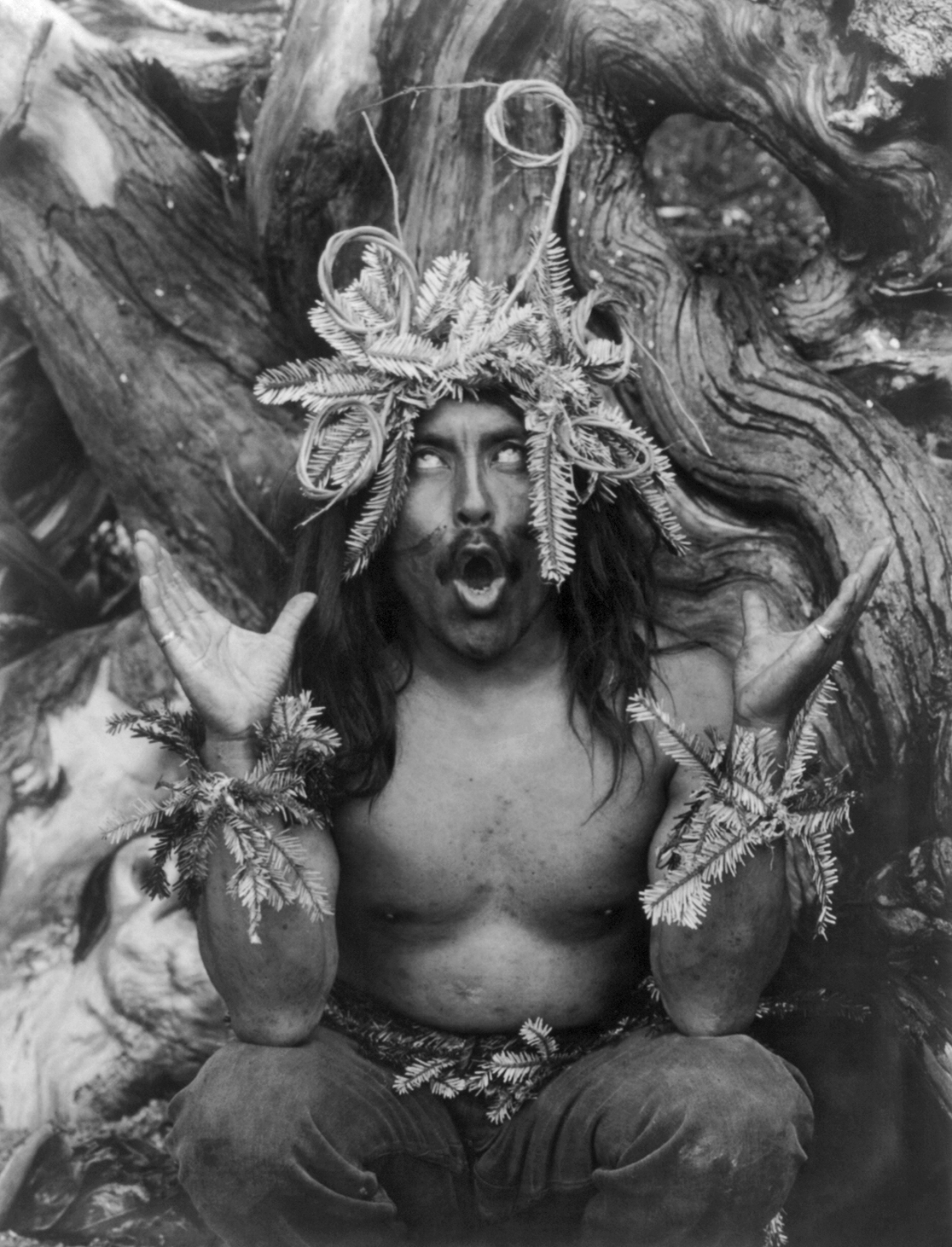
Shamanism in Chains
![]() |
| Indian shaman |
According to a June 8 story in the National Post—I need simply cite the title--“Prisons pay more for native spiritual services than all other faiths combined.”
I see several problems here. First, it seems that the Canadian prison service knows only of cartoon Indians. While one quarter of those incarcerated, sadly, are aboriginal, most real Indians are either Catholic or Anglican. Only five percent of federal prisoners identify themselves with “native spirituality.”
This means that we are giving wildly disproportionate funding to the religion of a small minority. In doing so, with taxpayer dollars, we seem to be violating the principle, one our ancestors fought hard for in early Canada's history, of funding no established religion. No problem with governments funding religion—even if you are not yourself a member of any faith group, you must surely recognize that religion serves useful social purposes, and is of value to the society as a whole. We fund, in Ontario, the Catholoic separate schools. But funding must be in proportion to the proportion of the population, or it amounts to an established church.
Consider, too, how you might feel as an aboriginal Anglican or Catholic, seeing all this extra money going to “Indian spirituality.” The message from above seems to be, those above you look more favourably upon, and want you to convert to, native spirituality. Perhaps doing so might give you better treatment in other ways. Perhaps an earlier parole?
![]() |
| Salish shaman |
Given that “native spirituality,”unlike Anglicanism or Catholicism, has no moral element, is it really even in our general interest to promote this sort of conversion, let alone the obvious injustice?
And those not of native ancestry, for whom converting to “native spirituality” is not a realistic option? Too bad; they are simply second-class citizens, and made by this to understand so. Great thing, for inspiring them to have confidence in the justice system.
On top of this, threre is a further problem. There is a reason why we have no proper name for this thing, that we are forced to refer to as “native spirituality.” There is no such religion as “native spirituality.”
When the first Jesuits came and dwelt among the Indians, they reported back to France that the Indians as they encountered them had no religion. And they were right: in Korea, with a shamanic tradition similar to that of North American aboriginals, local friends insisted to me that shamanism was “not a religion.” That, to them, was a fundamental misunderstanding. Buddhism is a religion. Christianity is a religion. Islam is a religion. Shamanism is not a religion. It is a set of magical practices. It is like going to a fortune teller.
“Religion” literally means “binding.” To have a religion is to take on moral and ritual obligations. This is why we protect “freedom of conscience.” The religious need legal protection: laws must not interfere with anyone's prior religious obligations.
But shamanism, unlike religions, imposes no obligations, any more than using the services of a plumber or a dentist. There are no regularly-held rituals, and nothing that would be identified as “ritual” by a real practitioner. Individuals who consult a shaman might be concerned with being moral, or unconcerned; shamanism itself has no moral teachings. One simply goes to a shaman when one needs something done. He or she claims special expertise in dealing with the spirit world. Accordingly, he can tell you your future, sell you some charm for luck in the hunt or the next examination, put a curse on your enemies, lift a curse on you, perhaps heal you of an illness. All, in the end, practical matters.
![]() |
| Indian shaman |
Shamans are otherwise not widely beloved or welcome presences, as, for example, a priest or minister might be. They are not moral guides or exemplars, as might be useful in the prison situation. Indeed, if you are an Indian, they are generally avoided if possible. They are a bit of a burden and a risk to have around. They bring spooks. They also sometimes demand obedience to their desires and perhaps regular payment in return for not laying a curse on you, resulting in some loathsome disease.
Accordingly, any authentic shamanist might not thank Prisons Canada for making sure one of their ministers is always around.
Much is made of the “sweat lodge” ceremony as an Indian religious ritual. But this is not a regular observance, like going to church. It is done for health, and usually because you are sick. Not different, in principle, from a Swedish sauna. Putting in a saune might be a good idea, too, but it should then be available to all prisoners, without discrimination.
Other than t his, and no shaman is needed or wanted for this, there are no regular observances or rituals that an Indian shamanist needs his “minister” to perform. They might at times be useful to put a curse on a particular prison guard, or some fellow prisoner. Perhaps causing much strife within the prison—yeah, that ought to help. How badly do we, as taxpayers, want to fund this?
There are, of course, no seminaries for shamans, no ordinations, no governing body. In a real, living Indian community, one managed to support oneself as a shaman by developing a reputation among the other people of your village for effective cures or curses. This works, after a fashion, so long as the usser pays.
So—somebody claiming to be an Indian shaman shows up at the prison gates, demanding payment for his services as a chaplain. How is the prison system establishing his bona fides? Does he first have to demonstrate his ability to make it rain? Or is this just a matter of random handouts?
And then again, there is the awkward matter of animal or even human sacrifice, which shamanism, having no moral dimension, will quite often require. This is something we might not want to encourage.
All of this is probably beside the point, however. Intimations in the article suggest instead that the money is going to native “elders.” Older Indians understood to have a large store, thanks largely to their age, of cultural knowledge.
Certainly less potential for harm in that. But this is not “spirituality.” It is what an oral culture uses instead of books—one must, without writing, depend on the memories of the old for any knowledge of the past. Not clear, then, how this is especially helpful, or why it could not be done far more efficiently, and more equitably for those of other ethnicities, by the novel device of having a prison library.
Monday, January 07, 2013
"Spiritual But Not Religious" is a Bad Place to Be
This strikes me as exactly right from my own experience. If you are spiritual but have not embraced a specific tradition, you are like someone caught with one foot on the dock, and another in the boat. You are going to be torn in two irreconcilable directions, pulled one way by the demands of the world and the other by the demands of God. Been there, and known a lot of other people in that dilemma.
You have to make Kierkegaard's "leap of faith." You gotta serve somebody. You gotta be whole-hearted.