Playing the Indian Card

Showing posts with label class. Show all posts

Friday, November 28, 2025

Proof There Is No Racism in America


I see that Koreans are rapidly turning white. In this, they follow the Japanese, who were declared white by the old apartheid government of South Africa. In this they follow a path once trod by the Italians, the Irish, and the Jews.  All used to be “non-white” or the equivalent in the popular mind. There were Irish slaves, and signs saying “No Irish Need Apply.” Today, the Irish are considered generically white, as white as anyone, and the Jews perhaps “ultra-white.”

From this it is obvious that “non-white” is not a racial designation at all. It is a euphemism for something else, something more like a class distinction. If an ethnic group becomes prosperous, this makes them “white.” So “non-white” essentially poor. 

But this is not a class distinction in the Old World sense, either. In class societies, there is little or no mobility. You remain in the class you were born into, regardless of prosperity or personal effort. This has obviously not been so for many Irish, Italians, Japanese, or Jews. 

And it also does not quite mean “poor”; for there is indeed a class of “poor whites.” 

To be non-white, it seems you must be poor, and belong to a group that seems to have a strong independent identity and stands apart from the cultural mainstream.

So there is no racism in North America; and perhaps in the West generally. Blacks have not been discriminated against; nor have Canada’s First Nations. If they have remained “non-white,” while other groups have moved into the mainstream, the reason must be found elsewhere.

The problem is first, that these groups are chronically poor, generation after generation. Secondly, they have persisted in seeing themselves as distinct and apart, with their own culture, rather than integrating with the cultural mainstream. Segregation is the problem, but it is self-imposed.

And as their poverty is not due to discrimination, the fact that they are chronically poor suggests some flaw in their chosen culture. Not hard to see this if you listen to “gangsta rap.” Or if getting an education is considered “acting white” or cultural genocide.


Thursday, March 14, 2024

Blessed Are the Poor


I have a friend with whom I regularly share our nostalgia about N.D.G.—Notre-Dame-de-Grace, an old inner suburb of Montreal. We both grew up there, at about the same time, and went to the same church and school, although we did not know each other then. 

Recently, he sent me a vintage photo of Montreal West, knowing I had lived there for a time as well. 

But I do not have fond memories of Montreal West. The feeling is completely different.

Which makes me wonder why. 

Growing up, I lived in and around Gananoque, a small town in Ontario; N.D.G.; Westmount, another part of greater Montreal; Montreal West; and then to university in Kingston. I have fond memories of Gananoque and N.D.G., and an abiding distaste for Westmount, Montreal West, and Kingston.

Thinking about it, I recognize the commonality. Westmount and Montreal West are posh. Kingston is cut by Princess Street, and this border is deeply significant. We lived on the south side, the posh side. And I was going to Queen’s, perhaps the poshest of Canadian universities. Gananoque was necessarily, as a small town, mixed. N.D.G. was mostly recent immigrants, many families in rented apartments.  In Montreal West, I found my friends down the hill in the duplexes of Ronald Drive, the one non-posh part of the neighbourhood. My truest friend in Kingston grew up north of Princess, and had no contacts with the university.

At one point, as the family business collapsed, we moved from a huge house in Montreal West to a house without running water four miles outside of Gananoque, where we slept two to a bed. Both I and my brother, in more recent years, have reminisced about how happy we were then. “Away from it all.”

I conclude that I do not tend to like rich people, and they are on the wrong side of life. To begin with, rich people tend to be aggressive and competitive. They tend to be emotionally unavailable, always wearing a mask and blinders; not open to new ideas or new experiences. They also tend to be one-dimensional, lacking interests. This makes them seem unintelligent. They are relatively robotic. They are not fully alive. They have sacrificed real life and selfhood to an appearance of life and self.

Poor people are more varied in their characteristics and their interests. They have fewer shared assumptions, and are more open to the assumptions of others. They are often creative, and often kind. 

They smile more. 

My poorer grandmother, a farmer’s wife with eight kids, used to laugh with her whole body; I remember her always smiling. 

I never remember my richer grandmother laughing; she would titter, but it was obviously calculated. She was a good woman, I believe, and kind to a fault, a rebel against her class and its assumptions; but not a happy person.

It can all perhaps be summed up in a short phrase: blessed are the poor.

Some rich people are good people, and some have diverse interests. But those who do suffer for this, because they are then alienated from their milieu. Their milieu is full of  the sort of people the New Testament calls hypocrites.

It is possible that what I say about the Canadian upper class would not apply in other countries; Canada does not have an upper class in the European sense. What I describe in Canada as upper class values might correspond to what Europeans call “bourgeois values.”

But I think of Jesus’s call in the Beatitudes. He plainly spoke of the lower class, the poor, or the poor in spirit, as his people, and not the rich nor the professional class. The rich, more or less by definition, are all in on this world, have committed to it and endorsed its rules. As Jesus says, “they already have their reward.” But, as St. Paul says, the wisdom of this world is folly to God. 

The relatively poor are often the more thoughtful, who consider things more carefully, who have more diverse or more balanced goals. Things like family, friendship, faith, morality, beauty, art.

The rich do not often get this; they see the only issue as money. But I remember the resistance of one factory worker when his progressive employer wanted to end the assembly line to make his work more meaningful: “they pay me for my time. I do not want to sell them my mind. I want my mind to be free.”

Probably the philosophy of most long-distance truckers; or most farmers. Or most shepherds, traditionally. One of the most interesting and erudite people I ever met was a shepherd at the livestock market in Al Ain, Saudi Arabia. Such people have time to think.

By contrast, I was acutely conscious going to grad school, and then working as a professional editor and college prof, that one was always required to accept and endorse some shared ideology; some group idolatry. Much of what we call professional education is really vetting people for conformity.

This being so, it is the poor who are the creative element in our, or any, society. The great breakthroughs and insights and poetic epics will appear in garages, or be proclaimed by shepherds returning from the hills.


Saturday, August 05, 2023

Merit and Class


Kathy Shaidle

David Brooks’s NYT essay “What If We’re the Bad Guys Here?” is stirring much attention. Link was posted here yesterday. This seems to mark an inflection point in the ongoing collapse of the ancien regime. Members of the Second Estate are starting to move over, to acknowledge that the Third Estate has legitimate grievances. They are not just deplorables, bitter clingers, rednecks, racists, unwashed peasants,

However, Brooks does not fully get it. He argues that the problem is the “modern meritocracy,” “that sorts and excludes people on the basis of the quality that we [sic] possess most: academic achievement. Highly educated parents go to elite schools, marry each other, work at high-paying professional jobs and pour enormous resources into our children, who get into the same elite schools, marry each other and pass their exclusive class privileges down from generation to generation.”

To describe this system as a “meritocracy” is to add insult to injury. A system that preserves class privileges generation to generation is the opposite of a meritocracy: it means success is by birth rather than merit.

Arguably, one reason why things do not seem to work as well as they used to, in Canada or in the US, is that we have in recent decades abandoned merit in favour of inherited privilege. Some of this privilege is enforced by “affirmative action,” discrimination on the basis of race or sex rather than merit. But most of it comes from the growing emphasis on, as Brooks says, “academic achievement.”

Academic achievement is not merit, and is not necessarily related to it. Merit means being the best at doing the given job. Free markets tend to do that. Credentialism (“academic achievement”) and such similar regulations and restraints on trade work against that.

Journalism is a case in point. As Brooks points out:

“When I began my journalism career in Chicago in the 1980s, there were still some old crusty working-class guys around the newsroom. Now we’re not only a college-dominated profession, we’re an elite-college-dominated profession. Only 0.8 percent of all college students graduate from the super elite 12 schools (the Ivy League colleges, plus Stanford, M.I.T., Duke and the University of Chicago). A 2018 study found that more than 50 percent of the staff writers at the beloved New York Times and The Wall Street Journal attended one of the 29 most elite universities in the nation.”

This parallels a clear decline in the quality of North American journalism, which surely everybody who loves the smell of wet ink can see, and which is reflected in the subscription numbers. And the rising competition that is eating this legacy media’s lunch is, just as in the glory days of journalism, most often card-carrying members of the working class who never attended university, let alone journalism school: Kate MacMillan, Kathy Shaidle, Matt Drudge, “Clyde Do Something,” “the Pleb,” and the like.

Journalism is a highly-skilled occupation: perhaps the most highly skilled. Language is itself mankind’s most sophisticated invention, underlying and comprehending everything else we have accomplished. A journalist must be master of it: able to write both well and fast, on any topic, on demand. Moreover, he must know how to become an instant expert on any topic.

Being able to do it well is the acid test. On the whole, more members of the “working class” can than members of the professional class. This is a strong indication that the professional class collectively is not more intelligent than the working class. The magnificent organization of the recent “Freedom Convoy” to Ottawa, all done on the fly, is another.

Our growing demand over recent decades for formal academic credentials has worked to weed out the people who can do journalism well. It weeds out the best and brightest, no doubt, in other fields too. 

It works against merit in a number of ways. 

First, one’s family must have a good bit of money, and be prepared to invest it in you, for you to be able to stay out of the workforce for four, six, or nine years gathering some academic credential. This would be true even if higher education were free. This favours established wealth over ability.

Second, higher education is of course not free. Brooks notes that the journalists at the top newspapers come not just from universities, but from the top 29 most elite universities. He cites the Ivy League, MIT, Stanford, Duke, and the University of Chicago. These are all private universities, with astronomical tuition—tuition growing ever higher, vastly faster than the rate of inflation. Your parents must be wealthy to afford you this entry ticket—even leaving aside the common “legacy” preferences. The rich thus stay rich, and the poor, poor.

Third, even if higher education were free, and students could earn money while attending, the skills required to succeed in a classroom are usually different from the skills needed to succeed in a given job. And this is true not just in the trades. As a sometime teacher of language, I am acutely aware that a classroom is about the worst place possible to teach someone to speak a language. The best place, obviously, is out in the street, where one has a chance at actual conversation. A classroom is designed for lectures. As a sometime teacher of writing, I am acutely aware that writing is the same. It cannot be taught by rote and rule, because once any rule is commonly followed, breaking it is desirable: it makes the reading more interesting. Moreover, since writing is the hardest brain exercise available to mankind, doing anything else but sitting down and starting to write is less effective at learning the craft than the craft itself.

Good students, overly devoted to rote and rule, are almost automatically going to be bad writers, and bad journalists. They will be bad, or not particularly good, at any number of other things. They are inclined, to speak bluntly, to be drudges.

Fourth, as any intelligent teacher must realize, or any intelligent person prepared to think about it, in a classroom, some students are always left behind. Because students will always vary in their abilities, and in their prior knowledge, a teacher must pitch the lesson to some, and ignore the needs of others. A classroom ends up working best for those of average intelligence and ability. The less intelligent or less well prepared get left behind, and either fail out, or keep moving up the queue without ever learning the material—because the class has moved on before they have had time to grasp it. The more intelligent are left bored and with nothing to do—the time spent in class actually hinders their learning and holds them back. They learn to be lazy, or begin to rebel. As often as not, they too fail out, or drop out.

While there is much public sympathy and concern for less intelligent or less prepared students, and programs to supposedly help them, there is virtually nothing for the most intelligent—if anything, they are resented. Worse, if teachers or administrators, exercising their exquisite social conscience, insist on pitching the lesson or curriculum lower to make sure the slow students get it, necessarily, more students towards the top of the spectrum get left behind.

Therefore, beyond a certain point, a little above average intelligence, academic achievement weeds out not just the lower end of the intellectual spectrum, but the higher end, and produces mediocrity.

Journalism used to be an opportunity for those brightest students who could not tolerate high school, or were too poor to get to college. That is now lost, and journalism is in crisis as a result. So too with a number of other occupations, that are just not getting done what they once could do. Teaching is another example. I am sure readers know others, based on their own professional experience.

Fifth, our public schools are actually designed, since the beginning of the 20th century, to turn out factory workers. They are designed to produce conformity and submission, not to educate as such, and certainly not for leadership or initiative. Those who succeed in this system will be good soldiers, but too easily led. 

The original plan was that expensive private schools would teach leadership, keeping the ruling elite in power. This was bad enough; but, over time, the same philosophy has seeped into the private schools, through the ed schools and legal requirements for private schools to hire only “qualified” teachers, so that now everybody is trained for obedient conformity.

It is not, as Brooks blithely assumes, the educated elite that “invent new technologies that privilege superskilled workers.” Steve Jobs and Bill Gates were college dropouts. Orville and Wilbur Wright were bicycle mechanics. Albert Einstein was a patent clerk. New inventions and new ideas are more likely to come outside than inside the established academic institutions. Academic institutions are innately conservative—not necessarily or always a bad thing; they are supposed to be there to preserve and to pass on established wisdom. A task at which they are now failing.

I’m not sure Brooks quite understands why “it’s not the entrepreneurs who seem most threatening to workers; it’s the professional class.” They see Trump, a rich entrepreneur, as their champion. This confuses the professional elite. Based on their Marxist ideology, the working class should see such a “rich capitalist” as the enemy, keeping them down. While the socialist professional elite should be seen as the allies of the working class. Even if they would not be caught dead in their vicinity

But, while Trump may not have started from the bottom, the thing about entrepreneurship is that it is indeed a pure meritocracy. 

It is not any lack of merit that is keeping the working class down.


Saturday, December 26, 2020

A Case for Aristocracy


Reviewing images of the First World War, preparing to teach All Quiet on the Western Front, I am struck by an obvious fact: Eliot’s “Waste-Land,” and Beckett’s barren landscape in Waiting for Godot, are no-man’s land.


The modern meaningless, the slow suicide of civilization, rises from the trenches of the Great War.

And the thing that was shattered then was largely the old aristocracy:

Summer surprised us, coming over the Starnbergersee 

With a shower of rain; we stopped in the colonnade,

And went on in sunlight, into the Hofgarten,

And drank coffee, and talked for an hour.

Bin gar keine Russin, stamm’ aus Litauen, echt deutsch.

And when we were children, staying at the arch-duke’s,

My cousin’s, he took me out on a sled,

And I was frightened. He said, Marie,

Marie, hold on tight. And down we went.

In the mountains, there you feel free.

I read, much of the night, and go south in the winter.

The First World War swept the active aristocracy from most of Europe: from Germany, from Austria-Hungary, from Russia, from Turkey. Not just titles and monarchs, but the functioning guts of the most aristocratic states. In those others that had retained kings, they were presiding over functioning democracies. Austria-Hungary and Russia were the models of autocracy.

It feels odd to realize that Eliot, and perhaps Beckett, laments their loss. It feels odder still that, in reading The Waste Land, or visiting the museums of Istanbul, I lament their loss too. This was the “ceremony of innocence” that Yeats saw drowned in a “blood-dimmed tide.” Now the falcon can no longer hear the falconer—a reference to the most aristocratic of sports.

There was a genuine beauty in the pageant and plumage of the old aristocracy; something is lost.

Yet it is aristocracy against which America was founded, and modern liberalism. As a Canadian, and indeed as a Christian, I have always scorned titles and class distinctions. Aristocracy violates the fundamental principle that all men are born equal, with equal protection before the law.

It is also undeniable that the European aristocracy brought about their own ruin, along with untold suffering for the population at large. It was the most autocratic states that bore the greatest responsibility for the war: Austria-Hungary, Russia, Germany.

Life in Austria-Hungary or Russia was also notably lacking in democracy and human rights; government was oppressive. Economies were underdeveloped. 

On the other hand, the successor governments, once these autocracies collapsed, were far worse: The Nazis, the Bolsheviks, the Young Turks, the Holocaust, the Holodomor, the Armenian genocide, the ethic cleansings of the Balkans. A blood-dimmed tide indeed. I had not thought death had undone so many.

And what passes for an upper class in Britain or America has often produced its best leaders: George Washington, Winston Churchill. What tends to mark them is a commitment to principle over either personal advantage or ideology. There is something to be said for that.

Perhaps these upper class twits, these preening peacocks, were necessary to European Civilization; perhaps with their collapse, it lost its ridgepole.

One advantage of an aristocracy is that it can be bred for power; as Plato recommended for his Republic. That is, to wield power responsibly. Because position comes with birth, aristocracy does not advantage either the ruthless or the egotistically ambitious. Because the charge is passed on generation to generation, one is able to educate and train for the function, inculcating essential values of chivalry, fair play, and sportsmanship. Because the charge is passed on within the family, there is incentive not to loot or overreach; one wants to pass on the family business in good order to one’s grandchildren.

An idle class—idle at least in times of peace—also has the time to devote to the finer things in life. They become sponsors and advocates of the culture. While much can be said for popular culture, the average man, forced to forge a living by his sweat, does not have the time to devote to poetry or to art. There is not the time to develop a truly discerning taste.

Lacking such aristocratic patrons, artists are required to rely either on popularity or on government largesse. Neither are going to be as discerning as an aristocrat.

Our arts have grown moribund since the aristocracies fell; perhaps as a direct result.

The aristocracy serves, as well, as a check on the enthusiasms of the mob. It stands as a bulwark of tradition. This was the idea behind the Canadian Senate or the British House of Lords: “chambers of sober second thought.” We have reduced their power, offended by their anti-democratic nature. Perhaps this has been a mistake.

The role that once was played by these bodies, of standing against the popular will, has increasingly been taken up by the courts, the press, and the academy. Yet the courts, the press, and the academy do not do nearly as good a job at it: rather than upholding precedent, they seem to be in the vanguard of overthrowing it. They emerge, after all, from the same class as did the Russian Bolsheviks or Robespierre. Perhaps, lacking the principle of inheritance, the incentive is overwhelmingly to leave their personal mark on history by initiating some great change.

I am not sure I have a solution. Perhaps it is to identify the most intelligent among us in infancy, something that could now be done by IQ testing, and educate them to aristocratic positions in a new Senate or House of Lords. Since IQ is largely hereditary, they might then still have the incentive to preserve things for their progeny.

This would more or less correspond to both the Platonic and the Confucian ideal. Of course, it would not be democratic and would not be egalitarian. But might it be better nevertheless, even for all concerned?


Monday, January 20, 2020

Classism in Canada


Members of the English upper classes throng around Harrod's, early 20th century.


Canada has never had a formal ruling class. Actually, “never” is not right. New France had a ruling class under the seigneurial system. But since the British Conquest, it hasn’t. Everyone was a freeholder.

We North Americans tend not to realize how unique this is. It is foundational. Everywhere in the Old World, class something you were born into, it was unambiguous, and it was enforced by law.

Although that system has been abolished, profound effect linger. At my college in Saudi Arabia, I was the sole North American for some years, and hung out with Brits and Irish. They would dismiss someone, for example, as a “peasant”; as though that were saying something to the latter’s discredit. You don’t hear “peasant” as a common insult in Canada. Or they would refer to tradesmen disparagingly as “cowboys.” As if there were something wrong with being a tradesman or a cowboy.

Same in China. My students were acutely aware of one another’s background. One doctoral student, his fellows warned me, was “just a peasant.” Not to be taken seriously.

While there, as is traditional, I took a Chinese name. I chose “Shi Jiang.” Literally, “Stone River”; the image appealed to me. It meant roughly what the name of my home town, Gananoque, means in Iroquoian.

My students were most concerned. They felt it undignified for a college professor. “You shouldn’t take that name! That’s a working class name!”

Because “Shi Jiang” is also the Chinese term for a stonecutter or stonemason.

Compare Canada: Alexander Mackenzie, our second Prime Minister after Confederation, was a stonemason.

Even  other parts of the Americans had established upper classes. Here, Mexican aristocrats.

And don’t get started on India and the remaining influence of the caste system.

We in Canada lack this influence, like the US and Australia. This is what it means when the Declaration of Independence declares that all men are created equal, and are entitled to equal protection from the law.

We no longer understand how revolutionary that was. Revolutionary to none so much as my Irish ancestors, Catholic and Protestant, who formed the bulk of the population of English Canada in the 19th century. It instilled in them a fierce loyalty to this land, which immediately could not be swayed by any American or Fenian invasion, or any tragic events back in Ireland. Here, everyone pulled together.

But perhaps all this is changing.

Because we have never known class, perhaps we no longer understand the danger.

Alexander Mackenzie.

We are admitting immigration now at unprecedented levels. These newcomers are liable, indeed likely, to retain their notions of class, and bring them with them. In smaller numbers, they might soon see differently; this is less likely when the numbers are so large.

Worse, for decades, our Canadian immigration system has been favouring the well educated and well heeled, on the premise that these will most likely soon be net contributors, instead of net drags, on the economy and the tax rolls. A reasonable assumption—but since we are drawing newcomers largely from the Third Word, this means we are importing the resident ruling classes.

They, of anyone, will be disinclined to shed their classist attitudes.

Has anyone else considered the probable result?

All this is amplified by another factor: ironically enough, our democratic system.

Some years ago, I got involved in local politics. I learned from a local alderman that the only way to achieve office was to have some organized group behind you. More than money, you needed volunteers, to knock on doors, put up posters, and get out to vote for you because you were one of them.

This means that, despite the theories, local democracies can be controlled by small groups—cliques.

In Canada, because of the Westminster system, all politics is to some degree local—office is achieved riding by riding. Such tight-knit, organized groups can easily take over nomination meetings, then significantly advantage their chosen candidate in the election.

This explains why identity politics is so powerful: organized minorities with strong self-identities thus magnify their power far beyond their numbers.

And, in effect, they can become a de facto ruling class; even a legally enforced ruling class.

We see this power being exercised by the teachers’ unions; by CUPE; by the feminist lobby, the gay lobby, and the professions. The farmers, the farm lobby. Regardless of what the majority of the population wants, or what is in their interests, the various parties tend to bow to their agendas and interests.

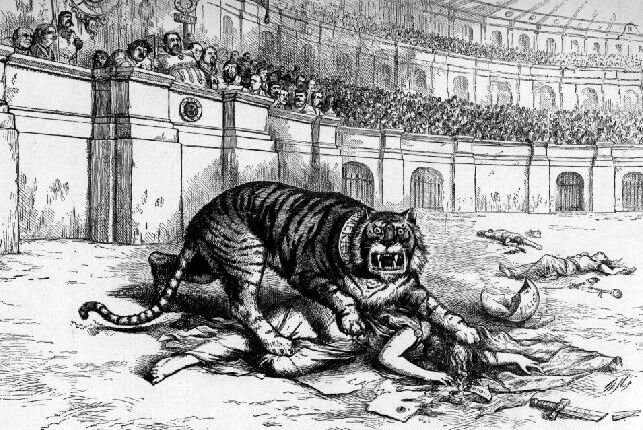
Tammany Hall devouring democracy--19th century cartoon by Thomas Nast.

And the same principle works well for tribal groups of immigrants, who will come out for one of their own. The alderman who explained the system to me back in Kingston was Greek; his machine was the Greek community. In the old days in Toronto, it was always the Orange Lodge. In the big city machines in the US, it tended to be the Irish Catholics. When I ran for school board in Toronto once, I found myself caught in the crossfire between the Italian candidate and the Portuguese candidate.

All this is bad enough. But our new ethnic tribes are not just close-knit, enabling them to take power; they are also largely composed of people who view themselves as upper class, with upper class attitudes and with upper class expectations or privilege and advantage.

And official multiculturalism is actually encouraging and underwriting this process. In fact, the sacred cow status of multiculturalism is perhaps itself an example of a ruling class carving out for itself special and separate privileges.

Besides killing off multiculturalism, and changing our immigration system, we should introduce some counterbalance to local control of all offices. Such as an elected senate, elected proportionally from national lists.


Friday, March 03, 2017

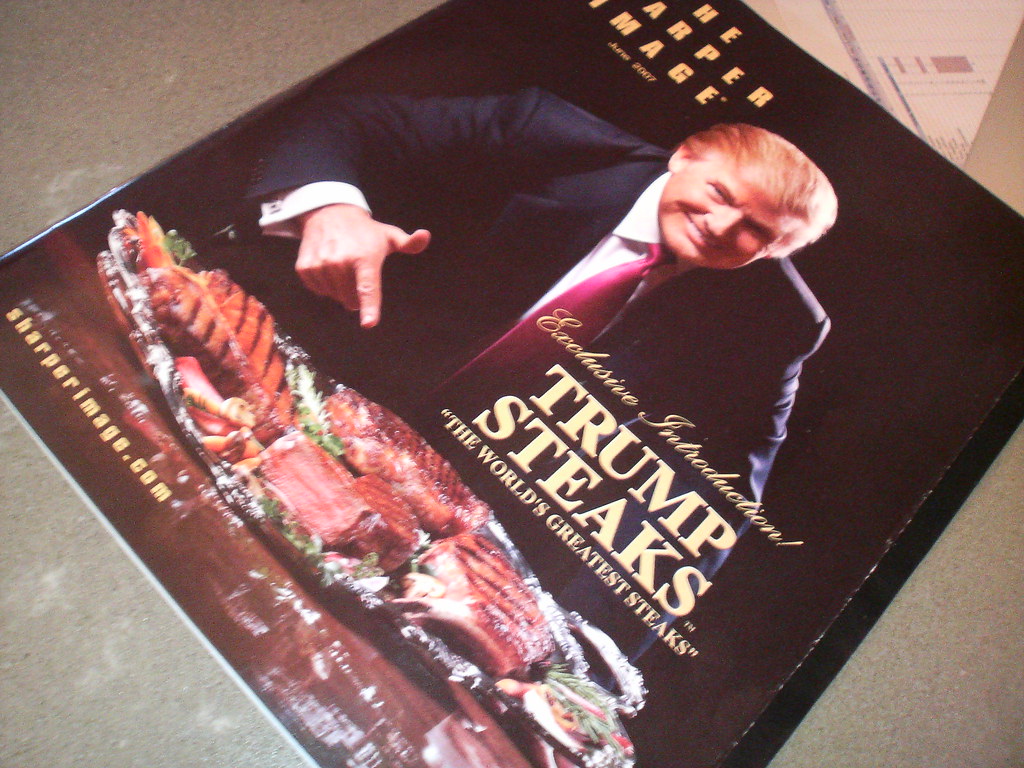
Trump Steaks


In the latest news, Melania Trump has worn an unacceptable black dress to Trump’s speech to congress. Ivanka Trump wore an unacceptable red dress. Democratic congresswomen all wore acceptable white dresses, but it was unacceptable when Melania Trump wore a white jumpsuit at the Republican convention.

More importantly, Donald Trump is reported to have ordered a steak well-done, then put ketchup on it.

This is truly unacceptable.

Kind of sums it up. Most of the resistance to Trump is about class. The people who oppose him oppose him because they think he is nouveau riche. The people who support him support him because they think he is nouveau riche. He is not nouveau riche, but he endearingly acts just as most working guys feel they would if they were. Marry a babe much younger, live in a Manhattan penthouse, tell everyone to go hang, put your name on everything.

And order steak, lots of steak, just the way you damned well like it.

Trump’s critics, on the other hand, hate him not just because he lacks class, but because he does not defer to class. Because he does not defer to expertise, to his betters. One ought to listen to the chefs on how to eat a steak; they are the experts. Or, more generally, one ought to defer, whatever the people think, to those who see this sort of thing and object—the elite, those who went to the right schools and the right cocktail parties, and know how one is supposed to eat steak.

They have every right, after all, to tell you what to eat.

You can eat cake.


Sunday, April 13, 2014

Who Is Privileged?

A good rule (not my own, but I do not remember where I heard it) for figuring out who is really in the cat bird seat in a given society is to figure out who you are not allowed to criticize--at least not in polite company, or with folks you do not know well.

It pretty well goes without saying that anyone officially designated as "privileged" is not in this group.

So go to it--who is it you dassn't razz at a cocktail party of supposedly well-bred folks?


Friday, March 28, 2014

What Is Your Social Class?

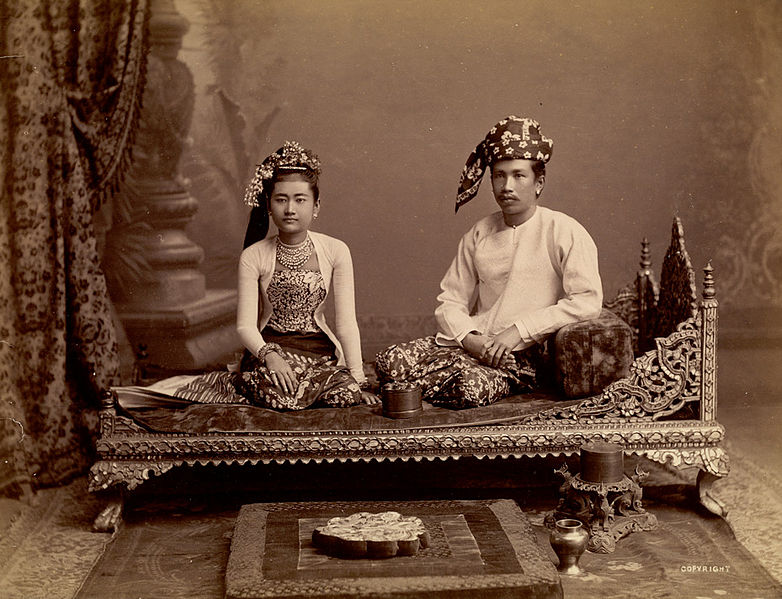
Upper class Burmese couple, 1890s.
I recently tried a quiz offered by the Christian Science Monitor, “What is your social class?” It put me in the middle class, which is just about spot on. Ain't nobody here but us bourgeois. But I found the analysis behind the questions shocking. It turns out that the current American upper class, based on real science, is the "small slice of society that tends to feel the least bound by the legal and moral rules observed by other Americans” In other words, the US has a corrupt and immoral upper class. 

If this is news, it is bad news. It seems to me that keeping the upper class honest is the sine qua non of civilizational success. This is the whole ball o'wax. It is what codes of chivalry, Confucianism, gentlemanliness, honour, professional ethics, are all about trying to do. That fight is always an uphill fight, because there are always fewer practical constraints on an upper class; self-indulgence is an eternal temptation. And the New Testament is no doubt right that the poor are always more ethical than the rich. But I do suspect things have gotten much worse since the Sixties, which were largely a rebellion by the upper classes against any constraints on their desires.


Police lead upper class New Yorkers through the slums of Five Points, 1880s.
A corrupt upper class is the sole difference between the Third World and the First. I suspect as well that the New Testament's persistent warnings about the corruptabiltiy of the upper class are the secret key to the Christian West's tendency to keep ahead of the rest of the world on most measures of social success. The upper classes are now in open rebellion against all that, in a way we have not seen for almost two thousand years.

On specifics, the studies behind the CSM quiz show that the American upper classes of this day are 1) more inclined to envy; 2) less inclined to courtesy (i.e., stopping for a pedestrian); 3) more inclined to steal; 4) more inclined to lie; 5) less inclined to trust or think highly of others; 6) less able to read others' emotions; 7) more inclined to spoil their children; 8) vastly less inclined to enjoy gospel music; 9) more likely to be atheist or agnostic; 10) less likely to give to charity; 11) more concerned about status in buying clothing. 

Hunting tigers out in India.
All bad traits, it seems to me.

Number six is particularly interesting: it suggests that the upper classes have less empathy for others. It also suggests that one does not get ahead in this culture by being sensitive to the feelings of others, but by being insensitive to them: that "emotional intelligence," to the extent that it really is a key ingredient in personal material success, is not a matter of learing empathy, but of learning psychopathy.

Wednesday, December 04, 2013

Why They Love Cohen in Norway


Leonard Cohen is a gentleman in the full meaning of the term. Montreal produces them. This is why he is understood and appreciated in Europe, but not in the U.S.A.

Are we missing something in the rest of North America in lacking this class of gentlemen, of people trained in good manners, style, taste, and honour?

Saturday, November 24, 2007

The Rich Vote Democrat

This study confirms something I have been saying for a long time: the Democrats are the party of the upper class in the US, and the Republicans are the party of the working class.

Equally, in Canada, the Liberals are the party of the rich, and the Conservatives are the party of the working class. The NDP is the party of the government bureaucracy and bureaucrats. The richest ridings in Canada are almost all safe Liberal seats.

This, of course, is counter to the rhetoric. Perhaps it makes the rich feel better about their wealth to pretend they are poor, while it makes the poor feel better to pretend they are the rich.

It's a strange world.