Playing the Indian Card

Showing posts with label Leonard Cohen. Show all posts

Tuesday, November 26, 2024

Democracy Has Come


Leonard Cohen died November 7, 2016, the day before Donald Trump was first elected. Cohen’s son Adam says his father predicted Trump would win. Everyone thought Clinton would. Why did he think so?

Like any great poet, Cohen was a prophet. He saw deeply into the zeitgeist; he could see which way things were heading. In 1992, he put out an explicitly prophetic album, “The Future.” In in he traced two possible paths: a dark one: “I’ve seen the future, baby. It is murder”; and a hopeful one: “Democracy is coming—to the USA.” It was, clearly, a warning.

It does seem America and the world has been going down the dark path traced in “The Future”:

Give me absolute control
Over every living soul
And lie beside me, baby
That's an order
Give me crack and anal sex…


This sounds like the obsession with power relationships and self-indulgence that underlies woke culture.


Destroy another fetus now
We don't like children anyhow
I've seen the future, baby
It is murder


That hardly needs comment, does it?


On the other hand, surely Trump’s election was and is the second path, the path of light. Cohen saw that the US was, as of 1992, not truly democratic. That new truer democracy is the “populism” Trump and Elon Musk’s X represents.

It's coming from the silence
On the dock of the bay
From the brave, the bold, the battered
Heart of Chevrolet


This predicts a return from multicultural idolatries to traditional American culture. Make America great again!

It's coming from the sorrow in the street
The holy places where the races meet
From the homicidal bitchin'
That goes down in every kitchen
To determine who will serve and who will eat.


The holy places—sounds like a predicted religious revival. The more so since he also says it comes “From the staggering account/In the Sermon on the Mount.” In “The Future,” he laments, “Give me Christ or give me Hiroshima!” 

And this stanza also sounds like a rejection of feminism and sexual politics, the great example of the woke power dynamics.

He also says true democracy is coming from “the ashes of the gay.” This might mean gay martyrdom. Or it might mean gay politics become a spent force.

Democracy is, Cohen says, coming to America first partly because of America’s cultural dominance, partly because the US system is flexible. It has “the machinery for change.” And partly because “It’s here the family’s broken.” This sounds like a need to return to “family values.”

I wonder if Cohen died in peace, seeing clearly that the US and the world was going to choose the better path after all.


Thursday, September 28, 2023

Jesus Wept


Cohen’s “Come Healing” is a great hymn.

This in particular is a remarkable stanza. It explains original sin:

Behold the gates of mercy
In arbitrary space
And none of us deserving
The cruelty or the grace

But this is even deeper:

O, troubledness concealing
An undivided love
The heart beneath is teaching
To the broken heart above

And let the heavens falter
Let the earth proclaim
Come healing of the altar
Come healing of the name

“The Name” is how an Orthodox Jew refers to God himself. 

God himself is broken-hearted. God needs healing, and it is up to us to help. God is love, and there is no love without pain. God loves us with an unrequited love. We hurt him beyond measure, enough that he was prepared to die.

Jesus hears of the death of Lazarus.

He needs us. He created us because he needs us.

What? God has emotions? God has needs?

Of course he does. As Blake points out, the greatest thing any human can imagine is a perfect human. A being lacking emotion would be less than human, not more than human. Just a cyborg presence. God loves, he can be angry, he can be amused, he can be sad.

He is reaching out to us, like a lover,  vulnerable like a lover always is.

And let the heavens hear it
The penitential hymn
Come healing of the spirit
Come healing of the limb.


The Vaisnava Hindu metaphor of the Rasa-Lila: each soul dances with God.


Monday, January 16, 2023

Multicultism


In 1897, Leonard Cohen’s grandfather founded the Jewish Times in Montreal, Canada’s first English-language Jewish-interest newspaper. 

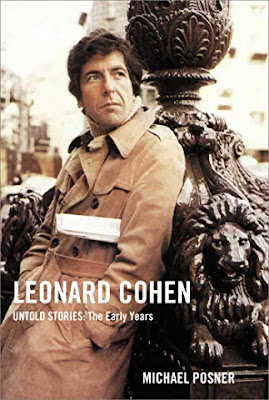
“The paper had a clear mandate: to help Canadianize the teeming influx of Yiddish-speaking Jews arriving from Eastern Europe…. Essentially the journal sought to promote the adoption of mainstream non-Jewish social customs that, religious observance aside, would make Jews indistinguishable from their gentile neighbours” (Michael Posner, Leonard Cohen: Untold Stories. The Early Years).


This is the attitude past waves of Canadian immigrants took: the task was integration, Canadianization.

Now imagine if Leonard Cohen’s family, and the rest of Montreal’s Jewish community, had instead embraced the modern cult of multiculturalism, and decided the imperative was instead to cling to their Jewish and European traditions. Imagine Leonard Cohen, Irving Layton, A.M. Klein, Mordecai Richler publishing only in Yiddish, in small-circulation Yiddish-language journals, writing of Ashkenazi ethnic culture and concerns. Or, if writing in English, writing only of Jewish life. Imagine how much poorer Canadian, and indeed world, culture would be. And imagine how much worse this would have been for them. They would not have had a career.

That gives some sense of the harm done by multiculturalism. It is, not to split hairs, pure evil. It is pandemonium. We need the melting pot. We need e pluribus unum.

I am, by family tradition, part Mohawk (“Haudenosaunee”), if mostly Irish. Some of my in-laws and cousins have their Indian cards; although I would never consent to carry one. I am Canadian, and all Canadians are Metis. 

Growing up largely in an immigrant area of Montreal, I studied world religions and literatures to the doctoral level. I have spent half my adult life in Asia. My wife is East Asian; my kids are tri-racial. Yet I have no place in a “multicultural” Canada, because I am too multicultural. I do not fit into any convenient, mutually hostile, ethnic ghetto. Canadians have no place in modern Canada. We are discriminated against.

Cultures belong to people, not people to cultures. Cultures have no rights; they are not alive. People have rights. Multiculturalism is a violation of human equality; an insult to human dignity. It promotes hatred of your neighbour, because he is different from you. It is racism. It is corrosive of Canadian society and culture.


It is harmful, most of all, to more recent immigrants. Anyone who has lived in a new culture knows the dangers. Culture shock is the common reaction. The unwise retreat into their own world, fearing and hating those around them. Their daily lives become hellish; nothing around them makes sense. Some literally go mad. Others become aggressively antisocial. 

The cure, as old hands always tell the newcomers, is to get out and engage with the culture. Learn how things work here. 

Multiculturalism thus encourages exactly the wrong attitude and the worst behaviour.

Life in a ghetto, which it demands, also limits economic opportunities. Ask Martin Luther King; such segregation is what he fought so hard against. It is why Canadian First Nations are so poor—that is, those who have stayed on the reserves. Why did we decide apartheid and segregation was a good idea?

Multiculturalism also condemns the immigrant to live his life in exile. Home is forever far away, in the land he left; Canada remains forever foreign. Our patriotic task as Canadians, and what we owe our neighbours, is to build a sense of common home here, in this land, among these people.

Culture is a series of tools, strategies and knowledges, if you will allow the plural, for a good life. As with any other technology, it ought to evolve and improve over time. If it does not, it is failing; it is dying. It needs to be abandoned for a better tool. Only a fool sticks with a poor tool simply because it is the one he is familiar with. 

As an immigrant nation, Canada has the perfect opportunity to assimilate the best elements of all the world’s cultures. This should make Canadian culture the strongest and best the world has ever known. That is what the Canadian “mainstream” is, and what it has always done.

To encourage us instead to stick with a horse and buggy, because our ancestors drove one,  is spectacularly stupid. Or intentionally malicious.


Tuesday, December 27, 2022

Everybody Knows


As a Christmas present, I treated myself yesterday to a visit to the current exhibit at the Art Gallery of Ontario on Leonard Cohen.

It was a disappointment. But then, I expected it to be. How do you host an art exhibit on a poet? Wrong medium. 

You got to see his notebooks under glass; but usually just the covers, and the covers look like any other notebooks, after all. Letters to and from other celebrities; very hard to read in handwriting and under glass, with others crowding you. Much better printed as a book or a web page. One of his guitars; his electronic keyboard. Look very much like any other guitar or Casio keyboard. Videos of him singing; using clips readily available on YouTube. So what?

When I went to an AGO exhibit years ago on William Kurelek, it felt life-changing. I left with a sense of what Kurelek was all about, what he was saying. When I went to a more recent exhibit on Andy Warhol, I left with a sense of what Warhol was all about. When I left the exhibit on Cohen, I was feeling, “was that really all he was about?” 

I had to remind myself of the actual lyrics. Being a writer, Cohen was far better at revealing himself than any museum curator’s collection of memorabilia could be. 

Had I known of Cohen only from the exhibit, I would have thought that Cohen was interested only in producing tunes that someone could enjoy while doing the laundry, or dance to. Ironic, since Cohen often did not write the tunes, only the lyrics. And did not have one of the world’s great voices. Again and again, the clips chosen seemed to downplay the significance of the lyrics, the poetry, and the novels. Beautiful Losers was the product of sunstroke. “First We Take Manhattan” was an attempt to say “something about Berlin.” “The Future” was gloomy, but saved by an upbeat tune.

If there was a core message, okay, Cohen loved his mother, his family, and his hometown. All actually highly dubious assertions, based on what he actually wrote. If true, merely bland and pedestrian. He was fascinated with guns, for some unexplained reason; he was not a pacifist. He thought the ultimate meaning of life was getting laid. Totally soulless.

At the exit, you had the opportunity to buy a trilby hat like the one he wore on stage, or a keychain, or a t-shirt. Fan stuff.

I felt Cohen’ legacy was being falsified and crassly exploited, either by his surviving family, or by the museum, or, most probably, both.

The title chosen for the exhibit was appropriate: “Everybody knows.” It merely traded on Cohen’s fame, and withheld anything not apparent to everybody.


Monday, December 05, 2022

Purdy on Cohen


Al Purdy has disappointed me. It does not pay to read what one of your idols thinks of another of your idols. It does not pay to have Al Purdy review the poetry of Leonard Cohen. 

Purdy complains that Cohen is “Absolutely conventional in metre and form.” “They [Cohen’s poems] gained distinction through other people’s poems.” “Most avant-garde work south of the border seemed to have escaped his attention.”

The problem is, it seems to me, that Purdy is objecting to Cohen for not being Purdy. 

Perhaps Cohen would do the same if asked to critique Purdy. But Cohen notably refuses to pass judgment on the poetry of his peers; he cannot be drawn out, for example, on comparing his songwriting to Bob Dylan.

To be fair to Purdy, perhaps he did it for money. I think Purdy knows as well as anyone that poetry is ineffable, that there is no sense talking about this or that technique. It comes if it comes, and it works if it works. But people want him to say something, so he comes up with something to say.

Ironically, in complaining that Cohen is too conventional, Purdy is repeating the conventional criticism of Cohen: Louis Dudek said the same. It was this criticism, according to Cohen’s biographer Sylvie Simmons, that made him decide to move on from poetry to songwriting. Only there could his love of versifying be allowed. Joni Mitchell was similarly driven out of her first love, the visual arts, because the art schools scorned representational painting.

But why does poetry have to be unconventional? Why does it have to be experimental? 

In fact, many literary forms rely on convention: that is what genre is about. In genre literature, points are gained by following the conventions, perhaps playfully, but not by failing to follow them: sonnets, fairy tales, cowboy stories, tragedies, the blues.

In fact, poetry relies on convention more than most other forms. The medium of prose is the printed page. The medium of drama is the spoken word. The medium of poetry is memory.

Memory loves and relies on conventions.

As a result, almost the moment poetry violates instead of following convention, it destroys itself.

Al Purdy’s own best work relies on and refers to memory: 

But it has been a long time since

And we must enquire the way of strangers.

If you want one reason why poetry is no longer a popular art form, look here: the idea since Eliot (who was frying altogether other fish) that it needs to be experimental.

The idea of experimental art is a flowover from scientism, the ruling idolatry of our time: the pagan notion that science is the measure of all things. Science does indeed proceed by experiment, and the old is forever superseded by the new. Art does not. Homer or Shakespeare are not superseded by Toni Morrison or Charles Bukowski, as Ptolemy is superseded by Copernicus, or Paracelsus by Pasteur. An achievement in the arts is more or less immortal, eternal. Beauty remains beauty forever.

In an effort to achieve novelty, current poets have thrown over all the elements of good poetry. No wonder if the poetry no longer works as well. 

It is true that novelty, freshness, is sometimes desirable as an aesthetic quality. It is valuable in humorous verse, for example. It can also be overdone, be recherche.

As to sounding like other poets, Purdy needs to explain what is wrong with that. Shakespeare made a rather decent career out of sounding like other people in his verse. Someone—was it Blake?--said, “a bad poet seems to steal from others. A good poet really does.” Writing a poem “in the style of” Catullus or Virgil used to be and ought to be a prime accomplishment—given that it is good.

I would have expected Purdy to be too wise to fall for such foolish scientism. My estimation is lowered a notch.


Sunday, November 14, 2021

Puppets


German puppets burned the Jews

Jewish puppets did not choose

“Puppets,” from Leonard Cohen’s posthumous album, Thanks for the Dance. What’s he on about?

The same thing folks are on about when they talk of “NPCs.” Or Ionescu was on about in his play Rhinoceros. Or why zombies are all the rage in popular culture.

The truth is, more and more of us are aware that more and more of us have been turning into automatons. Something is making us lose our free will, our full awareness of our surroundings, and our sense of meaning in our lives. And then we do awful things. Nazism was one dramatic expression of this, but the process seems to continue into the present time.

Cohen takes it a bit further than Ionescu, with his “puppet” image. For this suggests not just an absence of free will and consciousness, but control by another.

And Cohen suggesting this is not control by some oppressive government, dictator, or cabal. The president, too, is a puppet. 

Puppet Presidents command

Puppet troops to burn the land

It is not just the Nazis who are puppets, either; the Jews are puppets too. The root is deeper than Nazism itself.

The ultimate puppet master is the Devil. As Bob Dylan said, “You gotta serve somebody.” And this is a real psychological/spiritual phenomenon. Once we embrace any vice, we gradually lose our free will and even our sense of reality. The vice controls us, and our thinking runs in smaller and smaller circuits, with more and more prohibited to us. The sense is captured by the old temperance saying, “first the man takes a drink. Then the drink takes a drink. Then the drink takes the man.”

Cohen seems to suggest an escape from being controlled with the lines

Puppet lovers in their bliss

Turn away from all of this

But if so, he is perfectly wrong. It is actually addiction to sex that has brought us to this state of pinocchiohood. Starting in the Twenties, and mostly accelerating since. 

This is the way it always works: the addiction presents itself as an escape from the addiction. One gets drunk to forget that one is an alcoholic. Hence the downward spiral.

Although there is no question he has wrestled with such addictions personally, I suspect Cohen knows this. Otherwise this couplet would be at the end of the poem. Instead, in the poem, the puppethood persists past this. Puppet day is only followed by puppet night.

A bleak poem. 


Tuesday, October 19, 2021

Killers in High Places


One thing that troubles me about writing poetry is that what you write is so commonly misunderstood; and the same is so for creative fiction. So if people are not going to get it, are you wasting your time writing it?

A recent discussion on a Leonard Cohen Facebook group was over someone’s puzzlement over the lines

I can't run no more

With that lawless crowd

While the killers in high places

Say their prayers out loud

But they've summoned, they've summoned up

A thundercloud

They're going to hear from me

And the interpretations they got were various. Some suggested that “killers in high places” referred to the government of George W. Bush. And the “thundercloud” was a political revolution.

The reference, of course, is to all governments. It is the plain understanding of both the New Testament and the Old that “the nations” are up to no good, that the Devil is the lord of this world: “it has been given to me, and I can give it to anyone I want to.” (Luke 4:6).

All governments kill as a matter of course. Being able to kill without repercussions is pretty much definitive of government: the monopoly on force. We even tacitly acknowledge this in selecting as our leaders relatively ruthless men. A Churchill, a Lincoln, a Sherman; they did some very cruel things. This is why Constantine delayed his baptism until his deathbed—because he had to sin so long as he was going to be Emperor, and so baptism would be insincere and meaningless until then.

Government is necessary. Government cannot be much improved. Revolution does little. The thundercloud is divine judgement.


Thursday, October 14, 2021

Democracy is Coming ... to the USA


It seems to me we are seeing a general collapse of all social systems. We can no longer rely on any institutions. 

The parliamentary system, of reasoned debate, used to keep our legislatures functioning reasonably well. Now that civil discourse seems to have completely broken down. It is just a matter of massing votes.

But now, in America, nobody trusts the voting system, either.

The church used to stand as a voice of moral authority against excesses in the secular world. This seems no longer true. For mainstream Protestantism, it has not been true for generations. The last bastion of this, the Vatican, has now been stormed and fallen under Pope Francis.

The court system used to stand as an independent adjudicator to whom we could appeal, based on reason and precedent. Now the courts have become more political than the legislatures. Reason and precedent are largely ignored, and whims are “read into” the law.

The universities used to be semi-monastic in their separation from practical affairs, and able to reflect objectively on them. Now they have become more political than anywhere.

The press used to pride themselves on their independence and lack of respect for any authority. Now they are an arm of the professional establishment. Journalistic standards have been abandoned, and news reports are not reliable.

We used to think science was objective and incorruptible. We could trust the science. That was probably always false, but the COVID crisis has revealed multiple examples of this not being true. “The science” too has become political.

We used to suppose private enterprise was a check against government. That was probably always false; but it is increasingly clear that large corporations and governments work hand in glove. 

We used to trust in a professional civil service. The trustworthiness of the government seems cast in dramatically greater doubt by revelations off the “deep state.” They now seem to be lunging for greater power. An example is Merrick Garland’s Justice Department declaring dissatisfied voters at school board meetings “domestic terrorists.”

I and many like me used to think that Silicon Valley and high-tech was a force for freedom; some of us are old enough to remember Apple’s “1984” commercial. Now they have been revealed as Big Brother.

Nothing in the system seems to work any longer as it is supposed to; everything has been subverted by people interested only in power.

I blame postmodernism.

But all of these institutions are also in decline, notably due to technology. Perhaps the rapid loss of power and relevance has provoked a panic reaction, and fear has led to overreach.

If we are seeing the fall of the American Empire, I see no obvious replacement in the wings.

Back in the 90’s, Leonard Cohen recorded his album “The Future.” It offered two competing visions: the title song, which saw chaos coming; and this has proven accurate; and “Democracy is Coming to the USA,” which saw instead an American revival, and a new birth of freedom. 

Perhaps he accurately foresaw both. 

Perhaps we are witnessing a case of creative destruction. Perhaps as old systems are dying, new systems are about to emerge. And perhaps Cohen is right, that it is still America where the new is most likely to appear.

It's coming to America first,

the cradle of the best and of the worst.

It's here they got the range

and the machinery for change

and it's here they got the spiritual thirst.


I see hope in groups like the Daily Wire, Steven Crowder, and Tim Poole trying to build independent cultural engines. I see hope in Andrew Yang's new political party, proposing a new form of voting. I think we may be on the brink of a new moment of immense creativity.


Monday, June 21, 2021

Nathan Cohen


Nathan Cohen

Another lyrical clue that all was not well between Leonard Cohen and his father, from the song "Everybody Knows":

Everybody knows that the boat is leaking
Everybody knows that the captain lied
Everybody got this broken feeling
Like their father or their dog just died

That always struck me as an inapt parallel--surely a father dying is a more significant event than a dog dying. But maybe that is the point; maybe Cohen is calling his father a dog, and no more. After all, given his own life experience, this cannot be a casual mistake. He knows exactly what it feels like to lose a father, for his father died when he was nine.

His father may also be meant by "the captain." 


More lyrics from the same song seem to criticize the fashion industry, Cohen pere's business:

Everybody knows the deal is rotten
Old Black Joe's still pickin' cotton
For your ribbons and bows
And everybody knows.


Saturday, June 19, 2021

Everybody's Wounded


 Well, it's Father's Day, and everybody's wounded

First we take Manhattan, then we take Berlin.


These are the final words of Leonard Cohen’s song/poem “First We Take Manhattan.” In it, he is clearly equating the fashion industry with Nazism. His father was in the fashion business. 

I don’t like your fashion business, mister

I don’t like those drugs that keep you thin

I don’t like what happened to my sister

First, we take Manhattan

Then we take Berlin.


These are the first words of Leonard Cohen’s song/poem “The Story of Isaac,” in which he speaks as Isaac, about to be ritually slaughtered by his father Abraham.

The door, it opened slowly

My father, he came in

I was nine years old.

His father died when Cohen was nine.

Something was going on between Cohen and his father, that he is not speaking openly about.

When it all comes down to dust

I will kill you if I must

I will help you if I can

When it all comes down to dust

I will help you if I must

I will kill you if I can

Perhaps something was also going on between Bob Dylan and his father. Dylan alludes to the same Biblical story of Abraham and Isaac in “Highway 61 Revisited.” The song is important enough in his mind that it also gives its name to the album.

Oh God said to Abraham, "Kill me a son"

Abe says, "Man, you must be puttin' me on"

God say, "No." Abe say, "What?"

God say, "You can do what you want Abe, but

The next time you see me comin' you better run"

Well Abe says, "Where do you want this killin' done?"

God says, "Out on Highway 61."


It might be significant that Dylan’s father’s name was Abraham. Highway 61 passed by his childhood home.

Happy Father’s Day. Everybody’s’ wounded.


Sunday, January 31, 2021

Thanks for the Dance


Leonard Cohen's posthumously-released "Thanks for the Dance" performed by his former lover Anjani Thomas.

Touching--although the lyrics work better if sung by an old man.


Thanks for the dance

I'm sorry you're tired

The evening has hardly begun

Thanks for the dance

Try to look inspired

One, two, three, one, two, three, one

There's a rose in your hair

Your shoulders are bare

You've been wearing this costume forever

So turn up the music

Pour out the wine

Stop at the surface

The surface is fine

We don't need to go any deeper

Thanks for the dance

I hear that we're married

One, two, three, one, two, three, one

Thanks for the dance

And the baby you carried

It was almost a daughter or a son

And there's nothing to do

But to wonder if you

Are as hopeless as me

And as decent

We're joined in the spirit

Joined at the hip

Joined in the panic

Wondering

If we've come to some sort of agreement

It was fine, it was fast

We were first, we were last

In line at the Temple of Pleasure

But the green was so green

And the blue was so blue

I was so I

And you were so you

The crisis was light

As a feather

Thanks for the dance

It was hell, it was swell

It was fun

Thanks for all the dances

One, two, three, one, two, three, one...


Friday, January 22, 2021

Dirty Sex and the Bible


Whenever we read a news story dealing with a field or event with which we are familiar, we are astonished at how wrong they get it. I have long been appalled at how poorly journalists seem to get religion. We ought to realize that they are probably just as bad on fields we do not know.

A recent piece in the Daily Mail mocks Biden’s White House for showcasing Cohen’s “Hallelujah” during a memorial ceremony for those who have died of COVID. Trump also had the song performed at a recent White House event—I think it was for Thanksgiving. It is becoming a nondenominational religious standard.

But the Daily Mail objects:

“Jewish fans of late Canadian singer Leonard Cohen are pleading for his classic hit 'Hallelujah' to no longer be played at memorials and other somber events because of the ballad's sexual lyrics after it was performed at a COVID-19 memorial this week on the eve of Joe Biden's inauguration.”

“It's actually a sexual song - and people should stop trying to make it into something it's not.”

“'Yes, Christians, all Jewish people make fun of you when you sing the song about Jewish sex to celebrate your holidays and commemorate your lost. All of us'”

The author of the Mail piece, and his Jewish informants, are apparently unaware that the story of David and Bathsheba is word for word in the Christian as well as the Jewish Bible. There is no reason why the adulterous allusion would be apparent to Jews and not Evangelical Christians, who do have a bit of a reputation for reading their Bibles.

And suggesting that Cohen’s song is not religious because it describes this affair makes just as much sense as saying the Bible is not about religion because it describes this affair. Do they imagine that sex and the relationship between the sexes is not a part of God’s creation? Have they never read the Song of Songs?

Probably not. They would be shocked.

The Daily Mail piece helpfully quotes the lyrics, although not accurately.

There are actually several versions of the song. But just go with the lyrics published with this story. They end

“I'll stand before the Lord of Song 

With nothing on my tongue but Hallelujah.”

Who can the author and his Jewish informants imagine this “Lord of Song” might be? Donald Duck?

And don’t they know Hebrew? The word “Hallelujah” means “Praise God (Yahweh).” How subtle is that?

More on the meaning of Cohen’s “Hallelujah” here.

In similarly stupid recent articles elsewhere, Donald Trump is taken to task for having them play “Frank Sinatra’s ‘My Way’” as he departed the White House. They quote Mia Farrow and Nancy Sinatra saying Frank would have hated Trump. So how dare he take her father’s and her husband’s song?

Frank Sinatra had no rights to the song. The lyrics are by Paul Anka. Sinatra merely covered it. Trump has precisely as much right to it as Frank Sinatra did.


Friday, October 02, 2020

There Are Children in the Morning


There seems to be a common belief out there that Leonard Cohen is politically on the left. After all, he’s an artist, isn’t he? All artists are on the left. As Andy Warhol once put it, perhaps plaintively, “artists just can’t be Republican, can they?”

There is immense pressure on artists to support the left. There has been since the 1950s, probably as a reaction to the McCarthy witch hunts, and it has only grown since. Today, anyone who admits a stray right-wing thought risks their livelihood. It is rarely worth it for an artist; their commitment is to their art, and politics is a minor concern for most by comparison.

We need an artists’ liberation movement. But the current cancel culture and blacklisting is probably soon going to swing everything around, because it is just like McCarthyism, yet worse.

As a result of this pressure, we can assume anyone not openly left-wing is secretly right-wing. Along with some who are openly left-wing.

And Cohen has always played his politics close to the vest.

It is clear, nevertheless, that he opposes abortion, and has always opposed abortion.

“Teachers,” from his first album:

“Some girls wander by mistake
Into the mess that scalpels make.”


“Story of Isaac,” from his second album:

“You who build these altars now
To sacrifice these children,
You must not do it anymore.”


“Diamonds in the Mine,” from “Songs of Love and Hate”:

“And the only man of energy, the revolution’s pride
He trained a hundred women just to kill an unborn child.”


“Dance Me to the End of Love,” from “Various Positions”:

“Dance me to the children who are asking to be born.”


And finally, “Thanks for the Dance,” the title track of his last, posthumous album:

“Thanks for the dance
I hear that we're married
One, two, three, one, two, three, one
Thanks for the dance
And the baby you carried
It was almost a daughter or a son.”


It has in fact been an abiding concern. I suspect it was, for Cohen, a core concern.


Tuesday, September 29, 2020

Leonard Cohen: The Early Years


Coming soon from a friend of mine, accomplished biographer and journalist Michael Posner.

He's previously done biographies of Mordecai Richler and Anne Murray.

Pre-order at this link: Leonard Cohen, The Early Years. Stories from a magical time, when Montreal was consecrated to poetry.


Sunday, August 16, 2020

The Words of the Prophet


Leonard Cohen was a true prophet, and foresaw the current social collapse in the US back in 1992. He sang about it in “The Future.”

“Give me absolute control
Over every living soul
And lie beside me, baby
That's an order.”
Over every living soul And lie beside me, baby That's an order.”

Here, he is speaking from the Nazi/postmodern viewpoint. Seen already in the Weimar Republic's sexual license


“Give me crack and anal sex
Take the only tree that's left
And stuff it up the hole
In your culture.”

It sounds like a plea for ecological awareness, right? Wrong. He seems to be saying instead that a preoccupation with trees shows a deficit in the culture. The environmental movement, the glorification of the “natural,” has dangerous moral implications. It suggests we ought to act on pure impulse, like animals. Animals kill and eat one another. The Nazis were great environmentalists.


“Give me back the Berlin wall
Give me Stalin and St. Paul
I've seen the future, brother
It is murder”

Why would he want the Berlin Wall? The point is the clear distinction between good and evil, Stalin and St. Paul, the free world and the evil empire. It is an image of choosing sides. It is vital to preserve the distinction between right and wrong, or murder breaks loose.

Cohen betrays on which side of the Berlin Wall he stands, with Stalin or with St. Paul, with the phrase “I’ve seen the future.” It was famously applied to the early Soviet Union, by Lincoln Steffens in 1919: “I’ve seen the future, and it works.” Cohen clearly differs: it is murder.

"Won’t be nothing… you can measure any more.
The blizzard, the blizzard of the world
Has crossed the threshold
And it has overturned
The order of the soul"

This is the essence of the problem: the order of the soul has been overturned. The blizzard is an image of disorder. There is nothing we can measure any more, when we dispense with truth or right and wrong. These are the measures of all things.

You don't know me from the wind
You never will, you never did
I'm the little Jew
Who wrote the Bibl

Getting explicit, surely; we have lost touch with the Bible and our Judeo-Christian roots.


There'll be the breaking of the ancient western code
Your private life will suddenly explode
There'll be phantoms
There'll be fires on the road
And the white man dancing

Isn't this a remarkably clear image of what is happening now? Nothing in your past is private any longer; anything can be dug up with a Google search. And has been, on anyone targeted for political reasons. We see news photos of "white" people kneeling before "blacks." We see black-clad phantoms setting fires in the streets.


Was this visionary, or was it all so predictable?


Destroy another fetus now
We don't like children anyhow
I've seen the future, baby
It is murder


This is not the only or the first time Cohen has sung against abortion. He seemed to see it, as I do, as a key issue.


When they said (they said) repent (repent), repent (repent)
I wonder what they meant

And this, improbable and difficult as it seems, is the only solution: repentance. Cohen repeats the chorus relentlessly.

Cohen did; but can we hope for this for the world as a whole?


Saturday, August 01, 2020

Kanye West Is Not Picasso


Since Kanye West has been in the news, there has been much recent tweeting and posting of Leonard Cohen’s posthumously published poem “Kanye West Is Not Picasso.” Unfortunately, nobody seems to understand what it means.

Most people take it as a “dissing” of Kanye West. And then take sides in this imagined conflict over who is the greater artist and who is the megalomaniac.

It is, instead, although not in my view a great poem, a Buddhist meditation on the self. It is a koan.

I think, for purposes of review, it is fair dealing to quote it in full; I note that others are.


It is the mystery of the self, the ego.

The ego is, at the same time, the only thing we know; and we know nothing about it.

I meant just then to say, “we all sometimes think we are Picasso, or greater than Picasso.” But then, I do not, cannot, know that.

For none of us ever knows any ego but our own.

It is of course nonsense to say “I am Picasso.” Picasso is Picasso.

At the same time, our ego contains all things; it is truer too to say “I am Picasso” than to say “Picasso is Picasso.”

And yet that “I” is nobody at all.

Anyone, including Picasso, who thinks they are Picasso is a fool.

The ego, of course, although it is nothing, is the most dangerous thing in the universe.

It seeks war against all things.


Sunday, June 14, 2020

Marianne and the Child


I think it is wrong to pry into the lives of famous people. Celebrities whatever their field are entitled, like the rest of us, to privacy. Interest in their personal affairs is generally the sin of calumny.

I am about to break that rule for Leonard Cohen.

Cohen is too important. He is not just another famous person. He is a spiritual guide, and, in the righteous words of Jennifer Warnes, Canada’s national poet. His soul intersects with Canada’s soul, and contains multitudes.

I was listening recently to the late song “Choices,” off the “Can’t Forget” tour album. And I realized how sad it was.

I've had choices
Since the day that I was born
There were voices
That told me right from wrong
If I had listened
I wouldn't be here today
Livin' and dyin'
With the choices I've made

It is a confession. It is sung in the voice of a hopeless alcoholic. Cohen did not write it, but the fact that he chose to perform it regularly suggests it meant something to him.

I was tempted
At an early age I found
That I liked drinkin'
No, I never turned it down
There were loved ones
But I chased them all away


Cohen did have a problem with drinking; but I fear that is not what he is really talking about. It stands in here for another vice, because he cannot quite speak that truth squarely. It is too painful to admit.

His vice was sex. It was lust.

This was, after all, the title of his first, autobiographical, novel: “The Favourite Game.” The favourite game was recreational sex: the hunt, the conquest. A common and commonly celebrated vice in his young adulthood, the era of Hemingway’s machismo, James Bond, Playboy, and the “sexual revolution.” A blind alley down which too many wandered then, and wander now.

Some girls wander by mistake
Into the mess that scalpels make.

Wrapped up in this is Marianne Ihlen: “So Long Marianne.” You can see her on the back cover of Songs from a Room. I have not seen the movie, “Marianne and Leonard,” but I think the issue is clear enough. It was his first committed relationship. By all the rules and right, that was his marriage, and it should have been for life. There was a child. It is unnatural and inhumane to break such bonds. I gather Cohen walked out on her, gradually, because, starting to become famous, he suddenly had lots more opportunities for casual sex. He was tempted as few of us ever are, and it was a temptation he could never resist.

Ever since he has had to live and die with that choice that he made. A fatal spiritual mistake.

The worst of it is that the child went mad by adulthood. Cohen must have wondered if he was responsible for that.

Cohen never could commit to any permanent relationship. He could never get past the lust; and always had chances to indulge it due to fame. He was an addict.

Notwithstanding, Cohen was a good man. He was just fallen like all of us; all of us have our temptations. The sign of his goodness was that he was wracked by guilt, and continued to wrestle with it. And to confess.

What I loved in my old life
I haven’t forgotten
It lives in my spine
Marianne and the child
The days of kindness
It rises in my spine
and it manifests as tears
I pray that loving memory
exists for them too
the precious ones I overthrew
for an education in the world

But Cohen fans and all of us need to realize that his early and sometimes celebrations of sexuality, attractive to so many, are phantoms on the road, demon voices that ruined his own life, the lives of many women, and the lives of many children, and continue to do so.


Sunday, January 19, 2020

I've Seen the Future, Brother. It is Murder


The Spirit of the Age?


A troubling thing; a poetic friend has sent me a really fine poem he wrote. But it is a fantasy about raping some woman. Perhaps also killing her.

Recently George Elliott Clarke was forced to pull out of a Regina reading because he had planned to read poetry by Stephen Brown. Clarke has edited some of his work, and obviously considers him a good poet. Brown was convicted of murdering a local girl.

What is going on here?

It is hard enough that we cannot trust government, or the clergy. Now it seems we cannot trust poets either.

Even though they, to the extent that they are good poets, have a direct line to the spiritual world—“inspiration.”

Leonard Cohen seems to have seen this coming. In “The Future,” he refers to

“All the lousy little poets coming round,
Trying to sound like Charlie Manson.”

It is all a reminder, in the first place, that, if poets channel spirits, not all spirits are good spirits. There are demonic forces.

Sensitive souls are connecting, it seems, to some deep rage. And it seems to be a rage against women. Perhaps aroused by feminism, perhaps by the “sexual revolution.”

Cohen also may have seen that. The lines just before those quoted above are:

“You’ll see your woman hanging upside down
Her features hidden by her fallen gown.”

We are in a post-Christian phase, as a culture, and perhaps the pagan rules again apply.

Perhaps we are hearing from the Erinyes.


Thursday, January 17, 2019

Cohen on the Future


What did he see?

I think Leonard Cohen got it right when he said that the modern world is in the middle of a spiritual catastrophe.

I think he was right to say that the essence of that catastrophe is a lack or a failure of love.

And I think he believed, and I think he was right, that the most troubling and evident example of that absence of love is abortion.

“Destroy another foetus now

We don’t like children anyhow.”

In this regard, things are rapidly getting worse. We are everywhere dissolving into warring factions, with few or no bonds of common morality or common civility left.

Perhaps Cohen was ready to die when he did die, as he said he was, because he did not want to see what was coming. Many, including his son, thought it was significant that he died on the very eve of Trump’s election as US President. (This does not mean that the problem is Trump; it could as well mean Trump is a symptom and result of the problem. Indeed, it must, since Cohen clearly believed the problem long preceded Trump. And it might be the inevitable reaction to his election, as much as or more than the election itself, that was his concern.)

“I’ve seen the future, brother.

It is murder.”

Glenn Beck recently publicly said he instinctively or intuitively expects some great general war within the next few years.

Some say Beck is inclined to be alarmist. Kind of like spiritual click-bait. That may be so.

I have been inclined to be more optimistic, to feel that the forces of hate had by now become so blatant and blatantly wrong that there would be a natural and general pulling back to morality. That their very virulence suggested they were becoming desperate.

But then, I’ve thought that since the early Seventies. So far, I have been wrong.

Perhaps Beck and Cohen are right. Desperate hate may well take down everyone and everything possible before allowing its own defeat. It will go, but it may well not go quietly.


Friday, March 23, 2018

Editing Cohen


For all his mastery and for all his craftsmanship, Leonard Cohen does from time to time very oddly put a word wrong. Here are two examples:

Go By Brooks

Go by brooks, love
Where fish stare,
Go by brooks,
I will pass there.

Go by rivers,
Where eels throng,
Rivers, love,
I won’t be long.

Go by oceans,
Where whales sail,
Oceans, love,
I will not fail.

A line like “Where fish stare” is what is so great about Cohen. But “Where whales sail” is just not right. Whales do not sail; the image is cartoonish. Aside from that, it lacks the emotional pull of “stare” or “throng.” And easily fixed: “Where whales wail.” Preserves the rhyme, massive alliteration, whales really do wail, and it is emotionally evocative.


Dance Me to the End of Love

Dance me to your beauty with a burning violin
Dance me through the panic 'til I'm gathered safely in
Lift me like an olive branch and be my homeward dove
Dance me to the end of love 
Oh let me see your beauty when the witnesses are gone
Let me feel you moving like they do in Babylon
Show me slowly what I only know the limits of
Dance me to the end of love 
Dance me to the wedding now, dance me on and on
Dance me very tenderly and dance me very long
We're both of us beneath our love, we're both of us above
Dance me to the end of love 
Dance me to the children who are asking to be born
Dance me through the curtains that our kisses have outworn
Raise a tent of shelter now, though every thread is torn
Dance me to the end of love 
Dance me to your beauty with a burning violin
Dance me through the panic till I'm gathered safely in
Touch me with your naked hand or touch me with your glove
Dance me to the end of love.

This is a minor tour de force, because there are not many rhymes for “love” in English. That is one of the great things about lyrics. They force the poet to use rhyme. Rhyme is sadly out of fashion in modern poetry, and it is of great value for several reasons. One is that it forces craftsmanship; it is a great challenge to take an almost inevitable rhyme and keep it from looking forced.

Cohen pulls it off here. Including a truly magnificent line using the rhyme, “Show me slowly what I only know the limits of.” In fact, the problem is not with any of the rhymes. It is with that phrase “homeward dove.” You know what he means, but that is not the right adjective. And a better one seems easily at hand: “homing dove.” As in homing pigeon. Why not?