Playing the Indian Card

Showing posts with label Montreal. Show all posts

Thursday, November 21, 2024

The Lost Promised Land


I saw him once in a subway station.


There was a wonderful flowering of Canadian culture in Montreal when I was young. It was a magic time. There was Irving Layton, Leonard Cohen, Mordecai Richler, A.M. Klein, F.R. Scott, Hugh MacLennan. There was Aislin. There was the NFB.

And that flowering wilted and died. 

I believe it was killed, first, by Quebec separatism, which made life difficult for Anglophones, and caused many of the best and brightest to head for Ontario. So the centre in Montreal was broken up.

But why couldn’t it have simply re-formed in Toronto? Toronto has never been able to match Montreal’s creative ferment of the forties to sixties.

I believe this is due to the dogma of multiculturalism, which suppresses the development of Canadian culture. Toronto is the centre of the multicult. The multicult will not publish Canadians; only writers celebrating their alienation from Canadian culture.

But there seems to be another factor. See how many of those Montreal names are Jewish. Montreal in those years had the largest concentration of Jews in Canada. Toronto, it is true, now has more, but as part of a much larger population—not as concentrated.

And some of the brightest lights of Toronto culture are also Jewish: Wayne and Schuster; Sharon, Lois and Bram; Lorne Michaels.

For Jews really are a light unto the nations, a leaven commissioned by God to spread culture wherever they go.

Any nation that wants a rich culture should encourage Jews to immigrate and to stay.

As immigrants, Canada should give absolute priority to Jews. This would vastly enrich Canada, and at the same time, reduce tensions in the Middle East, where Jews are apparently not welcome. The more fools they. It’s a win-win situation.

Of course, many resent the success of Jews. This is the sin of envy, and should be condemned whenever encountered. It is obviously to the benefit of all that the best rise to the top.

If the Jewish population of Canada were large enough, it would be that much harder for other ethnic groups to oppress them. It would be a protection for them.

I think even now, they would be safer in Canada than in Israel.


Tuesday, September 29, 2020

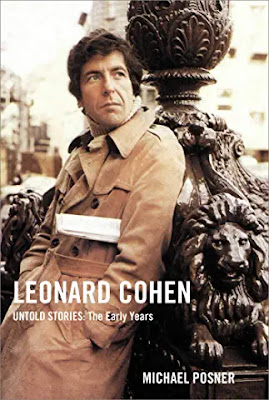
Leonard Cohen: The Early Years


Coming soon from a friend of mine, accomplished biographer and journalist Michael Posner.

He's previously done biographies of Mordecai Richler and Anne Murray.

Pre-order at this link: Leonard Cohen, The Early Years. Stories from a magical time, when Montreal was consecrated to poetry.


Sunday, June 28, 2020

Public Art


Nelson's Column, Monttreal
Okay, people are saying they are offended by statues. 

The remedy is the same as with freedom of speech: if you disagree, put up your own statue. Just as, if you disagree, you do not try to silence the other, but counter his argument.

Like many other places in the former British Empire, Montreal has a Nelson’s Column, commemorating the great British admiral.

In Dublin, they blew theirs up, to express their distaste for English rule.

The Quebecois, surely, had more reason to feel offended, since, after all, it was France against which Nelson won his victories. But they hose the civilized Canadian way. Instead of tearing Nelson down, as they surely could have any time in the past hundred years, they put up another statue nearby, of Vauquelin, a French naval hero of the Seven Years’ War. Both ethnic groups get their heroes. 


The Confederate statues, like them or not, are important memorials for some Americans of their history. If seeing them offends some, it is equally true that seeing them come down offends others. Mutual respect requires that they stay.

But by all means, all other groups ought to feel free to fund and erect their own public statues, then, of Malcolm X, or Martin Luther King, or John Brown, or Nat Turner, or Sitting Bull, or Pontiac, or, really, anyone else..

More public art is good. Less public art is bad. More free speech is good. Less free speech is bad.

This is not complicated.


Friday, April 13, 2018

What Montreal Needs


Someone on Quora asked, what does Montreal need? I lost the question. So what the heck; I’ll answer it here.

It needs to be the capital of Canada, in the first place. That’s a no-brainer. Everybody loses so long as it is not.

It needs a transparent canopy over St. Catherine Street from Crescent to St. Laurent to keep out the winter snow and cold. Perhaps we can extend this to other downtown streets as well. This is obvious for Montreal: cold, snowy, and with tight little streets downtown.

In needs a zoo, along the lines of the old Garden of Wonders in LaFontaine Park, but much bigger. It should feature mythological creatures from around the world.

It needs back both the Expos and the Montreal Maroons.

It needs to lose the requirement for all newcomers’ children to be educated in French. That’s a serious head office killer. Let the parents decide.


Friday, April 06, 2018

Toronto Mediocrities


Historic ancient castle--Toronto

Growing up in Montreal, I always thought of Toronto as a cultural desert. This perception is common among Montrealers. In the 2009 Montreal film “The Trotsky,” the protagonist must move to Ontario, and is consoled by his mother, “I’m sure Ontario is more than just Alice Monro stories.”

Not at all to knock Alice Monro; but the perception was that she was all they’d got.

I still actually think this is true. Toronto has no culture in comparison to Montreal. Toronto is charming in its agricultural, Main Street way, but it has no sense at all when it comes to art or literature. Growing up, visits to the Montreal Museum of Fine Arts (MMBA) were a favourite pastime. I lived ten years in Toronto, and rarely went to the Art Gallery of Ontario. In recent years, I again visited both. The MMBA still exudes something the AGO does not. The MMFA collection, although smaller, seems well-chosen. The AGO collection feels more like a jumble. “Okay, we need something here by Emily Carr.” Not anything of special merit; the point is the signature.

Even the donations differ. The MMFA has the Weider collection of Napoleonic memorabilia. The AGO has a sampling of shrunken knock-off busts collected by Ken Thompson. Perhaps no important art in either, perhaps just businessmen trying to buy a cultural pedigree, but the Weider legacy at least has a theme and a vision. It is not just stuff.

Toronto itself is of the opinion that it has no culture. That’s why it is so big on, and so proud of, its multiculturalism. Culture is always something from somewhere else. It is some quaint foreign thing. Entertaining every now and then, like visiting the zoo. Hey, let’s do a Greek restaurant!

Montreal, by contrast, has its own food: poutine, Montreal smoked meat, Montreal bagels, St. Hubert chicken, spruce beer, Oka cheese, Vachon treats.

In Montreal, the arts are central to the city’s sense of self, central to the city’s life. When Leonard Cohen died, the city quickly threw up two massive commemorative murals; Leonard Cohen expressed something to Montreal of the real Montreal. Even though he was an Anglophone poet in a Francophone city. The art gallery launched an exhibition in his honour, even though he was not a visual artist. In Toronto, b contrast, art is always an add-on, something people vaguely feel they need to have to be a proper grown-up city, but take no personal interest in. Kind of like vitamin supplements.

A distinctly Toronto phenomenon that has no Montreal parallel is that of the famous mediocrity. Artists or entertainers quite commonly become big names in Toronto without actually having much talent. And in Toronto, nobody seems to notice. They just needed an artist in this slot, and nobody actually looks or listens. Such a thing would be unthinkable in Montreal.

A few examples of the classic Toronto mediocrity:

The Group of Seven—absolutely nothing there but hype.

The Royal Canadian Air Farce—with a special shout out to Luba Goy. If they even heard a good joke, they probably would not get it. Dave Broadfoot was the exception; but he did not last with them, did he? Not to mention that he was originally from Vancouver, not Toronto.

Peter Gzowski. For a time, he was everywhere and did everything in Canadian journalism. He even passed as some kind of intellectual. By why?

Ben Wicks. Could never draw, and was never funny. Compare Montreal’s Aislin: da Vinci versus childish doodle.

The Irish Rovers. Always going for whatever’s cheapest and easiest. The first of Toronto’s cute ethnics.

Murray McLaughlin. Out to rescue the neglected working class. Apparently nobody else ever noticed them…

Casa Loma. No history, no special architecture, no connection with the arts or even some culturally meaningful business enterprise. Just ostentation. And an imitation of foreign models.

The CN Tower. Wow; it’s high. So what? Nouveau riche.

“The Henry Moore.” Hey, look how sophisticated we are!

To be clear and to be fair, there are also some legitimate talents who have come through Toronto. Glenn Gould; Marshall McLuhan; Northrop Frye. But even there, there is sometimes something off. Robertson Davies, for example, wrote one great novel, Fifth Business; but he also was also guilty of a lot of posing and hype, with his wizard-like beard and his Jungian mystic prattle. He was trained in drama, and he was an actor to the end. Margaret Atwood really is a fine poet and a better literary critic; but she also lived on hype with her feminist politics, as if the writing was secondary.

Perhaps not their fault. In Toronto, talent and art does not count. You need an ulterior motive to justify it.

This is, in the end, I think, the difference between Catholicism and Calvinist Protestantism. Montreal is more or less the Paris of North America. But not so; Montreal would not settle for being an imitation. In the old days, Toronto was known as the Belfast of North America. It still is, in its soul. “Toronto the Good.”

To Catholicism, beauty is one of the three key aspects of divinity, along with truth and the good. To Calvinism, beauty is from the devil, and not legitimate unless it serves some practical, earthly purpose like selling dry goods.

As a Catholic, I never could reconcile with that attitude.


Monday, October 16, 2017

Le Musée de Cire Historique Canadien


When I was a kid in Montreal, the city featured a great private history museum, “Le Musée de Cire Historique Canadien.” “The Wax Museum of Canadian History.”

It was a great idea for teaching history, and I feel it is a pity that it is gone. The problem with museums often is that it is just not that interesting to look at some artifact in a glass case. And it does not tell you much of anything. This was probably a less expensive way to go—the museum was run as a profitable private enterprise—and was more useful.

This museum, instead, was well designed to be memorable. No doubt this was done primarily to pull in paying customers, not to be pedagogical about things—but as it turns out, the customer is usually right. The wax figures brought history to life, left you with a vivid image in the mind’s eye of some event. This could then became a hook on which to hang your otherwise perhaps dry historical facts.

Most wax museums are mostly portraits in wax of famous people. This, to me, makes them boring and useless. If they are currently famous, you already have a good image in your mind of what these people look like. So you are learning nothing, seeing nothing new, by seeing their portrait in wax. All you get is a sense of how close the resemblance is. Big deal. A test of skill, I suppose. And usually the resemblance falls well short of being convincing, leaving only a sense of disappointment. An “uncanny valley” effect leaves many figures looking ghoulish, zombie-like. You feel as though you are looking at someone’s cadaver.

I went to the wax museum in Dublin a few years ago. Mostly wax figures of famous writers and politicians, sitting around in chairs, which is about all a famous writer or politician ever does, moderately well done. Nothing visually interesting there. There was no chance to suspend disbelief: what is the thrill in seeing James Joyce done as a wax dummy? And certainly the wax dummy left no clearer image in your mind than the photos in the history books or on the dustcovers. With one exception: an image of Grace O’Malley, the 16th century Irish pirate, standing and pointing a finger at the horizon, really looked shockingly alive, and has burned itself into my memory.

Statue of Grace O'Malley, Mayo, Ireland.


Here, the trick was in the choice of subject. The artist was not constrained to compete with the camera. Neither I nor the sculptor had any idea what the breathing Grace O’Malley looked like. So he was free to create something really lifelike and striking.

This was the approach taken throughout the Musée de Cire Historique. No attempts to reproduce famous people whose features were already familiar to anyone, except perhaps Saint Andre Bessette. Creating something far more interesting, compelling, and worthwhile.

The other thing the Musée de Cire Historique did right was to put in lots of blood and gore; lots of drama. Most scenes implied action. This is just the sort of thing that gets carefully cut out of our schoolbooks and our stories for children, ensuring that they are boring and the kids will remember nothing. Instead, we throw all the blood and gore into things we present to parents, who at least ought to have grown out of such stuff.

Here is a sample of some of the dioramas that fixed themselves in my memory. I recently found them shown on a web site (https://studiopluche.blogspot.ca/2011/07/le-musee-de-cire-historique-canadien.html). These are the ones I instantly recalled. I was probably not older than 12 or 13 the last time I saw them.

A rather interesting experiment, then, in what is mnemonically, meaning educationally, sound:


The funeral of a dead child in the early Christian community. This is obviously going to be gripping to a child—seeing a child about their own age dead. The palm implies martyrdom: a story is evoked.


Christians waiting to be fed to the lions. Note the children included.


Roman gladiators. For what it is worth, this, with the previous diorama, are the two I seem to best recall.


Cartier lands at Gaspe: the discovery of Canada.

Note that the event is shown from the Indian perspective. This informs us, I think, of an important truth. Contrary to what you often hear, Canadians have never considered Indians some despised foreign “other.” In our hearts, we have always thought of ourselves as the Indians.

Americans are the same.


Saint Marguerite d’Youville conceals an English officer and misdirects an Indian warrior looking for him.

You might see this as a negative portrayal of Indians. The Indian certainly looks scary and threatening. But that is historically accurate. The whole point of Indian war paint was to look scary and threatening. And the women are plainly not afraid. There is no visible concern here that the Indian might massacre unarmed women. Rather bad form, if he is indeed a bloodthirsty savage.

The women are showing mercy by protecting their sworn enemy, the Englishman, against their ally, the Indian.

Ever wax museum I have been to ever since has been, by comparison, a disappointment.

These pictures are taken from https://studiopluche.blogspot.ca/2011/07/le-musee-de-cire-historique-canadien.html and I hope count as fair dealing for review purposes. Please do go to the link to see more. The original page is in French, but remember, if your French is rusty or nonexistent, there is always Google translate.


Saturday, August 12, 2017

How to Make a Montreal Bagel


https://www.facebook.com/NationalPost/videos/10155537519796182/

I have a feeling that now that the fever of separatism is over, Montreal is poised to resume its rightful place as Canada's metropolis.

Geography argues that it ought to be. Only politics has been holding it back.

Ontario's current government is doing everything it can to help.


Saturday, August 05, 2017

Ville Marie Under Attack


Photo of the offending plaque from National Post/Canadian Press. See linked article.

The Cultural Revolution continues apace. Now there is news of a drive to efface a plaque in Montreal’s Place Royal/Place d’Armes commemorating the city’s founding.

The plaque reads:

“Near this square afterwards named La Place d’Armes the founders of Ville-Marie first encountered the Iroquois whom they defeated. Paul de Chomedey de Maisonneuve killing the chief with his own hands. March 1644.”

This, neutral and purely descriptive as it appears to be, turns out to be offensive to Canada’s native people. And the Bank of Montreal has promised to destroy this public relic of Canadian history as soon as they get permission from the provincial government to do permanent damage to an officially designated historic property.

Place d'Armes


“We need to put into context the fact that the Iroquois chief was defending his territory,” explains Mohawk activist Michael Rice. “Depicting (the Iroquois) as fish waiting to be shot or as bloodthirsty Iroquois doesn’t do justice to history.”

He apparently sees some reference to fish on the plaque that I don’t. Perhaps some reader can help me with this.

Our book cover image is actually a detail from the Chomedey statue in the Place d'Armes--showing an Indian ally.


But he is factually wrong that the Iroquois chief was just there “defending his territory.” There were no Iroquois living in the St. Lawrence Valley at the time. Mohawk are there now; they came as immigrants after the French set up missions. They moved there so that they could live safely as Christians. The Iroquois lands, however, were in upstate New York. The Iroquois who attacked the French settlement at Ville Marie were a raiding party, there to kill Frenchmen and for no other purpose. They were foreign invaders. The French were in alliance with the local Indians, who were Huron and Algonquin. The Huron and Algonquins were the Iroquois’s enemies. The Iroquois, specifically, wanted to prevent these interior tribes from trading directly with the French, in order to preserve their monopoly on the fur trade due to their own proximity to Dutch trading posts at Albany.

There are reasons why it is important to preserve our history. This controversy shows one: it is too easy otherwise for self-interested groups to falsify it for political purposes.


Wednesday, May 11, 2016

How the Cross Came to Be on Mount Royal


From the Jesuit Relations, the annual report of the Jesuit missionaries back to France, volume 24, 1643:

“God has shown us the care that he has for this settlement, by defending it this winter against the waters, which, in an uncommon flood, threatened it with total ruin, if he had not, by his providence, stayed their course. They covered, for a little while, the meadows and the places near the fort; at the sight of this inundation, which was continually increasing, every one withdraws into the safest place. They have recourse to prayers. Monsieur de Maisonneuve feels himself inwardly prompted to go and plant a Cross at the edge of the little river, — at the foot of which the settlement is built, and which was beginning to overflow, — in order to entreat his divine Majesty to confine it in its usual place, if that should be for his glory; or to acquaint them with the place where he wished to be served by those Gentlemen of Montreal, — to the end of establishing the principal settlement there, in case he permitted that the waters should come to destroy the one that had just been started. He forthwith proposed this sentiment to the Fathers, who found it good; he writes it on a piece of paper, has it read publicly, so that they might recognize the purity of his intention; goes to plant the Cross, which the Father blesses, at the edge of the river, with the writing which he attaches to the foot. He returns, with a promise; which he makes to God, to bear a Cross himself alone upon the mountain of Mont-Royal, if he please to grant his request. The waters nevertheless continued to pass beyond, God wishing to prove their faith. They were seen to roll great waves, one after the other, fill the moats of the fort, and rise even to the gate of the settlement, — seeming liable to swallow up everything, without remedy. Everyone surveys this spectacle without agitation, without dread, without complaint, — although it was in the heart of the winter, at full midnight, and at the very time when the Nativity of the Son of God is celebrated on earth. The said Sieur de Maisonneuve does not lose courage and hopes soon to see the effect of his prayer, which was not long delayed: for the waters, after having stopped a little while at the threshold of the gate, without swelling further, subsided by degrees, put the inhabitants out of danger, and set the Captain to the fulfillment of his promise.
He employs the workmen, without delay, — some to make the road, others to cut the trees, others to make the cross. He himself takes a hand in the work, in order to encourage them by his example. And the day having come, — it was Epiphany which they had chosen for this ceremony, — they bless the cross; they make Monsieur de Maisonneuve first soldier of the cross, with all the ceremonies of the Church. He loads it upon his shoulder, although very heavy; walks a whole league, freighted with this burden, following the Procession; and plants it on the summit of the mountain. Father du Perron said Mass there, and Madame de la Pelletterie was the first to receive communion there."

Wouldn't it be meaningful to have a procession following the route every Epiphany?


Friday, October 02, 2015

Irish Montreal


Homes, Goose Village

Jerusalem is built as a city
Strongly compact.
It is there that the tribes go up
The tribes of The Lord.


We left ship for land at Bonsecours
The little city shimmering with fever
A hundred suns reflected on tin roofs.
Yet angels welcomed us
And far and up away we saw a cross.


Spring flood in Griffintown.

Where we began, the land was so bog low
It flooded with the snow melt every spring.
Yet generation by generation, we have climbed toward the cross, always in our sight.
Block by block, sometimes with full barrow, against snow, sometimes on our knees.
Past better shops, universities, art museums, widening areas of green.

Until finally last fall we made the summit.
The city looked lovely below us,
More beautiful than we remember.
But around us,
We discovered only graves, as far as eye could see.  


- Stephen K. Roney


Children, Goose Village, 1910.