
Playing the Indian Card

Showing posts with label classism. Show all posts

Monday, January 20, 2020

Classism in Canada


Members of the English upper classes throng around Harrod's, early 20th century.


Canada has never had a formal ruling class. Actually, “never” is not right. New France had a ruling class under the seigneurial system. But since the British Conquest, it hasn’t. Everyone was a freeholder.

We North Americans tend not to realize how unique this is. It is foundational. Everywhere in the Old World, class something you were born into, it was unambiguous, and it was enforced by law.

Although that system has been abolished, profound effect linger. At my college in Saudi Arabia, I was the sole North American for some years, and hung out with Brits and Irish. They would dismiss someone, for example, as a “peasant”; as though that were saying something to the latter’s discredit. You don’t hear “peasant” as a common insult in Canada. Or they would refer to tradesmen disparagingly as “cowboys.” As if there were something wrong with being a tradesman or a cowboy.

Same in China. My students were acutely aware of one another’s background. One doctoral student, his fellows warned me, was “just a peasant.” Not to be taken seriously.

While there, as is traditional, I took a Chinese name. I chose “Shi Jiang.” Literally, “Stone River”; the image appealed to me. It meant roughly what the name of my home town, Gananoque, means in Iroquoian.

My students were most concerned. They felt it undignified for a college professor. “You shouldn’t take that name! That’s a working class name!”

Because “Shi Jiang” is also the Chinese term for a stonecutter or stonemason.

Compare Canada: Alexander Mackenzie, our second Prime Minister after Confederation, was a stonemason.

Even  other parts of the Americans had established upper classes. Here, Mexican aristocrats.

And don’t get started on India and the remaining influence of the caste system.

We in Canada lack this influence, like the US and Australia. This is what it means when the Declaration of Independence declares that all men are created equal, and are entitled to equal protection from the law.

We no longer understand how revolutionary that was. Revolutionary to none so much as my Irish ancestors, Catholic and Protestant, who formed the bulk of the population of English Canada in the 19th century. It instilled in them a fierce loyalty to this land, which immediately could not be swayed by any American or Fenian invasion, or any tragic events back in Ireland. Here, everyone pulled together.

But perhaps all this is changing.

Because we have never known class, perhaps we no longer understand the danger.

Alexander Mackenzie.

We are admitting immigration now at unprecedented levels. These newcomers are liable, indeed likely, to retain their notions of class, and bring them with them. In smaller numbers, they might soon see differently; this is less likely when the numbers are so large.

Worse, for decades, our Canadian immigration system has been favouring the well educated and well heeled, on the premise that these will most likely soon be net contributors, instead of net drags, on the economy and the tax rolls. A reasonable assumption—but since we are drawing newcomers largely from the Third Word, this means we are importing the resident ruling classes.

They, of anyone, will be disinclined to shed their classist attitudes.

Has anyone else considered the probable result?

All this is amplified by another factor: ironically enough, our democratic system.

Some years ago, I got involved in local politics. I learned from a local alderman that the only way to achieve office was to have some organized group behind you. More than money, you needed volunteers, to knock on doors, put up posters, and get out to vote for you because you were one of them.

This means that, despite the theories, local democracies can be controlled by small groups—cliques.

In Canada, because of the Westminster system, all politics is to some degree local—office is achieved riding by riding. Such tight-knit, organized groups can easily take over nomination meetings, then significantly advantage their chosen candidate in the election.

This explains why identity politics is so powerful: organized minorities with strong self-identities thus magnify their power far beyond their numbers.

And, in effect, they can become a de facto ruling class; even a legally enforced ruling class.

We see this power being exercised by the teachers’ unions; by CUPE; by the feminist lobby, the gay lobby, and the professions. The farmers, the farm lobby. Regardless of what the majority of the population wants, or what is in their interests, the various parties tend to bow to their agendas and interests.
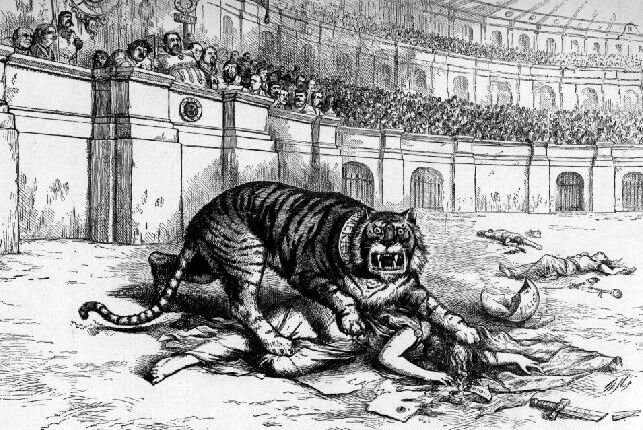
Tammany Hall devouring democracy--19th century cartoon by Thomas Nast.

And the same principle works well for tribal groups of immigrants, who will come out for one of their own. The alderman who explained the system to me back in Kingston was Greek; his machine was the Greek community. In the old days in Toronto, it was always the Orange Lodge. In the big city machines in the US, it tended to be the Irish Catholics. When I ran for school board in Toronto once, I found myself caught in the crossfire between the Italian candidate and the Portuguese candidate.

All this is bad enough. But our new ethnic tribes are not just close-knit, enabling them to take power; they are also largely composed of people who view themselves as upper class, with upper class attitudes and with upper class expectations or privilege and advantage.

And official multiculturalism is actually encouraging and underwriting this process. In fact, the sacred cow status of multiculturalism is perhaps itself an example of a ruling class carving out for itself special and separate privileges.

Besides killing off multiculturalism, and changing our immigration system, we should introduce some counterbalance to local control of all offices. Such as an elected senate, elected proportionally from national lists.


Monday, January 15, 2018

Pinkies Must Be Out While Drinking Tea!


Archie Bunker with age-challenged individual.

My wife is taking a course in Technical Writing here in the Philippines. Her textbook includes a section on politically correct language, and suggests the following alternatives. It is interesting and informative to see it all done from a non-North American perspective.

Examples are simply in the order given.

For "Angry," write "Passionate" or "emotional."

Like most examples of "politically correct" language, the problem is that the replacement is meant to obscure or confuse rather than communicate information. As a result, it defies the basic objective of writing, and so is bad writing. "Emotional" can mean many things, only one of which is "angry."

Moreover, it describes the person, rather than the emotion. You are saying of anyone who gets angry that they are habitually angry, that they have a character flaw. It might instead be healthy and righteous anger; you are accusing them of one of the Seven Deadly Sins.

For "Asians," write "Pacific Islanders."
Did you see that one coming? So it is now offensive to call anyone "Asian"? This is obviously meant, although it is not specified, to refer only to Filipinos. Technically correct, but still confusing, so long as you do not also refer to Japanese or Taiwanese as "Pacific Islanders." Which I doubt is intended.

The bottom line here, no doubt, is that many Filipinos prefer "Pacific Islanders" because it makes the Philippines sound like an American possession. Like Guam or Samoa--that is what is normally meant by "Pacific Islander." They would rather be associated with Americans than Chinese. They are not reconciled to the idea of Philippine independence. Cute, but daffy.

For "Autistic," write "Special child."
This is the usual problem--trying to obscure rather than inform. There are many ways in which a child can be special. And actually, a lot of them are worse than autism. Are you doing the autistic kid any favour, by conjuring up all these other possibilities? Ever see "Rosemary's Baby"?

For "Bald people," write "Comb free."
Good joke. But they're actually serious.

For "Black sheep," write "Outcast."
Okay, the problem is plain enough--associating the colour black with anything negative is currently a problem, because "black" is also used to describe subSaharan Africans. A bit odd that this would be an issue in the Philippines, though. Here it is hard to imagine anyone thinking that "black" referred to people instead of sheep. It shows the prevalence of American culture.

For "Blind," write "Visually-impaired."
This is just wrong. Visually-impaired means partial vision. Blind means no effective vision. 

And isn't it offensive to suggest that there is something wrong with being blind?

For "Deaf," write "Hearing-impaired."
Same problem. Simply an error.

For "Gifted," write "Advanced learner."
Agan, two different things. A gifted child is just as likely to be lagging behind the slated curriculum, in an average school. Because they are bored. Many advanced learners are not gifted, and many gifted children are not advanced learners.

For "Incapable," write "Fertility-challenged."

This again is funny. It reveals where Filipino values are. Having children is close to the point of life; so "ability" automatically means the ability to have children. Take note, all you foreigners considering Filipina brides. She WILL want children, and if you do not, it is heartless not to give her clear advance warning. And don't forget to wave goodbye.

Here the replacement is far more specific than the "bad" word. Which is itself surely already a euphemism. Why not "infertile"?

For "Insane," write "Mentally-challenged."
This is grotesquely wrong. It implies that insanity is cognate to stupidity. This is the reverse of the truth: the greater the intelligence, the higher the likelihood of insanity. The lower the intelligence, the more likely to be "sane." This bit of "political correctness" directly promotes prejudice, and spreads a falsehood in order to do so.

For "Janitor," write "Sanitarian."

If there is something wrong with being janitor, whatever happened to "building custodian"? "Sanitarian" means a public health worker, and is simply wrong for "janitor."

For "Lazy," write "Different interest."
Again, sounds like a joke. How will the reader be able to guess the real meaning?

For "Negro," write "African American."
Again, this shows how influential American culture is in the Philippines. Because, of course, this "correction" is nonsense, and will introduce an error, anywhere outside the USA. And we are outside the USA. How many African Americans are there in Zimbabwe or Canada or Jamaica?

The text is at least more honest than usual about what "politically correct" language is all about. It is usually represented in Canada, or the States, as meant to reduce discrimination and/or to protect the feelings of the group referred to. It usually does the exact opposite. Even the very resort to euphemism obviously implies there is something wrong with belonging to that group.

The text includes this nonsense explanation, but it feels like it does so as a matter of rote. It adds that the terms you use reflect which schools you attended. And that is exactly right, exactly the point. Filipinos get this, because the Philippines is a far more class-conscious society than the US or Canada. The point of using "politically-correct" language is that it is a class marker. It shows you went to the right schools and know the secret handshakes. You are not a member of the unwashed working class, not an Archie Bunker.


Tuesday, July 16, 2013

Uppity Rednecks

A view of the Zimmerman-Martin case from the Pittsburgh Post-Gazette.

According to my sources, in order to reach one million readers, I am still supposed to be writing about the Zimmerman trial. Okay, so here goes:

The line that has been pushed in the media from the beginning is that Trayvon Martin was killed because he was black: that it was all about race. This is certainly incorrect, according to the facts. Who is pushing this lie so aggressively, and why?

The real truth seems to be that George Zimmerman's prosecution is all about class. He has been demonized in the media, and prosecuted beyond reason, not because of his race, which is completely unclear, but because he is working class--technically, lower-middle class. Worse, he is lower-middle class trying to get ahead. The ordinary working stiff was acting “uppity.” To read the comments and commentaries, those who want to see him hanging from the nearest tree are most enraged because he supposedly acted as if he were a figure of authority, watching and following Martin as a suspicious character.

Of course, this is more or less what the police would do; and it is obviously not a hanging offence when they do it. The problem is that Zimmerman, though in fact legally entitled to do this, was not formally qualified. He was acting above his station, in the minds of the professional elite, including “professional” journalists.

One can see how this would ring all kinds of bells, if subconsciously, in the typical newsroom. What professional group is more threatened by citizen volunteerism these days than the media? Zimmerman and those like him are to them an existential threat. It was in their vital interests to take him down by whatever means necessary.

“Racism” is a preferred and time-honoured stratagem in this regard. According to the professional elite, the Pharisiate, the working class is racist by nature. That's why they must be kept in their place. The black mobs now raging through Oakland, et al, and the “low-information voters” generally, are useful idiots for these purposes. “Low-information voters,” pretty much by definition, are people who want to be taken care of, and are happy to have a ruling elite do their politics for them.