

 Posts
Posts


 |
| Members of the English upper classes throng around Harrod's, early 20th century. |
Canada has never had a formal ruling class. Actually, “never” is not right. New France had a ruling class under the seigneurial system. But since the British Conquest, it hasn’t. Everyone was a freeholder.
We North Americans tend not to realize how unique this is. It is foundational. Everywhere in the Old World, class something you were born into, it was unambiguous, and it was enforced by law.
Although that system has been abolished, profound effect linger. At my college in Saudi Arabia, I was the sole North American for some years, and hung out with Brits and Irish. They would dismiss someone, for example, as a “peasant”; as though that were saying something to the latter’s discredit. You don’t hear “peasant” as a common insult in Canada. Or they would refer to tradesmen disparagingly as “cowboys.” As if there were something wrong with being a tradesman or a cowboy.
Same in China. My students were acutely aware of one another’s background. One doctoral student, his fellows warned me, was “just a peasant.” Not to be taken seriously.
While there, as is traditional, I took a Chinese name. I chose “Shi Jiang.” Literally, “Stone River”; the image appealed to me. It meant roughly what the name of my home town, Gananoque, means in Iroquoian.
My students were most concerned. They felt it undignified for a college professor. “You shouldn’t take that name! That’s a working class name!”
Because “Shi Jiang” is also the Chinese term for a stonecutter or stonemason.
Compare Canada: Alexander Mackenzie, our second Prime Minister after Confederation, was a stonemason.
 |
| Even other parts of the Americans had established upper classes. Here, Mexican aristocrats. |
And don’t get started on India and the remaining influence of the caste system.
We in Canada lack this influence, like the US and Australia. This is what it means when the Declaration of Independence declares that all men are created equal, and are entitled to equal protection from the law.
We no longer understand how revolutionary that was. Revolutionary to none so much as my Irish ancestors, Catholic and Protestant, who formed the bulk of the population of English Canada in the 19th century. It instilled in them a fierce loyalty to this land, which immediately could not be swayed by any American or Fenian invasion, or any tragic events back in Ireland. Here, everyone pulled together.
But perhaps all this is changing.
Because we have never known class, perhaps we no longer understand the danger.
 |
| Alexander Mackenzie. |
We are admitting immigration now at unprecedented levels. These newcomers are liable, indeed likely, to retain their notions of class, and bring them with them. In smaller numbers, they might soon see differently; this is less likely when the numbers are so large.
Worse, for decades, our Canadian immigration system has been favouring the well educated and well heeled, on the premise that these will most likely soon be net contributors, instead of net drags, on the economy and the tax rolls. A reasonable assumption—but since we are drawing newcomers largely from the Third Word, this means we are importing the resident ruling classes.
They, of anyone, will be disinclined to shed their classist attitudes.
Has anyone else considered the probable result?
All this is amplified by another factor: ironically enough, our democratic system.
Some years ago, I got involved in local politics. I learned from a local alderman that the only way to achieve office was to have some organized group behind you. More than money, you needed volunteers, to knock on doors, put up posters, and get out to vote for you because you were one of them.
This means that, despite the theories, local democracies can be controlled by small groups—cliques.
In Canada, because of the Westminster system, all politics is to some degree local—office is achieved riding by riding. Such tight-knit, organized groups can easily take over nomination meetings, then significantly advantage their chosen candidate in the election.
This explains why identity politics is so powerful: organized minorities with strong self-identities thus magnify their power far beyond their numbers.
And, in effect, they can become a de facto ruling class; even a legally enforced ruling class.
We see this power being exercised by the teachers’ unions; by CUPE; by the feminist lobby, the gay lobby, and the professions. The farmers, the farm lobby. Regardless of what the majority of the population wants, or what is in their interests, the various parties tend to bow to their agendas and interests.
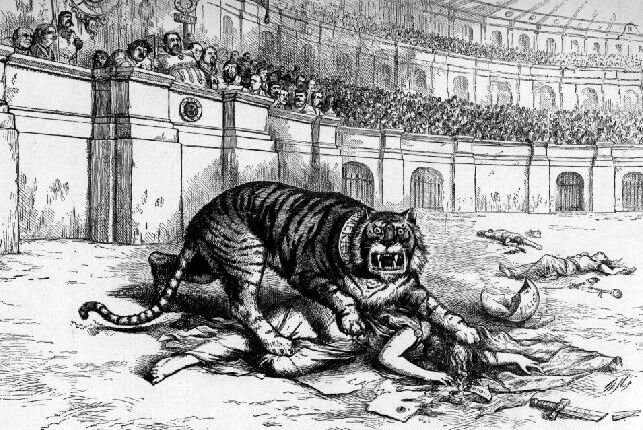 |
| Tammany Hall devouring democracy--19th century cartoon by Thomas Nast. |
And the same principle works well for tribal groups of immigrants, who will come out for one of their own. The alderman who explained the system to me back in Kingston was Greek; his machine was the Greek community. In the old days in Toronto, it was always the Orange Lodge. In the big city machines in the US, it tended to be the Irish Catholics. When I ran for school board in Toronto once, I found myself caught in the crossfire between the Italian candidate and the Portuguese candidate.
All this is bad enough. But our new ethnic tribes are not just close-knit, enabling them to take power; they are also largely composed of people who view themselves as upper class, with upper class attitudes and with upper class expectations or privilege and advantage.
And official multiculturalism is actually encouraging and underwriting this process. In fact, the sacred cow status of multiculturalism is perhaps itself an example of a ruling class carving out for itself special and separate privileges.
Besides killing off multiculturalism, and changing our immigration system, we should introduce some counterbalance to local control of all offices. Such as an elected senate, elected proportionally from national lists.