Playing the Indian Card

Showing posts with label ruling class. Show all posts

Tuesday, June 16, 2026

The Real Ruling Class May Not be Whom You Think

Con artist, or just dumb?


Marx misidentified the ruling class. He claimed the bourgeois were in control, and before them the landed gentry. Neither were ever in charge. They were just the wealthy class. The ruling class, the class that governed, and had the highest social authority, was always the educated class—the clerisy. The aristocrats and the bourgeois were subject to the law; even the king, since Magna Carta. And while kings might sometimes issue edicts, for the most part, who made the laws and stood in judgement? The clerisy—that is, the lawyers and the judges and the bureaucrats. Even the aristocrats were under their control. The bureaucrats always run the government—any government. If anyone else has power, either in an aristocracy or a democracy or a monarchy, they act only as a partial check on the clerisy, who manage most things day by day.

In pre-revolutionary France, when Louis XVI was required to summon the Estates General—required by the law, which he too had to obey-- who was the First Estate? Who was acknowledged as the top of the social scale? Marx’s bourgeoisie was jumbled in with the peasants in the Third Estate. The landed aristocracy was the Second Estate. The First Estate was the clerics, the clerisy, the educated class. 

Do not assume this meant just priests in the modern sense. Anyone who graduated university, in those days, was ordained. Cleric = clergy, but also clerk. Most of them spent little of their time in church. They held all the desk jobs; they were the civil service. They were the ones who knew how to read and write, how to keep accounts, how the system worked. Cardinal Richelieu, Cardinal Mazarin, Cardinal Wolseley, Thomas More, Cardinal Cromwell, and so on down.

In India, with its rigid caste system, who was the highest caste? Same as in France. Not the bourgeoisie; they were Vaishyas, third rank, above the Sudras, who were the manual labourers. Not the aristocracy, the Kshatriyas. As in Europe, they were second class. Highest caste was the Brahmins, the priestly, the educated class. They ran everything, and had to be deferred to by everyone else.

In pre-revolutionary China, the aristocracy was barely a thing. They were usually looked down on as uneducated boors. It was the Mandarins who ran the show.

This educated clerisy is the same group that form the backbone of the “progressive” movement in North America, which emerged in the early 20th century—the core “progressive” idea was rule by “experts.” The clerisy formed the backbone of the Nazis and the Fascists in Europe—it was the universities and the civil service, promoting state power: meaning power to the bureaucracy. In Russia the clerisy formed the Bolsheviks, as a supposed “vanguard of the proletariat”: like Marx, mostly well-educated pencil pushers. 

The continuing program of the clerisy in modern times is to consolidate power, to suppress any rival authority. For power is their coinage; telling others what to do, controlling them, governing them. By contrast, the capitalists are mostly only interested in making money. 


Monday, January 20, 2020

Classism in Canada


Members of the English upper classes throng around Harrod's, early 20th century.


Canada has never had a formal ruling class. Actually, “never” is not right. New France had a ruling class under the seigneurial system. But since the British Conquest, it hasn’t. Everyone was a freeholder.

We North Americans tend not to realize how unique this is. It is foundational. Everywhere in the Old World, class something you were born into, it was unambiguous, and it was enforced by law.

Although that system has been abolished, profound effect linger. At my college in Saudi Arabia, I was the sole North American for some years, and hung out with Brits and Irish. They would dismiss someone, for example, as a “peasant”; as though that were saying something to the latter’s discredit. You don’t hear “peasant” as a common insult in Canada. Or they would refer to tradesmen disparagingly as “cowboys.” As if there were something wrong with being a tradesman or a cowboy.

Same in China. My students were acutely aware of one another’s background. One doctoral student, his fellows warned me, was “just a peasant.” Not to be taken seriously.

While there, as is traditional, I took a Chinese name. I chose “Shi Jiang.” Literally, “Stone River”; the image appealed to me. It meant roughly what the name of my home town, Gananoque, means in Iroquoian.

My students were most concerned. They felt it undignified for a college professor. “You shouldn’t take that name! That’s a working class name!”

Because “Shi Jiang” is also the Chinese term for a stonecutter or stonemason.

Compare Canada: Alexander Mackenzie, our second Prime Minister after Confederation, was a stonemason.

Even  other parts of the Americans had established upper classes. Here, Mexican aristocrats.

And don’t get started on India and the remaining influence of the caste system.

We in Canada lack this influence, like the US and Australia. This is what it means when the Declaration of Independence declares that all men are created equal, and are entitled to equal protection from the law.

We no longer understand how revolutionary that was. Revolutionary to none so much as my Irish ancestors, Catholic and Protestant, who formed the bulk of the population of English Canada in the 19th century. It instilled in them a fierce loyalty to this land, which immediately could not be swayed by any American or Fenian invasion, or any tragic events back in Ireland. Here, everyone pulled together.

But perhaps all this is changing.

Because we have never known class, perhaps we no longer understand the danger.

Alexander Mackenzie.

We are admitting immigration now at unprecedented levels. These newcomers are liable, indeed likely, to retain their notions of class, and bring them with them. In smaller numbers, they might soon see differently; this is less likely when the numbers are so large.

Worse, for decades, our Canadian immigration system has been favouring the well educated and well heeled, on the premise that these will most likely soon be net contributors, instead of net drags, on the economy and the tax rolls. A reasonable assumption—but since we are drawing newcomers largely from the Third Word, this means we are importing the resident ruling classes.

They, of anyone, will be disinclined to shed their classist attitudes.

Has anyone else considered the probable result?

All this is amplified by another factor: ironically enough, our democratic system.

Some years ago, I got involved in local politics. I learned from a local alderman that the only way to achieve office was to have some organized group behind you. More than money, you needed volunteers, to knock on doors, put up posters, and get out to vote for you because you were one of them.

This means that, despite the theories, local democracies can be controlled by small groups—cliques.

In Canada, because of the Westminster system, all politics is to some degree local—office is achieved riding by riding. Such tight-knit, organized groups can easily take over nomination meetings, then significantly advantage their chosen candidate in the election.

This explains why identity politics is so powerful: organized minorities with strong self-identities thus magnify their power far beyond their numbers.

And, in effect, they can become a de facto ruling class; even a legally enforced ruling class.

We see this power being exercised by the teachers’ unions; by CUPE; by the feminist lobby, the gay lobby, and the professions. The farmers, the farm lobby. Regardless of what the majority of the population wants, or what is in their interests, the various parties tend to bow to their agendas and interests.

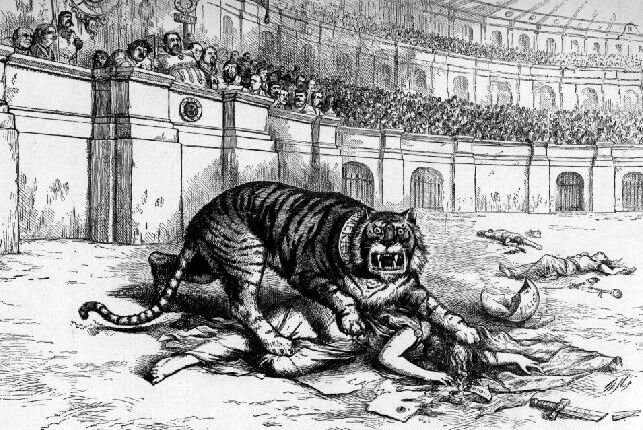
Tammany Hall devouring democracy--19th century cartoon by Thomas Nast.

And the same principle works well for tribal groups of immigrants, who will come out for one of their own. The alderman who explained the system to me back in Kingston was Greek; his machine was the Greek community. In the old days in Toronto, it was always the Orange Lodge. In the big city machines in the US, it tended to be the Irish Catholics. When I ran for school board in Toronto once, I found myself caught in the crossfire between the Italian candidate and the Portuguese candidate.

All this is bad enough. But our new ethnic tribes are not just close-knit, enabling them to take power; they are also largely composed of people who view themselves as upper class, with upper class attitudes and with upper class expectations or privilege and advantage.

And official multiculturalism is actually encouraging and underwriting this process. In fact, the sacred cow status of multiculturalism is perhaps itself an example of a ruling class carving out for itself special and separate privileges.

Besides killing off multiculturalism, and changing our immigration system, we should introduce some counterbalance to local control of all offices. Such as an elected senate, elected proportionally from national lists.


Sunday, July 02, 2017

On the Horror of Boarding Schools


We all know the horror stories about boarding schools. Not just the residential schools Canadian Indians attended. Indeed, there is no reason to suppose those were worse than the “public schools” rich Brits have sacrificed their scions to for generations beyond counting. We have seen the movie “If...” and read of Orwell’s experiences in “Such, Such Were the Joys.” Awful, no doubt, for many, especially sensitive, children. Even Tom Brown’s School Days admits that the “public” schools were hell for sensitive children; and describes some bullying that veers close to attempted murder.

Nevertheless, it seems to me there is a good reason why prominent families for centuries sent their wee ones there. In most cultures, the pukka classes seem to have had their children farmed out in one way or another. The Irish gentry used to swap kids. Everybody got brought up by a foster family, with all the fairy tales tell us that entails. There is also, of course, the tradition of the wet nurse or nanny.

It was for the kids’ benefit.

Some, no doubt, as they say, are born great. Others have greatness thrust upon them. But others achieve greatness, at least in the eyes of the world, by looking out for the main chance. The odds are fair that any who become very socially prominent and wealthy became so in part because they are, basically, selfish and self-aggrandizing. They put themselves and their wishes first in all situations. They acquire a lot of money because their priority is to acquire a lot of money. They acquire prestige and social position because their priority is to acquire prestige and social position. Which is to say, more broadly, their number one priority is themselves. They believe themselves pretty awesome.

See the Gospel of Luke on that one. No man can serve two masters.

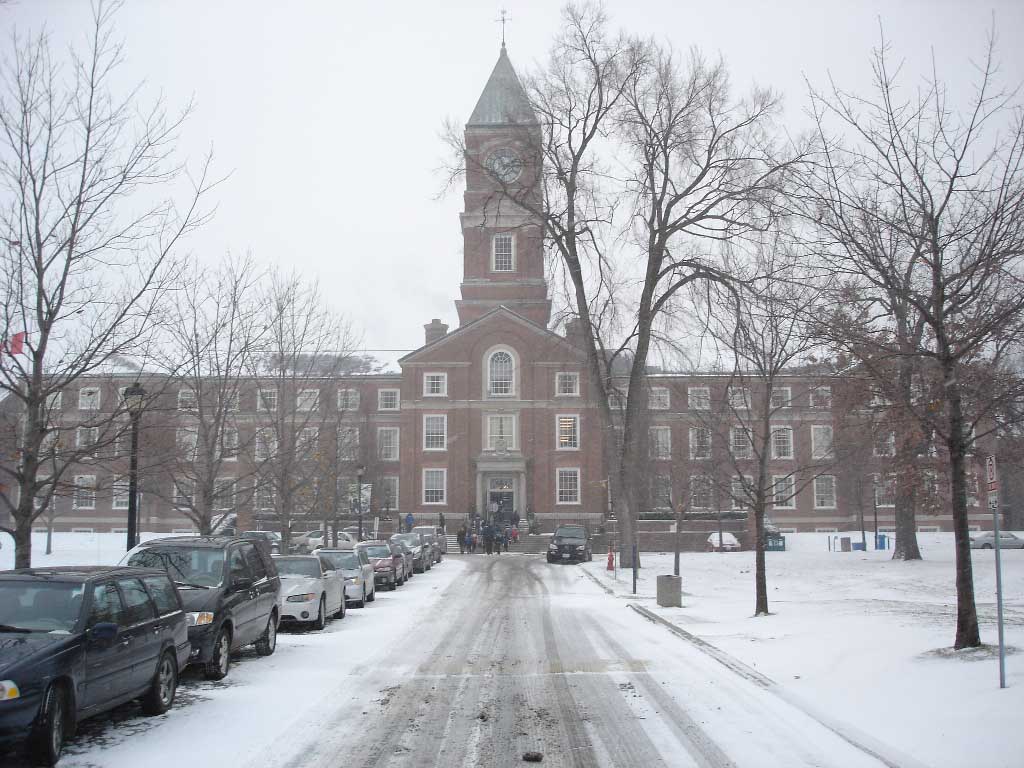
Upper Canada College, Toronto

Yet that is not even the worst risk. If these are people who have achieved for themselves, at least in part by hard work, talent, and enterprise, from obscure beginnings, they have some perspective on what they have accomplished. They have some real perspective, then, on their just desserts; they know not always having it. Moreover, the ability for a selfish person to achieve spectacular success is limited, by those around him or her gradually smelling out his motivations. In business, at least, as they say, honesty is the best policy.

The worse danger is parents who have had wealth and prestige handed to them: the second generation of the rich and famous. Always knowing wealth and privilege, they are naturally inclined to come to believe they deserve it. Always having others fawn on them, they are naturally inclined to believe they and their wishes are simply more important than those of others.

Besides being disastrous for the enterprises and the nation they are called on to run, these are exactly the sort of people who will see their children as their possessions, there only for their benefit. They are likely to abuse them. They are going to want to manipulate and control them. They are never going to allow them to develop into themselves.

Worse still if the unlucky child turns out to be exceptionally talented in some way. Then they are going to look like competition for attention. The self-absorbed parent is going to see an existential threat in that. This, I suggest, is the true import of all those Delphic oracles in classic myth of the child murdering the father.

Sending Thurston Junior off to boarding school protects him, in the second generation, from becoming a devouring monster; and, should his parents have become such monsters, can protect him from being devoured.

Granted, such schools are themselves also natural magnets for abusers. And some of the students will arrive as abusers. But, on the odds, the poor kids’ chances are better among strangers. Among their social peers, they cannot consider themselves so special. They must learn to interact with others as equals. Non-relatives will not feel the urge to coddle them. And, at worst, the strangers will not see them and their eventual success as a personal threat. At worst, they will not have as much social power to use against them. So the kids have a better chance of surviving emotionally intact into adulthood.

Ruling classes learn this lesson, or they do not remain ruling classes. The Laius complex naturally tends to destroy any prominent family within three generations: hence, for example, Greek tragedies usually came in groups of three, tracing a noble family through generations. The first generation achieves, the second generation reaps the rewards while achieving little, and then devours the third generation.

Even in China, they know this: “greatness,” so the Chinese proverb goes, “costs a family three generations.”


Saturday, March 05, 2016

Trump and the Case for the Republican Establishment


The latest national poll on the Republican field shows Trump at 49%. It was taken on February 29; his results in the Super Tuesday primaries just the day after do not bear this out. I hope this means the Trump bubble is at last popping.

Still, the fact that Trump has come so far does not speak well of the average American voter or for democracy. For all that folks, including commentators, are critical these days of the Republican establishment, I think on balance this shows that a sense of civic responsibility in the establishment generally has been all that has been keeping the US from disaster. Otherwise, why have we not seen campaigns like Trump's before? Even previous populists—William Jennings Bryan, for example—had a strong core of principle that they would not violate. This may have been the difference between the US and, say, the Weimar Republic.

In another sense, though, we are indeed seeing the failure of the ruling classes. In part, they have grown much less principled since the Sixties or so, and so they have lost their moral authority. As happened in the Weimar Republic, where the elite became sexually libertine, and were in any case blamed for the German failure of the First World War and the postwar economic chaos. In part, I suspect, the vastly improved communication technology over the past few years—internet, social media, smart phones—has exposed their flaws to the rest of us and rendered their leadership less necessary. A Trump and his followers can now organize without them.

Apparently, there is a case to be made for elites.


Tuesday, August 04, 2015

In God We Trust. All Others Pay Cash.


Perceived levels of corruption by country, 2014, according to Transparency International. The reader will note how cloesly this corresponds with GDP. 

Here's a chilling statistic, from Robert Reich in the Christian Science Monitor: “In 1964, Americans agreed by 64% to 29% that government was run for the benefit of all the people. By 2012, the response had reversed, with voters saying by 79% to 19% that government was 'run by a few big interests looking after themselves.'”Looking at the trend lines here, the first hit seems to have been the Vietnam War, circa 1967-8. The biggest hit seems to have come with Watergate. Since then, the confidence has not returned, but has on the whole slowly continued to slide.

Nor is it just government. Trust in all other social institutions seems also to have fallen over the same period: in the press, the churches, the schools, the professions. What we are seeing here, in sum, is a sense of declining morality within the ruling class.

I fear this lack of confidence is probably justified: those on top have increasingly become immoral and self-seeking over this period. One might hypothesize that they were always this immoral, and the only difference is increased scrutiny. But I don't think the evidence supports this. In 1960, anyone of prominence in the US would at least have given lip service to the truth and importance of morality. Now, much conventional morality, and even at times the very idea of morality, is openly scorned among the gentry.

It is a very bad portent for the health of the US. The single greatest asset any society can have is a general confidence in the social contract; a basic trust, a gentlemen's code of conduct that need not be enforced by law. Losing it is the difference between America and, say, Paraguay.

If gentlemen cannot be counted upon to be gentlemen, no amount of law enforcement can make much difference. For who then can trust the police?

If the majority of people believe those in control are merely out for themselves, this justifies them in turn in ignoring any rules that do not seem to be for their own personal benefit.

Society collapses into the primordial war of all against all.

In the meantime, any rival society that can do better than this is certain to conquer.

Perhaps the only thing that preserves America in its preeminence now is the equal or greater decadence of all visible competition.

Monday, November 15, 2010

The Ruling Class

It seems to me it is pretty important to understand just who the ruling class is. It also ought to be pretty straightforward; but it seems it isn't.


I recently mentioned to a left-leaning friend of mine that he and I were members of the ruling class. He reacted badly. In fact, he wrote that I “had a lot of gall” to suggest such a thing of him.

If I was right in saying so, it is odd that he would not know it. But it is even odder, surely, that he would consider the thing an insult. That's surpassingly strange, surely, and suggests immediately that somebody here has things upside down.

Why did I say we were both members of the ruling class? Because we were both well-educated professionals. But perhaps my friend, being a leftist, might have misunderstood. He might have thought I was saying he was a member of the class _Marx_ claimed to be the ruling class: the hated, grubby, money-soiled, lower-class bourgeoisie. After all, besides being a well-educated professional, he was awkwardly also independently wealthy thanks to inheriting part-ownership of a family firm, and also previously owned his own separate profitable national company.

When it comes to an opiate for the intellectuals, Marx is the great enabler—by conjuring up an imaginary ruling class of rich bourgeoisie, a “them,” the real ruling class can exploit and oppress at will without objection, and, even better, without guilt. Just getting a little of their own back from “them.” Even better when the bogus ruling class is a group traditionally looked down on by the real ruling class as far beneath them.

It all looks like a clever and deceitful plan; except that people aren't really that clever, in groups. Everyone is just buying in, as most people mostly do, to the nearest comfortable lie when it is offered, rather than seeking truth. Maybe even Marx himself. When these things look organized, it is not because of some Bavarian Illuminati, it is because the Devil is indeed an independent intelligence. Marxism just happened to be available for the purpose—but, you will note, it is so useful that it is being clung to by the real ruling class long after it has been objectively disproven, for that reason.

The ruling class never changes. It used to never be any secret at all who the ruling class was. The ruling class is, was, and no doubt forever shall be, the educated class. The desk workers, aka “bureacrats,” aka “professionals.”


A Medieval scribe.


When, on the cusp of the French Revolution, the Estates General were summoned by the king for new powers of taxation, we all know that the Third Estate comprised both the bourgeoisie and the common people; but who was the First Estate?

The aristocracy? The Wealthy landowners? Wrong. They were still only number two. The First Estate was the clergy.

Now, don't imagine that, in pre-modern terms, “clergy” meant only those who presided at religious services. “Clergy” in those times meant more or less anyone who could read, write, and keep sums. The big landowners generally couldn't; they could rarely even sign their name. It is worth noting that Prince Charles, not yet king, is the first ever in line for to the British throne with a university education. In these days, moreover, a university degree automatically came with a clerical gown and ordination. All desk-bound or “clerical” work was, as the word implies, done by “clergy,” “clerks,” “clerics.”

That is, the First Estate was the estate, broadly, of knowledge workers; of what we would today call “professionals.”

And they, of course, were the people who actually ran the government, and all the big estates, and all the businesses, all along, regardless of who held ownership. This was necessarily so, since only they knew how.

As in Europe, so too anywhere else in the world. Indeed, the Indian system is the best one to look at for clarity, because it is in India that the system of class or caste is most socially prominent, public, and articulated. Who were and are the highest caste in India? Not the rajahs, who are from the warrior class, the ksatriyas or big leandowners. Certainly not the bourgeoisie, the merchant class, the Vaidyas. It is the Brahmins—the knowledge workers—who emerged out of the head of Brahma. All other castes emerged from his body; only the Brahmins can claim his consciousness.

Who, in turn, are the acknowledged powers in China? In China, historically, there was little room for any landed aristocracy; all land legally belonged to the Emperor. All government power was in the hands of the Mandarinate, the learned class.


Chinese mandarins.


As in all things, seemingly, the New Testament gets this right. In ancient Palestine, whom do Jesus and John the Baptist consistently target and rail against as the as oppressors of the common people? Not the Roman procurator—his position seems almost ceremonial. Not the Roman centurions, nor the tax collectors, who are portrayed as only doing a job. The real power over the average man is obviously wielded by the scribes and Pharisees—the educated class: the professional teachers and those who made a living from their ability to read and write. The Sadducees, a professional priestly class, also figure in prominently, as a sort of upper bureacracy: in modern terms, doctors and scientists as opposed to mere teachers or accountants.

You can find the same ruling class even among hunter-gatherers—as soon as there is any possibility of class at all, the learned class immediately assumes its place of privilege. Most tribes have two distinct leaders: a war leader, and a “medicine man,” who, as the name implies, is the all-purpose professional. He keeps the tribal records and laws, presides at all rituals, tallies up ownerships, and functions if needed as a doctor as well.

In other words, Marx was completely wrong on his two main points: first, in who the ruling class was, and second, in claiming that the ruling class changes over time.

Is the same class ruling over us today? You bet. Suppose, today, some family makes it good in the family business: what is most often their fondest hope? Is it that their son or daughter, too, may become a successful businessperson, although perhaps on a larger scale? Not usually; their hope is that he may move up into the professions. Even Lord Thompson of Fleet, having made it bigger in business than most could imagine, insisted that his son Ken had to attend Cambridge. That was real success. The working class? Every group of workers if they can strives to form themselves, and be recognized, as a “profession.” Who is striving to be recognized as a shopkeeper or a bourgeois? Professionals, brahmins, of course look down on businessmen, on the “greedy” bourgeoisie, as they always have; just as, but even more than, they always looked down on those blustering, ignorant aristocrats. Hence the oddity of being offended by the suggestion that they are part of the “ruling class.”

As to whether the professions really hold all the power, once you get beyond the small family businesses and sole proprietorships that have always defined the bourgeoisie, who is actually running all the big corporations? Professionals: professional managers, professional accountants, professional lawyers, professional engineers. Ownership is usually dispersed, and rarely heard from. Who in turn, is running the government, and all the public services? Professionals: professional managers, professional teachers, professional social workers, professional academics. And whom do we elect, in theory to oversee them and keep them in line? Professionals—lawyers, mostly, with the odd manager, teacher, academic, or social worker.

It would be very funny, if it were not so serious.

Perhaps there is nothing intrinsically evil about a ruling class; or perhaps there is. The attitude of Jesus in the New Testament seems to make no allowances for the possibility that the ruling class of bureaucrats might be either good or necessary. It is, after all, a general principle that all individuals should be left as much as possible to rule themselves; this is the doctrine of human rights. There are great and honourable ethical traditions of this learned class: those of Confucius, Rabbinical Judaism, Hippocrates, the Jesuits, and so forth. But then, other classes can also claim their own great ethical traditions: those of chivalry, Calvin's “Protestant work ethic,” and so forth. The problem with any ruling class is that it seeks power over others, and those who join that ruling class will be those who seek power over others, and seeking power over others is probably intrinsically immoral, a violation of “do unto others....”

And there is definite reason to fear mischief from a structure in which the true ruling class is a matter for concealment.


A professional officer, near a small town in Belgium.


Unfortunately, over the past several centuries, more or less the opposite of what Marx, and indeed most others, have thought to have been happening, has been happening. The ruling class has been gathering more and more power to itself. In the pre-modern era, any tendency by the clerical Brahmin class to overreach could be countered by the landed class, the Ksatriyas. With their power over the military, they could intervene if they felt it necessary. The French Revolution, American Revolution, and English Revolution by and large took out this landed military class. The result was that the professional, clerical class had a much freer hand. Indeed, more or less the immediate result of both the French and the English revolutions was the seizure of the military power by the clerics, and its recasting on “professional” lines, with a professional officer corps: Cromwell's “New Model Army,” Napoleon's “Grand Armee.”


Lord Protector Cromwell, every inch the professional soldier, arrives at Parliament.


So, contrary to popular opinion, these revolutions may have reduced, rather than expanded, the freedom of the ordinary man. Regulations grew, and grew more strict: Cromwell's Puritans banned nearly everything, and Napoleon sought to regulate all phases of national life.

But these revolutions still left the Vaidyas, the merchant class, intact. The Marxist and Fascist revolutions of the Twentieth Century have been attempts to also strip all remaining power from the Vaidyas, the merchant class, aka the bourgeoisie, as well, and give them too to the professionals, leaving the professionals in that much more complete control.

It seems no coincidence, by the way, that the Communists and Fascists have done best in nations where a good education is traditionally most admired: in those most inclined in the first place to give power and prestige to the learned. China, Eastern Europe, then Catholic countries more than Protestant countries.

In the meantime, with or without a formal Marxist or Fascist revolution, the power of governments and their proportion of the GDP has been growing steadily, seemingly inexorably, worldwide throughout the Twentieth Century. Rules and regulations have continued to multiply.

Is there no escape?

Perhaps there is.

Up to this point, technological innovation has by and large only served to increase the power and prestige of the learned. Though new technologies did not necessarily come from the learned class, as technology improved, there tended to be more things to know, and so more need for learned sorts who knew how to operate them. So the professional class has grown richer, more powerful, and more numerous.

But in the end, the educated class exists due to a shortage of knowledge. What happens if knowledge instead is freely available to everyone, more or less at the click of a mouse?

That is what is happening with the Internet. The Internet will no doubt vastly increase the overall store of knowledge available, as did the invention of printing, but it also, vitally, and unlike the invention of printing, makes it instantly searchable. Increasingly, one can find the precise bit of knowledge one needs, right when one needs it.

There is perhaps, therefore, no longer a need for a professional class, really; everyone is capable of doing these things for themselves. Rather than needing to hire an expert on copyright law, who has studied the laws and casebooks and has them at least partly committed to memory, you can in principle get the relevant information, law and cases, for your situation quickly online. Rather than going to a doctor to have your symptoms diagnosed, you can use an expert system online. Knowing what your ailment is, you can fairly quickly become a more current expert on possible treatments than your doctor.

You may have noticed that Marx's third class, the proletatiat, the manual labourers, has largely disappeared in the most developed countries, instead of multiplying as he predicted, since he wrote. No doubt, in the early stages of the process, it looked as though they were growing. Technology instead made them largely obsolete, replacing much manual labour with machinery.

Just so, computers can replace much mental labour with machinery, probably over time making the professional class start to vanish.

We seem to be seeing this effect already. We are witnessing, it seems, the rapid decline and fall of the “legacy media,” which is to say, the “profession” of journalism. This makes sense: journalists are the first line of the keepers of the knowledge hoard, the daily disseminators of knowledge. They are no longer needed.

The rise of the Tea Party looks as though it is the beginning of a similar collapse in the power of professional politicians.

Teachers, too, are starting to feel the heat; Chris Christie in New Jersey is getting a lot of political milage out of challenging their unions.

Other, higher-level professions will probably follow. Real estate agents are about as useful now as elevator operators. General medical practitioners are only a shade better off, absent their legal monopoly on prescriptions—and the rising cost of health care should go far to bust that trust.

It might seem ironic that the world of the “knowledge professional” would collapse just at the moment when they seem to have reached the apex of their power, and everyone and their agent is striving to become a professional. But that is the way these things often are. Overreaching is part of the usual process. The French monarchy, too, fell just as it had seemingly consolidated everything under a Sun King, who could claim, “L'etat, c'est moi.”

If the ruling professional class actually falls, for the first time in human history, what will be left? And what will we all do for a living? That's a good question. Leonard Cohen may have been a true prophet in singing, back in the early nineties, “Democracy is coming—to the USA.” Who knows? We may see, for the first time, a direct, participatory democracy. The truth is, this is now for the first time ever truly feasible, thanks to the connectivity of the Internet. But that is secondary; the greater breakthrough would be a reversal of the trend towards greater government regulation.