





 Posts


Sunday, March 19, 2017


Saturday, March 18, 2017
The Globe Reports the Dutch Election
The dear old mainstream media is incorrigible. They’ll never change.
The headlines after the Dutch election read:
BBC: European relief as mainstream triumphs
PBS: Dutch reject far-right Geert Wilders in national election for prime minister
Guardian: GreenLeft proves to be big winner in Dutch election
Independent: Green Party big winner of Dutch elections.
Globe and Mail: Centre-left shift in Dutch elections deals blow to populism
These headlines range from spin to fake news.
This is mostly not malicious. But then, neither is most “fake news.” The problem is the need to come up with a striking headline, that will tempt the reader to keep reading the story. “Click-bait” is no new thing—the print equivalent has always been at the core of the news business. Nor is this, in itself, wrong. There is nothing bad about making things sound interesting. The problem is that, too often, the story seems to be falsified for the sake of a good lede.
Here, specifically, the problem is that the election results were indecisive. And they closely reflected the final polls. So what can you say to make them sound important and surprising?
And, then again, some of it is just partisan hackery. The last three headlines, the Guardian., the Independent, and the Globe and Mail, really cannot be explained on other grounds.
Would you know from this glance at the days headlines that the government coalition collapsed? And the “Greens” came in tied for fifth place, with less than 10% of the seats? That’s as though the Liberals or the NDP pulled 30 seats. Big win?
Mark Rutte’s centre-right VVD hung on to the title of largest party, losing eight seat and ending with 33 in the 150-seat house. Seems less than a ringing endorsement. But that is why the headline cannot be “Dutch government falls.” The ruling coalition did indeed fall; but as the head of the largest party, Rutte has first chance to form a new one.
The biggest story is probably that his coalition partner, until now the second-largest party, Labour, sister to Labour in the UK, was crushed. They lost 29 of their 38 seats.
Okay, “second-largest party crushed” does not draw well. But then, how is the collapse of the largest party on the left a move to the left?
The new second-largest party is Wilders’ Trumpesque PVV. They picked up five seats, for 20. If Rutte cannot cobble together a working coalition, he'll get a crack at it. But his chances look to be slim to none.
The second-biggest shift was the Green Party picking up ten seats. But this is no ideological shift to the left of the electorate: the votes that Labour lost had to go somewhere. It turns out that only a third of them stayed on the left, then, with the Greens. Who are clearly also-rans here.
The Christian Democrats, on the right, picked up six seats. And they have five more seats than the Greens. The leftist Socialist Party dropped one seat. D66, whose main issue is direct democracy, picked up seven. Does that count as left or right?
Given the results, at least four parties will be needed to form a government. And they won’t all be on the same side ideologically. So it looks as though any new government may not last. The
Since he heads the largest party, Rutte get first crack. Looking at the seat totals, and who can likely agree on policy, the best bet seems to be a coalition of Rutte (conservative), the Christian Democrats (conservative), D66 (not clear), the Christian Union (conservative), 50Plus (conservative), and maybe the Party for the Animals (you decide). This would be a significant move to the right; remembering that Rutte’s own party is conservative. There are no available coalitions that would move the government to the left. There are available coalitions that would move it further than this to the right—but Rutte has vowed not to allow Wilders into government.
There you go: “Centre-left shift in Dutch elections deals blow to populism.”
You read it in the Globe first.
Friday, March 17, 2017

Wednesday, March 15, 2017
Rep. Steve King and White Supremacy
It comes as a bit of a shock to me. After all, I have spent my life in non-Western cultures, and studying them has been my great interest. I have been married twice, first to a Pakistani woman, now to a Filipina, and my two children are half-Filipino. Politically, I have always been a liberal, condisering it self-evident that all men are created equal, and endowed by their Creator with certain rights. In religion, as a Catholic, I believe that all men are brothers, of equal worth in the eyes of God.
But no—somehow the word “white supremacist” has changed definition. It apparently no longer requires believing, as I do not, that there is any such thing as a “white race.” And it no longer requires believing that people with pale skin should be given some special rights—i.e., supremacy.
I suppose this should not surprise me. I had, in earlier days, supposed that being a liberal put me on the left of the political spectrum. But that ground got shifted decades ago.
I am jolted into this realization by the current controversy over US representative Steve King.
The Washington Post writes:
King told CNN that he is merely “a champion for Western civilization,” which he called “a superior civilization.” Which means, of course, that he considers other civilizations inferior. But we knew that.
… We should pay attention to his lexicon, however, because today’s white supremacism tends to shy away from overtly racial terminology. Listen instead for words such as “culture” and “civilization.”
The idea is that the United States is the land of the free and the home of the brave because its “civilization” is “European” or “Western” — euphemisms, basically, for “white.”
I face an obvious problem here. It is conceivable, I suppose, that some people use “European civilization” as a euphemism for “white race.” Maybe King is doing this, although I think we owe it to people generally to take their words at face value, and not put new words in their mouth.
But what about people like me who are simply using “European civilization” to mean “European civilization,” and are making the point that it is the most advanced civilization in the world?
For we would naturally say exactly the same thing. How does the Washington Post, or anyone, tell the difference?
It seems the answer is that racism no longer requires believing in race. It is this very opinion, that Western civilization is superior, that is intolerable. The WaPo apparently has a problem with the mere statement that “other civilizations are inferior.” “But we knew that.”
To be fair, King also said something more controversial. He tweeted, “We can’t restore our civilization with somebody else’s babies.”
If American culture is not race-based, and it obviously is not, then yes, of course, they can. But King has explained that this is not what he meant: he was referring not to the children’s genetic makeup, but to the values instilled by their parents. Which seems a perfectly fair point. If race does not matter, in a country like the US or Canada, values matter that much more.
It ought also to be pointed out that there is nothing intrinsically wrong with a country being race-based. Some countries are: Japan, Korea, other Asian countries. If we really suddenly have a problem with this, we are going to have to re-think a lot of things. Is Japan Japanese-supremacist because they do not take in immigrants? Are they morally obliged to do so? Are the Falklands morally obliged to take in Argentine immigrants?
Rep. John Lewis tweeted,
“Rep. King’s statement is bigoted and racist. It suggests there is one cultural tradition and one appearance that all of humanity should conform to. These ideas have given rise to some of the worst atrocities in human history, and they must be condemned.”
Actually, King did not say this. He was speaking of America, not the world. He was saying there is one cultural tradition all Americans should adhere to. Nigerians are presumably free to conform to theirs, and Koreans to theirs. But now simply claiming that there is a distinct American culture, and it is worth preserving, is “bigoted and racist.” Why would this be so? What about claiming there is a distinct Korean culture, or a distinct Jamaican one?
But I would go father than King here. I actually think there is indeed one cultural tradition all of humanity should conform to. You could call it the emerging world culture. I have been in Korea, the Philippines, China, and the Middle East for most of the past twenty-five years. And I tell you, it is artificial any longer to speak of different cultures. Everybody now listens to the same music, eats the same fast food, plays the same games on the Internet.
And I believe this is a good thing. As I have said before in this space, there is no such thing as “Western civilization.” There is only civilization and lack of it. The great task of human existence is to take the best wherever we find it, and build human civilization.
As it happens, that is more or less what America already is.
Anyone who is against that, and who insists instead on preserving their little cultural ghetto, is doing the devil’s work.
King is not doing that. King wants more melting pot. Lewis and the Washington Post and cultural relativism are doing that.
Monday, March 13, 2017
Jumping Through Hoops
 |
| Ancient Minoan fresco |
Students recently spray-painted “White Girl, Take OFF Your Hoops!!!” on a campus wall at Pitzer College dedicated to free speech. Alegria Martinez writes, in The Claremont Independent, “Why should white girls be able to take part in this culture?”
 |
| Another Minoan fresco. |
Problem: the first hoop earrings of which we have record were in Sumeria and Minoan Crete. Both, for what it is worth, “white” cultures. By this logic, it is black girls who must now take off their hoops. Along with their jeans, blouses, shoes, glasses, and any plastic or metal. And stop using English, for heavens sake!
Is this what Martin Luther King was about? Segregation did not work well last time. And, frankly, cultural appropriation has tended, historically, to work mostly one way.
 |
| Sumerian jewellery. |
Saturday, March 11, 2017
Stop Me, Before I Kill Again...

In reaction to the allegations by Trump that his campaign headquarters were bugged, Mark Levin and Stefan Molyneux have joined Sarah Hoyt in pressing the panic button. Molyneux warns of likely violence to come, and compares the situation to that before the French Revolution. Levin seemed to be literally trembling with rage as he made his case with news reports. He said this was “orders of magnitude” more serious than Watergate
We do not yet know whether there is any thing substantial behind Trump’s charges. If there is, it would seem that we have a constitutional crisis. Bob Woodward was interviewed, and said there is no good mechanism to deal with this.
I wonder. Democratic government—any stable society—depends on a series of gentleman’s agreements. Bad guys will always break them, but everyone counts on most people not doing so. Everyone must trust that most people in authority will do the decent thing when it comes down to it. That level of trust seems to be gone in the US now. There is already fighting in the streets. We have just seen a particularly nasty incident at Middlebury College in Vermont. We are suddenly seeing masked protesters everywhere--eerily like the Fascists in their day.
You have to wonder. What happens if there is a civil war or revolution in America?
A civil war like the first one would require some states to vote to secede from the union. For that to be possible, I think you have to assume a Democratic majority in both state houses, given that the federal government is solidly Republican. Not many states currently qualify: California, Oregon, Nevada, Massachusetts, Rhode Island, Connecticut, Vermont, New Jersey, Delaware, Maryland, Illinois, New Mexico.
Note that these do not form one geographical block. There is a clump of three on the West Coast, a clump of four on the East Coast, another clump of three on the East Coast, and two odd states in the interior, far apart. So in the case of civil war, or forming a separate country, it could not be a unified opposition. A separatist movement might hope that the rest of the US would do nothing, but if the rest of the US chose to deny them the right to independence, as happened last time this was tried, it would probably not be a terribly even fight. The interior states, if they separated on their own, would be quickly overrun. They probably would not try. It would be unlikely to get more than one of the three-state clumps to pull out in tandem. Independently, even if they did, they would probably easily be overrun. At best, it would be 40 states against 10 in three separate groups which could be picked off separately.
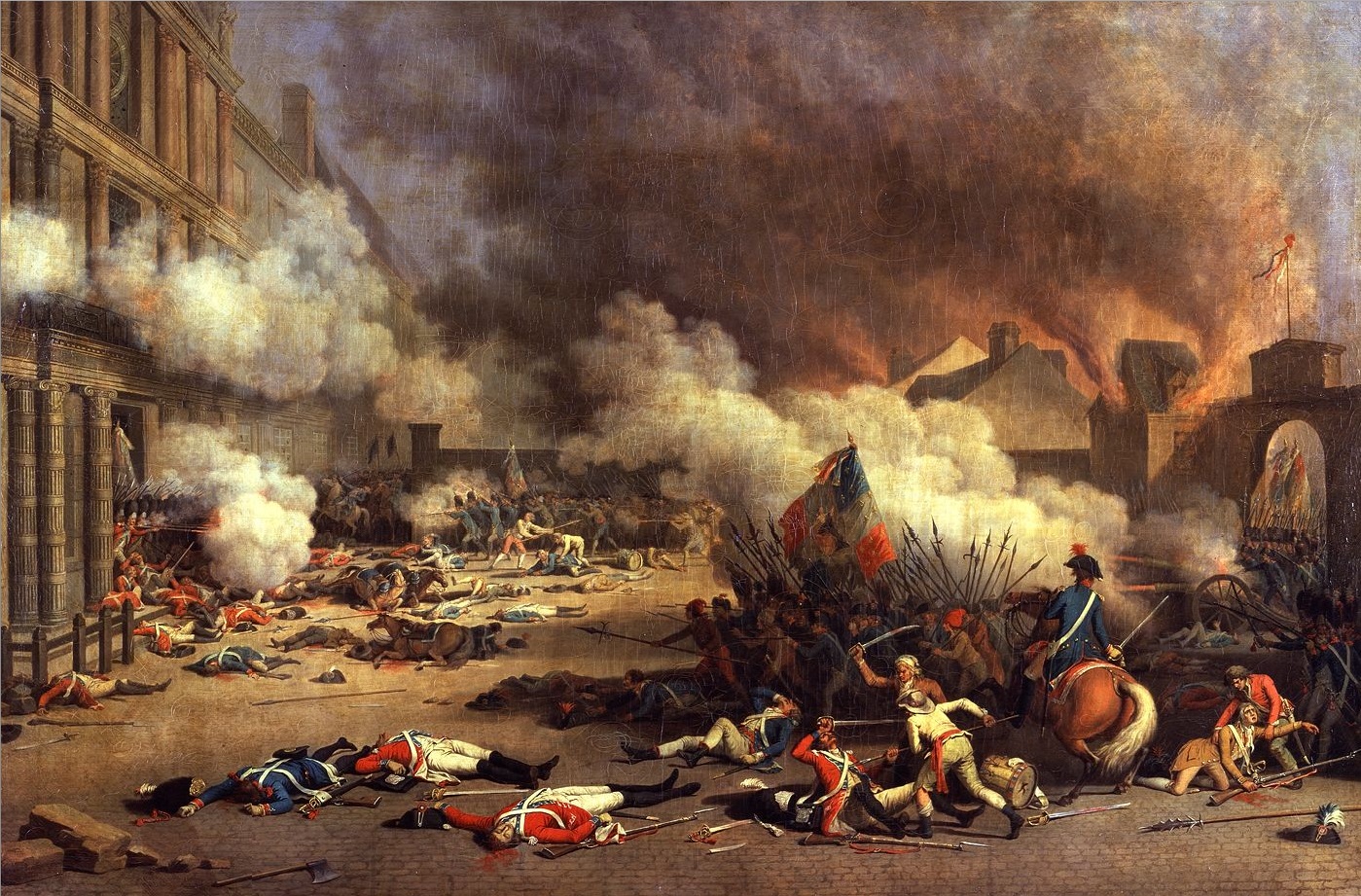
Some talk of the rebel states joining Canada. That would not help, militarily. Canada does not have the military strength to defend its own land mass, much less help defend someone else’s. And there is no chance of defense in depth. Unlike Russia, everything strategic is in a narrow band just north of the border. A quick tank thrust into Winnipeg, and Canada is cut in two. It would be suicide for Canada to get involved, if it came to fighting.
So how about a revolution? Here, the left’s chances look better. They control the press, the bureaucracy, the schools and universities, the professions. In day to day terms, their hands are already on the levels of power. And they control the inner cities.
But if it came to actual shooting, again, they look as if they are at a disadvantage. In past revolutions, like the French or the Russian, controlling the capital or the big city was vitally important. But it may not be so any more, thanks to our vastly improved communications. The hinterland gets immediate news, and can make their own voice heard. So it is hard for one mob in one place to carry the day.
On the other hand, the crucial issue in any of the classic revolutions in the past has been the attitude of the army. The turning point always comes when the army refuses to fight the crowd.
Here, it seems that the Trump forces have the advantage. Both the military and the police forces are probably on the Republican side. The more so since Black Lives Matter has been demonizing the cops. The more so since Trump has appointed prominent and well-respected military men to top administration posts. And promised more money for the military. Any civilians with guns are also likely to be Trump supporters, given the left’s fight for gun control.
So, if it comes to fighting in the streets, most of the weaponry and military discipline will be on one side. If it comes to a quick attempted coup, they had better be ready to face tank turrets below their office windows within days.
This being so, it seems like suicide for the left to be taking to the barriers now, refusing to work within the system as it stands, in which they are favoured, and fighting against open discussion, free speech and democratic mechanisms. It is a spectacular case of historical blindness and arrogance.
And if anyone tries to warn them, they are the enemy.
I wonder if it is a case of their own guilty consciences demanding they be found out and punished. It is said to be so, for example, for serial murderers, that they secretly want to be caught, and will keep taking risks and leaving clues until they are.
The Erinyes are out, and are taking no prisoners.
Thursday, March 09, 2017
Coming: Cheap College Online

I do not think he is entirely right. His vision calls, for example, for a suspension of all copyright for online education materials. This is a non-starter. It expects everyone to work for free. Not right, and not going to happen. Some may choose, as they can now, to offer their work for free under Creative Commons License.
He also writes “you need some form of accreditation.” I think he overlooks the obvious path. In the future, I suspect, name institutions like Harvard will be limited to creating evaluation procedures. Where you acquire the knowledge is wide open. The university simply certifies that you have it.
But his basic point is correct. It is true right now, at this moment, that online teaching platforms are more flexible, allow better experiences, than classrooms do. At a small fraction of the cost, when you calculate in the need for students to move and cover living expenses.
Wednesday, March 08, 2017
Leitch's Values Test
 |
| Canadian values: Fernie Swastikas, 1922. |
Kellie Leitch would not be my pick for Canadian Conservative leader. I find her efforts to mimic Trump in the US amateurish and embarrassing. However, it is strange to me that her proposal for “values testing” immigrants is controversial. It is something we ought to be doing.
Canada is obviously not an ethnically-based state. We speak two official languages; if predominantly Christian, we are half Protestant and half Catholic; we come from everywhere. The whole idea of immigration belies that notion of an ethnically-based state, even if most other states are.
So what is left that makes Canada Canada? Is it no more than a geographical designation? If so, who cares? Why take up arms, for example, to defend it? Can any conceivable enemy sink this geography beneath the waves?
No, if Canada exists at all, it is on the basis of shared values.
Since this is so, it is vital to ensure that immigrants share those values. If they do not, they constitute a threat to Canada’s existence. Because that, shared values, is what Canada is.
What values?
Not a tough question. They would, of course, be those found in the Canadian Constitution.
The values test could, of course, be skewed towards things that are not really shared Canadian values, but a partisan political agenda. That does not seem to be what Leitch has in mind. Here are her sample questions:
Are men and woman equal, and entitled to equal protection under the law?
Is it ever OK to coerce or use violence against an individual or a group who disagrees with your views?
Do you recognize that to have a good life in Canada you will need to work hard to provide for yourself and your family, and that you can't expect to have things you want given to you?Hard to see a problem with any of that. Okay, I don’t like the first one, because without context, the assertion that men and women are equal is incomprehensible. Of course they are not: men cannot have babies, for example. The issue is equality before the law.
“Are men and women entitled to equal protection under the law?”Surely question two is of vital importance to our way of life, to peace, order, and good government. It is, moreover, obviously not accepted everywhere. In the Arab world, for example, a word is considered as morally significant as an act. Therefore, you can kill someone for something they say. This cannot be accepted, or democracy is not possible, because open public debate is not possible: there is good reason why democracy has never been managed in the Middle East.
Question three is merely a matter of government acting as responsible stewards of the public purse.
It is not hard to think of other questions that should be asked.
Do you believe that everyone has the right to freely practice their chosen religion?This, of course, is not generally accepted in the Muslim world, and that is impossible to reconcile with basic human liberties. China presents the same problem.
Better yet to add:
Do you agree that everyone has the right to their own religious views, and to freely express them?Close to a restatement, but it eliminates the possible fudge that, as in China, one might be permitted to practice a religion in private, but not speak about it. That is not religious freedom.
Do you think everyone deserves equal protection under the law, regardless of race, sex, or place of origin?It is wrong to restrict the question to sex alone.
Perhaps it should be clarified by being restated in these terms:
Do you think the same laws should apply to everyone, regardless of race, sex, or place of origin?This clarifies what “equal protection under the law” means.
Here’s one that might seem controversial:
Do you accept Canada’s constitutional monarchy and parliamentary form of government?Some may feel immigrants ought to be free to disagree with monarchy. But they are actually not now. Allegiance to the throne is in the oath of citizenship, and the monarchy is not going anywhere, given its constitutional status. If nothing else, it is only fair to make this clear to new immigrants. And it seems wrong and seditious in principle to immigrate to a new country with the notion of changing its form of government.
Do you agree that everyone has a duty to support themselves and their families?More or less what Leitch wants to ask. But it removes the element of dishonesty. The fact is that, by world standards, most immigrants can indeed expect to have a good life in Canada without working. Sorry to say, but living abroad, I see immigration to Canada often sold in ads on the basis of “come and get your freebies!” Nothing we can really do about it, except point out the immorality of it. We ought at least to do that.
Do you agree that everyone has the right to their opinion, and to freely express it?Of course, the modern left, within Canada, does not accept this. But this is a huge problem and it ought not to be controversial. It is, after all, in the Charter of Rights and Freedoms. Without this, again, democracy is not possible. Nor is peace, order, and good government.
Do you agree that disagreements should not be solved by individuals with violence?Absolutely fundamental to peace and order. Why on earth would we not ask it?
Any others? What am I forgetting?
Tuesday, March 07, 2017
Domestic Zoos
 |
| A part of Canadian heritage. |
I read recently that some of the traditional dog breeds of England are in danger of extinction. It is a problem whenever a breed falls below 300 registrations a year—below that level, the gene pool is becoming dangerously small, and genetic defects are likely to develop. Times change; dogs that had an important role on a farm are not practical in the city. Among the breeds in this situation currently are the Cardigan Welsh Corgi, the Bloodhound, the Irish Wolfhound, the Kerry Blue Terrier, and the Skye Terrier.
But some of these breeds, it seems to me, are a part of British national heritage. As would be the Husky, the Newfoundland, the Border Collie, or the Labrador Retriever in Canada. This is the sort of thing it is the business of a government to preserve. As much as historic old buildings.
 |
| Ugly tomatoes taste best. |
And it would not be an expensive thing to do, when one considers all the benefits. What we need are “zoos” for endangered domestic animals. With, of course, breeding programmes. This is the sort of thing zoos are supposed to be for, after all, they say. But it would be one heck of a lot cheaper and more practical to do this for domesticated than for wild animals. And more useful, as such animals are domesticated in the first place because they are more useful to man. Such zoos should also, automatically, provide much entertainment and educational value for kids and the general public. What could be a more valuable break from the hustle and the troubles of daily city life than to be able to step back into an old-fashioned farm scape? If the animals are not as exotic as at a zoo, that is surely compensated for by the opportunity to get right up close and pet them.
 |
| The Canadian horse. |
In fact, many cities already have this sort of thing. But we should use them systematically, to preserve and promote breeds of local historical significance. Dogs, cats, horses, poultry, cattle. And not just animals: why not also preserve heritage crops. And some revenue could be made by selling the pups or seeds or cuttings or produce to the public. Promoting, in turn, local history, culture, and heritage.
Monday, March 06, 2017
Haters Gonna Hate

More on the clear and present danger of "Islamophobia":
The stats available online are not that current—2013--but they show the number of hate crimes in Canada declining overall, and specifically the hate crimes based on religion—down 22% year over year. So why promote the impression that they are spiralling out of control?
Among hate crimes inspired by religion, far and away the most were against Jews—two to three times more than those aimed at Muslims. Per capita, the imbalance is even greater: Jews experienced 54.9 hate crimes per 100,000 (Jewish) population; Muslims experienced 6.2 hate crimes per 100,000. I think that qualifies as an order of magnitude.
So why are we singling out hate crimes against Muslims for special condemnation, and refusing to mention hate crimes against Jews? Given the facts on the ground, that looks more like a green light for hate crimes against Jews than something inspired by hate crimes against Muslims.
Saturday, March 04, 2017
The Madness in their Method
It’s getting nasty out there.
I am now reliably informed that if I oppose M-103, the motion currently before the Canadian Parliament condemning “Islamophobia,” I am an Islamophobe, a Fascist, and a white supremacist.
The empire is striking back. They seem to have taken down Milo Yiannopoulis and Pew-di-pie. They are working on Jeff Sessions. The elites smell blood. And ultimately, it is their own. Who could expect them to go down without a fight? Things are starting to get to the streets.
But it is more than just the elites. There are a lot of people who are with the old regime in this as well. People who are not themselves getting fat off the system. Why? Are they just naive?
Seems not possible. They include some pretty intelligent people, and the charges they are supporting are little short of delusional. How many Fascists, for example, do you really think are living in Metropolitan Toronto?
I guess I had better weigh in on M-103. First, it makes no sense to single out Islam among the religions for special concern. In Canada, there are currently and historically more crimes of prejudice against Jews. And they seem to be growing. Worldwide, there are more hate crimes against Christians than anyone. Moreover, the largest proportion of both currently are actually done in the name of Islam. So it seems perverse to single out Islam here as under threat. It looks like deliberate misdirection. Or like giving Islam special status, and tacitly endorsing hate towards Christians and Jews.
Second, enshrining the term “Islamophobia” in the motion is a problem. First, a phobia is a mental illness (sic); it is something over which people have little control. It is not something willed, and it is something nobody would wish upon themselves. For the government to condemn something as a “phobia,” is to say that phobia is culpable. This is well calculated to promote prejudice against the mentally ill, who already have enough to suffer; and who are already a group that is discriminated against. No government should be giving any kind of sanction to such an expression.
On the flip side, the term seeks to prevent legitimate debate: a particular viewpoint is not to be questioned. If you do, you are simply mentally ill, and your concerns need not be addressed. This is an old Soviet tactic.
Then there is the term Islam. The word is “Islamophobia,” not “Muslim phobia.” It is a very different matter to condemn Islam than to condemn Muslims. One can certainly argue that condemning Muslims is illegitimate discrimination. But condemning Islam is anyone’s right. Obviously, if you are not yourself Muslim, it is because you disagree with one or more of the teachings of Islam. This concept of “Islamophobia” implies that simply disagreeing with Islam is not legitimate. Allow that, and you have ended freedom of religion, free speech, and freedom of thought.
It is vital that we preserve this distinction. Which is, indeed, currently in danger of being lost. For example, the idea that homosexual sex is a human right has recently extended to the idea that it is not permitted to say that homosexual sex is morally wrong.
Hard to see how you can parse that with the fact that Islam condemns homosexual sex as morally wrong; but logical inconsistency is the least of our problems here.
When the Liberal government were offered the opportunity to back a bill that took out these troublesome elements, while preserving the claimed intent, to protect religious liberty against discrimination, they refused. Why would they, unless this proves an ulterior motive?
The intent is not to protect Islam. But it is not really to end free speech and freedom of thought either, at least in the many people who are not part of the elite, but are going along enthusiastically with this agenda.
It is, I think, the opportunity to target a specific portion of the population as deplorable, morally intolerable. As “Fascists,” “white supremacists,” and “Islamophobes.”
It would be simpler, granted, to simply so target Muslims. And the left has done that in the past. But if you are so obvious about it that people realize what is happening, it does not work.
Because the whole point of scapegoating is to sublimate some guilt you yourself feel over something you have done. If you can blame the scapegoat for supposedly scapegoating, that gives you license to scapegoat them guilt-free.
A large body of people with guilty consciences, then, are eager to blame everything on some “basket of deplorables,” or “Nazis” or “white supremacists” or “the alt-right.” Just as they at other times would have blamed the Jews, or the bourgeois, or Catholics. And they do it, by unjustly accusing others of the same sin, of hating immigrants, or Mexicans, or Muslims, or blacks. Great bit of misdirection. It is not so much that these others are poisoning the wells; but that they are utterly bad, and so, by opposing them, I must be essentially good.
I do think, for the great mass of people who support this leftist pogrom, that it all comes down to abortion and free sex. So many people have bought into this, and their consciences have been after them about it. So, along with crazy, almost psychotic leftist politics, we have things like the self-esteem movement. A lot of people are going on these days about the need to “forgive yourself,” to love yourself, and so forth.
Forgive yourself for what? It all presupposes a troubled conscience.
Forgive yourself, sure, but the first step is to acknowledge the sin. That’s the hard part.
Rather than do that, those with said guilty consciences are demanding popular acceptance of crazier and crazier propositions: unisex bathrooms, free choice in gender, resolution M-103, and so forth. You have to sign on, or they no longer feel "safe."
"Safe," ultimately, from the truth.
But the truth shall set you free.
Friday, March 03, 2017
Trump Steaks
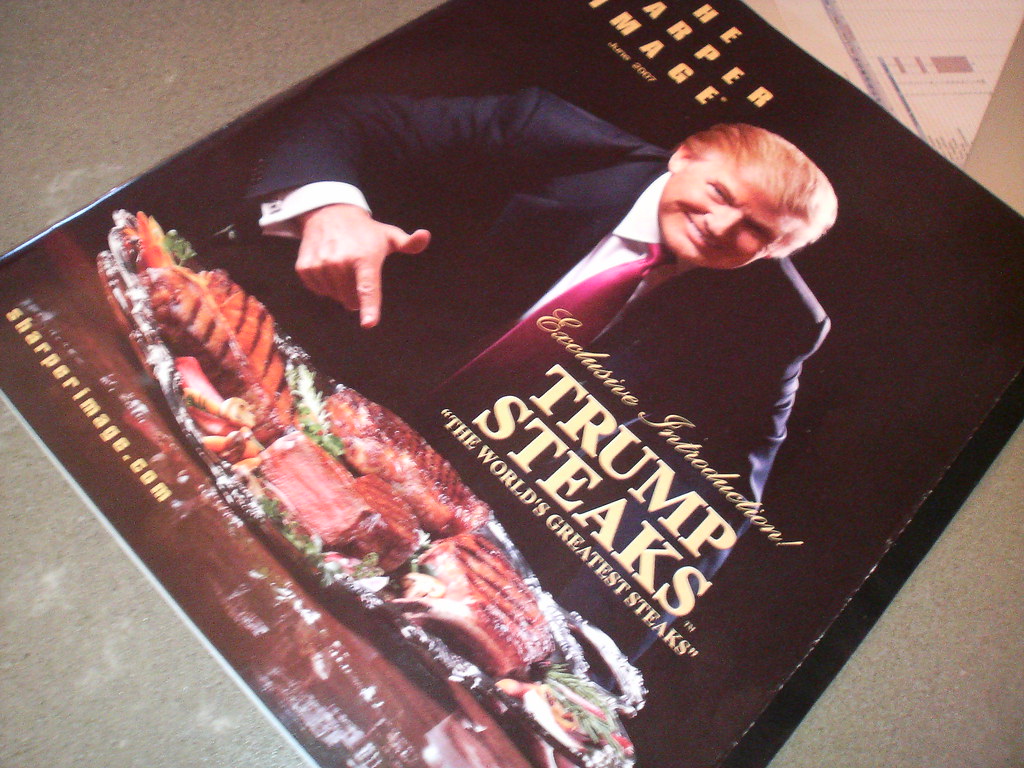
In the latest news, Melania Trump has worn an unacceptable black dress to Trump’s speech to congress. Ivanka Trump wore an unacceptable red dress. Democratic congresswomen all wore acceptable white dresses, but it was unacceptable when Melania Trump wore a white jumpsuit at the Republican convention.
More importantly, Donald Trump is reported to have ordered a steak well-done, then put ketchup on it.
This is truly unacceptable.
Kind of sums it up. Most of the resistance to Trump is about class. The people who oppose him oppose him because they think he is nouveau riche. The people who support him support him because they think he is nouveau riche. He is not nouveau riche, but he endearingly acts just as most working guys feel they would if they were. Marry a babe much younger, live in a Manhattan penthouse, tell everyone to go hang, put your name on everything.
And order steak, lots of steak, just the way you damned well like it.
Trump’s critics, on the other hand, hate him not just because he lacks class, but because he does not defer to class. Because he does not defer to expertise, to his betters. One ought to listen to the chefs on how to eat a steak; they are the experts. Or, more generally, one ought to defer, whatever the people think, to those who see this sort of thing and object—the elite, those who went to the right schools and the right cocktail parties, and know how one is supposed to eat steak.
They have every right, after all, to tell you what to eat.
You can eat cake.
Thursday, March 02, 2017
Comes the Revolution...
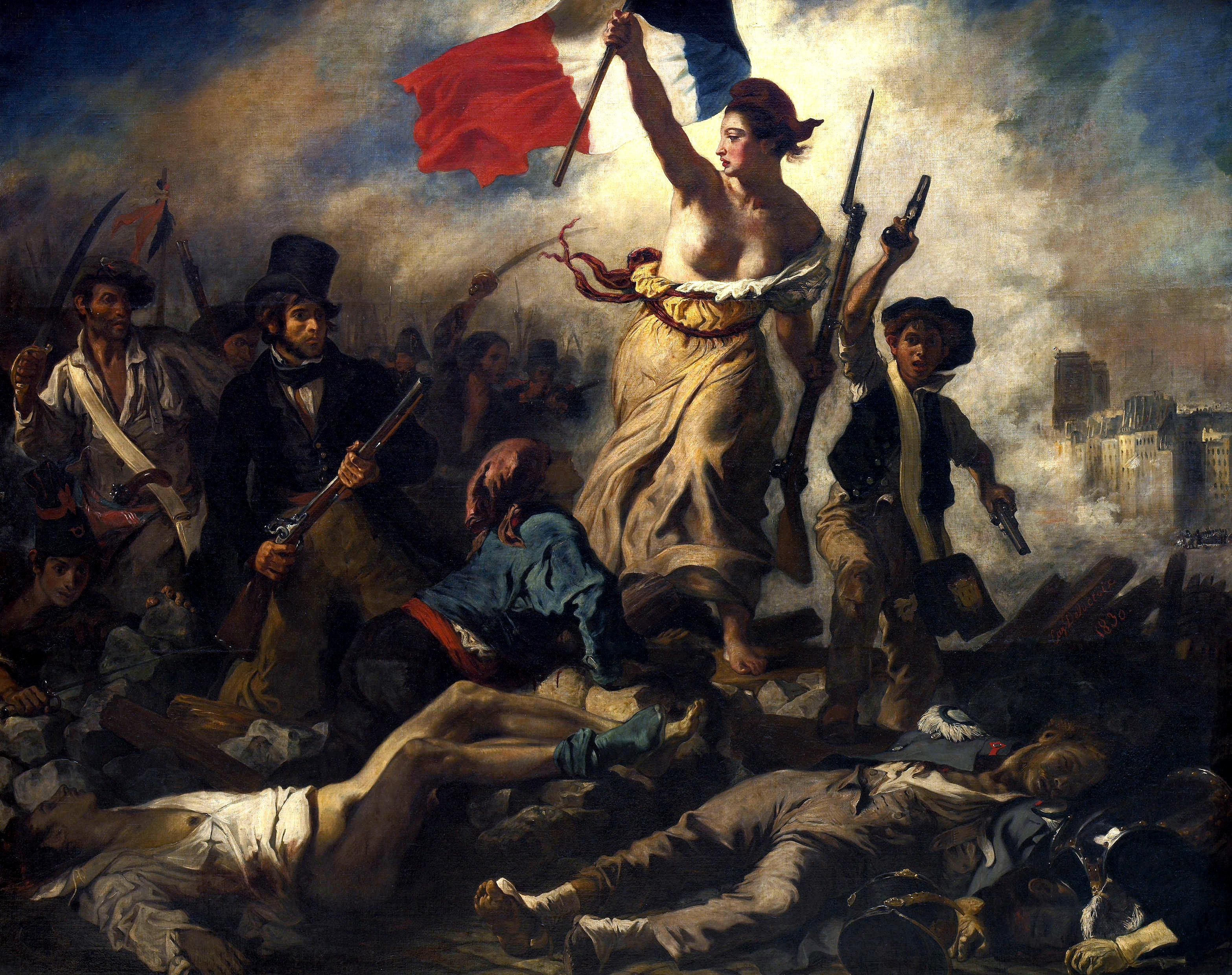
Sarah Hoyt has posted an interesting piece arguing that the times are ripe for revolution. I think she is right.
“This means that the leaders appear incompetent. Really incompetent. Crowds smell fear, like any wild animal. The other things crowds do is notice failure, and the collapse and insanity of the press makes it hard for them to hide it.”
Anyone who has taken Poli Sci 101 should assent to her observation that revolutions do not come as a result of oppressive government. Craine Brinton demonstrated this generations ago. They come when a government, or a leadership, is revealed as incompetent, or uncertain. Moreover, they come in a context of generally rising expectations. Russia was the fastest-growing economy in the world when the Russian Revolution hit. Czar Nicholas or Louis XVI were not strong, but weak, leaders.
And that is indeed the sort of time we are in. Quickly improving technology has revealed our “elite,” in many or all fields, as being uncertain and comparatively clueless.
“If you look around in the fields you know, the feeling is always that the worst possible bozos are in charge.
This is not true. It’s easier to adapt when you don’t carry the responsibility for others, and for picking the right change for others.”
I would differ with Hoyt, mind, in her assertion that they are not really incompetent, but only appear so because of the times. My own suspicion is that the rulers re usually incompetent, but only exposed as so at such times. There are natural pressures ensuring that the best do not rise to the top.
Hoyt points out that this explains the bizarre recent behaviour of the press and other “elites”over the election of Donald Trump.
“Because the confused and shell-shocked elites have started fighting back. This is most obvious after the elections, and in politics, but it’s happening at all levels. And because they don’t know why things are failing, they’re starting to get paranoid.”
And this, of course, is what tends to make revolutions inevitable.
I guess we have been forewarned. Things are about to “go upside down.”
Wednesday, March 01, 2017
Breathing While Male
 |
| Seen in better days. |
The awkward mixup at the Oscars a few nights ago is another example of female privilege.
Who read out the name of the wrong movie as Best Picture winner? Faye Dunaway.
Who immediately gets blamed? Warren Beatty. He was immediately blamed in public, on stage, by Jimmy Kimmel: "Warren, what have you done?"
Why him and not her? Only because he was the nearest male. Whenever a woman does something wrong, instead of being blamed, blame is automatically deflected to the nearest available male.
And it is so automatic that nobody even seems to notice.
For the record, of course, neither Dunaway nor Beatty was really to blame.
But it was Beatty who was put through the wringer.
Saturday, February 25, 2017

Thursday, February 23, 2017
A Mystery Majlis in the Tent of Dawn

Abraham's lamb, Ishmael-Isaac
Capered like a goat about the pyre,
His father’s gaze fixed somewhere past the stars.
"Children are for killing,"
God said;
And he should know;
For the entrance of his tent is spread with hides; and
Death is the tattoo of all his tribe.
-- Stephen K. Roney
The Glass Menagerie
 |
| Tennessee Williams. |
We know the play, “The Glass Menagerie” is full of symbolism. Tom, as narrator, alerts us to this at the beginning: “I have a poet's weakness for symbols.”
And the most obvious symbol is the glass unicorn and the glass menagerie. As the original meaning of “ménagerie” is “household,” the “glass menagerie” surely represents the family. A family of glass, an artificial and mythological creation.
But who is the unicorn, the star of the show? It seems most obviously to reflect its owner, Laura, who is singled out within the family as the “problem” member.
But the most obvious may not be true, in a family based on illusion and magic, in a play. Note what Jim, the gentleman caller, says of the unicorn when it first appears. “But aren’t unicorns extinct in the modern world?” This is an inane comment in the circumstances, and not literally true of unicorns. This should alert us to the presence of a symbol.
It also does not accurately describe Laura, making it seem less likely the unicorn symbolizes her. She is spoken of as an “old-fashioned girl,” but this is surely a polite fiction. Her personality is rather more extreme than that.
Yet, among the characters in the play, it is not Laura who lives in a fantasy world. It is not her who is out of touch with reality. At the beginning of the play, she is instead busy restraining her mother’s extravagant fantasies, reminding her of reality:
AMANDA: … Stay fresh and pretty! It's almost time for our gentlemen callers to start arriving. …
LAURA: … I don't believe we're going to receive any, Mother.
This other character in the play is more obviously something that is “extinct in the modern world”: Amanda, the mother. She represents herself as a southern aristocrat, a classic Southern Belle. But this is obviously at variance with her circumstances: she lives not in the rural south, but the urban Midwest; “one of those vast hive-like conglomerations of cellular living-units that flower as warty growths in overcrowded urban centres.” She is not wealthy, but desperately poor. She is not courted by seventeen wealthy suitors at a time; she is abandoned by a husband who worked for the phone company. Nor could her supposed memories of her own supposed past be true. She speaks of being courted by wealthy planters and tended by black house-servants: a world that died with the Civil War in the 1860s. The time of the play, though, as pointed out in the prologue, is the 1930s, indeed the late thirties, during the Spanish Civil War. For her to really have had such experiences, she would have to be at least ninety years old.
 |
| Laura and the candles. |
Her image of herself, her past, and her family are actually entirely mythological. Tom makes this yet clearer by warning us, in the prologue, that memory itself is mythic: “it is sentimental, it is not realistic.” She is, as she presents herself, a glass unicorn, lit by the reflected light of an audience’s willing suspension of disbelief.
She is by her nature an actress on a stage, and so the true centre of the play as play.
And like the unicorn in the glass menagerie, she is the star of the family. She is the first character mentioned by Tom as narrator, and the first character heard in the play.
Her image of herself is actually crafted of romance novels she has read: it is no accident that she speaks of “Gone With the Wind” with great admiration, as the compulsory reading of what must have been her youth, the years just after the first world war. She has invented herself as Scarlett O’Hara, reduced in her circumstances to St.Louis by the burning of Atlanta. Her enthusiasm for serial romances is obvious in her sales pitches on the telephone, which we are permitted to hear.
Her view of her children is similarly fictional. She speaks of Laura’s gentlemen callers, knowing she has none. She demands of Laura things she must know are unrealistic. She insists that Tom is not going to the movies every night—yet ironically, it seems he really is. To satisfy her, he invents a more lurid fantasy, in which he wears green whiskers and is known as “El Diablo.” Just as, to satisfy her, Laura must invent the fiction of going to business school.
Indeed, Laura seems to be acting out a script modeled for her by her mother. When Amanda returns home with the discovery that Laura has not been attending business college, she models all the behaviours that have forced Laura to drop out: she has skipped her DAR meeting just as Laura has skipped her typing course.
Tom, as narrator, makes it clear that the family is mythological: he describes Jim the caller, the one from outside, as the only “real” character in the play: “He is the most realistic character in the play, being an emissary from a world of reality that we were somehow set apart from.” The others are all manufactures of glass.
The image of glass carries the secondary suggestion that the illusion on which the family is founded is fragile. Glass creatures, as Laura points out and as the action demonstrate, are very fragile and require great care. Unicorns in particular.
So, for all that Amanda’s rule is tyrannical, it is also fragile. All it takes is a single intruder from outside, and the illusion begins to shatter. We find, once Jim is left alone with Laura, that she is not that shy after all. She will sit close to him; she is able to speak freely of her feelings for him; she is game to dance with him, and to accept a kiss. She turns out too to have her attractions for the opposite sex; it seems likely she could get, if not this gentleman caller, some other genuinely interested in a permanent relationship.
 |
| From the original Broadway production. |
The unicorn falls, and loses its mythical qualities. It loses its horn, and becomes like any other horse.
So why, at the end of the play, is the illusion apparently still intact—Tom has perhaps escaped it, but apparently not Amanda and Laura?
It is Laura who is primarily responsible for this. She is the keeper of the menagerie. She is the keeper of the ancient phonograph. She is not the powerless creature she appears.
Tom seems well aware of this: it is Laura’s face that haunts him, and it is Laura to whom he appeals in the end to act: “blow out your candles, Laura.”
It stands to reason. As is pointed out, the beauty of the unicorn is borrowed: it is from the light of a candle playing through it; it does not shine by its own light.
Laura does seem to intervene regularly to keep the family together: urging, for example, her brother to apologize to her mother; warning her mother that Tom is not happy. Certainly it seems to be concern for her that keeps her brother from running off long before.
The fact that the children secretly control the illusion is brought out symbolically by the power failure in the play. This is secretly Tom’s doing: it is up to him to pay the light bill. When he departs, a major part of the light playing on the unicorn is gone.
But that leaves Laura’s candles, the three lit by Jim, which Tom urges her to blow out. Amanda remains sustained by the light of her belief.
Amanda goes on about what a burden her children are, and how she wishes they would succeed, and how incompetent they are without her. But it is they who are supporting her; she is making little money, it looks like, on sales commissions for her romance serials. She seems to be dong it largely because it gives her someone to talk to. She is telling her children, at the same time, that she wants them to leave and wants them to stay. She urges Tom to go ahead and live his dream of joining the Merchant Marine—“but not until you’ve found us a replacement.” She objects to his not staying home evenings. She wants Laura to begin a career, yet she wants her to get married.
No surprise that this double bind slowly drives Laura mad, just as the psychologist R.D. Lang would predict. “We know all about the tyranny of women,” Amanda ironically remarks.
We can imagine that Amanda, ultimately, feels lonely and needy: we suspect her fictions, her manipulations, and her dependence have driven her husband away, as soon as we see her interacting with Tom. We can see how hungry for conversation and how manipulative she seems in her telemarketing job. No doubt it is a craving for companionship that makes the job appealing to her.
Why does Laura sustain the illusion, since she suffers more than anyone for it—losing her chance at her own family, at career, ultimately losing her mind?
Perhaps she does it out of love; although perhaps misguided love. She seems to have a deep capacity for love: doting from a distance on Gentleman Jim since high school. She refuses to see him as anything less now.
Or maybe we should ask, why do we, as audience, come repeatedly to see this play? For our relation to it is Laura’s relation to her family: a willing suspension of disbelief. Although unpleasant in its portrayal of life, it lives illuminated by the light of our faith in it.
Ultimately, it is the attraction of beauty, of art, of myth. It is what attracts Tom to his films and his magic shows, what attracts Laura to her music and her art galleries. It is the beauty we all feel in a glass unicorn.
Given the chance at escape, given the unicorn operated on, no longer “freakish,” able to consort with common horses, Laura gives it away. It is no longer the wonderful thing it was.
Wednesday, February 22, 2017
Fast Notes on a Few Philosophers

Confucius
Confucius is probably the most influential philosopher who ever lived. But he did not really leave us a philosophy. Rather than carefully reasoned argument, he left aphorisms, short pieces of advice on how to live, without explanation or justification.
How can this have been so influential? Why should we take Confucius’s word for it?
This, I think, is because rather than appealing to reason, he appealed to conscience. Given a conscience, if the moral right is simply demonstrated or pointed out, it is undeniable. Resorting to reason, by contrast, might just rationalize wrong. This illustrates Confucius’s most important point: that people are best governed by example, not by laws. If the ruler is visibly virtuous, the people will be virtuous. If the ruler is visibly dishonest, the people will not care about virtue.
A moral and social philosopher, Confucius analysed all human relationships as of five types: parent-child, sibling-sibling, husband-wife, friend-friend, ruler-subject. Each implied specific obligations, and if everyone followed their proper role, society would always function well. Some object that this implied a rigidly hierarchical society, always with superiors and inferiors. This is wrong: it is like the game of rock-paper-scissors. If you must play the subordinate in relationship A, you are going to be the superior in some other relationship.
It worked very well for China and East Asia for thousands of years. If there is a problem here, however, it is that the reliance on direct appeals to conscience instead of general principles can leave gaps. For example, since a foreigner or a stranger does not obviously fit into one of the five relationships, he or she can become a ghost, of no account. Consider the story of the Good Samaritan for comparison. If violence or injustice is done outside your sight, similarly, it may be felt to be less troublesome.
There is this example from Confucius’s follower Mencius:
The King was sitting up on the pavilion. There was an ox being led past the pavilion. The King saw it and said, "Where is the ox going?" Someone responded, "We are about to consecrate a bell [with its blood]." The King said, "Spare it. I cannot bear its frightened appearance, like an innocent going to the execution ground." Someone responded, "So should we abandon the consecrating of the bell?" [The King] said, "How can that be abandoned? Exchange [the ox] for a sheep."
Mencius commends the king for doing right, and says “This is just the way benevolence works.[4] You saw the ox but had not seen the sheep.”
To my mind, however, this is unjust. One ought to care as much for those one does not see. This is why codes of law like the Ten Commandments are, in the end, useful. Even though St. Augustine says, in the spirit of Confucius, “Love, and do what you will.”

Descartes
Descartes set out to doubt everything he could doubt, and came up with one certainty: “I think—even if I doubt—therefore I am.” He could not doubt that he was doubting. So the self exists, “I,” if nothing else. He goes on, then, to point out that at least some of the thoughts do not come from him, nor did he create himself, and so at a minimum God too exists. The existence of God, in turn, is a warrant that anything we perceive clearly and distinctly is likely to be real and true. A good God would not deceive us.
Ironically, Buddhism is based on what seems to be the opposite premise: its core doctrine is anatman, “There is no self.” Does this disprove Descartes? I don’t think so. Both assertions, I think, can be true. We cannot doubt the existence of the perceiving subject, but the point Buddhism is making is that this subject, this “I,” has no content. Or if it does, we cannot know what it is. We cannot perceive it directly--”I” cannot be both subject and object. A mirror cannot reflect itself. We do not really know what it is, we cannot say anything about it.
The second common criticism of Descartes is for “Cartesian dualism.” He posits two distinct realms of existence, the mental or spiritual and the physical. Many have argued that it seems logically impossible for two separate realms like this to have any influence on one another. Like parallel lines, they should never meet. How does that physical cat out there somehow get into our mind? How does our thought make our arm rise up? I do not really see any problem here, however. On the analogy of hardware and software, it seems perfectly reasonable: they are two separate realms, in just the same way, but they do interact. The other solution is more radical: why assume there is a physical world? Maybe everything is spirit!

Rousseau
Rousseau is best known as a social philosopher, although he said important things about education as well. I think his basic premise can be stated in this way:
God exists. God is perfectly good. God created all things. Therefore, all things must have been created perfectly good. “Nature” is a model of perfect goodness. All evil in the world must come from change over time to the original, natural pattern God set. All change from what is original and natural is a falling away.
I see an immediate problem here. It means anything men try to do is a bad thing. Rousseau believes that all art and all science is in error, is a result of human “pride,” like the Tower of Babel. Do we presume we can do better than God?
I think that the Biblical advice “by their fruits ye shall know them” disproves Rousseau in practical terms. To follow his philosophy, nobody would ever try to make the world better. Everyone would just do what they first wanted to do, because that is what is “natural” to them: sex, drugs, stealing, laying about, and so forth. As a result, trying to put Rousseau’s ideas into practice, as in the French Revolution, seems to have always ended badly.
The response to Rousseau, I think, is the idea of original sin; his philosophy is sensible only because he rejects original sin. If there was indeed an original sin, human nature cannot be assumed to be spontaneously good; nor can nature be trusted as a model of the way things ought to be. Both, as we know them now, are in a fallen state.
I think Rousseau’s assumptions also do not work well on his own initial premise, that God is supremely good. If God is supremely good, would he have created a world that must inevitably decay over time? Would he have created man with nothing useful to do? By contrast, the idea that God created an essentially good world, with free will, which is also good, but original sin caused it to fall, leaves the possibility of a process leading to a more perfect world. Therefore, this is the world God would have created.
Tuesday, February 21, 2017
Bullying
 |
| Young Abe Lincoln vanquishes a bully. |
Bullying is a serious problem, but our attempts to do anything about it seem worse than crippled by a general inability to understand what bullying actually is.
This seems odd, because the matter is straightforward. My leftist columnist friend offers a good one: when “it makes you feel good to make someone else feel bad.” I’d expand it: less extreme bullying is the attempt to control another person: to “push them around.” Merriam-Webster has: “bully: one who is habitually cruel, insulting, or threatening to others who are weaker, smaller, or in some way vulnerable.” Oxford says: “bully: A person who uses strength or power to harm or intimidate those who are weaker.”
Yet people keep getting it wrong.
For example, I went to a talk by a supposed expert on teaching writing from McGill University. His main thesis was that writing should always be done in groups. With no assigned roles. And, if one member of a group tended not to go along, such “bullying” was to be punished.
So dissent from the group is bullying? Orwell would be proud: that makes Winston Smith the bully in 1984. It just about has the valences perfectly reversed.
Then it occurred to me: one big reason why we seem to have such trouble dealing with bullying and with even understanding the concept is that there are, in fact, a lot of bullies out there. And bullies are never going to admit the real nature of bullying. Not as a matter of deliberate conspiracy, mind you. It is just that bullies are never going to see themselves as bullying. That, after all, would reflect badly on them. And bullies always have to be right. They will see themselves as special, above others. And so bullying as their right, because they are special. And anyone who resists their bullying—that is the bully.
Who is feeding us our current ideas about bullying? Who is pushing the current “anti-bullying” initiative? Most notably, teachers, psychologists, psychiatrists, and perhaps social workers.
Guess what? Those are exactly the professions in which one would expect bullies to congregate.
As a result, it is only too likely that this “anti-bullying” initiative is really going to be a huge boon to bullies. It gives them another, especially choice weapon for their arsenal: charging their victims with being bullies. Imagine the mental anguish! No wonder the thing is so popular.
People keep saying, for example, that Donald Trump is a bully. This is an example similar to that of the McGill professor. Trump is the very opposite of a bully. He is someone who stands up to bullies and bullying. He actively and openly resists being pushed around by the media, and by the Republican party establishment. So he gets called a bully, and not them! But whom has he ever bullied, so far as we know?
Yes, he can be harsh and strident. But he seems to follow a clear moral code. He does not attack unless attacked. It is always in defense.
This is why a lot of people who feel bullied have rallied behind him.
It seems unlikely that Trump is a bully even in private. First, politics is not a good career for a bully. Succeeding in politics, in a democratic system, requires continuing support by those under you—ultimately, the general public. A bully might not be found out, but it surely goes against his grain to be always helping others in need, and deliberately being nice to them. Trump’s electoral success in itself suggests therefore that he is not a bully.
 |
| Young George Dewey, the hero of Manila, takes on a bully. |
Hillary Clinton, on the other hand—there we have reasons to suspect a bully. There are indeed rumours that she is a bully in private, to secret service agents, to aides. And it would help to explain her surprising electoral failures. She has gotten further than she ought through marriage; she got to parachute in at the top of the electoral pyramid. But in a serious campaign, she seems to have consistently lost, despite starting out as a favourite. The public senses something, a lack of empathy, and her subordinates are perhaps not prepared to go the extra mile for her.
Second, Trump is a notable success as an entrepreneur and a salesman. Again, that is especially hard for a bully to pull off. Both require people trusting you and feeling inspired by you. You pretty much have to treat them well to get very far at this.
Bullies can succeed in business now and then, but as bureaucrats in large corporations, not as entrepreneurs and salesmen. In any business, bullies are going to pull the enterprise down. A bully will be a consistent failure at business. You do not get far in business by treating either your customers or your employees badly. Because, generally speaking, they always have somewhere else to go. Business is not where you are likely to find them. But in a large corporation they may not as swiftly be detected.
Third, Trump’s children seem close to him, and he seems prepared always to give them important responsibilities. This is a good test: a bully will probably bully, first and foremost, his own children. Trump, far from controlling them, seems to treat them as colleagues.
My left-wing friend then singles out military officers as bullies. This is another common false conception. The common image of the drill sergeant. But this is also based on a second dangerous misdirection: the identification of strict discipline with bullying. There is no relation. The military is a pretty unlikely place to find a bully. A bully wants a helpless victim. With the military any potential victims are likely to be armed. Not just the enemy, either. An officer who was not honourable to his men always stood the chance of getting “fragged” in combat, in any war. Most times, nobody would ever know. Among higher officers, the main element of success is the ability to inspire: to inspire people to risk their lives for you. That is an extremely high level of trust, and no bully is going to command it.
He then mentions clergy. It is popular to bash clergy today, but this is probably the one least likely place in the world to find bullying. A bully needs a victim who is trapped. Everything about religion is voluntary. You bully a parishioner, and he just turns and walks out the door. Without leaving anything in the collection plate.
A current anti-bullying campaign urges everyone to wear a pink shirt, in solidarity with bullying’s victims. And here we see another common misdirection. Pink seems to suggest homosexuality, does it not? Maybe, you will protest, not to you, because that sounds possibly politically incorrect to notice. But undeniably, to most people, pink on a man puts a blip on the gaydar. The misdirection is a common suggestion that bullying has something in particular to do with your treatment of gays. There is no, or little relation. Yes, once upon a time, you could use their homosexuality as a club to bully people with. But no more. Moreover, it is equally possible for gays to bully. If you do not believe this, you know little of the English public school system. Or, for that matter, the SA and Hitler’s rise to power. So making it all about being nice to gays just gives a blank cheque to gays who are bullies.
Where are you actually likely to find bullies, and the worst, most unrestrained bullying?
Think for a moment. The perfect venue is the family. The perfect scenario for a determined bully is simply to have a kid, or better, a bunch of kids, and push them around mercilessly. They are completely vulnerable. They are there all the time. And you, legally, have close to absolute power over them. The rest of the world really does not want to interfere with the family. Yes, you do have to contend with their other parent. But that can be solved by marrying a doormat, or a milquetoast, which a bully is going to tend to do anyway. Then they will not dare to raise a peep. And you can bully them into the bargain.
Hence, I suspect, most or all of what we call mental illness. It is PTSD from those who have grown up being bullied, with no escape.
First and foremost, actually, in the family. If you are a bully, the simplest and most satisfying outlet is simply to have a good number of kids, and torture them at will. Nobody wants to interfere, because we do not want to bust up families. You get them day or night, and it’s generally nobody else’s business. The only tricky part is having to deal with your spouse. Properly, you want someone who is temperamentally an absolute worm, because the spouse really does have options.
Another really great option, unfortunately, is to become a psychiatrist or psychologist. The downside is that it is hard to qualify. But the upside is that, once you have, you are accorded immense social prestige, so you will be more or less left alone to do your worst. With great pay for pursuing your hobby. Obviously, psychiatric patients are emotionally vulnerable. Most often, they are pre-selected as the perfect victims. That is how they got where they are: by being systematically bullied by someone in the past. If they object or report you, no problem. Heck, they’re crazy. You are a respected professional. Why would anyone believe them? It’s perfect.
And who is it who is giving us our current perspective on bullying and its causes? We should assume everything we are being fed about bullying by the “professionals” will be a lie.
Next to psychiatry, palliative care nursing is probably your best option. Failing that, any kind of in-hospital nursing. There people are under your care around the clock, often when no one else is around. They are often physically unable to protect themselves—that’s why they’re there—and in many cases, nobody cares what happens to them any more.
We’re incredibly careless about this possibility—no, probability.
Next to that, probably teaching. This makes it especially worrisome that the current drive against bullying comes from the schools. Teaching is a great profession. The kids are of course physically and emotionally vulnerable. The system gives you physical control and supervision of them for a good number of hours every day, and the wonderful weapon of getting to mark them as well. If you’re a bully, you get to be both perpetrator, prosecutor, and judge. Kafka would enjoy the situation. If the kids complain, well, they are just kids; they are probably lying, imagining things, or they got it wrong. The danger, of course, is from the parents. If schools is no longer compulsory, or if they have the option to change schools, the jig is up. Hence you are adamantly against things like school vouchers. Public education is our right!
Not as good is being a judge. You get to self-righteously drop heavy bricks of phony moral outrage on the vulnerable, and nobody faults you for it. On the other hand, we have a solid system of judicial review, so I don’t think this is a great problem in our system. Prison guard is another good one, although those prisoners can be tough, and there are a lot of them, so there are certain risks. Cop is good, but nowadays we are pretty well on to the risks, and web cams can go a long way towards accountability.
Being a social worker is a really great one. You get to mess with people’s most intimate concerns. Usually people of low social status, poor, socially vulnerable. And we have few checks against this. Sure, they can complain to the politicians, but if they are marginal enough, they are likely not to be listened to.
Being a manager in the civil service is a pretty good one. First off, being in charge of people, you get to mess with them. Second, because it’s the civil service, nobody gets fired. So you cannot get fired for acting as you want. Sure, you can’t fire anyone either, but you can make their lives hell. Your victims are trapped to some extent by their very job security. It would be catastrophic for most to leave their secure job and huge promised pension. So they have to put up with offal from you indefinitely. You can humiliate; you can berate; you can hogtie; you can play mind games forever. This is why we get the term “go postal.” A poisonous work environment is the norm in the civil service.
In a dictatorship, being a civil servant generally is an ideal opportunity for a bully. The public is at your mercy; nobody can walk away from the government. It works much less well in a democracy, because your political bosses are vulnerable to public displeasure. This is one of the best arguments for democracy.
Why do bullies become bullies? Again, we must not trust the experts here. Many or most of them have a vested interest in misdirection. The common claim today is that bullies bully because of “low self-esteem.” And/or they bully because they have been bullied. This, again, is the predictable opposite of the truth. By process of natural empathy, if someone has suffered, they identify more easily with others who are suffering. Those with low self-esteem are the least likely to put their own interests over others, as bullies do even in the most trivial matters.
No, bullies are made by being spoiled. By being taught to believe they are special, and whatever they do is wonderful. Therefore, if they want something, or if they do something, it is wonderful. Other people, by comparison, are significantly less wonderful in every way, and so the bully, as the hammer of righteousness, has the right to kick them around. Pharisees are bullies; bullies are pharisees. They will be convinced of their own righteousness, and so impervious to improvement.
Hence the old wisdom that to spare the rod is to spoil the child. We are now adamant against any sort of physical punishment. Another misdirection as to bullying: the claim that it is the same as being violent. Children must always be told they are awesome, and that everything they do it wonderful. Another misdirection: fair but strict rules and honest but tough evaluations are not bullying.
No, far from ending bullying, such educational movements guarantee more of it over time.
Subscribe to:
Posts (Atom)