Playing the Indian Card

Showing posts with label tertiary education. Show all posts

Monday, May 25, 2026

Musk on Universities

McGill Campus


Elon Musk has recently spoken against the model of the university. He himself holds two bachelor’s degrees, but he points out the Steve Jobs, Bill Gates, and Larry Ellison are all dropouts.

Universities, Musk says, are geared to the average brain. Ever since the postwar years, it has been the stated ideal that everyone ought to have the opportunity to attend university. Governments promoted this idea: they were afraid of an unemployment crisis with all the soldiers returning from the war, and civil unrest as a result; for this had happened in the years after the First World War. So they passed the GI Bill—university for the masses. And the cachet of the college man was pushed relentlessly by popular culture through the 1950s.

This meant that ordinary folks without a great passion for scholarship started attending universities.

The universities could not fail more than a limited percentage of students. After all, they had paid their tuition. If most of your students fail, you go out of business. So the schools had to adjust the curriculum and the standards so that the average intellect could get through, without too much effort.

Among other things, this created teenagers starting in the 1950s. That is, a distinct culture of young people alienated from the mainstream culture. This was an inevitable result of holding them back from joining the adult world, starting a family, and assuming social responsibilities. They were all dressed up, with nowhere to go. By contrast, George Washington had a profession and was earning his living as a surveyor at age 16.

For the most intelligent, high school would already have been mind-numbingly boring: forced to do time-consuming yet meaningless dog work all day instead of reading great novels, designing software, or building a business. Now university had gone the same way, was just a continuation of high school, and they were kept in that same intellectual straightjacket for an additional four years or more.

Now that everyone was going to college, entry requirements for almost any job went up. After all, every job wanted to look like a “profession,” and therefore command higher wages.  Now you needed a four-year degree, with all the time and money that cost, to get a job as, say, a newspaper reporter or a graphic designer. Or two degrees to be a public school teacher or librarian.

This drove the very intelligent out of fields that might in the past have been their escape hatch. As a result of that, the objective quality of journalism, graphic design, teaching, and librarianship, went down.

Meantime, university tuition fees have been going up at exponential rates, especially in the US, as they spend more money on administration and less on teaching. This looks suicidal, as if they know in their hearts they are doomed, and want to soak up as much cash as they can before the gravy train ends.

The Internet and now AI should happily lance that bubble. As a practical matter, nobody needs to go to university anymore. All the information you need is on your smartphone, available when you need it. Were it not for international students, the North American colleges would already be dead. They remain relevant as a cultural experience for Asian students; now more or less a branch of the tourism industry.

I for one deeply mourn the passing of Harvard, Yale, Oxford, Cambridge, McGill, Queen’s, Yonsei, the Sorbonne, and the like. They were once places of dreams—of my own dreams. But that dream really died a long time ago.


Monday, January 29, 2024

The New University


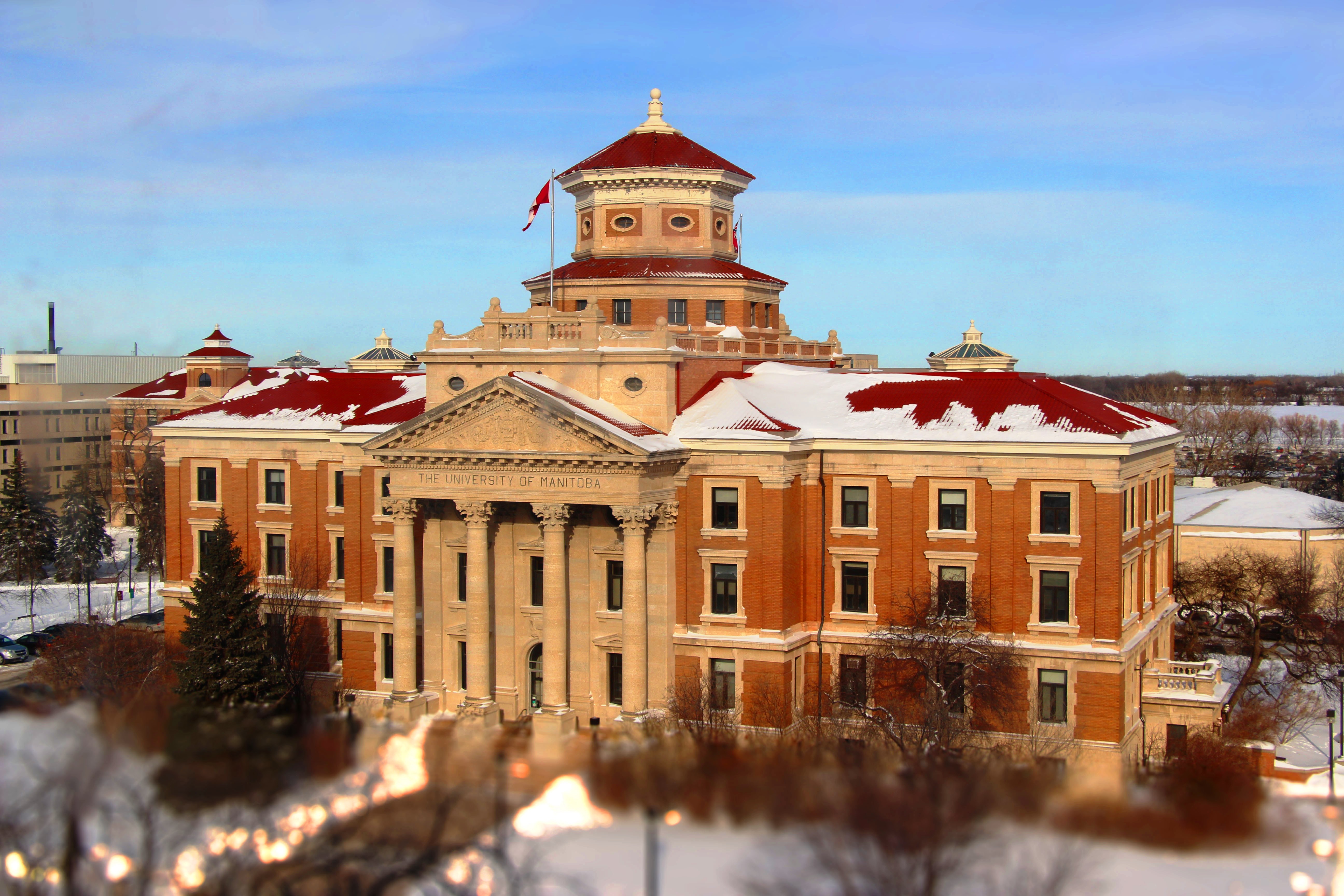
Canada's most photographed building

Jordan Peterson, who should know, has joined a chorus saying that our current university system is unsalvageable, and needs replacing. This is true even purely on technological grounds.

Here is what we need:

First, no funding from any government for the social sciences. If fortune telling is illegal, the social sciences should also be illegal, for the same reason: fraud.

No legal recognition should be given, and no public money spent, for academic qualifications in education, journalism, or art. These degrees do harm and no good.

All universities must have a charter of first principles, and be required to adhere to them in all courses. Without such principles, the humanities, based on deductive reasoning, are impossible. This indeed used to be the case: St. Michael’s was Catholic, McMaster was Baptist, Queen’s was Presbyterian. These charters need not be religious; the US Declaration of Independence, for example, would work. These charters must vary to ensure diversity and justify the existence of different institutions. No two institutions with the same or very similar charter in the same state or province.

Professors cannot be selected by existing faculty, as now happens. Once the existing faculty is corrupted, this system cannot work. Instead, professors establish their credentials as was originally the case, by attracting students. They offer video lectures, and see how many students sign up.

Students must therefore be allowed their choice of professors and lecturers online, from anywhere in the world, given that they are approved as doctrinally sound by the given institution.

To prevent corruption, we need to separate the job of teaching from the job of evaluation. Marking can be done by AI, which can plausibly now create challenge tests by auditing the lectures and the course materials, together with the university’s charter. 

Sitting for an evaluation will have to be done in person at the institution—so that the students cannot, for their part, resort to AI. The institution can also offer “study pods” and tutors, including residence if desired, so that students studying the same field can discuss matters and socialize.

And it would all be much cheaper than what we are doing now. And it would be far easier to upgrade and learn throughout one’s career, necessary when technology is changing so fast.


Sunday, September 18, 2022

The State of the Academy in Indiana


How to speak good English...

One of my Korean students has just started classes at the University of Indiana. He is confused that all international students from countries in which English is not the official majority language must take an extra course in English as a Second Language. He accepts the need in his own case, but notes that some of these students speak impeccable English; some seem, to his ear, to have better English than the professor. And no entrance test was administered: all must take the course, depending only on their place of origin.

This seems to be discriminatory, and to make no sense.

But it makes more sense when we see the topic for his first homework assignment. It is to summarize and compare two short essays. One is by a Chinese-American lamenting that her father is foolishly proud to have lost his Chinese accent. She considers that he has thereby lost part of his ethnic identity, and it is due to cruel social pressure from the majority population. The cruel social pressure being, in part, his being complemented on speaking English well. The other is by a woman of Ojibwe ancestry, who laments that her ancestors had the language taken from them, by having learned English. None of her relatives speak to her in Ojibwe; it has been reserved for prayers. As a result, she must learn it as a second language, in order, in her mind, to reconnect with the thinking of her ancestors.

So the point of the course is apparently not to improve the students’ English. It is to discourage them from improving their English. English, although the course is given entirely in English, is the enemy.

Political indoctrination is plainly the point of this course. But this is actually secondary. The problem in the academy actually goes beyond political indoctrination. To justify their existence, many academic fields and many academics must spend their time in teaching nonsense. If they stuck to the sensible and true, there would be nothing to teach in many fields. Everyone knows, for example, that learning something new is a good thing, to the student’s benefit. If you spend a year simply teaching that it is useful to learn English, you have no course, and no job. 

So why not teach actual content? Why not teach how to write better?

To quote a certain plastic doll, “math is hard.” This requires that the field actually knows anything; and that the professor has learned it. The expansion of the academy into new fields has meant the creation of many new fields without substantial actual content. And in many other fields, the academy is not the proper venue.

In homeschooling my own kids in Canadian history, I read them a sequence of reports from the Kingston Standard of 1832, on the arrival of cholera from Europe. I thought it was especially interesting to compare it with our own recent experience of covid. But the comparison prompted a different response from them:

“How come the writing in newspapers then was so much better?”

This for what was a small-town newspaper, by modern standards.

It is because in those days, people were hired to write for newspapers because they could write well. In our day, people are hired to write for newspapers because they have graduated from journalism school.

Writing cannot be taught in the classroom. This is equally true of other fields: the arts in general, and even teaching itself.

At the same time, teaching correct English, at this level, it is only too likely that students will know more than the professor. That is a frightening prospect for a professor. Best to steer clear of that subject.

So you have to invent something to teach that nobody is likely to know. It therefore has to be something so absurd nobody would have thought it.

And so we get so many of our lunatic “woke” ideas, generated in the academy.

It is wrong to point to a problem without pointing to a solution. The solution is probably already spontaneously in progress. The conventional academy must die, and be replaced by open competition among online courses. The Harvards and McGills may survive by offering comprehensive testing to certify knowledge in a field.


Wednesday, August 24, 2022

Biden Cancels Student Loan Debt


Joe Biden has unilaterally announced $300 million dollars in student loan forgiveness.

This is a bad idea. It takes from the poor and gives to the rich. Those who could not afford university in the first place must now pay for those who could. Shop hands and factory workers are subsidizing doctors and lawyers.

Further, we have too many people going to university. We need more skilled trades. Sending so many people to university simply unnecessarily raises the qualifications expected for white collar jobs. 

And more and more of what is taught at university now is useless. I do not mean the humanities, as such, not the proverbial degree in Ebnglish lit, which is of immense social value, but I do mean the social sciences, gender and cultural studies, which are purely political indoctrination, and then pop culture courses on things like the history of rap music, Armenians in film, or the like. Pop culture is worth studying, but in such courses, by trying to be contemporary, the students start out knowing more than the teacher. So they are a waste of time in the university setting. 

Many technical or scientific courses present the same problem, and are generally better suited to a technical college. When technology or science is moving fast, by the time one has finished a four-year degree, what one learned in years one and two is probably obsolete. Worse—your professor must have spent nine years or more getting a Ph.D. By then he is so out of touch that almost everything he knows is wrong.

The better approach is to snag two foundation years, then keep learning on the job. If necessary, night courses online.

With so many going to university who are not really suited to university and the life of the scholar, much taught in university could be, should be, and previously was taught in high school. Now there is almost always, for example, a first year remedial writing course.

On top of this, whenever the government puts more money into tuition or higher education subsidies, the universities have the temptation to simply raise their fees. If the average middle class family could afford $5,000, and the government will give them $5,000 for university, why not hike the fees to $10,000? The cost of tuition has been rising for years at an indefensible rate, far more than the rate of inflation. The money ends up not helping kids or families, but in the pockets of an army of university bureaucrats.

This may be exactly what is intended: this is the Democratic Party’s base. But a better plan, if this is not graft, would be a system of vouchers for two years at either university or technical college, along with carefully audited state schools that would provide education for no more than the vouchers pay.


Thursday, July 29, 2021

Getting an Education at OCAD


OCAD's appropriately postmodern architecture.

Noticed recently: a job ad for OCAD University’s English Department. It is jarring to see the courses for which they want instructors. English lit is no longer about what you think it is.

COURSE TITLE: ENGL-2003 POSTCOLONIAL LITERATURE

COURSE DESCRIPTION: This course looks at national and transnational literatures in a comparative perspective, focusing particularly on constructs of nation, gender, colonialism, and difference. Its aim is to imagine multiple literary times and spaces grounded in different parts of the world and in their different histories. That is, rather than creating a snapshot or conducting a literary tour of the world, this course seeks to refuse an easy commodification of Literature as a global product. All texts will be studied in their original English or in English translation.

To look at “postcolonial” writing from non-Western cultures is to severely limit one’s exposure to foreign culture and foreign ideas. These are necessarily drawn only from the postwar period, and are in the Western idiom, written by authors educated in the West.

Students should be exposed instead to Rumi, Li Bai, Basho, the Ramayana, and the like. That would give them a non-Western perspective. That’s the last thing they’ll get here.

And the focus is to be on “nation, gender, colonialism, and difference.” Only contemporary concerns of the political left. No new ideas or new cultural perspectives to be risked here. 

COURSE TITLE: ENGL-2011 LITERATURE AND SOCIAL CHANGE

COURSE DESCRIPTION: This course takes a close look at the relationship between literature and concerns for equity, sustainability and social justice, focusing on the ways writers, artists and intellectuals work as agents for social change. The course discusses representations of topics such as dis/ability; gender, sexual and racial equity; labour activism; demands for Indigenous sovereignty; critiques of settler colonialism; postcolonial struggles against empire; and calls for environmental preservation. Texts are disciplinarily diverse and may be performative as well as written. Forms include comics, nonfiction, fiction, poetry and more.

All politics, no literature. “Texts may be performative.” 

COURSE TITLE: ENGL-2012 TRANS AND QUEER LITERATURE

COURSE DESCRIPTION: In this course, we explore the ways in which sexualities, gender identities and sexual politics are addressed in literature. Texts will be by transgender, lesbian, gay, bisexual, two-spirit, queer and asexual creators, and will reflect the complicated nature of queer life. Intersectionality will be a guiding principle, as we examine ways race, gender, language, culture and disability justice intersect within representations of queer life across a variety of literary forms, such as fiction, nonfiction and memoir, poetry, drama and comics.

The subject matter is of obvious interest to, at a maximum, three percent of the population, in aggregate. The texts are also limited to that same three percent. Realistically from only the last couple of decades as well, because before that there was no market for gay lit. Yet this course is apparently offered every semester. One suspects the primary objective is to give sexual adventurers of various types an opportunity to meet, identify their preferences, and hook up.

Then finally something that almost looks sensible. They want someone to teach a course in Children’s Literature. An important and neglected field.

But you have to know that critical theory has a special focus on Children’s Literature. For the obvious sinister reason: they want to indoctrinate, and they think the best approach is to get them as young as they can.

COURSE TITLE: ENGL-2010 CHILDREN'S LITERATURE

COURSE DESCRIPTION: This course aims to answer the question: What is children's literature? The course will survey children's fiction, poetry, and picture-books to introduce students to a wide range of children's literature. We will examine different cultural and critical approaches to this field in relation to cultural interpretations of childhood and gender. As we discuss the social and political visions put forth in these texts, we will consider the effects of publishing and the media (for example, the Harry Potter films) on the field of contemporary children's literature. Our analysis of genre will include the study of the relationship between text and illustration. Course readings may include works by Carroll, The Brothers Grimm, Lewis, Rowling, Seuss, and others.

“As we discuss the social and political visions put forth in these texts.” The important thing about children’s literature is its political vision. Obviously, children and their own interests are of no concern here.

And OCAD is not unusual; I have seen similar course descriptions at Queen’s, for example.

The very least we can do is pull all taxpayer funding.


Saturday, May 29, 2021

Indigenous Health and Cultural Safety


University College, U of T

Are the universities salvageable? Would it make more sense now to just close them and start again?

Looking at recent faculty openings for any established mainstream university is disheartening. 

The University of Toronto is currently calling for a tenure-track instructor in “Indigenous Health and Cultural Safety” for the Dalla Lana School of Public Health, the Temerty Faculty of Medicine, and Women’s College Hospital. Both parts of that discipline title are troubling. Is indigenous health different in principle from the health of humans in general? Should it be studied separately? What can this imply but discrimination? But a fundamental difference in kind among people, that would justify different treatment?

And what is “cultural safety,” and what does it have to do with one’s health?

“Excellent Indigenous knowledges methodology skills are essential.” Is “indigenous knowledge” different in kind from human knowledge? If aboriginal groups “know” differently than the majority, there is presumably no chance for integration. If their reality is different, any conceivable action against them might, in principle, be justified.

“Preference will be given to candidates who self-identify as Indigenous. Recognizing that there are a variety of terms that potential candidates may use to self-identify, the University uses the term ‘Indigenous’ in this search, which forms part of the U of T Response to Canada’s Truth and Reconciliation Commission, to encompass the people of Turtle Island, including those who identify as First Nations, Métis, Inuk (Inuit), Alaska Native, Native American, and Native Hawaiian people.”

Those who have posted the job notice do not seem to understand that “Turtle Island” refers to the entire Earth, indeed the cosmos, not to any one geographical area. Accordingly, anyone native to the cosmos should properly identify as “indigenous.” 

But it is just as well, since hiring someone on the basis of their race is a violation of the Canadian Constitution and of human rights.

Perhaps this descent into objective madness was inevitable once the universities lost their religious raisons d’etre. They are now like ancient masted ships without a keel or anchor. They blow any which way, or no way at all.


Friday, May 26, 2017

A Plan to Revive the Secular Humanities


The Humanities are in full collapse. Nobody wants to study “Humanities” any more, and for good reason: they are not taught. Instead, left-wing politics is taught under their guise.

What has happened, and how can we fix it?

The traditional system, peer review, cannot work any longer. It relies upon the field being essentially sound, and only preserving whatever already is. If the system is already corrupted, it only preserves the corruption. How do you clean house and start again?

One approach often suggested is to return to the idea of a Western Canon, a fixed body of knowledge, the “Great Books.”

This seems attractive, but there are two problems.

First, it is artificially limiting, and in a way that is insupportable. We ought not to be studying only the “Western” canon. Any honest search for truth and wisdom must also include the great books of the East: the Confucian classics, the Upanishads, the Tao Te Ching, the Analects, Ibn Khaldun, and so forth.

Okay; not so hard to fix that, on the face of it.

But there is a second problem. It is not just the subject matter that is depraved. It would be perfectly easy to teach a course, or write a research paper, on “the problem of patriarchy in the Old Testament,” or “The homoeroticism of the Arjuna-Krishna relationship in the Bhagavad Gita.”

Arjuna meets Krishna

This is the deeper problem: not the current subject matter of the Humanities, but the interpretive lens.

The hard sciences are all about the interpretive method. It is simple, straightforward, and mechanical: experiment and observation.

By comparison, the Humanities are all at sea, and that is our problem. You have a play by Shakespeare: what do you do with it? How do you, as a scholar, add any value to what Shakespeare has already done?

What, in other words, is the purpose of the Humanities? Very well; read Aristotle. But what do you need a professor for?

This used to be clear: the interpretive lens was theology. Or rather, since theology itself has oftgen become free-form, it was the magisterium, the deposit of faith. One was adding to the mountain of known truth. How did Shakespeare’s Portia conform to or violate the moral law? How did she illuminate it?

Portia: Millais

This is why universities—and schools at lower levels as well—were originally religiously based. That anchor of faith was necessary to the enterprise. Theology was the queen of the sciences.

What we have now is an ark without a rudder. This is actually a problem for the hard sciences as well; but less obviously. For the Humanities, the problem is almost immediate.

The obvious attempt to compensate for this was scientism: the elevation of the techniques of science and its current conclusions to the status of theology.

This was disastrous.

Science cannot touch the Humanities. Science can deal only with what is observable by the senses, the physical, and, by definition, metaphysics is beyond what it can see. So this approach required the invention of a series of pseudo-sciences, ultimately nonsensical, but immediately embraced and pressed into academic service because they offered the Humanities and Humanities scholars an interpretive lens, a mechanical method, which would allow them to churn out papers and courses. Marxism was the original one, and still widely popular: you could do a Marxist or class interpretation of Shakespeare, or Plato, or anything. Freudianism is another popular one. Then there is feminism, behaviourism, structuralism, deconstruction, post-colonialism, and on and on. A new one pops up every few years. All the better, because the low fruit gets picked by that time. The definitive Freudian interpretation of Hamlet has already been written; to write it again, you would have to do better. But now there is an opportunity to do the feminist interpretation.

All of them start out as nonsense in any scientific or philosophical terms, and as a result anything they produce is nonsense. GIGO. Their sole advantage is that they are easy to do.

The obvious solution is to re-establish the Humanities on a religious basis. And this has started to happen, in the movement to re-establish the Christian college. Examples are Our Lady Seat of Wisdom Academy in Barry’s Bay, Redeemer College in Ancaster, and Trinity Western University in BC.

There is still perhaps a bit of a problem with that. It is hard to fit in non-Western materials, because they begin with such different assumptions. And, of course, there is an issue for many with public funding of denominational institutions.

Failing that, at a minimum, public universities’ Humanities departments might set the following rule: no interpretive method may be legitimately applied to a work if the interpretive method is newer than the work itself.

This principle alone would kill much of the faddish nonsense.

It would actually be reasonable to offer a Marxist interpretation of Steinbeck’s The Grapes of Wrath or Malraux’s Man’s Fate. Here, after all, Marx might well have been an influence, and pointing this out could help in understanding the work.

It would, on the other hand, not be reasonable or academically legitimate to offer a feminist interpretation of either, Malraux or Steinbeck, since modern feminism came later, and so cannot have been an influence.

Without this rule, lazy scholars can spend their time learning feminism instead of engaging Malraux.

With it, the work must be engaged with on its own terms, and some awareness of the history of ideas must be displayed and conveyed.


Tuesday, April 18, 2017

How to Write Real Good


Kaia Shivers, as posted by herself on InDesign

Now this is chilling.

It has come to the point that not being able to write a grammatical sentence is no bar to becoming a writing professor. Skin colour and sex are what qualify or disqualify you.

This exposes, I think, a fatal flaw in the entire academic exercise. It is all based on “peer review”: which means, those who already hold the job get absolute discretion over who else gets the same job. This is true for academic publication, and even more so for hiring and tenure at universities.

This is an automatic conflict of interest. You get to choose your competition. What are your incentives to select the best? Aren’t they instead to select always and only someone clearly worse at the job than you? This also puts a premium on group solidarity and on not rocking the boat, saying nothing that is going to upset your colleagues. As in, no new or revolutionary ideas that might alter the field. This almost forces the creation of a class mentality: us against the outsiders.

This now manifests itself in the academy’s universal “left wing” ideology. It is the academy openly against the interests of those outside the academy, or its wider web of social allies. Against the interests of the economy, of the culture, of the average woman and man, of the nation.

The argument for it, of course, is that only “experts” can judge good work in their field.

This is true enough, I guess, so far as it goes, but it works only if you have some other reliable scheme for picking your first experts, who then pick all other experts. Otherwise, the whole thing rests on an infinite regression. And the experts you choose must also always be impeccably moral, an improbable assumption, with a devotion to truth and knowledge for its own sake, or they are not going to choose their successors well.

This might work if the whole thing rested on a sincere religious foundation—if professors were selected at least in part on their faith and moral character. Keeping pay for professors relatively low would also help: it means the job would tend to attract in the first place only those to whom knowledge and the pure pursuit of truth were more important than personal or material considerations.

Medieval scholars in debate.

Traditionally, our university system in the West indeed relied on both of these foundations. A university professor had to be an ordained minister or priest. Universities were confessional. Harvard and Yale were Congregational; Princeton was Presbyterian: Colombia was Church of England. Queen’s was Presbyterian; U of T had separate colleges for the various denominations; McMaster was Baptist; Western and Bishops were Anglican; and so forth.

The further back you go, the clearer the religious character.

And pay for profs was modest.

We have been systematically sawing off this branch on which we sat.

In the old days, too, the mettle of professors was established by public lecture, and by public debate. So there was some input from the general population.

If we are going to fix the crisis in our universities, we are going to have to go back to these practices.

Otherwise, we get writing profs who write like this:

Teaching Statement: Taking from Paolo Freire, “knowledge emerges only through invention and re-invention” with pedagogies that resist hegemonic regimes of knowing when those who are learning are as empowered and humanized as those who are teaching.

My philosophy is to offer a safe space for students to cultivate intellect, understand and develop personal and collective agency, connect with peers, and actively participate in their own learning. The two main objectives in teaching is to facilitate learning by helping students to gain the necessary skills to take control of their own learning — and eventually use their intellectual growth and skills as productive global citizens.

I focus on assisting students in developing critical viewpoints, while sharpening their skills of written and verbal analyses and articulation in current and historical themes; and employing multimedia and interactive pedagogical methods.

It is tiresome to translate this into English: it is language written deliberately to obscure meaning, which is a moral offense against language, and especially against teaching and learning, which it is designed to prevent. But the meaning is chilling:

Knowledge is something you invent yourself to suit your own purposes. My philosophy is to teach nothing. I give them assignments, then sit and judge. But I do teach them to be “critical” of current themes—in other words, I mark them on whether they share my politics.


Thursday, March 09, 2017

Coming: Cheap College Online


Scott Adams, the creator of Dilbert, believes college, now almost prohibitively expensive, will soon be free online.

I do not think he is entirely right. His vision calls, for example, for a suspension of all copyright for online education materials. This is a non-starter. It expects everyone to work for free. Not right, and not going to happen. Some may choose, as they can now, to offer their work for free under Creative Commons License.

He also writes “you need some form of accreditation.” I think he overlooks the obvious path. In the future, I suspect, name institutions like Harvard will be limited to creating evaluation procedures. Where you acquire the knowledge is wide open. The university simply certifies that you have it.

But his basic point is correct. It is true right now, at this moment, that online teaching platforms are more flexible, allow better experiences, than classrooms do. At a small fraction of the cost, when you calculate in the need for students to move and cover living expenses.


Wednesday, January 11, 2017

There is No Western Civilization


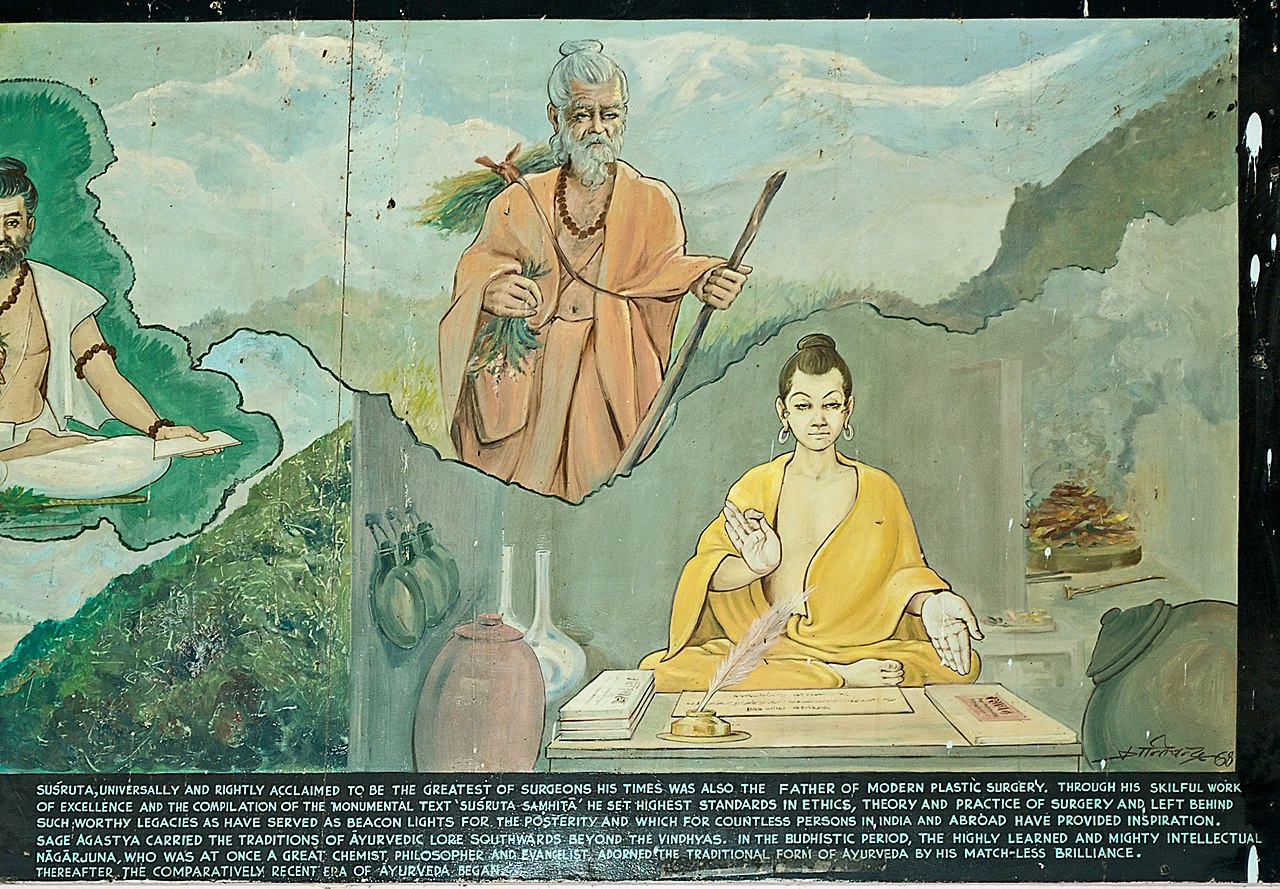
Ngarjuna

Botheration. The students at London’s School of Oriental and African Studies have proposed that “the majority of philosophers on our courses” should be from Africa and Asia. This has caused a backlash in the press.

Powerline comments

“This is so pathetically stupid that it doesn’t really deserve a response. I take it that these people claim to be studying philosophy, right? So that means they need to study philosophers. What we call philosophy is a Western invention. I remember when Paul and I were taking a Greek philosophy class from Professor Duggan at Dartmouth. At one point in a lecture, he referred to ‘Western philosophy,’ then paused and said: ‘as if there were any other kind.’”

Bodhidharma

Here is an interesting case where I think both sides are wrong. It is an old problem, one that I have cared deeply about since undergrad days, and it seems we are never going to resolve it. The truth seems to have no voice. I majored in Comparative Religions, and went on to do grad work in the field, very largely because it was the only place in the academy where one might study the vast domain of non-European thought. Perhaps two thirds of the world’s knowledge, and all untouched elsewhere.

In principle, it seems to me that the students are absolutely right. What was the name of the school again? If you study philosophy at the School of Oriental and African Studies, you have every reason to expect that the philosophers you study will be primarily Oriental and African. Otherwise, your degree is a fraud.

As to the claim that the only philosophy worth studying is Western philosophy, that is simply extreme chauvinism. It is pig ignorant. I tell you with some conviction, anyone who has not studied Buddhist philosophy, Ngarjuna, Hui Neng, the Tao Te-Ching, Confucius, Mencius, Chuang Tzu, Shankara, Ramakrishna, Ibn Khaldun, Ibn Arabi, Ibn Sina, Al-Ghazali, has missed important parts of the human argument and experience. He or she is only half-educated.

And they are understudied. If you are not going to find them in the School of Oriental and African Studies, then where?

Ibn Sina


One can argue, technically, that philosophy is a purely Western invention. But only technically. In the sense that the word is Greek. Yes, Eastern thinkers often dwell on different issues than the classic ones that have preoccupied the West. But that only reveals an artificial limitation on our viewpoint—a good reason in itself to study Eastern philosophy. One could similarly argue, and I have heard it argued, that comedy and tragedy are a Western invention, and there is no comedy outside Europe. This is true in the same sense: our definitions of the two genres come from Aristotle and the Greek ritual tradition. Nevertheless, it is absurd to suggest that we cannot find funny plays or sad plays in other cultures, and more absurd to suggest that non-Western drama is not worth studying because it does not fit into our categories. What in the end, is wrong with learning something? Why would we want to exclude it from a university?

This sort of chauvinism implies cultural relativism. Truth does not have a skin colour or an ethnicity. There is no “Western civilization.” There is only civilization. It is the human duty to seek truth and to seek the best. Wherever we find it, regardless of the “culture” that spawned it. Is something that is true in Toronto not true in Mumbai?

Shankara

That is, incipiently, what American culture and English-speaking culture is: taking the best wherever we find it. That is its genius. And, moreover, that is what Christian culture is. Might I point out that Jesus was Asian? St. Augustine, though, was African. We are building the world culture, those of us who are with the program. Take the best music, whether from Ireland or Africa; the best food, whether from Italy or China; and so forth. That is our project.

Unfortunately, while those who object to the student union proposal seem hopelessly misguided on this, this is in fact not what the students want either.

Here is the relevant portion of their “Educational Priorities”:

Decolonising SOAS: Confronting the White Institution: 
Decolonising SOAS is a campaign that aims to address the structural and epistemological legacy of colonialism within our university. We believe that SOAS should take a lead on such questions given its unique history within British colonialism. In light of the centenary and SOAS’ aims of curating a vision for itself for the next 100 years, this conversation is pivotal for its future direction.
Our aims are a continuation of the campaign last year:

To hold events that will engage in a wider discussion about expressions of racial and economic inequality at the university, focussing on SOAS.

To address histories of erasure prevalent in the curriculum with a particular focus on SOAS’ colonial origins and present alternative ways of knowing.

To interrogate SOAS’ self-image as progressive and diverse.

To use the centenary year as a point of intervention to discuss how the university must move forward and demand that we, as students of colour, are involved in the curriculum review process.

To review 10 first year courses, working with academics to discuss points of revamp, reform and in some cases overhaul.

To make sure that the majority of the philosophers on our courses are from the Global South or it’s diaspora. SOAS’s focus is on Asia and Africa and therefore the foundations of its theories should be presented by Asian or African philosophers (or the diaspora).

If white philosophers are required, then to teach their work from a critical standpoint. For example, acknowledging the colonial context in which so called “Enlightenment” philosophers wrote within.
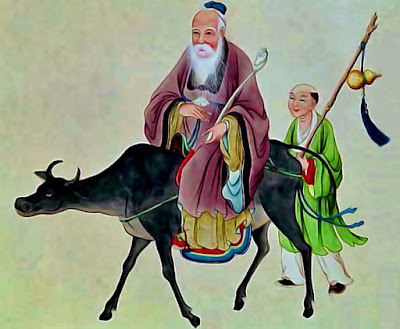
Lao Tzu heading west 


In other words, their problem is that SOAS is not racist enough.

“ a wider discussion about expressions of racial and economic inequality”? It is hard to shoehorn either European or Asian philosophers into a discussion of economics or race. Not an issue most of them have been interested in. It is a good excuse to avoid having to deal with any of them. And not even really about politics, either. It is an excuse for saying “you owe me a degree without working for it.” Because oppression.

“present alternative ways of knowing.” Thank you, Carlos Castenada. As any proper philosopher, East or West, North or South, could inform them, there are no “alternative ways of knowing.” Epistemology 101. By definition—or it is not knowledge. If such cultural relativism is true, we are indeed wasting our time studying Oriental or African thought. This is just a way to reject any criticism of your own thinking. “It’s just my way of knowing.” How dare you mark me! Oppression!

“ we, as students of colour” This is presented by the Student’s Union. Are all students at SOAS really “students of colour”? If so, the school should be defunded. It is just an academic ghetto. Or is it that only students of colour are worth mentioning? Then we have extreme discrimination against whites. Either way, it further assumes that Oriental and African thought is of interest only to students of Oriental and African background. If so, again, studying it is a waste of time. And why should any Europeans be asked to fund it?

“SOAS’s focus is on Asia and Africa and therefore the foundations of its theories should be presented by Asian or African philosophers (or the diaspora).” I almost bought it, it almost was true, until that first parenthesis. “Or the diaspora”? That is, people of African or Asian ancestry living in Europe or North America? Outside of African Americans, there would be few of those more than a couple of generations back; among Africans in the US, only a few centuries. A small pool in which to find some of the world’s greatest thinkers. No; this is a fairly obvious claim by the “students of colour” that they themselves are, due to their ancestry, already authorities on Oriental and African thought. It I impertinent of their professors to suppose they know better. So stop annoying them with questions and give them their degrees. Racists.

Averroes

“ acknowledging the colonial context in which so called ‘Enlightenment’ philosophers wrote within.” Pardon the bad grammar; its probably correct in African or Oriental Diaspora thought. Again, there is a point here. The Age of Discovery was deeply influential in European thought. You could do a lot with that premise. But has it been generally unacknowledged? If so, congratulations! You just found a thesis topic!

One gets the feeling the authors never thought of that. That in itself is a chilling reflection on the state of the academic project. This is something the professors are supposed to do for them?

“Culture studies,” which is something we vitally need, has been co-opted everywhere. Instead of studying culture, they simply award unearned degrees on grounds of race or sex or sexual orientation.

I propose a rule: harsh, but perhaps necessary. If you are going to have a department of “women’s studies,” only men should be permitted to enroll. If you have a department of “queer studies,” only straight people should be allowed to enroll. If you have a department of African or Oriental Studies, they can accept nobody of African or Oriental parentage.

If such studies are of any value, they must be of value to those who are not themselves from the culture. On the other hand, follow the implied logic of the SOAS proposal. Students of the African or Asian Diaspora already know all this stuff. They are wasting their time pretending to study it.


Monday, October 24, 2016

Discrimination at University of Manitoba


Bastion of white privilege.


A recently dismissed sessional instructor at the University of Manitoba has written a piece in the campus graduate student magazine protesting the system of student evaluations that caused her not to be renewed, on the grounds that it is unfair to minority professors.

Her evidence is that studies show “minority faculty often receive significantly lower and more negative evaluations in comparison with their white counterparts.”

Given that no studies are clearly cited, we need not accept that claim. There is a reason why academic standards require clear references and footnotes. Lose that, and anyone can say anything. The word “often” renders it ambiguous in any case—it does not necessarily mean more often than “white” instructors.

But let us assume that is so. It does not demonstrate that said minorities are being discriminated against because of their ethnicity. It might equally demonstrate that the current regime of affirmative action in hiring and promoting is, predictably enough, producing an inferior product. Why would it not, when you hire not on the basis of merit, but of other irrelevant factor like genitalia or skin colour? Merit must suffer, and especially among those of the preferred skin colour. It will correspondingly rise in those groups discriminated against—here, the “whites.”

Odd, though, that this could be a consideration for someone named Sardana Nikolaeva. Isn’t that an Eastern European name? Yet she is implicitly claiming here to be non-white. If Eastern Europeans are not white, who is? Does the term mean anything? Is there really a general prejudice toward Eastern Europeans in Canada?

Indeed, it seems quite a stretch for her to claim she got her--by her own account--universally negative evaluation sheerly because of her supposed visible minority status. Especially since she demonstrates the truth of the complaints in this very essay. Among the intolerable student comments she quotes are, ”she had an agenda,” ”she made me feel ashamed that I was white,” “she hates Canada and our culture,” as if they could not possibly be true. But her next paragraph begins, “As any predominantly white neo-liberal educational institution, the University of Manitoba functions within the politics of ignorance.” Is she not saying that any “white” institution is ipso facto “ignorant”? Would that not include Canada?

The seminar she taught, she explains, “revolved around the topics of racism and discrimination, white privilege, problematic aspects of multiculturalism, and experiences of marginalized communities in Canada.” Doesn’t sound like she has any political agenda, there, does it?

You might also note that much of what she writes is rather difficult to make plain sense of. It is not just the illogical assumption that disparity of outcome must prove discrimination, or her arbitrary concept of “white.” It is sentences like this: “The biased attitudes expressed in student evaluations of minority faculty are particularly problematic as they contribute to already existing practices of discrimination, marginalization, and lack of support from peer faculty and administrators in predominantly white campuses.” That is unnecessarily obscure. Why not “Biased student evaluations add to existing discrimination from colleagues and administrators.” An inability to express thoughts clearly is the most basic sort of incompetence in an instructor.

Anyone who has been reading the news for the past twenty or thirty years, too, must be surprised by the claim made here that college campuses generally are hotbeds of anti-minority and anti-female sentiment. The reverse is the obvious case.

It is simply so that, in a democracy, it is improbable if not impossible to see the government intervene to protect any genuinely oppressed minority from general discrimination. If there really is general discrimination, such measures could not pass the bar of majority approval, pretty much by definition.

It follows that any intervention by the state or by state institutions like public universities in favour of one group over another will always be a case of increasing an advantage already bestowed upon that group by common prejudice.

Black like me...


We can therefore expect student evaluations, in fact, to already be biased in favour of, not against, “visible minority” instructors. But this is not enough. Advantaged groups always expect more advantage. The truly oppressed learn through experience that they must remain silent.

But this, in the end, does not logically apply to an instructor with an Eastern European name. Here, the demand for special rights for preferred minorities is clearly only a cover, an alibi, for discarding the idea of student evaluation of professors in general. The peons of the unwashed majority must be understood to be prejudiced and incompetent, and kept in their place.

Yet the very idea that the customer should have no say in his own interest would be deeply shocking any other context than education. Why should we not choose our own professors, just as we choose our own doctors, lawyers, repairmen, or legislators? Even if the student did not have that natural and inalienable human right, isn’t he, as a purely practical matter, in a better position than anyone else to evaluate the quality of instruction?

In the end, the essay demonstrates the frightening totalitarian tendencies of the modern academy.


Wednesday, May 08, 2013

University as an Investment

This table is an interesting study of the financial value of a university education.

The return on investment seems rather low for most schools. That kind of money could probably do better invested elsewhere. This is a good indication that there is a bubble here likely to burst. Even when the investment looks good, at the top schools, this investment is going to require a lot more hard work than most others. Not everyone can hack Harvard's academic requirements.

There is a solution to this mess, of course: on-line, for profit, higher education.

Tuesday, December 11, 2012

Murder in the Ivory Tower


Minerva among the Muses. Thinking panty raid?

What this study primarily demonstrates is that students really don’t learn very much in college: “45 percent of students did not demonstrate any significant improvement in learning during the first two years of college; 36 percent of students did not demonstrate any significant improvement in learning over four years of college.”

The study evaluates only critical thinking and reasoning skills. But the knowledge gains are even worse. Other studies suggest that the typical student at an Ivy League college actually graduates with less general knowledge than when he entered—he forgets more than he learns over the four years.

But notice that there is one bright spot. “Students majoring in liberal arts fields see significantly higher gains in critical thinking, complex reasoning, and writing skills over time than students in other fields of study."

The bad news is, the liberal arts are dying everywhere. They are being taken over or replaced by the social sciences.

So which discipline scores the lowest skills and knowledge gains over four years of college?

You guessed it: social sciences. “Students majoring in business, education, social work and communications showed the smallest gains.”

Another interesting finding: “Students who study by themselves for more hours each week gain more knowledge -- while those who spend more time studying in peer groups see diminishing gains.” So why is it that current educational methods insist on group work at all times and under all circumstances?

It almost seems as though there is a plan to destroy education.

And I suspect that is exactly right. Not a conscious conspiracy. But somehow (and I suspect affirmative action has at least something to do with it), relatively stupid people have been given the reins of the educational establishment, and they have set out over time to destroy anything in it that might reveal their stupidity. It’s a matter of instinctive self-preservation, I suppose; but the effects on the culture are bound to be devastating. They will kill what they do not understand.