Playing the Indian Card

Friday, February 10, 2012

Sunday Reading.

A leper. From Wikimedia Commons.


A leper came to Jesus and kneeling down begged him and said,"If you wish, you can make me clean."Moved with pity, he stretched out his hand, touched him, and said to him, "I do will it. Be made clean."The leprosy left him immediately, and he was made clean.Then, warning the him sternly, he dismissed him at once. 
He said to him, "See that you tell no one anything,but go, show yourself to the priest and offer for your cleansing what Moses prescribed;that will be proof for them."
The man went away and began to publicize the whole matter.He spread the report abroadso that it was impossible for Jesus to enter a town openly.He remained outside in deserted places,and people kept coming to him from everywhere.
Jesus heals a leper. Byzantine mosaic. Wikimedia Commons.


Note Jesus's instruction, after he heals the leper, that the latter is to tell no one how this happened. This demand for secrecy is consistent through the three synoptic gospels, and is commonly referred to as “the Messianic secret.” That is, Jesus seems to try to keep it secret that he is the Messiah.

But why?

I think this analysis misses the mark by a bit. Unfortunate, because, properly understood, this “Messianic secret” reveals an important secret underpinning Western Civilization.

Which is, after all, really Christian Civilization, “Christendom.”

In Canada, recently, an immigrant family, man, wife, and son, were all convicted of murder for the “honour killing” of three daughters and a second wife. My friend the liberal columnist points out, in explanation, that while “Western” culture is based on “guilt,” “Eastern” cultures are based on “shame.” “It’s not about what you do,” he writes, “but about its effect on the reputation of your family, clan, or caste. Collective honour matters more than love, genetics, or moral principles.” A distinction I have heard made before. And, as you can see from this short quote, despite his liberal beliefs in theory in cultural relativism, he seems unable here to see the Western model as anything but better, more moral.

And it is. I think most Muslims, Buddhists, or Hindus, would agree, given the facts of the Shafia case.

But note that the terms “Western” and “Eastern” here are meaningless dodges. The real contrast is between Christian culture and all others: the importance of “face” is striking in the Muslim Middle East, Hindu India, the Buddhist Far East, or among North American or African shamanists. It is only Christian culture in which its value is so diminished.

And the reason is right here before us. It is the New Testament, the “Messianic secret,” and such passages as this. Jesus is not trying to conceal the fact that he is the Messiah, as such; he is trying to conceal a good deed.
And this is simply practicing what he preaches. From the Sermon on the Mount:

1“Beware of practicing your righteousness before men to be noticed by them; otherwise you have no reward with your Father who is in heaven.2“So when you give to the poor, do not sound a trumpet before you, as the hypocrites do in the synagogues and in the streets, so that they may be honored by men. Truly I say to you, they have their reward in full. 3“But when you give to the poor, do not let your left hand know what your right hand is doing, 4so that your giving will be in secret; and your Father who sees what is done in secret will reward you.5“When you pray, you are not to be like the hypocrites; for they love to stand and pray in the synagogues and on the street corners so that they may be seen by men. Truly I say to you, they have their reward in full. 6“But you, when you pray, go into your inner room, close your door and pray to your Father who is in secret, and your Father who sees what is done in secret will reward you. --Mt. 6:1-6.

The rejection and condemnation of hypocrisy is one of the most consistent, perhaps the most consistent, messages of the gospel. It is so much of the New Testament that our very English word, “hypocrisy,” --let alone “Pharisee”-- is New Testament Greek.

That is what a “culture of shame” actually is—a culture of hypocrisy.

Christianity alone stands head and shoulder above all other religious traditions on this one point: that of recognizing and combating the natural human tendency towards hypocrisy.

The message is conveyed in the present reading not only by the request to keep the deed secret, but by the deed itself—touching and healing a leper. Lepers themselves were a particularly obvious example of social shaming. As the passage notes, they suffered social ostracism. Not because of any moral fault, not for sin, but for being “unclean.” This was not, as Michel Foucault has pointed out, for medical reasons either. It turns out that it is rather difficult to catch leprosy from another, and certainly the mere act of touching a leper was not going to do it. Lepers wer shunned, and considered “untouchable,” because their disease made them look hideous.

Lepers, Jerusalem, 1906. Wikimedia Commons.


A perfect metaphor, then for shame as opposed to guilt. By touching and healing the leper, Jesus was rejecting and/or overcoming this issue of shame. It is a visible way in which Christ has redeemed the Christian: we no longer suffer under the burden of social shame, and need only deal with our guilt.

The New Testament nails this idea to the wall, again and again.

This strong message has made explicitly Christian societies freer, and on the whole more honest—with less of “such boastings as the Gentiles use,” in Kipling's phrase, less focus on mere social advantage and clawing over to the Eastern Wall at all levels; more on principle and getting the job done.

It has been both a moral advantage, and a competitive advantage in many ways, over the millennia, reducing the social friction in Christian jurisdictions.

Thursday, February 09, 2012

A Brokered Convention

Now that he's won the last three primaries, Rick Santorum is certainly not going to drop out of the Republican race any time soon. Having won South Carolina and still doing well in the national polls, neither, I expect, is Newt Gingrich.  Paul and Romney have the money and organization to stay in until the end no matter what.

This could mean nobody has a majority of delegates by the convention. And if this happens, if my memory serves, delegates are released from their pledge to a given candidate after the first ballot. The possibility opens for the convention to turn to a candidate who has not run in the primaries. moreover, there would be a certain obvious logic to doing so--a general dissatisfaction with the present field seems to be fuelling the voter indecision.

I suspect Romney has blown his chance to be the nominee by going too negative. Negative campaigning does have a tendency to blow up the author as well as the target. Romney was rather unloved by fellow Republicans before this all started; his extremely harsh attacks on Gingrich, added to that, may have made it impossible for the party to unite behind him.

Sunday, February 05, 2012

Bombing Iran


Leon Panetta, amazingly, has just said he expects an Israeli attack on Iran in April, May, or June.

This is remarkable, because if he knows something, this is sensitive information. If Iran can expect an attack at that time, they can watch and try to prepare for it. The huge tactical advantage of surprise is largely lost.

So why would Panetta do this? The only motive I can see is to make it clear it is not the US who is attacking, hence perhaps avoiding Iranian and Muslim backlash against America and American interests.

This fits with a few other recent bits of news. First, just a week or two ago, the US leaked the claim that they had no bombs that could definitely crack the Iranian bunkers, and so they were ordering an upgrade. Again, on the face of it a damaging leak that threatened US interests. But if believed, it tells Iran that the US is not planning and is not responsible for any attack in the very near future on Iranian installations.

And the third, even more disturbing, piece of evidence is the American withdrawal of all forces from Iraq just a month or so ago. Officially, this was because the US and Iran could not agree on a SOFA. But several sources have claimed the US did not try very hard. This withdrawal was against the advice of the top military brass. Again, it seems against US interests, or at least risks losing US prestige.

But it too makes sense on the premise that there is going to be a big attack on Iran soon. A small American deployment in Iraq might simply have been sitting ducks for Iranian retaliation. A large American deployment in Iraq might have trapped American into a large-scale land war with Iran.

My take is this: there will probably be a massive air attack on Iranian nuclear facilities. It will be done by Israel, though America or others may help behind the scenes. America believes Iran is capable of doing a lot of damage in any counter-attack. Hence it is wisest to limit possible retaliatory targets to Israel alone.

And it will probably happen before April.

Let's watch and see.

Leonard Cohen the Jew

Adam Cohen, Leonard's son, has confirmed in stark terms in a recent piece in the Winnipeg Free Press the thesis I proposed on this blog some time ago: that Leonard Cohen is in fact a devout practicing Jew. He writes of his memories of his father, "He was there to protect values. It would be lighting the Sabbath candles and learning Hebrew prayers, singing songs, reading the Bible."


Most artists seem to end up religious. And this fact is generally kept pretty secret. Not least by the artist himself: he knows it will hurt sales.

Saturday, February 04, 2012

Mark 1: 29-39


On leaving the synagogue
Jesus entered the house of Simon and Andrew with James and John.
Simon's mother-in-law lay sick with a fever.
They immediately told him about her.
He approached, grasped her hand, and helped her up.
Then the fever left her and she waited on them.

When it was evening, after sunset,
they brought to him all who were ill or possessed by demons.
The whole town was gathered at the door.
He cured many who were sick with various diseases,
and he drove out many demons,
not permitting them to speak because they knew him.

Rising very early before dawn, he left
and went off to a deserted place, where he prayed.
Simon and those who were with him pursued him
and on finding him said, "Everyone is looking for you."
He told them, "Let us go on to the nearby villages
that I may preach there also.
For this purpose have I come."
So he went into their synagogues,
preaching and driving out demons throughout the whole of Galilee.


What jumps up at Christian Scientists about this Sunday’s reading is that Jesus had the power to heal, and healing illness was a major part of his activity. What jumps out at me in the reading is that there were clearly a lot of people possessed by demons in First Century Judea. About as many, it sounds like, as people with physical illnesses, at a time when physical illnesses must have been more common than today.


So why do we not have many people possessed by demons today? What happened between then and now? Or do we?


After all, demons are real. That is non-negotiable for a Catholic. All things, visible and invisible, seen and unseen. Logically, then, demonic possession is also real, and the Church retains rites to deal with it. So, not incidentally, do the Orthodox Churches, Islam, and virtually all other religions. Can they all be wrong?


The obvious conclusion, and the one I make, is that what was then called demonic possession we now call “mental illness.” Freud even used the terminology: he speaks of “obsession.” “Obsession” originally meant “hostile action by an evil spirit,” one notch down from possession. What could be clearer? And this, of course, is why we, as if instinctively, fear the “mentally ill.”


A “schizophrenic” of my acquaintance keeps hearing metallic voices telling him to go jump off the balcony. Occam's razor: the simple and obvious explanation is that he is being tempted by an evil spirit. Anything else requires a good deal of mental gymnastics.


Another, to use the classic example, thinks he is Napoleon? The simple explanation is that he is possessed by the spirit of Napoleon, or of an evil spirit masquerading as the French Emperor.


So too with anxiety and depression. 1 Samuel 16:4: 14 “Now the spirit of the LORD had departed from Saul, and an evil spirit from the LORD terrified him.”


Given that “mental illness” is necessarily, by definition, mental or spiritual in nature, it seems only sensible and efficient to address it in mental or spiritual terms. In other words, if a person thinks he is being invested with an evil spirit, he is being invested by an evil spirit, because in this case the thought is the thing itself. And the most efficient cure is something that will drive out the thought of the evil spirit. If the thought is gone, the thing is gone.


How? How do you change hearts and minds?


Two ways: art and prayer.


Shamanic cultures use what seems to us very much like drama: a story which can engage the mind and concentration, Coleridge’s “willing suspension of disbelief,” and which then catches up and drives out, as Aristotle explained (it is the meaning of his term “cartharsis”), the evil spirits. This is how Korean mudangs, female exorcists, work, or the Native American “False Face Societies.” Other arts can also do this, in their various ways. David's harpistry drove the evil spirits from King Saul: “seek out a man who is a skilful player on the harp; and it shall be, when the evil spirit from God cometh upon thee, that he shall play with his hand, and thou shalt be well.”


Myths, two, are probably designed to do this. “Myth” literally simply means “story.” Make it a real stemwinder, and it should have the engaging power to chase off the plague dogs.


If so, it is a serious misunderstanding to suppose a myth is a serious, but mistaken, statement of “scientific” cosmology—that it is meant to be taken seriously as the scientific explanation of how the leopard got his spots. It is real and true to the extent that it is engaging and vivid. This is why, for example, the Greeks, the Egyptians, or the Indians, could happily accept several contradictory myths in this scientific sense: several different origins for the sun, for example, or for mankind. Not a problem.


This is not science, but spiritual technology. Myths make the world meaningful and significant, and so fend off the demons. Or, should a demon come, immersion in a suitable myth can heal.


Now, what happens when the old stories, or the art, breaks down? That is, either it is forgotten by a large portion of the people, or it loses its power to enthral, to suspend disbelief?


All hell should theoretically break loose. There should be a general sense of meaningless and barrenness to the world; what was once a garden of shining meanings becomes a desert or a wilderness. And then the demons, who dwell in the wild places, like Lilith, or Pan, or the djinn, will come.


And they do. The classic case where this can be expected to happen is during rapid cultural change; when, for example, a culture long isolated encounters a new culture suddenly and massively.


Think, for example, of the North American Indians: as is generally understood, as soon as the Spanish arrived on their shores, they started dying off in droves. The usual explanation is the contact with unknown diseases, and that is fair enough, but it does not fully explain the matter. For one thing, logically, that spread of diseases ought to have gone about equally both ways, so the Europeans should also have started dying off. There is, indeed, evidence that syphilis came to the old world from the New; but it hardly had the effect on Europe the Indians experienced. For another, it does not explain how the early Conquistadors, with only a handful of men, were able to conquer vast Empires, the Incans and the Aztecs, with little effort.


Darwin spends some time in “The Descent of Man” documenting many similar examples from around the world, from the many new contacts of the European age of exploration and colonization. He does not see the effects of new viruses so much as the sudden loss of fertility: people in these societies stop having, and caring for, children.


Why?


Not because they are ill, but because they are dispirited. As we see in microcosm whenever an individual has a case of culture shock, the encounter with a new culture throws all the old stories into question, all the meanings the human world has acquired for that individual or culture. The individuals in the culture become depressed, unable to go on because unable to see any point in their existence. In time, they may well also become possessed--mad.


Why did the same thing not happen to the Europeans? Because they were inoculated by already, rather recently, having had contact with other alien cultures. Notably, the Spanish only finally drove the Muslims out of Spain in the same year Columbus sailed. More notably, they had long ago been inoculated by a mythos developed during the Alexandrian and Roman Empires, with their mixing of peoples.


I suspect, indeed, that a milder version of this sort of cultural collapse with the loss of the old stories was the general condition in Palestine and in the Roman Empire at the time of Christ. The conquests of Alexander, followed quickly by the conquests of Rome, suddenly brought a wide variety of cultures into direct contact, Persians, Semites, Greeks, Egyptians, Celts, destroying the common heritage of the shared stories and psychic dramas that Homer, for example, would have known. As a result, the gods were no longer taken very seriously. And as a result, a sense of meaningless and then an epidemic of demonic possession should be expected to be extremely common at that time. And it was—we can trace the sense of meaninglessness, the general depression, in the writings of what is sometimes called the “Axial age.” circa 500 BC. 


Ecclesiastes is the perfect expression of depression. Buddhism, Pythagoreanism, the Tao Te Ching, and the Upanishads are of the same time, and of the same genre.


Then, we seem to see, in the New Testament, the upwelling of demonic possessions—of that madness beyond depression and anxiety.


This explains, in turn, how Christianity spread so quickly through the Empire: its ability to cast out demons. This is in fact what the ancient historians tell us: that first the Jews, and then the Christians, developed a huge prestige throughout the empire specifically for their ability to cast out demons. The powerful impression of its spiritual coherence, its spiritual truth, its vivid and compelling narrative, was strong enough to restore the shattered spiritual order. Later, it was strong enough to give Europe the upper hand in encountering alien cultures world-wide. Later still, its ability to drive out the demons and restore psychic order has led to its rapid adoption throughout the Third World: in the Americas, Africa, and now China.


Unfortunately, in the more developed parts of the world, we have recently seen another shattering: the one reported by Eliot in The Waste Land, or Yeats in The Second Coming. Things have again fallen apart, over the past century or so; again the spiritual centre cannot hold. Again what we see around us is no longer the shimmering garden of meaning, but a desert, the desert too of “Waiting for Godot.” Art has become derelict and morbid, and the incidence of mental illness seems, by many accounts, to be skyrocketing.


We are all going mad. We are all becoming possessed by demons. There is a spiritual catastrophe taking place.


This, I believe, is not because of globalization. That has been a relative constant for five hundred years. It is because our fascination with the material successes of science and scientific technology has caused us to neglect and to abandon our spiritual technology. We are no longer teaching our children the stories. We are no longer enthralled by the mystery of the Mass. We no longer believe in anything in particular.


As a result, we have stopped having children, or caring for them.


We are letting the demons in.

Wednesday, January 25, 2012

American Religious Exceptionalism

Americans, as anyone can fairly readily see, are more religious, more interested in and committed to religion, than Europeans. Why?


I just heard an interesting theory.

A podcast interviewee suggested that, in comparison to Europe, America has had a freer market in religion. Its many denominations and indeed congregations compete to fill their churches each Sunday. If they fail, their church must close its doors. 

As a result, they have become and remained responsive to their congregations. But in Europe, there has been less religious diversity, and often, as in Britain and Germany, a state-supported church.  Religion as government bureaucracy drifts out of touch.

This never occurred to me, but it sounds right as soon as I hear it.

 The best argument for 

1. separation of church and state, and 
2. religious tolerance.

Friday, January 20, 2012

More on the Current Crisis


... But there is a broader point. It is self-evidently wrong to apply “science” to man himself. What we call science is fundamentally based on observation—in other words, what we can see, hear, smell, taste, and touch. The human soul, by definition, if it exists, cannot be seen, heard, smelled, tasted, or touched, and neither, by definition, can God. The application of scientific method to the human realm or to the divine, therefore, is just as foolish as debating how many angels can dance on the head of a pin.

Nor does the fact that science can tell us nothing useful about the human soul or the meaning of life mean that there is no human soul and no meaning to life—any more than trying to hammer in a nail with a knitting needle, and failing, proves there is no nail. Yet that is the silly Scylla and Charybdis we have caught ourselves between.

Now let's look at that another way: if science is fundamentally based on observation, as it is, it necessarily must also assume there really is an objective observer, apart from the thing observed and capable of interpreting sensations from the sense organs meaningfully. A human mind, a human soul, in other words. The various strands of Modernism and of “social science” all hold one dogma in common: that there is no objective observer, no human soul free of the observed world. Darwin held our perceptions and consciousness to be developed, not to perceive the real, but to aid in the struggle for survival. If Darwin is right, there is therefore no way of knowing, for example, whether Darwin's own theories, or those of any other thinker, have anything to do with reality, or have simply been developed by his mechanical consciousness as a way to aid him in reproduction and survival. In other words, Darwin is self-contradictory.

Marx, similarly, held our perceptions and consciousness were radically determined by “ideology,” which is to say, the beliefs and opinions that were most to the benefit of the ruling class: “a set of ideas proposed by the dominant class of a society to all members of this society” (Wikipedia entry on “Ideology”). There is therefore no way of knowing, similarly, whether Marx's own theories pertain to reality, or have simply been developed by his consciousness to reinforce the interests of the economic system and class into which he was born. He contradicts himself.

Freud held, like Darwin, that “All subjective reality was based … on the play of basic drives and instincts, through which the outside world was perceived.” If so, were Freuds' theories, and those of all other scientists and thinkers of all kinds, based on any objective truth, or only the effusions of his subconscious trying to get laid by his Mum?

Just the three most obvious examples; but I submit that any form of “social science,” any attempt to apply the techniques of science to mankind himself necessarily has this logical contradition at its foundation: if the mind is the object, it cannot also be the detached observer.

So you see, besides leading to mass murder and unimaginable human suffering, to wars and massacres, and besides not producing any useful knowledge in its century or more of trying, Modernism or social science is also immediately self-contradictory. It is also detrimental to true science. If social science is true, science cannot be. The Na'vi that Modernists so admire, you will notice, are not especially hi-tech.

We are not machines, but free agents.

In practice, of course, the social scientist is necessarily assuming that, while ordinary people, or perhaps everyone else, is an automaton following natural laws, he or his class or professional cadre, for some unexplained reason, is not. They are the enlightened ones. This necessarily sees mankind as radically unequal, and can justify practically any level of inhumanity, practically any level of compulsion imposed on the human subjects.

Thursday, January 12, 2012

A Statement of the Problem


There is a Crisis

“One gets the feeling some spiritual catastrophe has taken place…” – Leonard Cohen.

In some ways, life is getting better and better. In one important way it seems to be getting worse: in the experience of what is called “mental illness.” Current National Institute of Mental Health (NIMH) data state that 46.4% of Americans have or will have some form of “mental illness” (http://www.nimh.nih.gov/statistics/1ANYDIS_ADULT.shtml). One in four, one quarter of us, is mentally ill in any given year.

Very little is really known by the science called psychology about this thing called “mental illness.” I’ve been watching the field long enough to realize that the things we know one year turn out to be untrue by ten or twenty years later. We seem to be running around in circles on this. What causes mental illness? Do the pills work? Do the new pills work better than the old pills? What is the most common form of mental illness? Is mental illness A really distinct from mental illness B, or are they two symptoms for the same malady? And is the incidence of such things growing?

We don’t know. We don't know. We don't know. The entire field seems permanently behind a shroud, uncanny and mysterious.

All we are really sure about is that a lot of people claim to be suffering a lot.

My own sense is that the incidence really has been growing, rapidly, at least in the developed world. I find it hard to believe that, a hundred or two hundred years ago, nearly half the population was suffering from what we now call mental illness, and nobody noticed anything in particular. Albeit it does not seem to attract the attention it deserves today either.

Perhaps the true experts on all this are the artists. Artists, I expect, detect the zeitgeist well before the rest of us do, because they are more sensitive to such things; like the proverbial canary in the mine. And Leonard Cohen is far from the only artist to proclaim some sort of broad social or cultural breakdown—a “spiritual catastrophe.”


Duchamp's "Fountain"


Artists have been saying this with remarkable persistence at least since Marcel Duchamp’s “Fountain” (1917), WB Yeats’ “The Second Coming” (1919), and TS Eliot’s “The Waste Land” (1922), the three great original landmarks of “modernism”: things have fallen apart, everything has died, the culture is in broken shards. Some artists have celebrated this fact, and some have lamented it, but all seem to have been saying the same thing ever since: “I saw the best minds of my generation ruined by madness.”

So what has happened over the last hundred years?

What is the Cause of this Crisis?

The obvious immediate cause of the crisis reflected in Eliot’s and Yeats’s great poems was the First Word War and the revolutions that followed it—most notably the Bolshevik Revolution in Russia. Yet this is not sufficient explanation, since this spiritual crisis clearly is still with us now. It has long ago gotten downright tedious: what is “Piss Christ” saying that Marcel Duchamp's “Fountain” was not already saying a century ago? Yet the Great War is now several wars ago, and the Bolshevik regime has faded into history. There must be a deeper cause behind this proximate cause.

Piss Christ


Nor is this deeper cause, I think, hidden. It is the philosophical tendency called “Modernism”—the label commonly applied to these three artistic works.

According to the Catholic Encyclopedia, the term “Modernism” as it is modernly understood was coined by a professor M. Perin at the University of Louvain, in 1881. He defines the term, primarily, as “the ambition to eliminate God from all social life” (http://www.newadvent.org/cathen/10415a.htm).

That is a Catholic viewpoint, and a negative definition. Perhaps it is clearer if we invert it: Modernism was and is the ambition to inject science into all social life. The Modernists of philosophy, seeing the success of science and technology in the Industrial Revolution, wanted to set society, too, on a proper scientific foundation.

Wikipedia elucidates, in its entry on Modernism: “Two of the most significant thinkers of the period were, in biology, Charles Darwin, and in political science, Karl Marx” (http://en.wikipedia.org/wiki/Modernism). Darwin was publicly an agnostic. “Darwin's theory of evolution by natural selection undermined the religious certainty of the general public.” “The notion that human beings were driven by the same impulses as ‘lower animals’ proved to be difficult to reconcile with the idea of an ennobling spirituality.” Marx’s atheism was open and strident: “religion is the opiate of the people,” and all our thoughts are entirely conditioned by the economic system. Both doctrines proposed, essentially for the first time, that “science” and “religion” were opposed systems.

Planet of the Apes?


Both theories were promptly applied to society, indeed were designed to be applied to society, on the notion that society and culture could now be run on an efficient, “scientific” basis. Bad idea. People are not cogs. Marx gave us the Bolsheviks; Darwin gave us the Fascists.

The tendency to view society and humans as machines was then exacerbated by the influence of Einstein and Freud. Mussolini, for example, appealed directly to Einstein. If, as Einstein said, the foundations of the physical world were uncertain, “relative,” then the doctrines that guide our thoughts and deeds were also “relative,” and everything was up for grabs. All norms were expendable as proved convenient—in practice, especially moral norms. The very same argument is, of course, still made by the postmodernists.

Freud, in turn, claimed that “All subjective reality was based … on the play of basic drives and instincts, through which the outside world was perceived” (http://en.wikipedia.org/wiki/Modernism). We could not perceive objective reality, if any existed; we were animals driven entirely by instincts.

I think one can see the appeal of this doctrine. If God does not exist, there is no moral law. If there is no moral law, I can do as I please. Whoopie! Cue the Jazz Age!

More or less literally, all hell broke loose.

Now of course, it looks rather reactionary, rather hindwards-looking, to suggest that we have been on the wrong course for the past century. Heck, that makes me a Victorian. I am, for example, quite explicitly, calling for the abandonment of all “social science.” Sorry about that. I do not think the Victorian times were a golden age. Their overconfidence in the perfectability of man and society largely led to this. But I submit that some such backtracking is necessary and progressive in the true sense: there is nothing discreditable in pulling your finger out of an electrical socket. Since we went off on this Modernist path, we have actually lost all confidence of social or cultural progress. We now imagine that all of civilization has been a mistake, the past ten thousand years or so, and the feral Na'vi and their real-life hunter-gatherer counterparts are the folks who had it right.

Damned inconvenient that they so often have such unfortunate habits as slavery, infanticide, cannibalism, and constant war.

Is this only a problem of “Western civilization”? It appears not. Eastern Europe and Japan seem at least as subject to suicides and “mental illness”; one suspects China is too. Africa, the Muslim world, and perhaps India may have held out somewhat better so far, but they also seem to be undergoing a major trauma on this point. The fight against modernism is a useful prism through which to understand the rise of “Islamism,” for example.

The objection to modernism is not, note, an objection to science. Quite the reverse. The scientific claims of Marx and Freud have long ago been exploded; nobody who believes in science should have anything more to do with their ideas. Einstein, in turn, right or wrong, was simply misinterpreted by the social and cultural relativists. Darwin alone seems problematic—that debate is too complex to dive into here.

But there is a broader point. What we call science is fundamentally based on observation—in other words, what we can see, hear, smell, taste, and touch. The human soul, by definition, cannot be seen, heard, smelled, tasted, or touched, and neither can God. The application of scientific method to the human realm or to the divine, therefore, is exactly as nonsensical as debating how many angels can dance on the head of a pin. Nor does the fact that science can tell us nothing useful about the human soul or the meaning of life mean that there is no human soul and no meaning to life—any more than trying to hammer in a nail with a knitting needle, and failing, proves there is no way to hammer in a nail. Yet that is the silly Scylla and Charybdis we have caught ourselves in.

Wednesday, January 11, 2012

How Gingrich Could Still Win...

Mitt Romney's achievement in winning the first two primary season contests is historic. But, as noted previouosly in this space, the rules this year have changed: few states are now winner-take-all. That means a strong early showing is not prohibitive to others any longer.

As others drop out, the anybody-but-Mitt faction--which seems to be about 75% of the Republican Party electorate--will inevitably coalesce around one candidate, and there may well still be enough delegates in play at that point to keep it interesting. In addition, oddly, Romney has not yet really faced the scrutiny and attacks others have. Now that he is beginning to, he may see the same drop in the polls as they. Takes about two weeks for this to have an effect. That two week lag takes us to about the time of the South Carolina primary.

Now, who is best placed to last long enough to benefit from this possibility? Santorum has the benefit of his strong showing in Iowa, but he did not do nearly as well in NH; so the momentum may be lost. One of today's headlines has him "crashing to earth in New Hampshire." And his campaign has always looked short of money. Perry reputedly has money, but his showing in both Iowa and NH has been dismal. Texas must be beckoning. Paul has a natural ceiling on his support; he cannot be an ABRomney champion. The same could be said of Huntsman--he can do rather well in an open primary like NH, where Democrats can vote for their favourite Republican, but he has been running to Romney's left, and that has turned out--to my own surprise--to be a very shallow pool in the Republican party this time around. In SC polls, he currently runs somewhere behind Steve Colbert. That leaves Gingrich. He at least seems to be picking up steam now instead of losing it--beat everyone else on the solid right in the NH vote, edging out Santorum. He will have the same advantage in South Carolina, of coming from the next state, that Romney had in NH.And he has just had a major new infusion of cash from a wealthy backer, apparently.

Imagine a win for Newt in South Carolina that surprises the pundits enough to become a big news item, like Hilary's win in NH last time, or McCain's. Things could then change. And the latest polling shows him only four points behind.

Imagine further that a relatively poor showing there forces Perry and Huntsman out of the race.

As they say, a week is a long time in politics.

Full disclosure: I personally want Newt Gingrich to win. Why? Because he is such an interesting character. I would love to hear what he has to say over the next four years.


Wednesday, January 04, 2012

Iowa

Conventional wisdom about Iowa's caucuses is that they winnow the field: "Two tickets out of Iowa." But there is no reason why this should any longer be so. The rules have changed--primaries and caucuses are no longer "winner take all." This reduces a considerable advantage held by front-runners. Those in the back of the pack can now hang in longer before the mathematics eliminates them, hoping for a stumble or a surge. And the rapidity with which messages now get out makes late surges and stumbles that much more likely. A brokered convention also becomes more of a possibility, meaning it might pay to stay in the race in order to wield influence.

The only question is whether the candidates understand this. If they do, they will probably hang in there.

Saturday, December 24, 2011

The Renaissance of the British Empire


Bigger than a breadbox.
The recent exclusion of the UK from the latest deal to rescue the Euro moves us a big step closer to seeing the Anglosphere reunite--Britain is visibly and definitively pulling back from the EU now.

But then, a guest on the BBC was just quoted as saying the Euro itself is now doomed; it is only a matter of time. And the EU itself is likely to break up when this happens.

England may then not be the only European country interested in chipping in instead with NAFTA. Among those shopping for some new association might well be Ireland, Spain, and Portugal--all turfed out of the Euro as bad financial risks. All three have powerful New World connections.

I can see a possible reunion, not just of the old British Empire plus the US, but this also combined with the old Spanish Empire plus the old Portuguese Empire, for a that much more formidable free trade area. This free trade area would be far stronger than the EU, because it would combine areas with a great diversity of resources and economic strengths, along with greater unity of language and culture. It could include two important emerging powerhouses, India and Brazil.

It would permanently dwarf China.

Thursday, December 22, 2011


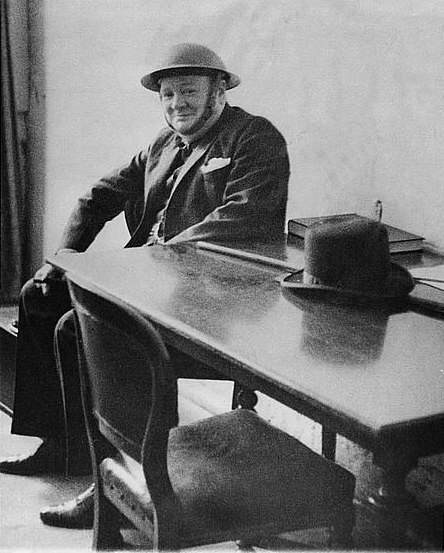
During an air raid.


Here is the peroration of one of Churchill's most celebrated speeches, made in 1940:

“What General Weygand called the Battle of France is over. I expect that the Battle of Britain is about to begin. Upon this battle depends the survival of Christian civilization. Upon it depends our own British life, and the long continuity of our institutions and our Empire. The whole fury and might of the enemy must very soon be turned on us. Hitler knows that he will have to break us in this Island or lose the war. If we can stand up to him, all Europe may be free and the life of the world may move forward into broad, sunlit uplands. But if we fail, then the whole world, including the United States, including all that we have known and cared for, will sink into the abyss of a new Dark Age made more sinister, and perhaps more protracted, by the lights of perverted science. Let us therefore brace ourselves to our duties, and so bear ourselves that, if the British Empire and its Commonwealth last for a thousand years, men will still say, 'This was their finest hour.'”

I quote it because it makes clear what was understood as the two sides to the conflict at the time: on one side, the Allied side, “Christian civilization.” On the Nazi/Fascist side, “perverted science.” I think this is worth pointing out and remembering, because in recent years this has been falsified. Many fashionable writers have tried instead to claim that “Christian civilization,” (viz John Ralston Saul), or even, absurdly, the Catholic Church (viz Christopher Hitchens), was responsible for Nazism. But Nazism was openly anti-Christian, as Churchill notes.

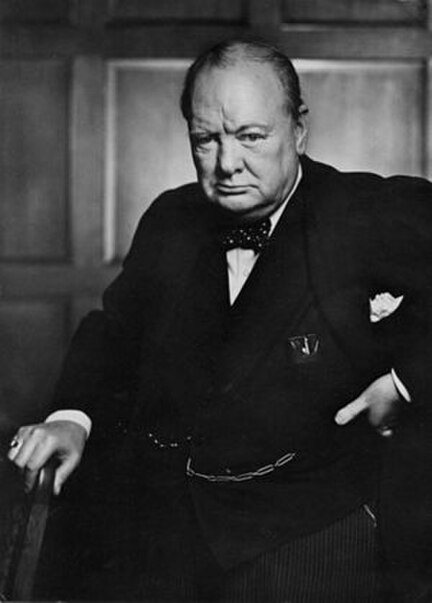
The Karsh portrait


Nor was Fascism, as I have seen claimed, anti-science. No, science, or rather, scientism, as Churchill says, was at its core: Darwin and the theory of evolution was obviously and directly appealed to by Hitler as the essence of human life, and Einstein's Theory of Relativity was used by Mussolini to claim that all values were culturally relative. Nazism was not a conservative movement, in any sense, but a “progressive” creed. It appealed to science for its justification, and held, like the “progressives” of today, that science had superceded old moralities.

Those who do not study history are condemned to relive it. And not as the guys on top.

Friday, December 09, 2011

Fourteen Reasons to Homeschool

Bullying kids.

Bullying was always a problem at schools. It is quite possibly made worse by the current “self-esteem” movement.

Bullying teachers.
    The job of teacher is tailor-made for bullies, control freaks, and terminal bores who cannot otherwise get anyone to listen to them. Unfortunately, we have created no defenses against this. To the contrary, the culture of the public school seems to promote bullies and control freaks.

    Current public school teaching methods don't work.

    See “Operation (aka Project) Follow-Through,” for proof; and the many studies that show that both private schools and homeschooling produce better results on a number of measures. We are at best simply wasting our children's time by sending them to public school.

    Our system of public school teacher selection ensures the worst.

    We know that certain teachers can make a huge difference to scores on standardized tests, and we further know that the best teachers are those who are best at learning and who know the subject best. But our system of teacher certification values courses in education over subject knowledge. Further, we know that those who enter ed schools have lower SAT scores than for virtually any other subject, and almost nobody fails. We are selecting for those who are worst at learning and who know the subject least.

    The public school curriculum has been stripped of the culture. It has become culture-hostile.

    A solid grounding in one's culture—in the wisdom of one's ancestors--is almost the entire point of education. However, the current attitude in schools is that culture is oppression by “dead white males.” This amounts to a systematic attempt to prevent children from becoming educated.

    The public school curriculum has been stripped of essential skills.

    Besides culture, children need facility with certain useful life skills: the proverbial “reading, 'riting, and 'rithmetic,” not to mention logic, foreign languages, and such. The problem, however, is that all such skill acquisition requires memorization. Current educational practice is actively prejudiced against memorization and drill as supposedly “uncreative.”

    The public school curriculum has been stripped of all religious references.

    So currently public schools don't teach any culture, and they don't teach basic skills. Is there anything left? Indeed there is. But they don't teach that either. Even more important than such basic skills for employability and cultural context, the core of any real education is religion. Religion is systematically banned from the public school classroom.

    The public school system does not teach any coherent set of morals.
      This goes with the last point. It is essential that children be taught the difference between right and wrong; the public school is not even prepared to accept that there is a right and a wrong. To the extent that there is a morality taught, in any public school class, it will conflict with any known moral code, confusing and subverting any child being raised with one.

      The public school system is designed to produce employees, not leaders or independent thinkers.

      In response to the accusation that they fail to teach either important information (culture) or basic skills, I expet many defenders of public schools would claim that they instead teach students to think. That, at least, is supposed to be what the resistance to memorization is in favour of. But this is demonstrably false. To teach someone to think, you teach them formal logic, logical fallacies, philosophy, the rules of debate, and the rules of parliamentary procedure. Private schools teach this; public schools rarely do.

      And why not? There is a historical reason. The public schools were consciously designed at the beginning of the last century to produce reliable workers for industry, not leaders. This was a way to preserve the ascendancy of that class that could afford to send their children to private schools. Woodrow Wilson said as much.
      The public school system dehumanizes. It treats kids as objects to be molded to conformity, instead of individual souls.
        The modern school was more or less consciously designed on the model of the assembly line, to produce workers for industry. This is one reason for the elimination of the old one-room schoolhouse—it did not fit the factory model. The “scientific” approach to teaching necessarily objectifies the students.

        The public school system is hostile to boys.

        Boys and girls have very different interests and learn in different ways. Thanks to feminism, almost everything that might interest boys has been banned from the modern classsroom. Boys are commonly told they are no good. This is exacerbated by the fact that elementary teachers are almost overwhelmingly women, who think like women and give boys no role model. Indeed, few men dare teach, because it makes them sitting ducks for career-ending charges of sexual harassment or child abuse, from which women are largely exempt.

        The public school system is hostile to very intelligent kids.

        The system, in the name of “equality,” is invariably more interested in raising the achievement of the slow than in raising the achievement of the quick. Given big classes and big schools, one size must fit all, and the quick are the ones who end up round pegs. They can have little in common with teachers who are not themselves very bright, and may, being control freaks, resent children who are.

        The public school system indoctrinates into a specific political viewpoint.

        Departments of education are commonly hotbeds of radical left-wing politics; a lot of teachers are quite open about their main objective being to indoctrinate. This, of course, works directly counter to the objective of teaching students to think for themselves.

        The public school system is resistant to the new technology with which it is crucial for students to become familiar.

        Because they essentially cannot be fired, having tenure, and face no competition, there is nothing impelling public school teachers to adopt new technology or new methods, other than a personal sense of responsibility or personal desire. Unfortunately, matters are very different in the real world of work most students will face. There, it is essential to keep up with the latest technological innovations in order to compete. This disparity leaves schools lagging further and further behind.

        Sunday, December 04, 2011

        Revolution Truths


        Taking it to the streets.


        Denial is more than just as river in Egypt, they say. It may not be a popular thing to say in all the euphoria around the Arab Spring, but among the popular delusions of our day is the common notion that revolution is good. The cult of revolution is everywhere: on campus, and among the clerical class generally. It forms part of the national ideology of both America and France, not to mention China, Mexico, and on and on.

        But really, when has a revolution ever brought more good than evil? The Russian Revolution brought us Stalin. The Chinese Revolution brought us Mao. The French Revolution brought us Robespierre, then Napoleon. The English Revolution brought us Cromwell. The Iranian Revolution brought us Khomeini and Ahmadinejad. There is a pattern: power goes soon to a strongman, not to the people. There is less liberty, not more liberty; and despite Potemkin villages, there is relative economic stagnation, not greater wealth.

        This result is, moreover, perfectly logical and predictable. A full revolution more or less by definition kicks down the basic law, the nation's constitution, whatever it is. Everything is up for grabs in the street. Without law, what one has left is not freedom, but the law of nature: a natural struggle of all against all. And laws, in the end, are there to protect the weak. Inevitably, where there is no law, the strongest and most ruthless will benefit, and the weak will be crushed. Think "Lord of the Flies": after much spilling of blood, some organized group with weapons will emerge to dictate. They will have triumphed by sheer ruthlessness and lust for power. They are going to be in the mood to exercise it.

        Sounds like a good idea?
        Unfortunately, the American Revolution can be pointed to as a counterexample. Unfortunately, because it gives revolution a cachet of morality and progress. But to see the American struggle as a revolution, rather than a war of independence, seems arbitrary. At state and local level, those in power before the revolution, remained in power after the revolution, as did all the state laws. That makes a crucial difference. Government never descended into the street.

        And even then, did the American struggle for independence really produce more good than harm? For, besides the blood shed at the time, it surely set the precedent of a right to secession which then led directly to the American Civil War, not to mention that fuss over in France in 1789, and further tumult throughout the Americas. And for what, exactly? To avoid ending up like Canada? 

        Can one name a single nation that went directly and peacefully from a genuine revolution to a liberal democracy? For one can cite many who went from a military junta or absolute monarchy to a liberal democracy without internal conflict. 

        Of course, this is a bitter pill for those saddled with a genuinely oppressive and corrupt government—a Muammar Ghaddafi, for example; himself, note, the product of a prior revolution. One might argue that a truly bad government makes revolution necessary. But any glorification of revolution for its own sake? Be careful what you wish...

        Comrades in arms.

        Friday, November 11, 2011

        Britain's Choice


        The current “Eurozone” crisis really does seem to be moving in an interesting direction. The response of France and Germany seems to be to push for an “ever closer union,” but a more restricted one, to counter the sorts of stresses now apparent in the monetary union. This is fundamentally a plan to break up the EU.

        Britain now faces the choice of throwing in its lot with a monetary union that has so far looked like a very bad idea, and surrendering a good deal of its sovereignty, or being relegated to a second-tier status within Europe.

        Time to propose again my own preferred alternative: an Anglosphere union. Britain should instead leave Europe and join what is now called NAFTA. Trade ties would probably almost automatically bring Ireland with it, possibly some Scandinavian countries. Australia and New Zealand would find it hard then to stay out, given the cultural ties. Most of the English-speaking nations of the Caribbean would probably join in a flash if the opportunity was offered—they've ben seeking union with Canada, the US or Britain for some time anyway. Voila! More or less the union I've been speaking of.

        It makes sense not just on grounds of shared culture or shared trade, but a shared historic political and economic philosophy. The Anglosphere is the home of the social philosophies of John Locke and Adam Smith, not to mention the legal traditions of Common Law and Magna Carta. I think they would find it much easier and more comfortable to work together in a tighter economic or political union that Britain would with the rather different traditions of Europe.

        Thursday, November 10, 2011

        The Sidewalks of New York

        One of the great things about Irish music is that the songs keep getting picked up again and reinterpreted in new ways. We have mellow versions, punk versions, classical versions, rock versions.

        It's time someone went back and reinterpreted some of the songs of the fin de siecle up to the twenties in this way. There are some great songs with some great lyrics from that time, but they are only ever done as period pieces, which makes them sound like they are preserved in formaldehyde rather than being living songs, which I think they really could be.

        "The Sidewalks of New York" really jumps out at me in this regard. So does "After the Ball is Over." "Ol' Man River." "My Blue Heaven." "Sweet Georgia Brown."

        Note, I mean not done in repro style, but recast as modern songs.

        There's a huge market niche for a new musical act there.

        Monday, November 07, 2011

        Why the Beatles are Bound to Fail


        Rock and roll is dead. That is so fifties. Folk is what young people want to hear now.
        Nobody wants to listen to an ensemble. You need one human face on the act, for people to identify with. At least one obvious leader. 
        Neither McCartney nor Lennon can read music. How the heck can they write music?
        McCartney is left-handed. Where is he going to get a left-handed bass guitar? Left-handed guitars are expensive, and he is from a poor family.
        Lennon admits he has no sense of rhythm.
        Rock and roll is black American music and alien to the English experience. No white Englishman is going to be able to do it very competently.
        Nobody in America is going to listen to an Englishman playing American music.
        English music acts do not play well in the US. Ever heard of Cliff Richard?
        Nobody in their early twenties is going to be all that accomplished at their instrument, whatever it is.

        Need I go on? Anything everybody knows is sure to be wrong, and the next big thing will always be something that goes against what everybody knows.

        Thursday, November 03, 2011

        Oh, The Humanities!


        I recently downloaded to my iPod an episode from TVO featuring an award-winning lecturer speaking on W.B. Yeats.

        I'll grant that the talk was entertaining, but this guy did not know his stuff. Is this the best we get in university Humanities departments these days?

        For example: he referred to Michael Collins as President of Ireland. He was Minister of Finance. He spoke of Padraic Pearse being strapped to a board because of injuries in order to be shot. Pearse survived the Easter Uprising without major injuries; the lecturer is probably thinking of John Connolly, who was tied to a chair. Then he claimed that the Byzantine Empire was destroyed by Crusaders; it was overthrown by the Turks in 1453.

        Okay, so history is not his field—even history directly related to his field.

        But he also asserted that Yeats' poem “Down by the Salley Gardens” was autobiographical, and referred to an island be used to enjoy visiting. Yeats himself pointed out that the poem was a reconstruction of an old Irish poem, “Ye Rambling Boys of Pleasure,” in which the “salley gardens” already appear.

        The universities have somehow become isolated, stagnant pools of misinformation, rumour, and urban legend. Truth is more likely to be found on the Internet. I chalk this up to the free exchange of ideas and information.