





 Posts
Posts


From Coolopolis, the essential Montreal history blog.
Sunday, October 20, 2013


Global Warming for a Greener Future
 |
| Heat is not the problem. |
But an obvious weakness is point 3. After all, the “Medieval warm period” seems to have been a time of relative prosperity.
Basically, CO2 is food for plants. It is a powerful fertilizer. Therefore, the rising CO2 concentrations that supposedly cause global warming are also certainly boosting crop yields and greening the planet. This may be considered separate from the global warming issue; but any plan to reduce CO2 emissions is also, automatically, going to reduce plant growth (and hence animal habitat) worldwide. Isn't this what we were claiming to avoid?
In general, heat from the sun is also a powerful fertilizer. There is a reason why it is called the “greenhouse effect.” A longer growing season in the temperate zones also means more vegetation and more food.
Is there a tradeoff, conversely, in the tropics? No—even at the equator, it is not “too hot” for agriculture. Flora and fauna are simply much more abundant, and crops come in year-round.
Ah, you are thinking deserts, perhaps? Look on a map. Deserts do not occur at the equator. They are not caused by excessive heat from the sun. They are caused by a lack of moisture, caused in turn by prevailing wind patterns.
So, would global warming increase the size of deserts? Warming, per se, will not, so we have to guess at collateral effects. I ain't no climate scientist, but it seems to me the effect of CO2 promoting plant growth will work to reduce, not expand desert areas. And increased heat should lead to increased evaporation, therefore increased cloud cover, and increased precipitation. Result: less desert worldwide.
However, the bad news is that recent data seem to refute climate change point 1—the Earth has not gotten warmer since the 1990s.
Saturday, October 19, 2013
Free Trade with Europe
Nice to see some good news for a change.
If the US does not do the same, Canada instantly becomes the preferred location for just about any international business: nowhere else has relatively tariff-free access to such a large market.
But the US in fact must do the same, and is about to.
Nevertheless, this doubles the size of both the NAFTA and EU free trade zones, theoretically doubling the economic benefits of each.
If the US does not do the same, Canada instantly becomes the preferred location for just about any international business: nowhere else has relatively tariff-free access to such a large market.
But the US in fact must do the same, and is about to.
Nevertheless, this doubles the size of both the NAFTA and EU free trade zones, theoretically doubling the economic benefits of each.
Friday, October 18, 2013
The Real World of Ethnic Slurs
 |
| What did Sambo ever do to make his very name a bad word? |
Dr. Charles Krauthammer weighs in on the Washington Redskins controversy. He thinks the name should be changed. The Washington Post loves it. I respectfully disagree.
As Dr. K. says himself, “There is no particular logic to this evolution.” Exactly the problem. He is apparently one of the postmodern crew who believe that language is determined by nothing but popular usage. Yet it is not. Language is logic, or it is nothing; it ceases to communicate, especially across the ages. Nor has it ever been determined by general usage, at least until very recently: this is why folks can always point to favoured neologisms actually already being used long ago. Doesn't make them right that they are old, any more than that they are common. No number of people over any length of time will make “ain't” correct usage, or “youse.” Both are common and ancient. But they violate a part of the language's logic.
Usage counts; but not common usage. What is correct is demonstrated, not by popular usage, but by the consistent usage of the best writers. This only makes sense: there is expertise in language just as there is expertise in medicine or in science. You don't want a writer doing your brain surgery, and you don't want your surgeon shaping the language.
Importantly, this has nothing to do with resisting language change. File under herring, red. The point is that a change in language must not be arbitrary, but must follow the rules and the logic and the music of the language.
If we let all hell break loose, as Dr. Krauthammer recommends, a lot of people are unnecessarily harmed. Notably, in the present example, the owners, players, and fans of the Redskins have built up a valuable brand and a cherished cultural artifact over the years. Is it right that, through not fault of their own, they must now lose it all? This obviously violates natural justice; for, on the other hand, absolutely nobody is harmed by the Redskins name.
This collateral damage to the innocent commonly happens when linguistic logic is thrown to the wind. Most often, those most harmed will be those previously most favourably inclined to the minority group supposedly maligned, as in the case of those who sought to identify themselves as redskins. Worse, language by popular vote allows politics to creep in and manipulate the language for its own benefit, just as George Orwell warned in 1984. This is a clear and present threat to our liberties.
| How dignified is this? |
When it comes to racial epithets, the rule ought to be clear. To be offensive, the term must indeed, as Krauthammer says, “carry an inherently derogatory connotation.” That should mean that the word's derogatory implication is not a matter of fickle public opinion, or worse, cocktail party opinion, subject to unpredictable change which can sideswipe the innocent or uninitiated, but inherent in the word's actual meaning.
To cite one of Krauthammer's own examples: if the word “gyp” meaning “to cheat” really did come from gypsy, then yes, it is indeed derogatory, and should not be used: it implies that all gypsies are swindlers.
Actually, though, even here, there is a problem. What Krauthammer knows is not so. He has been to too many cocktail parties. We do not know where the word really came from.
This false positive is indicative of a certain endemic problem: there is now an industry and a class structure built on fabricating these racial shibboleths, so that those who do not know and use the current preferred term, who did not go to the right schools and do not continue to read the right publications and attend the right parties, are systematically disadvantaged. Unsurprisingly, the groups most likely to be harmed by this classism are ethnic minorities.
On what else is Dr. K. Wrong? Going through the list of terms Krauthammer cites:
Redskins – there is nothing inherently derogatory about a reference to an ancient war practice. This would be equivalent to calling modern Scandinavians “Vikings.” Not a problem.
Negro – there is nothing derogatory about referring to someone's skin colour, unless you begin by buying into the belief that there is something wrong with that skin colour. Accordingly, it is more racist to avoid the term “negro” than to use it. The same goes for “nigger.”
Gypsy – there is nothing derogatory about this term unless you hold that there is something wrong with coming from Egypt. Again, more racist to avoid it than to use it. Krauthammer uses “Roma” for preference. Big problem: actually racist in the extreme.
Retarded – purely descriptive, and polite about it. Developmentally disabled is simply a more long-winded way of saying “retarded.” Occam's razor applies to English: if a shorter word or phrase is already available, one should not use the longer form (without special reason). Therefore, this term should be avoided.
| L to R: Nigger Jim, Huck Finn. |
If you've been following, you will have noted a disturbing trend: the modern “politically correct” terms are often more pejorative than the terms they replace. This linguistic trend is increasing, not reducing, racism.
Other terms that are in fact not pejorative, but currently often thought to be: welsh as a verb (no known relation to the ethnicity), wop (really means something like “handsome young swell”), wog (origin unknown), Paki (is Brit or Yank offensive?), squaw, Indian, Injun, Hymie, Hebe, gook (origin unknown), frog (it's a delicacy, for goodness' sake), Dago, chink (probably from Qing or Chine), Chinaman (more or less the cognate of the Chinese term).
Terms that are commonly used, but really are pejorative: Boche, camel jockey, cheesehead (actually used by Hitler, for the Dutch), cheese-eating surrender monkey (no argument here, right?), cracker (means “boastful”), greaseball, honky (implies an uneducated manual labourer), Hun (actually German-coined, but implies savagery), kike (is it really used any more?), raghead, shiksa.
One advantage of keeping it logical and keeping the record straight is that the language then becomes a useful and accurate barometer of who is being discriminated against and who is not. Compare usage with the internal logic of the word: if an inoffensive word is considered offensive in “polite society,” you have identified a group that is being discriminated FOR. If an offensive word is considered inoffensive in “polite society,” you have identified a group that is being discriminated AGAINST.
On that reliable measure, we are currently discriminating in favour of American Indians, blacks, Hispanics (or is that now disallowed? Should I say “Latinos”?) and South and East Asians. We are discriminating against Arabs, Germans, French, Canadians ("cheeseheads," in parts of the US), Wisconsinites, and whites generally.
Bingo.
Actually, come to think of it, isn't "Krauthammer" a bit of a slur against the Germans? Shall we start a petition to have the doctor change his name?
Thursday, October 17, 2013
Drunk Sex
Instapundit makes an interesting point. These days, by law, in both Canada and the US, if a man has sex with a woman who is inebriated, it is rape. The idea is that a woman cannot give consent if she is drunk.
Fine--but what if the man is also drunk? Sexual equality: if the woman when drunk is not responsible for her own actions, then neither is the man. Any way you slice it, it is not rape.
Stones Don't Float
Brian Jones has left the pool
Brian Jones, get out of the pool.
Oh my God, he still has a pulse.
I can hear that faint beat from his foolish heart
Brian Jones, you stunned drunk junkie, sober up.
Everything is possible.
it's all imagination, isn't it?
Brian Jones, you are totally bumming everyone out.
Brian Jones, you are slipping up on the Diddley rhythm
You're playing too serious and slow, it's only rock and roll.
Get up and shake it, or you're going to kill a thousand dances
Clap like you would to old St. Vitus's Boogie Blues
We need your mouth harp; breathe out, breathe in
It's not only you, generic Jones;
You're not in the army, but you're in a band.
Okay, goodbye then, Brian. But don't expect any true sorrow,
You penny ante panto Adonais
This train's moving on to Almonte and beyond
Even if you up and rise again
We don't want to know
I hope Hit Parader doesn't cover it.
This is live, Mr. Jones. This is happening.
There will be no overdubs,
And no retakes.
--Stephen Roney
Wednesday, October 16, 2013
Best US Presidents
.jpg) |
| Just imagine what you can see from the Canadian side... |
Here's my top five list:
George Washington. He could have been the man on the white horse. He could have made himself dictator or king. That's the usual thing following revolutions. That he did not do so, and set the precedent of the two-term limit, is probably the single most important act by anyone guaranteeing American democracy.
Thomas Jefferson. He roughly doubled the size of the US, without war, lowered taxes, and lowered the debt. Not a bad record, on the whole.
Theodore Roosevelt. Ushered the US onto the world stage as a great power. Showed how the presidency should work: as a “bully pulpit,” by force of personality. Personified the American spirit in a way no other president has.
Calvin Coolidge. Reduced taxes and reduced the federal debt. Cleaned the KKK out of government, granted full citizenship to Indians, fought for civil rights.
Ronald Reagan. Achieved the unprecedented feat of generally acknowledged greatness while trying to shrink, rather than expand, government. Won the Cold War.
Here are a few who did not make it, and why:
Andrew Jackson. A shameless warmonger who introduced the patronage system.
Abraham Lincoln. It is easy to look like a great leader if you lead during a major war. But objectively, the North did not do well in the Civil War: they started with overwhelming strategic advantages, and it devolved into a bloody, protracted affair. Lincoln must take responsibility for his military appointments and firings. He also played pretty fast and loose with civil rights and constitutional protections in the process.
Woodrow Wilson. Again, given unearned credit for leading during war. He introduced racial segregation in the federal government. He greatly enlarged the size and power of the federal government, getting him unearned points for activism which may well have been destructive. His foreign policy was a failure on all counts.
Franklin Roosevelt. His policies probably prolonged the sufferings of the Great Depression. He vastly expanded government and executive powers. He stayed out of World War II until forced to come in; if this was dishonourable for Neville Chamberlain, why should it be honourable for Roosevelt? He broke the precedent of staying for only two terms.
Harry Truman. Bottom line: a machine politician not qualified for his job. He gets unearned praise for having been a war leader (WWII and Korea).
Dwight Eisenhower. He has risen of late in popular estimation. I blame him for kicking a lot of cans down the road. His foreign policy, in my opinion, was disastrous. He stabbed Britain and France in the back over Suez, creating a power vacuum the US was then obliged to fill. He got the US into Vietnam, an unwinnable fight. He set some of the tone for the Eisenhower years, which were not a good time in a lot of ways. There was a reason for the Sixties, after all.
Woodrow Wilson. Again, given unearned credit for leading during war. He introduced racial segregation in the federal government. He greatly enlarged the size and power of the federal government, getting him unearned points for activism which may well have been destructive. His foreign policy was a failure on all counts.
Franklin Roosevelt. His policies probably prolonged the sufferings of the Great Depression. He vastly expanded government and executive powers. He stayed out of World War II until forced to come in; if this was dishonourable for Neville Chamberlain, why should it be honourable for Roosevelt? He broke the precedent of staying for only two terms.
Harry Truman. Bottom line: a machine politician not qualified for his job. He gets unearned praise for having been a war leader (WWII and Korea).
Dwight Eisenhower. He has risen of late in popular estimation. I blame him for kicking a lot of cans down the road. His foreign policy, in my opinion, was disastrous. He stabbed Britain and France in the back over Suez, creating a power vacuum the US was then obliged to fill. He got the US into Vietnam, an unwinnable fight. He set some of the tone for the Eisenhower years, which were not a good time in a lot of ways. There was a reason for the Sixties, after all.
Tuesday, October 15, 2013
Movies: Some Personal Favourites
And to remind myself that film really can be art. These days, with what is coming out of Hollywood, it is hard to remember.
- O Brother, Where Art Thou? Nobody does Americana better than the Coens. Best soundtrack ever.
- Fargo. Saw it in Korea with subtitles.
- The Big Lebowski. The Coens' take on the modern West. Nice ferret. Liked it so much I had to read the screenplay.
- The Princess Bride. Everybody loves it now, which is disappointing. There was a time I thought I was the only one who knew.
- Pennies from Heaven. This may be my favourite movie of all time. Saying anything would be a spoiler.
- The Birds. Disliked it first time. Now I think it is Hitchcock's best. Best part is the scene outside the school with the children singing inside. Why is it so ominous? The best thing about The Birds as a whole is that nothing is explained.
- The Grave of the Fireflies.Shows why I think animation is the pinnacle of film as art.
- Howl's Moving Castle. Hang the story. I love it as pure visual art.
- O What a Lovely War! Best thing, of course, is the soundtrack. I'm a sucker for musicals. The more multi the media the better.
- No Country for Old Men. I'm a little reluctant to include it, because everyone thinks so. Still, I think it might be the definitive picture of the soul of America in film.
- Gettysburg. My candidate for the best war movie ever. Accurate historical reenactment.
- True Grit (Cohen Bros.). Can't get it out of my mind. Single-handedly revives the Western as a living genre. Cinematography rules.
- The Magnificent Ambersons. Overshadowed by Citizan Kane, but I like it better personally. An American epic.
- Culloden. My candidate for best documentary ever. Often imitated since, mever matched.
- Paths of Glory. Not the best war movie ever; the best courtroom drama.
- O Lucky Man! When I saw this at twenty, I thought it explained the universe. I love coming of age films.
- High Noon. I saw this in early childhood, and it marked me for life. It demonstrates the full power of the classic unities. Another essential American tale.
- Who's Afraid of Virginia Woolf? I am told it is better as a play. It's the verbal jousting that makes it.
- Bonnie and Clyde. Saw this three times in rapid succession. The full impact is hard to appreciate now, because it has been imitated by everybody.
- Full Metal Jacket. Powerful war film, great Sixties soundtrack, but perhaps best understood as a film about love.
- Rope. Another great argument for the classic unities. White knuckles all the way.
- Dial M for Murder. And another. A Chinese box.
- Polanski's MacBeth. Best take on Shakespeare ever. None of the usual stuffiness. Nor of the silly trendiness of "modernising."
- Dog Day Afternoon. Another one that is close to the classic unities. So crazy it could only be true.
- 90 Days. A little NFB film that I expect few have noticed. Innovative and very human.
- Pleasantville. Loved it so much I read the screenplay. An oblique parable of growing up.
- Eyes Wide Shut. Much derided, I think it is Kubrick's final statement. The casting sucks, but the soundtrack is great and the film leaves you with much to think about.
- Lolita (Kubrick). Powerful portrait of guilt. Peter Sellers is transcendent.
- American Pop. I love musicals and I love animation. A history of American music in cartoon. For me, irresistible, even though it's corny as heck.
- The Shining. Wonderful camera work; debut of the steadicam. Kubrick does Hitchcock well.
- The Lion King. Sure, everybody knows it is great, but adults without kids should make a point of watching it too.
- The Jungle Book (Disney). Relatively overlooked, Disney's last and perhaps his greatest. It kind of explains the Sixties, believe it or not. Great soundtrack, and the model for animation voice work.
- A Man for All Seasons. This one changed my life philosophy. Robert Bolt should have won a Nobel for Literature.
Monday, October 14, 2013
Giving Thanks
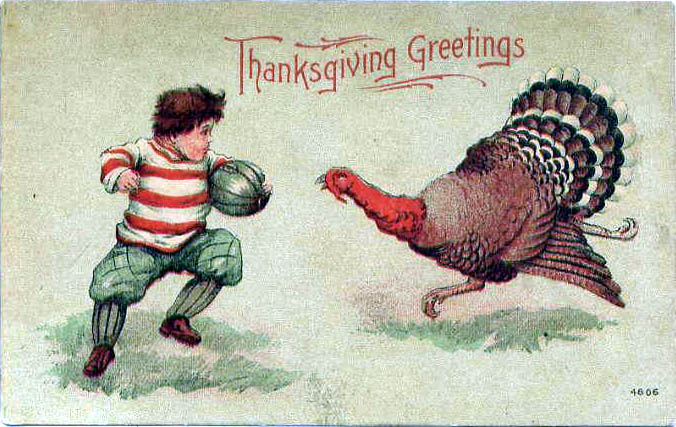 |
| The turkey's revenge. |
- I am thankful to have been born Canadian, so that I know enough to celebrate Thanksgiving on the correct date.
- I am thankful to have been raised Catholic, so that I didn't have to go through the costly and embarrassing process of having my son circumcised.
- I am thankful to have enough food to eat, even if the supermarket is often out of my favourite things and some of it is not always cooked so well.
- I am thankful to have been raised speaking English, so that I can make money teaching it instead of having to learn it. Because it really is a pain in the butt.
- I am thankful to have gray hair, instead of either of the two obvious alternatives.
- I am thankful for all the technology that has appeared over my lifetime. Just not entirely happy at how old it makes me feel.
- I am thankful for all the fine writing, music, and art in the world. Even if it seems to be diamonds buried in horse manure.
- I am thankful for the companionship of certain people along the path. Especially when they let me share their Skittles.
- I am thankful for dogs, which were definitely a good idea.
- I am thankful for the sunrise. Just don't make me get up and see it.
- I am thankful that I have had the chance to see the world. Turns out most of it looks like a hotel room.
- I'd like to be thankful for my wife and kids, but I'm afraid it might give them swelled heads.
Thursday, October 10, 2013
Redskins
 |
| Raven and the First Men - Bill Reid. |
The longstanding controversy about the Washington Redskins team name is, for some reason, heating up again. President Obama recently weighted in, suggesting the name change might indeed be a good idea. The problem, of course, is that the term “Redskins” is supposedly disparaging to North American Indians.
Odd, since the terms Minnesota Vikings and Notre Dame Fighting Irish are not considered disparaging to the Irish or the Swedes.
Many current dictionaries call “redskin” an offensive term. But there should be some logic behind such claims: what is disparaging about a reference to Indian ancestors painting themselves red when they went to war? Is this somehow worse than calling Swedes “Vikings,” an ancient name, or showing the Fighting Irish mascot with his fists raised in an old-fashioned boxing stance?
But it is not the term “redskin,” in the end. It is any reference to Native North Americans. I was at Syracuse University in the Seventies when they were similarly pressured into abandoning their own longstanding mascot, the Saltine Warrior. “Warrior” is, apparently, also insulting to American Indians. Sad, because there is so much Native American history associated with Syracuse. The original location of the Peace Tree, the capital of the Iroquois Confederacy, is held by the Iroquois themselves to be on Syracuse University's campus.
 |
| The Saltine Warrior |
Yet this, apparently, must not be mentioned; the students at Syracuse must have no idea.
When the Saltine Warrior was abandoned, he was replaced by a generic ancient Greek charioteer. Not terribly imaginative; but at least there was no protest raised by the Greek students on campus. At the time, the administration solicited other suggestions, but complained that many of them did not seem serious. An animated orange was one notorious suggestion. “I can guarantee you it won't be an orange,” promised Ulysses J. Connor, director of student activities.
The official mascot of Syracuse University sports teams is now Otto the Orange.
 |
| SU's own annoying orange. |
As we all also know, along with “redskin,” the term “Indian” is also no longer to be used. Also disparaging, apparently—although to say so seems a bit of an insult, surely, to the billion people who reside in the Indian Subcontinent. So is “Eskimo,” though etymologists have been unable to find any disparaging implication in the term.
So why are at least some Native North Americans upset by something that most other ethnicities would consider a compliment?
I suspect the real problem here is not with what others call the North American native peoples. It is with what they call themselves.
This is usually the same thing. Haida, Mikmaq, Innu, Inuit, Anishinaabe, Beothuk, Abenaki, to cite a few examples all mean “human being.” That is, as opposed to the rest of us, who are not Haida, Mikmaq, Innu, Inuit, Anishinaabe, Beothuk, or Abenaki. We are not human beings. Nor are Innu, of course, if you are Mikmaq. These are, in themselves, rather dramatically worse racial epithets, if reverse racial epithets, than the Nazi German “herrenvolk” or “master race.” Let alone “Indian” or “redskin.” Yet they are the current preferred, politically correct terms, supposed to replace the neutral “Indian,” “Eskimo,” “Algonquin,” and so forth.
To be fair, Native North Americans are not the only groups to indulge in such extreme racism. At least two other examples seem worthy of comparison: the Gypsies refer to themselves as Rom, or Romani, and so, now, must the rest of us. “Rom” or “Romani” too means human. And at least some Chinese commonly refer to foreigners as gwailo or guizi—literally, “evil spirits.”
Now, interestingly, other than this extremely degraded view of outsiders, what do these ethnic groups—gypsies, Han Chinese, and Indians--seem to have in common? An extreme tendency not to integrate with the surrounding society, surely. Native North Americans do not want any references to themselves in the broader society, because they view the broader society, ultimately, with contempt, as subhuman.
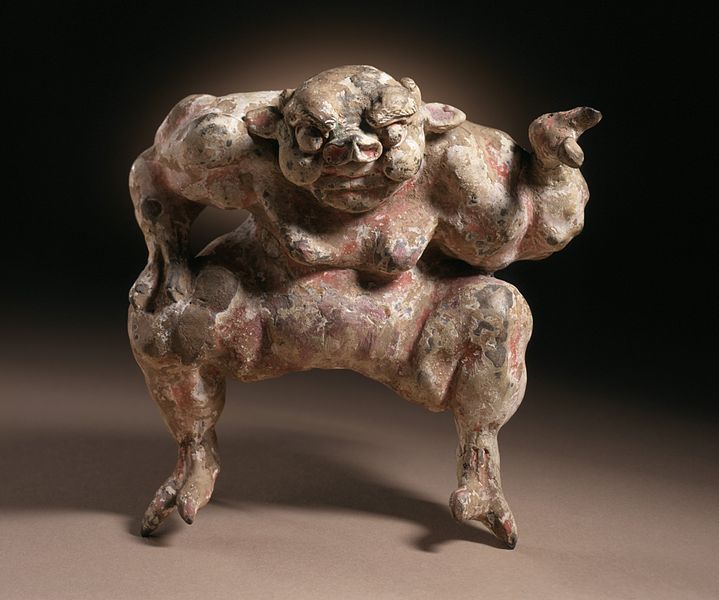 |
| O wad some Pow'r the giftie gie us To see oursels as ithers see us! - Chinese sculpture of an evil spirit. |
Unfortunately, this attitude, besides being frankly immoral, is usually self-destructive. The Chinese are doing okay—perhaps because they have recently come out from under their extreme xenophobia, which held them back for so long—but Native Americans, gypsies, and North Koreans just do not seem to fare too well economically.
And let's be clear: segregation and apartheid and indeed poverty is not being imposed on the Native people. It is the Native people who are imposing it on the rest of us.
Anti-Bullying Programs Promote Bullying
You read it predicted here first; now confirmed by a study. Just as "anti-racism" programs promote racism. This is the usual and predictable (and often intended) effect of most such interventions.
Tuesday, October 08, 2013
Proposed Platform for the Conservative Party of Canada
These proposals are perhaps radical, but I think they are realistically marketable. Unfortunately, politicians tend to bow to popular opinion and, even worse, the consensus in the press, instead of advocating for policies and trying to change opinions. The latter is real leadership. It was what Reagan, Thatcher, and Churchill were so good at. But it is very hard to do: you have to be an exceptional communicator to bypass the press.
National Unity
Move the capital to Montreal. I would propose doing this slowly, piece by piece, to keep the costs down. First up: the GG’s residence and the Houses of Parliament. Government departments can remain in Ottawa for the time being, but any new physical plant, as needed, is in Montreal. The reasoning for this has been given elsewhere: it makes Quebec separation almost unthinkable.
Reform the Senate: make it elected, but have senators elected not by province or region, but by proportional representation from a Canada-wide franchise. Everybody votes for all senators. The Senate becomes the house of national unity. Bypasses bickering about how many senators per province, too.
Promise to appoint only non-political figures as GG and LG. In practice, appoint distinguished actors, for reasons given elsewhere. The GGship, in the hands of a skilled actor, can be a powerful image of nationhood and a force for national unity.
Give preference for immigration to Christians and Jews. This ought to be uncontroversial: we similarly give preference to those who already speak English or French, because they will more readily fit in. In the same way, Christians and Jews will more readily fit in than others, because they share a crucial element of culture with the existing majority. This is not religious discrimination under the Charter, because the guarantee of freedom of religion legally applies to citizens, not foreigners. This would allay some of the fears in Quebec which have generated the Quebec Charter of Values. It would also be justifiable on grounds of human rights, because currently, Jews and Christians face widespread discrimination and physical danger in large parts of the world. In the meantime, shared values really do make for a more unified nation.
End all funding to “multiculturalism.” Canadian government money should only be funding Canadian culture.
The Economy
A no-brainer, and no longer even controversial: seek free trade deals wherever possible.
End all subsidies to corporations. This, David Lewis showed years ago, can be sold as “ending corporate welfare.” It is a waste of money for the government to try to manipulate the free market by subsidizing this or that industry or player. It is also obviously unjust. And it is an open door to graft and corruption. One reason why it is so popular with politicians. End it, and the economy should benefit quickly from the lack of this distortion.
Simplify the income tax code. I’d say “introduce a flat tax,” but nobody really wants a flat tax in the literal sense. The idea is to simplify the tax code as much as is realistically possible to reduce its distortions of the economy and to reduce the huge costs in money and time in conforming to it.
Remove the right to strike for all public employees. The idea of a strike against the public is an ideological mooncalf, nonsensical on any respectable theory of government. This should prevent disruptions to the economy and reduce the costs of government.
Legally limit compensation for public employees to a fixed percentage of the average compensation for Canadians performing the same or a similar job in the private sector. Do the same for public employee pensions. As a matter of course, public servants should make somewhat less than those in the private sector, in return for their relative job security. They now make more--creating an unelected ruling class. Of course, this will also save money, and should boost the economy.
Health Care
This is a growing issue as the population ages; savings are needed. Health is, of course, properly under provincial jurisdiction, but the Federal government has taken a major role with the Canada Health funding mechanism.
First, allow pharmacists to prescribe. This will drastically reduce the need for doctor visits, and so drastically reduce the costs of health care.
Second, permit a small deductible to Canada Health, to discourage frivolous use. Maybe $5 per visit or procedure? Not much more than a city bus ride, after all.
De-fund abortion and contraception. These are obviously, at a minimum, elective procedures, not to mention unrelated to health and a violation of freedom of religion if government funded.
Allow private hospitals or clinics to collect from Canada Health. This simply introduces the element of competition, and is standard throughout Europe. It is disastrous not to allow it, especially now that Canadians may soon no longer be able to go to the US for procedures.
Human Rights
Abolish the hate laws. They are an obvious and automatic violation of freedom of speech.
Abolish all “affirmative action.” As American Chief Justice Roberts put it, “The way to stop discrimination is to stop discriminating.”
End all federal funding for advocacy groups. Government funding for advocacy groups is a violation of equal protection. Save money and end graft at the same time.
Pass common-sense restrictions on abortion: no abortion after the first trimester, say. While I would prefer a stronger ban, I bow here to political realities. But Canada is one of only four countries in the world that have no restrictions at all on abortion. And two of the other three are not good company.
Decriminalize marijuana use; “look into” decriminalizing other drugs. A bow here to the libertarians—a constituency we want to nail down. The “war on drugs” has been about as effective as Prohibition, for all the same reasons. It is time to wake up to this and move on. Doing so should sharply reduce crime and violence, and boost the economy (tourism from the US, for example…not to mention BC agriculture…). I’d rather decriminalize all drug use; but that is probably too radical politically. Decriminalize cannabis for now, and strike a commission to start the national debate.
Foreign Affairs
Don’t abolish the CBC; turn it into an international service. At home, it is an unjustifiable intrusion into the free market; not to mention being totally unnecessary in this era of low-cost media. Beamed abroad, however, it could be a useful experiment in “soft power”: establishing and promoting the Canadian brand, Canadian influence, and the popular desire for Canadian products. No harm in letting Canadians pick it up on cable and satellite as well; but the mission statement needs to change.
Key foreign aid strictly to human rights. Canada is in an enviable position; it can afford to really do this. Big powers cannot; they have too many geopolitical interests to protect. By doing this consistently, we again boost the Canadian brand and soft power throughout the world.
Be nice to the Americans. It is puerile to cause them any unnecessary grief—and it looks like that to the rest of the world. Aside from anything else, being a good neighbor is just good manners.
Monday, October 07, 2013
Fat Facts
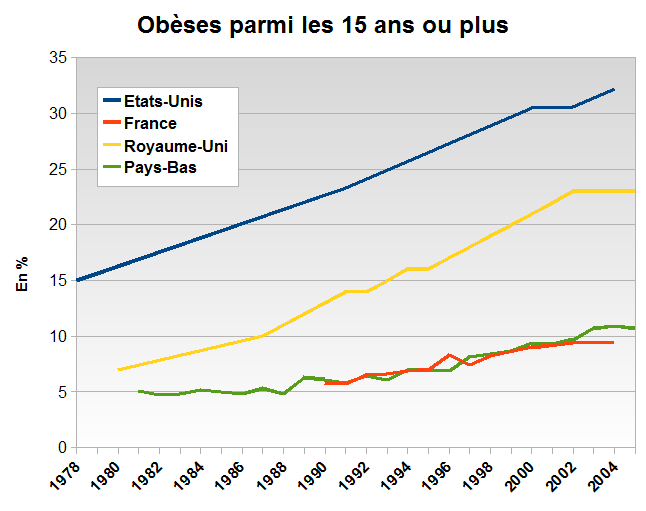
A lot of folks, particularly doctors and public health professionals, are alarmed at the “obesity epidemic,” which is also increasing risks of heart disease and diabetes, in the North American population. But nobody seems to have a clear idea of why it is happening. My left-wing columnist friend, predictably, blames the "sugar industry," although how they are all controlling us in order to do this he does not say.
 |
| Ah, beautiful for spacious skies, for amber waves of grain... |
I think there is a simple explanation, and a simple cure.
First, as is more or less self-evident, just about everybody likes sweet flavours. Second, sugar is cheap. Therefore, the makers of prepared foods of all kinds find it good business to add sugar to their products: it increases their market.
But if people make the same foods themselves at home, that is, when they actually see how much sugar goes in, they use much less. Prepared food tends to scrimp on other ingredients, and cannot be as fresh, and so, home-cooked food can taste as good as or better than prepared food without the sugar.
To a great extent, the same is true for fats. Fat is a quick and dirty way to make fast food more appealing.
Thanks to feminism and the breakdown of the family, people are relying more and more on prepared foods and fast food instead of doing their own cooking.
 |
| Slow food may be the answer. |
Ergo, people are getting fatter.
Note, in the chart above, how obesity is skyrocketing in particular in the US and UK, yet not in France. Why? Because France cares too much about food. They will not so readily accept processed foods as good enough.
Ideally, we should get rid of feminism and start supporting the traditional family. But that is a tough fix. There is a simpler one that would be pretty effective.
Only require that all processed foods display clearly on the label how much sugar is added, in whatever form, to their product. Require that this be expressed in teaspoon equivalents.
It would simply scare the trousers off most consumers to know that a soft drink contains 19 teaspoons of sugar; that each serving of spaghetti sauce includes two teaspoons; one squirt of ketchup adds one teaspoon; and so forth.
Do this, and I expect a consumer market would quickly appear for alternatives with less sugar. Note that the plateaus you see in the US and UK stats above as of the early oughts seem to reflect publicity given to the amount of sugar in soft drinks, and a corresponding drop in their sales.
In the meantime, this site, it turns out, illustrates the concept.
Sunday, October 06, 2013
Canadian Cuisine Comes to the UAE
Finally, Canadian food is beginning to register on the international charts.
Of course, "Canadian cuisine" mostly means Montreal cuisine. I had a wonderful time of it this summer in Montreal going crazy with all the old favourites, and introducing some to my family for the first time. St. Hubert chicken, poutine, butter tarts, marshmallow cookies, bran muffins, smoked meat, feves au lard, fiddleheads ...
Of course, "Canadian cuisine" mostly means Montreal cuisine. I had a wonderful time of it this summer in Montreal going crazy with all the old favourites, and introducing some to my family for the first time. St. Hubert chicken, poutine, butter tarts, marshmallow cookies, bran muffins, smoked meat, feves au lard, fiddleheads ...
Thursday, October 03, 2013
The Higher Education Bubble: A Brief History
 |
| The Four Aging Lads in 1969. |
This piece argues that the higher education bubble in the US—if you agree that there is a bubble—is caused by a shortage of suitable jobs, driving the price of admission for those jobs up.
I don’t think that is the real story.
The history suggests that the movement has been mostly on the supply, not the demand side. As Anne Coulter has pointed out, at the time of the Second World War, the average American had a grade eight education. But immediately after the Second World War, there was the GI Bill, causing a flood of 2.2 extra students who might well not otherwise have been able to afford a higher education. You can see the immediate effects on the culture. Pop culture began to assume a mass market with a college education: The Lettermen, The Four Freshmen, The Four Lads with “Moments to Remember,” the folk boom, the Bohemian musings of Salinger’s short stories.
While the GI Bill was US legislation, the influence of American culture was so great that its effects were felt everywhere; going to college became the normal thing. So too with further US legislation.
The GI Bill sent through a second wave of 1.2 million students after Korea. Add in the “Sputnik Crisis” of 1957. The US’s immediate response to this demonstration of Soviet scientific prowess was to funnel, in the National Defense Education Act, billions of additional dollars into colleges across the US. College funding in the US increased sixfold.
 |
| Actually, he had cause. |
And then there were the Sixties. The GI Bill was extended to all veterans in the Sixties, and their families: 6.8 million extra collegians. Then there is the issue of the draft deferment given to college students during Vietnam. This too must have had the effect of convincing a huge cohort of young people who would not otherwise have considered it to hang on and get a college degree, or two, or even three.
And so, over a generation or so, 1945-1975, the Baby Boom generation, we have a wholesale manufacturing of new degrees and degree-holders—a glut on the supply side, regardless of demand.
That alone might account for the Sixties. Suddenly you had a whole lot of people going to college who in earlier generations would not have gone to college. People who did not necessarily have a great interest in scholarship or study or the intellectual enterprise.
This was probably a lousy idea.
First, this painfully extended period of dependency is cruel to youth. No wonder, then, that we saw stirrings of rebellion almost immediately, in the 50s, with the emergence of the disaffected teenager and the generation gap; reaching full bore in the 60s. The painfully extended adolescence also surely called forth, almost demanded, the sexual revolution. Since young people could not afford to marry, they sought release in casual sex. It was and is unreasonable to expect otherwise. Societies that really expect celibacy also permit marriage during adolescence. Hence the breakdown of the modern family.
Second, it probably caused the demographic winter we now face throughout the developed world, which really threatens to destroy Western civilization. On the one hand, couples are discouraged from having children by the knowledge that they will now have to support them well into adulthood, in addition to the crippling burdens of tuition. On the other, young people going through their multiple degrees must put off marriage and childbearing for longer. They cannot yet afford it.
Thirdly, the effect on higher education itself has been awful. This one really is a zero-sum game: you cannot raise IQs. More people coming into higher education means the average quality of college graduates and college courses must decline. Rather than raise the general standard of education, for the most part all we have really managed to do is to begin to do in 16 years what we used to do in 12. In particular, the draft deferment has prompted a lot of people to go into graduate school, and then college teaching, who are not themselves scholarly by nature.
This has led in turn to a growing class consciousness. We saw it almost immediately in the 50s: a divide between greasers, who did not go to college, and listened to doo-wop and rock and roll, and the college kids, who listened to folk and jazz and read beatnik poetry. This original divide has blossomed since into the full-scale “culture wars.” Weirdly, during their formative younger years ,the upper class had no money, while the lower class had some, because they already held jobs. This has caused an odd distortion in our politics, so that the rich professionals see themselves as "leftist," while the working poor, the "rednecks," are supposed to be "right-wing."
 |
| Meet the new upper class |
Now that college is no longer about scholarship or the pursuit of knowledge, it has had to redefine itself, essentially, as a kind of initiation procedure into membership into the broad upper class, the clerical or professional class. One gets a college degree, and especially a higher degree, not by hard work or intelligence, but by conforming to the imposed consensus, to the group interest.
This is the value of the college degree now, and it explains why they are still preferred by employees, even though the actual skills and knowledge gained can seem irrelevant to the job. It demonstrates a reliable commitment to the class/profession. One is going to go along and is not going to rock the boat.
Of all these ill effects, the college tuition bubble, and the college debt bubble, are probably the last and least. But it seems about to make the whole edifice unsustainable.
Thank God.
Subscribe to:
Posts (Atom)