Playing the Indian Card

Saturday, March 10, 2012

Reading for March 11


Since the Passover of the Jews was near,
Jesus went up to Jerusalem.
He found in the temple area those who sold oxen, sheep, and doves,
as well as the money changers seated there.
He made a whip out of cords
and drove them all out of the temple area, with the sheep and oxen,
and spilled the coins of the money changers
and overturned their tables,
and to those who sold doves he said,
"Take these out of here,
and stop making my Father's house a marketplace."
His disciples recalled the words of Scripture,
Zeal for your house will consume me.
At this the Jews answered and said to him,
"What sign can you show us for doing this?"
Jesus answered and said to them,
"Destroy this temple and in three days I will raise it up."
The Jews said,
"This temple has been under construction for forty-six years,
and you will raise it up in three days?"
But he was speaking about the temple of his body.
Therefore, when he was raised from the dead,
his disciples remembered that he had said this,
and they came to believe the Scripture
and the word Jesus had spoken.

While he was in Jerusalem for the feast of Passover,
many began to believe in his name
when they saw the signs he was doing.
But Jesus would not trust himself to them because he knew them all,
and did not need anyone to testify about human nature.
He himself understood it well.

John 2: 13-25


School of Hieronymous Bosch

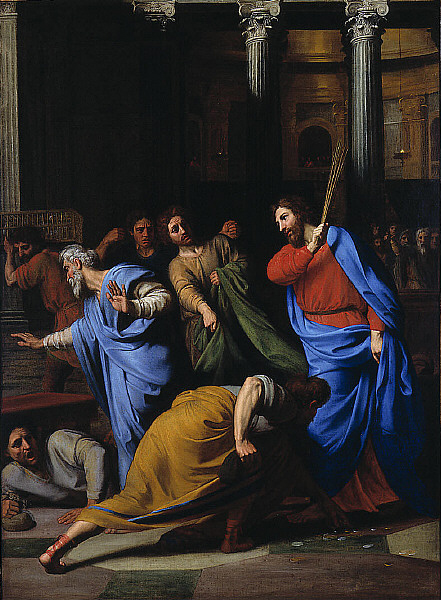
So why does Jesus come after the moneychangers? There is surely no great evil here. Just some small businessmen trying to make a living. And their trade was not, on the face of it, disrespectful to the temple. It involved meeting the requirements of Jewish law. They were selling animals to sacrifice, and exchanging Roman coins, which had the emperor's face on them, for Jewish shekels, which did not, so that one's offering did not offend the ban on graven images. What's wrong with that? After all, Jesus doesn't lose his temper in this way towards tax collectors, publicans, prostitutes, or Roman centurions.

Durer


I think the point is symbolic. It is not that these people were doing something wrong, and it is not that Jesus was really angry. He was proclaiming the new covenant.

He overturned the tables of the moneychangers, because the prohibition against graven images was now no longer in effect. The problem had been the impossibility of portraying God, who is pure spirit, as a creature. Yet now he himself, after all, was God, and at the same time man. We could now therefore legitimately portray God with a human face. The moneychangers were no longer needed. Worshippers had, at the same time, been released by God from this burden.
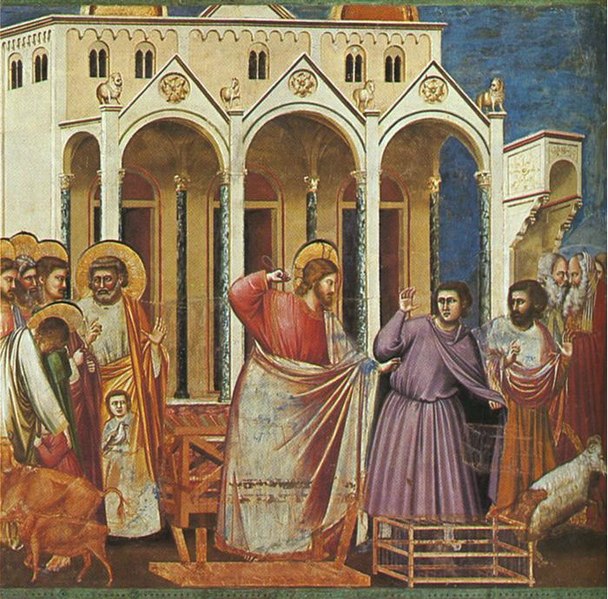
Giotto.

In the same way, he dispersed the sellers of doves, oxen, and sheep, and their animals, because the days of blood sacrifice had now ended. Now, he himself would be the sacrifice, as he is daily in the Mass; releasing both animals and humans from this bondage.
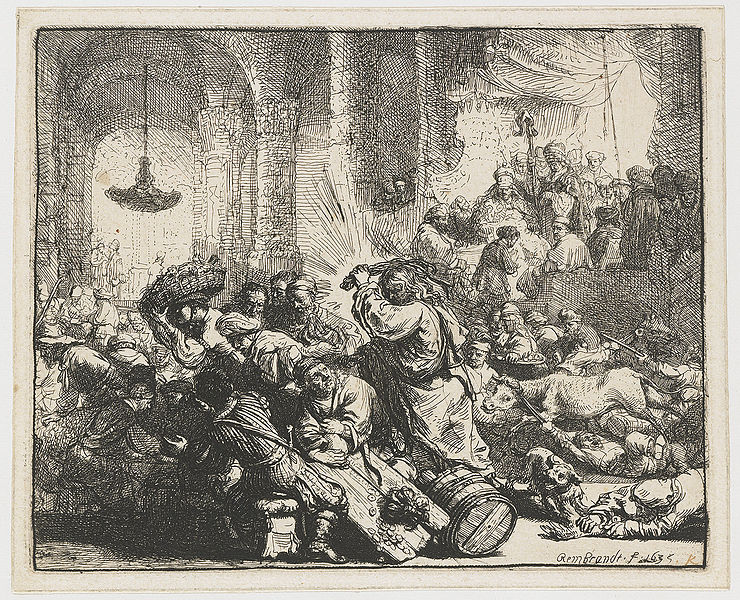
Rembrandt.

And what is this about speaking of the Temple as his body? Again, this is the New Covenant. Before, the temple was the one place where the divine and human worlds met, making it the only proper place for true worship and sacrifice. Now, however, the divine and human met instead, and more completely, in him. He had become what the temple was previously. And the tearing down and then in three days raising up this new temple of his body was the foundation of the New Covenant.

Tuesday, March 06, 2012

The Transfiguration


Rubens.


Jesus took Peter, James, and John
and led them up a high mountain apart by themselves.
And he was transfigured before them,
and his clothes became dazzling white,
such as no fuller on earth could bleach them.
Then Elijah appeared to them along with Moses,
and they were conversing with Jesus.
Then Peter said to Jesus in reply,
"Rabbi, it is good that we are here!
Let us make three tents:
one for you, one for Moses, and one for Elijah."
He hardly knew what to say, they were so terrified.
Then a cloud came, casting a shadow over them;
from the cloud came a voice,
"This is my beloved Son. Listen to him."
Suddenly, looking around, they no longer saw anyone
but Jesus alone with them.

As they were coming down from the mountain,
he charged them not to relate what they had seen to anyone,
except when the Son of Man had risen from the dead.
So they kept the matter to themselves,
questioning what rising from the dead meant.

--Mk 9: 2-10.

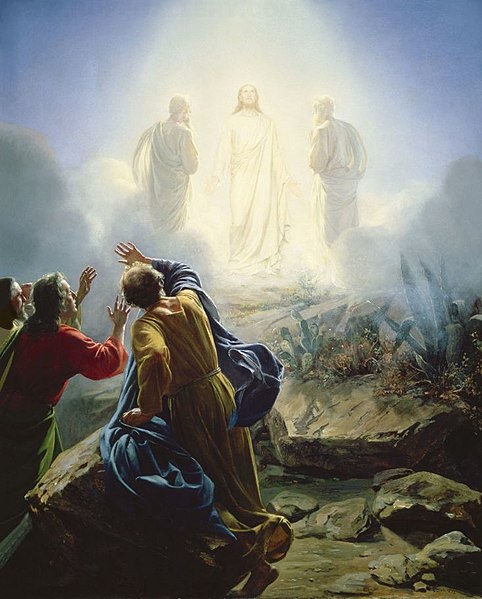
Bloch


As usual, today's gospel is a funny bit. The punch line is Peter's offer to build three tents, one for Jesus, one for Elijah, and one for Moses. Elijah and Moses; long dead. How could they need tents to shelter them from the elements? And he knows very well who they are—he cites them by name.

The gospel says he is confused; but what is he thinking?

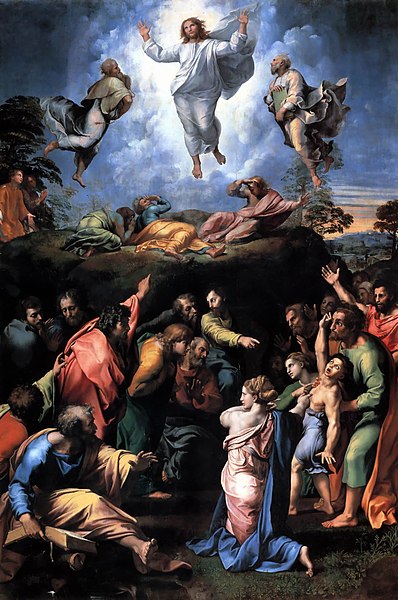
Raphael

One would necessarily assume that a dead person is an entirely spiritual being, would one not? If there is survival after death, it is only the spirit, and not the body, that survives. We see the body rot. The natural assumption, therefore, on Peter's part, should have been that Moses and Elijah, if they have reappeared, have done so purely as apparitions—visions, wraiths, ghosts, that sort of thing.

The point of his offer, and perhaps of his confusion, must be a strong impression, nevertheless, that these men before him were not, in fact, apparitions. To all appearance, they must have been plainly there physically, solid flesh. The impression must have been so strong as to overcome the obvious assumption that they were disembodied spirits.

Rather like the man the apostles met, later, on the road to Emmaus, who actually ate with them, as an apparition could not.

Russian icon

The passage notes that Jesus himself, undeniably still in the flesh, was “transfigured.” In what way the gospel does not say, but his clothing became supernaturally white—a perfect white. Might it therefore be that Jesus here assumed his perfected body, as all our bodies will be perfected at the Resurrection. As the cosmic Christ, he was of course capable of doing this; and after his own resurrection from the tomb, he seems to have assumed just this transfigured, perfectged body. This body was able to eat, but could also pass through walls, or be in two places at one time.

But given that Jesus had been transfigured onto his post-resurrection body, what about Moses and Elijah? Might, they too have appeared in their perfected post-resurrection bodies, and so be genuinely physical?

This seems to be what the gospel suggests. But then, what are Moses and Elijah doing in their post-resurrection bodies before the resurrection? Jesus can do these things; he's God. But they are just men. Or, indeed, what are they doing popping up at all before the resurrection of Jesus? Isn't everyone supposed to be in Hell, or in Sheol, until Jesus harrows it, between Good Friday and Easter Sunday, cancels the stain of original sin, and opens the gates of heaven?

Byzantine icon

It all has to do, I think, with the nature of eternity. Eternity is not, cannot be, an infinite extension of time. All real, as opposed to theoretical, extensions into infinity are logically impossible, as is demonstrated by the Kalam cosmological argument. So that is not what eternity is. But what it is seems perfectly obvious. It is a state of not being bound by time—in which time is perfected, and has no limits.

In our temporal, earthly, physical experience, we can move through time in only one direction, from the past through the present into the future. Isn't that an absurd limitation? It is as though we could only walk in one direction. Conceptually, then, eternity is a simple matter of being able instead to move at will from past to future or future to past. Or, indeed, to jump suddenly about, out of any necessary sequence. That would be a genuine eternity, but does not require the logical contradiction of an infinite extension in time.

This is how Jesus is able to assume at any time his post-resurrection body. This is how Moses and Elijah, too, can assume their post-resurrection bodies, before Jesus opens the gates of heaven, and before the Last Judgement.

Greek icon.

It explains what happened to the righteous who died before Jesus was crucified: the grace of his sacrifice effects the past as well as the future.

It explains a lot more that is otherwise puzzling in the Bible. This is why Jesus might say, “it is given to man once to die, and then the judgement.” There is no distinction between the particular judgement, that we each face at the moment of death, and the general judgement that comes at the end of time. At death, we enter eternity, and have immediate access to the end of time.

It explains how he could say, two thousand years ago, “the kingdom of heaven is at hand,” and that the Kingdom of Heaven shall appear on earth before all of his listeners, the present generation of his time, would pass away. This was no failed prophecy: it was the literal truth, and remains the literal truth for every generation that reads the Bible.

And it explains how Jesus could say on the cross to the good thief that he will join him that very evening in paradise, despite a prior engagement harrowing hell.

Monday, February 27, 2012

The Temptation in the Wilderness: This Sunday's Gospel


Russian icon


The Spirit drove Jesus out into the desert, 
and he remained in the desert for forty days,
tempted by Satan.
He was among wild beasts,
and the angels ministered to him.

After John had been arrested, 
Jesus came to Galilee proclaiming the gospel of God:
"This is the time of fulfillment.
The kingdom of God is at hand.
Repent, and believe in the gospel."

Monreale Cathedral mosaic
 

Jesus goes out into the desert. Why? Besides the obvious privations, as the passage notes, he risks being torn apart by wild beasts. And for what? For the opportunity of being tempted by Satan? Don't we pray, “lead us not into temptation?” Where's the upside here?

Yet all the prophets, up to and including John the Baptist, preceded him in this pilgrimage out into the barrens. So have many monastics after him, beginning with St. Anthony of Egypt. So, in fact, did the Native Americans—young men were supposed to spend a time exposed alone out in the wild on the cusp of adulthood.

Temptation of St. Anthony attributed to Bosch.

The first moral I take from this is that the religious are not, contrary to much popular misconception, the shy wallflowers of the world. They are not the Father Mulcaheys. They are not ignorant of evil, and they do not avoid evil. Instead, virtue is heroic. It is a matter of meeting with temptation, and battling it eye to eye and hand to hand.

This only stands to reason. If one does not sin simply because one is not tempted, one is not acting morally. It is only with temptation that we have the opportunity to be moral beings.


Accordingly, it is only after a heated struggle with evil, with suffering, and with temptation, that one is ministered to by angels. It is in this solitary setting, along with the wilder spirits, Lilith and her kind, that God himself speaks clearly. It was in Sinai, in the desert, and alone, that Yahweh spoke to Moses. Artists, too, commonly find themselves liberated, and their muses made chatty, by solitude, or exile. Our Christian Lent is a reflection of this, and the Catholic tradition of penance, and the Catholic tradition of “retreat.”

There's more. In order to come into proper contact with the spirit, we first need to shut out the incessant din, not just of the material, but even more, of the social. The world of spirits, which we then contact, includes beings and experiences both good and evil. Rick Santorum, as it happens, is right. There really is a Devil. That's rough; that's what happens when you have free will; but the good includes the Highest Good.

Saftleven, Temptation of St. Anthony

This uncovers a tragic problem with modern psychiatry. The last thing in the world any psychiatrist or psychologist worth their degrees will tolerate is a patient's solitude. All solitude or desire for solitude is thought pathological. Never having been to the desert themselves, the good doctors see it as the typical townsman sees it, only as a barren and dark place full of dragons. They do not know what happens if you ever slay those dragons. They themselves have never ventured out of doors.

The result, I suspect, is often if not always to turn what should be a life-fulfilling spiritual quest, indeed, the point of life itself, into a state of life-long torture. Get repeatedly yanked back into town, and you just get the monsters, again and again and again.

Grunewald, Temptation of St. Anthony

The best treatment for “mental illness” might also be the cheapest. Basically, let the poor pilgrims work it out on their own, and stop harassing them.Take the welfare cheque they would be due in any event, and use it to rent a simple cabin somewhere in the woods. Not hard to find such a thing in Canada, especially in the winter, when the tourists have gone home. Instead of an expensive physician, who knows not what he does, just hire someone local with a truck to deliver the necessities of life to the cabin door weekly. I'd suggest stocking the cabin with a little bit of reading material as well—such as, oh, I don't know, say, a Bible. No problem if you want to get non-denominational and add a Book of Mormon, a Qur'an, the Bhagavad Gita, and the Tao Te Ching. The more, the merrier. A few psychiatric pills would probably do no harm.

Then just wait until the blessed hermit phones and says he's ready to rejoin the world.

Wijnen, Temptation of St. Anthony

In Canada, what could be simpler?

I have heard former schizophrenics claim they actually cured themselves with a procedure like this. I have heard many people who were mentally ill pine for this, saying they thought this would be the way they might be cured.

Why not?

Better yet, perhaps we could prevent much “mental illness” in the first place if, like the Native Americans, we all did this at a certain point in our lives, as a matter of course.

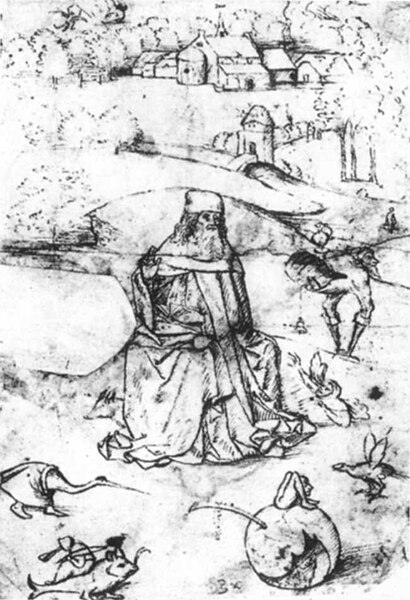
Bosch, Temptations of St. Anthon

Thursday, February 23, 2012

The Devil and Rick Santorum


Rick Santorum is accused by Drudge Report of saying, at Ave Maria University, that Satan is attacking America.

Pleased to meet you. Hope you guessed my name.


Satan is, of course, doing exactly that. Santorum was speaking at a Catholic gathering at a Catholic university in proper Catholic theological terms. Check the Catechism of the Catholic Church. Satan is real. He is pure spirit. He attacks both individuals and societies. “ his action may cause grave injuries - of a spiritual nature and, indirectly, even of a physical nature- to each man and to society” (CCC, para 395). If no presidential candidate is permitted to say this, even in a religious setting, then no Catholic is permitted to run for president.

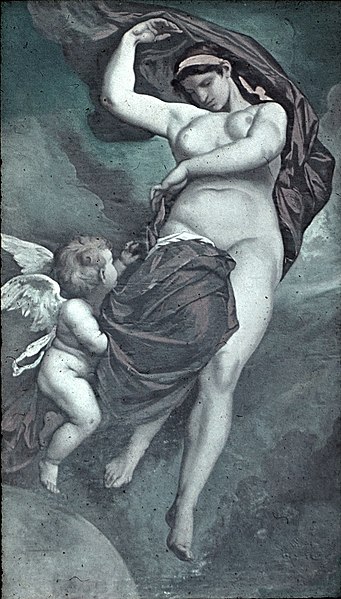
Gaea by Feuerbach. Wikimedia.


So too with Santorum's remarks that Obama's environmental policy is based on a “theology that does not come from the Bible.” It ought to be self-evident, surely, that he was referring to the quasi-religious beliefs of radical environmentalists. Yet the Obama White House, along with many commentators, objected immediately that Santorum was impugning Obama's Christianity. Obliquely, I suppose he was, but surely in a perfectly legitimate way, in saying that his environmental policy is not in keeping with Christian ideas. It isn't. Radical environmentalists consider humanity a kind of cancer on the suffering body of the goddess Gaea. Ask David Suzuki. This is incompatible with the Christian idea that man is above nature—let alone that nature is not divine.

The problem here, I think, is just that too many people, notably including journalists, are theologically illiterate.

Monday, February 20, 2012

Sunday's Reading


When Jesus returned to Capernaum after some days,
it became known that he was at home.
Many gathered together so that there was no longer room for them,
not even around the door,
and he preached the word to them.
They came bringing to him a paralytic carried by four men.
Unable to get near Jesus because of the crowd,
they opened up the roof above him.
After they had broken through,
they let down the mat on which the paralytic was lying.
When Jesus saw their faith, he said to the paralytic,
"Child, your sins are forgiven."
Now some of the scribes were sitting there asking themselves,
"Why does this man speak that way? He is blaspheming.
Who but God alone can forgive sins?"
Jesus immediately knew in his mind
what they were thinking to themselves,
so he said, "Why are you thinking such things in your hearts?
Which is easier, to say to the paralytic,
'Your sins are forgiven,'
or to say, 'Rise, pick up your mat and walk?'
But that you may know
that the Son of Man has authority to forgive sins on earth"
-he said to the paralytic,
"I say to you, rise, pick up your mat, and go home."
He rose, picked up his mat at once,
and went away in the sight of everyone.
They were all astounded
and glorified God, saying, "We have never seen anything like this."

--Mk. 2:1-12


Paralysed man flying.


As usual, this Sunday's Gospel reading is pretty darned funny. Picture the remarkable detail of those four men, unable to get close to Jesus, actually climbing onto the roof of the house, pulling their paralysed friend up with them, breaking the roof open, and lowering him down. They were bound and determined to find that poor man a cure.

And then Jesus's reaction: he looks at the man, and says, “Child, your sins are forgiven.”

That's is. His sins are forgiven. Imagine the reaction of the four men who have lowered him down with such effort. That's it? His sins are forgiven? What about his blooming paralysis?

Consider just how much obvious sin a paralysed man is likely to be getting up to. Adultery? Gluttony? Armed robbery? Is it really likely this is a man lost in sin? Yet Jesus ignores the blindingly obvious physical limitation.

He does then cure him of paralysis, but, only to make a point—that he can forgive sins. It seems purely an afterthought.

Your sins are forgiven. Too bad about the paralysis, though.


There is a very good reason why miracles are trivial. God is good; and God made the world. It follows that the world is already set up for our benefit. Accordingly, no miracles will really make things better for us. We need no miracles. All we need, as St. Theresa of Avila said, is a relationship with God. Which is to say, all we need is to know that God forgives us our sins.

So why any miracles at all?

Miracles are God's reminders that he is there, and that he loves us. We should expect and accept them purely in these terms.

Friday, February 17, 2012

A Bitter Pill

The Jewelled Gates of the New Jerusalem.


I am amazed by the sheer folly of the Obama administration's requirement for religious organizations to provide medical insurance for their employees that includes free contraception. It looks like a deliberate attempt to pick a fight with the Catholic Church in an election year, which all the polls suggest will be tight and hard-fought. How can this make sense? Catholics are 27% of the US population; no small voting bloc. In 2008, 54% of them voted for Obama. Even that was much lower than historical averages; before Reagan, in the days of Al Smith and John F. Kennedy, the Democratic Party could count on the solid backing of Catholics in every election. Yet instead of luring them back, Obama's administration seems to be driving them away, or at least forcing them to choose: it's us or their Catholicism.

It's more remarkable when you consider that the administration, if their objective was to ensure that contraceptives were free, could easily achieve this without forcing the churches to pay for it or provide it—as their “accommodation” or “compromise” really still does. They could, for example, issue separate government vouchers for contraceptives. One is forced to assume that the entire point of this policy was simply to pick a fight with the Catholic Church.

Why? Apparently, they thought they could harm the Catholic Church with this, and felt this was worth doing even if it cost them support—even if it cost them this election, or even many elections to come. The Church's stance on contraception is not popular, even among Catholics. They figured that, by forcing a fight on this ground, they could diminish the popularity of the Catholic Church. Even if it's crazy to think this would raise instead of lower their Catholic vote overall. Or indeed, that such an assault on the First Amendment and freedom of conscience would raise instead of lower their support among the religious generally.

For them, clearly, this was a matter of principle, above all electoral politics. Religion, and especially Catholicism, is bad.

Thomas Nast's most famous anti-Catholic cartoon.


That's also, I suspect, the reason for the prominence of the issue of homosexuality over the last few decades. A conservative columnist a few years ago openly pondered how it is possible that such a small portion of the population, only 1-3%, had pushed its concerns to the top of the social agenda. They didn't; they're only being used. The answer, I think, is that those who hate the Catholic Church saw the Church's stand on homosexuality as an issue with which they could accuse the Church of prejudice--as if homosexuals were an ethnic group like blacks or Jews. It also goes a long way to account for the current near-hysteria about child molestation. It was not perceived as all that fundamental in its evil—witness the once-burgeoning NAMBLA--until the moment Catholic priests were accused of it. Then it was unspeakable.

If it can hurt the Catholic Church, it seems, it is worth doing, even if it sacrifices other principles, even if it leads to dangerous consequences for others. Why? Because, for many on the left, the Catholic Church is the very essence of evil.

It makes sense, in a backwards way. When “the pill” was introduced in the early 1960s, a lot of us, especially on the left, believed the millennium had arrived. Because sex had supposedly been untethered from procreation, a whole lot of new pleasure became permissible. All moral objections to unrestrained sex had disappeared. Whoopie!

The Catholic Church, almost alone at first, held out against this. It was this that confirmed me, personally, as a Catholic, because the premise was obviously wrong from the start. It is just that people wanted it so much to be true, that they refused to see the reality. And the Church's refusal to be swayed proved that it alone cared about the truth. But I also feared, at the time, that the Church was being very brave, and would inevitably pay a heavy price.

By a twisted logic typical of human beings, when they do wrong, far from facing up to it, they are far more inclined to see evil in their victims, and then in anyone who breathes a hint that what they did might have been wrong. Hence the Catholic Church is evil, and all religion is evil; if they could only be made to shut up, the rest of us could do what they want. Never mind that they in fact have no power, that the real and only reason that their words seem to hurt so much is our own conscience. And that means that, really, shutting them up would do nothing for us.

We can all see clearly enough now that “the pill” did not really change anything. Even aside from the emerging health dangers of the pill, women still kept getting pregnant without intending to. So we had to decide abortion was okay too—and unrestricted abortion. Another bit we forgot was venereal disease: old venereal diseases getting a new lease on life, old diseases developing immunities, and indeed new opportunistic venereal diseases like AIDS. All entirely predictable. So was the rise in broken marriages, with all the pain and suffering by children and adults they entail—who'd have thunk that sex actually had something to do with emotion? Other, that is, than every sane human being?

He was right.


But instead of admitting we were wrong, perversely, we hate the Catholic Church all the more for being right. So the tone of anti-Catholicism ratchets up as all this becomes more and more apparent. Nobody on the left would care much what the Catholic Church said if it were clear that the Church is wrong.

It cannot work, of course. Over time, any attempt to silence the conscience becomes self-destructive. This is what we are seeing now, with the left actually running the clear risk of sacrificing their electability and their future to the cause. It is a mark of their desperation, and a sign that the end, at least in America, is coming soon.

The end, that is, of the anti-religious left.

Let Whitney Houston Rest in Peace


The recent death of Whitney Houston seems to have already spawned two hot controversies. First is whether her doctors were culpable for prescribing her tranquilizers that may or may not have been the immediate cause of her trip to the hereafter. Second is whether she deserves the honour of having flags in New Jersey lowered to half-mast, since she basically killed herself.

Of course, both these claims cannot be true. But I'd say it's pretty obvious neither of them are.

Haven't we seen this many times before? Aren't two things staggeringly obvious?

  1. Great talent is a great burden.
  2. “You ought to be famous” is a curse.

We are blinded to these universal truths by our own foolish envy.

Friday, February 10, 2012

Sunday Reading.

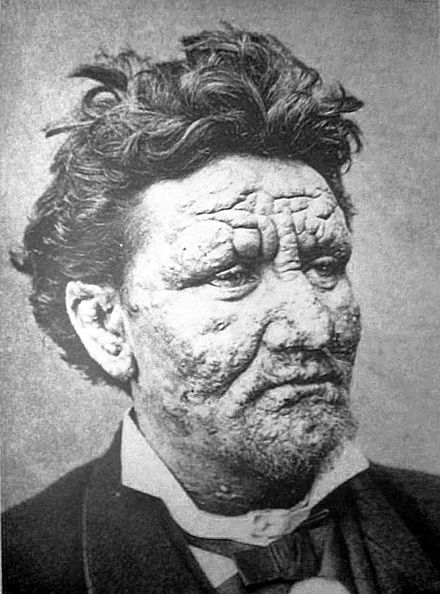
A leper. From Wikimedia Commons.


A leper came to Jesus and kneeling down begged him and said,"If you wish, you can make me clean."Moved with pity, he stretched out his hand, touched him, and said to him, "I do will it. Be made clean."The leprosy left him immediately, and he was made clean.Then, warning the him sternly, he dismissed him at once. 
He said to him, "See that you tell no one anything,but go, show yourself to the priest and offer for your cleansing what Moses prescribed;that will be proof for them."
The man went away and began to publicize the whole matter.He spread the report abroadso that it was impossible for Jesus to enter a town openly.He remained outside in deserted places,and people kept coming to him from everywhere.
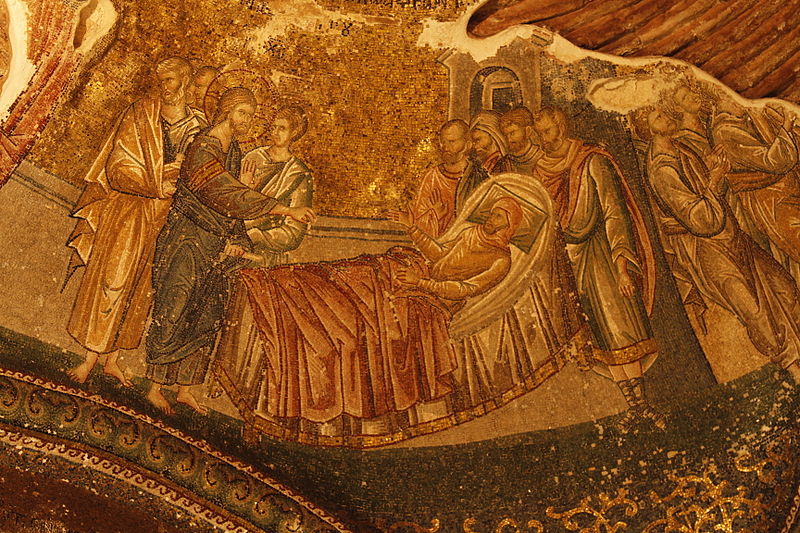
Jesus heals a leper. Byzantine mosaic. Wikimedia Commons.


Note Jesus's instruction, after he heals the leper, that the latter is to tell no one how this happened. This demand for secrecy is consistent through the three synoptic gospels, and is commonly referred to as “the Messianic secret.” That is, Jesus seems to try to keep it secret that he is the Messiah.

But why?

I think this analysis misses the mark by a bit. Unfortunate, because, properly understood, this “Messianic secret” reveals an important secret underpinning Western Civilization.

Which is, after all, really Christian Civilization, “Christendom.”

In Canada, recently, an immigrant family, man, wife, and son, were all convicted of murder for the “honour killing” of three daughters and a second wife. My friend the liberal columnist points out, in explanation, that while “Western” culture is based on “guilt,” “Eastern” cultures are based on “shame.” “It’s not about what you do,” he writes, “but about its effect on the reputation of your family, clan, or caste. Collective honour matters more than love, genetics, or moral principles.” A distinction I have heard made before. And, as you can see from this short quote, despite his liberal beliefs in theory in cultural relativism, he seems unable here to see the Western model as anything but better, more moral.

And it is. I think most Muslims, Buddhists, or Hindus, would agree, given the facts of the Shafia case.

But note that the terms “Western” and “Eastern” here are meaningless dodges. The real contrast is between Christian culture and all others: the importance of “face” is striking in the Muslim Middle East, Hindu India, the Buddhist Far East, or among North American or African shamanists. It is only Christian culture in which its value is so diminished.

And the reason is right here before us. It is the New Testament, the “Messianic secret,” and such passages as this. Jesus is not trying to conceal the fact that he is the Messiah, as such; he is trying to conceal a good deed.
And this is simply practicing what he preaches. From the Sermon on the Mount:

1“Beware of practicing your righteousness before men to be noticed by them; otherwise you have no reward with your Father who is in heaven.2“So when you give to the poor, do not sound a trumpet before you, as the hypocrites do in the synagogues and in the streets, so that they may be honored by men. Truly I say to you, they have their reward in full. 3“But when you give to the poor, do not let your left hand know what your right hand is doing, 4so that your giving will be in secret; and your Father who sees what is done in secret will reward you.5“When you pray, you are not to be like the hypocrites; for they love to stand and pray in the synagogues and on the street corners so that they may be seen by men. Truly I say to you, they have their reward in full. 6“But you, when you pray, go into your inner room, close your door and pray to your Father who is in secret, and your Father who sees what is done in secret will reward you. --Mt. 6:1-6.

The rejection and condemnation of hypocrisy is one of the most consistent, perhaps the most consistent, messages of the gospel. It is so much of the New Testament that our very English word, “hypocrisy,” --let alone “Pharisee”-- is New Testament Greek.

That is what a “culture of shame” actually is—a culture of hypocrisy.

Christianity alone stands head and shoulder above all other religious traditions on this one point: that of recognizing and combating the natural human tendency towards hypocrisy.

The message is conveyed in the present reading not only by the request to keep the deed secret, but by the deed itself—touching and healing a leper. Lepers themselves were a particularly obvious example of social shaming. As the passage notes, they suffered social ostracism. Not because of any moral fault, not for sin, but for being “unclean.” This was not, as Michel Foucault has pointed out, for medical reasons either. It turns out that it is rather difficult to catch leprosy from another, and certainly the mere act of touching a leper was not going to do it. Lepers wer shunned, and considered “untouchable,” because their disease made them look hideous.

Lepers, Jerusalem, 1906. Wikimedia Commons.


A perfect metaphor, then for shame as opposed to guilt. By touching and healing the leper, Jesus was rejecting and/or overcoming this issue of shame. It is a visible way in which Christ has redeemed the Christian: we no longer suffer under the burden of social shame, and need only deal with our guilt.

The New Testament nails this idea to the wall, again and again.

This strong message has made explicitly Christian societies freer, and on the whole more honest—with less of “such boastings as the Gentiles use,” in Kipling's phrase, less focus on mere social advantage and clawing over to the Eastern Wall at all levels; more on principle and getting the job done.

It has been both a moral advantage, and a competitive advantage in many ways, over the millennia, reducing the social friction in Christian jurisdictions.

Thursday, February 09, 2012

A Brokered Convention

Now that he's won the last three primaries, Rick Santorum is certainly not going to drop out of the Republican race any time soon. Having won South Carolina and still doing well in the national polls, neither, I expect, is Newt Gingrich.  Paul and Romney have the money and organization to stay in until the end no matter what.

This could mean nobody has a majority of delegates by the convention. And if this happens, if my memory serves, delegates are released from their pledge to a given candidate after the first ballot. The possibility opens for the convention to turn to a candidate who has not run in the primaries. moreover, there would be a certain obvious logic to doing so--a general dissatisfaction with the present field seems to be fuelling the voter indecision.

I suspect Romney has blown his chance to be the nominee by going too negative. Negative campaigning does have a tendency to blow up the author as well as the target. Romney was rather unloved by fellow Republicans before this all started; his extremely harsh attacks on Gingrich, added to that, may have made it impossible for the party to unite behind him.

Sunday, February 05, 2012

Bombing Iran


Leon Panetta, amazingly, has just said he expects an Israeli attack on Iran in April, May, or June.

This is remarkable, because if he knows something, this is sensitive information. If Iran can expect an attack at that time, they can watch and try to prepare for it. The huge tactical advantage of surprise is largely lost.

So why would Panetta do this? The only motive I can see is to make it clear it is not the US who is attacking, hence perhaps avoiding Iranian and Muslim backlash against America and American interests.

This fits with a few other recent bits of news. First, just a week or two ago, the US leaked the claim that they had no bombs that could definitely crack the Iranian bunkers, and so they were ordering an upgrade. Again, on the face of it a damaging leak that threatened US interests. But if believed, it tells Iran that the US is not planning and is not responsible for any attack in the very near future on Iranian installations.

And the third, even more disturbing, piece of evidence is the American withdrawal of all forces from Iraq just a month or so ago. Officially, this was because the US and Iran could not agree on a SOFA. But several sources have claimed the US did not try very hard. This withdrawal was against the advice of the top military brass. Again, it seems against US interests, or at least risks losing US prestige.

But it too makes sense on the premise that there is going to be a big attack on Iran soon. A small American deployment in Iraq might simply have been sitting ducks for Iranian retaliation. A large American deployment in Iraq might have trapped American into a large-scale land war with Iran.

My take is this: there will probably be a massive air attack on Iranian nuclear facilities. It will be done by Israel, though America or others may help behind the scenes. America believes Iran is capable of doing a lot of damage in any counter-attack. Hence it is wisest to limit possible retaliatory targets to Israel alone.

And it will probably happen before April.

Let's watch and see.

Leonard Cohen the Jew

Adam Cohen, Leonard's son, has confirmed in stark terms in a recent piece in the Winnipeg Free Press the thesis I proposed on this blog some time ago: that Leonard Cohen is in fact a devout practicing Jew. He writes of his memories of his father, "He was there to protect values. It would be lighting the Sabbath candles and learning Hebrew prayers, singing songs, reading the Bible."


Most artists seem to end up religious. And this fact is generally kept pretty secret. Not least by the artist himself: he knows it will hurt sales.