If for any reason you cannot find the paperback version of Playing the Indian Card at your favourite bookstore or online retailer, please ask them to carry it. Protest and picket the store entrance if necessary.
Last evening, I attended a Christian discussion group. Nominally, it was a group for those thinking about becoming Christian; but in reality, all but one were practicing Catholics.
The topic for the day, based on a video we had all just watched, was “how to resist evil.”
Striking to me, nobody seemed to have much concept of evil. They seemingly had not thought about it, and did not want to think about it. How is this healthy Christianity?
Challenged at one point with the question “what is evil?” there was general silence. Eventually one participant looked up the dictionary definition on her smart phone.
When someone brought up demonic possession, the facilitator visibly balked. I pressed in with Biblical references; otherwise I think he was about to scoff at the idea. As if demons were anything more than an antiquated superstition!
This is the “happy happy joy joy” motivational speaker Christianity. It is lame, and goes in circles, because it lacks one leg. You cannot believe in God, and not the Devil. Otherwise you are lying to yourself.
Refusing to see evil does not make it go away. It ensures that evil thrives.
“All that is needed for evil to succeed is for good men to do nothing.”
“The Devil’s greatest trick is convincing people that he does not exist.” The Devil loves the darkness.
Deny his existence, and you not only stop resisting evil around you, and in you. You begin to believe in all kinds of scapegoating and mad conspiracy theories involving the “other.”
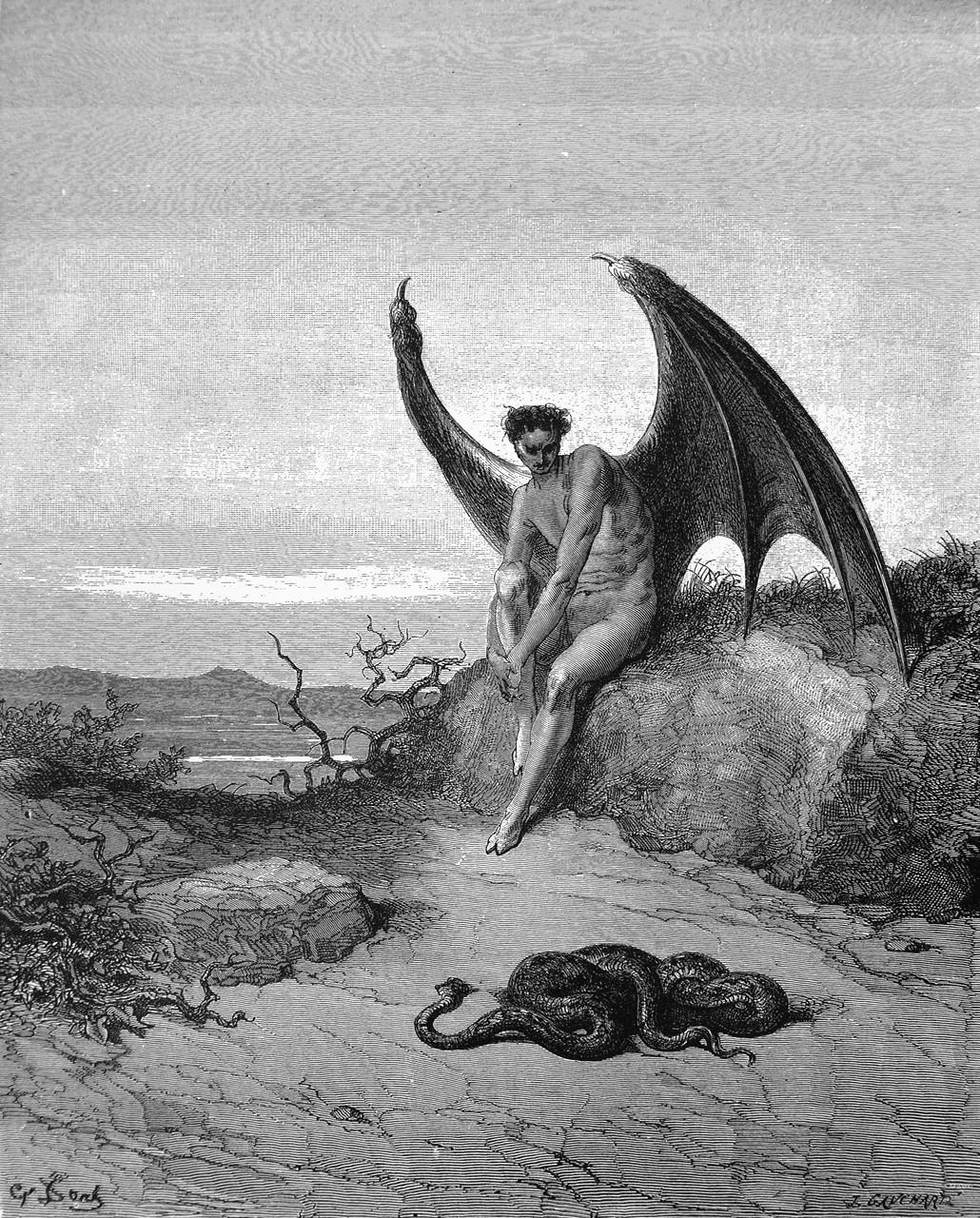
At a writers’ meeting I attended recently, the challenge was to write some familiar story from the point of view of the villain. One did Wile Coyote. One did Voldemort. Someone did Pontius Pilate. Someone tried to write about the fallen angels from the Devil’s point of view. Nothing especially shocking about that; Milton did the same. I do not recall the details.
But then someone piped up, “That’s not the way it really happened.”
“What actually happened was that Lucifer was God’s first son. Before Jesus. He was God’s favorite. But he objected to angels not having free will. So God threw him out of heaven.”
Someone else across the table raised an objection: “No, that’s not right.”
And she responded firmly. “You can’t dispute that. It’s the real history.”
The meeting just moved on.
I too was in no mood to challenge something so mad. Especially since she was so adamant. But I was left wondering where this came from, and how she could possibly feel such certainty.
Of course Lucifer’s fall from heaven is not “history.” No historical account is beyond dispute, saying something is history does not end an argument, but even so, history is based on written records from the relevant time. No one was present at the war in heaven, taking notes. It is supposed to have happened at the beginning of creation, before the first man.
Nor does this woman’s account of Lucifer’s motive make any sense. If angels lacked free will, how could Lucifer himself rebel against God?
The Bible says Lucifer rebelled seeking to “make himself like the Most High.”
“This ‘fall’ consists in the free choice of these created spirits, who radically and irrevocably rejected God and his reign. We find a reflection of that rebellion in the tempter's words to our first parents: ‘You will be like God.’ …
It is the irrevocable character of their choice, and not a defect in the infinite divine mercy, that makes the angels' sin unforgivable. ‘There is no repentance for the angels after their fall, just as there is no repentance for men after death.’”
Lucifer and the fallen angels rejected God’s authority while in his presence. Just as the damned each individually and consciously choose hell at death, in the divine presence. This makes it unambiguous and irreversible. And for the reason Milton gives: “I would rather rule in hell than serve in heaven.”
So, this strange idea does not come from history, as claimed. It is not from the Bible. It is not from Church tradition, and it is not a logical thought. Perhaps this woman was getting her “facts” from some gnostic tradition? But I can’t find anything like it in the gnostic texts. There do seem to be references to Satan as God's elder son in some Mormon scripture; but not the part about free will.
How can someone be so certain of something so strange and counter to traditional understanding, something she might have read somewhere once, that she would assert it adamantly to a room of perhaps twenty people?
Was I dealing with a madwoman? Yet some at the table knew her well, and nobody thought her insane.
It seems to me a symptom of the present age. We have generally become untethered from any sense of truth or reality, so that anyone is free to believe anything, and impose it on those around them by strength of will.
Thus men can decide to be women, or women men. People can continue to believe debunked claims like the mass graves hoax, or the January 6 insurrection hoax, or the Charlotte “fine people” hoax, or the Russia hoax. When you do not believe in God, you can believe in anything, and people believe what they want to believe. Or become paranoid.
This idea of Lucifer as the righteous rebel does sound like something someone might want to believe, if they wanted to deny sin, deny the authority of God, and claim the right to do what they will.
Using Blogger's new AI tool to insert relevant links above. It appeared just today, and trying it out.
Friend Xerxes, the left-wing commentator, for some reason this week hearkens back to the Satanic child abuse scares in Saskatchewan back in the eighties and nineties. And his conclusion seems to be that the fatal error that led us astray was believing in the Devil.
“Unfortunately, there’s no tab in the corner of our mental screens to ‘Hide Satan.’”
Wanting a tab on your mental browser to “hide Satan” sounds like whistling past the graveyard: “if I don’t look, he can’t see me.” Denying evil exists is not a wise strategy; but a sadly common one.
The Saskatchewan hysteria, and the paranoia all around the world for a couple of decades over imaginary child abuse cults, was founded on two gross fallacies: a belief in repressed memories, and the claim that “children never lie.” (Unfortunately echoed more recently with the mantra that “women never lie about rape.”) These two obviously false claims led people into the hysteria. I remember, circa 1984, proposing in a Banff workshop a book arguing against the idea of repressed childhood memories, and getting shock and horror from a female member of our group. Didn’t I care about child abuse? Was I such a monster?
This was also the first time I ever heard of a speaker being shouted down on a Canadian college campus: some speaker at McGill pointing out that there was no evidence for repressed memories. I would not have thought such a thing possible; now it is the norm.
People only want to shout things down when they are true: never when they are false…
But the idea of repressed memories obviously defied common sense. If something genuinely traumatic happens to us, we do not forget it. Just the reverse: the memory haunts us, and we find it hard to turn away from it.
And nobody who has been around children can honestly believe kids never make things up. Ask them who took a cookie from the cookie jar. Small children even start out having difficulty distinguishing imagination from reality.
Why did people want so badly to believe in ritual child abuse rings? So badly that they would rid themselves of basic reason to do so, and refuse to listen to argument? I suspect it was projected guilt over abortion, fully legalized at almost the same time. People needed a scapegoat, some other, so they could still think of themselves as loving and defending children despite supporting abortion.
Significantly, the pedophilia hysteria broke out at about the same time: the panic about pedophile priests, pedophilic orphanages, the idea that pedophiles once convicted must be identified to all neighbours whenever they moved, the idea that they must be either chemically or physically castrated, and can never be rehabilitated.
Of course, pedophilia is a problem; but I can recall how much more casually it was thought of and dealt with in my youth. Something had changed, and it was not the pedophilia.
So too, I suspect, how much more protective we have become of our children in general, not allowing them to do anything without supervision. Giving them “safe spaces” wherever they go, never letting them be “triggered.” It is all overcompensation for abortion. Although the moment our own interests are impacted, the kids are a ready sacrifice: get them all vaccinated, shut down the schools, although the vaccine is more dangerous to them than the virus, and the hiatus in their education is liable to harm their future. After all, otherwise they might infect adults.
The residential schools hysteria is a continuation, a culmination, of this same mass psychosis. The accusations are all the same as the Satanic cult panic: sexual abuse, torture, children being secretly buried in mass graves, and so forth. The projection is perfect: the guilt over abortion gets assigned to those who object to abortion. Most notably the Catholic Church, which ran most of the schools.
No surprise that no bodies turned up in any mass graves.
The residential schools charges rely on the same evidence as the earlier satanic cult legends: the tacit assumption that Indians, being childlike innocents, can never lie—the romantic myth of the “noble savage.” That childhood memories are reliable—memories from childhood are much of the “evidence.” And that indigenous “oral history” is reliable—in any other context, the term for this would be “urban legend.” Many of the charges can indeed be found elsewhere as urban legends.
And of course, it is about the children. That hints at its origin in guilt over abortion. Although Indian children on reserve are being driven to suicide, and young Indian women keep going missing, and we continue to allow that to happen instead of dealing with the problems of the Indian family.
Whether the Devil actually exists is not relevant here. It will not do to doubt there actually are such things as Satanic cults. That is a matter of record: the Hellfire Clubs of the 18th century, Aleister Crowley and the Golden Dawn, Anton LaVey and the Church of Satan, Gnosticism tracing back to the early centuries AD, Hindu Shakti cults, Haitian voodoo, and so on. To shift the question from the existence of child abuse to the existence of Satan is a red herring.
Of course, child abuse really does happen, more often than we want to admit. So does child sexual abuse, sadism, and pedophilia. So does evil in general. To recognize as much is not hysteria. Refusing to recognize it is hysteria. Nor is it hysteria to believe in Satan as a personal spirit, with an independent will; as have most of the greatest minds of history.
The hysteria, the paranoia, is in what we accept as evidence.
A random comment seen on Twitter, in response to a local school banning Mother’s Day: “woke destroys everything good.”
A simple statement, but truth is usually simple. I think it is deeply true.
Begin with the premise, known and accepted from ancient times, that the purpose of human life is to seek the good, the true, and the beautiful. This is so regardless of your particular religion, regardless even of whether you are a monotheist, a secularist, or a pagan. The absolute value of these three things is intrinsic, self-evident and beyond argument. You simply cannot coherently say that good is not good, or truth is not true. The response to beauty is immediate, unmediated, not a matter for judgment or doubt. The monotheisms merely posit a personal God as the ultimate source and essence of all three.
Now we see a contrary spirit, roaming the landscape as if to devour, a rough beast; which we currently call “woke.” It targets these three, goodness, truth, and beauty, as if a guided missile.
Begin with motherhood; for the present epidemic seems to have begun here. It is an emblem of the good. In a healthy culture, motherhood is inviolate. Remember “motherhood and apple pie?” This is why the cow is sacred in India: as a symbol of motherhood. Individual mothers fall short, but motherhood itself is an image of selfless love, of wanting the best for the other; and this is the essence of the Good. Perhaps even more, the child’s reverence for the mother or father is an image of the proper loving attitude towards the divine. Which is why we pray the “Our Father.”
And he said: “Truly I tell you, unless you change and become like little children, you will never enter the kingdom of heaven.”
For comparison, it is because they do not nurture their young that serpents and reptiles have become, everywhere, a symbol of moral evil.
Sometime in the early 1960s, the culture turned against motherhood and children. Witness feminism. The premise of feminism is that motherhood is bad; all else follows from this. And this was reinforced, suddenly, with a concern over “overpopulation.” Having children was bad. Indeed, they should be actively done away with. And then we have abortion. Now actually glorified as a kind of sacrament. We are now moving on to genital mutilation of children to ensure that the next generation is infertile.
Homosexuality became admirable, largely or entirely because it does not lead to motherhood and children.
Parallel is the attack on “conventional morality,” i.e., morality as such, and the common constructivist claim of moral relativism. Churches are vandalized; priests and ministers jailed; crosses replaced by snowflakes. We are now “spiritual, but not religious.” Why the difference? Religion implies a commitment to moral conduct.
The term “woke” is itself an attack on truth. It means here the opposite of its literal meaning. The “woke” become like NPCs. If they think for themselves, if they diverge even slightly from the “narrative”—and this term is itself a denial of truth—they are no longer “woke.” They are like sleepwalkers, in sum. The concept of a “zombie apocalypse” has so captured the popular imagination in recent decades because it is exactly what we are experiencing, day to day.
“Political correctness,” a term that emerged in the 1970s in its current sense, as a shorthand for adherence to “woke” doctrine, is a systematic reversal of the meaning of words, an assault on truth and truth-telling. A spade must not be called a spade. “Exceptional children” are now not the most intelligent or talented, but the least. “Gender-affirming care” destroys one’s gender. “Pro-choice” strips the child, the father, the grandparents of all choice. “Reproductive rights” deny men’s reproductive rights. “Equity” means inequality. “Social justice” means systemic social injustice. “Anti-racism” means racism. “Antifascism” means fascism. “Community” means alienation from your neighbours in favour of strangers who share some political interest. “Health care” means killing, of unborn children or, more recently and increasingly, the old, the poor, the despondent.
The “deplatforming,” the “unfriending,” the censoring, the cancelling, and the “hate laws,” are also an assault on truth, because it is only through free discussion that truth can be sought or known. Now everyone must guard their speech, and anyone who seems to say what they actually believe is, for that reason, and apparently no other, condemned, perhaps fired. Witness Tucker Carlson. Witness Joe Rogan. Witness Trump Derangement Syndrome.
As for the assault on beauty: feminism made a virtue out of making oneself appear ugly. The current issue of “fat shaming” is in this mold: one is now obliged to accept a woman’s declaration that she is beautiful, regardless of one’s own senses. But then, just as often, if you say she is beautiful, you are harassing her. And this is surely at least a part of the current celebration of crossdressing: the bottom line is that Dylan Mulvaney and other “drag queens” are grotesque, a parody of feminine beauty.
As for the beauty of art, that has been under attack since perhaps R. Mutt in 1917. Witness more recently the pulling down of statues, of public art, the burning down of beautiful churches, the assaults on paintings in the galleries of Europe.
Many attribute it all to George Soros or to Klaus Schweib and the WEF. But this is not an adequate explanation. Even if they plan evil, these people would not have the power to do so much. They are themselves zombies. The real culprit has to be a powerful spirit with a capability for mind control, for possession, fascination, or ecstasy; these are the characteristics of the pagan gods, the daemons, the obsessions. And a spirit bent systematically on evil and the destruction of man. Perhaps you can, as the Rolling Stones once sang, guess his name. There is a spirit of destruction in the universe, who hates God and mankind.
The term “woke” is a funny little tipoff here. It seems borrowed from the Gnostics, the Satanic heresy that has dogged the monotheisms throughout the centuries. Gnostics imagine themselves superior to the general run of mankind, because they are “awake,” possessing secret knowledge. This puts them above concerns like morality or truth that delude the common rabble. They can create their own morality, invent their own truths. Raskolnikov in Crime and Punishment was the type. Hitler was apparently an acolyte. Self-styled “elites,” along with those who have been pampered growing up, are particularly vulnerable to such thinking.
Where does this all lead? We must have faith. God is in control, and evil is self-limiting. It will go so far, and then it will collapse.
I think Bishop Barron goes off the rails a bit in this
consideration of the Devil. Unsurprisingly—as he explains, the Devil was not even
considered real in his seminary formation. The modern church has lost touch
with its own teachings here. As a result, he is more or less forced to wing it,
and draw his own conclusions. The gap can too easily be filled by pop culture
beliefs floating in through the Overton window.
The Bishop notes that the old Hebrew term “satanas,” Satan,
means “the accuser.” He concludes that we are doing the Devil’s work when we
accuse anyone of sin.
The Holy Spirit, he explains, is always affirming. Negative
feelings about ourselves or others must come from the Devil.
If so, Jesus himself
regularly did the Devil’s work, as he regularly accused the scribes, Pharisees and
others of sin. John the Baptist was an agent of the Devil, when he accused
Herod Antipas of adultery and incest. And, of course, the Catholic Church is an
agent of the Devil for making an unholy fuss over abortion.
It is obviously wrong as an interpretation; but it conforms
to our “non-judgmental” postmodern ethos.
My own formal religious education understood this title, “the
accuser,” or “the adversary,” as a survival of an older Jewish conception of
Satan as a kind of prosecuting attorney, declaring our sins before the throne
of God. His conduct in the Book of Job is supposedly an example.
Satan in the Book of Job: Blake.
But this too is not quite right. God would have no need of
such a functionary being; He is omniscient. This usual mythological explanation
thus requires us to believe that the original conception of the Hebrew God was
either polytheistic, gnostic, or badly thought out—“primitive.”
And it does not actually fit the Book of Job. In Job, Satan
is not pointing out Job’s sins; Job has not sinned. Satan claims Job reveres
God only because he has been rewarded, and, if he faces suffering, will turn
away from Him. This is an accusation, but it is a false accusation—for it is accusing
Job of a sin he has not committed.
This is an important distinction. That is a different matter
from merely judging others. That is, in a word, “prejudice”—pre-judging others.
Significantly, judging others is not condemned in the Ten Commandments; “bearing
false witness against your neighbour” is.
This is what Satan apparently does.
Bishop Barron misses it, remarkably, even though he
immediately then notes that the Devil is called “the Father of Lies.” And this
is just how lying is defined in the Ten Commandments.
Another part of Bishop Barron’s treatment also does not quite
ring true.
John’s Gospel calls the Devil “a murderer since the
beginning.” The Bishop takes this as meaning only that the Devil is behind a
broad “culture of death.” He cites as confirming evidence the mass murders of
the Twentieth Century, suggesting they can only be explained by the existence
of an independent spirit that seeks murder.
But this doesn’t really work. In principle, the difference
between one murder and a million is only one of scale, not of kind. So the
difference in itself does not seem to require us to postulate the action of an
independent spiritual being. And this reading does not explain why murder is
singled out as coming from the Devil, and not the other sins--other than lying,
which is also repeatedly singled out.
And there remains that phrase “since the beginning.” Why is
it there?
The mass killings of the Twentieth Century are in no sense
primordial, at the beginning of something. There seems to be something else
here, that Bishop Barron is not addressing.
Let’s look at the phrase in context:
Jesus therefore said to those Jews who had believed him,
"If you remain in my word, then you are truly my disciples. You will know
the truth, and the truth will make you free." They answered him, "We
are Abraham's seed, and have never been in bondage to anyone. How do you say,
'You will be made free?'"
Jesus answered them, "Most certainly I tell you,
everyone who commits sin is the bondservant of sin. A bondservant doesn't live
in the house forever. A son remains forever. If therefore the Son makes you
free, you will be free indeed. I know that you are Abraham's seed, yet you seek
to kill me, because my word finds no place in you. I say the things which I
have seen with my Father; and you also do the things which you have seen with
your father."
They answered him, "Our father is Abraham." Jesus
said to them, "If you were Abraham's children, you would do the works of
Abraham. But now you seek to kill me, a man who has told you the truth, which I
heard from God. Abraham didn't do this. You do the works of your father." They
said to him, "We were not born of sexual immorality. We have one Father,
God.”
"Therefore Jesus said to them, "If God were your
father, you would love me, for I came out and have come from God. For I haven't
come of myself, but he sent me. Why don't you understand my speech? Because you
can't hear my word. You are of your father, the devil, and you want to do the
desires of your father. He was a murderer from the beginning, and doesn't stand
in the truth, because there is no truth in him. When he speaks a lie, he speaks
on his own; for he is a liar, and its father. But because I tell the truth, you
don't believe me. Which of you convicts me of sin? If I tell the truth, why do
you not believe me? He who is of God hears the words of God. For this cause you
don't hear, because you are not of God."
Jesus is making a distinction here between one’s physical
parent and one’s spiritual parent. His listeners are Abraham’s “seed,” but
Abraham is not their true father. Everyone is the child of only two fathers:
God or the Devil.
And he is making a distinction between those who sin—who are
thereby bondservants to the Devil—and those who consciously throw in their spiritual
lot with the Devil, becoming his children.
The Devil shown in a 15th century manuscript.
And when he comes to calling the Devil a murderer, again we
see the issue of false accusation: “When he speaks a lie, he speaks on his own;
for he is a liar, and its father. But because I tell the truth, you don't
believe me. Which of you convicts me of sin?”
This is apparently how, according to John’s passage, the
Devil murders: he murders with false accusations.
False accusations “from the beginning.”
Which most naturally implies, from the victim’s earliest
childhood. Hence too perhaps the reference to parentage, fatherhood. This seems
to conform with his role in Job: a young child, below the age of reason, is
incapable of sin. So any such accusations in early childhood must be false.
This seems to mesh in turn with something else Jesus says in
the Gospels, about the gravity of misleading children:
“but whoever causes one of these little ones who believe in
me to stumble, it would be better for him that a huge millstone should be hung
around his neck, and that he should be sunk in the depths of the sea.” (Matthew
18:6)
“It would be better for him if a millstone were hung around
his neck, and he were thrown into the sea, rather than that he should cause one
of these little ones to stumble.” (Luke 17:2)
The word translated “stumble” here is open to
interpretation; it suggests either sin or error, being misled.
Technically, however, once again, it cannot refer to sin,
because a young child is incapable of stumbling in this sense.
It would seem to fit the case of a child wrongly told they
had sinned when they had not; misled about their sinfulness.
And this might be said to murder their soul.
At least, to complete the Christian message, were it not for
Jesus, who sets such bondservants of the Devil free, even raising them from the
dead.
Haplesss victim of circumstances beyond her control.
In a recent debate, Bernie Sanders said Hillary Clinton represented the establishment. Clinton immediately took strong exception to this. "Sen. Sanders is the only person who I think would characterize me, a woman running to be the first woman president, as exemplifying the establishment." Adding irony, her husband, the former president, Bill Clinton, later insisted at a campaign stop that his wife was not a part of the establishment.
She is a former First Lady of th US, leaving aside an education at Wellesley and Yal and a career as US Senator and Secretary of State. If she is not a member of the establishment, who is? A woman cannot by definition be in the establishment? Queen Elizabeth is not? Queen Victoria was not? Lady Crawley, the Dowager Countess of Grantham, cannot be and is just putting on airs?
Yet there is every chance she believes it. This is the same millionaire who exposed herself to public ridicule by once saying she and her husband were dead broke when they left the White House.
The modern left, at least tits leadership, is largely composed of wealthy and powerful people who believe someone else is in charge. By income, Republicans and Democrats are almost evenly matched; in bluesttes, generally the richer ones, the wealthy tend to be to the left, in red states they tend to be on the right--along with everybody else. By postgradte edoucation, Democrats predominate, In other words,the Democrats are the party of the professional elite. Generally fat capitalists are blamed for being in control of everything.There are actually few left, or many, if you count all retired people., A capitalists is prorerly someone who lives entirely by the fruit of fhis capital investoments This is a social class which has essentially disappeared since Marx created it over 150 years ago. Large coroprations are instead usually publicly held, which is to say, controlled by professional fund managers and professional managers, both of whom lean Democratic. Yet Bernie sanders sgainst the billionaire class who controls our politics. He does not note that there are in total less than a thousand of them, that most of them are politically to the left, or that, if they really controlled politics, he could not have won the New Hampshire primary.
It is a conspiracy theory, it deals in phantoms, but it is easy to believe this. It is, after all, uncanny how there does seem to be a malicious intelligence controlling the world's affairs. It i not just that the world is full of lies, but that the lies seem remarkably calculated and generally the very opposite of the truth, Hence the constant stream of conspiracy theories, involving not just rich capitalists, but the Koch brothers, the Jews, the Illuminati, the international Catholic Conspiracy, the gnomes of Bilderberg, the Trilateral Commission, the Masons, and so forth.
The key to the strength of the modern left is that. the more one is oneself a member of the establishment, more the case with Democrats than Republicans at the leadership level, the easier it is to believe in such conspiracy theories, especially the wilder ones. After all, one is acutely aware, despite one's own high position, of affairs distinctly following what seems to be a malicious pattern beyond your control. How else explain this? Someone must be doing this, and someone who is somehow keeping themselves hidden, for you are nominally in charge and should at least know who they are, should catch them doing it. Case in point: Paul Hellyer, former Canadian Minister of Defense, who is now convinced that the governments of the world are concealing dealings with aliens. And planning an intergalactic war,
The real answer is simple. The devil is real. He is a coherent intelligence. He really is, as the New Testament says, the prince of this world. He has real power. Fail to understand this, and the least of your worries is that you get the basic nature of the social world completely wrong. This misunderstsng has also led to some of the worst crimes of history: Hitler's scapegoating of the Jews, the scapegoating of the well-off in Communist countries, and so forth.
Rick
Santorum is accused by Drudge Report of saying, at Ave Maria
University, that Satan is attacking America.
Pleased to meet you. Hope you guessed my name.
Satan
is, of course, doing exactly that. Santorum was speaking at a
Catholic gathering at a Catholic university in proper Catholic
theological terms. Check the Catechism of the Catholic Church. Satan
is real. He is pure spirit. He attacks both individuals and
societies.
“his
action may cause grave injuries - of a spiritual nature and,
indirectly, even of a physical nature- to each man and to society”
(CCC, para 395).If
no presidential candidate is permitted to say this, even in a
religious setting, then no Catholic is permitted to run for
president.
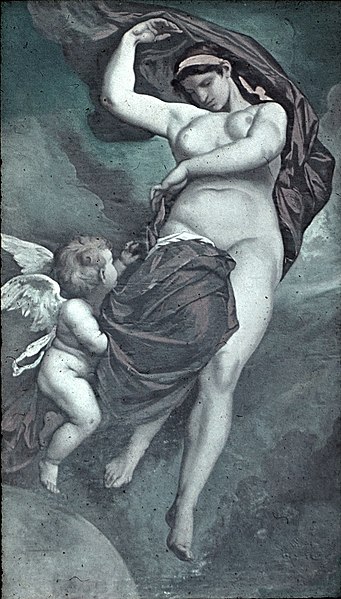
Gaea by Feuerbach. Wikimedia.
So
too with Santorum's remarks that Obama's environmental policy is
based on a “theology that does not come from the Bible.” It ought
to be self-evident, surely, that he was referring to the
quasi-religious beliefs of radical environmentalists. Yet the Obama
White House, along with many commentators, objected immediately that
Santorum was impugning Obama's Christianity. Obliquely, I suppose he
was, but surely in a perfectly legitimate way, in saying that his
environmental policy is not in keeping with Christian ideas. It
isn't. Radical environmentalists consider humanity a kind of cancer
on the suffering body of the goddess Gaea. Ask David Suzuki. This is
incompatible with the Christian idea that man is above nature—let
alone that nature is not divine.
The
problem here, I think, is just that too many people, notably
including journalists, are theologically illiterate.





 Posts