


Get the scoop on the heresy now infecting the Catholic church at our SubStack feed. And subscribe for free!


Catholic comments on the passing parade.


 Posts
All Comments
Posts
All Comments

Get the scoop on the heresy now infecting the Catholic church at our SubStack feed. And subscribe for free!

Ezekiel 33: 7-9
7 So thou, O son of man, I have made thee a watchman to the house of Israel: therefore thou shalt hear the word from my mouth, and shalt tell it them from me.
8 When I say to the wicked: O wicked man, thou shalt surely die: if thou dost not speak to warn the wicked man from his way: that wicked man shall die in his iniquity, but I will require his blood at thy hand.
9 But if thou tell the wicked man, that he may be converted from his ways, and he be not converted from his way: he shall die in his iniquity: but thou hast delivered thy soul.
Matthew 18:
15: But if thy brother shall offend against thee, go, and rebuke him between thee and him alone. If he shall hear thee, thou shalt gain thy brother.
16 And if he will not hear thee, take with thee one or two more: that in the mouth of two or three witnesses every word may stand.
17 And if he will not hear them: tell the church. And if he will not hear the church, let him be to thee as the heathen and publican.
18 Amen I say to you, whatsoever you shall bind upon earth, shall be bound also in heaven; and whatsoever you shall loose upon earth, shall be loosed also in heaven.
19 Again I say to you, that if two of you shall consent upon earth, concerning any thing whatsoever they shall ask, it shall be done to them by my Father who is in heaven.
20 For where there are two or three gathered together in my name, there am I in the midst of them.
The postmodernists insist we must never be “judgmental.” We must never accuse others of wrongdoing. This Sunday’s readings demonstrate that this attitude is unbiblical and immoral.
We are all the sons of men. Ezekiel makes plain that this gives us an obligation to point out to others when they are sinning. If we do not, we will be held accountable for their sin. We have aided and abetted it. Above all else, we owe it to the sinner to advise them of their sin.
A point it seems lost on Pope Francis.
At the same time, this obligation is limited to the “House of Israel.” There is, after all, no point in trying to help someone who does not believe, in the first place, in right and wrong, in ethical monotheism. They are bound for hell in any case.
This principle is shown again in the second reading: one has both a right and a duty to point out when a fellow Christian has sinned, against us or against another. If he (or she) does not accept this and seek atonement and reconciliation, he has, by this, demonstrated he is not a Christian and not a brother. He is “a heathen.”
A second common distortion is also revealed by the second reading. The last verse is often misquoted as “wherever two or more of you are gathered in my name, there I am in the midst of them.” And this is used to stress the need for community over against the individual conscience, and so demand conformity.
But the original is “two,” then “two or three.” If “one” is excluded from God’s presence, so too is any group larger than three. The ideal unit imagined is something the size of a couple or family, not even a typical church congregation.
Accepting the authority of the latter is simply the ad populam fallacy. If a larger group automatically has more authority than a smaller group, Christianity itself is disproven.
The point is the presence of love; which necessarily requires more than one, as in the Trinity.
Hence too no doubt the reference to a fellow Christian at the beginning of the passage, and in general, as “brother.” The reference is to brotherly love, filos.
Whoever has such love is your brother. Whoever does not, is not.
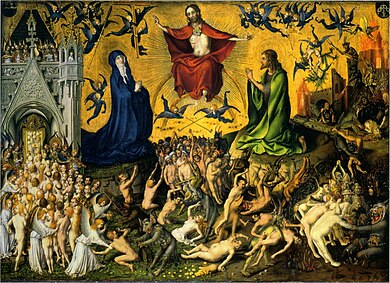
Xerxes proposes that there are two competing images of God: for some, God is “unconditional love.” For others, he is a “ruthless judge.”
This is a neat example of the fallacy of the false alterative: it implies that, if you do not believe God is unconditional love, you believe he is ruthless. You are therefore driven to accept that he is unconditional love.
Yet he clearly is not, if by “unconditional love” you mean that he sets no conditions. He does from the very beginning, with not eating the fruit of the tree of the knowledge of good and evil. God’s love is expressed as a series of covenants: he has obligations, man has obligations, and if man does not meet his obligations, punishment can be swift and severe.
Caritas or agape, divine love, does not mean overlooking faults and flaws; any more than married love does. It means keeping contracts, and at all times wanting the best for the other. It also implies respecting the other’s moral agency. A “love” that demands nothing of the other does not. That would be seeing the other as an object. It is the sort of love one might have for a good steak. It is a form of hate.
This is why the Bible says “One who spares the rod hates his son, but one who loves him is careful to discipline him.”
So is God a “ruthless judge”? The flaw here is in seeing justice as in opposition to love or mercy. Perfect justice is the ultimate mercy.
 |
| Satan in the Book of Job: Blake. |
Jesus therefore said to those Jews who had believed him, "If you remain in my word, then you are truly my disciples. You will know the truth, and the truth will make you free." They answered him, "We are Abraham's seed, and have never been in bondage to anyone. How do you say, 'You will be made free?'"
Jesus answered them, "Most certainly I tell you, everyone who commits sin is the bondservant of sin. A bondservant doesn't live in the house forever. A son remains forever. If therefore the Son makes you free, you will be free indeed. I know that you are Abraham's seed, yet you seek to kill me, because my word finds no place in you. I say the things which I have seen with my Father; and you also do the things which you have seen with your father."
They answered him, "Our father is Abraham." Jesus said to them, "If you were Abraham's children, you would do the works of Abraham. But now you seek to kill me, a man who has told you the truth, which I heard from God. Abraham didn't do this. You do the works of your father." They said to him, "We were not born of sexual immorality. We have one Father, God.”
"Therefore Jesus said to them, "If God were your father, you would love me, for I came out and have come from God. For I haven't come of myself, but he sent me. Why don't you understand my speech? Because you can't hear my word. You are of your father, the devil, and you want to do the desires of your father. He was a murderer from the beginning, and doesn't stand in the truth, because there is no truth in him. When he speaks a lie, he speaks on his own; for he is a liar, and its father. But because I tell the truth, you don't believe me. Which of you convicts me of sin? If I tell the truth, why do you not believe me? He who is of God hears the words of God. For this cause you don't hear, because you are not of God."
 |
| The Devil shown in a 15th century manuscript. |
“but whoever causes one of these little ones who believe in me to stumble, it would be better for him that a huge millstone should be hung around his neck, and that he should be sunk in the depths of the sea.” (Matthew 18:6)
“It would be better for him if a millstone were hung around his neck, and he were thrown into the sea, rather than that he should cause one of these little ones to stumble.” (Luke 17:2)
 |
| Michelangelo's "Last Judgment." |

