Playing the Indian Card

Monday, February 20, 2012

Sunday's Reading


When Jesus returned to Capernaum after some days,
it became known that he was at home.
Many gathered together so that there was no longer room for them,
not even around the door,
and he preached the word to them.
They came bringing to him a paralytic carried by four men.
Unable to get near Jesus because of the crowd,
they opened up the roof above him.
After they had broken through,
they let down the mat on which the paralytic was lying.
When Jesus saw their faith, he said to the paralytic,
"Child, your sins are forgiven."
Now some of the scribes were sitting there asking themselves,
"Why does this man speak that way? He is blaspheming.
Who but God alone can forgive sins?"
Jesus immediately knew in his mind
what they were thinking to themselves,
so he said, "Why are you thinking such things in your hearts?
Which is easier, to say to the paralytic,
'Your sins are forgiven,'
or to say, 'Rise, pick up your mat and walk?'
But that you may know
that the Son of Man has authority to forgive sins on earth"
-he said to the paralytic,
"I say to you, rise, pick up your mat, and go home."
He rose, picked up his mat at once,
and went away in the sight of everyone.
They were all astounded
and glorified God, saying, "We have never seen anything like this."

--Mk. 2:1-12


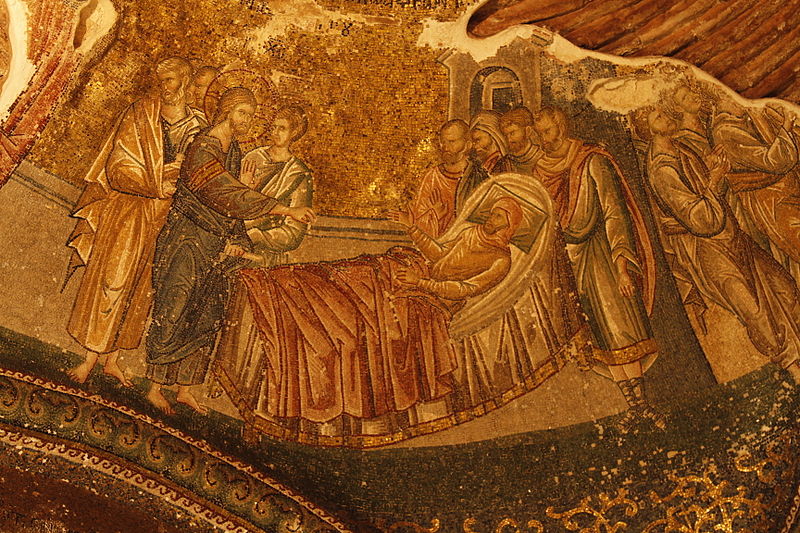
Paralysed man flying.


As usual, this Sunday's Gospel reading is pretty darned funny. Picture the remarkable detail of those four men, unable to get close to Jesus, actually climbing onto the roof of the house, pulling their paralysed friend up with them, breaking the roof open, and lowering him down. They were bound and determined to find that poor man a cure.

And then Jesus's reaction: he looks at the man, and says, “Child, your sins are forgiven.”

That's is. His sins are forgiven. Imagine the reaction of the four men who have lowered him down with such effort. That's it? His sins are forgiven? What about his blooming paralysis?

Consider just how much obvious sin a paralysed man is likely to be getting up to. Adultery? Gluttony? Armed robbery? Is it really likely this is a man lost in sin? Yet Jesus ignores the blindingly obvious physical limitation.

He does then cure him of paralysis, but, only to make a point—that he can forgive sins. It seems purely an afterthought.

Your sins are forgiven. Too bad about the paralysis, though.


There is a very good reason why miracles are trivial. God is good; and God made the world. It follows that the world is already set up for our benefit. Accordingly, no miracles will really make things better for us. We need no miracles. All we need, as St. Theresa of Avila said, is a relationship with God. Which is to say, all we need is to know that God forgives us our sins.

So why any miracles at all?

Miracles are God's reminders that he is there, and that he loves us. We should expect and accept them purely in these terms.

Friday, February 17, 2012

A Bitter Pill

The Jewelled Gates of the New Jerusalem.


I am amazed by the sheer folly of the Obama administration's requirement for religious organizations to provide medical insurance for their employees that includes free contraception. It looks like a deliberate attempt to pick a fight with the Catholic Church in an election year, which all the polls suggest will be tight and hard-fought. How can this make sense? Catholics are 27% of the US population; no small voting bloc. In 2008, 54% of them voted for Obama. Even that was much lower than historical averages; before Reagan, in the days of Al Smith and John F. Kennedy, the Democratic Party could count on the solid backing of Catholics in every election. Yet instead of luring them back, Obama's administration seems to be driving them away, or at least forcing them to choose: it's us or their Catholicism.

It's more remarkable when you consider that the administration, if their objective was to ensure that contraceptives were free, could easily achieve this without forcing the churches to pay for it or provide it—as their “accommodation” or “compromise” really still does. They could, for example, issue separate government vouchers for contraceptives. One is forced to assume that the entire point of this policy was simply to pick a fight with the Catholic Church.

Why? Apparently, they thought they could harm the Catholic Church with this, and felt this was worth doing even if it cost them support—even if it cost them this election, or even many elections to come. The Church's stance on contraception is not popular, even among Catholics. They figured that, by forcing a fight on this ground, they could diminish the popularity of the Catholic Church. Even if it's crazy to think this would raise instead of lower their Catholic vote overall. Or indeed, that such an assault on the First Amendment and freedom of conscience would raise instead of lower their support among the religious generally.

For them, clearly, this was a matter of principle, above all electoral politics. Religion, and especially Catholicism, is bad.

Thomas Nast's most famous anti-Catholic cartoon.


That's also, I suspect, the reason for the prominence of the issue of homosexuality over the last few decades. A conservative columnist a few years ago openly pondered how it is possible that such a small portion of the population, only 1-3%, had pushed its concerns to the top of the social agenda. They didn't; they're only being used. The answer, I think, is that those who hate the Catholic Church saw the Church's stand on homosexuality as an issue with which they could accuse the Church of prejudice--as if homosexuals were an ethnic group like blacks or Jews. It also goes a long way to account for the current near-hysteria about child molestation. It was not perceived as all that fundamental in its evil—witness the once-burgeoning NAMBLA--until the moment Catholic priests were accused of it. Then it was unspeakable.

If it can hurt the Catholic Church, it seems, it is worth doing, even if it sacrifices other principles, even if it leads to dangerous consequences for others. Why? Because, for many on the left, the Catholic Church is the very essence of evil.

It makes sense, in a backwards way. When “the pill” was introduced in the early 1960s, a lot of us, especially on the left, believed the millennium had arrived. Because sex had supposedly been untethered from procreation, a whole lot of new pleasure became permissible. All moral objections to unrestrained sex had disappeared. Whoopie!

The Catholic Church, almost alone at first, held out against this. It was this that confirmed me, personally, as a Catholic, because the premise was obviously wrong from the start. It is just that people wanted it so much to be true, that they refused to see the reality. And the Church's refusal to be swayed proved that it alone cared about the truth. But I also feared, at the time, that the Church was being very brave, and would inevitably pay a heavy price.

By a twisted logic typical of human beings, when they do wrong, far from facing up to it, they are far more inclined to see evil in their victims, and then in anyone who breathes a hint that what they did might have been wrong. Hence the Catholic Church is evil, and all religion is evil; if they could only be made to shut up, the rest of us could do what they want. Never mind that they in fact have no power, that the real and only reason that their words seem to hurt so much is our own conscience. And that means that, really, shutting them up would do nothing for us.

We can all see clearly enough now that “the pill” did not really change anything. Even aside from the emerging health dangers of the pill, women still kept getting pregnant without intending to. So we had to decide abortion was okay too—and unrestricted abortion. Another bit we forgot was venereal disease: old venereal diseases getting a new lease on life, old diseases developing immunities, and indeed new opportunistic venereal diseases like AIDS. All entirely predictable. So was the rise in broken marriages, with all the pain and suffering by children and adults they entail—who'd have thunk that sex actually had something to do with emotion? Other, that is, than every sane human being?

He was right.


But instead of admitting we were wrong, perversely, we hate the Catholic Church all the more for being right. So the tone of anti-Catholicism ratchets up as all this becomes more and more apparent. Nobody on the left would care much what the Catholic Church said if it were clear that the Church is wrong.

It cannot work, of course. Over time, any attempt to silence the conscience becomes self-destructive. This is what we are seeing now, with the left actually running the clear risk of sacrificing their electability and their future to the cause. It is a mark of their desperation, and a sign that the end, at least in America, is coming soon.

The end, that is, of the anti-religious left.

Let Whitney Houston Rest in Peace


The recent death of Whitney Houston seems to have already spawned two hot controversies. First is whether her doctors were culpable for prescribing her tranquilizers that may or may not have been the immediate cause of her trip to the hereafter. Second is whether she deserves the honour of having flags in New Jersey lowered to half-mast, since she basically killed herself.

Of course, both these claims cannot be true. But I'd say it's pretty obvious neither of them are.

Haven't we seen this many times before? Aren't two things staggeringly obvious?

  1. Great talent is a great burden.
  2. “You ought to be famous” is a curse.

We are blinded to these universal truths by our own foolish envy.

Friday, February 10, 2012

Sunday Reading.

A leper. From Wikimedia Commons.


A leper came to Jesus and kneeling down begged him and said,"If you wish, you can make me clean."Moved with pity, he stretched out his hand, touched him, and said to him, "I do will it. Be made clean."The leprosy left him immediately, and he was made clean.Then, warning the him sternly, he dismissed him at once. 
He said to him, "See that you tell no one anything,but go, show yourself to the priest and offer for your cleansing what Moses prescribed;that will be proof for them."
The man went away and began to publicize the whole matter.He spread the report abroadso that it was impossible for Jesus to enter a town openly.He remained outside in deserted places,and people kept coming to him from everywhere.
Jesus heals a leper. Byzantine mosaic. Wikimedia Commons.


Note Jesus's instruction, after he heals the leper, that the latter is to tell no one how this happened. This demand for secrecy is consistent through the three synoptic gospels, and is commonly referred to as “the Messianic secret.” That is, Jesus seems to try to keep it secret that he is the Messiah.

But why?

I think this analysis misses the mark by a bit. Unfortunate, because, properly understood, this “Messianic secret” reveals an important secret underpinning Western Civilization.

Which is, after all, really Christian Civilization, “Christendom.”

In Canada, recently, an immigrant family, man, wife, and son, were all convicted of murder for the “honour killing” of three daughters and a second wife. My friend the liberal columnist points out, in explanation, that while “Western” culture is based on “guilt,” “Eastern” cultures are based on “shame.” It’s not about what you do,” he writes, “but about its effect on the reputation of your family, clan, or caste. Collective honour matters more than love, genetics, or moral principles.” A distinction I have heard made before. And, as you can see from this short quote, despite his liberal beliefs in theory in cultural relativism, he seems unable here to see the Western model as anything but better, more moral.

And it is. I think most Muslims, Buddhists, or Hindus, would agree, given the facts of the Shafia case.

But note that the terms “Western” and “Eastern” here are meaningless dodges. The real contrast is between Christian culture and all others: the importance of “face” is striking in the Muslim Middle East, Hindu India, the Buddhist Far East, or among North American or African shamanists. It is only Christian culture in which its value is so diminished.

And the reason is right here before us. It is the New Testament, the “Messianic secret,” and such passages as this. Jesus is not trying to conceal the fact that he is the Messiah, as such; he is trying to conceal a good deed.
And this is simply practicing what he preaches. From the Sermon on the Mount:

1“Beware of practicing your righteousness before men to be noticed by them; otherwise you have no reward with your Father who is in heaven.2“So when you give to the poor, do not sound a trumpet before you, as the hypocrites do in the synagogues and in the streets, so that they may be honored by men. Truly I say to you, they have their reward in full. 3“But when you give to the poor, do not let your left hand know what your right hand is doing, 4so that your giving will be in secret; and your Father who sees what is done in secret will reward you.5“When you pray, you are not to be like the hypocrites; for they love to stand and pray in the synagogues and on the street corners so that they may be seen by men. Truly I say to you, they have their reward in full. 6“But you, when you pray, go into your inner room, close your door and pray to your Father who is in secret, and your Father who sees what is done in secret will reward you. --Mt. 6:1-6.

The rejection and condemnation of hypocrisy is one of the most consistent, perhaps the most consistent, messages of the gospel. It is so much of the New Testament that our very English word, “hypocrisy,” --let alone “Pharisee”-- is New Testament Greek.

That is what a “culture of shame” actually is—a culture of hypocrisy.

Christianity alone stands head and shoulder above all other religious traditions on this one point: that of recognizing and combating the natural human tendency towards hypocrisy.

The message is conveyed in the present reading not only by the request to keep the deed secret, but by the deed itself—touching and healing a leper. Lepers themselves were a particularly obvious example of social shaming. As the passage notes, they suffered social ostracism. Not because of any moral fault, not for sin, but for being “unclean.” This was not, as Michel Foucault has pointed out, for medical reasons either. It turns out that it is rather difficult to catch leprosy from another, and certainly the mere act of touching a leper was not going to do it. Lepers wer shunned, and considered “untouchable,” because their disease made them look hideous.

Lepers, Jerusalem, 1906. Wikimedia Commons.


A perfect metaphor, then for shame as opposed to guilt. By touching and healing the leper, Jesus was rejecting and/or overcoming this issue of shame. It is a visible way in which Christ has redeemed the Christian: we no longer suffer under the burden of social shame, and need only deal with our guilt.

The New Testament nails this idea to the wall, again and again.

This strong message has made explicitly Christian societies freer, and on the whole more honest—with less of “such boastings as the Gentiles use,” in Kipling's phrase, less focus on mere social advantage and clawing over to the Eastern Wall at all levels; more on principle and getting the job done.

It has been both a moral advantage, and a competitive advantage in many ways, over the millennia, reducing the social friction in Christian jurisdictions.

Thursday, February 09, 2012

A Brokered Convention

Now that he's won the last three primaries, Rick Santorum is certainly not going to drop out of the Republican race any time soon. Having won South Carolina and still doing well in the national polls, neither, I expect, is Newt Gingrich.  Paul and Romney have the money and organization to stay in until the end no matter what.

This could mean nobody has a majority of delegates by the convention. And if this happens, if my memory serves, delegates are released from their pledge to a given candidate after the first ballot. The possibility opens for the convention to turn to a candidate who has not run in the primaries. moreover, there would be a certain obvious logic to doing so--a general dissatisfaction with the present field seems to be fuelling the voter indecision.

I suspect Romney has blown his chance to be the nominee by going too negative. Negative campaigning does have a tendency to blow up the author as well as the target. Romney was rather unloved by fellow Republicans before this all started; his extremely harsh attacks on Gingrich, added to that, may have made it impossible for the party to unite behind him.

Sunday, February 05, 2012

Bombing Iran


Leon Panetta, amazingly, has just said he expects an Israeli attack on Iran in April, May, or June.

This is remarkable, because if he knows something, this is sensitive information. If Iran can expect an attack at that time, they can watch and try to prepare for it. The huge tactical advantage of surprise is largely lost.

So why would Panetta do this? The only motive I can see is to make it clear it is not the US who is attacking, hence perhaps avoiding Iranian and Muslim backlash against America and American interests.

This fits with a few other recent bits of news. First, just a week or two ago, the US leaked the claim that they had no bombs that could definitely crack the Iranian bunkers, and so they were ordering an upgrade. Again, on the face of it a damaging leak that threatened US interests. But if believed, it tells Iran that the US is not planning and is not responsible for any attack in the very near future on Iranian installations.

And the third, even more disturbing, piece of evidence is the American withdrawal of all forces from Iraq just a month or so ago. Officially, this was because the US and Iran could not agree on a SOFA. But several sources have claimed the US did not try very hard. This withdrawal was against the advice of the top military brass. Again, it seems against US interests, or at least risks losing US prestige.

But it too makes sense on the premise that there is going to be a big attack on Iran soon. A small American deployment in Iraq might simply have been sitting ducks for Iranian retaliation. A large American deployment in Iraq might have trapped American into a large-scale land war with Iran.

My take is this: there will probably be a massive air attack on Iranian nuclear facilities. It will be done by Israel, though America or others may help behind the scenes. America believes Iran is capable of doing a lot of damage in any counter-attack. Hence it is wisest to limit possible retaliatory targets to Israel alone.

And it will probably happen before April.

Let's watch and see.

Leonard Cohen the Jew

Adam Cohen, Leonard's son, has confirmed in stark terms in a recent piece in the Winnipeg Free Press the thesis I proposed on this blog some time ago: that Leonard Cohen is in fact a devout practicing Jew. He writes of his memories of his father, "He was there to protect values. It would be lighting the Sabbath candles and learning Hebrew prayers, singing songs, reading the Bible."


Most artists seem to end up religious. And this fact is generally kept pretty secret. Not least by the artist himself: he knows it will hurt sales.

Saturday, February 04, 2012

Mark 1: 29-39


On leaving the synagogue
Jesus entered the house of Simon and Andrew with James and John.
Simon's mother-in-law lay sick with a fever.
They immediately told him about her.
He approached, grasped her hand, and helped her up.
Then the fever left her and she waited on them.

When it was evening, after sunset,
they brought to him all who were ill or possessed by demons.
The whole town was gathered at the door.
He cured many who were sick with various diseases,
and he drove out many demons,
not permitting them to speak because they knew him.

Rising very early before dawn, he left
and went off to a deserted place, where he prayed.
Simon and those who were with him pursued him
and on finding him said, "Everyone is looking for you."
He told them, "Let us go on to the nearby villages
that I may preach there also.
For this purpose have I come."
So he went into their synagogues,
preaching and driving out demons throughout the whole of Galilee.


What jumps up at Christian Scientists about this Sunday’s reading is that Jesus had the power to heal, and healing illness was a major part of his activity. What jumps out at me in the reading is that there were clearly a lot of people possessed by demons in First Century Judea. About as many, it sounds like, as people with physical illnesses, at a time when physical illnesses must have been more common than today.


So why do we not have many people possessed by demons today? What happened between then and now? Or do we?


After all, demons are real. That is non-negotiable for a Catholic. All things, visible and invisible, seen and unseen. Logically, then, demonic possession is also real, and the Church retains rites to deal with it. So, not incidentally, do the Orthodox Churches, Islam, and virtually all other religions. Can they all be wrong?


The obvious conclusion, and the one I make, is that what was then called demonic possession we now call “mental illness.” Freud even used the terminology: he speaks of “obsession.” “Obsession” originally meant “hostile action by an evil spirit,” one notch down from possession. What could be clearer? And this, of course, is why we, as if instinctively, fear the “mentally ill.”


A “schizophrenic” of my acquaintance keeps hearing metallic voices telling him to go jump off the balcony. Occam's razor: the simple and obvious explanation is that he is being tempted by an evil spirit. Anything else requires a good deal of mental gymnastics.


Another, to use the classic example, thinks he is Napoleon? The simple explanation is that he is possessed by the spirit of Napoleon, or of an evil spirit masquerading as the French Emperor.


So too with anxiety and depression. 1 Samuel 16:4: 14 “Now the spirit of the LORD had departed from Saul, and an evil spirit from the LORD terrified him.”


Given that “mental illness” is necessarily, by definition, mental or spiritual in nature, it seems only sensible and efficient to address it in mental or spiritual terms. In other words, if a person thinks he is being invested with an evil spirit, he is being invested by an evil spirit, because in this case the thought is the thing itself. And the most efficient cure is something that will drive out the thought of the evil spirit. If the thought is gone, the thing is gone.


How? How do you change hearts and minds?


Two ways: art and prayer.


Shamanic cultures use what seems to us very much like drama: a story which can engage the mind and concentration, Coleridge’s “willing suspension of disbelief,” and which then catches up and drives out, as Aristotle explained (it is the meaning of his term “cartharsis”), the evil spirits. This is how Korean mudangs, female exorcists, work, or the Native American “False Face Societies.” Other arts can also do this, in their various ways. David's harpistry drove the evil spirits from King Saul: “seek out a man who is a skilful player on the harp; and it shall be, when the evil spirit from God cometh upon thee, that he shall play with his hand, and thou shalt be well.”


Myths, two, are probably designed to do this. “Myth” literally simply means “story.” Make it a real stemwinder, and it should have the engaging power to chase off the plague dogs.


If so, it is a serious misunderstanding to suppose a myth is a serious, but mistaken, statement of “scientific” cosmology—that it is meant to be taken seriously as the scientific explanation of how the leopard got his spots. It is real and true to the extent that it is engaging and vivid. This is why, for example, the Greeks, the Egyptians, or the Indians, could happily accept several contradictory myths in this scientific sense: several different origins for the sun, for example, or for mankind. Not a problem.


This is not science, but spiritual technology. Myths make the world meaningful and significant, and so fend off the demons. Or, should a demon come, immersion in a suitable myth can heal.


Now, what happens when the old stories, or the art, breaks down? That is, either it is forgotten by a large portion of the people, or it loses its power to enthral, to suspend disbelief?


All hell should theoretically break loose. There should be a general sense of meaningless and barrenness to the world; what was once a garden of shining meanings becomes a desert or a wilderness. And then the demons, who dwell in the wild places, like Lilith, or Pan, or the djinn, will come.


And they do. The classic case where this can be expected to happen is during rapid cultural change; when, for example, a culture long isolated encounters a new culture suddenly and massively.


Think, for example, of the North American Indians: as is generally understood, as soon as the Spanish arrived on their shores, they started dying off in droves. The usual explanation is the contact with unknown diseases, and that is fair enough, but it does not fully explain the matter. For one thing, logically, that spread of diseases ought to have gone about equally both ways, so the Europeans should also have started dying off. There is, indeed, evidence that syphilis came to the old world from the New; but it hardly had the effect on Europe the Indians experienced. For another, it does not explain how the early Conquistadors, with only a handful of men, were able to conquer vast Empires, the Incans and the Aztecs, with little effort.


Darwin spends some time in “The Descent of Man” documenting many similar examples from around the world, from the many new contacts of the European age of exploration and colonization. He does not see the effects of new viruses so much as the sudden loss of fertility: people in these societies stop having, and caring for, children.


Why?


Not because they are ill, but because they are dispirited. As we see in microcosm whenever an individual has a case of culture shock, the encounter with a new culture throws all the old stories into question, all the meanings the human world has acquired for that individual or culture. The individuals in the culture become depressed, unable to go on because unable to see any point in their existence. In time, they may well also become possessed--mad.


Why did the same thing not happen to the Europeans? Because they were inoculated by already, rather recently, having had contact with other alien cultures. Notably, the Spanish only finally drove the Muslims out of Spain in the same year Columbus sailed. More notably, they had long ago been inoculated by a mythos developed during the Alexandrian and Roman Empires, with their mixing of peoples.


I suspect, indeed, that a milder version of this sort of cultural collapse with the loss of the old stories was the general condition in Palestine and in the Roman Empire at the time of Christ. The conquests of Alexander, followed quickly by the conquests of Rome, suddenly brought a wide variety of cultures into direct contact, Persians, Semites, Greeks, Egyptians, Celts, destroying the common heritage of the shared stories and psychic dramas that Homer, for example, would have known. As a result, the gods were no longer taken very seriously. And as a result, a sense of meaningless and then an epidemic of demonic possession should be expected to be extremely common at that time. And it was—we can trace the sense of meaninglessness, the general depression, in the writings of what is sometimes called the “Axial age.” circa 500 BC. 


Ecclesiastes is the perfect expression of depression. Buddhism, Pythagoreanism, the Tao Te Ching, and the Upanishads are of the same time, and of the same genre.


Then, we seem to see, in the New Testament, the upwelling of demonic possessions—of that madness beyond depression and anxiety.


This explains, in turn, how Christianity spread so quickly through the Empire: its ability to cast out demons. This is in fact what the ancient historians tell us: that first the Jews, and then the Christians, developed a huge prestige throughout the empire specifically for their ability to cast out demons. The powerful impression of its spiritual coherence, its spiritual truth, its vivid and compelling narrative, was strong enough to restore the shattered spiritual order. Later, it was strong enough to give Europe the upper hand in encountering alien cultures world-wide. Later still, its ability to drive out the demons and restore psychic order has led to its rapid adoption throughout the Third World: in the Americas, Africa, and now China.


Unfortunately, in the more developed parts of the world, we have recently seen another shattering: the one reported by Eliot in The Waste Land, or Yeats in The Second Coming. Things have again fallen apart, over the past century or so; again the spiritual centre cannot hold. Again what we see around us is no longer the shimmering garden of meaning, but a desert, the desert too of “Waiting for Godot.” Art has become derelict and morbid, and the incidence of mental illness seems, by many accounts, to be skyrocketing.


We are all going mad. We are all becoming possessed by demons. There is a spiritual catastrophe taking place.


This, I believe, is not because of globalization. That has been a relative constant for five hundred years. It is because our fascination with the material successes of science and scientific technology has caused us to neglect and to abandon our spiritual technology. We are no longer teaching our children the stories. We are no longer enthralled by the mystery of the Mass. We no longer believe in anything in particular.


As a result, we have stopped having children, or caring for them.


We are letting the demons in.

Wednesday, January 25, 2012

American Religious Exceptionalism

Americans, as anyone can fairly readily see, are more religious, more interested in and committed to religion, than Europeans. Why?


I just heard an interesting theory.

A podcast interviewee suggested that, in comparison to Europe, America has had a freer market in religion. Its many denominations and indeed congregations compete to fill their churches each Sunday. If they fail, their church must close its doors. 

As a result, they have become and remained responsive to their congregations. But in Europe, there has been less religious diversity, and often, as in Britain and Germany, a state-supported church.  Religion as government bureaucracy drifts out of touch.

This never occurred to me, but it sounds right as soon as I hear it.

 The best argument for 

1. separation of church and state, and 
2. religious tolerance.

Friday, January 20, 2012

More on the Current Crisis


... But there is a broader point. It is self-evidently wrong to apply “science” to man himself. What we call science is fundamentally based on observation—in other words, what we can see, hear, smell, taste, and touch. The human soul, by definition, if it exists, cannot be seen, heard, smelled, tasted, or touched, and neither, by definition, can God. The application of scientific method to the human realm or to the divine, therefore, is just as foolish as debating how many angels can dance on the head of a pin.

Nor does the fact that science can tell us nothing useful about the human soul or the meaning of life mean that there is no human soul and no meaning to life—any more than trying to hammer in a nail with a knitting needle, and failing, proves there is no nail. Yet that is the silly Scylla and Charybdis we have caught ourselves between.

Now let's look at that another way: if science is fundamentally based on observation, as it is, it necessarily must also assume there really is an objective observer, apart from the thing observed and capable of interpreting sensations from the sense organs meaningfully. A human mind, a human soul, in other words. The various strands of Modernism and of “social science” all hold one dogma in common: that there is no objective observer, no human soul free of the observed world. Darwin held our perceptions and consciousness to be developed, not to perceive the real, but to aid in the struggle for survival. If Darwin is right, there is therefore no way of knowing, for example, whether Darwin's own theories, or those of any other thinker, have anything to do with reality, or have simply been developed by his mechanical consciousness as a way to aid him in reproduction and survival. In other words, Darwin is self-contradictory.

Marx, similarly, held our perceptions and consciousness were radically determined by “ideology,” which is to say, the beliefs and opinions that were most to the benefit of the ruling class: “a set of ideas proposed by the dominant class of a society to all members of this society” (Wikipedia entry on “Ideology”). There is therefore no way of knowing, similarly, whether Marx's own theories pertain to reality, or have simply been developed by his consciousness to reinforce the interests of the economic system and class into which he was born. He contradicts himself.

Freud held, like Darwin, that “All subjective reality was based … on the play of basic drives and instincts, through which the outside world was perceived.” If so, were Freuds' theories, and those of all other scientists and thinkers of all kinds, based on any objective truth, or only the effusions of his subconscious trying to get laid by his Mum?

Just the three most obvious examples; but I submit that any form of “social science,” any attempt to apply the techniques of science to mankind himself necessarily has this logical contradition at its foundation: if the mind is the object, it cannot also be the detached observer.

So you see, besides leading to mass murder and unimaginable human suffering, to wars and massacres, and besides not producing any useful knowledge in its century or more of trying, Modernism or social science is also immediately self-contradictory. It is also detrimental to true science. If social science is true, science cannot be. The Na'vi that Modernists so admire, you will notice, are not especially hi-tech.

We are not machines, but free agents.

In practice, of course, the social scientist is necessarily assuming that, while ordinary people, or perhaps everyone else, is an automaton following natural laws, he or his class or professional cadre, for some unexplained reason, is not. They are the enlightened ones. This necessarily sees mankind as radically unequal, and can justify practically any level of inhumanity, practically any level of compulsion imposed on the human subjects.

Thursday, January 12, 2012

A Statement of the Problem


There is a Crisis

“One gets the feeling some spiritual catastrophe has taken place…” – Leonard Cohen.

In some ways, life is getting better and better. In one important way it seems to be getting worse: in the experience of what is called “mental illness.” Current National Institute of Mental Health (NIMH) data state that 46.4% of Americans have or will have some form of “mental illness” (http://www.nimh.nih.gov/statistics/1ANYDIS_ADULT.shtml). One in four, one quarter of us, is mentally ill in any given year.

Very little is really known by the science called psychology about this thing called “mental illness.” I’ve been watching the field long enough to realize that the things we know one year turn out to be untrue by ten or twenty years later. We seem to be running around in circles on this. What causes mental illness? Do the pills work? Do the new pills work better than the old pills? What is the most common form of mental illness? Is mental illness A really distinct from mental illness B, or are they two symptoms for the same malady? And is the incidence of such things growing?

We don’t know. We don't know. We don't know. The entire field seems permanently behind a shroud, uncanny and mysterious.

All we are really sure about is that a lot of people claim to be suffering a lot.

My own sense is that the incidence really has been growing, rapidly, at least in the developed world. I find it hard to believe that, a hundred or two hundred years ago, nearly half the population was suffering from what we now call mental illness, and nobody noticed anything in particular. Albeit it does not seem to attract the attention it deserves today either.

Perhaps the true experts on all this are the artists. Artists, I expect, detect the zeitgeist well before the rest of us do, because they are more sensitive to such things; like the proverbial canary in the mine. And Leonard Cohen is far from the only artist to proclaim some sort of broad social or cultural breakdown—a “spiritual catastrophe.”


Duchamp's "Fountain"


Artists have been saying this with remarkable persistence at least since Marcel Duchamp’s “Fountain” (1917), WB Yeats’ “The Second Coming” (1919), and TS Eliot’s “The Waste Land” (1922), the three great original landmarks of “modernism”: things have fallen apart, everything has died, the culture is in broken shards. Some artists have celebrated this fact, and some have lamented it, but all seem to have been saying the same thing ever since: “I saw the best minds of my generation ruined by madness.”

So what has happened over the last hundred years?

What is the Cause of this Crisis?

The obvious immediate cause of the crisis reflected in Eliot’s and Yeats’s great poems was the First Word War and the revolutions that followed it—most notably the Bolshevik Revolution in Russia. Yet this is not sufficient explanation, since this spiritual crisis clearly is still with us now. It has long ago gotten downright tedious: what is “Piss Christ” saying that Marcel Duchamp's “Fountain” was not already saying a century ago? Yet the Great War is now several wars ago, and the Bolshevik regime has faded into history. There must be a deeper cause behind this proximate cause.

Piss Christ


Nor is this deeper cause, I think, hidden. It is the philosophical tendency called “Modernism”—the label commonly applied to these three artistic works.

According to the Catholic Encyclopedia, the term “Modernism” as it is modernly understood was coined by a professor M. Perin at the University of Louvain, in 1881. He defines the term, primarily, as “the ambition to eliminate God from all social life” (http://www.newadvent.org/cathen/10415a.htm).

That is a Catholic viewpoint, and a negative definition. Perhaps it is clearer if we invert it: Modernism was and is the ambition to inject science into all social life. The Modernists of philosophy, seeing the success of science and technology in the Industrial Revolution, wanted to set society, too, on a proper scientific foundation.

Wikipedia elucidates, in its entry on Modernism: “Two of the most significant thinkers of the period were, in biology, Charles Darwin, and in political science, Karl Marx” (http://en.wikipedia.org/wiki/Modernism). Darwin was publicly an agnostic. “Darwin's theory of evolution by natural selection undermined the religious certainty of the general public.” “The notion that human beings were driven by the same impulses as ‘lower animals’ proved to be difficult to reconcile with the idea of an ennobling spirituality.” Marx’s atheism was open and strident: “religion is the opiate of the people,” and all our thoughts are entirely conditioned by the economic system. Both doctrines proposed, essentially for the first time, that “science” and “religion” were opposed systems.

Planet of the Apes?


Both theories were promptly applied to society, indeed were designed to be applied to society, on the notion that society and culture could now be run on an efficient, “scientific” basis. Bad idea. People are not cogs. Marx gave us the Bolsheviks; Darwin gave us the Fascists.

The tendency to view society and humans as machines was then exacerbated by the influence of Einstein and Freud. Mussolini, for example, appealed directly to Einstein. If, as Einstein said, the foundations of the physical world were uncertain, “relative,” then the doctrines that guide our thoughts and deeds were also “relative,” and everything was up for grabs. All norms were expendable as proved convenient—in practice, especially moral norms. The very same argument is, of course, still made by the postmodernists.

Freud, in turn, claimed that “All subjective reality was based … on the play of basic drives and instincts, through which the outside world was perceived” (http://en.wikipedia.org/wiki/Modernism). We could not perceive objective reality, if any existed; we were animals driven entirely by instincts.

I think one can see the appeal of this doctrine. If God does not exist, there is no moral law. If there is no moral law, I can do as I please. Whoopie! Cue the Jazz Age!

More or less literally, all hell broke loose.

Now of course, it looks rather reactionary, rather hindwards-looking, to suggest that we have been on the wrong course for the past century. Heck, that makes me a Victorian. I am, for example, quite explicitly, calling for the abandonment of all “social science.” Sorry about that. I do not think the Victorian times were a golden age. Their overconfidence in the perfectability of man and society largely led to this. But I submit that some such backtracking is necessary and progressive in the true sense: there is nothing discreditable in pulling your finger out of an electrical socket. Since we went off on this Modernist path, we have actually lost all confidence of social or cultural progress. We now imagine that all of civilization has been a mistake, the past ten thousand years or so, and the feral Na'vi and their real-life hunter-gatherer counterparts are the folks who had it right.

Damned inconvenient that they so often have such unfortunate habits as slavery, infanticide, cannibalism, and constant war.

Is this only a problem of “Western civilization”? It appears not. Eastern Europe and Japan seem at least as subject to suicides and “mental illness”; one suspects China is too. Africa, the Muslim world, and perhaps India may have held out somewhat better so far, but they also seem to be undergoing a major trauma on this point. The fight against modernism is a useful prism through which to understand the rise of “Islamism,” for example.

The objection to modernism is not, note, an objection to science. Quite the reverse. The scientific claims of Marx and Freud have long ago been exploded; nobody who believes in science should have anything more to do with their ideas. Einstein, in turn, right or wrong, was simply misinterpreted by the social and cultural relativists. Darwin alone seems problematic—that debate is too complex to dive into here.

But there is a broader point. What we call science is fundamentally based on observation—in other words, what we can see, hear, smell, taste, and touch. The human soul, by definition, cannot be seen, heard, smelled, tasted, or touched, and neither can God. The application of scientific method to the human realm or to the divine, therefore, is exactly as nonsensical as debating how many angels can dance on the head of a pin. Nor does the fact that science can tell us nothing useful about the human soul or the meaning of life mean that there is no human soul and no meaning to life—any more than trying to hammer in a nail with a knitting needle, and failing, proves there is no way to hammer in a nail. Yet that is the silly Scylla and Charybdis we have caught ourselves in.

Wednesday, January 11, 2012

How Gingrich Could Still Win...

Mitt Romney's achievement in winning the first two primary season contests is historic. But, as noted previouosly in this space, the rules this year have changed: few states are now winner-take-all. That means a strong early showing is not prohibitive to others any longer.

As others drop out, the anybody-but-Mitt faction--which seems to be about 75% of the Republican Party electorate--will inevitably coalesce around one candidate, and there may well still be enough delegates in play at that point to keep it interesting. In addition, oddly, Romney has not yet really faced the scrutiny and attacks others have. Now that he is beginning to, he may see the same drop in the polls as they. Takes about two weeks for this to have an effect. That two week lag takes us to about the time of the South Carolina primary.

Now, who is best placed to last long enough to benefit from this possibility? Santorum has the benefit of his strong showing in Iowa, but he did not do nearly as well in NH; so the momentum may be lost. One of today's headlines has him "crashing to earth in New Hampshire." And his campaign has always looked short of money. Perry reputedly has money, but his showing in both Iowa and NH has been dismal. Texas must be beckoning. Paul has a natural ceiling on his support; he cannot be an ABRomney champion. The same could be said of Huntsman--he can do rather well in an open primary like NH, where Democrats can vote for their favourite Republican, but he has been running to Romney's left, and that has turned out--to my own surprise--to be a very shallow pool in the Republican party this time around. In SC polls, he currently runs somewhere behind Steve Colbert. That leaves Gingrich. He at least seems to be picking up steam now instead of losing it--beat everyone else on the solid right in the NH vote, edging out Santorum. He will have the same advantage in South Carolina, of coming from the next state, that Romney had in NH.And he has just had a major new infusion of cash from a wealthy backer, apparently.

Imagine a win for Newt in South Carolina that surprises the pundits enough to become a big news item, like Hilary's win in NH last time, or McCain's. Things could then change. And the latest polling shows him only four points behind.

Imagine further that a relatively poor showing there forces Perry and Huntsman out of the race.

As they say, a week is a long time in politics.

Full disclosure: I personally want Newt Gingrich to win. Why? Because he is such an interesting character. I would love to hear what he has to say over the next four years.


Wednesday, January 04, 2012

Iowa

Conventional wisdom about Iowa's caucuses is that they winnow the field: "Two tickets out of Iowa." But there is no reason why this should any longer be so. The rules have changed--primaries and caucuses are no longer "winner take all." This reduces a considerable advantage held by front-runners. Those in the back of the pack can now hang in longer before the mathematics eliminates them, hoping for a stumble or a surge. And the rapidity with which messages now get out makes late surges and stumbles that much more likely. A brokered convention also becomes more of a possibility, meaning it might pay to stay in the race in order to wield influence.

The only question is whether the candidates understand this. If they do, they will probably hang in there.