
Playing the Indian Card

Showing posts with label sola fides. Show all posts

Sunday, June 07, 2020

Does John's Gospel Promise Salvation by Faith Alone?


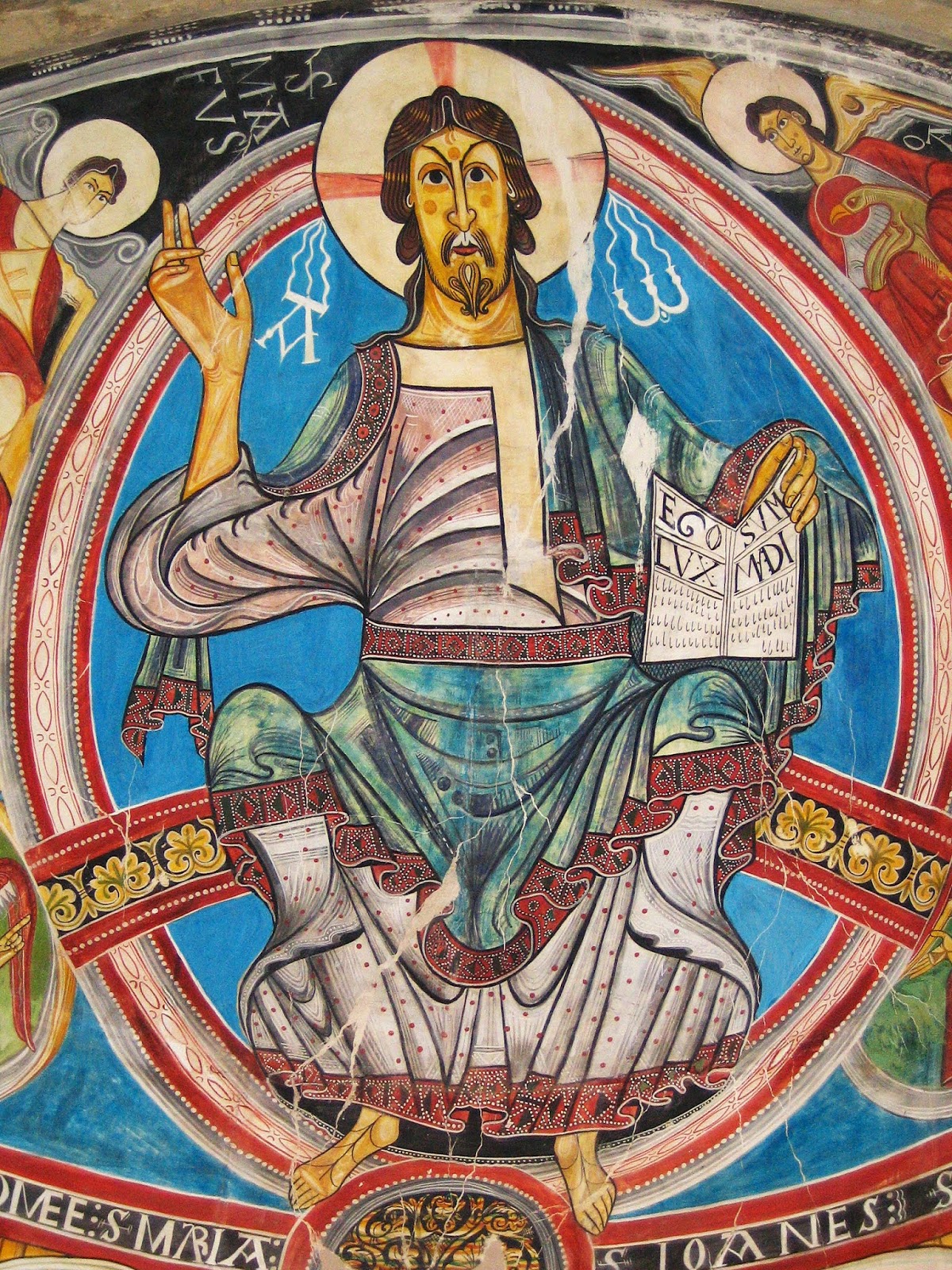
Jesus Pantocrator, National Museum of Catalunya, Barcelona. A Romanesque mural.


God so loved the world that he gave his only Son,
so that everyone who believes in him might not perish
but might have eternal life.
For God did not send his Son into the world to condemn the world,
but that the world might be saved through him.
Whoever believes in him will not be condemned,
but whoever does not believe has already been condemned,
because he has not believed in the name of the only Son of God.

-- John 3: 16-18

Today’s gospel reading seems to be a clear endorsement of the Lutheran doctrine of salvation by faith alone: believe in Jesus, and you are saved. Jesus will never condemn you, no matter what you do. It sounds like the ultimate “Get Out of Jail Free” card.

Fail to believe in him, and you are damned, no matter how sincere you are or what your virtuous works might be. Mahatma Gandhi? Most certainly burning in Hell.

But that is not what it means. God is neither than capricious nor that unjust.

Begin with the context, from which these words have been untimely ripped. These words are spoken by Jesus himself, to Nicodemus. It is therefore striking that he refers to “him,” not “me.” Why would he do that? Why the ungrammatical circumlocution?

In the last sentence, too, there is something else odd. Jesus says not “believed in the Son of God,” but “believed in the name of the Son of God.” What does it even mean to believe in or fail to believe in a name? “Yes, I devoutly believe that your name is Catherine and not Elizabeth”?

And if it is the name that is crucial, we are presumably all in trouble, for we actually do not know Jesus’s name. We are not certain how it would have been pronounced in Hebrew or in Aramaic in Jesus’s day, and we are not altogether certain which form he would recognize. Joshuah? Yeheshuah? Johashuah?

So we’re all going to hell.

The puzzle is perhaps partly produced in translation. The original Greek here, onomia, also means “name” in the sense of “reputation.” So the import is probably something like “has not believed in what the only Son of God stands for and represents.” Or, “what stands for and represents the only Son of God.”

There is perhaps a second implication as well. When asked what his first task would be were he ever given civil power, Confucius famously answered, “the first task is the rectification of terms.” That is, calling everything by its proper name, telling the truth; “calling a spade a spade.”

Belief in the “name” of the Son of God therefore means belief in truth, and our commitment to always seek the truth.

For Jesus himself says, in this same Gospel, that truth is what the Son of God represents. “I am the Way, the Truth, and the Light.”

This explains then why he cannot say simply to Nicodemus “believe in me,” or “believe I am the Son of God.” Nicodemus, who shows himself to be a literalist, would likely misunderstand it: he would be bound to take this in the literal sense, and think he was speaking simply of the historical person standing before him, Yeheshuah von Nazareth.

The passage immediately following this one makes things much clearer; you might say it throws light on the matter:

“And this is the verdict, that the light came into the world, but people preferred darkness to light, because their works were evil. For everyone who does wicked things hates the light and does not come toward the light, so that his works might not be exposed. But whoever lives the truth comes to the light, so that his works may be clearly seen as done in God.”

“Son of God,” therefore, = light, = morality, and = truth. In sum, the Logos. The fact that Joshuah also = the Son of God is not critical at this level.

And now we are back to works. To believe in the Son of God means not necessarily to believe in Yeshua ben Yusef, or in anything particular about him, but to believe in the light, the truth, the moral law. Anyone who does ultimately believe in truth, and the good, and submits to them wholeheartedly, will be saved. Anyone who does not, is already damned. They damn themselves.

This does not mean such a one will always tell the truth and do the right thing; for such sins, we will be forgiven, so long as we acknowledge the fault and preserve the intent. The problem arises when we no longer acknowledge sin, no longer acknowledge truth. This is what happens with settled vice. Then we begin to flee the light, to flee the truth, to deny the Son of God.

Only secondarily, we as Christians assert that anyone who is fully exposed to the reputation, the name, of Yeheshuah the Nazarene, will also acknowledge that he personifies Truth and Good. A good man will therefore recognize him as his proper Lord and Savior.

But it equally follows that a truly principled Buddhist or atheist will enter heaven. “I have other sheep that are not of this fold.”

The person who merely proclaims himself a Christian, on the other hand, instead of sincerely seeking the True and the Good, will not.

“Not everyone who says to Me, 'Lord, Lord,' will enter the kingdom of heaven, but he who does the will of My Father who is in heaven will enter.”


Wednesday, April 22, 2020

Doubting Thomas and Blind Faith


There is a disturbing element to last Sunday’s reading. I got distracted yesterday into writing once again about transubstantiation. I meant to write once again about salvation by faith alone.

Thomas, called Didymus, one of the Twelve,
was not with them when Jesus came.
So the other disciples said to him, “We have seen the Lord.”
But he said to them,
“Unless I see the mark of the nails in his hands
and put my finger into the nailmarks
and put my hand into his side, I will not believe.”

Now a week later his disciples were again inside
and Thomas was with them.
Jesus came, although the doors were locked,
and stood in their midst and said, “Peace be with you.”
Then he said to Thomas, “Put your finger here and see my hands,
and bring your hand and put it into my side,
and do not be unbelieving, but believe.”
Thomas answered and said to him, “My Lord and my God!”
Jesus said to him, “Have you come to believe because you have seen me?
Blessed are those who have not seen and have believed.”

It seems “Doubting” Thomas is criticized for not believing without evidence. This is a common reading of the passage. He should have believed it all without seeing the evidence for himself.

But this makes no sense. Why should anyone believe anything without evidence? Why should this be considered admirable, instead of merely credulous? If we are to believe without evidence, how do we choose what to believe, and what not to believe? What if we are told the moon is made of emerald Camembert?

I think the passage must be read differently. Those who believe without having seen are being congratulated for their good luck, not commended. “Blessed” can obviously have this meaning. When Jesus says, in the Beatitudes, “blessed are those who mourn,” surely he is not saying we have a moral duty to mourn without cause. “Lucky for you if you can believe without evidence.”

True faith is not blind, and is not an act of arbitrarily believing this or that in order to be saved. That is not faith in God; that is usurping the powers of God. It requires faith to pursue the logic and evidence relentlessly, fearlessly, humbly, wherever it leads. To assert a truth because you want it to be true, because you think it will gain you something to believe it, is the opposite of faith.

Accordingly, as Descartes for one demonstrated, doubt is the foundation of all faith. Thomas is modelling the proper attitude.

Jacob wrestling with God at the Jabbok River demonstrates it too. 


Jacob was left alone, and wrestled with a man there until the breaking of the day. When he saw that he didn’t prevail against him, the man touched the hollow of his thigh, and the hollow of Jacob’s thigh was strained as he wrestled. The man said, “Let me go, for the day breaks.”

Jacob said, “I won’t let you go unless you bless me.”

He said to him, “What is your name?”

He said, “Jacob.”

He said, “Your name will no longer be called Jacob, but Israel; for you have fought with God and with men, and have prevailed.”

For this, he won the name that he has passed down to all his descendants, “Israel.” The name means “Wrestles with God.”

Any truly religious person must know such nights. It is the man who is forever engaging with God who has true faith.


Monday, April 20, 2020

Salvation by Grace and Salvation by Works


St. Peter denies he knows Jesus.

With the pandemic, church services are being streamed live. That has its upside. This Sunday, I was able to virtually attend two I probably never would have gotten to if it had been in person, but two I was curious about: a small Pentecostal group, of which a friend’s nephew is pastor, and a Byzantine-rite Catholic mass.

They were more or less at opposite ends of the spectrum in terms of worship style. The Pentecostals very informal, just singing, praying together, and a sermon. The Byzantines all ritual; all sung and with lots of responsorials. The priest would stop the cantor if he was doing it wrong.

I loved them both. I am, at heart, a Charismatic Catholic. That’s combining the two.

But in terms of theology, I found the Pentecostal service lacking, even troubling. The message of the sermon was that God loves you, no matter when you have done. God does not care what you have done; his love is infinite and unconditional. “That was yesterday.” Repent, and all is forgotten.

That is a consoling message, no doubt, to those aware of grave sin. It is not so consoling to those who have been sinned against.

“Amazing Grace, how sweet the sound
That saved a wretch like me.
I once was lost, but now am found;
Was blind, but now I see.”

The legend goes that “Amazing Grace” was written by a former slave trader. Consoling, no doubt to him; but would it be equally consoling to the slaves?

Nor is it healthy for sinners. I can easily imagine an alcoholic hearing all this, that he is forgiven, and going out and having a drink to celebrate.

After all, it does not matter; he cannot justify himself by works. God loves him unconditionally. He will forgive him again tomorrow.

Nor does it match Jesus’s message. He is forgiving of the woman taken in adultery; he is not forgiving of the scribes and Pharisees. He is forgiving of Peter, who betrayed him three times. He is not forgiving of Judas, who betrayed him. He forgives the good thief on his right; he does not forgive the other thief on his left.

There is an obvious and dramatic distinction made in the New Testament, between forgiven and unforgiven, sheep and goats.

And being sorry is not enough. Judas is sorry.

“Then Judas, who betrayed him, when he saw that Jesus was condemned, felt remorse, and brought back the thirty pieces of silver to the chief priests and elders, saying, ‘I have sinned in that I betrayed innocent blood.’”

Part of the issue is indeed repentance; but just as a sin, to be mortal, must be grave, intentional, and fully understood, so a valid repentance must fully recognize and accept the gravity of the sin. It must be heartfelt. And such an acceptance of the gravity of the sin necessarily includes a sincere desire to make restitution, and accept just punishment, for the sin. It cannot involve any motive of getting away with anything.

This is a common misunderstanding of the Catholic sacrament of confession/reconciliation. No, you do not get off punishment once you have confessed your sin. That is why a penance is imposed. That is what purgatory is for. You preserve your salvation, but you do not escape punishment.

Jesus does not impose any further punishment on the woman taken in adultery; but we can probably assume she has already been sufficiently punished for the sin, without meriting death. She has already been publicly shamed, a public shaming that will follow her throughout life, which she will forever struggle to live down. He forgives the good thief—but the good thief is already undergoing extreme punishment for his sins, a punishment he explicitly admits he deserves.

He forgives Peter for denying him three times on the night he is crucified. He does not forgive Judas, and the Bible does not forgive him. But there is a relevant passage later in the Gospel of John. Jesus appears after the Resurrection, and speaks to Peter:

So when they had eaten their breakfast, Jesus said to Simon Peter, “Simon, son of Jonah, do you love me more than these?”

He said to him, “Yes, Lord; you know that I have affection for you.”

He said to him, “Feed my lambs.” He said to him again a second time, “Simon, son of Jonah, do you love me?”

He said to him, “Yes, Lord; you know that I have affection for you.”

He said to him, “Tend my sheep.” He said to him the third time, “Simon, son of Jonah, do you have affection for me?”

Peter was grieved because he asked him the third time, “Do you have affection for me?” He said to him, “Lord, you know everything. You know that I have affection for you.”

Jesus said to him, “Feed my sheep. Most certainly I tell you, when you were young, you dressed yourself and walked where you wanted to. But when you are old, you will stretch out your hands, and another will dress you and carry you where you don’t want to go.”

Why does he ask the same question three times?

Peter had denied knowing him three times.

Because he had denied him, now Jesus gives him the commission to witness to him three times, despite all dangers—clearly linking it to the earlier denial. This is Peter’s penance.

Salvation by grace alone subverts the Gospel.


Monday, January 27, 2020

The Purpose of the Moral Law


Romans 3:

Now we know that whatever the law says, it says to those who are under the law, so that every mouth may be silenced and the whole world held accountable to God. Therefore no one will be declared righteous in God’s sight by the works of the law; rather, through the law we become conscious of our sin.

But now apart from the law the righteousness of God has been made known, to which the Law and the Prophets testify. This righteousness is given through faith in Jesus Christ to all who believe.
This passage is commonly used by Protestants to justify Luther’s idea of “salvation by faith alone.”

I think they are missing it.

Nothing here suggests that the Law—the moral law—has been superseded. No; through it “the whole world” is to be held “accountable to God.” It “testifies” to whatever Jesus represents.

To suggest that nobody can fulfill the law—that nobody is justified by it—is a very different thing from saying that nobody should try to fulfill the law, or that it is irrelevant to try.

And the difference is exactly that between a good and a bad person, between Jesus’s sheep and goats on Judgement Day.

The real point of the law, Paul explains, is to make us conscious of sin. “Through the law we become conscious of our sin.”

This involves accepting that we are not, ourselves, God; we are imperfect beings. That there is a Being and an objective moral standard that is more important than ourselves and our desires.

Which is no doubt why Jesus says, in the Beatitudes, “blessed are the meek.” With William Blake’s useful clarification: “humble before God, not before men.” Jesus himself was hardly humble in the latter sense.

When Paul says it is faith in Jesus Christ that justifies us, he does not mean faith in, say, the historical accuracy of the gospel record, or faith in the proposition that the historical person we know as Jesus of Nazareth was the son of God. He does not mean calling upon the name “Jesus” in prayer.

For if he meant only using that name in prayer, “Jesus,” it would be nonsensical. That is not even the man’s real name; it is a conventional Latinization. And how is anyone to blame if they do not know it?

If he meant belief in the proposition that the gospel is historically accurate, or that this man was the son of God, the standard is both nonsensical and immoral: morality consists in seeking truth based on the best evidence available, not in arbitrarily declaring true what you want to believe. And were it the latter, what makes one arbitrary belief better than another? On what grounds could we choose one over the other, and how could God hold us accountable if we chose wrongly?

Paul must be referring here to faith in Christ in a cosmic sense: “the Way, the Truth, and the Light,” as Jesus identifies himself in the Gospel of John.

That is the Logos: the moral law and the truth. One is justified by one’s commitment to the moral law, and one’s commitment to truth. This is distinct from always obeying the moral law—it is an acceptance that one is bound by it.

I am the Way: Morality is naturally imaged as a “way,” and the metaphor is used elsewhere in the Gospels: “Enter through the narrow gate. For wide is the gate and broad is the road that leads to destruction, and many enter through it.” Or St. John in the wilderness: “’Prepare the way for the Lord, make straight paths for him.’"

I am the Light: “light” is defined elsewhere in the Gospel of John to refer to both morality and truth:

“Light has come into the world, but people loved darkness instead of light because their deeds were evil. Everyone who does evil hates the light, and will not come into the light for fear that their deeds will be exposed. But whoever lives by the truth comes into the light, so that it may be seen plainly that what they have done has been done in the sight of God.”

This is no doubt why Jesus says, in the Beatitudes, “Blessed are those who hunger and thirst after righteousness”: the blessed are those who believe deeply in the moral law.

And, no doubt, “Blessed are the pure in heart”: those who do not dissemble or operate on ulterior motives.

For theirs is the Kingdom of Heaven.