


Find out by checking out our SubStack feed. Free to subscribe!


Catholic comments on the passing parade.


 Posts
All Comments
Posts
All Comments

 |
| Lucifer in Hell; as conceived by Dante and Dore. |
To some who were confident of their own righteousness and looked down on everyone else, Jesus told this parable: “Two men went up to the temple to pray, one a Pharisee and the other a tax collector. The Pharisee stood by himself and prayed: ‘God, I thank you that I am not like other people—robbers, evildoers, adulterers—or even like this tax collector. I fast twice a week and give a tenth of all I get.’
“But the tax collector stood at a distance. He would not even look up to heaven, but beat his breast and said, ‘God, have mercy on me, a sinner.’
“I tell you that this man, rather than the other, went home justified before God. For all those who exalt themselves will be humbled, and those who humble themselves will be exalted.”
This parable, the gospel reading at last Sunday’s mass, identifies pride as the one unforgivable sin.
And it is. It is the source of all sin. Pride is the sin of Lucifer, and of Eve (“you shall be as gods”). It is the sin the Greeks called hubris; what modern psychology calls “narcissism.”
As the parable says, all sins are forgiven so long as you are humble. And so long as you are proud, no virtues count. Pride or humility is the entire ball game. What could be clearer?
This is surely the sense in which Jesus says we must be like little children to enter the kingdom of heaven. Little children are not moral; they do not always behave well. But they think of themselves as little, incapable, needing guidance and help. This is the attitude we need to have towards God.
People speak of “Catholic guilt,” as if guilt were a bad thing. But that is the whole point of Christian morality. “I want you to be perfect, as your father in heaven is perfect.” None of us can achieve that. All of us will sin.
That is the point. The point is to stay humble.
This is one more reason why I deeply dislike “happy happy joy joy” Christianity. The minute we decide we are in the clear, we are lost. Blessed are those who mourn.
A caveat: anti-Christian bullies will use this against Christians, demanding they humble themselves and submit to the bully—and to the general consensus. William Blake said, “humble before God; not before men.” Humbling yourself to the mighty in this world is not moral. It is just cowardice and cunning. John the Baptist did not humble himself before Herod. The Old Testament prophets did not humble themselves before the kings and queens of Judea and Israel. Jesus did not act humbly at the temple, nor speak humbly of himself at the synagogue. Saint Dymphna did not submit humbly to her father the King; nor Saint Francis to his father the rich merchant.
We must serve the Truth, and not either ourselves or he powers and principalities of this dark world. We must “work out our salvation in fear and trembling.”
Friend Maximilian sends a video clip of Irish comic Dave Allen. The gag is that Catholics think only Catholics go to heaven. And he points to a comment: “I always thought every religion thinks that way.”
Actually, only some fundamentalist Protestants think this way: that only “born again” members of their own denomination get to heaven. This is a reasonable conclusion from Martin Luther’s doctrine of “salvation by faith alone.” If you are saved by your belief, you must have the correct belief to be saved.
For the Catholic Church, however, this position is heretical. Yes, non-Catholics can get to heaven. Google “Feeneyism”; and note the ethnicity of the name. Like Allen, and, indeed, like Maximilian, Feeney was Irish. Due to long contact and subjugation, Irish Catholics have often picked up Protestant heresies. Don’t ask me about my own Irish “Catholic” upbringing.
This does not quite mean that Catholics believe “all good people go to heaven.” Rather, to be clear, all who sincerely seek truth, as well as striving to do what is morally right, get there. Faith is involved. If this search for truth nevertheless does not lead them to Catholicism, so long as they are sincere in their beliefs, they are protected from guilt by what Catholics refer to as “invincible ignorance.” Indeed, so long as anyone seeks truth, they are a follower of Christ: “I am the way, the truth, and the life.”
The same is true for Jews, Hindus, or Buddhists: none of them think you must be formal members of that religion to achieve heaven, or enlightenment, or blessedness. It is only Protestants; and not even all Protestants. Many Anglicans, for example, are “latitudinarians.” Yet the fundamentally Protestant background to English-speaking culture leads many to assume that this is the standard among all religions.
Maximilian objects, “What about the Muslims and the Jews?” He was clearly thinking of the situation in Gaza.
Being a leftist, he was at the same time taking the “plague on both your houses” position, supposing the Jews were equally responsible for the hostilities. Or rather, to avoid blaming anyone for their actions, religion was. If we could only get rid of religion, we would all live in peace and harmony.
Hamas started the war, of course, not Israel.
There is surely an ethnic more than a religious distinction between the two sides. One fifth of the population of Israel is Muslim. Before Hamas took over, the PLO led the fight against Israel; and the PLO was Marxist, not Islamist. George Habash, leader of the more radical Popular Front for the Liberation of Palestine, was Christian, not Muslim. The conflict pre-existed any religious justification for it.
So does Islam hold that you must be a Muslim to go to heaven?
Islam, too, believes you do not have to be a formal member of the faith to get to heaven. “Islam” means “submission.” Anyone who submits to the will of the one God is “Muslim.” Muslims will therefore argue that Islam is the world’s oldest faith, and that Jesus and Moses and Abraham and St. Francis of Assisi were all Muslims.
Islam is, however, almost uniquely, a political as well as a religious doctrine. By its standards, the only government that is ever legitimate is an Islamist government, imposing the laws laid out in the Quran and Hadith.
This does not mean all others must convert: but they must submit to being governed by the shariah law.
This is akin to the demands of liberalism, enshrined in the UN’s Universal Declaration of Human Rights, that all governments must recognize certain human rights and democratic principles in order to be legitimate. It is an ideological or political issue, not a religious one.
In both cases, it is based on an appeal to divine authority. It is because God says so: “endowed by their creator.” “The laws of nature and of nature’s God.”
So, the problem is not religion; it is this annoying concept of human rights.
For the sake of world peace, should human rights be banned? Show of hands?
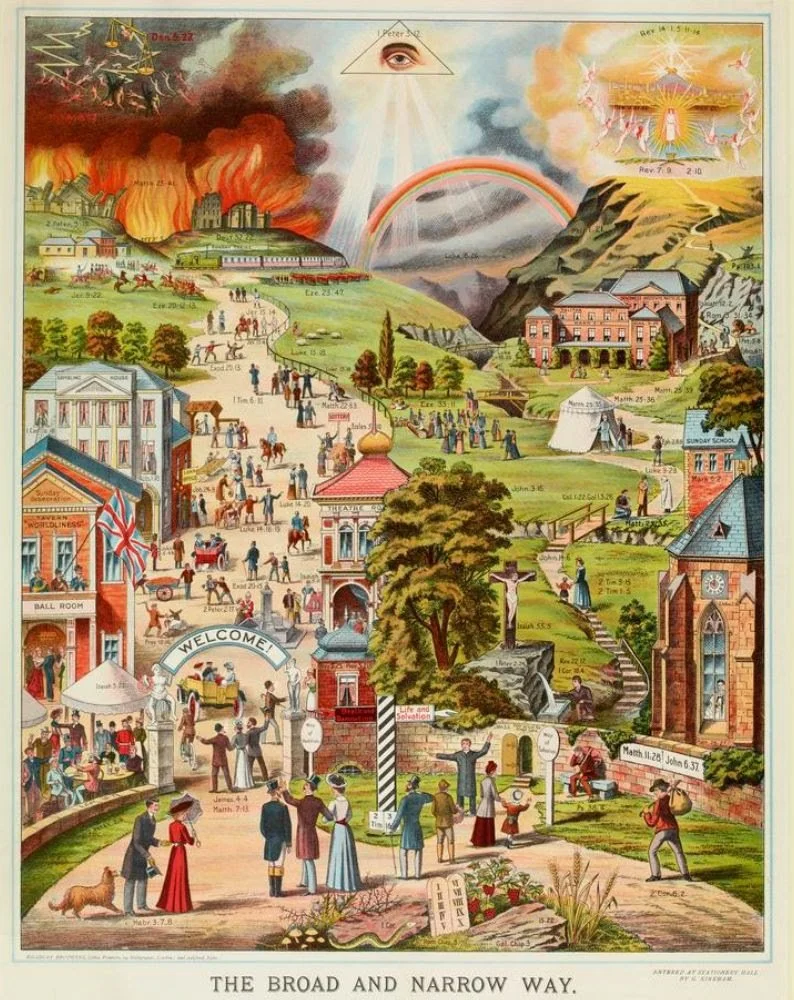
There are suggestions in the Bible that few people make it
to heaven.
“Narrow is the path that leads to life, and few find it.”
Many read the book of Revelations to say that only 144,000
all told make it to heaven.
The visionaries of Fatima saw multitudes falling into hell.
This is troubling.
I wonder, however, if this is literal. It sounds to me like
the Buddha’s description of upaya in the Lotus Sutra: whatever is
necessary to lure the children out of the burning building. It is perhaps not
so much an accurate description of the population of Hell or the consequences
of sin, as a strategic or rhetorical device to illustrate the right path.
The point may more accurately be, we cannot get to heaven by
going along with the crowd; by doing what everyone else does.
This is necessarily true, because going along with the
crowd, or with others around us, or the social consensus, avoids making moral
decisions; so we cannot be earning merit even if the deed is objectively good.
It is the easy way, and, if by chance also the moral way, as Jesus says, “you
already have your reward.”
But the situation is worse than that. Any crowd or social environment
will tend toward the evil. As the Bible says, the Devil is the prince of this
world. Those guilty of sin will have a vested interest in promoting that sin, encouraging
others to that sin, avoiding personal responsibility for it. Those who go along
will go along, making the sin conventional. As happened in Sodom and Gomorrah; or
the world before the flood; or among the Canaanites or Carthaginians, who
practiced child sacrifice; or the extermination of Jews in Nazi Germany; or slavery
in so many countries; or abortion today. The worse the sin, the stronger the
social pressure to condone it. So as not to cause a fuss.
“The best lack all conviction, while the worst
Are full of passionate intensity.”
So going along with the crowd, a failure to take moral
responsibility, is doubly culpable. It is doing objective evil, and refusing to
take responsibility for it. Taken together, that looks like turning away from God himself, the sin
against the Holy Spirit.
But does this interpretation give us any greater hope? Surely,
by definition, if going along with the crowd leads to hell, most people must therefore
be destined for hell.
Not necessarily. It is actually possible that “the crowd” or
“the social consensus” is not the majority. It could be only the largest single
group, the one that speaks with one voice, even if most people approach issues
individually—since, after all, those who think for themselves do not operate as
a crowd.
It is the NPCs; joined in Hell, of course, by those who
think for themselves but have chosen evil.
What proportion is that of the general population? Your guess is probably as good as mine.
There are suggestions in the Bible that few people make it to heaven.
“Narrow is the path that leads to life, and few find it.”
Many read the book of Revelations to say that only 144,000 all told make it to heaven.
The visionaries of Fatima saw multitudes falling into hell.
This is troubling.
I wonder, however, if this is literal. It sounds to me like the Buddha’s description of upaya in the Lotus Sutra: whatever is necessary to lure the children out of the burning building. It is perhaps not so much an accurate description of the population of Hell or the consequences of sin, as a strategic or rhetorical device to illustrate the right path.
The point may more accurately be, we cannot get to heaven by going along with the crowd; by doing what everyone else does.
This is necessarily true, because going along with the crowd, or with others around us, or the social consensus, avoids making moral decisions; so we cannot be earning merit even if the deed is objectively good. It is the easy way, and, if by chance also the moral way, as Jesus says, “you already have your reward.”
But the situation is worse than that. Any crowd or social environment will tend toward the evil. As the Bible says, the Devil is the prince of this world. Those guilty of sin will have a vested interest in promoting that sin, encouraging others to that sin, avoiding personal responsibility for it. Those who go along will go along, making the sin conventional. As happened in Sodom and Gomorrah; or the world before the flood; or among the Canaanites or Carthaginians, who practiced child sacrifice; or the extermination of Jews in Nazi Germany; or slavery in so many countries; or abortion today. The worse the sin, the stronger the social pressure to condone it. So as not to cause a fuss.
So going along with the crowd, a failure to take moral responsibility, is doubly culpable. It is doing objective evil, and refusing to take responsibility for it. Taken together, that looks like turning away from God himself, the sin against the Holy Spirit.
But does this interpretation give us any greater hope? Surely, by definition, if going along with the crowd leads to hell, most people must therefore be destined for hell.
Not necessarily. It is actually possible, if not probable, that “the crowd” or “the social consensus” is not the majority. It could be only the largest single group, the one that speaks with one voice, even if most people approach issues individually—since, after all, those who think for themselves do not operate as a crowd.
It is the NPCs; joined in Hell, of course, by those who think for themselves but have chosen evil.
What proportion is that of the general population? Your guess is probably as good as mine.
 |
| John at the Jordan |
If anyone sees his brother sinning, if the sin is not deadly, he should pray to God and he will give him life. This is only for those whose sin is not deadly. There is such a thing as deadly sin, about which I do not say that you should pray. All wrongdoing is sin, but there is sin that is not deadly.
We know that anyone begotten by God does not sin; but the one begotten by God he protects, and the Evil One cannot touch him.
We know that we belong to God, and the whole world is under the power of the Evil One.
We also know that the Son of God has come and has given us discernment to know the one who is true. And we are in the one who is true, in his Son Jesus Christ. He is the true God and eternal life.
Children, be on your guard against idols.
This passage from the First Epistle of John, the first reading at last Sunday’s mass, is challenging.
First, it says “We know that anyone begotten by God does not sin.” This seems to contradict the Catholic position that we are all sinners. If this is so, if Christians cannot sin, there ought to be no need for the sacrament of confession.
Second, it says you need not pray for those guilty of grievous sin. Aren’t we supposed to pray for everyone? Aren’t we supposed to love our enemy, and seek the best for them?
Third, it affirms that the true follower of Christ is capable of telling who else is and is not true. So much for the popular doctrine that we are not to judge, not “be judgemental.” Apparently we can judge, reliably.
Fourth, it declares that “the whole world is under the power of the Evil One.” Surely a surprise to any “Hallelujah Chorus” or “prosperity gospel” Christians. And anyone who thinks they can live a Christian life reconciled to the world.
These issues are interconnected.
As to the first point, other translations render “We know that anyone begotten by God does not sin” as “will not continue to sin,” “will not persist in sin.” The literal translation from the Greek is “not continues to sin.” This can be read not as meaning we will not sin once we believe in God, or that we will not persist in sin, which is to say, develop a vice. Because a vice, a kind of addiction, surrenders a part of our will, the vices are often conceived of as independent spirits, demons. Hence, developing a vice counts as “the Evil One touching us,” getting his hands on us. When we develop a vice, we “belong” to the Evil One, and no longer to God.
This fits with the distinction between ordinary sins and “deadly sins” in the reading (the Greek is literally “sin unto death”). When we pray for someone who has sinned, we are presumably praying for their soul, that they do not fall into vice. If they have fallen into vice, there is no more we can do.
The vices are, after all, called the “Seven Deadly Sins.” They are deadly because they are settled habits. They both persist, in principle unto death, and are the death of the soul. If they can ever be escaped, it takes a miracle.
If this seems harsh, it seems to be the attitude of John the Baptist in the Gospel. He calls to repentance: and the people come out into the desert. If they do, expressing thereby their repentance, he washes them of their sins.
But not everyone.
But when he saw many of the Pharisees and Sadducees come to his baptism, he said unto them, O generation of vipers, who hath warned you to flee from the wrath to come?
They are not welcome to repent. Either it is an impossibility, or else it offends divine justice.
And John the Baptist seem fully capable of judging them on sight.
This is also the obvious sense of Jesus dividing mankind onto sheep and goats, and condemning goats to the eternal fire.
Consider now the last words of this passage, “Children, be on your guard against idols.”
Vices, because they take over the will, are demons. They are idols. When you develop a vice, you have surrendered your will to some idol.
Acts 4: 8-12
Peter, filled with the Holy Spirit, said: “Leaders of the people and elders:
9 If we are being examined today about a good deed done to a cripple, namely, by what means he was saved,
10 then all of you and all the people of Israel should know that it was in the name of Jesus Christ the Nazorean whom you crucified, whom God raised from the dead; in his name this man stands before you healed.
11 He is the stone rejected by you, the builders, which has become the cornerstone.
12 There is no salvation through anyone else, nor is there any other name under heaven given to the human race by which we are to be saved.”
Lumen Gentium:
16. Finally, those who have not yet received the Gospel are related in various ways to the people of God. In the first place we must recall the people to whom the testament and the promises were given and from whom Christ was born according to the flesh. On account of their fathers this people remains most dear to God, for God does not repent of the gifts He makes nor of the calls He issues. But the plan of salvation also includes those who acknowledge the Creator. In the first place amongst these there are the Muslims, who, professing to hold the faith of Abraham, along with us adore the one and merciful God, who on the last day will judge mankind. Nor is God far distant from those who in shadows and images seek the unknown God, for it is He who gives to all men life and breath and all things, and as Saviour wills that all men be saved. Those also can attain to salvation who through no fault of their own do not know the Gospel of Christ or His Church, yet sincerely seek God and moved by grace strive by their deeds to do His will as it is known to them through the dictates of conscience. Nor does Divine Providence deny the helps necessary for salvation to those who, without blame on their part, have not yet arrived at an explicit knowledge of God and with His grace strive to live a good life. Whatever good or truth is found amongst them is looked upon by the Church as a preparation for the Gospel. She knows that it is given by Him who enlightens all men so that they may finally have life. But often men, deceived by the Evil One, have become vain in their reasonings and have exchanged the truth of God for a lie, serving the creature rather than the Creator, Or some there are who, living and dying in this world without God, are exposed to final despair. Wherefore to promote the glory of God and procure the salvation of all of these, and mindful of the command of the Lord, "Preach the Gospel to every creature", the Church fosters the missions with care and attention.
An interesting theological back-and-forth on YouTube, based on last Sunday’s first reading, from Acts, given above. It is a topic of deep interest to me. For some years, I could not see myself as a Catholic due to the misunderstanding that the Church held that only Catholics could be saved. This is obviously wrong, and offensive. No just God would accept this.
So I agree with Bishop Barron, and disagree with Father Goring, here. On the other hand, Bishop Barron is too eager to allow everyone into heaven. Dr. Martin adds a valuable corrective.
To accept Jesus as God is not simply to acknowledge “Jesus” as the name of God. This is silly and trivial. It is not to declare oneself Catholic without actually studying the teachings of the Church, and sincerely believing them. To do this is to follow the Evil One, having “exchanged the truth of God for a lie.”
Jesus is not just a guy. He is the Cosmic Christ: the Logos of creation. He is the Way, the Truth, and the Light. The person who follows Jesus and is a member of his Church is the person who sincerely and wholeheartedly seeks the way, the truth, and the light.
Any nominal Catholic who has not made a sincere effort to examine the faith, or is not fully in agreement with it, is not Catholic, and is emphatically not saved. Conversely, any Muslim of Buddhist who has made a sincere effort to examine their faith, and is fully in agreement with it, and seeks wholeheartedly to do as it requires, is a true follower of Christ, a true Christian, and is saved. The Church is the community of believers, living and dead. These people are members in good standing.
Bishop Barron focuses on conscience: he seems to say that anyone who sincerely follows his conscience is saved. This is not true; I agree with Father Goring on this. As Dr. Martin points out, this overlooks the critical last three sentences of Lumen Gentium 16. One must not just seek the Good, but also Truth.
Dr. Martin holds that the great majority of humanity is doomed to hell. He cites Matthew 7:
Enter through the narrow gate. For wide is the gate and broad is the way that leads to destruction, and many enter through it. But small is the gate and narrow the way that leads to life, and only a few find it.
I’m not sure this is what that passage means. It means one must seek truth and morality for oneself, not simply do what those around you are doing. We must examine the stones the builders have rejected.
It does seem to me that most people avoid making choices about truth and morality by simply doing this, by going along to get along. Anyone who does this is condemned. They are not following God or Jesus: they are following society, profit and self-interest.
This does appear to be the majority of mankind.

These are the words of consecration at the mass:
“the bread we offer you: fruit of the earth and work of
human hands, it will become for us the bread of life.
“the wine we offer you: fruit of the vine and work of
human hands, it will become our spiritual
drink.”
I suddenly realize it is significant that the bread and wine
have two sources: nature plus human effort. This is their essential nature, and
this is why they are the things we consecrate.
They are works of art, in the proper sense: they are
co-productions of God and man.
This is the divine plan of salvation: God made the natural
world to be perfected by man in art. God offers each of us grace and salvation,
and it is up to us to respond and to work with it, as in the creation of art.
This is the contrast between the wine of the Eucharist, and
the apple of Eden.
We are saved by art—not just the fine arts, but by every
craft and skill. We are made, in Genesis, to be gardeners. We are made out of red
clay by Yahweh, as a pot is made, and made in his image—to be potters. We are to imitate Christ--and Christ was a carpenter.
Through each work of art, we are building the New Jerusalem.
 |
| St. Peter denies he knows Jesus. |
“Amazing Grace, how sweet the sound
That saved a wretch like me.
I once was lost, but now am found;
Was blind, but now I see.”
So when they had eaten their breakfast, Jesus said to Simon Peter, “Simon, son of Jonah, do you love me more than these?”
He said to him, “Yes, Lord; you know that I have affection for you.”
He said to him, “Feed my lambs.” He said to him again a second time, “Simon, son of Jonah, do you love me?”
He said to him, “Yes, Lord; you know that I have affection for you.”
He said to him, “Tend my sheep.” He said to him the third time, “Simon, son of Jonah, do you have affection for me?”
Peter was grieved because he asked him the third time, “Do you have affection for me?” He said to him, “Lord, you know everything. You know that I have affection for you.”
Jesus said to him, “Feed my sheep. Most certainly I tell you, when you were young, you dressed yourself and walked where you wanted to. But when you are old, you will stretch out your hands, and another will dress you and carry you where you don’t want to go.”

Now we know that whatever the law says, it says to those who are under the law, so that every mouth may be silenced and the whole world held accountable to God. Therefore no one will be declared righteous in God’s sight by the works of the law; rather, through the law we become conscious of our sin.This passage is commonly used by Protestants to justify Luther’s idea of “salvation by faith alone.”
But now apart from the law the righteousness of God has been made known, to which the Law and the Prophets testify. This righteousness is given through faith in Jesus Christ to all who believe.
“Light has come into the world, but people loved darkness instead of light because their deeds were evil. Everyone who does evil hates the light, and will not come into the light for fear that their deeds will be exposed. But whoever lives by the truth comes into the light, so that it may be seen plainly that what they have done has been done in the sight of God.”


