Playing the Indian Card

Showing posts with label Protestantism. Show all posts

Sunday, March 24, 2024

Catholicism and the Bible


A friend of mine who is a Protestant minister put a post critical of Catholicism up on Facebook a few days ago. It has now disappeared from her feed. It listed a series of Catholic dogmas which were purportedly “not in the Bible.” 

I assume she got some pushback from Catholics, or even from fellow Protestant ministers, and thought better of it. 

Catholic teaching is always Biblical, in the sense that the Bible is the primary evidence for the teaching. It is always an inference from the text. One can, no doubt, have other interpretations. But if your interpretation is different, you need to make your argument.

But there is a more fundamental problem with this charge: it assumes the doctrine of “sola scriptura,” that all truth comes from scripture. This is a Protestant tenet, not a Catholic one. It is from Martin Luther. So even if you could establish that some Catholic teaching is not “in the Bible,” you have only proven that Catholicism is not Protestantism. Science is also not Protestantism. This does not prove that it is wrong.  

And, for Protestants, from whence comes the assurance that the Bible as we have it is complete, accurate, and authoritative? What gives them such assurance? Private revelation?

The Catholic answer is that its accuracy is certified by the Catholic Church, which selected and preserved this canon. Jesus gave his mandate to the church, not to a book of writings. “You are Peter, and on this rock I will build my church.” (Granted, this itself is recorded in the Bible) So the Bible cannot logically disprove Catholicism; Catholicism proves the Bible.


Monday, April 20, 2020

Salvation by Grace and Salvation by Works


St. Peter denies he knows Jesus.

With the pandemic, church services are being streamed live. That has its upside. This Sunday, I was able to virtually attend two I probably never would have gotten to if it had been in person, but two I was curious about: a small Pentecostal group, of which a friend’s nephew is pastor, and a Byzantine-rite Catholic mass.

They were more or less at opposite ends of the spectrum in terms of worship style. The Pentecostals very informal, just singing, praying together, and a sermon. The Byzantines all ritual; all sung and with lots of responsorials. The priest would stop the cantor if he was doing it wrong.

I loved them both. I am, at heart, a Charismatic Catholic. That’s combining the two.

But in terms of theology, I found the Pentecostal service lacking, even troubling. The message of the sermon was that God loves you, no matter when you have done. God does not care what you have done; his love is infinite and unconditional. “That was yesterday.” Repent, and all is forgotten.

That is a consoling message, no doubt, to those aware of grave sin. It is not so consoling to those who have been sinned against.

“Amazing Grace, how sweet the sound
That saved a wretch like me.
I once was lost, but now am found;
Was blind, but now I see.”

The legend goes that “Amazing Grace” was written by a former slave trader. Consoling, no doubt to him; but would it be equally consoling to the slaves?

Nor is it healthy for sinners. I can easily imagine an alcoholic hearing all this, that he is forgiven, and going out and having a drink to celebrate.

After all, it does not matter; he cannot justify himself by works. God loves him unconditionally. He will forgive him again tomorrow.

Nor does it match Jesus’s message. He is forgiving of the woman taken in adultery; he is not forgiving of the scribes and Pharisees. He is forgiving of Peter, who betrayed him three times. He is not forgiving of Judas, who betrayed him. He forgives the good thief on his right; he does not forgive the other thief on his left.

There is an obvious and dramatic distinction made in the New Testament, between forgiven and unforgiven, sheep and goats.

And being sorry is not enough. Judas is sorry.

“Then Judas, who betrayed him, when he saw that Jesus was condemned, felt remorse, and brought back the thirty pieces of silver to the chief priests and elders, saying, ‘I have sinned in that I betrayed innocent blood.’”

Part of the issue is indeed repentance; but just as a sin, to be mortal, must be grave, intentional, and fully understood, so a valid repentance must fully recognize and accept the gravity of the sin. It must be heartfelt. And such an acceptance of the gravity of the sin necessarily includes a sincere desire to make restitution, and accept just punishment, for the sin. It cannot involve any motive of getting away with anything.

This is a common misunderstanding of the Catholic sacrament of confession/reconciliation. No, you do not get off punishment once you have confessed your sin. That is why a penance is imposed. That is what purgatory is for. You preserve your salvation, but you do not escape punishment.

Jesus does not impose any further punishment on the woman taken in adultery; but we can probably assume she has already been sufficiently punished for the sin, without meriting death. She has already been publicly shamed, a public shaming that will follow her throughout life, which she will forever struggle to live down. He forgives the good thief—but the good thief is already undergoing extreme punishment for his sins, a punishment he explicitly admits he deserves.

He forgives Peter for denying him three times on the night he is crucified. He does not forgive Judas, and the Bible does not forgive him. But there is a relevant passage later in the Gospel of John. Jesus appears after the Resurrection, and speaks to Peter:

So when they had eaten their breakfast, Jesus said to Simon Peter, “Simon, son of Jonah, do you love me more than these?”

He said to him, “Yes, Lord; you know that I have affection for you.”

He said to him, “Feed my lambs.” He said to him again a second time, “Simon, son of Jonah, do you love me?”

He said to him, “Yes, Lord; you know that I have affection for you.”

He said to him, “Tend my sheep.” He said to him the third time, “Simon, son of Jonah, do you have affection for me?”

Peter was grieved because he asked him the third time, “Do you have affection for me?” He said to him, “Lord, you know everything. You know that I have affection for you.”

Jesus said to him, “Feed my sheep. Most certainly I tell you, when you were young, you dressed yourself and walked where you wanted to. But when you are old, you will stretch out your hands, and another will dress you and carry you where you don’t want to go.”

Why does he ask the same question three times?

Peter had denied knowing him three times.

Because he had denied him, now Jesus gives him the commission to witness to him three times, despite all dangers—clearly linking it to the earlier denial. This is Peter’s penance.

Salvation by grace alone subverts the Gospel.


Thursday, August 16, 2012

United We Fall


The United Church is making news over the last few days, because they are holding their General Council. The big news is that delegates are entertaining resolutions against the Northern Gateway Pipeline and affirming a boycott of Israeli goods.

Yes, this is a church.

Oddly, they seem to be getting the most flak in the mainstream media for the move that is most germane to their nature as a church: passing a resolution against gossip. Aka, as good Catholics know, the sin of calumny. Apparently, an interest in actual morals is out of fashion.

They are also adding officially a new statement of doctrine, the “Song of Faith,” poetic in a way only a committee could accomplish. The point, it seems, is simply to be as vague as possible. Something good poetry, of course, never is.

How about their position on Scripture? Just try to work it out from the relevant passage:

Scripture is our song for the journey, the living word

passed on from generation to generation

to guide and inspire,

that we might wrestle a holy revelation for our time and place

from the human experiences

and cultural assumptions of another era.

God calls us to be doers of the word and not hearers only.


The Spirit breathes revelatory power into scripture,

bestowing upon it a unique and normative place

in the life of the community.

The Spirit judges us critically when we abuse scripture

by interpreting it narrow-mindedly,

using it as a tool of oppression, exclusion, or hatred.

They do work in some politics:

We are all touched by this brokenness:

the rise of selfish individualism

that erodes human solidarity;

the concentration of wealth and power

without regard for the needs of all;

the toxins of religious and ethnic bigotry;

the degradation of the blessedness of human bodies

and human passions through sexual exploitation;

the delusion of unchecked progress and limitless growth

that threatens our home, the earth;

the covert despair that lulls many into numb complicity

with empires and systems of domination.

We sing lament and repentance...

Apparently, it is important in the United Church to have the right politics, but your opinions on matters of religion are pretty much up to you.

In the meantime, one further story getting a little attention is the decline in United Church membership. Its high-water mark was 1965, with a million members (note that not all “adherents,” i.e., folks who consider themselves United Church, are “members”). It is now only half that, and the average age of members is 65. In other words, no new members are coming in; it is just a matter of time until all the current members die off.

This seems a natural consequence of the path the church has taken. If your interest is religion, why join a religion that has no interest in it? If, on the other hand, your interest is politics, why join a church instead of a political party?

I fear this path in turn is a natural consequence of a “bottom-up” church membership structure. The average person is not all that religious, and not all that moral. If you make the average person the arbiter of your church, you have nowhere to go.

This seems to be a recurring problem for Protestantism. The fires burn bright, the spirit speaks clearly, for a generation or so. Then the decline is swift, and the spirit moves on.

In these cases, politics becomes the obvious substitute for religion, because it offers a cheap moral justification. Having the right politics is painless. And it "proves" you are "moral," one of the chosen; you can then feel righteous while going about doing what you damn please.

Thursday, October 28, 2010

More on Luther and Islam


Luther burns the Papal Bull.


A friend who is schooled in Medieval History has been good enough to review my recent piece on Luther and Islam and give his possible objections to the thesis that Luther was influenced by Islam. Here are his comments and my responses. We'll call him Albertus Magnus:


Albertus:
Thomas More is known for the pleasure he took in making ad hominem arguments. Why didn't he throw this one at Luther, that he was a closet Mohammedan?


Abbot:
I think that reputation comes specifically from More's response to Luther's attack on Henry VIII's defense of the sacraments. Here's a choice passage translated into the English vernacular:

“Come, do not rage so violently, good father; but if you have raved wildly enough, listen now, you pimp. You recall that you falsely complained above that the king has shown no passage in your whole book, even as an example, in which he said that you contradict yourself. You told this lie shortly before, although the king has demonstrated to you many examples of your inconsistency ....

But meanwhile, for as long as your reverend paternity will be determined to tell these shameless lies, others will be permitted, on behalf of his English majesty, to throw back into your paternity's shitty mouth, truly the shit-pool of all shit, all the muck and shit which your damnable rottenness has vomited up, and to empty out all the sewers and privies onto your crown divested of the dignity of the priestly crown, against which no less than against the kingly crown you have determined to play the buffoon.

In your sense of fairness, honest reader, you will forgive me that the utterly filthy words of this scoundrel have forced me to answer such things, for which I should have begged your leave. Now I consider truer than truth that saying: 'He who touches pitch will be wholly defiled by it' (Sirach 13:1). For I am ashamed even of this necessity, that while I clean out the fellow's shit-filled mouth I see my own fingers covered with shit.”
St. Thomas More, sketch by Hans Holbein.


Thomas More was a very good writer; his Utopia is a classic of English Lit. He is using irony very nicely here. I think his point is as he states it—he is deliberately adopting Luther's own tone and turning it back at him, “throwing back into your paternity's shitty mouth all the shit that it has vomited up.” Henry VIII no doubt felt it far too far beneath his dignity to reply in kind himself. Indeed, so did More—he published the defense pseudonomously. To say that he “took pleasure” may be true, but it is purely an inference, and an inference going counter to his own professions in doing it.

It is only just and fair to fight fire with fire; and everyone has the inalienable right to self-defense. This hardly makes both sides equally guilty.

Ergo, More at least, on this example at least, is not a salient counter to my point that Catholic writers were just too sincere and academically well-bred to make such accusations as “closet Muslim” against Luther. More, even if he were aware of Luther being influenced by Islam, could only have used that claim here if Luther had already made the accusation against Henry.

Albertus:
There is another example of a Catholic apologist taking the gloves off; why didn't he, too, accuse Luther of Mohammedanism? One of the first people to write against Luther, named Cochlaeus, titled one of his pamphlets "Against the Cowled Minotaur of Wittenberg." An idea he proposed somewhere was that Luther's career as so-called reformer was simply a matter of the old rivalry between Augustinians and Dominicans getting out of hand. I don't know if he was entirely serious in saying so or in what spirit he said it.


Abbot:
Nor I, but from what you quote, it sounds as though Cochleaus's spirit is more good-naturedly humorous than angry. To call someone a “cowled minotaur” might easily be an expression of respect—suggesting someone formidable in the mazes of scholarly argument.

The mild tone here would actually tend to support my thesis. Accusing Luther of being an overly-partisan Augustinian? It reminds me of a little book I picked up somewhere of early WWII British propaganda, called “Adolf in Blunderland.” It portrayed Hitler, of course, as Alice, and as a bit of a confused naive, and began by apologizing for the thing obviously being propaganda, but “turnabout is fair play.” Read today, it seems absurdly pusillanimous. If the Brits could so misread Hitler, even after the war had begun, when we now find his mendacity and evil so obvious he is more or less considered evil incarnate, it seems possible enough that the Catholics could have misread Luther, even all along.

Not to say Luther is the devil incarnate. Just that he might well have been influenced by Islam without this being pointed out.
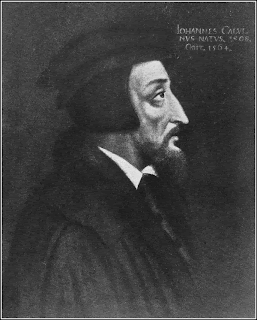

Calvin, without Hobbes.


Albertus:
The two sides don't appear to have held back in throwing whatever they had against one another. An example (maybe pertinent to your thesis) is that Protestants accused Catholics of being Judaizers for their supposed attachment to works and for other reasons; and Catholics accused Protestants of being Judaizers for their scripturalism and for other reasons. Everyone accused the Anabaptists of Judaizing. No one I've heard of said anything about Islam, but not, apparently, because they were all too inhibited to say nasty things (Judaizer -- not a compliment -- and other things) against one another. And if one side had consisted of only fair-minded disputants and it honestly believed that the other was influenced by Islam, of course it would have said so. If you believe that the accusation of Judaizing was a fair one and was deserved, then you should agree that a fair accusation of Islamizing would have been made, by the same token.


Abbot:
Albertus, you are a Jew. No offense intended. You know this, but our learned audience may not. I think you are guilty of a common and very odd Jewish misconception here; one that I have heard many times. Thanks for giving me the chance to point it out.

No, calling someone a “Judaizer” would not be an insult among Christians.

Even very well-educated Jews seem convinced that Christians are somehow opposed to Judaism. Here's simple proof that they are wrong: Luther quite openly and publicly revised his Bible to reflect the Jewish one. No secret, and nobody on either side thought this discredited him in any way. Just the reverse—the Jews were respected as an authority on these books at least arguably higher than that of the Church councils, otherwise infallible. That's pretty high praise.

Just stop and think: the Hebrew scriptures are well over half of the Christian Bible. When Christians read these books, do you really think they are despising the people they read about? Do you think they see them as an alien people? Do they scorn Moses, Abraham, Isaiah, Solomon, David, and the Maccabees? Or Jesus, Peter, and Paul, for that matter? Of course not. They--we--read it, with the conviction that we are the Hebrews. Everyone and anyone who has grown up as a devout Christian, be assured, believes in his heart that he is a Jew.

It is no coincidence that fundamentalist Christians tend to be strong supporters of the state of Israel. The identity is intense.

Jews do not seem to get this. It seems to be important to their (your) self-identity instead to suppose that Christians are against them. A Jewish fellow grad student in religion at Syracuse once informed me solemnly, as if she were the expert on the Christian education system, and I as a Christian would not know, that all Christians are taught that “the Jews killed Christ.” When I told her I had gone to Catholic schools all my elementary years, and never heard this, she advised me that my school must have been unusually liberal. It wasn't—for one thing, it wasn't just one school I went to, but several. For another, my family, and Gananoque, where I mostly grew up, as a community, were culturally and politically conservative, not liberal. Moreover, I have asked other Catholics, and none have ever remembered being taught anything of the sort. Not suprisingly: it would be obvious theological nonsense. If one Catholic were to suggest such a thing to another Catholic, he would probably be laughed at, even if not condemned for racism. (Can't vouch for Protestants).

Yet this seems to be an article of faith among even very well-educated Jews, even those specializing academically in Comparative Religions, and even in the face of obvious empirical evidence: if the Christians have all been taught this, how is it they do not know they have been taught this?

Also at Syracuse, more or less of a piece with this, one semester I signed up for a course on the Holocaust, taught by some renowned Jewish scholar, there as a guest lecturer for a semester. She began the first class, on the first day, with the unsubstantiated declaration that “the Jewish question is the central issue of all European history.”

I dropped the class the same day; I knew no independent thought would be permitted, nor clear reasoning presented, and it would be a waste of a semester.

My ancestors are from Ireland. I'm quite sure the very last thing they had on their mind over the last two thousand years, or the last five hundred, was “the Jewish question.” And I'm sure this was always true for the vast majority of the population of Europe. Most probably lived their lives having never seen a Jew, and having no idea what a Jew was, had they cared. Jews here indulge in pure paranoid thinking. They seem convinced the rest of the world spends all their free time trying to figure out new tortures for Jews.

Of course, the interfaith contact between Jews and Christians, and Jews and Muslims, has not always been sweetness and light. Of course, Christianity has specific theological disagreements with Judaism. But the most remarkable thing about it all is this: there are still Jews. This cannot be said of any other significant European or North African or Middle Eastern faith group of comparable antiquity, can it? Never mind faith group: probably not of any other group ethnically distinct on any other grounds left without a geographical home for a comparable length of time. Where on the streets of modern Toronto (and leaving aside pop cult pseudo-religions without any historical pedigree) are the followers of Mithras, or Orpheus, or Pythagoras, or Sol Invictus, or the mystery religions, or Isis?

This is the great miracle. Leaving aside Divine Providence, as we certainly should not, the obvious principal reason Judaism, by contrast to all imaginable others, has survived, is surely the innate respect it commands in the other Abrahamic religions that have embraced it in their bosoms. That is the bottom line: R-E-S-P-E-C-T, not hostility.

I think it can be argued—indeed it has been argued—that the holocausts and pogroms have mainly come precisely where the fabric of Christianity (or Islam) has been somehow torn, usually by the rise of secularism, removing the Jews' protective gabardine cloak (or perhaps, cloak of many colours). Nazi Germany would be the prime example.


Huss.


It is very dangerous to Judaism, and to Jews, not to mention interfaith relations, that Jews do not seem to recognize this. Tragically, the average Jewish intellectual seems always assiduously to be sawing at the branch he is sitting on.

So, in sum, the cases are not parallel. To call someone a Judaiser would have been as likely to be praise as blame. Hence no ad hominem. But to call someone a Muslimizer would have been an accusation of cultural treason. It was not the Jews mustering at the gates of Vienna.

So actually seeing the connection would not have been sufficient reason for a Catholic apologist to make the charge. It could well have been considered beyond the pale.

(Ah, there's another example of Jewish paranoia. I have had Jewish friends inform me that the English expression “beyond the pale” refers originally to the Jewish settlements in Russia. Of course it doesn't. The original idiomatic “pale” was probably the one surrounding the English possessions in France, but a far earlier and the best-known pale in English is that which fenced out the native Irish in Ireland. For most of their history, truly, the English really were not that obsessed with where the Jews were living in Russia.)

Albertus:
If the accusation was plausible and even deserved, how could it have been a secret to the entire Catholic Church, a learned institution that had been interrogating suspects (including Huss and Wycliff) regarding their religious beliefs for centuries and recording detailed confessions of all kinds?

SR:
As above, I have no reason to assume it was a secret.

But, indeed, it might have been.

First, though, and most fundamentally, note that your argument here is simply an appeal to authority. This cannot be allowed in debate, because it preempts all debate in advance, and indeed all possibility of human progress. For example, one could as readily ask, “okay, if there really is an America, how come nobody ever discovered it before Columbus?” “If the theory of relativity is correct, how come nobody thought of it until Einstein?” “If it is really possible to fly a plane, how come nobody ever did it before the twentieth century?” And so on... The question presupposes that no new ideas are possible.

So this particular question need not be answered.

Nevertheless, I will answer it. First, regarding interrogations specifically, there is of course a natural human tendency not to self-incriminate. That should go without saying.

Second, besides it being entirely possible that many Catholics knew it, without saying it, and many Protestants knew it, without saying it, I think it is within the bounds of probability for us to have been blinded by our categorization system. Academics stick to their academic subject. Theologians study theology, and they tend to study it in isolation from history and geography. Geographers, conversely, rarely wade into the details of theology. To do so would be positively discouraged among academics—it smacks of dilettantism, and runs the risk of being made to look foolish or uneducated, surely any academic's greatest fear.

Accordingly, fresh insights are often possible when we knock down these walls and study two or three subjects in parallel—say, theology, history, and geography together.

Third, we tend to study only our own civilization, and even only our own national culture; this used to drive me mad as an undergrad. Doing so blinds us to the constant crossfire among different cultures. To cite an obvious and common, but infuriating, example, I was only a few hours ago reading an essay that remarked that such and such a large reptile species was only discovered a few years ago. Discovered by whom? In fact, it has probably been well known to humans for millennia, and was a common feature of the local diet in the area of the Philippines in which it was “discovered.” Discovered by academics from an English-speaking country—nobody else, apparently, is human. The classism and racism of this casual assumption is staggering, yet it is the way academics usually think.

Ergo, to many, even most academics, and specifically to those studying Christian theology, Islam and Muslim theology per se probably did not exist. It is even quite possible that Luther or Hus or Wycliffe got their ideas from Islam without knowing they were from Islam, picking them up more or less from the cultural backchatter on the quad—ideas in the air. I tend to give them credit for at least knowing whereof they spoke, though.

And fourth... see below.


Albertus:
For the record, each side had its mild and fair champions.


Abbot:
Nope, uh-uh, I won't let you get away with that one, Al. It's a question of morality. That's “moral equivalence.” That's the usual alibi of the innocent bystander, and there's none so guilty as the innocent bystander. While there may have been some harsh words on both sides, that does not mean they must have been equally harsh. To cite the obvious, extreme example, if there was some obvious bad feeling between the Nazis and the Jews in the 30s and 40s, and no doubt harsh words on both sides, it does not follow that they must have been equally guilty of the Holocaust. Don't pull a Pontius Pilate, Al. It's not very Magnus of you.

For my part, I find it striking that throughout the history since the Reformation, and continuing in the present day, Catholic thinkers and writers have generally tried to be rather scrupulous and fair—even to absurd lengths, to my mind—towards Protestant thinkers and Protestant doctrines, while Protestants seem completely unrestrained in attacking Catholics, up to and including lies and calumnies.

Case in point, on the Catholic side: I picked up Bokenkotter's A Concise History of the Catholic Church at my own church's bookshop. Obviously, then, a Catholic perspective. How does it treat Luther?

How compatible Luther's theology was with Catholic tradition is a question that has been debated ever since.... Unlike too many presentations at that time, it was ... profoundly biblical. ... a recent Catholic scholar has affirmed that the real paradox of the Reformation is that until the Council of Trent, Martin Luther was one of the few theologians in Germany who uncompromisingly defended the biblical and Catholic teaching of man's bondage to sin...” (p. 189)

And so on, in similar vein. Nicey-nice.

Meantime, some Protestants are still today writing tracts insisting that the Vatican is the “Scarlet Woman,” the “Whore of Babylon,” in Revelations.

As it happens, there is a theological reason for this.

Catholic” means universal. It is of the essence of Catholicism's self-conception that is sees itself as the guardian and embodiment of the consensus of all Christians. This comes, of course, from the Nicene Creed, which defines the true church as “one, holy, catholic, and apostolic.” There is, therefore, an intrinsic drive to see agreement among Christians whenever possible, and to woo outliers back into the fold rather than anathematize them. The separation with the Orthodox East is a wound to the Church's very being, to its self-perception. The separation with the Protestant North is a second, similar wound. The urge is therefore always to lure back the lost sheep.

The Reformed and Lutheran Churches, whether or not they accept the Nicene Creed, see things very differently. For them, the Bible is prior to the Creed. They look at the concept of “the Elect,” in Revelations, and in many of Jesus's words, and assume from this that most people are going to hell. Accordingly, it does not seem to them any kind of rebuke to themselves if they do not represent the broad consensus of all Christians. The broad consensus is the road to hell. That is, instead, cause for confidence that their particular denomination constitutes “the elect.”

Not to get sidetracked into how Catholics interpret these passages—I leave it at two words, purgatory, and works.

So, what to Catholics seems a “scandal,” to Protestants, seems a self-justification. It follows that their practical approach to the split will be different. The drive among Catholics is almost always to kiss and make up, to seek some consensus, while among Protestants it is generally to somehow prove that all Catholics are damned.

This is reflected, for example, in a huge body of “black legends”--of anti-Catholic propaganda—imbuing Protestant culture, and indeed English-language culture, as a result. You probably believe some of them yourself. Yet there is simply no equivalent body of “black legends” among Catholics or Catholic cultures about Protestantism. To cite just one classic example, Protestants almost always believe with some fierceness that the intention of the Medieval Catholic Church was to keep the common people ignorant, that Catholics do not read the Bible, are told not to read the Bible, and the Catholic Church fought against translating the Bible into the vernacular. This is more than just debatable-- it is wild-eyed, dishevelled-haired, false. Feel free to ask for other examples; I could fill books with them...and others have.

Nothing comparable on the Catholic side.

Refusing to mention the obvious similarities between Protestant and Muslim theology, even if they see them, could easily be an example of this approach. Pouring oil on troubled waters. Bringing up such ad hominems is not going to make reconciliation easier.

Meantime, as I said, the Protestant side cannot really be expected to blow the whistle on themselves.

Tuesday, October 19, 2010

Martin Luther and Islam


Our classification of the world of knowledge into different academic specialties can sometimes lead us to miss important connections. So can our division of the world of knowledge into different “civilizations”-- as if they never spoke to one another.

Take Martin Luther. Nobody ever seems to remark upon the obvious and detailed way in which his objections to the Catholic Church, and those of other early Protestants, reflected positions historically taken by Islam. No: to read all accounts, Luther was driven solely by what he saw in the Church of his day, never by any alternate model of which he might have become aware.

But how likely is this, really, given that, in Martin Luther's lifetime, Islam was making a serious bid to take over Europe, and most specifically, a serious bid to take over his own nation, the Holy Roman Empire? How could he not have been aware of it and of what it taught?

Review this timeline:


1389 – Ottomans take Serbia.

1396 – Ottomans take Bulgaria.

1416 – Jan Hus, in Bohemia, declares that popes should not take up the sword in the name of the Church.

1420-1432 – Hussite Wars in Bohemia.

1453 – Ottomans take Constantinople.

1463 – Ottomans take Bosnia.

1475 – Ottomans take Crimea.

1478 – Ottomans take Albania

1480 – Ottomans take Otranto, in Italy.

1498 – Ottomans take Montenegro.

1514 – Selim I of the Ottomans defeats the Shah of Iran and takes Tabriz, his capital. Eastern Anatolia and Kurdistan are annexed.

1517 – Selim I takes Syria, Palestine, Egypt, Mecca and Medina.

1517 – Selim is declared Caliph of Islam, and takes possession of the mantle and sword of Mohammed. This involves a claim to world rulership.

1517-1520 – Selim I preparing grand expedition against Hungary.

1517 – Luther nails his 95 Theses on the door of Wurms Cathedral.

1519 - Ottomans take Algeria.

1520 – The Ottoman Empire is now three times its size in 1500.

1520 – Luther publicly burns copy of canon law. He writes The Babylonian Captivity, his definitive break from Rome.

1521 – Suleiman takes Belgrade.

1521- Luther's “Here I stand” speech at Wurms.

1522 – Suleiman takes Rhodes.

1524 – Luther stops wearing the religious habit.

1525 - Luther takes a wife.

1526 – Suleiman takes Budapest, conquers Hungary, and arrives at the borders of the Holy Roman Empire.

1529 – (First) Seige of Vienna. Suleiman attacks with 325,000 men, 90,000 camels and 500 cannon.

1530 – Augsburg Confession

1531 – Luther declares Catholic priests and monks to be sodomites.

1531 - Smalkaldian Alliance of Protestant princes.

1532 – Second Seige of Vienna.

1533 – Ottomans take Mesopotamia.

1533 – John Calvin undergoes “sudden conversion.”

1535 – Henry VIII breaks away from the Catholic Church.

1536 – Calvin's Institutes of the Christian Religion

1536 – Geneva City Council passes Calvin's Genevan Confession

1538 – Barbarossa, the Ottoman admiral, destroys the combined fleets of Venice, Spain, and the Papal states, establishing Muslim dominance over the Mediterranean.

1539 – Luther endorses polygamy.

1543 – Ottoman navy takes Nice.

1543 – John Calvin founds his theocratic government in Geneva

1551 – Ottomans take Libya.

At the very least, some odd coincidences there. Are these matters unrelated?

Realistically, what would have happened had Vienna fallen? Those among the learned ready to leave the Catholic Church and convert to Islam would have moved up very quickly in the courts of the new Ottoman government. The Ottomans would have desperately needed a civil service both literate and fluent in the local vernacular.

Indeed, from 1453, if not before, what might an especially well-educated man have easily suspected to be the inexorable future of Eastern and Central Europe? H.G. Wells says it, in his Outline of History: “A man of foresight surveying the world in the early sixteenth century might well have concluded that it was only a matter of a few generations before the whole world became Mongolian [Wells counts the Turks as “Mongols”] -- and probably Muslim” (Wells, p. 582). This Muslim ascendancy continued until the Battle of Lepanto, in 1571, which finally, in Cervantes's words, “broke the pride of the Osmans and undeceived the world which had regarded the Turkish fleet as invincible.”

Did educated people in Europe really not know what was going on elsewhere? Not likely—especially in a time when the educated of Europe all read the same language, Latin. When the Hussites rose against Rome in Prague, for example, Joan of Arc off in France, herself not literate, sent a letter warning she might lead an army againt them. As the Ottomans conquered each succeeding country, peasants stayed on their lands if they could, and nobles too, perhaps, their wealth being based on their land. But wouldn't many members of the educated clerical classes choose to flee, to neighbouring Christian countries, bringing with them some reports of the conquerors and their views?

Martin Luther, 1526


Now let's consider the demands of the Hussites, the “first blush of the Reformation.” According to the relevant Wikipedia entry, they held:

  1. the Bible is the sole rule for human society
  2. the Bible is to be applied in both sacred and civil matters
  3. images of the saints are not to be used
  4. no intercession for the dead
  5. lay preachers
  6. no transubstantiation of the host. Communion is symbolic only.
  7. receipt of communion as both bread and wine
  8. hostility to the monastic orders

Commentary, on each element in turn:

  1. Bible alone. The idea of the Bible as the sole rule seems to come directly from Islam—in which, it has been said, the Qur'an takes the position held in Christianity by Jesus Christ. The “Word of God” in Islam is the holy book; in Christianity, until the Reformation, it was Jesus, the Logos. This doctrine, of “sola scriptura,” becomes fundamental to Luther as well.

  1. Bible as law. This violates the original Christian notion of a separation of church and state, as in Jesus's “render unto Ceasar what is Caesar's.” Pope and Emperor have always had separate spheres of influence, at least in principle. It is, however, central to Islam, in which the earthly ruler is expected, beginning with Mohammed himself, and continuing with the persons of the Ottoman Caliphs, to also be the supreme spiritual leader. This notion of the civil power being able to decide religious affairs is the cornerstone of Luther's later Smalkaldian Alliance; of Calvin's Genevan Republic; and of course of Henry VIII's policy of “Anglicanism.”

  1. No images. Though there is of course some sanction in the Bible, iconoclasm—the opposition to “graven images”--could easily also come directly from Islam. Wahhabi Muslims even today object in the strongest terms to images of the prophets (roughly equivalent to Catholic saints). One might think it could come also from Judaism—but excavations at Dura-Europos suggest that Judaism, too, got this from Islam. The synagogue there, built in the third century, is replete with images.

  1. No intercession. The objection to intercession for the dead can be understood as, and later explicitly became, a denial of the existence of purgatory. One was either saved or damned, a simply binary gate. There was only heaven and hell after this life. This conforms well with the Muslim conception, in which there are similarly no grey areas, and no purgatory. The denial of intercession for the dead was the original grounds, of course, for Luther's break with Rome.

  1. Lay preachers. This evolved into lay ministers in later Protestantism. The emphasis on laity and de-emphasis on a formal priestly office, again, seems to reflect a strong tendency in Islam, which opposes any professional priesthood. Every individual Muslim is supposed to read the Qur'an for himself, and leadership at services is by lay volunteers.

  1. No transsubstantiation. This de-emphasis on the ritual and sacramental elements of Christianity also conforms with Islam, which has no sacraments and no rituals. A Muslim service is simply prayer, no more and no less. This also eliminates the need for a priesthood.

  1. Communion in both species. This is one demand that seems to have nothing to do with Islam. But it would also be no problem for church authorities, then or now. If communion has traditionally been bread only, this is mostly because of the danger of communicating disease from a shared cup. This would have been an especially good idea at the time of the Hussites, when Black Plague was decimating Europe. The fact that priests always did themselves take the wine as well, however, might have made this seem, to Hussites, to be a kind of priestly privilege, and so this demand becomes part of their Islamist distain for a professional priesthood.

  1. No monks. Hostility to monasticism is very much in accord with the teachings of Mohammed, who declared “no monkery in Islam.” To Muslims, and to Protestants, it is wrong to withdraw from the world; to Muslims, and to Protestants, it is wrong to remain celibate. Luther personally took a wife, and went so far as to condone the practice of polygamy.

All these Hussite causes, in other words, are equally Muslim causes. They are all also Lutheran causes. Luther adds “sola fides,” the doctrine that salvation is accomplished by faith alone. This deemphasizes good works; it also deemphasizes reason. From the Muslim point of view, the rationalism of Catholic Christianity was a Greek intrusion on the pure original revelation. Sola fides is also in accord with the Muslim belief that what counts is “submission to God,” Islam, and not acts. Muslims are saved; infidels are damned.

A similar rush by intellectuals, by knowledge workers, to embrace the doctrines of an opposing power has happened many times in history. Julian Benda traces the phenomenon in his celebrated book La Trahison des Clercs. Like the Vicar of Bray, the bureacrats do whatever is necessary to preserve their power and the power of the bureaucracy. From 730 to 787, in the first blush of Muslim conquests, a similar sort of proto-Reformation broke out across the Byzantine Empire, indeed encouraged by the Emperor. This “iconoclasm” objected to the use of religious images of all kinds. In this case, the connection with Islam is clear, and uncontroversial: from 635 to 677, the Muslim Arabs were steadily annexing the lands of the Eastern Empire, culminating in 677 in a seige of Byzantium itself.

We have seen again a similar phenomenon in our own time. Throughout the Cold War, as Western democracies faced a massive military threat from the Marxist regimes of Russia and China, the average Wetern intellectual became convinced—and stayed convinced right up to 1989—that something like Soviet Communism was the world's future. From the fall of Fascism in the 40s, the faculty lounges of North America and Europe were steadily growing in their nominal admiration for Marx, Mao, Ho Chi Minh, and Che Guevara. Smart move, on the whole—no downside now, and if and when the Communists did take over, they might well keep their tenure.

Now that the most apparent threat has shifted to Islamism, so, with alacrity, are the faculty lounges. We have seen an odd alliance emerge of faculty Marxists with Islamists, against Israel and in oppostion to “Islamophobia.” The intellectual ground is shifting as we speak; in a generation or two, if Islamism retains its preeminence in opposition, university faculty generally will probably buy in in herds, and the present Marxism will be down the memory hole.

This all suggests, of course, pure mendacity on the part of the intellectuals. Benda called it “treason.” First, they seem insincere in claiming their positions are based on learning and reason, as opposed to power and their own class interests. Second, in political-military terms, it really is treason. What could be better calculated to weaken the West while in its mortal peril from the Ottomans than the Hussite demands and rebellion, the Lutheran demands and rebellion? These were Fifth Columns, very much in Franco's sense of the term.

So, of course, were the American academics who more recently opposed the Vietnam War, encouraged Mao, Ho, and Che, and called for unilateral disarmament. Not to mention those who praised Saddam and demanded a unilateral pullout from Iraq.

When future sources of power seem uncertain, it seems good sense to hike that clerical gown and climb onto the nearest fence. Ready to jump.

Such times are the times and trials that separate sheep from goats, and the sincere of the Beatitudes from the Pharisees.

To stay on the side of truth, and regardless of what we think of Islam, when seeking to learn from history, we should always decide in favour of the side that stood against the seeming tide of sheer self-interest.

I know my Protestant friends are not going to like this—and really, it's no reflection on them. But it is hard to see how Luther was anything more than a shrewd Pharisee.

That's one reason why I am Catholic.