Playing the Indian Card

Showing posts with label logos. Show all posts

Thursday, May 02, 2024

Withering on the Vine


Jesus said to his disciples:
"I am the true vine, and my Father is the vine grower.
He takes away every branch in me that does not bear fruit,
and every one that does he prunes so that it bears more fruit.
You are already pruned because of the word that I spoke to you.
Remain in me, as I remain in you.
Just as a branch cannot bear fruit on its own
unless it remains on the vine,
so neither can you unless you remain in me.
I am the vine, you are the branches.
Whoever remains in me and I in him will bear much fruit,
because without me you can do nothing.
Anyone who does not remain in me
will be thrown out like a branch and wither;
people will gather them and throw them into a fire
and they will be burned.
If you remain in me and my words remain in you,
ask for whatever you want and it will be done for you.
By this is my Father glorified,
that you bear much fruit and become my disciples."


This was last Sunday’s Gospel reading. 

It contradicts the Deist position, that scorns asking God for things in prayer. 

It contradicts the position that everyone is basically good, and everyone is equally a sinner: the “don’t be judgmental” pose. It instead makes a radical distinction, as the Gospels repeatedly do, between good people and bad people: the good bear much fruit, the bad are thrown into the fire.

The question: what is meant by “fruit”? 

If it means “good deeds,” the claim does not seem to work. Surely we all know of bad people, and of course atheists, who do some good things by an objective standard. Hitler was a vegetarian who was kind to his dog. He built some fine highways. The moral law, according to Christians, is binding on everyone, not only Christians.

And why would God “prune” those who do good deeds? “Every one that does he prunes so that it bears more fruit.” It sounds as though he is punishing his followers for doing good.

Nor can “fruit” have the most obvious meaning, children. Everyone can, in principle, have children if they so desire.

I think the passage works only if by “fruit,” the gospel means what we call art. As any true artist knows, you can do nothing alone. The work comes to you from somewhere else. Steven King describes it as a process of excavation. Michelangelo said he freed a figure that was already in the rock. In other words, it is inspired. By whom? By God. By Jesus, the Logos.

Hence, “without me you can do nothing.”

It continues to come so long as you are connected to Jesus as the Logos, that is, so long as you are sincerely aligned with truth, good, and beauty. The last thing an artist can ever do is lie. So long as you are fully committed to this, if you pray for inspiration, it will come. 

“If you remain in me and my words remain in you, ask for whatever you want and it will be done for you.”

If you are not committed to telling the truth, if you are trying to lie, promote what is sinful, or create something ugly, the inspiration will dry up, like a branch withers. 

“People will gather them and throw them into a fire and they will be burned.”

This is not a reference to hell as afterlife. God won’t do this, according to the passage. Their conscience won’t do it. That is what sends you to hell. People will do it. The audience, the readership, human posterity will do it. Their works will fail the test of time, and will not be preserved.

This all no doubt sounds wrong to many: since when were bohemians our standard for morality? Plato calls poets liars; fiction writers write fiction. Since when is this our standard for truth?

But that apparent dissonance is largely the fault of established religion, which is inevitably co-opted by pharisaism. Pharisees will hate the truth, and will malign and slander artists for it.

An art too is of course infested with poseurs. But that is the art that will not endure. 

Individual artists can also hold wrong beliefs, and be wrong in their behaviour. That does not change the equation, so long as they are sincerely seeking the true and the good. The thing is, they are sincerely seeking, not just accepting it from authority without consideration. They are communicating with the Logos, not the local magistrates.

And we cannot always believe what we hear about artists. They are obviously vulnerable to slander from the pharisees, who will see them as a threat, just as they saw Jesus and the prophets. One interesting datum: Jim Morrison, of the Doors, was legendary as a sexual predator. Yet not one paternity suit was ever filed against him. Despite his great wealth. How could that tally? Ray Manzarek, his bandmate and friend, insists he was entirely unlike the common portrayal.

And artists may even promote this reputation as outlaws, as it can gain attention for their art while protecting them from worse attacks. Morrison seemed to.

And if artists lead disordered lives, it may be as victims, not perpetrators. God does seem to “prune” artists. If this seems unjust, it also seems that suffering provokes art, just like pruning forces the tree to turn to fruit. “Behind every beautiful thing, there's been some kind of pain.” “You have to have suffered to sing the blues.”

This may be the universal justification for the existence of suffering: it leads us to truth, good, and beauty.

If we are not speaking of hell, what does it mean to wither, die, and be thrown into the fire? That can indeed also be a reference to hell in the afterlife. But perhaps we can see it in this life as well. Those who turn away from truth seem to lose all inspiration, and then seem to lose their will. They become like automatons, NPCs, in the grips of some vice or addiction. They live their lives with blinkers on, to avoid truth, and the blinkers keep getting larger until all is darkness, and they live in a deluded world.

In the truest sense, at this point, they have lost their soul. All that is left is ash.

The moral of this story is that we are created to create: made from the clay by the divine potter, and inspired by his own image, to go forth and create as he did.

Everything else in life is zero sum.


Friday, November 24, 2023

The Theology of Superman


Friend Xerxes has rejected monotheism in his latest column, on the grounds of that old saw about God logically not being able to create a stone too heavy for him to lift. Therefore, the concept of God as omnipotent is incoherent.

“Can God do anything?” the boy asked.

“Yes, dear,” said his mother.

“And God can make anything?”

“Yes, dear. That’s why we call him Creator.”

The boy asked, “So could God make a rock so big that even he can’t lift it?”

This is the “irresistible force meets immovable object” paradox. I remember it being the premise of a Superman comic as a child. Superman supposedly being both. It appears in China already in the 3rd century BC. 

Is it a problem for monotheism? No; there are two ancient responses.

It is a logical contradiction to posit that there can exist at the same time both an irresistible force and an immovable object. It is definitionally impossible. And the Christian response is that God is subject to logic, because logic is his own essence—the Logos. God cannot create a square circle, or a female male, or a married bachelor. So he cannot create both an irresistible force and an immovable object, existing at the same time. This is not a limit to his omnipotence, because if you abandon logic, “omnipotence” itself has no meaning.

If, on the other hand, you accept that God is not subject to logic, the problem or paradox still disappears. Then he could create a stone too heavy for him to lift, and lift it. This is only impossible if you accept the need to conform to logic, to Aristotle’s law of non-contradiction.

It is actually an argument for monotheism: if there cannot be both an immovable object and an irresistible  force, there can be only one God, one entity who is both immovable and irresistible.

The Christian belief, that God creates, abides in, and follows laws, gives birth in turn to science. Science is based on the premise that there is no such thing as chance, randomness, or coincidence. Everything has an explanation if we study it closely. As Einstein crudely put it, “God does not throw dice.” God creates and follows laws.

Xerxes then, predictably, raises the problem of evil: if there is a God, and God is good, why is there evil in this world?

And this question too is older than monotheism itself. With or without a God, why is there evil in the world?

The point is, monotheism provides an answer.

To begin with, how do you define evil? How do you know that a thing is evil?

Xerxes’s example is “a logging truck … crushing your daughter’s car.”

This is evil if you define evil as something you do not want. This is obviously a thing you do not want, and something your daughter did not want. 

But does that demonstrate that it is evil? Consider a small child wanting another chocolate before supper. Is it evil that his parents refuse it?

No; to simply define “good” as “getting what we want” is puerile. It also does not work if, say, what we want is something someone else has. Good instead means something like “justice” and what is best for all concerned.

Now, while we know that our daughter does not want to be hit b a logging truck and killed, do we know that it is best for her not to die?

We do not, because we do not know what comes after death. For all we know, death releases her from bonding into a much better life.

We also know we do not want suffering, either the physical pain she might experience in the crash, or our own loneliness at her sudden absence. But do we know that suffering is evil, in the sense of not being in our best interests?

The parent who refuses the child a chocolate makes him suffer. The parent who takes his child to the dentist makes him suffer.

What about the muscle strain and bruising you feel as you win the Grey Cup, or the intense soreness after? Seriously, would the win be as sweet if you had done it without any pain or effort? Is a film fun to watch if nothing bad or scary ever happens to the heroine throughout?

Suppose that ignorance is bliss, and beauty only comes with suffering. Would you rather have a frontal lobotomy and be ignorantly happy? To remain in a childlike or vegetative state? Or is it worthwhile to grow up into wisdom, responsibility, and creativity?

To be, with God, a co-creator?

To embrace logic, justice, and beauty?


Sunday, June 07, 2020

Does John's Gospel Promise Salvation by Faith Alone?


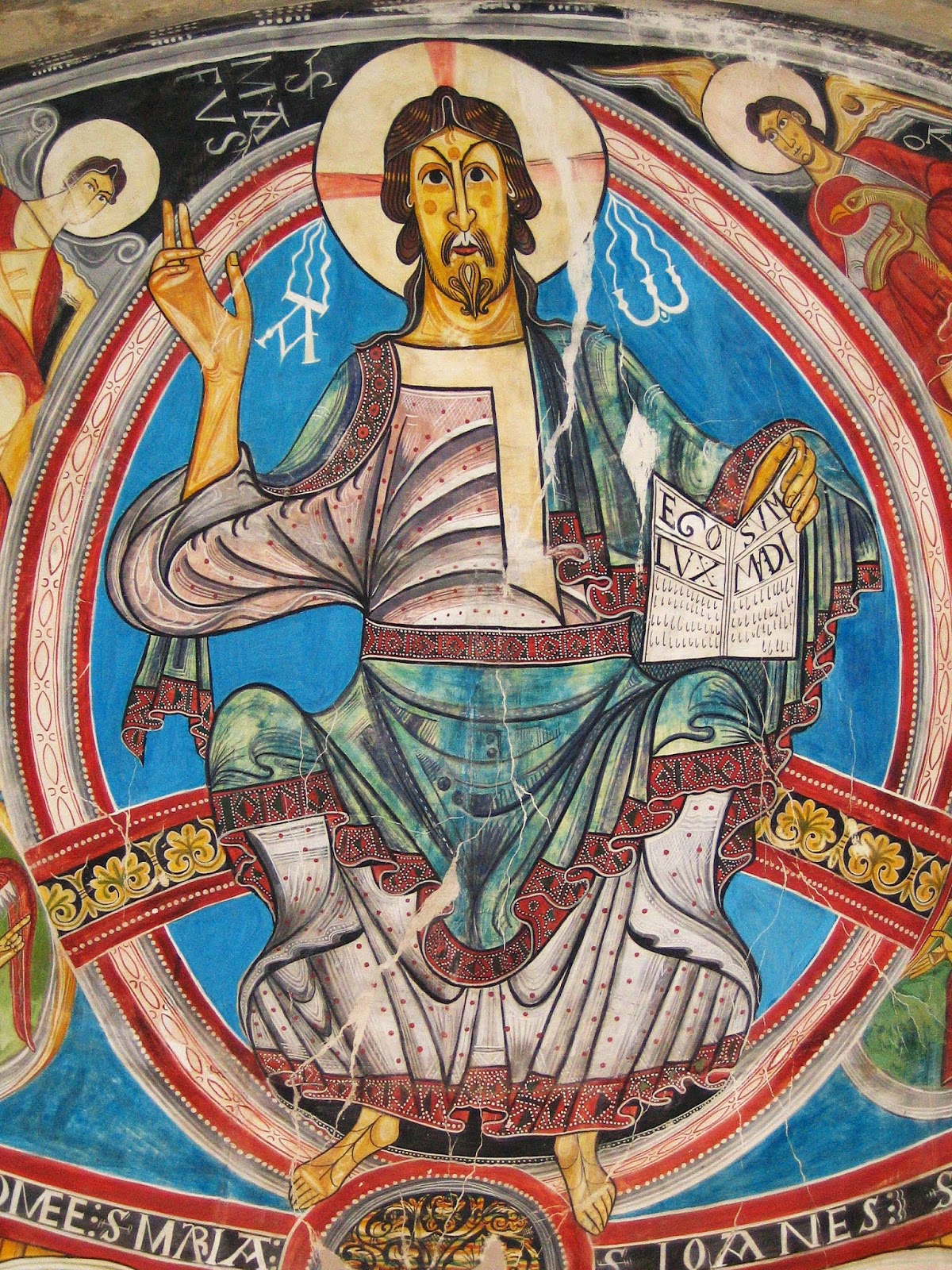
Jesus Pantocrator, National Museum of Catalunya, Barcelona. A Romanesque mural.


God so loved the world that he gave his only Son,
so that everyone who believes in him might not perish
but might have eternal life.
For God did not send his Son into the world to condemn the world,
but that the world might be saved through him.
Whoever believes in him will not be condemned,
but whoever does not believe has already been condemned,
because he has not believed in the name of the only Son of God.

-- John 3: 16-18

Today’s gospel reading seems to be a clear endorsement of the Lutheran doctrine of salvation by faith alone: believe in Jesus, and you are saved. Jesus will never condemn you, no matter what you do. It sounds like the ultimate “Get Out of Jail Free” card.

Fail to believe in him, and you are damned, no matter how sincere you are or what your virtuous works might be. Mahatma Gandhi? Most certainly burning in Hell.

But that is not what it means. God is neither than capricious nor that unjust.

Begin with the context, from which these words have been untimely ripped. These words are spoken by Jesus himself, to Nicodemus. It is therefore striking that he refers to “him,” not “me.” Why would he do that? Why the ungrammatical circumlocution?

In the last sentence, too, there is something else odd. Jesus says not “believed in the Son of God,” but “believed in the name of the Son of God.” What does it even mean to believe in or fail to believe in a name? “Yes, I devoutly believe that your name is Catherine and not Elizabeth”?

And if it is the name that is crucial, we are presumably all in trouble, for we actually do not know Jesus’s name. We are not certain how it would have been pronounced in Hebrew or in Aramaic in Jesus’s day, and we are not altogether certain which form he would recognize. Joshuah? Yeheshuah? Johashuah?

So we’re all going to hell.

The puzzle is perhaps partly produced in translation. The original Greek here, onomia, also means “name” in the sense of “reputation.” So the import is probably something like “has not believed in what the only Son of God stands for and represents.” Or, “what stands for and represents the only Son of God.”

There is perhaps a second implication as well. When asked what his first task would be were he ever given civil power, Confucius famously answered, “the first task is the rectification of terms.” That is, calling everything by its proper name, telling the truth; “calling a spade a spade.”

Belief in the “name” of the Son of God therefore means belief in truth, and our commitment to always seek the truth.

For Jesus himself says, in this same Gospel, that truth is what the Son of God represents. “I am the Way, the Truth, and the Light.”

This explains then why he cannot say simply to Nicodemus “believe in me,” or “believe I am the Son of God.” Nicodemus, who shows himself to be a literalist, would likely misunderstand it: he would be bound to take this in the literal sense, and think he was speaking simply of the historical person standing before him, Yeheshuah von Nazareth.

The passage immediately following this one makes things much clearer; you might say it throws light on the matter:

“And this is the verdict, that the light came into the world, but people preferred darkness to light, because their works were evil. For everyone who does wicked things hates the light and does not come toward the light, so that his works might not be exposed. But whoever lives the truth comes to the light, so that his works may be clearly seen as done in God.”

“Son of God,” therefore, = light, = morality, and = truth. In sum, the Logos. The fact that Joshuah also = the Son of God is not critical at this level.

And now we are back to works. To believe in the Son of God means not necessarily to believe in Yeshua ben Yusef, or in anything particular about him, but to believe in the light, the truth, the moral law. Anyone who does ultimately believe in truth, and the good, and submits to them wholeheartedly, will be saved. Anyone who does not, is already damned. They damn themselves.

This does not mean such a one will always tell the truth and do the right thing; for such sins, we will be forgiven, so long as we acknowledge the fault and preserve the intent. The problem arises when we no longer acknowledge sin, no longer acknowledge truth. This is what happens with settled vice. Then we begin to flee the light, to flee the truth, to deny the Son of God.

Only secondarily, we as Christians assert that anyone who is fully exposed to the reputation, the name, of Yeheshuah the Nazarene, will also acknowledge that he personifies Truth and Good. A good man will therefore recognize him as his proper Lord and Savior.

But it equally follows that a truly principled Buddhist or atheist will enter heaven. “I have other sheep that are not of this fold.”

The person who merely proclaims himself a Christian, on the other hand, instead of sincerely seeking the True and the Good, will not.

“Not everyone who says to Me, 'Lord, Lord,' will enter the kingdom of heaven, but he who does the will of My Father who is in heaven will enter.”


Wednesday, November 27, 2019

True Christianity


RIP

At my brother’s recent funeral (and PBOH, as the Muslims say), somebody spoke with a bit of a sneer of his “spirituality” --said as if in scare quotes -- presumably because he was not a Christian, and might have described himself as an atheist.

Here’s how that rolls out.

First Premise: the job of being human is the job of wholeheartedly seeking the Good, the True, and the Beautiful.

This is necessarily so because these three qualities are of intrinsic value. Their value does not derive from elsewhere.

This is also necessarily so because a good and honourable God would ensure that the proper purpose of life would be apparent to all mankind, at all times. It cannot be concealed only in this or that book or community.

The value of truth, moral good, and beauty is, moreover, as a visible fact, recognized worldwide regardless of religions. All of mankind indeed understands these value as self-evident. We may disagree about what is true, or good, but not about the desirability of the truth, or good.

Perhaps, it is true, this is less clear for beauty than for the other two. Just as lower animals cannot appreciate moral issues, some humans seem incapable of appreciating beauty. It requires a more refined soul. However, just as the fact that pigs have no morality does not disprove morality, the fact that some humans cannot appreciate beauty does not discount its value—so long as it is felt by all those who do appreciate it.

Second premise: one is not saved by saying one is Christian and going to church. One is not saved by mouthing the name “Jesus” in prayer. One is saved by accepting the cosmic essence of Jesus, the Logos, which Jesus identifies: “I am the way, the truth, and the life.” In other words, the moral path, the truth, and inspiration. The good, the true, the beautiful.

One can easily do this as a Buddhist, a Hindu, a Jew, or an atheist.

Jesus said “I have other sheep, which are not of this fold. I must bring them also, and they will hear my voice.” At the time, in context, he was no doubt speaking of non-Jews; but literally, he was speaking in general of people who had not yet heard of him. Until and unless all the world is nominally Christian, Jesus has sheep outside the nominally Christian fold.

If you claim to be a Christian, but do not sincerely believe Christian teachings, as in the Apostles’ or Nicene Creed, you are simply a Pharisee, a hypocrite. You are simply dishonest.

If anyone would assert that truth is a matter of exerting the will to believe, let him be anathema. He is not following God; he is declaring himself God.

It follows that, if you sincerely believe there is no God, and say and act so, you are a good Christian in the true sense of the word.

Similarly, if you claim to be a Christian, but do not practice the good as you see it--or do what Christianity teaches even though you do not believe it is good--you are simply a Pharisee, a hypocrite.

James 2: “What good is it, my brothers and sisters, if someone claims to have faith but has no deeds? Can such faith save them?”

And if you claim to be a Christian, are capable of appreciating beauty, and do not seek to nurture and sustain it, you are also a Pharisee and a hypocrite. This applies to both natural beauty and the beauty of art. It is the true basis of our ecological duties, for example.

The obligation to be Christian and to pray the name “Jesus Christ” simply follows from the fact that Christianity is true and a reliable moral guide. At the same time, if one is sincerely not personally convinced of that, to pretend otherwise would be deeply sinful.

It follows that my brother was, in fact, a very good Christian, and a far better Christian than one who would sneer at him and his values at his own funeral.

My brother lived his life seeking truth, and to be good, and, perhaps most of all, beauty.

A comment almost always heard from friends is about the utter sincerity of his smile and of his laugh. He was never deceitful, calculating, pretentious, or manipulative. He always lived the truth as he saw it.

Next, they always say what a gift he had for friendship. There are many stories of how much he would do for a friend. Throughout his life as I knew him, he never showed malice to anyone.

And last, he lived his life for beauty, both natural and artistic. His two great loves were music—he was a brilliant guitarist, and fostered other musicians far and wide—and the natural beauty of Canada’s Thousand Islands district, where he chose to live alone in the woods.

I believe my brother Gerry is a saint in heaven.