Playing the Indian Card

Showing posts with label sanity. Show all posts

Sunday, July 07, 2024

The Only Sane People in the World


I have lived in a number of countries around the world. One thing I have learned from that—the main thing—is that everyone is insane.

This should not be surprising. Every religion tells us so. Truth, enlightenment, is revealed only to a few. It might come as a surprise only if you buy into modern “scientific” psychology. Lacking any standard for truth or reality, it merely defines “sane” as “having the majority opinion.” That obviously does not work. It is a recognized logical fallacy: ad populum.

We all live on delusions. Francis Bacon classified the common sources centuries ago, and founded empirical science as a way to break through. It has not worked. Churchill once said something like, “Most people, if they stumble upon the truth, will just pick themselves up and dust themselves off.” Bertrand Russel once said, “Most of us would sooner die than know the truth. And most of us do.”

One of the standard sources of delusion, as Bacon shrewdly classifies them, is “idols of the tribe.” These are delusions shared by a social group, the members of which can easily mutually reinforce each other in the delusion. It is hard in isolation to persist in a delusion.  When everyone around you is agreeing with you, it is far easier. These delusions of the tribe are actually encouraged by psychology. Shared delusions tend to define a nation.

Living in another country, especially one with a significantly different culture, reveals these delusions. If unreflective, an expat will after a few months come to the conclusion that they are all mad here. If he is more thoughtful, and more self-reflective, he may conclude instead that he is mad. If more reflective still, he will realize that both are—or at least, he too had been, on this or that matter, before now. 

All that is a lead-in to this: not all nationalities are equally mad. In my still limited experience, North Americans, at least in these times, are profoundly mad. Madder than hatters. Thank me for sharing. The Chinese can always be counted on to be mad. The French are certainly mad. We all know about the Germans and their fits of madness. The Japanese are mad, Koreans are mad. These are beautiful cultures, perhaps the most impressive cultures, cultures in which education is highly valued. And one would expect education to be a cure for madness. Yet it can as easily be the reverse: it can be an education into the shared delusions. And great art can be the individual’s desperate attempt to break through the matrix of thyeir culture. Like the sand in the oyster’s shell that forms the pearl of great price.

 Italians are far less prone to be mad. Greeks are less prone to group madness. This despite their impressive cultures. But perhaps too, it explains why they are not as creative as they once were.

I probably can’t be objective about the Irish, but I think they are uncommonly sane.

But the sanest group of people I have ever had to deal with—and I have dealt with them quite a bit, largely for this reason—are the Filipinos. They are on the whole profoundly sensible, always with their two flat feet on the ground. Among other things, this makes them, contrary to what seems the stereotype, quite unromantic. They are, on the other hand, religious, and take seriously the other world. Being practical and non-delusional means you do take account of the spiritual world. 

Materialism is the greatest of our North American delusions.


Monday, July 25, 2022

Pandemonium


Canute explains global warming to his courtiers.

It is exhausting dealing with other Canadians; because most Canadians are insane. They believe in delusions. We noted the “chemical imbalance” theory of mental illness last post. It is nonsensical at best, yet over 85% of Canadians buy it.

Other examples abound. The average Canadian accepts as true that there has been a huge conspiracy in all cultures throughout history to oppress women. But they scorn "conspiracy theories" out of hand.  They believe that homosexuality is inborn, although this violates the Theory of Evolution, which they also believe. Any gene for homosexuality would be bred out within two generations. They believe that American Indians lived in peace and comfort until the evil Europeans arrived with their agriculture, technology, and law enforcement: the “noble savage” myth. They believe that building schools for the Indians was oppressive, demanding apology and reparations. They believe that a man can decide to be a woman; or be a woman because they believe so. But even though it is all in the mind, and biology doesn’t matter, it is still essential to give hormone blockers and cut off their genitals to suit. They believe, as King Canute never did, that the government of Canada can order the tides not to rise, or the equivalent: "global warming." Canada can apparently fix global warming with a carbon tax, though industry can simply move to China. They believe that by raising the price of carbon, the tax will cause everyone to use less of it. But a minimum wage, by raising the price of labour, will not cause anyone to use less of it. 

They believe, and will say in so many words, that there is no objective reality. 

This is the definition of insanity. It means no rational conversation is possible. How does one respond when talking to a madman? Just nod your head and back away? The main concern is that they may become violent.

Not a pleasant intellectual climate.

I think Jung had it right that the human mind is easily drawn by “archetypes” away from reality.

I may be too optimistic, but I feel not everyone is as crazy as Canadians are. I lived in the Philippines for years, and with a Filipina longer, and I do not think Filipinos are nearly as crazy.

I think the clue is in Chesterton’s observation that “those who stop believing in God will believe in anything.” We need meaning, and if we reject God, we will deify almost anything: science, nature, sex, Adolf Hitler, you name it. Call them archetypes, idols, pagan gods; it is the same thing. The Filipinos avoid this because they still, most of them, believe in God. Those who don’t are still kept relatively sane by those who do.

Most of the rest of us are spinning out of control. Things fall apart, the centre cannot hold. The best lack all conviction, while the worst are full of passionate intensity.


Friday, June 10, 2022

Send Out the Clowns


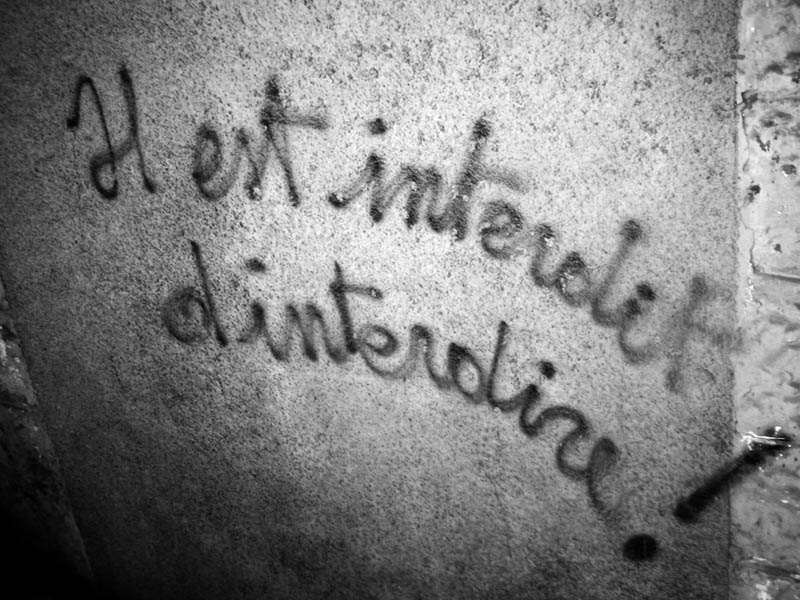
Graffito, Paris, 1968

Although she claimed on the stand that all she wanted was to put it all behind her, and she wished Johnny could do the same, Amber Heard refuses to put it all behind her. She continues to dog Johnny Depp on social media, claiming her defeat in court was a grave injustice to herself and for all women. Important elements of the legacy media, including the New York Times, seem to be taking the same stand. Ignoring the judgement of nine jurors who heard the evidence, and indeed of the vast majority of those who watched the trial online, they still insist that Heard was abused by Depp.

The problem is that, to the narcissist, the only definition of good and evil is that “good” is whatever is good for me, and “evil” is whatever is not. Accordingly, it is good to maintain that something untrue is true, if the lie is good for me. If it is best for women that we should believe all women, any evidence to the contrary must be declared evil and shouted down. And it does not matter what happens to any male as a result.

The issue is obvious to me because I grew up with narcissistic parents. I recall as late as my late twenties still trying to reconstruct, in light of my childhood, what “good” really meant, and what “real” meant. Any child of a narcissistic parent is bound to be confused on this, because what they have been taught is both wrong and, to anyone other than the narcissist, incoherent. What is good is whatever is good for my parent? What is real is whatever my parent says is real? Despite my senses, despite reason?

Living in the latter half of the 20th century, or the 21st, does not help. There is a narcissistic philosophy permeating society and its institutions, postmodernism or critical theory, sometimes called cultural Marxism. I can trace it back at least as far as the Frankfurt School. I think the Frankfurt School was a continuation in turn of a philosophy found in Nazism. A bit of graffiti seen during the Paris uprisings in 1968 read “Beware! Even the ears have walls!” The rebellion was against any concept of reality itself. Freedom meant freedom to invent and have “your own truth.”

Graffito, Paris, 1968

“Reality is a function of belief.” I remember that as a watchword back then; I thought it came from Kierkegaard, but perhaps not. Or Blake: “a firm persuasion that a thing is so, makes it so.”

It was seductive, and I was myself at least half seduced in grad school.

But thinking this is insanity, straight up; and sanity is being aware of the good and the true. 

We live today in a world gone mad.


Wednesday, January 12, 2022

Playing the Fool


Basil the Blessed, a celebrated Russian "fool for Christ"


Another possible objection to Christianity found in my 1982 notebook:

“Because religion is unreasoning. It is bound to appeal primarily to those whose reasoning is deficient. Therefore it is by nature anti-intellectual, and, if I subscribe to it, I am announcing to the world that I am not as intelligent or intellectual as I would like them to think. Therefore the world will mock me as a fool.”

This is based on a false premise, dealt with in a previous post: that religion is unreasoning. 

But, leaving that aside, this is a good example of the first of the three great temptations to sin, “the world, the flesh, and the devil.” It is caring about what the world thinks instead of what is true.

If you become religious, it is probably always true that the world will mock you as a fool. “For the wisdom of this world is foolishness with God.” The world is, by definition, of average intelligence and, as the old saying goes, “no better than it should be.” The world will value the average, and resent the exceptional. Some psychologist claims to have determined that, if you meet someone whose IQ is fifteen points higher than yours, you simply cannot understand their thinking. They will to you appear mad.

This principle of mediocrity therefore extends to the social class commonly recognized as “the intellectuals.” Who decides who is or is not of this class? They choose one another, generation after generation, in the academic faculty and “peer review” model. Which tends to extend as well to such things as literary magazines. But who selected this group, to go on to select the others? It will ultimately be the mass of common people—crowds flocking to Jordan Peterson lectures today, students flocking to Socrates in his day. The mass of common people are not qualified to recognize who is much smarter than they are, and who isn’t. A little smarter, yes. A lot smarter, no.

The recognized intelligentsia will therefore not be the highly intelligent, but people of average intelligence or a bit more who play this role, and mouth the opinions currently supposed to be the intelligent ones. The only thing certain about these opinions is that they will go against common sense—for if they were common sense, they would not set you apart as one of the intellectuals.

Not that common sense is a very reliable guide—just a better one than always having to go against common sense.

One could, perhaps, select the supposed intelligentsia by raw IQ score. But this would not work either. There is the issue of application. Just because you have tha ability to reason well does not mean you habitually use it. Not everyone who is seven feet tall is a great basketball player. In fact, people with high natural intelligence can learn to be intellectually lazy. To cope with everyday life they never need to think very hard.

We all have the moral obligation, however, not to just conform to those around us, and to think as carefully as we can, for ourselves, about what is true and right and wrong.

How narrow is the gate, and restricted is the way

that leads to life! Few are those who find it.

--Matthew 7:14


In Search of a Man on a White Horse


Dave Rubin says, “at this point, you only have to be sane to find yourself on the right.”

That seems obviously true. To be on the left, you have to believe that men can decide to be women, and women men. You have to believe that there is nothing morally troubling about abortion. You have to believe that there was an attempted coup by a crowd of people pushing into the Capitol Building. You have to believe that human equality is a racist concept. And so on and on, with a new impossibility seemingly added every day.

A lot of people are surprised to find themselves on the right. Including Dave Rubin. Or me.

Surely this means the left must implode. It falls under the category of “extraordinary popular delusions and the madness of crowds.” Such movements generally end with a crash, as everyone suddenly sobers up. 

Indeed, those on the left seem to be deliberately pushing into more and more ridiculous contradictions, as though desperate to be called out.

I fear they are implicitly calling for a dictator, some strong parent-like voice that will take over the responsibility and discipline they are having trouble with and tell them what to believe. A daddy who will set some boundaries.  A Charlie Manson or a Hitler, possibly. Or a Mark Zuckerberg, a Tony Fauci, or a Jordan Peterson.

It bears remembering that Hitler and Mussolini arose on the left, not the right.


Thursday, November 18, 2021

A List of Extraordinary Popular Delusions


Sir Francis

Francis Bacon wrote:

For everybody … has his own individual den or cavern, which intercepts and corrupts the light of nature; either from his own peculiar and singular disposition, or from his education and intercourse with others, or from his reading, and the authority acquired by those whom he reverences and admires, or from the different impressions produced on the mind, as it happens to be preoccupied and predisposed, or equable and tranquil, and the like: so that the spirit of man (according to its several dispositions) is variable, confused… 

We are all, in other words, more or less mad, thanks to our upbringing. More mad if our parents or our culture did not raise us well.

In our current culture, our perceptions are especially distorted. The proof of this is the upward spiral of mental illness, suicides, “accidental” deaths and overdoses. A recent study calculates that “overall, more than 50% of the general population in middle‐ and high‐income countries will suffer from at least one mental disorder at some point in their lives.” 

I rue the many years I spent struggling with the delusions imposed by the culture, before I finally had the courage to reject them fully and walk away. 

1. The delusion that the existence of a divine intelligence is dubious. There are actually multiple proofs—more proofs than there are of anything else in human experience. Why are we not told this in school?

2. The common delusion that the universe is meaningless. It is suffused with meaning. This follows almost automatically from the existence of God. But it is also true that science would not work otherwise—yet it does. Realizing this could prevent many suicides and overdoses.

3. The assertion that there is no objective right and wrong, but ethics is simply decided by society. Kant proved this wrong, and it is impossible to think rationally in these terms. Make the assertion, and you immediately go on to insisting that those who point out a wrong are wrong—a self-contradiction.

4. The delusion that it is wrong to make moral judgements, to be ”judgmental.” This is the self-contradiction just cited.

5. Intertwined with this, the notion that the majority has the right or the ability to determine truth or morality. That would mean, if we voted that the moon was plaid, it would be. Why does anyone assert such nonsense? A desire to avoid admitting their own sin.

6. The idea that morality consists of respect for authority, going along, and not making waves. A fine idea, if your goal is the full and final rehabilitation of National Socialism. Is it?

7. The delusion that the physical is the real; that only the physical exists. I recall first noticing the words of the Nicene Creed translated as “I believe in all things visible and invisible.” It hit me like a slap upside the head with a wet flounder. Prior to this, I had always heard it as “seen and unseen,” which lacks the clear implication that there is a world beyond the senses. Not only is there, self-evidently; Berkeley nicely demonstrated that the existence of the world of the senses is dubious.

8. The delusion that “science” means “truth.” In fact, science makes no truth claims, as Karl Popper pointed out, and Copernicus understood. “Believe in science” is the opposite of the scientific point of view.

9. The delusion that “science” means “reason”: that the scientific view is the only rational view. In fact, science is the rejection of reason in favour of experience. It has its place, as a check on pure reason, but it must not be allowed to supplant reason.

10. The nonsensical idea that imagined things “do not exist.” This is incoherent: if they did not exist, we could not imagine them. If we imagine them, they exist. They are simply not physical objects.

11. The Freudian idea that emotions or urges grow more powerful and fester if they are not acted upon. If this were true, the cure for alcoholism would be to have another drink.

12. The “Playboy philosophy”: the delusion that sexual gratification can be divorced from either genuine affection or procreation, and enjoyed for itself. If this is true of anyone, they should not be proud of it. It makes them animal, not human.

I submit that most people in North America currently embrace all of these delusions. This makes the average person significantly less sane than many diagnosed as “mentally ill.” A little “mental illness” may be the truth dawning.

I count it my great good fortune that I attended Catholic grade schools. Few can. This planted the seeds of dissent against some of these delusions, which survived many winters to at last be there when I needed them.

It would have been far better had I attended a high school that gave an early education in philosophy and logical fallacies, as some Catholic high schools do. For most of these popular delusions are simple logical fallacies, relatively easy to disprove.

I find it sinister that philosophy is not taught in the schools.


Friday, October 01, 2021

Who Is Mad?


To be insane is to be out of touch with reality. But what is reality?

It is not just the majority opinion. That is the ad populum fallacy. The majority of men once thought the sun moved around the earth. A plurality of Germans voted for Hitler. 

Plato’s cave analogy suggests reality is experienced by only a few; most of us may live a delusion. Buddhism asserts the same. As, arguably, does Christianity. “For the wisdom of this world is foolishness in God’s sight.” (1 Corinthians, 3:19) A more familiar concept to many may be that of the Matrix films.

And postmodernists, of course, assert that there is no reality. Everyone just makes things up.

So what is real is not self-evident. We therefore cannot use it as a standard for sanity, or else one man’s sanity becomes another’s madness. The person who experienced the world as it is might be declared insane by the deluded majority. “Men would say of him that up he went and down he came without his eyes; and that it was better not even to think of ascending.” (The Republic, Book 7, Jowett trans.)

Rather, then, than saying that sanity is knowing what is real and what is not, we might say that Sanity is the quest for what is true. Insanity is no longer caring or trying to find out. We all understand the concept of a lie, a denial of the facts or of the evidence. Insanity is believing a lie, while being at least partly aware that it is a lie.

This means that sanity is always at least in part a moral issue. 


Monday, April 06, 2020

Born with the Gift of Laughter, and a Conviction that the World Was Mad


Plato's wine cave.

Perhaps the most important insight religion has, one of the most important bits of wisdom life can offer, is that most people are insane.

Insane in the proper sense: they do not see reality.

Plato makes this argument in his analogy of the cave. But it is also asserted in Judaism, Christianity, Buddhism, Hinduism. Most people live lives of illusion. Few become enlightened. Few are saved.

It is not because people are stupid. And it is not because the universe is designed by some evil genius to be deceptive.

Because dogs are obviously sane, yet we do not think of dogs as terribly smart.

Insanity is a moral issue. Modern psychiatry and psychology will do everything it can to insist otherwise; but psychiatry and psychology are insane. All insanity is what they call denial. We really see the truth, but do not want to see it. We make believe otherwise. And so our heart, our soul, our consciousness, becomes split, warring against itself. And we begin on a downward spiral.

Dogs, on the other hand, are whole-hearted. There are no filters, no internal monologues.

And this is no doubt why Jesus said not just “love God,” but “love God with all thy heart, and with all thy soul, and with all thy mind.” To see truth, we must be whole-hearted, as dogs are whole-hearted, as children are whole-hearted.

Dogs, luckily for them, are not moral beings. They are incapable of sin, and so incapable of this schizophrenia.

When the Buddha, sitting under the Bo tree, was on the verge of enlightenment, he was attacked by all the legions of Mara, of illusion. They tempted him; they threatened him. And he stretched down his hand to touch the Earth, and called the Earth as witness to his true merit.

His enlightenment was not a matter of figuring things out; not an intellectual feat. It was an act of moral courage.

Where does that leave those people we currently call “insane”? The bipolars, the schizophrenics?

Perhaps not sane, yet, but less insane than the rest of us. They are at least conscious of the disconnect, and struggling with it. They are dealing with the legions of Mara.

I find it difficult to watch the daily pandemic briefings by Prime Minister Trudeau. Because no answer he gives is ever honest. You see he is not saying what he thinks. Truth is to be avoided at all costs, even when there seems to be no reason to avoid it. Everything must be said to be perfectly okay, no matter what the real situation.

Trump, in the US, I find more reassuring. Or Johnson, in the UK. They might lie now and then, but often you know they are saying what they think. They are at once more honest and more sane.

For it is the same thing.