 |
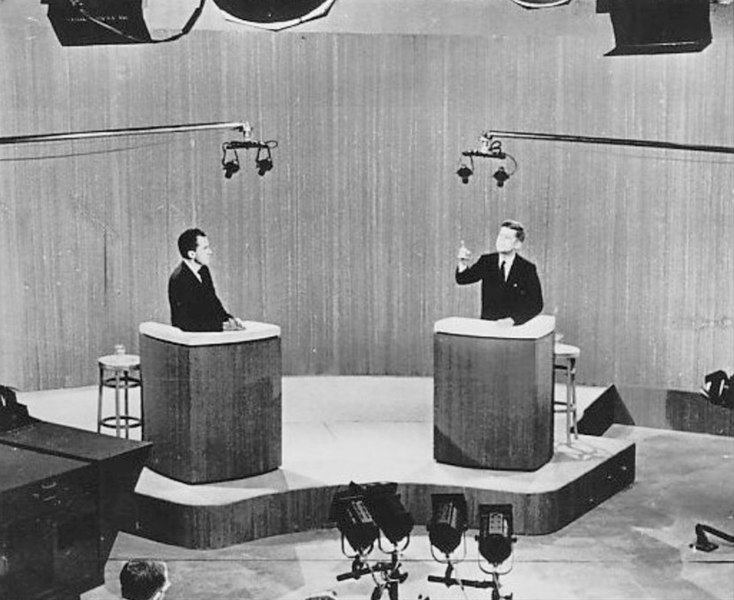
| Kennedy vs. Nixon, 1960. |
In both Canada and the US, we are about to hear the first candidate debates of the current elections. My great regret, as a political junkie, is that the Canadian and US debates are scheduled, as usual, for the same time. This is done, of course, because were it not so, few in Canada would be watching. They would just switch to some American network for the regular programming.
They are not, of course, really “debates.” There is no topic. Nobody expects to hear a new argument; there is little opportunity to build one. In their debates in 2004, I think John Kerry clearly bested George Bush in terms of debating points. Yet Bush “won,” largely by ignoring any semblance of debate and repeating familiar points. The same thing happened in the Canadian leaders' debates in 2008. Stephane Dion, Jack Layton, Elizabeth May and Gilles Duceppe all piled on Stephen Harper. Harper mostly just sat there and smiled, making his own case, responding to nothing. By debate rules, he lost badly. Yet polls said he won the debate, and he won the election. The others seemed angry; people admired Harper for taking it all calmly.
So these are not so much “debates” as joint press conferences, or, better, beauty contests. We watch and listen not to be persuaded by argument, but for blunders or zingers. It's kind of like watching a stock car race: we're mostly looking for a crack-up. One might see this as unkind and unworthy. Or one might see this as trying to discern something about the candidates' characters.
This was obvious from the very first famous televised candidates' debate, Kennedy-Nixon, in 1960. On points, most agree, Nixon at least held his own. But in political terms, Nixon lost badly, so badly that he refused ever to debate anyone again. His problem was that Kennedy looked relaxed and natural, whereas he looked stiff and uncomfortable.
And so it has been ever since.
The gaffe I remember best personally was Gerald Ford's insistence, against Carter in 1976, that Eastern Europe was not under Soviet domination. Ford confirmed the suspicion that he was in way over his head as President, that he was in the end a local pol with no wider vision than the next Rotary Club luncheon. It was not that Carter or Ford had made any kind of coherent point here; just a revelation of Ford's insufficiency.
In Canada, perhaps the best remembered score in debate is Mulroney's “you had a choice, sir. You could have said no” against Turner in 1984. But this was not argument; it was a simple negation of Turner's immediately prior statement that he “had no choice” (in making a batch of political appointments immediately on becoming prime minister. His larger claim was that this was part of a deal made with his predecessor, Trudeau). Again, this was not debate, not even a point scored by Mulroney, but a self-inflicted wound. It was the claim to have no control that killed Turner; Mulroney merely echoed the obvious. What kind of leader was this, who started out by refusing to take responsibility?
Tuner nailed himself again, at least in my opinion, on his second go-round with Mulroney in 1988, with the phrase most people remember from that debate: “I happen to think that you've sold us out” (speaking of free trade). To me, at least, that phrase, “happen to think,” implied either a misunderstanding of what thought actually entailed, or a lack of principle. As if political positions, in Turner's mind, could honourably be put on or taken off at whim, without any larger body of thought behind them. This was the more striking, to me, because opposition to free trade went against bedrock liberal principles; and Turner was leader of the Liberal Party. I'm not sure anyone but I noticed; but it made it impossible for me to vote for him.
Another famous line from a debate is Lloyd Bentsen's against Dan Quayle in 1988: “I knew Jack Kennedy. Jack Kennedy was a friend of mine. And senator, you're no Jack Kennedy.” But in fact, this was not an argument at all, and was, as Quayle responded at the time, “uncalled for.” First, it was ad hominem, and second, it was non sequitor. Quayle had not said he was like John Kennedy in any sense but his relative lack of experience. It worked, because it suggested Quayle was both inexperienced and callow.
Michael Dukakis blundered badly during the same campaign by taking a debate to actually be a debate. Asked if he would change his mind on opposing the death penalty if someone raped and killed his wife Kitty, he answered, properly, that his position opposing capital punishment was perfectly consistent. But the answer made him come across to the audience as a soulless suit.
Then there's Rick Perry's “oops” in the 2012 Republican debates. Obviously, no debate points scored. Ron Paul, at the next podium, even tried to help jog Perry's memory. It was the kind of memory freeze anyone could have. But it destroyed Perry's hyper-macho image. James Bond is not supposed to slip on the soap.
Reagan's “I paid for this microphone” in 1980 erased the suspicion that he was just too easygoing to be effective as president. His “I will not use my opponent's youth and inexperience against him” was a response to a moderator's question, not to anything raised by Walter Mondale. And, of course, it involved no argument.
 |
| Ali vs. Liston, 1965. |
Then there's Stockdale's “Why am I here?” in the 1992 VP debates. Okay, that had no legitimate point or purpose, since he had no chance of becoming VP anyway. It was just an awesome car crash.
So what does this mean? First, it is not unreasonable that we judge our candidates this way. Issues come and go over the course of four years. We have other ways of learning our politicians' stands. It makes sense instead to try to grasp their character. If there turns out to be a big disparity between their public and their private character, this is of limited importance. As a leader primarily of people who will only ever see them on TV, their public character is more relevant than their private persona anyway to their ability to lead.
At the same time, these “debates” run the risk of seriously debasing the popular idea of what a debate is or should be. This is important, because the ability to debate properly is a sine qua non of democracy.





 Posts
Posts


.jpg)


