Playing the Indian Card

Showing posts with label US Republican presidential contest. Show all posts

Tuesday, August 18, 2015

Trump on Immigration


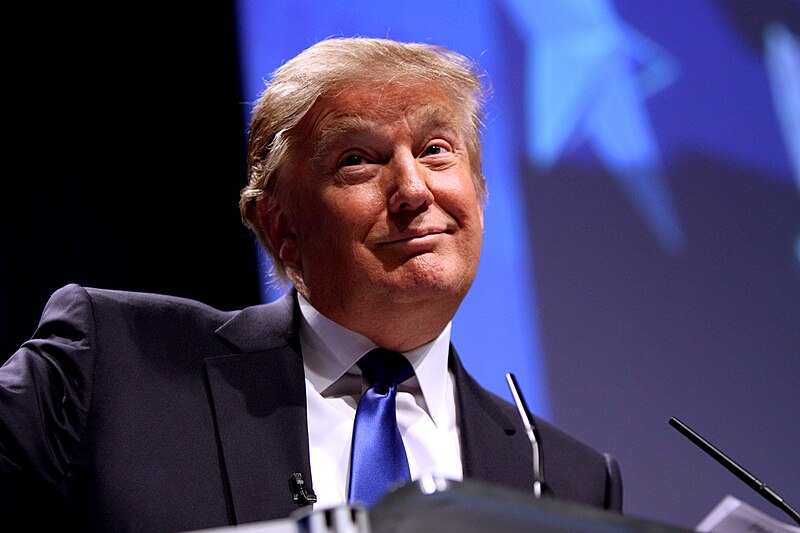
Hair today, gone tomorrow?

I had been on the point of writing a blog entry on Donald Trump’s candidacy being essentially based on his entertainment value, when he went and published as serious, detailed policy proposal. Agree with it or not, his newly revealed immigration policy is not clownish. Trump’s own campaign, at least, apparently believes the root of Trump’s popularity is not his entertainment value, but a popular backlash against immigration.

This may be so. Similar sentiments have proven politically powerful recently in Europe. This is also reminiscent of the Reform Party electoral rebellion in Canada, back in the 1990s.

It is what happens when the political elite leaves the public without an option on an issue they perceive as important. An outsider sees an opening, exploits the free electoral market, and surges into prominence.

In the Canadian example, all the federal political parties closed ranks to deny the public the chance to oppose the Meech Lake Agreement. At the same time, all supported multiculturalism and high levels of immigration. A lot of Canadians felt themselves and their concerns not listened to. The result: Reform came from nowhere to become the official opposition.

Ou sont les fauves d'autrefois?

In Europe, the issue has been immigration combined with the loss of national sovereignty to the EU. With some, mainly British, exceptions, polite society for many years has unanimously supported both, and seen opposition as beyond the pale. To oppose immigration or EU integration smelt like crypto-Fascism. The Economist regularly, and without fear of contradiction, referred to Jean-Marie LePen as a “thug.” Until LePen demonstrated his popularity by making the final round of the French presidential vote. Then he miraculously metamorphosed, in the editorial columns of The Economist, into “that wily ex-paratrooper.” Nigel Farage has made a similar impact more recently in Britain.

So Trump may be holding a hand worthy of his name. It is not true to say that discussing illegal immigration has been a shibboleth in the US; but the Republican causus in Congress, despite all saying they are against it, have been unwilling to pass legislation. Voters may well suspect a con.
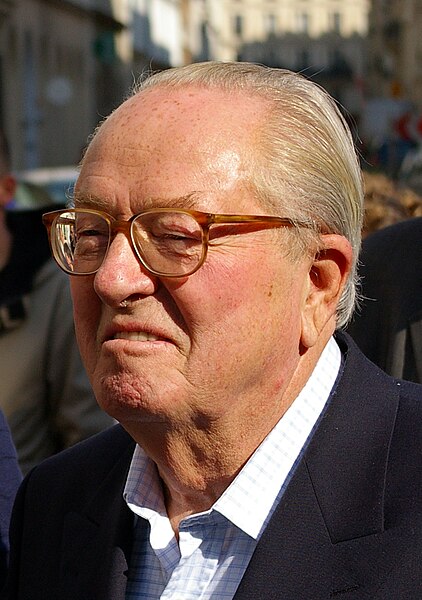
Nobody here but us wily ex-paratroopers.

I do not tend to agree with Trump on immigration. I have scruples about the rights of man, including freedom of movement. However, I also think the attacks on his plan that have immediately begun are over the top.

The Washington Post says it is unthinkable to no longer recognize citizenship by birth, to have twelve million residents who are not, and will never be, citizens. It would be too socially disruptive.

Tell that to Germany, or Japan, who have long had large guest worker populations, but do not recognize citizenship by birth. Tell that to Qatar or the UAE, where the majority of residents are not citizens. Life does seem to go on.

The WaPo also argues that the logistics of finding and deporting all the illegal residents would be hopelessly expensive. But Trump has already answered that objection: he points out that the costs of policing and social services caused by the presence of those illegals are also high.

The Post goes on to say that the mass deportation of twelve million would mean “staggering economic and social havoc.”

Not necessarily. In the spirit of the platform of the Alliance for Canadian Unity Party, I have a suggestion. The problem is undocumented foreign workers taking the jobs of unemployed lower class Americans, right? Yet businesses say they need the workers, or face financial ruin, because Americans will not take the jobs. Hence the idea of economic havoc.

Fair enough. Let the unemployed Americans themselves do the policing. If any American citizen finds an illegal worker performing a job they would like to have, they have the right to turn him in, have him or her deported, and get the job themselves as a reward. If they decline the offer, the illegal immigrant stays.

This would allow illegals to continue to take “the jobs Americans do not want to do,” if and when this is the case. It would allow Americans to protect their jobs, if this is the real issue.

Would there be many takers?

Why not find out?

Friday, August 07, 2015

Debates Wrapup


Herr Goebbels scores a debating point against Herr Godwin.

Miscellaneous thoughts on yesterday's debates.

First, I confess that I saw only the Canadian leaders' debate. I do not have access to Fox News at the moment, and so have seen only highlights of the American debates. That being so, perhaps my first comment should be on the Canadians.

Having slept on it, I think Mulcair's performance was much worse than I at first thought. The sense of something ominous grows on you. I think the impression he left of insincerity and barely repressed anger could be a big problem: asking people to vote NDP this time, with government in prospect, is asking for a leap of faith, a departure from the familiar. Would you, after all, buy a used car from this man? I see in online comments that others also get this vibe from Mulcair as of last night.

At the same time, as I said, although he was competent, Trudeau really failed to set himself up as an alternative. He was too quiet, grappled, when he did, most memorably with Mulcair rather than Harper, seemed a bit uneasy, ummed a lot, and looked disconcertingly young. Great performance were he running for student council president.

The leader who did set herself up as a credible alternative, unfortunately, was Elizabeth May. Great for May, but also a gift to the Conservatives. A three-way instead of a two-way split in the opposition vote.

All that said, viewership was low and the race has only begun.

On the Americans: everyone agrees that Carly Fiorina won the undercard debate, and I am part of everyone. But the case is rather like that of Elizabeth May: where does this go? She is too politically inexperienced to have a credible claim to the nomination, and even her business resume is spotty. Given that she is a great asset in a campaign, what does the Republican Party do with her?

In the unlikely event that Clinton gets the Democrats' nomination, Fiorina absolutely should be the VP pick. If not, make her ambassador to the UN.

Nobody clearly won the evening debate. However, I think strategically it was a bad night for Trump. Viewership was through the roof: Trump did that with his celebrity. Unfortunately for him, he just drew the rubes in to hear and get to know his competition a little better. He had nowhere to go but down, and they had nowhere to go but up, by sharing the stage. So a draw goes against Trump.

And I think that, for him, it was a bit worse than a draw. I think his veiled threat to Megyn Kelly was beyond the pale. For me, it was a bit of a suck in your breath moment. I don't think most folks are comfortable with addressing a woman in that way. Especially a very pretty one. It might have solidified the suspicion that Trump is in the end just a bully. It should have; there is something morally damaged about the American public, I fear, if it did not.

Robespierre cutting his physically much larger colleague Danton down to size.


Another loser: Rand Paul. He took on Trump almost immediately, and then had a sharp exchange with Christie, albeit one he did not initiate. It might have worked for some, but it did not look good on him. And angry Paul, with tousled hair and bulging eyes, looked like a pipsqueak: one of those short skinny guys who, given a little power, compensate by picking fights and bullying others. A Robespierre, a Goebbels. Being ideological tends to go with the territory.

Mike Huckabee and Marco Rubio probably get a boost in the polls. They are both charismatic, highly talented politicians, good with words, and the exposure helped demonstrate that. Some may now be looking for an alternative to Trump, someone who also seems like an unapologetic straight-talker, and they, based on debate performance, along with Fiorina, most closely fit that bill.

To some extent, Kasich did the same thing, but more plausibly as a substitute for Jeb Bush among more moderate GOPers than for Trump.

Thursday, August 06, 2015

American President


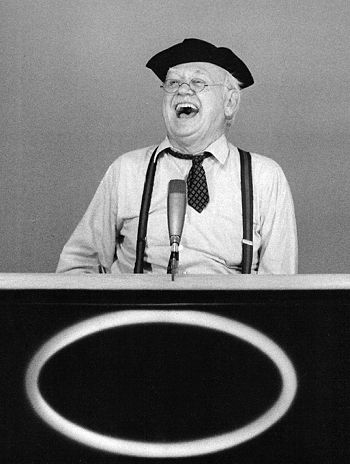
Bernie Sanders on the original Hollywood Squares.


I am as unhappy as anyone with the format of this evening's US Republican debate: with, that is, the exclusion of seven viable candidates. This presumably serves the interests of Fox News Network, or perhaps those of the Republican Party, who want to winnow the field quickly. It does not serve the voters, or American democracy.

Polls change like the weather; standing in recent polls is not a valid indicator of who is a viable candidate. Especially so early in the race, when few are paying much attention yet, and much that the polls measure is mere name recognition. Polls come with a margin of error, and all of those excluded are excluded for polling differences within that margin of error. Not only does this make the selection arbitrary; it promotes an unscientific attitude towards polls. In any case, the thing is circular: if you are not already sufficiently popular, the format prevents you from becoming popular. You might as well take the current poll leader, and declare him the nominee; as if the entire campaigning process serves no purpose.

And look at who is being excluded. Rick Perry, the longest serving governor ever of the second largest state. George Pataki, the man who defeated Mario Cuomo to become three-term governor of New York, a position once held by Nelson Rockefeller, Al Smith, and both Teddy and Franklin Roosevelt. Bobby Jindal, whose name has been widely mentioned for both president and vice president for over eight years. Carly Fiorina, who, whatever might be said about her lack of political background, has been probably the most articulate spokesperson for the party thus far in the campaign. Rick Santorum, runner-up in the last go-round. Lindsey Graham, a three-term senator from an early primary state, a foreign policy expert in a cycle in which US foreign policy seems to be in ruins. And some guy named Jim Gilmore, only a former governor of Virginia. Just like Thomas Jefferson, Patrick Henry, and James Monroe.

I understand the problem with time constraints. Still, Fox is already allocating time for everyone: the top ten at nine, the bottom seven at five pm. They apparently just don't want to waste prime time on the lesser lights. Okay, so why not just start the whole thing at nine, give the candidates the chance to choose when they will field their first question based on their initial poll numbers, and let the whole thing run later into the night?


I have also heard the objection that that many candidates will not fit comfortably into one camera angle. I cannot believe this is important to anyone, but if it is, the matter is solved, someone has suggested, by setting them up in two dimensions, as in Hollywood Squares.

But there is an even better option. Fox is seeing a problem where they should see an opportunity. What is hotter than reality television? Ask Donald Trump. What could be more profitable than a reality show in which the participants are largely already celebrities, and downright eager to appear for free?

So make a series out of it. Have the candidates compete in groups of four or five, on the same weeknight over successive weeks. After each debate, let a panel of pundits pronounce, then have the audience vote for the winner electronically, as they do on American Idol. Then host a blockbuster final.

Rinse and repeat.

Wednesday, August 05, 2015

That's Debatable


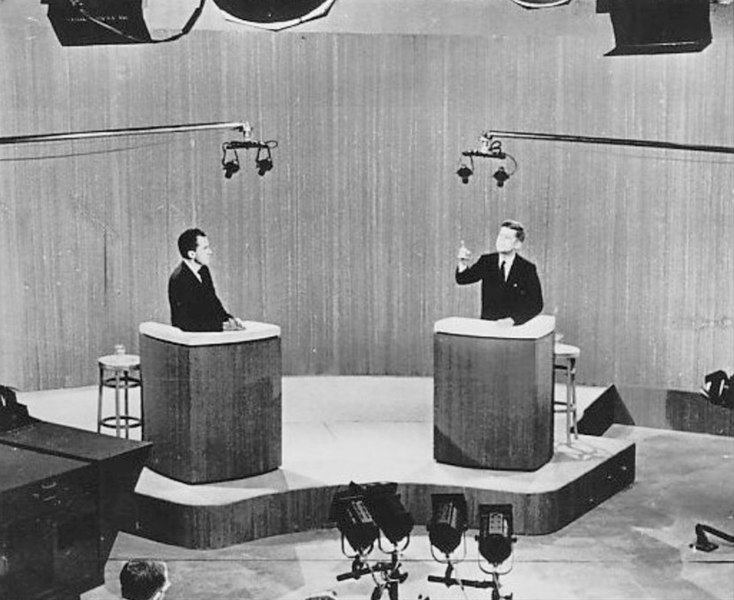
Kennedy vs. Nixon, 1960.

In both Canada and the US, we are about to hear the first candidate debates of the current elections. My great regret, as a political junkie, is that the Canadian and US debates are scheduled, as usual, for the same time. This is done, of course, because were it not so, few in Canada would be watching. They would just switch to some American network for the regular programming.

They are not, of course, really “debates.” There is no topic. Nobody expects to hear a new argument; there is little opportunity to build one. In their debates in 2004, I think John Kerry clearly bested George Bush in terms of debating points. Yet Bush “won,” largely by ignoring any semblance of debate and repeating familiar points. The same thing happened in the Canadian leaders' debates in 2008. Stephane Dion, Jack Layton, Elizabeth May and Gilles Duceppe all piled on Stephen Harper. Harper mostly just sat there and smiled, making his own case, responding to nothing. By debate rules, he lost badly. Yet polls said he won the debate, and he won the election. The others seemed angry; people admired Harper for taking it all calmly.

So these are not so much “debates” as joint press conferences, or, better, beauty contests. We watch and listen not to be persuaded by argument, but for blunders or zingers. It's kind of like watching a stock car race: we're mostly looking for a crack-up. One might see this as unkind and unworthy. Or one might see this as trying to discern something about the candidates' characters.

This was obvious from the very first famous televised candidates' debate, Kennedy-Nixon, in 1960. On points, most agree, Nixon at least held his own. But in political terms, Nixon lost badly, so badly that he refused ever to debate anyone again. His problem was that Kennedy looked relaxed and natural, whereas he looked stiff and uncomfortable.

And so it has been ever since.

The gaffe I remember best personally was Gerald Ford's insistence, against Carter in 1976, that Eastern Europe was not under Soviet domination. Ford confirmed the suspicion that he was in way over his head as President, that he was in the end a local pol with no wider vision than the next Rotary Club luncheon. It was not that Carter or Ford had made any kind of coherent point here; just a revelation of Ford's insufficiency.

In Canada, perhaps the best remembered score in debate is Mulroney's “you had a choice, sir. You could have said no” against Turner in 1984. But this was not argument; it was a simple negation of Turner's immediately prior statement that he “had no choice” (in making a batch of political appointments immediately on becoming prime minister. His larger claim was that this was part of a deal made with his predecessor, Trudeau). Again, this was not debate, not even a point scored by Mulroney, but a self-inflicted wound. It was the claim to have no control that killed Turner; Mulroney merely echoed the obvious. What kind of leader was this, who started out by refusing to take responsibility?

Tuner nailed himself again, at least in my opinion, on his second go-round with Mulroney in 1988, with the phrase most people remember from that debate: “I happen to think that you've sold us out” (speaking of free trade). To me, at least, that phrase, “happen to think,” implied either a misunderstanding of what thought actually entailed, or a lack of principle. As if political positions, in Turner's mind, could honourably be put on or taken off at whim, without any larger body of thought behind them. This was the more striking, to me, because opposition to free trade went against bedrock liberal principles; and Turner was leader of the Liberal Party. I'm not sure anyone but I noticed; but it made it impossible for me to vote for him.

Another famous line from a debate is Lloyd Bentsen's against Dan Quayle in 1988: “I knew Jack Kennedy. Jack Kennedy was a friend of mine. And senator, you're no Jack Kennedy.” But in fact, this was not an argument at all, and was, as Quayle responded at the time, “uncalled for.” First, it was ad hominem, and second, it was non sequitor. Quayle had not said he was like John Kennedy in any sense but his relative lack of experience. It worked, because it suggested Quayle was both inexperienced and callow.

Michael Dukakis blundered badly during the same campaign by taking a debate to actually be a debate. Asked if he would change his mind on opposing the death penalty if someone raped and killed his wife Kitty, he answered, properly, that his position opposing capital punishment was perfectly consistent. But the answer made him come across to the audience as a soulless suit.

Then there's Rick Perry's “oops” in the 2012 Republican debates. Obviously, no debate points scored. Ron Paul, at the next podium, even tried to help jog Perry's memory. It was the kind of memory freeze anyone could have. But it destroyed Perry's hyper-macho image. James Bond is not supposed to slip on the soap.

Reagan's “I paid for this microphone” in 1980 erased the suspicion that he was just too easygoing to be effective as president. His “I will not use my opponent's youth and inexperience against him” was a response to a moderator's question, not to anything raised by Walter Mondale. And, of course, it involved no argument.

Ali vs. Liston, 1965.

Then there's Stockdale's “Why am I here?” in the 1992 VP debates. Okay, that had no legitimate point or purpose, since he had no chance of becoming VP anyway. It was just an awesome car crash.

So what does this mean? First, it is not unreasonable that we judge our candidates this way. Issues come and go over the course of four years. We have other ways of learning our politicians' stands. It makes sense instead to try to grasp their character. If there turns out to be a big disparity between their public and their private character, this is of limited importance. As a leader primarily of people who will only ever see them on TV, their public character is more relevant than their private persona anyway to their ability to lead.

At the same time, these “debates” run the risk of seriously debasing the popular idea of what a debate is or should be. This is important, because the ability to debate properly is a sine qua non of democracy.