





 Posts


Showing posts with label natives. Show all posts
Showing posts with label natives. Show all posts
Wednesday, June 21, 2017


Wednesday, May 25, 2016
The Original Affluent Society
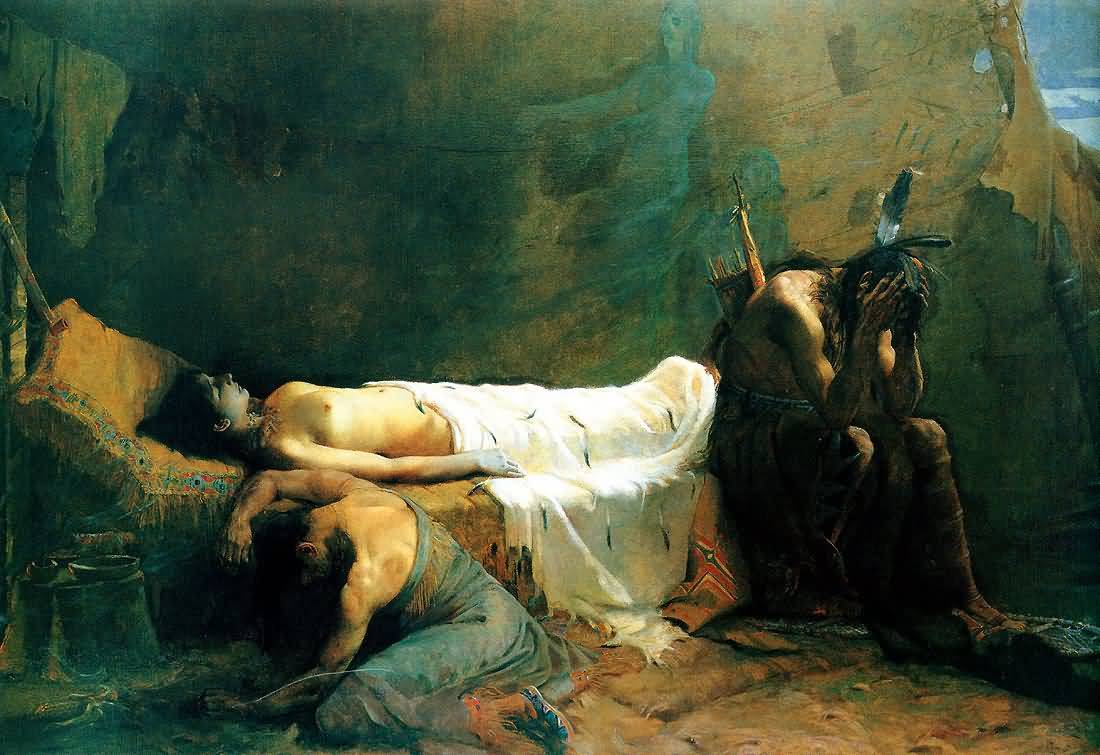 |
| Death of Minnehaha: The Romantic Indian |
It ought to be a no-brainer.
I don't know about you, but to my mind, this Noble Savage fellow has long outstayed his welcome. Believing him to be a real person is beginning to look positively looney. But in fact, we are not free of him yet. Not only did he practice perfect sexual equality, while at the same time paradoxically allowing feminine dominance in all things; not only did he body forth the beautiful communist ideal; not only did he live in perfect peace with his neighbour, wanting only friendship and love. And not only did he get lots of hot, steamy love on demand. He also, apparently, was far richer than we, “the original affluent society,” to use the term popular in anthropology. And, unlike us, he got his material needs with little actual labour. None of this depressing nonsense about earning your living by the sweat of your brow. Remember, after all, this was Eden.
Surely, one might think, if one is prone to such activities, the average aboriginal is a lot better off with central heating, a no-leak roof over his head, perhaps a wide-screen TV, a refrigerator, a microwave, perhaps an iPod, a car, and such mod cons, than he once was living in skin tents, using stone tools, and wandering with the buffalo.
But no—it seems we modern miscreants have impoverished him.
According to Jared Diamond, he of Guns, Germs, and Steel, settled agriculture was, to use the title of a celebrated 1987 article he wrote for Discovery magazine, “the worst mistake in the history of the human race.” That's no small claim.
“Archaeologists studying the rise of farming,” Diamond explains, “have reconstructed a crucial stage at which we made the worst mistake in human history. Forced to choose between limiting population or trying to increase food production, we chose the latter and ended up with starvation, warfare, and tyranny.” Okay—we know this script. There are too many people. Apparently, people are a bad thing. Good thing we don't know any personally.
“[R]ecent discoveries suggest that the adoption of agriculture, supposedly our most decisive step toward a better life, was in many ways a catastrophe from which we have never recovered. With agriculture came the gross social and sexual inequality, the disease and despotism, that curse our existence” (“The Worst Mistake in the History of the Human Race,” Discovery Magazine, May, 1987).
Sounds a whole lot like the same old story of Mr. Noble Savage, Marxist-feminist edition. Agriculture it seems brought sexual inequality, despotism, starvation, and warfare. Probably bad teeth too. But the new claim, and the living nub of Diamond's argument, is this: before agriculture, man was able to satisfy his wants with very little actual work. “[T]he average time devoted each week to obtaining food,” Diamond says, “is only 12 to 19 hours for one group of Bushmen, 14 hours or less for the Hadza nomads of Tanzania” (ibid). And if that were not enough, it seems the items on the modern menu, although more costly, are worse for our health: “At Dickson Mounds, located near the confluence of the Spoon and Illinois rivers, archaeologists have excavated some 800 skeletons that paint a picture of the health changes that occurred when a hunter-gatherer culture gave way to intensive maize farming around A. D. 1150. Studies by George Armelagos and his colleagues then at the University of Massachusetts show these early farmers paid a price for their new-found livelihood. Compared to the hunter-gatherers who preceded them, the farmers had a nearly 50 per cent increase in enamel defects indicative of malnutrition, a fourfold increase in iron-deficiency anemia (evidenced by a bone condition called porotic hyperostosis), a theefold rise in bone lesions reflecting infectious disease in general, and an increase in degenerative conditions of the spine, probably reflecting a lot of hard physical labor. 'Life expectancy at birth in the pre-agricultural community was about twenty-six years,' says Armelagos, 'but in the post-agricultural community it was nineteen years'” (Diamond, op. cit.).
 |
| Bruegel, The Harvesters |
But how can nutrition be better for scavengers than for farmers? Isn't scavenging a bit iffy, like dumpster diving?
Diamond expands upon the point. “First, hunter-gatherers enjoyed a varied diet, while early farmers obtained most of their food from one or a few starchy crops. The farmers gained cheap calories at the cost of poor nutrition. ... Second, because of dependence on a limited number of crops, farmers ran the risk of starvation if one crop failed” (ibid.).
This thesis is not new with Diamond, writing in the late Eighties. Any guesses when it actually emerged?
Would “1960s” surprise you?
That was when the original studies of the Hazda and other foraging groups were undertaken. This is when the watershed “Man the Hunter” conference was held, in 1966, just in time for the summer of love. At which, it seems, the entire field of anthropology wheeled around at once to the premise that primitive man had it better than we do.
 |
| Bushmen, Bushwomen, and Bushbabies. |
The times, of course, were a'changing. Civilization in general meant to those of us there at that time eternal war and slow radiation death from the atom bomb. And even aside from a certain age of man, anthropologists in particular might be expected to be especially receptive to this Noble Savage message. They have given their life to the study of foraging societies. Why would they do this, if they did not hope or want to believe that such societies had something of value to tell us? Argue that primitive societies knew something of vital importance that we do not know, and suddenly it is a glorious thing to be an anthropologist.
And so, the Noble Savage's Affluent Society premise came to be, says David Kaplan, “widely accepted by anthropologists”; the “enlightened anthropological view” (“The Darker Side of the 'Original Affluent Society'” Journal of Anthropological Research, 56:3, Autumn, 2000, p. 301, 303). It has been ever since. Don't just ask Jared Diamond. Only last year, 2015, Yuval Harari summed it up in his best-seller Sapiens: A Brief History of Humankind. “Rather than heralding a new era of easy living,” Harari writes, “the Agricultural Revolution left farmers with lives generally more difficult and less satisfying than those of foragers. Hunter-gatherers spent their time in more stimulating and varied ways, and were less in danger of starvation and disease. . . The average farmer worked harder than the average forager, and got a worse diet in return. The Agricultural Revolution was history’s biggest fraud.”
Right. Got it. Let's look at the claims in turn.
First, as we have already heard from Engels and the Marxists, agriculture caused class divisions, and the birth of tyranny and social oppression. As Diamond puts it, “Besides malnutrition, starvation, and epidemic diseases, farming helped bring another curse upon humanity: deep class divisions. Hunter-gatherers have little or no stored food, and no concentrated food sources, like an orchard or a herd of cows: they live off the wild plants and animals they obtain each day. Therefore, there can be no kings, no class of social parasites who grow fat on food seized from others. Only in a farming population could a healthy, non-producing elite set itself above the disease-ridden masses” (ibid).
There is an immediate logical flaw apparent here. If only with agriculture was there enough excess food for anyone to devote their time to anything besides agriculture, how can it concurrently be true that people had more food, and acquired it more easily, before agriculture? Secondly, Diamond's thesis that those not producing food are “parasites” itself requires a pretty distinctly Marxist understanding of the world. Who's to say those folks too were not providing value from their work? Is food production the only thing of value to mankind? Is there nothing to be said for the existence, say, of some sort of government, to protect one's rights and goods from one's neighbour, or the tribe over the next hill? Would paying some to govern be so terrible? Not to mention underwriting the trades: milling, tailoring, pottery, storage, cartage, that sort of thing. Better off without them?
It takes a Marxist to see the mere division of labour as oppression.
Second, as we have already seen from Gage, Friedan, Steinem, and the girls, old Noble Savage was a ladies' man. In primitive society, as is only just, women got everything they wanted. Diamond notes, as a supposed contrast, that primitive New Guinea agriculturalists require their women to do all the heavy labour. “Women in agricultural societies were sometimes made beasts of burden. In New Guinea farming communities today I often see women staggering under loads of vegetables and firewood while the men walk empty-handed” (ibid.).
 |
| Yali people of New Guinea |
Of course, here Diamond contradicts Engels, who saw women doing all the work as irrelevant to their supposed emancipation. But let's leave that aside. Is what he says even true of agricultural society? Diamond offers no control. Let us grant, against Engels, as seems obvious, that the lot of women in primitive New Guinea agricultural societies is worse than that of Canadian women today. But the proper comparison is with women in hunter-gatherer societies, not modern post-industrial women, and Diamond offers no examples of this.
As it happens, we have a few. We find that the observations of the early Jesuits conform exactly to Diamond's--in describing practices among Canadian Indians. Here, too, women did all the heavy labour.
The problem is, these were hunter-gatherers, not farmers.
Accordingly, quite obviously, the oppression of women was not because of agriculture. Why would it be? Women's lot improved with agriculture, even if this took a little time. Women doing hard labour was more probably due to the constant warfare and petty banditry one is going to get without effective government. The men, being stronger, always needed their arms free in case of surprise attack.
Now we get down to what is truly novel about this anthropological argument: primitive society was materially better off. At least if you think only in terms of food.
Diamond makes much of the variety of available food sources: “It's almost inconceivable that Bushmen, who eat 75 or so wild plants, could die of starvation the way hundreds of thousands of Irish farmers and their families did during the potato famine of the 1840s” (ibid.) “[B]ecause of dependence on a limited number of crops, farmers ran the risk of starvation if one crop failed” (ibid).
But wait a nanosecond. Early foragers may well have had more food sources than 19th century Hibernian pastoralists. But there does not seem to be anything making this limited variety a necessary feature of agriculture. A farmer might just as easily keep a vegetable garden, cows, and chickens for eggs. What farmer, left unregulated, doesn't? Nothing even prevents him from, in a pinch, shooting a passing wild duck. He has, in effect, the hunter's food sources, plus his own. Hard to see how the additional food sources are a minus.
 |
| An Gorta Mor (Potato Famine) Memorial, Dublin |
He does not need to, and a wise farmer does not, put all his land into a single crop, or even just a few. That's not even good for the land.
In the case of the Irish, the problem was political, not practical. The native Irish were permitted to farm only tiny plots of land, too small to sustain their families with anything but potatoes. Their crops were effectively limited by government regulation; any other crops were exported.
Nor is it obvious that there is such a great diversity of food sources available in, say, a Canadian prairie winter. Here, the sedentary farmer has a definite advantage. Not needing to wander, he can store the harvest for the fallow months. A forager must follow the food sources, and cannot keep anything in reserve. If by chance there is no game today, he does not eat.
Ouside of Loblaw's, no great variety of foods is available in a Canadian winter. No fruit grows, no green shows. It's meat or nothing. Even most animals are in hibernation.
The notion that primitive societies were “affluent,” absurd on its face, is made possible by the corollary that, like good Buddhists, in a “zen” way, “they limited their wants.” So they were affluent strictly in the sense of achieving subsistence with relatively little work.
One can see the mark of the Sixties here. Out of the rat race, no nine-to-five job, no materialist hangups, living off the land, lots of free time for recreational drug use. Wish, meet fulfillment.
And it is actually true enough. Primitive tribesmen are not as busy as we aging former yuppies are. If not to the extent Diamond would have us believe. The Sixties studies show that Kalahari Bushmen had a “work week . . . of 2.4 days per adult,” (Lee, The !Kung San. Men, Women, and Work in a Foraging Society, 1979, pp. 250-280). Aborigines in Arnhem Land were clocked in at 15-20 hours per week (Kaplan, op cit., p. 303). Looking at all such studies, Sahlins (1972:34), choosing his words carefully, concluded that “Reports on hunters and gatherers of the ethnological present--specifically on those in marginal environments--suggest a mean of three to five hours per adult worker per day in food production'” (Kaplan, op. cit., p. 303).
 |
| Traditional food of Australian aborigines. |
Okay; that sounds pretty good. Almost like a governmnent job. But note, what is being measured is food production alone. Going out and hunting down a plump gazelle or picking mongongo nuts might take less time than accountancy, but it might involve a bit of food preparation as well, more than you need if you seize your food at the local Loblaw's in exchange for bits of paper and tiny pieces of shiny metal. When you add in butchering, peeling, processing, cooking on outdoor fires without the aid of a microwave, plus the maintenance of hunting tools, plus the commute to the hunting grounds, “the total work week for the bushmen on the lowest of estimates,” says Kaplan, “turns out to be between 6 and 7 eight-hour days (not counting child care)” (Kaplan, op. cit.).
The scavengers may still have the better deal. It is tough to get a fair comparison, because it is actually arbitrary what one includes in “work.” The average Hottentot does not punch a time clock. Travel time? Child care? Shopping? Washing the dishes? Business lunches? Meetings with the boss, or fellow villagers? By one attempted estimate, Kaplan to the contrary, Kalahari residents spend 44.5 hours a week at their “job,” if male, 40 hours if female. But a mainstream Canadian male spends, by the same rough measure, 40 hours at paid work, and then another 40 weekly taking care of business that must be taken care of without being in his job description (Kaplan, op. cit., p. 308). Advantage, still, to the Indians and aborigines. Just not as much advantage as might appear at first.
But now let's consider another factor. Granted that primitive tribes are able to fill their large intestines with less work. But isn't there something to be said for the quality of the food this labour produces? Wouldn't many of us prefer to work a little harder to pay for the food we like, say, pesto, as opposed to mac and cheese?
Hunters and gatherers cannot have the choices we do. If it is a porcupine we find on today's hunt, it is porcupine for supper. And lunch. And breakfast.
Fortunately, they come with toothpicks.
During the survey of foraging practices among the aborigines of Arnhem Land, anthropologists came upon a bit of a problem. The locals actually had access to charity food from mission stations. They could get flour, rice and sugar. And usually did. In order not to falsify their data, the anthropologists had to go to some lengths to convince the natives to abstain from these preferred foods for the course of the experiment. By the fifth day, tired of the “traditional” diet, a significant proportion of the men wanted to drop out (Kaplan, op. cit., p. 306).
 |
| Arnhem Land, north Australia: lush, tropical and full of mission stations distributing food. |
Sometimes spare time is not worth the effort.
Kaplan at least hints at the issue: “In 1980 the nut crop was a good one, but Wilmsen indicates that it was barely touched because most people [Bushmen] preferred maize meal. Hitchcock and Ebert ... also note that there are foragers in the Nata region of the Kalahari who have access to mongongos but choose not to exploit them in any quantity, presumably because they 'do not taste good'" (Kaplan, op. cit.).
Here, as it happens, we may also have an explanation of the better nutrition among hunter-gatherers than among early agriculturalists, as revealed by their skeletal remains.
Foragers may have a varied diet. Of necessity. But farmers have a choice as to what to eat. Given choices, people do not always make the best ones. Ask Adam and Eve.
People invariably prefer some foods to others. Some dislike spinach, some cannot stand olives. I can't get my fourteen-year-old boy, for example, to ever vary from macaroni for supper.
People will usually, given the choice, eat what they prefer. That will probably end up limiting their diet. Early farmers would have known little about good nutrition. They just knew what they liked.
Probable result: an overall decline in health. Not from scarcity, but from abundance.
The next issue is this, and we have already at least hinted at it: although food may have taken little time to acquire, was there always food to be had?
In fact, nothing was more obvious to early visitors to these shores than the extreme material poverty of the Indians. Father Bressani speaks of “this almost unexampled poverty” (Jesuit Relations 39, p. 246). Bressani was a seventeenth-century Italian. Keep in mind, when you read such observations, that peasant life in the Italian countryside in the seventeenth century was not itself all skittles and Chianti.
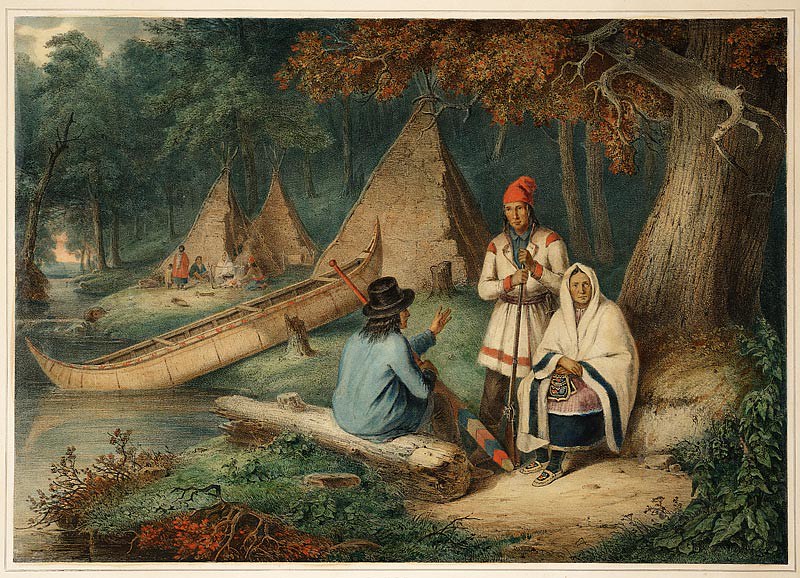 |
| Wigwams, Quebec |
Father LeJeune speaks of the state of Indian shelter. Apparently, there were no wide-screen TVs. “If you go to visit them in their cabins, ... you will find there a miniature picture of Hell, — seeing nothing, ordinarily, but fire and smoke, and on every side naked bodies, black and half roasted, mingled pell mell with the dogs, which are held as dear as the children of the house, and share the beds, plates, and food of their masters. Everything is in a cloud of dust, and, if you go within, you will not reach the end of the cabin before you are completely befouled with soot, filth, and dirt” (Jesuit Relations 17, p. 13).
Fleas were an endemic problem, commented upon by every observer. Champlain laments, of life among the Micmac, “They have a great many fleas in summer, even in the fields. One day as we went out walking, we were beset by so many of them that we were obliged to change our clothes” (Champlain, Voyages 1, Ch. 14). Lie down with dogs, and you get up with fleas.
And now we come to the food. The Hurons had it better than most. “A little Indian corn boiled in water, and for the better fare of the country a little fish, rank with internal rottenness, or some powdered dried fish as the only seasoning, — this is the usual food and drink of the country; as something extra, a little bread made of their corn, baked under the cinders, without any leaven, in which they sometimes mix some beans or wild fruits; this is one of the great dainties of the country. Fresh fish and game are articles so rare that they are not worth mentioning” (Father LeJeune, Jesuit Relations 17, p. 15).
But these were early semi-agriculturalists. It was worse for the wandering hunting tribes. “The roving Barbarians, before knowing the French, lived solely by hunting or fishing, and, through necessity, fasted more than half the year—… frequently lacking the means of preserving game or fish a long time, when these abounded, as they had no salt; while the smoke which they used in place of salt, was not adequate for preserving provisions a long time; whence they frequently died of hunger, or sometimes inflicted death out of pity” (Father Bressani, Jesuit Relations 39, p. 243).
Among these Indians, Bressani writes, hunger is a near-constant companion. And Champlain witnesses the same: “These people suffer so much from lack of food that they are sometimes obliged to live on certain shell-fish, and eat their dogs and the skins with which they clothe themselves against the cold” (Champlain, Voyages 2, Ch. 4).
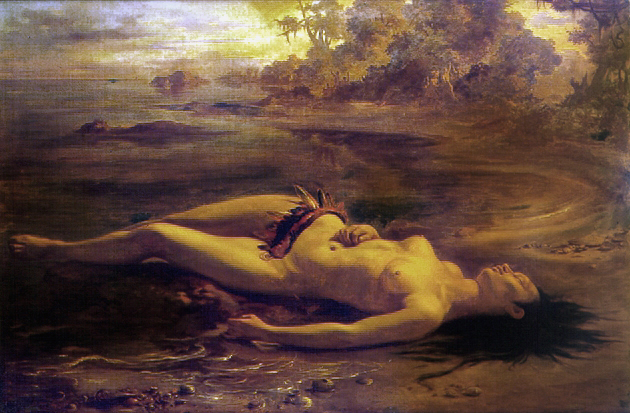 |
| The Romantic Indian: Portuguese/Brazilian "Indianism" painting |
Champlain reports an encounter with the Innu one winter, when Quebec had just been founded.
“On the 20th, some Indians appeared on the other side of the river, calling to us to go to their assistance, which was beyond our power, on account of the large amount of ice drifting in the river. Hunger pressed upon these poor wretches so severely that, not knowing what to do, they resolved, men, women, and children, to cross the river or die, hoping that I should assist them in their extreme want. Having accordingly made this resolve, the men and women took the children and embarked in their canoes,… we heard them crying out so that it excited intense pity, as before them there seemed nothing but death. ... [T]hey reached the shore with as much delight as they ever experienced, notwithstanding the great hunger from which they were suffering. They proceeded to our abode, so thin and haggard that they seemed like mere skeletons, most of them not being able to hold themselves up. I was astonished to see them, and observe the manner in which they had crossed, in view of their being so feeble and weak. I ordered some bread and beans to be given them. So great was their impatience to eat them, that they could not wait to have them cooked. I lent them also some bark, which other savages had given me, to cover their cabins. As they were making their cabin, they discovered a piece of carrion, which I had had thrown out nearly two months before to attract the foxes, .... This carrion consisted of a sow and a dog, which had sustained all the rigors of the weather, hot and cold. When the weather was mild, it stank so badly that one could not go near it. Yet they seized it and carried it off to their cabin, where they forthwith devoured it half cooked. No meat ever seemed to them to taste better. I sent two or three men to warn them not to eat it, unless they wanted to die: as they approached their cabin, they smelt such a stench from this carrion half warmed up, each one of the Indians holding a piece in his hand, that they thought they should disgorge, and accordingly scarcely stopped at all. These poor wretches finished their repast” (Voyages, vol. 2, Ch. 5).
Odd that the anthropologists seem never to have read these historical accounts. But that is the way with anthropologists. It turns out that even the early Sixties studies themselves discovered much of the same among the Kalahari bushmen they observed, but somehow entirely missed mentioning it in their published reports. Kaplan notes that during the legendary "Man the Hunter" conference, Lora Marshall commented: "The !Kung we worked with are very thin and . . . constantly expressed concern and anxiety about food." In a 1989 piece, Harpending and Wandsnider are quoted to assert that "Lee's studies of the !Kung [Bushmen] diet and caloric intake have generated a misleading belief among anthropologists and others that !Kung are well fed and under little or no nutritional stress" (Kaplan, p. 309, quoting Wilmsen, 1989). “Konner and Shostak [quoted again by Wilmsen, 1989] are quite emphatic that nutritional stress and its health consequences among the !Kung are hardly in the eye of the beholder: Deprivation of material things, including food, was a general recollection [of !Kung adults]” (Kaplan, op. cit., p. 309). “Periodic food shortages,” Kaplan continues, “have been observed among all recent hunters and gatherers” (Kaplan, op. cit., p. 321; Eaton, S.B., M. Shostak, and M. Konner, 1988, The Paleolithic Prescription. New York: Harper and Row). All of them.
There you go again: the Noble Savage archetype is powerful enough to in most cases supercede the evidence of our own eyes.
It is perhaps true that it takes only forty-four hours a week to get enough food to live on, if you are a hunter-gatherer. But it turns out that said food may oft times simply not be available.
By contrast, in many progressive municipalities, Loblaw's stores are open 24 hours.
There is, contrary to popular and fuzzy hip thought, no “balance of nature.” Nature usually follows a patternless pattern of boom and bust, one absurd extremity following upon another. A nice warm wet spring, and prey animals have a population explosion. Leading to a boom in predators, which then deplete the prey, causing a collapse in predator numbers as well as prey. Rinse and repeat. General starvation is a predictable part of the “great circle of life.” A hunter-gatherer lifestyle locks one in to these natural cycles, leading to inevitable periods of mass death.
Sadly, some have even recently died under the glamour of the Noble-Savage-Affluent-Society myth. Consider the now-famous case of Chris McCandless, only 24 years old, who sought to disappear “Into the Wild” of Alaska, and died quickly of either poisoning from eating the wrong wild plant, or simple unadulterated starvation.
 |
| Last picture of Chris McCandless alive |
Because he was a modern, this was memorable enough to be worth a best-selling book. Had he been a pre-contact aboriginal, it would not have even been news.
The 1960s Noble Savagist surveys, deliberately or not, did not account for possible slow periods in the good old merry-go-round of life, or rather slaughter—slow periods that, in Canada, will come predictably and severely every winter, for perhaps the odd seven months in a row. The studies of Bushmen and aborigines were “best-case” scenarios. Anthropologists were among their subjects for only a few days or a few weeks, at the most abundant time of the year. As Kaplan notes, “Although carried out under less contrived conditions than the McCarthy-McArthur survey in Australia, [which, note, was even worse in this regard] Lee's investigation [of the Bushmen] suffers from some of the same shortcomings: for example, to buttress his argument concerning Bushmen well-being, Lee would like to extrapolate his findings from one portion of the seasonal cycle to the entire cycle, even though he is aware of the significant difference between the dry season and the wet season. Between August and October, water is limited and food scarce. Lee's survey was done from July 6 to August 1” (Kaplan, op. cit., p. 307).
There may indeed be a good reason why all studies of existing hunter-gatherer societies are done in the tropics. The tropics may be the only place where hunting and gathering is even remotely viable. As my Filipina wife maintains, it is not easy to starve in the tropics. Some kind of fruit is in season at al times of the year; the woods are thick with birdsong.
There is never the ghostly silence of a Canadian winter.
 |
| "Iracema"; Portuguese "Indianism" painting |
Although there might be famine at any time, wind and weather permitting, this is when, according to the early French journal-keepers, Indian starvation inevitably appeared. For a period stretching perhaps from November to May, with nothing green other than pine needles growing, possible food is limited to ice-fishing and a few non-hibernating animals. Not easy to find at the best of times. Not easy to run down and kill, especially without rifles. Samuel de Champlain reports: “The savages who dwell here are few in number. During the winter, in the deepest snows, they hunt elks and other animals, on which they live most of the time. And, unless the snow is deep, they scarcely get rewarded for their pains, since they cannot capture anything except by a very great effort, which is the reason for their enduring and suffering much” (Champlain, Voyages, Volume 1, Ch. 6). Deep snow was the one thing that allowed them to overtake the prey, if they were equipped with snow shoes. The animals, by contrast, often got bogged down in the deep drifts.
As evidence that women in foraging societies supposedly had higher status, Diamond offers this consideration: “nomadic hunter-gatherers have to keep their children spaced at four-year intervals by infanticide and other means, since a mother must carry her toddler until it's old enough to keep up with the adults.” (Diamond, op. cit.).
A bit of a non sequitor, surely. Diamond to the contrary, this does not sound like a good thing, for either males or females. Better for women? Aren't a certain proportion of those dead children female? Or is it that, to Diamond or to other noble savages, children are not human? To me it sounds like a terribly evil thing, that we should all be glad to have put behind us. That is, if we really have.
Diamond's point is the usual feminist one that motherhood is oppressive to women. It gets awkwardly in the way of free sex, in any case.
Our point is different. The traditional Indian lifestyle, because of the severe food contraints, did not leave a lot of margin for the social safety net we have in modern Canada come to expect. Most kids, it seems, were killed as a matter of standard practice. Estimates for infanticide of female children in traditional Canadian native cultures range from 50 to 80 percent (Schrire, Carmel; William Lee Steiger, "A matter of life and death: an investigation into the practice of female infanticide in the Arctic". Man: the Journal of the Royal Anthropological Society 9: 162).
Thr Inuit killed children by throwing them into the sea. The Yukon tribes stuffed their mouths with grass and just left them to die. Dene traditions were similar. Such practices lasted into the 1930s and 40s, when contact with the mainstream culture, and welfare payments, ended them.
 |
| Eskimo mother and child. |
Father Jouvency reports of the Innu, “the women, although naturally prolific, cannot, on account of their occupation in these labors [the hard physical work demanded of them], either bring forth fully-developed offspring, or properly nourish them after they have been brought forth; therefore they either suffer abortion [i.e., miscarriage], or forsake their new-born children, while engaged in carrying water, procuring wood and other tasks, so that scarcely one infant in thirty survives until youth” (Jesuit Relations 1, p. 255-7). Orphans, he reports, are killed as a matter of routine (Jesuit Relations 1, p. 259).
Orphans and prospective infanticides became, therefore, for the Jesuits, a rich harvest of souls. Father Biard, working among the Micmac, notes, “I saw this girl, eight or nine years old, all benumbed and nothing but skin and bone. I asked the parents to give her to me to baptize. They answered that if I wished to have her they would give her up to me entirely. For to them she was no better than a dead dog. They spoke like this because they are accustomed to abandon altogether those whom they have once judged incurable “ (Jesuit Relations 2, p. 13).
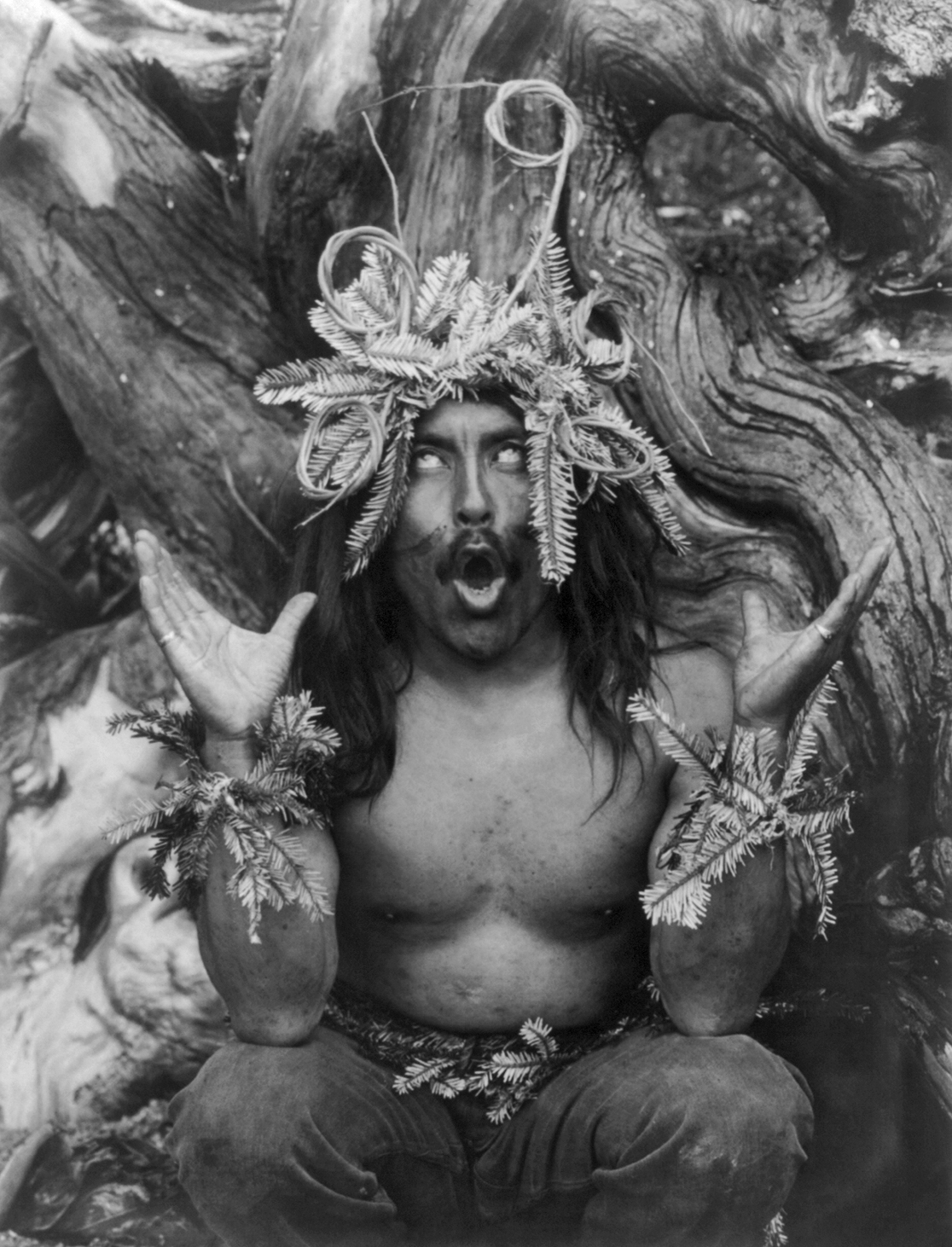 |
| Indian shaman |
If it is not already obvious, the same fate would similarly await the aged, as the merely ill of any age. No room for sentimentality here. “[I]t is the custom,” the Relations report of the Indians about Port Royal, “when the Aoutmoins [shamans] have pronounced the malady or wound to be mortal, for the sick man to cease eating from that time on, nor do they give him anything more. But, donning his beautiful robe, he begins chanting his own death-song; after this, if he lingers too long, a great many pails of water are thrown over him to hasten his death, and sometimes he is buried half alive” (Jesuit Relations 1, p. 167).
If you weren't dying fast enough, they were eager to help you along. Or perhaps not dying at all.
For all these sufferings, it is only too apparent, the greatest help was to live near the newly-arrived Europeans. Jesuits would take your excess babies. The French in their fort would give you, in need, provisions and birch bark. They would always trade food for furs. “[T]hose who are situated near the sea,” Bressani explains, “have, by the exchange of their Beaver skins, provisions for some part of the Year” (Jesuit Relations 39, p. 243). It does not seem to have been terribly clear to these first-contact Indians that the Europeans were viciously robbing them of their land and their happy, idyllic, affluent lifestyle. No doubt more recently the Arnhem Land aborigines have suffered the same confusion, in light of the free nourishment from the nefarious mission stations.
The Sixties studies of hunter-gatherers miss one further factor that would have been a matter of life-and-death for the earlier aboriginals. Modern hunter-gatherers have a government somewhere to keep relations with their neighbours on an even keel. Murder, theft, and cannibalism are punished. They might now, as before, have to spend only forty-four hours a week on food. But now, unlike then, they need spend no additional time on self-defense. In the real state of nature, as Hobbes points out, not to mention Darwin, and as we have already seen, self-defense would have been an all-consuming consideration. Government, oppressive as Diamond may find it, can prevent adversaries from killing you, or stealing your food, or taking you as food.
Hence, perhaps, the idle hours. That may be a new thing. It may not be because of the hunter-gatherer lifestyle. It may be because the hunter-gatherer lifestyle no longer really exists, anywhere.
So why do some societies, as Diamond points out, resist the change? Why are there still, at a minimum, Australian aboriginals, Kalahari Bushmen, and Canadian Indians?
Diamond takes the fact that some few societies seem to resist the transition to agriculturalism as itself evidence that agriculturalism is undesirable. That evidence, mind you, cuts both ways. Six thousand years ago, everyone was a hunter and a gatherer. Now, almost nobody is. The evidence here, surely, is that farming is overwhelmingly more desirable.
There are probably no true hunter-gatherer societies left, except those we can know nothing of, for they have not yet been contacted. A bit of an observer paradox here: the safe presence of white-skinned anthropologists almost necessarily means their subjects are no longer truly in the state of nature. Those who have not begun to farm may be sustained largely on the handouts from the misson stations, or government welfare.
If there is also a residual resistance on the part of a few cultures to settle down to pastoralism, the Bushmen of the Kalahari, or the Indians of Canada, might it mostly be that, for most males, hunting is fun, and farming is not? Evolution surely makes it so. We were hunters for a hundred thousand years, and farmers only in the last few thousand. Aren't we hard-wired, like any predator, to get a nice big adrenaline rush out of the hunt and the kill? Isn't it tough on most young men, naturally craving adventure, not to be able to do it any more, at least not daily, and not to have it valued? Might this feeling not also be amplified by the fact that, in hunter-gatherer societies, because of defense needs, any tilling of the land that did occur was done by the women? So farming was “women's work,” implicitly effeminate. To most red-blooded males, that is not a recommendation.
Didn't even the cowboys of the Old West feel this way about the settlers? Settling down meant an ultimate loss of freedom. Don't most young boys—or even aging accountants, according to Monty Python-- imagine themselves either running away to sea and being marooned on a South Sea Island, or as cowboys riding the lonely range?
Guiding a plough and reaping what you sow just isn't as exciting.
But be that as it may; there is something to be said for living past nineteen. There is something to be said about not living in constant hunger. Not to forget the central heating, Range Rover, and wide screen TV. In sum and in essence, even if only living in Attawapiskat on welfare, disregarding all further opportunities, Canadian Indians have a vastly better life in material terms than anything they might have hoped for in pre-contact days. They can still hunt and fish, after all, according to treaty, if they want. They just no longer have to rely on it for survival.
This being so, it is absurd to talk of financial reparations, or of someone having “stolen their land.” The net gain from colonization was at least as great for the Indians as it was for the more recently disembarked Europeans. Quite apart from any formal deal cut to extinguish aboriginal title. If working a bare minimum of hours is the only goal, for their “original affluent society,” they are living in the Land of Cockaigne, on the very summit of the Big Rock Candy Mountain.
Let us remember, too, before we walk away from the subject, that man does not live by bread alone. Poverty, and Indian poverty, pre-contact, was not just material. It was spiritual. With no permanent structures, no fixed abode where things could be kept, no writing, there was little way to preserve anything for future generations. That means not just food: that means any poetry, any visual art, any music, other than could be passed on memory to memory. Any Indian expressions of the human spirit were simply lost and forgotten; like wolves howling at the moon. Of numberless generations, we have and know practically nothing: a few ambiguous rock carvings, a few oral traditions of dubious authenticity. In the Far West, some totem poles not yet completely defaced by termites. Nothing for the young and restless soul, seeking meaning, seeking what life is really all about, seeking a voice to speak to them. Nothing but the daily struggle for barren subsistence. This is a profound cultural poverty.
When Wolfe approached the battlements of Quebec, it is recorded, he was reciting to himself Gray's poem, “Elegy Written in a Country Churchyard.” He would rather, Wolfe said, have written those lines, than to have taken Quebec.
 |
| A noble savage contrmplates the death of General Wolfe. Benjamin West. |
The burden of that great poem is the tragedy that so many men die unheard, unknown, and forgotten. None of their thoughts recorded, it is as though their lives were never lived.
Perhaps in this neglected spot is laid
Some heart once pregnant with celestial fire;
Hands, that the rod of empire might have sway'd,
Or wak'd to ecstasy the living lyre.
But Knowledge to their eyes her ample page
Rich with the spoils of time did ne'er unroll;
Chill Penury repress'd their noble rage,
And froze the genial current of the soul.
Full many a gem of purest ray serene,
The dark unfathom'd caves of ocean bear:
Full many a flow'r is born to blush unseen,
And waste its sweetness on the desert air.
Some village-Hampden, that with dauntless breast
The little tyrant of his fields withstood;
Some mute inglorious Milton here may rest,
Some Cromwell guiltless of his country's blood.
Gray, and Wolfe, were thinking of most seventeenth-century Englishmen. But the lament is far more poignant if applied to Canadian natives. That is just what Indian culture condemned every Indian who ever lived pre-contact to.
It is the deepest poverty known to man.
Thursday, May 05, 2016
On Promoting Aboriginal Languages
Not one, but two, good friends have posted on Facebook, to illustrate their approval, this blurb from “ourlanguages.gc.ca.” The Trudeau government has apparently launched an initiative to promote aboriginal languages. Sadly, they say, “these languages are spoken less and less, some are even at risk of disappearing. The federal government has therefore made this matter a priority by providing funding until 2017 for projects that promote Aboriginal languages.”
Let's step back a bit, shall we? What is the actual purpose of language? It is to communicate, right? It follows that a language with very few speakers, and the number of which are declining, is of little and declining use. It is doing people harm to ask them to preserve or to learn it. Mankind would be better off were it to die out. Sorry, but it is true, and people everywhere are voting with their tongues: mankind would be better off if everyone could speak English. In the case of Canadian Indians, preserving instead aboriginal languages is a tool of segregation. It cuts them off from the Canadian mainstream, and it cuts them off from the world mainstream.
Let us remember, too, that not one red cent of this money is going to Indians, who are often poor and perhaps could use it. It goes to wealthy academics and professionals, to fund studies and make “language tools” to put up on the Internet. Which any Indian who already speaks the language does not need.
Granted, this notion of language as only a tool for present-day communication is too simplistic. Some languages also enshrine a mighty literature. A communication with great thinkers of the past the subtleties of which cannot adequately be conveyed in translation. This is the case for philosophy, often, or for poetry, in which the beauty of the language is part of the allure. For this reason, people still often want to study ancient Greek, Hebrew, Latin. For this reason, languages other than English—let's give a shout-out to French here—are still viable.
But Canadian Indian languages were and are entirely oral. They have no literature. Long-ago Indians might have had great thoughts or spoken beautiful words, but no great thoughts or beautiful words are preserved, unless in French or English records.
So there is no point. It is a waste of our taxpayer money.
Or worse than a waste. For some language is also created and used simply to keep others out of the group—those, that is, who do not speak it. This is a use of language for evil. This is commonly the case for street slang, or for academic or professional jargon. This is literally the case for the word “shibboleth.” You don't say it right, you are disadvantaged.
As a matter of fact, this is the best way to acccount for the staggering diversity of languages among Canadian Indians. Differences were exaggerated over time to keep groups separate, promoting anomisity among them, and preventing the exchange of ideas.
Preserving and promoting dying Indian languages in modern Canada would do the same thing. Segregation is a good way to stay poor, misunderstood, and ignorant.
People are worth more than languages.
A Fate Worse than Death

General Sir Guy Carleton, sitting in his comfortable office at the Quebec Citadel in May, 1775, had a problem. He had just heard the shot heard round the world. Although Sir Guy was known for never betraying fear or concern, he knew well that Quebec, a vast territory stretching from Labrador to the present St. Louis, was in mortal peril. Thirteen of England's colonies were in open rebellion on his doorstep. Quebec, as a Catholic and Indian entity blocking their expansion westward, was one of their principal grievances. Perhaps the principal grievance, although modern historians prefer to focus on the nobler-sounding notion of “no taxation without representation.” Carleton had every reason to expect either invasion or insurrection, or both, and imminently. In fact, reinforcing the suspicion that Quebec was the main issue, the Yankees had already taken Fort Ticonderoga and Crown Point, defending the main land route north to Montreal.
Carleton had only 800 regular soldiers under his command—to hold half a continent.
The French-speaking population of Quebec no doubt held no special feelings for the Crown of old England: of a different language and religion, they had been conquered on the Plains of Abraham only twelve years earlier. There was also, it is true, a small English-speaking resident population, mostly in Montreal. But they came almost entirely from the Thirteen Colonies. They were already frustrated at being allowed mere equality with the despised French Catholics, and were more than likely to retain allegiances to their southern cousins.
Luckily for Carleton, at that moment two delegations of Indians arrived to offer their support: Algonquin-speakers from the West, and a faction of Iroquois from upstate New York, under the command of Guy Johnson, intrepid British Indian agent.
Carleton turned them both down.
He asked the Algonquins to go home and stay neutral. He asked the Iroquois to remain in Quebec, where they were less likely to be caught up in the battle.
Carleton was an able administrator as well as a military man. These were early days, and positions had not hardened. The US had not yet declared independence. Sir Guy had reason to hope that reconciliation of Britain and its errant colonists was still possible.
But unleash the Indians and, given their methods of warfare, the breach was likely to become irreparable.
Carleton was right. When, in 1776, the Continental Congress did decide for independence, their Declaration included, as one of their justifications for the parting of the ways, “He [George III] has excited domestic insurrections amongst us, and has endeavoured to bring on the inhabitants of our frontiers, the merciless Indian Savages, whose known rule of warfare, is an undistinguished destruction of all ages, sexes and conditions.”
This was just what Carleton had taken great risks to avoid. Unfortunately, later in 1775, two different American armies did indeed invade Canada—again suggesting the importance of this issue to the Continentals. It was a close run thing; Carleton held fast behind the walls of Quebec City until the Royal Navy could deliver reinforcements in the Spring. The Americans were then systematically pushed back, and, in a clash just outside Montreal remembered as “The Affair of the Cedars,” they ran into the Iroquois warriors.
According to the American accounts, after their surrender, the Iroquois tortured and executed American prisoners.
“The evening after major Sherburne was taken the Indians killed and scalped 2 of his men. Afterwards at different times they killed 4, or 5 others, one of whom was of those who had surrendered on capitulation at the cedars and was killed the 8th. day after that surrender. One other (as was affirmed by his companion now in possession of the savages and who saw the act) was first shot so however as not to kill him and then roasted. Others were left exposed on an island, naked and perishing with cold and famine, in which state they were found by Genl. Arnold’s detachment.” (sic; “Major Sherburne’s Testimony on the Affair at the Cedars” [17 June 1776]).
The British denied this; they claimed that the sheer terror of Indian torture led the Americans to surrender prematurely, and they then alleged actual torture to excuse their cowardice.
 |
| The Deah of Jane McCrea, as imagined by American propaganda, painted 1804 |
Either way, the incident may have been the fuse and powder that, in patriot propagandists' hands, finally alienated the Colonials. That, or the claimed execution by Indians travelling with British General Burgoyne of lovely young colonist Jane McCrea—although the Indians insisted she was killed by a stray Patriot bullet.
The Indians may or may not have committed actual acts of savagery in these particular instances. But at a minimum, we clearly see that they by this time had a solidly established reputation for such tactics. So solid that it was asssumed by the Americans as the rule.
And so we come to another rather discreditable element of traditional Indian culture, one that we may not want to endorse preserving. Yes, Indian war was constant. Yes, Indian ways of war produced massive casualties. Yes, they recognized no rights of non-combatants. But, as K-Tel used to say, wait, there's more. There was also the definite likelihood of torture if captured. They apparently knew nothing of the Geneva Convention. According to the early Jesuits, Indians in general believed that “those who go to war are the more fortunate in proportion as they are cruel toward their enemies” (Jesuit Relations 31, p. 29).
“Those who have been captured and led off to their villages,” Jesuit Father Jouvency continues in the Relations, “are first stripped of their clothing; then they savagely tear off their nails one by one with their teeth; then they bind them to stakes and beat them as long as they please. Next they release them from their bonds, and compel them to pass back and forth between a double row of men armed with thorns, clubs and instruments of iron. Finally, they kindle a fire about them, and roast the miserable creatures with slow heat. Sometimes they pierce the flesh of the muscles with red-hot plates and with spits, or cut it off and devour it, half-burned and dripping with gore and blood. Next they plant blazing torches all over the body, and especially in the gaping wounds; then, after scalping him they scatter ashes and live coals upon his naked head; then they tear the tendons of the arms and legs, lacerate them, or, after removing a little of the skin, leisurely cut them with a knife at the ankle and wrist. Often they compel the unhappy prisoner to walk through fire, or to eat, and thus entomb in a living sepulcher, pieces of his own flesh. Torture of this sort has been borne by not a few of the Fathers of the Society. Moreover, they prolong this torment throughout many days, and, in order that the poor victim may undergo fresh trials, intermit it for some time, until his vitality is entirely exhausted and he perishes. Then they tear the heart from the breast, roast it upon the coals, and, if the prisoner has bravely borne the bitterness of the torture, give it, seasoned with blood, to the boys, to be greedily eaten, in order, as they say, that the warlike youth may imbibe the heroic strength of the valiant man. … The rest of the crowd consume the corpse in a brutal feast. “ (Jesuit Relations 1, p. 269-73).
 |
| Martyrdom of St. Isaac Jogues |
Most famous among the victims of Iroquois torture were the “Jesuit martyrs,” of whom every Canadian Catholic schoolboy surely knows. We have Father (Saint) Isaac Jogues's own description of his torture. Captured in a party heading peacefully by canoe from Quebec to Trois-Rivieres, he recalls, “they [the Iroquois] fell upon me with a mad fury, they belabored me with thrusts, and with blows from sticks and war-clubs, flinging me to the ground, half dead. When I began to breathe again, those who had not struck me, approaching, violently tore out my finger-nails; and then biting, one after another, the ends of my two forefingers, destitute of their nails caused me the sharpest pain, grinding and crushing them as if between two stones, even to the extent of causing splinters or little bones to protrude” (Jesuit Relations, vol. 31, p. 25).
“They treated the good René Goupil,” he adds, “in the same way.” This, it seems, was just standard practice. Nothing personal.
The captives were then trekked back to Iroquois territory, thirteen days away. During this march, says Jogues, “the pain of our wounds,—which, for not being dressed, became putrid even to the extent of breeding Worms,—caused us, in truth, much distress” (ibid., p. 27).
On day eight, Jogues and his fellows were obliged for the first time to “run the gauntlet.” He describes the familiar procedure: “[T]hey set up a stage on a hill; then, entering the woods, they seek sticks or thorns, according to their fancy. Being thus armed, they form in line,—a hundred on one side, and a hundred on the other,—and make us pass, all naked, along that way of fury and anguish; there is rivalry among them to discharge upon us the most and the heaviest blows” (Jesuit Relations, vol. 31, p. 29). During the ordeal, Jogues passed out. To prolong the fun, the Indians cared for him tenderly until he revived, then resumed the torture. At this point, Jogues relates, “[t]hey burned one of my fingers, and crushed another with their teeth, and those which were already torn, they squeezed and twisted with a rage of Demons; they scratched my wounds with their nails; and, when strength failed me, they applied fire to my arm and thighs” (Jesuit Relations 32, p. 31-3).
“My companions,” he again adds, “were treated very nearly as I was.”
It was not, of course, only Europeans who suffered in this way. The bulk of the victims, we should recall, were now as always other Indians. “Among the Hurons,” Jogues reports, “the worst treated was that worthy and valiant Christian, Eustache. Having made him suffer like the others, they cut off both thumbs from his hands, and thrust through the incisions a pointed stick even to the elbow” (Jesuit Relations 31, p. 33).
During the thirteen day march, the captives were not fed. If they could snatch any wild fruits or berries from the trees and bushes as they passed, that was their sustenance. Eventually, they came to another Iroquois village, at which they were obliged to again run the gauntlet. This village, being near a Dutch trading post, was equipped with iron bars for the beating. The Indians, Jogues says, aimed for the shins.
It is, I think important to note one aspect of this torture ritual. All members of the tribe took part. Indeed, all members of the tribe seem to have been forced to take part. We see a repeated insistance that women and children, not just the brawny men, serve as torturers.
Why might this be?
People who are caught in an evil culture, I submit, always know perfectly well that what they are doing is wrong wrong; we all have a conscience, and morality is not relative to where you live. Were this not so, the Nuremberg Trials would have been illegitimate.
Because this is so, there is a natural eagerness to implicate others in any social crime. It is never okay for any member of the group to stand aloof. This automatically appears as a condemnation of the act, and the consciences of the original perpetrators cannot tolerate it.
At the same time, if you can implicate everyone in the crime from an early age, they are less likely to turn against the practice, or you, later. Doing so would then require them to face the fact that they themselves have done something terribly wrong. Guilt loves company.
So we see with Father Jogues. He reports, “An old man takes my left hand and commands a captive Algonquin woman to cut one of my fingers; she turns away three or four times, unable to resolve upon this cruelty; finally, she has to obey, and cuts the thumb from my left hand; the same caresses are extended to the other prisoners” (p. 41).
After this general cutting off of thumbs, a lesson for the little ones: “[T]hey made us lie down on pieces of bark, binding us by the arms and the feet to four stakes fastened in the ground in the shape of Saint Andrew's Cross. The children, in order to learn the cruelty of their parents, threw coals and burning cinders on our stomachs,—taking pleasure in seeing us broil and roast” (p. 43).
This is probably the worst thing about immoral cultures. They deliberately make it very hard for individuals to remain moral. They forever present them with moral dilemmas; they tempt and groom for immorality. This is why they need to be abandoned, claims of “cultural genocide” be damned.
In all, says Jogues, to continue the narrative, “we spent three days and three nights in the sufferings” on this particular scaffold (ibid, p. 43). Then their captors paraded the prisoners around to neighbouring villages in turn, each of which got a crack at them. During this time, “[o]ne of those Barbarians having perceived that Guillaume Cousture, although he had his hands all torn, had not yet lost any of his fingers,” no doubt a regrettable oversight, “seized his hand, striving to cut off his forefinger with a poor knife. But, as he could not succeed therein, he twisted it, and in tearing it he pulled a sinew out of the arm, the length of a span” (Jesuit Relations 31, p. 45).
“The young men thrust thorns or pointed sticks into our sores, scratching the ends of our fingers, deprived of their nails, and tearing them even to the quick flesh; and, in order to honor me above the others, they bound me to pieces of wood fastened crosswise. Consequently, my feet not being supported, the weight of my body inflicted upon me a gehenna, and a torture so keen that, after having suffered this torment about a quarter of an hour, I plainly felt that I was about to fall in a swoon from it” (Jesuit Relations 31, p. 47).
In normal circumstances, prisoners were tortured to death; this would properly have been the time to cut Jogues open and eat his heart. But a council of the Iroquois decided the Frenchmen were worth more alive than dead, that they might be bartered back to the Europeans for trade goods. Jogues was held as a slave. Eventually, he was bought by a Dutch trader, and able to set sail back to France.
In a few years he was back, volunteered for the Iroquois mission, and they finally finished the job.
There are many such stories in the Jesuit Relations. It seems pure prurience to tell them all; the outlines of the torture are usually similar. We cannot pass by, however, without retelling for the sake of fellow Catholics the case of the other most celebrated Jesuit martyr, Father (Saint) Jean de Brebeuf. It is told by a Huron witness, confirmed later by wounds found on his charred body.
 |
| Martyrdom of St. Jean de Brebeuf |
The Iroquois, on seizing and immolating with much slaughter the Huron village in which their Jesuit mission was located, seized two priests, including Brebeuf, “stripped them entirely naked, and fastened each to a post. They tied both of their hands together. They tore the nails from their fingers. They beat them with a shower of blows from cudgels, on the shoulders, the loins, the belly, the legs, and the face...” An Indian whom Brebeuf had catechized, now a captive of the Iroquois and no doubt hoping to improve his situation, a typical kapo, “baptized” the Jesuit mockingly three times with boiling water. Then they made their hatchets red hot in the fire, and applied them to his crotch and under his armpits. Then they strung the tomahawks into a collar, and hung it around his neck.
Either the Jesuit redactor, Father Regnault, or the Huron reporter, explains of this particular torture, “ you see a man, bound naked to a post, who, having this collar on his neck, cannot tell what posture to take. For, if he lean forward, those above his shoulders weigh the more on him; if he lean back, those on his stomach make him suffer the same torment; if he keep erect, without leaning to one side or other, the burning ratchets, applied equally on both sides, give him a double torture” (Jesuit Relations vol. 34, pp. 25-7). Another dilemma: the torture is both physical and mental.
“After that,” our source resumes, “they put on him a belt of bark, full of pitch and resin, and set fire to it, which roasted his whole body. ... To prevent him from speaking more, they cut off his tongue, and both his upper and lower lips. After that, they set themselves to strip the flesh from his legs, thighs, and arms, to the very bone; and then put it to roast before his eyes, in order to eat it” (ibid., pp. 27-9).
By now, Father Brebeuf was visibly weakened almost to the point of death. His tormentors, seeing this, proceeded to the denoument. They made him sit down on the ground; “and, one of them, taking a knife, cut off the skin covering his skull. Another one of those barbarians... made an opening in the upper part of his chest, and tore out his heart, which he roasted and ate. Others came to drink his blood, still warm, which they drank with both hands” (Jesuit Relations 34, pp. 29).
You get the general idea of how these things proceeded. We could give more examples. Both of our cases have involved Iroquois, but do not suppose the practice was limited to that tribe. This is more an artifact of our sources being French and Jesuit, and the Iroquois long being their sworn enemies. Father Regnault, in reporting the death of Brebeuf, adds, “I have seen the same treatment given to Iroquois prisoners whom the Huron savages had taken in war” (ibid, p. 31).The Jesuits also record it among Neutrals. Champlain, returning from his first joint raid upon the Iroquois, observed quite similar tortures by Algonquins, Montagnais (Innu) and Etechemins. From Champlain's journal:
“our men kindled a fire; and, when it was well burning, they each took a brand, and burned this poor creature [an Iroquois captive] gradually, so as to make him suffer greater torment. Sometimes they stopped, and threw water on his back. Then they tore out his nails, and applied fire to the extremities of his fingers and private member. Afterwards, they flayed the top of his head, and had a kind of gum poured all hot upon it; then they pierced his arms near the wrists, and, drawing up the sinews with sticks, they tore them out by force; but, seeing that they could not get them, they cut them. This poor wretch uttered terrible cries, and it excited my pity to see him treated in this manner… After his death, they were not yet satisfied, but opened him, and threw his entrails into the lake. Then they cut off his head, arms, and legs, which they scattered in different directions; keeping the scalp which they had flayed off, as they had done in the case of all the rest whom they had killed in the contest. They were guilty also of another monstrosity in taking his heart, cutting it into several pieces, and giving it to a brother of his to eat, as also to others of his companions” (Voyages, vol. 2, ch. 10).
Next expedition, and a new batch of prisoners was observed being treated in the same manner:
“They took the prisoners to the border of the water, and fastened them perfectly upright to a stake. Then each came with a torch of birch bark, and burned them, now in this place, now in that. The poor wretches, feeling the fire, raised so loud a cry that it was something frightful to hear; and frightful indeed are the cruelties which these barbarians practise towards each other. After making them suffer greatly in this manner and burning them with the above-mentioned bark, taking some water, they threw it on their bodies to increase their suffering. Then they applied the fire anew, so that the skin fell from their bodies, they continuing to utter loud cries and exclamations, and dancing until the poor wretches fell dead on the spot. As soon as a body fell to the ground dead, they struck it violent blows with sticks, when they cut off the arms, legs, and other parts; and he was not regarded by them as manly, who did not cut off a piece of the flesh, and give it to the dogs. Such are the courtesies prisoners receive. As to the other prisoners, which remained in possession of the Algonquins and Montagnais, it was left to their wives and daughters to put them to death with their own hands; and, in such a matter, they do not show themselves less inhuman than the men, but even surpass them by far in cruelty; for they devise by their cunning more cruel punishments, in which they take pleasure, putting an end to their lives by the most extreme pains” (Voyages, Vol. 2, Ch. 10).
Similar stories are recorded of almost every North American tribe. John Gyles, taken from his farm on the Saint John River in 1692, reports his own torture and that of his companions by the Malecites (Algonquin speakers) in his Memoirs of odd adventures, strange deliverances, etc. published in 1736. According to a memorial plaque on the site, his brother and fellows were “tortured by fire, compelled to eat their noses and ears, and then burned to death at the stake.” Susannah Johnson, captured in a raid on Charlestown, New Hampshire by the Abenaki in 1754, was forced with her companions to run the gauntlet, although in this case it seemed mostly pro forma (Narrative of the Captivity of Mrs. Johnson, 1834, p. 47). Mary Rowlandson, captured in a raid on Lancaster, Massachusetts by the Narragansetts in 1675, told of a companion slowly burned to death with her infant child (Narrative of the Captivity and Restoration of Mrs. Mary Rowlandson, Fourth Remove). Mary Jemison, taken by Senecas in the 1750s, wrote “we passed a Shawnee town, where I saw a number of heads, arms, legs, and other fragments of the bodies of some white people who had just been burned. The parts that remained were hanging on a pole, which was supported at each end by a crotch stick in the ground, and were roasted or burnt black as a coal” (James E. Seaver, The Life and Times of Mary Jemison, 1824, ch. 3). So too with the tribes of the plains. Gregory and Susan Michno, restricting themselves only to accounts from Texas in their book A Fate Worse than Death, decribe torture by the Sioux, Blackfoot, Comanche, Arapahoes, Cheyennes, Lakotas, Shoshones, Bannocks, Mojaves, Yavapais, Crow, Kiowas, Kickapoos, Utes, and Chiricahuas.
 |
| Native Americans scalping and roasting prisoners. |
The “captivity narrative,” almost always including accounts of torture, even became a recognized genre of American literature, and reports stretch all the way from first contact up to the final closing of the American frontier in the 1890s—when Mounties and Texas Rangers finally galloped onto the scene to end it.
Revisionist historians in recent years, it is true, have cast their doubts on just how widespread Indian torture really was. Believing devoutly, no doubt, in the innate sweetness of the noble savage, they argue that, “captivity narratives” having become a popular genre, there was an obvious incentive for authors to fake details, to make them as lurid as possible. Sells more tabloids, after all. What we see here, they also sometimes argue, is a clash of cultural values; no doubt the Indians similarly found some of our European ancestors' behaviour barbaric. Their final point is that, as propaganda, such stories might have been useful to justify settlers encroaching on Indian land.
These objections, I submit, really do not hold up well on close inspection. To deal with the last first, if the local Indians were not brutal, the settler reaction shown here would seem pretty far over the top. Why would they be so set against Indians as to invent such slanders? If farming the land might have put a crimp in Indian hunting practices, Indians simply following their traditional hunting practices did not really much interfere with farming the land; especially for these early settlers. Having Indians nearby could, on the other hand, be useful, so long as they did not enslave or torture: for showing what local plants were edible, explaining how to survive the local winter, to trade for mutual profit, and so forth. Land envy just does not seen sufficient to account for the evidence.
Most offensive is the idea that this is simply a clash of cultural values, and the Indians are entitled to their own whether we like them or not. Morality is absolute, or it does not really exist at all. Just because you live in Nazi Germany does not make it okay to kill Jews. Accordingly, cultures really can be more or less moral, just as can individuals. Torture is immoral. To suggest it isn't is apalling. There might be circumstances in which dire necessity might be used to justify it, but even so, where is the dire necessity here?
As for the yellow journalism charge, it is on its face more plausible. But note that the accounts we selected so far are mostly from early Jesuits, who already find the practice of torture widespread and in a variety of tribes. It is a bit hard to believe that either they or Samuel de Champlain, writing well before there was any established genre of captivity narrative, are already playing to the cheap seats. Moreover, it defies belief that men who have sacrificed everything to their faith, homeland, family, and life itself, would at the same time casually disregard one of its clearer tenets, that one ought not bear false witness against one's neighbour.
Finally, there is the matter of clear physical evidence. It is fairly easy to see if a thumb really has been cut off, or if a heart is missing. In many of these cases, it is not just one man's testimony: we have multiple witnesses, of unimpeachable moral character.
It might also be observed that those who knew the Indians best, the earliest settlers and those on the frontier, were those most inclined to believe these stories. Detroit's inhabitants, at the time on the far frontier of settlement, wrote in 1811 this poetic resolution pleading for government protection: “The tenderest infant, yet imbibing nutrition from the mamilia of maternal love, and the agonized mother herself, alike wait the stroke of the relentless tomahawk…. Nothing which breathes the breath of life is spared … It is in the dead of night, in the darkness of the moon, in the howling of the [wolf] that the demoniac deed is done” (Detroit public meeting resolution, December 8, 1811, quoted in Taylor, loc. 3985). Modern historians now and those back home in Britain then are and were most likely to doubt the tales; not those in the best position to know.
Even were all this not so, the tales of torture are so universal, it lends credence on the simple principle that where there is a choking smoke, there's apt to also be a fire.
Just as Indian torture played a role in the American War of Independence, it seems to have been crucial, fortunately and unfortunatley, in the sequel, the War of 1812.
It is an abiding mystery, on the statistics, how timid little Canada emerged from that conflict intact. The numerical advantage held by the Americans, after all, was overwhelming. The situation was little better than that outlined for Carleton's time. The US had 7,500,000 citizens; Canada had 500,000. Jefferson said it would be “a mere matter of marching.” Canadians still congratulate themselves on the remarkable “victory.” That's victory, of course, in traditional Canadian terms: for “victory,” read “survival.”
This time, unlike during the Revolutionary War, the British had no particular need to restrain their Indian allies. The rift with the Americans was already irreversible.
And so, Tecumseh and his united warriors were a major factor. Several of the most important British-Canadian victories were wrought from sheer American fear of being tortured by natives.
Begin with Brock's miracle of taking Detroit, almost the first action of the war. Hopelessly outnumbered by the Americans under General Hull, General Brock had the Indians parade in a circle outside the fort, passing repeatedly through a clearing into view, making their numbers appear much larger. He sent a note in to his American adversary: “It is far from my intention to join in a war of extermination, but you must be aware, that the numerous body of Indians who have attached themselves to my troops, will be beyond control the moment the contest commences” (Alan Taylor, The Civil War of 1812, loc. 3250). That did it. Almost without firing a shot, after taking some time to ponder, General Hull struck his colours. A mixed group of 1,300 under Brock took prisoner two thousand five hundred Americans, and their well-positioned fort, gateway to all the upper lakes.
Similar scenarios played out many more times. On May 29, 1813, a boatload of frightened American troops rowed out to Captain John Richardson, commanding a British warship on Lake Ontario, under a white flag. They petitioned to be allowed to surrender and “claim our protection as prisoners of war against the savages on the shore” (Taylor, loc. 3968). The Americans, he noted, were all well-armed. They were followed by a second boatload making the same request. In the summer of 1813, there were stories among the Americans of a raiding party that had been found “most shockingly butchered, their heads skinned, their hearts taken out and put in their mouths, their privates cut off and put in the places of their hearts” (Taylor, loc. 4011). It was discouraging.
And then there was the celebrated Battle of Beaver Dams.
 |
| Laura Secord reports to Lieutenant FitzGibbon |
You have probably heard of Laura Secord, who walked her weary cow through 20 miles—sorry, 32 kilometres--of rough and wild terrain to warn the British of an American attack?
Have you heard the rest of the story? Whom she reported to, and what he did with this information?
The officer's name was James FitzGibbon, as much as Secord a hero of Canadian history. FitzGibbon, forewarned, asked a few hundred Mohawks (250) in the area to wait in ambush. They waylaid the American column where the main road was flanked on both sides with forest. The Indians were heavily outnumbered, but, hidden in the trees, the Americans could not fire on them effectively, and could not see how many there were. The sound of the war-whoops was terrifying.
FitzGibbon then boldly marched his own scant band of regulars, in plain view, to block the American retreat. This was a brash and purely psychological move: although he did his best to mask their small numbers, had the Americans charged his line, they would easily have overwhelmed it. But the bluff worked. The Americans now thought themselves surrounded by Indians, and cut off.
FitzGibbon then cooly approached the Americans under flag of truce, and demanded surrender “in order to avoid unnecessary bloodshed,” saying he could not possibly control the Indians for more than another five minutes (FitzGibbon, A Veteran of the War of 1812, p 87). At this time, unknown to the Americans, the Indians were already retreating, feeling they could accomplish nothing more.
Nerves shattered, the American commander agreed to surrender if FitzGibbon's would guarantee, on his honour as a British officer, they would not be harmed by the Indians. FitzGibbon promised, if necessary, to give his life in their defense. With a force of 46 muskets, plus 250 Indian irregulars only loosely under his command, FizGibbon achieved the surrender of 554 American officers and men, two cannon, two cars of ammunition, and the regimental colours.
Were American fears unfounded? Surely not. The Indians in these cases outnumbered the British themselves. Accordingly, the British did not dare press to impose any restraint on their Indian allies. There are many credible reports of real Indian atrocities during this time, some of them witnessed by British officers.
And that, perhaps, was really how and why little Canada survived the War of 1812. It was American fear of Indian torture.
Let us make one final thing clear. It is wrong to blame these atrocities on “the Indians,” as individual human beings, or suggest we would not behave about the same in similar circumstances. For one thing, Indians were most often the victims as well as the torturers. A poisonous culture puts every individual in an impossible moral quandary. We have the example of Nazi Germany, where “civilized” Europeans behaved almost as badly. We have the famous Milgram experiment, in which American grad students mostly acted as ready torturers so long as they thought they were being asked by someone in authority.
It is certain some Indians disliked what they were asked to do. They knew it was wrong. Almost every account of torture also includes an account of one Indian or another secretly bringing aid or succor to the victim. Mrs. Johnson reports her Indian captor eventually said, through her interpreter, “'I could not sleep last night… She may have her child! I cannot withhold it from her any longer!'” And, with the returned child, she also gave clothing and several presents (Johnson, p. 56).
Of course, it is also possible that only those captives lucky enough to find unusually compassionate Indians survived to tell the tale.
In any group of people, there are some good and some bad, probably in about the same proportions. But just as people are not all good, neither are societies. As with Nazi Germany, or Sodom and Gomorrah, some societies can be thoroughly bad.
One remarkable thing about Indian torture is how little practical justification for it there seems to have been. This, of course, makes it harder to justify. It was not done, like waterboarding or the Spanish Inquisition, to extract information. One can imagine that it might work as a force miltiplier—if only one tribe did it. It seems to have been just that in the War of 1812. But that was only possible when there was another non-torturing party alongside, here the British regulars, to play “good cop.” In inter-Indian conflict, there would be none. The chance of torture after capture was surely just as likely then to convince opponents to fight to the last man and the last breath rather than surrender.
So Indian torture seems to have been done just for fun.
How did it happen that almost every Indian group seems to have done it?
Some people are bullies. You grew up with some of them, back in the state of nature that is childhood. Some kids love to tie tin cans to doggies' tails, swing cats, or blow up frogs with firecrackers. A certain percentage of people everywhere are psychopathic. They derive pleasure, perversely, by inflicting pain.
Now, in any small group lacking a solid government structure designed to prevent it, the bullies are naturally going to take control. This is because they want it more than anyone else, and because they lack any morals in achieving their goal.
Indian bands, as the early Jesuits observed, or as Jared Diamond (Guns, Germs, and Steel) would attest, lacked much government. They were “sans roi, sans loi, sans foi.” For the most part, aside from the influence one individual could have with another, everyone did just about as they pleased.
In this “state of nature,” without effective government, there is nothing to stop the bullies from taking charge: no primogeniture, no democracy, no first estate. It will happen, as in Golding's Lord of the Flies, sooner or later, probably sooner. Once they have it, the bullies will take pains to implicate everyone else in their crimes, ensuring their habits and their power are maintained.
Hence, hell on earth. And for many in the afterlife as well.
Preserve or revive native Indian culture? We owe it to ourselves, especially if we are Indian, to do whatever is possible to ensure that we are never again placed in such a situation.
Monday, March 21, 2016
Sir John A. Macdonald and Hitler
 |
| The old worthy, Kingston city park. |
The stated reason is that it was “politically insensitive (if not offensive) to celebrate and memorialize all Canadian prime ministers … on land that traditionally belongs to the … Anishnaube and Haudenausanee peoples...” The city of Kitchener backed out on the grounds that it did not reflect the “diversity”of the region.
 |
| As defaced. |
Tellingly, the online petition opposing the installation refers readers to a web page outlining similar protests in the US, against statues of Southern Civil War figures. This helps to explain the otherwise seeming non sequitor of statues of our prime ministers being somehow offensive to aboriginals: if something is happening in the US, we have to imitate it in Canada, whether the case is comparable or not. A recent example is the current push to put a woman on the banknotes. There is an online call for nominations. This follows the current American push to put a woman on the banknotes—there is an online call for nominations. It repeatedly and studiously ignores the awkward fact that, very unlike the case in the US, there has almost always been at least one woman on the Canadian banknotes, and more often women than men.
In the Waterloo statue case, most and probably all Canadian prime ministers have been pretty easygoing and ethnically inclusive in their attitudes and policies. This is part of the bedrock of Canadian history, if only due to the circumstance of being a half Anglophone, half Francophone, half Catholic, half Protestant nation run as a democracy. While politicians are by their trade not entirely to be admired, it is absurd to see Kim Campbell or John Turner as some kind of war criminals. This is beyond anything Godwin foresaw. But then, it is absurd to blame Sir John A. Macdonald. These are not the sort of people who went to war to defend slavery.
In the Waterloo statue case, most and probably all Canadian prime ministers have been pretty easygoing and ethnically inclusive in their attitudes and policies. This is part of the bedrock of Canadian history, if only due to the circumstance of being a half Anglophone, half Francophone, half Catholic, half Protestant nation run as a democracy. While politicians are by their trade not entirely to be admired, it is absurd to see Kim Campbell or John Turner as some kind of war criminals. This is beyond anything Godwin foresaw. But then, it is absurd to blame Sir John A. Macdonald. These are not the sort of people who went to war to defend slavery.
 |
| WLU statue |
Let's take Sir John A. He, after all, seems to be singled out for special condemnation by the social justice league of Canada. In Waterloo, it was his statue alone that was physically removed. In Kingston, last January 11, Macdonald's 201st birthday, somebody working in the night slashed the tires of the man organizing a commemorative ceremony, as well as splashing his car with red paint. Presumably symbolizing blood. They also apparently, in eerie if unintentional echo of KKK traditions, burned a Canadian flag on his lawn. One of the local “activists” (what would you prefer to call them?) is quoted by the papers referring to Macdonald as a “genocidal maniac.” In previous recent years, the anniversary had been celebrated by nocturnal spraypainting—again with red paint—of the John A. statue in Kingston's city park with the phrases “This is stolen land,” “murderer,” and “colonizer.” An Idle No More protester explained: “Would people commemorate the crimes that Hitler did? Because this is basically the same principle.”
No wonder this sort of thing happens again every year. Those who do not learn history are condemned to repeat it.
 |
| An oddly suitable memorial |
Macdonald's unspeakable crimes are apparently these: 1. as per the Kingston graffito, that he stole Indian land; 2. that he killed Indians by deliberate starvation, 3. that he was responsible, as longtime Superintendent of Indian Affairs, for the setup of the residential schools system, which constituted “cultural genocide” as well as enabling widespread child abuse 4. (per Timothy J. Stanley at Active History) that he made war against the Indians in 1885. That seems to be the basic bill of indictment. Lets deal with the charges in turn.
One: he stole Indian land. This seems to be another case of apishly following trends in the US. The truth is, the history of aboriginal-government relations is very different in Canada and the US. Which is why the US-Canada border was known among plains Indians as the Medicine Line. Which is why, in both the Revolutionary War and the War of 1812, aboriginals flocked to British/Canadian colours in great numbers. The favourable treatment of Indians, in fact, protecting them from wildcat European settlement beyond the Appalachians, was one of the causes of the Revolution, cited obliquely in the Declaration of Independence. Here was no Trail of Tears. Here was no Wounded Knee. Here, negotiated settlements, notably the numbered treaties that began under Macdonald, preceded any incoming settlement, along with the NWMP/RCMP to ensure peace and order—another initiative of Sir John A.'s. Their first mandate was to protect the natives against the predations of dubious non-aboriginal traders.
 |
| NWMP officers, 1898 |
If someone sells you his house, you did not steal it. If he comes back a few years later and demands more money, he is not a moral fellow. He certainly has no say if you choose to put a statue of anyone on your lawn.
Some natives have recently insisted that the Indian oral understanding of the original treaties was different from the government's written documents, that they, being non-literate, were lied to and conned by the government agents. They had intended to cede ownership of the land "only to the depth of a plough blade.” Their fellow Canadians therefore owed them trillions in past resource revenue.
 |
| Idle No More protestor. Oddly not considered hate speech. |
There are several problems with such claims. First, there is a reason for the invention of writing. The original reason was to keep accurate records in case of dispute. Oral records can be quite reliable, if it is in everyone's interest to preserve them intact. But they can also be altered at any time by either party, and therefore are not of great evidentiary value. Written evidence preserves the matter beyond dispute. As a result, there is every reason to give written records absolute priority. Second, this claim goes emphatically against the written text. In the words of Treaty Three, which become legal boilerplate for subsequent agreements: “[the Indian signatories] do hereby cede, release, surrender and yield up to the Government of the Dominion of Canada for Her Majesty the Queen and Her successors forever, all their rights, titles and privileges whatsoever, to the lands included.” There is no ambiguity there. To accuse the government agents of misleading the natives on this point requires accusing them of a truly breathtaking act of mendacity. Third, a large part of the very point of the treaties from the government's point of view was to allow for unhindered mineral extraction. To go back on that now would be unfair to that signing party. Fourth, the native cultures were still in the stone age. They did not mine any metals. They would have had little idea of value of any sort buried below ground, little use for it, and little reason to even think what was down there. It seems unlikely they would have made any such reservation, even in their own minds. Fifth, this being so, the government agents would have gained nothing by having lied on this point. It would have done nothing to improve their bargaining position. Sixth, the intrinsic unlikeliness of the native claims is itself evidence that their “oral understanding”of the agreements has been altered for their benefit, and is indeed not to be trusted.
Two: Macdonald killed Indians by deliberate starvation. The essential piece of evidence here is Macdonald's boast in the Commons, “[We] are doing all we can by refusing food until the Indians are on the verge of starvation...” Note this: “on the verge.” At worst possible interpretation, Macdonald is saying that to the best of his knowledge, nobody is starving. Nevertheless, Dennis Gruending, writing for Rabble, accuses Kingston's favourite son of creating “the conditions for a tuberculosis epidemic in aboriginal communities.” This is a bit of a stretch, since tuberculosis has been a major problem in aboriginal communities both before and after Macdonald. It is currently 31 times the rate among the general Canadian population. In any case, how can Macdonald's food policies be to blame? Everyone knows it is the residential schools that are at fault here.
 |
| Medal struck by Canadian government to commemmorate the signing of Treaties 3-7 |
Now, the words immediately before that “on the verge” are significant. A fuller quote is “We cannot allow them to die for want of food. We are doing all we can, by refusing food until the Indians are on the verge of starvation, to reduce the expense.”
That gives a little context. Simply on the face of it, there was no policy to starve the Indians, no genocide. Canada was in recession, and the opposition was challenging the government policy of sending food aid to the Indians as extravagant. Macdonald was defending against this attack, and perhaps using hyperbole in the effort. Politicians have been known to do this. Note that Canada at this time had no social safety net, no welfare, no disability, no child allowance, no old age pension. Other Canadians were left to sink or swim, as far as the government was involved. Yet this group was being helped out, in part by taking funds from fellow Canadians who might have needed it badly themselves. Note too that there was no actual obligation on the government to send food. Treaty One, Two, Three, Four, Five, and Seven say nothing about the government being responsible for sending aid in any circumstances. Aboriginals were given seed, large tracts of land, and farm implements, and expected thenceforth to look after themselves, like every other Canadian. Integration was the aim. The wording of Treaty Six alone, of all the treaties in effect during Macdonald's time, gives a mandate, but is ambiguous and leaves lots of wiggle room:
That in the event hereafter of the Indians comprised within this treaty being overtaken by any pestilence, or by a general famine, the Queen, on being satisfied and certified thereof by Her Indian Agent or Agents, will grant to the Indians assistance of such character and to such extent as Her Chief Superintendent of Indian Affairs shall deem necessary and sufficient to relieve the Indians from the calamity that shall have befallen them. (Treaty Six)
Very much at the discretion of the government, although it would have violated the spirit of Treaty Six to have done nothing. Treaty Six covered a large chunk of central Saskatchewan and Alberta.
 |
| The Qu'Appelle Residential School |
Three: Macdonald was guilty of “cultural genocide” for founding the residential schools system.
All of the numbered treaties included the requirement that the government set up schools and pay for teachers.
And further, Her Majesty agrees to maintain a school on each reserve hereby made whenever the Indians of the reserve should desire it. (Treaty One, Treaty Two)
And further, Her Majesty agrees to maintain schools for instruction in such reserves hereby made as to Her Government of Her Dominion of Canada may seem advisable whenever the Indians of the reserve shall desire it. (Treaty Three)
Further, Her Majesty agrees to maintain a school in the reserve allotted to each band as soon as they settle on said reserve and are prepared for a teacher. (Treaty Four)
And further, Her Majesty agrees to maintain schools for instruction in such reserves hereby made as to Her Government of the Dominion of Canada may seem advisable, whenever the Indians of the reserve shall desire it. (Treaty Five, Treaty Six)
Further, Her Majesty agrees to pay the salary of such teachers to instruct the children of said Indians as to Her Government of Canada may seem advisable, when said Indians are settled on their Reserves and shall desire teachers. (Treaty Seven)
 |
| Classroom, Fort Albany Residential Scvhool |
At whose insistence? Not the government's. Their priority was to spare expense, and this was an added expense. It was at native insistence, and was one of their chief goals in signing the treaties. They could see that their traditional way of life was unsustainable and far less desirable than that of the European settlers. They wanted the next generation to learn to farm or follow a trade, and to integrate. The treaties specified that schools would be built only where and when the Indians wanted; the vast majority of aboriginal children were always educated at day schools. The residential schools were for children whose homes were too remote to support a local school. The government did not want to pay for a residential school if they did not have to: it greatly increased their costs per student. The fact that only a small proportion of native children were ever educated in residential schools makes ludicrous the claim, often heard, that the residential schools are to blame for all the ills of Indian society even today.
The basic idea of the residential schools, from the start and at native insistence, was to promote integration. Objectively, the government probably did not particularly care: integration or segregation was all the same to them. It was, in fact, and transparently, the same programme advocated by Martin Luther King and the civil rights movement of the US South. If this was “cultural genocide,” King is a leading criminal against humanity.
 |
| Not his natural skin colour. Which was red. |
As for child abuse in the schools, it is a tragic certainty that those inclined to bully are inevitably going to have an incentive to choose careers, like teacher or palliative care nurse, which make this avocation easier to pursue. They will seek defenseless prey. They will, if possible, sign up for locations, like remote residential schools, where supervision is minimal. More remote day schools might have been worse. Pedophiles are going to look for jobs that put them in close contact with children, ideally without much supervision, for long periods of the day or night, ideally with the pedophiles in some kind of formal relationship of control. There are few ways to protect against this tendency; probably the best is to turn such positions over to those who have an apparent and stated religious or moral reason for being there, as this may explain their presence instead of predatory instincts. Better still if they have some sort of moral supervision by a religious society and superior. Probably a vow of celibacy is even better.
But this is exactly the path the residential schools took. It was not one hundred percent efffective, but nothing is. In recent years, we have been coming to a growing realization that this problem is pandemic to schools of all sorts; there is nothing special, and certainly nothing intentional in the design of residential schools, in this regard. Ironically, the very richest strata of society have traditionally insisted on paying great sums for the privilege of sending their children into the same circumstances considered abusive when the students are aboriginal. Heads you win, tails we lose.

In 2006-2007, a settlement of $2 billion was mandated by the courts--the largest class action settlement in Canadian history--to anyone who had gone to a residential school. Not just those who could demonstrate abuse. Anyone. This was a huge transfer of wealth to a privileged group from fellow Canadians. Who obviously had nothing to do with the residential schools, whether the latter were good or bad.
Discipline in the residential schools, they say, was strict. No doubt. It was strict everywhere. Some of it, there as elsewhere, was surely bullying. Welcome to school. On the other hand, there is an entirely forgotten reason for the good old hickory stick, quite apart even from discipline, and in the best interests of the students. For thousands of years, in essentially all cultures, it has been realized that our ability to remember is tied to some sort of emotional association with the thing remembered—Aristotle, for example, wrote that every memory involved an emotion. It follows that the ever-present fear of punishment helps us remember. “[P]hysical methods were thought to ensure that knowledge was securely impressed into the memories of schoolchildren” (Mary Carruthers and Jan Ziolkowski, The Medieval Craft of Memory, p. 21). What we do not remember, we have not learned.
 |
| Battle of Fish Creek. |
He did not. This seems to be another slavish imitation of American models. Macdonald is perhaps being confused with Andrew Jackson. The reference is to the Northwest Rebellion. The Indians, or rather a very small group of Indians, made war on him, in violation of treaty. They may have had real grievances, they may not, but this was not the way to address them. He had the natural right of self defense, as well as the public duty to keep the country together and in full possession of its territory.
It was all a comic opera affair, and few actually got killed. After a conventional trial and benefit of law, eight aboriginal ringleaders were hanged, along with Louis Riel. Maybe they did not deserve it; but it was not really Macdonald's call. Poundmaker went to prison for less than a year. The chief government response in the aftermath—which was Macdonald's call--was to send more food aid to the Western reserves.
If this is the worst that can be brought against any of Canada's leaders, Canada stands alone as the most tolerant of nations, We ought to be celebrating this.
How about a sculpture park?
Subscribe to:
Posts (Atom)