Playing the Indian Card

Showing posts with label creationism. Show all posts

Thursday, June 15, 2017

Monkeying with Darwin


My left-wing friend Xerxes is always giving me ideas. His latest column is a celebration of “evolution,” as opposed to “creationism.”

It is fascinating because, although he thinks he is a Darwinist, it is clear that he is not.

He begins by saying evolution is not a theory, but a “reality.”

This depends what you mean by “evolution.” And it is a fundamentally unscientific thing to say.

If you mean the simple proposition that things, including species of plants and animals, can change over time, this indeed comes pretty close to being a self-evident truth. It is almost as obvious as saying “things change,” which few anywhere would disagree with. Parmenides, I suppose, and maybe nobody else ever.

This is not, however, a “scientific truth.” There aren’t any. Strictly speaking, science can prove nothing, and never claims to. What science does is disprove faulty hypotheses. It disproves things.

But simply because a hypothesis has not yet been disproven can never establish it as a truth. Black swans may come to roost.

To suppose otherwise is the most fundamentally anti-scientific thinking. Science is all about testing everything, repeatedly, and taking nothing on authority.

Xerxes mentions gravity as an example of a proven scientific truth. Bad call. Ironically, Newton’s Law of Gravity has been more or less systematically refuted by Einstein. As to gravity itself, the physical experience, of course people were fully aware of this and how it worked, in practical terms, before Newton. This is not science. You did not suppose, dear reader, that Newton was first to discover that apples fell, did you?

Just so, Darwin did not invent evolution in the sense of realizing that things change over time. Including dogs or horses. Everyone always thought this. Augustine assumed that species changed into other species. Aquinas assumed this. Aristotle assumed this. Ever read Ovid?

Granted, some modern Protestants deny it—but this is a very recent thing. It is a reaction to Darwin, not a traditional idea.

Darwin’s theory, the “Theory of Evolution,” was about how these changes happened; about the mechanism behind the observed experience. Darwin’s theory is that evolution occurred by natural selection of random mutations in a general struggle for survival.

This is the science. And it is and will always be at least as vulnerable to refutation as Newtonian physics. Indeed, it is all rather dubious.

Xerxes points out that “not one scientific discovery has disproven evolution.”

There is a more fundamental question: what experiment would, given a specific result, disprove it? What hypothetical evidence conclusively would?

If there is none, it is not, in fact, science. As Karl Popper pointed out, the essence of science is “falsifiability.” If you cannot conduct an experiment to test the hypothesis, you are not doing science.

This is a common charge against Darwin’s theory: that as phrased, no plausible experiment can be done, and no evidence advanced, that would disprove it. If this is so, it must either be self-evident—and it clearly is not—or it is an article of faith. And an article of faith in a sense that even, say, Christianity is not. For Christianity could indeed be falsified, theoretically, if the corpse of Jesus were ever found.

Darwin, acknowledging the issue, proposed “If it could be demonstrated that any complex organ existed which could not possibly have been formed by numerous, successive, slight modifications, my theory would absolutely break down. But I can find out no such case.”

In response, Behe and others have cited many examples of what they call “irreducible complexity,” complex biological structures that seem indeed impossible to develop by stages, given that each intersecting stage must by itself have some survival value. But “impossibility” here is an impossibly high bar. It is almost no test at all. Who is to say it is impossible for unicorns to appear in yonder birdbath within the next five minutes?

Darwinism has always seemed to defy common sense and probability. Observe the humble giraffe: does it seem likely that he came into existence, just as he is, by a series of random chemical reactions? Does it seem likely, as the famous example goes, that a thousand monkeys, at a thousand typewriters, would sooner or later type out the complete works of Shakespeare?

“Of course,” answer the Darwinists, “given enough time.”

But are a hundred thousand years really enough? We are causing Occam some vertigo here.

Richard Dawkins, who has pretty obviously elevated Darwinism to his religion, has more recently been challenged on this point: what evidence, if ever found, would disprove Darwin? He responded with something from J. B. S. Haldane: “fossil rabbits in the Precambrian.” That is, a fossil appearing in an impossibly wrong place in the rock strata.

Problem: such fossils have indeed been found, and not infrequently.

And they have never been accepted as disproving evolution.

There are, after all, always alternative possibilities―like some disturbance to the sedimentary layers in later years. Or deliberate fraud. Or the simple possibility that, “it appears that rabbit evolution was not as we thought it was.” Without touching the overall thesis.

If it is not impossible, by this bar, Darwin must be right.

This would, moreover, not even address Darwin’s actual theory, but rather the more basic contention that species change over time. Which is not Darwin’s theory, and is not generally in dispute.

So the argument begs our attention: is Darwin science?

The creationists object especially to the Darwinian claim of “randomness.” (“Natural selection of random mutations.”) How can something ever be demonstrated to be “random”? What, in scientific terms, does it even mean? Isn’t the whole point of science to discover how things happen, to discover “laws” or “rules” nature follows? Isn’t saying it is “random” just an admission of failure? Wouldn't "I don't know" be more honest and accurate?

But then, if it is not random, but follows some kind of design―this becomes strong prima facie evidence, if not itself flat proof, of creation—of intelligent design. Can you have a design without a designer? Can a design be random? Isn’t this a contradiction in terms?

Darwinism then, as Dawkins proposes it, is such a crazy idea that almost nobody really believes it.

And, clearly, Xerxes does not.

He says, in his praise of evolution here, that “evolution never goes backwards.” This presupposes that evolution has a direction, a goal, a plan: that it is teleological. Which his to say, that it is a design. For if Darwin is right, there is no such thing as forwards or backwards.

He says “evolution always moves from the simple to the complex.” This indeed seems by observation to be so, and it is indeed a remarkable fact. Because by itself it disproves Darwin. If Darwin were right, it would not be so. Mutations persist because they have survival value. There is no survival value in being complex over being simple. Ergo, given Darwinism, organisms should evolve equally often in either direction: sometimes becoming simpler, sometimes becoming more complex.

Yet, in general, as Xerxes rightly notes, they do not.

Xerxes also says “evolution never puts all its eggs in one basket. It never relies on a single solution.” He says that evolution never makes a mistake. He says that “evolution always moves toward healing.”

However you slice it, he is here personifying “evolution” and thinking of it as a designer. He is imputing a plan and an intent. He is even imputing omniscience to it, and a moral purpose. Darwin disallows this. It is theism, the awareness of a personal God, yet for some reason insisting on calling God “evolution” instead of “God.” Others have resorted to the term “nature,” “the environment,” “Mother Earth,” or “Gaia.”

In other words, literally in other words, Xerxes is a creationist, and rejects the theory of evolution. He just does not know it.

Just like just about everybody else.

What is gained by substituting the word “evolution” for the word “God”?

I think the payoff for those who do is the tacit implication that Nature, or Evolution, or whatever else you call him, her, or it, is pagan. Which implies that, unlike the Judeo-Christian God, she or he or it has no interest in sexual morality. You can just “do what nature intends,” as some might say.

This means we are justified in indulging the pleasure principle. Lots of easy sex without guilt. A big plus to a lot of people.

Unfortunately, this comes with a downside. The same denial of moral order justifies and justified the social Darwinism of the Nazis. It can just as easily rationalize murder or rape as fornication, or anything else you like. Survival of the fittest, after all, eh?

Not a primrose path down which I want to tread.

To be fair, and to be clear, there is ultimately no necessary contradiction between Darwinism and monotheism. It all depends on what you mean by the word “random.” The Catholic Church, and some scientists, if not Dawkins, understand “random” here to simply mean that the “random mutations” do not appear specifically to meet some evolutionary need; that they are instead later selected for this. It does not necessarily mean that they are random in any wider sense. They might still be pre-programmed in some way.

If so, however, Darwinism is no longer of any use to those who want to dispense with Christian morality.


Wednesday, April 09, 2014

St. Thomas Aquinas on Evolution


Not only did Big Tom believe in evolution from the apes: he deliberately made himself look like a capuchin monkey.

In the recent past, I pointed out that Evolution  was no new idea with Darwin, but had been a live theory since ancient Greece. And I noted that St, Augustine assumed it. Now I discover, thanks to TOF's blog, that St. Thomas also assumed it. The money quote from Summa Theologica:

Species, also, that are new, if any such appear, existed beforehand in various active powers; so that animals, and perhaps even new species of animals, are produced by putrefaction by the power which the stars and elements received at the beginning.

-- Summa Theologica, I.73.1 reply3
Aquinas differs from Darwin only in the mechanism, which he imagines to be "putrefaction." St. Thomas also argues nicely that evolution is the most fitting way for God to create: creating things that can themselves create other things is an intrinsically greater feat and greater good than just creating everything all at once.

The idea that there is some conflict between Christianity and evolution per se is plain wrong. The problem, for some, is with Darwin's proposed mechanism. These two issues ought not to be confused.

Friday, April 04, 2014

Has Science Disproved Religion?

In a contemporary cartoon, a woman argues with Darwin that men may be descended from monkeys, but women's emotions are of a higher order.

Many folks, I come to discover, are under the impression that “religion” is something that has been supplanted by “science.” More specifically, they think the current controversy between “creationists” and “evolutionists,” came about because Darwin’s theory of evolution disproved the literal teaching of the Bible in Genesis, about Adam being formed from the mud, Eve from his rib, and so forth. Hence, they think, in sum, religion has been disproved by science.

They have this upside down. To being with, evolution—the idea that animals might develop over time into other animals-- did not originate with Darwin. It was one of the oldest ideas known to Western Civilization, dating back to pre-Classical Greece; it was a live hypothesis throughout the history of Christianity. Nor had the Christian Church ever taken a stand for or against the idea, before Darwin. Most of the Christian Church, of course, still hasn’t. St. Augustine, for example, was perfectly comfortable with the idea that animals evolved over a long period.

For Augustine did not assume that the Genesis account was literal. Nobody seems to have assumed that until relatively recently—in fact, until after Darwin. I mean, seriously, folks: it features talking animals. At least since ancient Greece, this has been a clear literary signal that the events described are allegorical or symbolic; or, more specifically, moral. See Fables, Aesop. Then there is the obvious clue of referring to days before the sun and moon are created. Don’t imagine the ancients would not have noticed this: they were a lot more sensitive to events in the sky than we are. There are other clues: the narrative, if read strictly literally, describes Adam as being created twice. Nearby tribes are referred to as existing both before and after the supposed universal flood.

There were some Biblical literalists before Darwin, although not much before Darwin. These were the “premillenialists,” those looking for signs of the Second Coming in contemporary events. That is, they believed that Jesus was about to return; they relied on a literal reading of parts of the Bible in their efforts to calculate a date. “They were,” Wikipedia observes, “not as concerned about the new findings in geology or biology, freely granting scientists any time they needed before the Garden of Eden to account for scientific observations, such as the fossil sequence and geological findings.” According to Wikipedia, even “in the immediate post-Darwinian era, few scientists or clerics rejected the antiquity of the earth or the progressive nature of the fossil record. Likewise, few attached geological significance to the Biblical flood, unlike subsequent creationists. Evolutionary skeptics, creationist leaders and skeptical scientists were usually willing either to adopt a figurative reading of the first chapter of Genesis, or to allow that the six days of creation were not necessarily 24-hour days.”

The idea that Genesis specifically must be read literally appeared with that group of Protestants called “Fundamentalists.” And they showed up only in the late 19th/ early 20th century. In other words, this new dogma appeared in reaction to Darwin.

Let’s be clear, then: Darwin did not disprove religion. This new dogma, rather, was created to disprove Darwin.

In Britain, the main “creationist” movement, the “Evolution Protest Movement,” popped up in the 1930s.

Any idea what other intellectual currents were getting stronger in the 1930s?

There's your clue to the source of this delayed reaction against Darwinism among the religious.

William Jennings Bryan, US Secretary of State during WWI, reading the war news.

William Jennings Bryan--he of the "Scopes Monkey Trial"--is the true father of the anti-Darwin movement. He campaigned across America, in the early 1920s, urging that Darwinism not be taught in schools. And, although personally religious, he was not a cleric. He was a lawyer and a politician; a three-time Presidential nominee for the Democratic Party. In a famous speech, delivered across America, he argued that “the Darwinian theory represents man reaching his present perfection by the operation of the law of hate, the merciless law by which the strong crowd out and kill off the weak. If this is the law of our development then, if there is any logic that can bind the human mind, we shall turn backward to the beast in proportion as we substitute the law of love. I choose to believe that love rather than hatred is the law of development."

Bryan, in turn, was brought to this view by a book, Headquarters Nights, famous at the time, that traced the views of the German intelligentsia and the German high command, during World War I, to Darwin's theories. Bryan, a determined pacifist, saw that this was antithetical to world peace, to the doctrine of human equality, and to human rights. And, of course, the events of the 1930s and 1940s proved him right.

This is why, in turn, there was a resistance to teaching Darwin in the schools. Wikipedia: in the early to mid 20th century, “The numbers of children taking secondary education increased rapidly, and parents who were fundamentalist or opposed to social ideas of what was called survival of the fittest had real concerns about what their children were learning about evolution.”

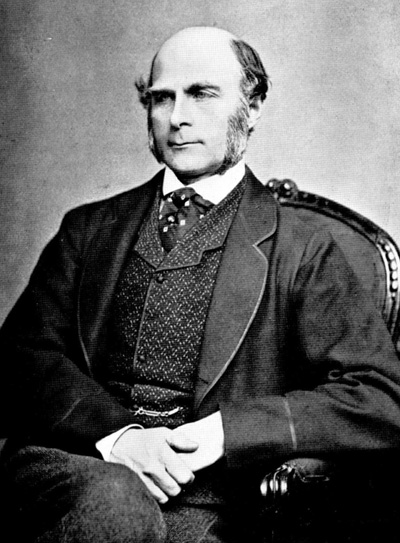
Francis Galton, Darwin's cousin and colleague, the father of eugenics.

Even the earliest reviewers of Darwin saw this problem with his theory. Richard Owen, the most prominent biologist of the day, the man who named the dinosaur, wrote that Darwinism was the sort of "abuse of science... to which a neighbouring nation, some seventy years since, owed its temporary degradation." He was referring to the French Revolution. Darwin described approvingly an early review in the Manchester Guardian: “received in a Manchester Newspaper a rather a good squib, showing that I have proved 'might is right', & therefore that Napoleon is right & every cheating Tradesman is also right." Even in approving of the theory, liberal academics saw it: a Unitarian reviewer noted that Darwinian evolution led "inevitably... towards the progressive exaltation of the races engaged in it."

That was the concern. Demanding a literal reading of Genesis was only a weapon in the fight. The problem was and is that, in the mechanism he proposed for how evolution took place, Darwin depicted nature as a state of permanent struggle in which the strong must kill the weak. And make no mistake: the post-Nazi claim that “Social Darwinism” is a misapplication of the original theory, that the mechanics of natural selection somehow end in the case of man and the races of man, would have been a surprise to Darwin. Darwin made clear in his second magnum opus, The Descent of Man, that the mechanism applied as much to man as to any other animal.

This is the problem, the issue underlying the conflict between Creationists or Intelligent Designers and Darwinists. True, it is not a scientific problem. Nor is it really a religious problem. The problem is not religious, per se, but moral.

It seems sinister to seek to obscure, or even to ignore or deny, this issue. As the advocates of Darwinism seem to be doing today.


Saturday, February 08, 2014

Questions from Creationists


A friend who represents herself as an atheist sent me this link on the premise that it had something to do with the question of existence of God. It does not, of course; creationism versus evolution is a very different issue.

But since she asked, it is interesting to look at some of the questions as someone who, as a Catholic, has no dog in this hunt. The questions from creationists are almost uniformly silly, but also look as if they are selected by the evolutionist for being easy to answer. Pop flies. Yet there are real issues here.

1. Bill Nye, are you influencing the minds of children in a positive way?

Truth is true regardless of one's personal preferences. To believe otherwise is to be a liar.

2. Are you scared of a divine creator?

Ad hominem. Imputing motive.

3. Is it completely illogical that the Earth was created mature? I.e., trees created with rings ... Adam created as an adult ...?

Yes, it is illogical, but the author does not address the issue. He says only that it is not plausible. He gives no basis for this claim. It is implausible because, as Descartes pointed out, such an assumption would make God a deceiver, and this is inconsistent with the nature of God.

Unfortunately, as the author is apparently not prepared to point out, non-theists are stuck on this point. For them, there is no justification to assume the one thing or the other.

4. Does not the second law of thermodynamics disprove evolution?

No; as the author states. Yawn. This would only be true if evolution were a closed system.

5. How do you explain a sunset if there is no God?

This is a valid point, which the author avoids. The question is, I presume, how can the theory of evolution explain the experience of beauty, and of beauty in nature? How does this have any survival value, and how can its survival value, if discovered, justify an experience that seems so self-validating, so meaningful in itself? It makes the theory of evolution seem trivial by comparison.

The author simply avoids the question by saying “we have evolved to appreciate colors, shapes, and metaphors.” Why? And why so profoundly? 

Then he throws in a blatant red herring/ fallacy of the false alternative by saying “understanding the science behind events adds to their beauty.” Then he covers the trail with another red herring/ad hominem by saying “incidentally, some creationists are geocentrists.”

Given all the misdirection, one can only assume he has no answer.

6. If the Big Bang Theory is true and taught as science along with evolution, why do the laws of thermodynamics debunk said theories?

Eh? Why is this question here? Besides being incoherent, it is, as the author points out, essentially a repetition of question four. The only purpose of including this question seems to be to obscure the point that the Big Bang theory supports the theistic hypothesis; by claiming or pretending that creationists themselves dispute it.

But then, perhaps I too am imputing motive.

7. What about noetics?

This question seems deliberately phrased so that it can be dismissed without being properly addressed. What “noetics” is is irrelevant, but the author is able to hide behind the obscurity of this term.

The underlying issue is presumably how Darwinian evolution can explain the existence of consciousness. After all, a robot ought to be able to handle stimulus-response in such a way as to maximize survival without ever being conscious or self-conscious.

The author also slips in an unjustified assertion here: “we know the mind is an effect of the brain—as many say, the mind is what the brain does.” We know no such thing. On the face of it, this assertion makes no more sense than saying “the meal is an effect of the menu; the meal is what the menu does.” Obviously the two are related in some way, but it is clearly not simple cause and effect.

Scientifically, we can in principle never know how the mind works, because science presupposes the presence of an objective observer. The observer necessarily cannot objectively observe himself. There is a necessary and unbridgeable distinction between subject and object.

This was understood as early as Heraclitus in the West, and Gautama in the East.

8. Where do you derive objective meaning in life?

This is irrelevant. Again, a thing is not true just because we find it convenient for it to be true.

9. If God did not create anything, how did the first single-celled organism originate? By chance?

The author surprises me by agreeing that this was not by chance. This issue of how the first single-celled organisms emerged is not a part of the Darwinian Theory of Evolution per se, but the big problem that many religious people have with the latter is its claim that mutations are random, i.e., “by chance.” If you admit that they are not, you are no longer a Darwinian. You have accepted the essential premise of Intelligent Design. The question then simply becomes whodunit.

I wonder if the author realizes this.

His final question, “who created God,” is puerile. It is part of the definition of God that he is self-existent, immortal. If he were not, he would not be God, so the question “who created God” is an immediate self-contradiction.

Why not say the same about the universe? Because the universe is simply the sum of things. If every single apple must come into existence, it is contradictory to suppose that two apples are immortal.
10. I believe in the Big Bang theory ... God said it and BANG it happened.

The author says, that's fine by science, and fine by theism. Perhaps he really is an adherent of Intelligent Design without realizing it.

11. Why do evolutionists ... reject the idea of there being a Creator God but embrace the concept of intelligent design from aliens or other extra-terrestrial sources?

As phrased, the question seems silly. The point, I presume, is that at least two well-known public evolutionists and atheists, Richard Dawkins and Carl Sagan, have been quite ready to entertain the thesis that life on earth is indeed an intelligent design, but by aliens rather than by God.

The author says “we don't”; but then, the author himself hints at finding the alien hypothesis at least possible.
And so again, the author seems to accept the thesis of Intelligent Design, which is supposed to be incompatible with Darwinism. He may have an argument still with Creationism, but he has ceded the argument to Intelligent Design. But then, why not take the next step? Why aliens when Occam's Razor would seem to make God the more scientifically acceptable answer as designer?

So something like this question apparently stands, and has not been answered here.

12. There is no in-between ... the only one found has been Lucy and there are only a few pieces of the hundreds necessary for an 'official proof.'

This is the oldest argument in the book. Ask the experts. Is there really a “missing link”?

13. Does metamorphosis help support evolution?

Again, this is confusing as phrased. The point is presumably that metamorphosis is a plausible alternative explanation for the data the Theory of Evolution seeks to explain. And the author seems to simply admit this.

Yet later he says evolution is fact, not just theory.

14. If Evolution is a theory ... why then is Evolution taught as a fact?

The author responds in part with a red herring: “If this question is an argument to allow creationism to be taught in schools, that's a violation of the First Amendment.” Let's suppose that statement is true (although it is really highly debatable):  it still does not answer the question.

He also asserts that evolution is “a fact and a theory.” Yes, but the fact is not the same as the theory. Evolution is a fact if by “evolution” we mean “change over time.” But that is certainly not what the creationists mean by the term. So the question remains.

Bottom line: it is thoroughly unscientific to teach the Theory of Evolution as a fact, and that is indeed what it happening now in schools (the same is true of most other school science). Moreover, teaching evolution as a fact, given that it goes against at least some parents' religious views, is itself a clear violation of the First Amendment.

15. Because [evolution] is 'theory'--not testable, observable, nor repeatable, why do you object to creationism or intelligent design being taught in schools?

The author gives a link here to an experiment any creationist would find irrelevant, because it shows nothing more than breeding, which is uncontroversial, not interspecies development. He mostly simply asserts that evolution “fits the criteria” for science. But whether it does or not is a very live debate. 

Richard Dawkins, challenged on the point that Evolution was not properly falsifiable, as a scientific hypothesis must be, claimed that it would be falsified if, say, a modern rabbit fossil appeared in an ancient rock formation.

But it turns out that this kind of fossil anomaly turns up fairly often. It is explained away in a variety of ways, all of which are superficially plausible. But that means the point stands, so far as I can tell: is Darwinian evolution really scientific? And, if not, what is the justification for not teaching other unscientific theories along with it?

16. What mechanism has science discovered that evidences an increase of genetic information seen in any genetic mutation or evolutionary process?

No idea what this is about.

17. What purpose do you think you are here for if you don't believe in salvation?

This is the same non sequitor we have seen earlier: because we want meaning in the universe does not mean there has to be meaning in the universe. 

But the author is wrong to imply, as he apparently does, that a devout Jew would have an answer very different from that of a devout Christian. All major religions believe in salvation.

18. Why have we found only one 'Lucy,' when we have found more than one of everything else?

Non sequitor. If we had found only one Lucy, it would make no material difference to the theory.

19. Can you believe in the big bang without faith?

I think the author misses the point of this question by answering “yes, we have tons of evidence for it.” I think the point is that the big bang implies the existence of God, per Aristotle, not that there is no evidence for the big bang. Again, the author seems to misrepresent or misunderstand theism as being hostile to the concept of the big bang.

20. How can you look at the world and not believe someone created/thought of it?

The author does not really address this simple statement of the argument from design. He says “it does not take very complex rules to create huge diversity.” Exactly. The fact that the physical universe can be discovered to follow a rather small set of consistent rules is another way of saying that it shows strong evidence of design. 

So--he leaves the challange unanswered.

21. Relating to the big bang theory ... where did the exploding star come from?

There was, of course, no exploding star. This badly stated question seems again to serve as a convenient red herring for the author. I presume the real question is “what caused the big bang?” That is a very good question, apparently requiring the Aristotelian thesis of a “First Mover,” and the author's answer is simply “we don't know.” He rejects a “supernatural” explanation, but what does “supernatural” mean here? If this is meant to dismiss God, it seems to me tautological: if God is involved, he is not “supernatural” in the relevant sense.

22. If we came from monkeys, why are there still monkeys?

This question makes no sense on its face. Sly to end with it, so it is the one that may stay in the reader's mind as the final statement by the opposition.