Playing the Indian Card

Showing posts with label Darwinism. Show all posts

Friday, October 16, 2020

Sex as Original Sin


Friend Xerxes interestingly simply assumes that the sin in the Garden of Eden was sex. He is not alone. As another friend of mine used to jape, “It wasn’t the apple on the tree; it was the pair on the ground.”

There is no textual warrant for this. Whatever “eating the fruit of the tree of the knowledge of good and evil” might mean in literal terms, there is no reason to see sex there. One would presumably need to assume that the Bible follows a strict Victorian morality, insisting on speaking of sex only very obliquely.

This is anachronistic. The Victorians were historically quite unusual in their prudery. And, after all, Genesis has no trouble naming the act in Genesis 4.

More significantly, there is the obvious point that, for any Jew or Christian, there would have been nothing sinful about Adam and Eve having sex. Their union had been formally declared before God. What conceivable moral system would object?

I suspect that this nonsensical association of sex with the original sin is a Trojan horse—pun not intended― to justify general immorality. Precisely because Adam and Eve having sex would be perfectly innocent, the implication is that all sin is really okay.

Xerxes himself goes on, ominously, to assert that the existence of sin is entirely God’s fault. He complains of “sins that grandpa God set up in the first place.” Note the plural.

Then Mr. X objects to the notion that God would play favourites in war. God has no righteous reason, then, to fuss over whether Hitler won World War II, or the South won the US Civil War. He presumably would not or should not take sides, either, if some gang breaks into your home to rape and steal. Or he is just being a troublemaker.

One can perhaps see from this, in miniature, why we have rioting and looting in the streets in the US right now, and where this all came from. We can trace it back through the sexual revolution of the 1950s, to Freud’s application of Darwinism to the human soul.


Thursday, June 15, 2017

Monkeying with Darwin


My left-wing friend Xerxes is always giving me ideas. His latest column is a celebration of “evolution,” as opposed to “creationism.”

It is fascinating because, although he thinks he is a Darwinist, it is clear that he is not.

He begins by saying evolution is not a theory, but a “reality.”

This depends what you mean by “evolution.” And it is a fundamentally unscientific thing to say.

If you mean the simple proposition that things, including species of plants and animals, can change over time, this indeed comes pretty close to being a self-evident truth. It is almost as obvious as saying “things change,” which few anywhere would disagree with. Parmenides, I suppose, and maybe nobody else ever.

This is not, however, a “scientific truth.” There aren’t any. Strictly speaking, science can prove nothing, and never claims to. What science does is disprove faulty hypotheses. It disproves things.

But simply because a hypothesis has not yet been disproven can never establish it as a truth. Black swans may come to roost.

To suppose otherwise is the most fundamentally anti-scientific thinking. Science is all about testing everything, repeatedly, and taking nothing on authority.

Xerxes mentions gravity as an example of a proven scientific truth. Bad call. Ironically, Newton’s Law of Gravity has been more or less systematically refuted by Einstein. As to gravity itself, the physical experience, of course people were fully aware of this and how it worked, in practical terms, before Newton. This is not science. You did not suppose, dear reader, that Newton was first to discover that apples fell, did you?

Just so, Darwin did not invent evolution in the sense of realizing that things change over time. Including dogs or horses. Everyone always thought this. Augustine assumed that species changed into other species. Aquinas assumed this. Aristotle assumed this. Ever read Ovid?

Granted, some modern Protestants deny it—but this is a very recent thing. It is a reaction to Darwin, not a traditional idea.

Darwin’s theory, the “Theory of Evolution,” was about how these changes happened; about the mechanism behind the observed experience. Darwin’s theory is that evolution occurred by natural selection of random mutations in a general struggle for survival.

This is the science. And it is and will always be at least as vulnerable to refutation as Newtonian physics. Indeed, it is all rather dubious.

Xerxes points out that “not one scientific discovery has disproven evolution.”

There is a more fundamental question: what experiment would, given a specific result, disprove it? What hypothetical evidence conclusively would?

If there is none, it is not, in fact, science. As Karl Popper pointed out, the essence of science is “falsifiability.” If you cannot conduct an experiment to test the hypothesis, you are not doing science.

This is a common charge against Darwin’s theory: that as phrased, no plausible experiment can be done, and no evidence advanced, that would disprove it. If this is so, it must either be self-evident—and it clearly is not—or it is an article of faith. And an article of faith in a sense that even, say, Christianity is not. For Christianity could indeed be falsified, theoretically, if the corpse of Jesus were ever found.

Darwin, acknowledging the issue, proposed “If it could be demonstrated that any complex organ existed which could not possibly have been formed by numerous, successive, slight modifications, my theory would absolutely break down. But I can find out no such case.”

In response, Behe and others have cited many examples of what they call “irreducible complexity,” complex biological structures that seem indeed impossible to develop by stages, given that each intersecting stage must by itself have some survival value. But “impossibility” here is an impossibly high bar. It is almost no test at all. Who is to say it is impossible for unicorns to appear in yonder birdbath within the next five minutes?

Darwinism has always seemed to defy common sense and probability. Observe the humble giraffe: does it seem likely that he came into existence, just as he is, by a series of random chemical reactions? Does it seem likely, as the famous example goes, that a thousand monkeys, at a thousand typewriters, would sooner or later type out the complete works of Shakespeare?

“Of course,” answer the Darwinists, “given enough time.”

But are a hundred thousand years really enough? We are causing Occam some vertigo here.

Richard Dawkins, who has pretty obviously elevated Darwinism to his religion, has more recently been challenged on this point: what evidence, if ever found, would disprove Darwin? He responded with something from J. B. S. Haldane: “fossil rabbits in the Precambrian.” That is, a fossil appearing in an impossibly wrong place in the rock strata.

Problem: such fossils have indeed been found, and not infrequently.

And they have never been accepted as disproving evolution.

There are, after all, always alternative possibilities―like some disturbance to the sedimentary layers in later years. Or deliberate fraud. Or the simple possibility that, “it appears that rabbit evolution was not as we thought it was.” Without touching the overall thesis.

If it is not impossible, by this bar, Darwin must be right.

This would, moreover, not even address Darwin’s actual theory, but rather the more basic contention that species change over time. Which is not Darwin’s theory, and is not generally in dispute.

So the argument begs our attention: is Darwin science?

The creationists object especially to the Darwinian claim of “randomness.” (“Natural selection of random mutations.”) How can something ever be demonstrated to be “random”? What, in scientific terms, does it even mean? Isn’t the whole point of science to discover how things happen, to discover “laws” or “rules” nature follows? Isn’t saying it is “random” just an admission of failure? Wouldn't "I don't know" be more honest and accurate?

But then, if it is not random, but follows some kind of design―this becomes strong prima facie evidence, if not itself flat proof, of creation—of intelligent design. Can you have a design without a designer? Can a design be random? Isn’t this a contradiction in terms?

Darwinism then, as Dawkins proposes it, is such a crazy idea that almost nobody really believes it.

And, clearly, Xerxes does not.

He says, in his praise of evolution here, that “evolution never goes backwards.” This presupposes that evolution has a direction, a goal, a plan: that it is teleological. Which his to say, that it is a design. For if Darwin is right, there is no such thing as forwards or backwards.

He says “evolution always moves from the simple to the complex.” This indeed seems by observation to be so, and it is indeed a remarkable fact. Because by itself it disproves Darwin. If Darwin were right, it would not be so. Mutations persist because they have survival value. There is no survival value in being complex over being simple. Ergo, given Darwinism, organisms should evolve equally often in either direction: sometimes becoming simpler, sometimes becoming more complex.

Yet, in general, as Xerxes rightly notes, they do not.

Xerxes also says “evolution never puts all its eggs in one basket. It never relies on a single solution.” He says that evolution never makes a mistake. He says that “evolution always moves toward healing.”

However you slice it, he is here personifying “evolution” and thinking of it as a designer. He is imputing a plan and an intent. He is even imputing omniscience to it, and a moral purpose. Darwin disallows this. It is theism, the awareness of a personal God, yet for some reason insisting on calling God “evolution” instead of “God.” Others have resorted to the term “nature,” “the environment,” “Mother Earth,” or “Gaia.”

In other words, literally in other words, Xerxes is a creationist, and rejects the theory of evolution. He just does not know it.

Just like just about everybody else.

What is gained by substituting the word “evolution” for the word “God”?

I think the payoff for those who do is the tacit implication that Nature, or Evolution, or whatever else you call him, her, or it, is pagan. Which implies that, unlike the Judeo-Christian God, she or he or it has no interest in sexual morality. You can just “do what nature intends,” as some might say.

This means we are justified in indulging the pleasure principle. Lots of easy sex without guilt. A big plus to a lot of people.

Unfortunately, this comes with a downside. The same denial of moral order justifies and justified the social Darwinism of the Nazis. It can just as easily rationalize murder or rape as fornication, or anything else you like. Survival of the fittest, after all, eh?

Not a primrose path down which I want to tread.

To be fair, and to be clear, there is ultimately no necessary contradiction between Darwinism and monotheism. It all depends on what you mean by the word “random.” The Catholic Church, and some scientists, if not Dawkins, understand “random” here to simply mean that the “random mutations” do not appear specifically to meet some evolutionary need; that they are instead later selected for this. It does not necessarily mean that they are random in any wider sense. They might still be pre-programmed in some way.

If so, however, Darwinism is no longer of any use to those who want to dispense with Christian morality.


Tuesday, September 15, 2015

What Immortal Hand or Eye?


Random collection of atoms.

Did Darwin disrupt the argument from design? New Atheists seem to think so.

The argument from design holds that the order in the universe demonstrates the existence of an intelligence behind it—aka God. The classic analogy is this: if you found a watch lying in a field, it would be obvious to you from the intricacy of the object that it was not randomly produced by the actions of wind and wave, but made intentionally by a reasonable being. Yet a giraffe, say, is in fact far more intricate than a watch. So…

Bu, New Atheists—and old ones too, no doubt—affirm that Darwin has given us an alternate explanation. Darwin, on this view, postulates a mechanism that can, given enough time, randomly produce a giraffe; hence no need for a watchmaker.

But that depends, in the first place, on what you mean by “random.” Darwin himself tends to us the term “chance.” Darwin certainly does not prove, nor can he really believe, that evolution is random in the higher sense: to Merriam-Webster, “an action that happens without order or without reason.” In fact, his theory itself, in presuming to explain how evolution works, presents it as an ordered process (evolution) with a reason (preservation of self and species). Moreover, he is not saying that evolution operates outside the laws of nature, which is to say, the established and accepted order in the universe. Indeed, with or without the giraffe, the fact that science works at all is proof that the universe is ordered and follows a design. If it did not, we would not be able to understand it or find rules behind it. As Einstein said, “The most incomprehensible thing about the world is that it is comprehensible.”

Determining randomness in the absolute sense is not just beyond the purview of science; it would be a disproof of science. The very point of science is to demonstrate that nothing is random, that everything follows laws.

So it really does seem that, whatever even Darwin himself thought, whatever Darwinists think, and whatever atheists in general think, Darwin’s theory does nothing to refute or reduce the power of the argument from design. A “random” process in the strict sense still did not produce the giraffe, and the process that did, it would seem, has to have been programmed in to the system by some designer.

It is unfortunate that Darwin and Darwinism use the term “random mutation.” They can only have meant “random” in some relative sense, but they themselves seem to have tricked themselves into thinking it is meant in an absolute sense. There are, I think, only two possibilities Alvin Plantinga, quoting Ernst Mayr, argues that the meaning of “random” or “chance” in this context can only be, that said mutations are random in relation to the specific objective of survival of the species. In other words, the words of Sober, “there is no physical mechanism that detects which mutations would be beneficial and causes those mutations to occur.” The mutations occur not randomly, but based on some orderly and yet unknown mechanism other than pure survival value.

No issue here, in terms of the argument from design. God could use a spiritual mechanism to do this directly, and in any case his intentions are surely higher than mere survival of species. Kind of goes without saying from the fact that he allows species to die out.

So the giraffe remains an apparent proof of divine power. We are simply postulating some of the tools the watchmaker might have used.

Wednesday, April 09, 2014

St. Thomas Aquinas on Evolution


Not only did Big Tom believe in evolution from the apes: he deliberately made himself look like a capuchin monkey.

In the recent past, I pointed out that Evolution  was no new idea with Darwin, but had been a live theory since ancient Greece. And I noted that St, Augustine assumed it. Now I discover, thanks to TOF's blog, that St. Thomas also assumed it. The money quote from Summa Theologica:

Species, also, that are new, if any such appear, existed beforehand in various active powers; so that animals, and perhaps even new species of animals, are produced by putrefaction by the power which the stars and elements received at the beginning.

-- Summa Theologica, I.73.1 reply3
Aquinas differs from Darwin only in the mechanism, which he imagines to be "putrefaction." St. Thomas also argues nicely that evolution is the most fitting way for God to create: creating things that can themselves create other things is an intrinsically greater feat and greater good than just creating everything all at once.

The idea that there is some conflict between Christianity and evolution per se is plain wrong. The problem, for some, is with Darwin's proposed mechanism. These two issues ought not to be confused.

Friday, April 04, 2014

Has Science Disproved Religion?

In a contemporary cartoon, a woman argues with Darwin that men may be descended from monkeys, but women's emotions are of a higher order.

Many folks, I come to discover, are under the impression that “religion” is something that has been supplanted by “science.” More specifically, they think the current controversy between “creationists” and “evolutionists,” came about because Darwin’s theory of evolution disproved the literal teaching of the Bible in Genesis, about Adam being formed from the mud, Eve from his rib, and so forth. Hence, they think, in sum, religion has been disproved by science.

They have this upside down. To being with, evolution—the idea that animals might develop over time into other animals-- did not originate with Darwin. It was one of the oldest ideas known to Western Civilization, dating back to pre-Classical Greece; it was a live hypothesis throughout the history of Christianity. Nor had the Christian Church ever taken a stand for or against the idea, before Darwin. Most of the Christian Church, of course, still hasn’t. St. Augustine, for example, was perfectly comfortable with the idea that animals evolved over a long period.

For Augustine did not assume that the Genesis account was literal. Nobody seems to have assumed that until relatively recently—in fact, until after Darwin. I mean, seriously, folks: it features talking animals. At least since ancient Greece, this has been a clear literary signal that the events described are allegorical or symbolic; or, more specifically, moral. See Fables, Aesop. Then there is the obvious clue of referring to days before the sun and moon are created. Don’t imagine the ancients would not have noticed this: they were a lot more sensitive to events in the sky than we are. There are other clues: the narrative, if read strictly literally, describes Adam as being created twice. Nearby tribes are referred to as existing both before and after the supposed universal flood.

There were some Biblical literalists before Darwin, although not much before Darwin. These were the “premillenialists,” those looking for signs of the Second Coming in contemporary events. That is, they believed that Jesus was about to return; they relied on a literal reading of parts of the Bible in their efforts to calculate a date. “They were,” Wikipedia observes, “not as concerned about the new findings in geology or biology, freely granting scientists any time they needed before the Garden of Eden to account for scientific observations, such as the fossil sequence and geological findings.” According to Wikipedia, even “in the immediate post-Darwinian era, few scientists or clerics rejected the antiquity of the earth or the progressive nature of the fossil record. Likewise, few attached geological significance to the Biblical flood, unlike subsequent creationists. Evolutionary skeptics, creationist leaders and skeptical scientists were usually willing either to adopt a figurative reading of the first chapter of Genesis, or to allow that the six days of creation were not necessarily 24-hour days.”

The idea that Genesis specifically must be read literally appeared with that group of Protestants called “Fundamentalists.” And they showed up only in the late 19th/ early 20th century. In other words, this new dogma appeared in reaction to Darwin.

Let’s be clear, then: Darwin did not disprove religion. This new dogma, rather, was created to disprove Darwin.

In Britain, the main “creationist” movement, the “Evolution Protest Movement,” popped up in the 1930s.

Any idea what other intellectual currents were getting stronger in the 1930s?

There's your clue to the source of this delayed reaction against Darwinism among the religious.

William Jennings Bryan, US Secretary of State during WWI, reading the war news.

William Jennings Bryan--he of the "Scopes Monkey Trial"--is the true father of the anti-Darwin movement. He campaigned across America, in the early 1920s, urging that Darwinism not be taught in schools. And, although personally religious, he was not a cleric. He was a lawyer and a politician; a three-time Presidential nominee for the Democratic Party. In a famous speech, delivered across America, he argued that “the Darwinian theory represents man reaching his present perfection by the operation of the law of hate, the merciless law by which the strong crowd out and kill off the weak. If this is the law of our development then, if there is any logic that can bind the human mind, we shall turn backward to the beast in proportion as we substitute the law of love. I choose to believe that love rather than hatred is the law of development."

Bryan, in turn, was brought to this view by a book, Headquarters Nights, famous at the time, that traced the views of the German intelligentsia and the German high command, during World War I, to Darwin's theories. Bryan, a determined pacifist, saw that this was antithetical to world peace, to the doctrine of human equality, and to human rights. And, of course, the events of the 1930s and 1940s proved him right.

This is why, in turn, there was a resistance to teaching Darwin in the schools. Wikipedia: in the early to mid 20th century, “The numbers of children taking secondary education increased rapidly, and parents who were fundamentalist or opposed to social ideas of what was called survival of the fittest had real concerns about what their children were learning about evolution.”

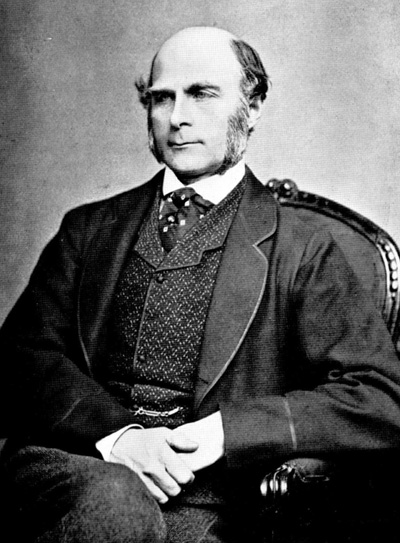
Francis Galton, Darwin's cousin and colleague, the father of eugenics.

Even the earliest reviewers of Darwin saw this problem with his theory. Richard Owen, the most prominent biologist of the day, the man who named the dinosaur, wrote that Darwinism was the sort of "abuse of science... to which a neighbouring nation, some seventy years since, owed its temporary degradation." He was referring to the French Revolution. Darwin described approvingly an early review in the Manchester Guardian: “received in a Manchester Newspaper a rather a good squib, showing that I have proved 'might is right', & therefore that Napoleon is right & every cheating Tradesman is also right." Even in approving of the theory, liberal academics saw it: a Unitarian reviewer noted that Darwinian evolution led "inevitably... towards the progressive exaltation of the races engaged in it."

That was the concern. Demanding a literal reading of Genesis was only a weapon in the fight. The problem was and is that, in the mechanism he proposed for how evolution took place, Darwin depicted nature as a state of permanent struggle in which the strong must kill the weak. And make no mistake: the post-Nazi claim that “Social Darwinism” is a misapplication of the original theory, that the mechanics of natural selection somehow end in the case of man and the races of man, would have been a surprise to Darwin. Darwin made clear in his second magnum opus, The Descent of Man, that the mechanism applied as much to man as to any other animal.

This is the problem, the issue underlying the conflict between Creationists or Intelligent Designers and Darwinists. True, it is not a scientific problem. Nor is it really a religious problem. The problem is not religious, per se, but moral.

It seems sinister to seek to obscure, or even to ignore or deny, this issue. As the advocates of Darwinism seem to be doing today.