Playing the Indian Card

Showing posts with label Warhol. Show all posts

Sunday, January 18, 2026

The Art of the Deal


 “Being good in business is the most fascinating kind of art. Making money is art and working is art and good business is the best art.” – Andy Warhol

Everybody except Andy Warhol seems to have missed this obvious fact: entrepreneurship is a form of art. An entrepreneur is a creator; perhaps the most creative of all artists. He works on the biggest canvas: the world. 

I see it every day. Many small local businesses are expressions of an artistic soul.

No, they are not designed to maximize profits. They are designed to make enough money to permit them to exist, in all their beautiful eccentricity. To express their owner’s vision: of what a cocktail should be, of the timeless traditions of the barber shop, of the beauty of old books and magazines.

It is ignorant to suppose that business is about greed. It is about “busy-ness,” that is, making things, getting things done. It is about the work, the craft, the opus, the essay. It is the joy of inventing a work of art that is self-perpetuating, that can live and run.

When asked why he kept creating new businesses, local magnate K.C. Irving responded plainly: “I like to see gears turning.” 

Money is just what makes the next thing possible, the artist’s brush, the writer’s pen

And it is grossly ungrateful not to see how much great entrepreneurs have contributed to American culture. What would America be today without P.T. Barnum? Without Henry Ford? Without Steve Jobs? Without Walt Disney? Without Elon Musk?

The great accomplishment of American culture is the entrepreneur and his art. 

We are now seeing, I believe for the first time since Washington and Jefferson, an entrepreneur in the Oval Office. And it feels as though America is coming into its own.


Saturday, December 24, 2022

Modernism and Postmodernism


These days, being in the arts is generally thought to mean being politically on the left. Despite the fact that some of the biggest names have let slip that they are not really with the program: Bob Dylan, Jack Kerouac, Andy Warhol.

Folks forget that a couple of generations ago, such literary lions as W. B. Yeats or T.S. Eliot or Hermann Hesse were publicly on the political right.

I think this marks the difference between modernism and postmodernism. The modernism of the early 20th century saw Western civilization as in a state of collapse, lamented the fact, and sought with little hope for solutions. The postmodernism of the late 20th and early 21st century sees Western civilization as in a state of collapse, and wants to hasten the process by whatever means necessary.

Eliot or Yeats celebrated the old aristocracy, as a class freed from the tedium of making a living and able to live the aesthetic life. Yeats referred to the need to earn as “this rock” we all live under. Re-reading “The Waste Land,” it is clear Eliot feels contempt for both the working class--Sweeney and Mrs. Porter; and the bourgeoisie--Mr. Eugenides, the one-eyed merchant. He mocks popular art, the music hall and the gramophone, contrasting it with the old high art of the landed aristocracy, which he considers superior. Hesse similarly laments the gramophone.

In sum, when Yeats or Eliot mourn the decline of Western civilization, they are thinking of the decline of the old ruling class; Yeats’ “ceremony of innocence.” This is what died in the First World War. They see this as meaning the decline of the culture itself, into crass “bourgeois” values.

The left, in theory, champions the working class, not the old aristocracy; they agree on hating the bourgeoisie. But this looks like a con. The working class has its own traditions and tends to be conservative. Who the left really are is the remnants or wannabe successors of the old privileged class. They react to their own declining fortunes by wanting to pull down the entire culture instead. 

It seems to me the notion that the landed aristocracy has a finer appreciation of the arts is not tenable. Why should it be so? 

No doubt the argument is Plato’s, that they are educated into it. But art is inspiration, and the spirit goes where it wants. How many mute inglorious Miltons, in the words of Grey, does a class system exclude from consideration? Shakespeare was from the petit bourgeoisie. Blake was working class. Given all their free time, the aristocracy has contributed surprisingly little to the arts, other than appreciation.

This preference for the upper classes in the judgement of art also violates the teaching of the Bible. That ought to matter to Christians. In the Beatitudes, Jesus calls specifically to the “little ones,” to the poor, the meek, and the oppressed, to “let their light shine,” to be “the salt of the earth,” to express themselves through the arts.

 Moreover, they are those who will understand the arts: “those who have ears to hear.”

With Andy Warhol, I find greatest beauty in the folk arts, in popular art, and in commercial art. Most recently, in comic books, in folk music, in rock and roll, in some film and TV. Yes, most of it is junk. Most of everything is junk. Great art of the past is just that 5% that was good enough to survive. But much of the current sense that art is moribund is due to looking in the wrong places, at the galleries and concert halls and academies. 

There are good cultural and technological reasons for the decline of the old ruling class. What that really was all about was the rise of the lower classes, to greater prosperity, more leisure time, better communication, better access to information, to the arts. The upper class is increasingly superfluous.

We should see as a result a great blossoming of the arts. What we see now is the academy and the old mainstream in a rearguard effort to suppress this great blossoming.

That bloom may come soon.


Saturday, July 31, 2021

What Andy Warhol Was Really Up To


Returning from a big Andy Warhol exhibit at the Art Gallery of Ontario:

The interpretive panels from the curators, and the audio guide, insistently aver that Warhol, with his Campbell Soup Cans and so forth, or sticking a French ad in his painting of the Statue of Liberty, was making ironic comments on American consumerism, mocking American pretentions of “liberty” and “democracy.”


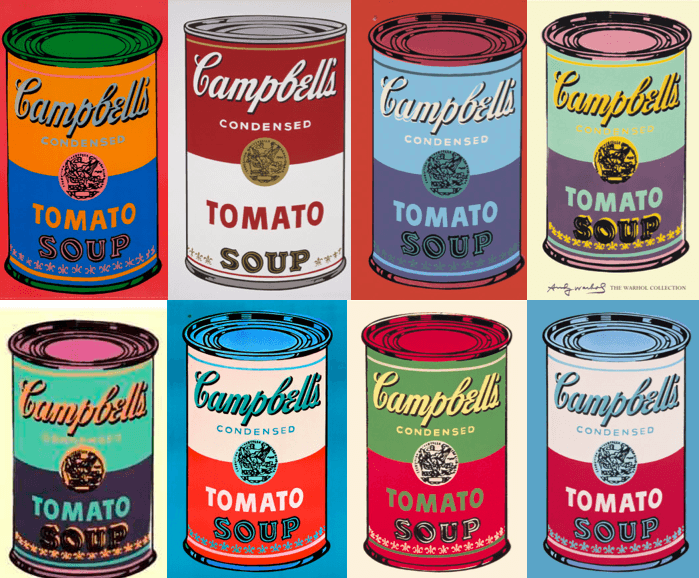
I don’t believe that. That is just what the cynical cognoscenti want him to be doing, and perhaps assume he must be doing. There is nothing in the works themselves to signal ironic intent, and if there is not, we have no business assuming one. Warhol’s Campbell Soup Cans are unpretentiously beautiful. That’s it. He sees their beauty, and celebrates it, wholeheartedly, just as he does with Marilyn Monroe, or Debbie Harry, or Karen Kain. He is an artist. He is into beauty.


Warhol was consistently and unironically celebrating American consumer culture, which is to say, its truly democratic popular culture and the beauty of everyday life. Everyone needs to eat. It is not conspicuous consumption or “consumerism” to buy a can of soup; this is poor man’s food. In America, everyone can afford a can of Campbell’s soup. Everyone can afford to go to the movies. And the design of the Campbell’s soup can, or the Hollywood movie, created to appeal to the taste of the masses, ought to be appreciated as much as any European high art, created for the tastes of the high and mighty. Accident of birth did not make them better arbiters of beauty.

Coming from a poor immigrant family, Warhol embraced it all. He once said “Making money is art and working is art and good business is the best art.”

He also once asked an interviewer, “Is an artist allowed to be a Republican?”

And that is about all we know about his politics.

The exhibit curators also made much of Andy Warhol’s supposed homosexuality, and paint him as a pioneer of gay culture—one of the first celebrities to be publicly “gay,” to be “out.”

Again I think this is bollocks. It is what they want him to have been, for political purposes, not what he was. Interviewed in the 1980s, Warhol claimed to be a virgin. Close friends say they think this was probably true. By proper definition, then, he was not a homosexual. A homosexual is someone who has sex with other men. He was more like a secular monk.

The evidence that he was homosexual is apparently that he dressed distinctively, with a silver wig; and that he did many portraits of anonymous New York drag queens.

He did those many portraits, I submit, not because he was trying to make any political or personal statement, but because he found them beautiful, and in an unpretentious, unsophisticated way. Just as he did Campbell’s Soup cans, or Elizabeth Taylor, or Dolly Parton. No need to see anything sexual about it. He was in open rebellion against “good taste”; that was an upper class, exclusionary, attitude to art. Transvestites were all about beauty without the pretensions of taste. 


If Warhol himself dressed flamboyantly, it was for the same reason.

Curators also commented on Warhol’s “obsession with death.” 

Indeed. Warhol was a devout Catholic, who attended mass daily.


Any good Catholic should have an “obsession” with death. Death is what life is all about. The memento mori is a traditional Catholic meditation, and is highly recommended.

It all makes me despair of art, and feel sorry for Warhol. What is the point of being a great artist or a great writer? You will just be forever misinterpreted by the academicians and the cocktail circuit. They will always put lipstick on your Mona Lisa.