Playing the Indian Card

Showing posts with label Saint Dymphna. Show all posts

Monday, January 29, 2018

The Andromeda Strain


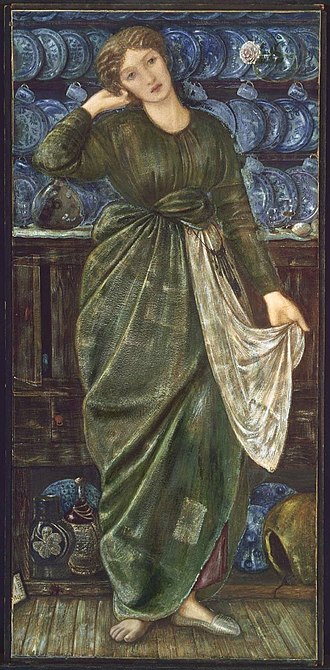
Rossetti, The Damsel of the Sangreal

In many cases, the reward for slaying the dragon is human, rather than or as well as an object. Our general-issue handsome prince, when he downs Sir Dragon, traditionally wins the hand of a lovely princess. Andromeda is Perseus’s reward for conquering the dragon Cetus. Gilgamesh’s conscious goal is to find the old man Utnapishtim, not at first the herb of immortality. Jason gains the Golden Fleece, and also the hand of Medea. Theseus, after conquering Herr Minotaur, makes off with Princess Ariadne. Rama’s goal and grail is his wife Sita. Ragnar Lodbrok kills his twin serpent adversaries for the hand of Princess Thora.

Given that the magical objects won by slaying dragons represent transcendental values, it seems reasonable to assume that the humans rescued in the same way also represent something transendental. In many cases, indeed, this human is portrayed as differing from your average lovely princess in being or becoming immortal—transcendental. Gilgamesh seeks Utnapishtim because he has become immortal and must then know the secret of immortality. Andromeda is granted immortality by Athena, and becomes a constellation in the starry heavens. Ariadne is taken by Dionysus to Olympus to be made a goddess. Medea is the granddaughter of Helios, the sun, and, depending on sources, semi-divine. Sita, rather than dying the way a conventional woman might, is swallowed up by the Earth, her mother, at the end of the Ramayana.

What does it mean for a human to be a transcendental? After all, in this shared word, humans are actually rather commonplace.

But there is something else, which is not commonplace at all, and yet is best illustrated by a human face. Love.

Not romantic love, not sexual love, not married love, but what is also called agape, caritas, charity. “God is love,” as Jesus or St. Paul or St. Augustine put it. “Whoever does not love does not know God, because God is love.” (1 John 4:8)

St. Paul famously outlines its form:

Love is patient, love is kind. It does not envy, it does not boast, it is not proud. It does not dishonor others, it is not self-seeking, it is not easily angered, it keeps no record of wrongs. Love does not delight in evil but rejoices with the truth. It always protects, always trusts, always hopes, always perseveres. (1 Corinthians 13:4-7, NIV)

This is not a common sort of love. It is the stark opposite of what a narcissist calls “love”: it is unselfish love.

Tristan and Isolde

But how to portray it? How to convey the point? What is our objective correlative here?

It is natural enough to portray it by the more familiar, more common affection of male for female, female for male (eros), or friend for friend (philios). So transcendent love may sometimes be portrayed here as the beautiful princess of the legends. Just as agape is expressed as romantic love in the Bible’s Song of Songs, or in St. John of the Cross’s Dark Night of the Soul, or in the Krishna-Radha cycle in India, or in the Sufi poets, or indeed in Medieval romance.

As a matter of effective storytelling, too, note that simply gaining possession of some object is a far inferior motivation for a character, a far inferior climax for a story, to finding “true love.” We naturally care more about the latter. In comparison to the committed presence of a living, breathing person, any mere object, whether gold cup, fleece, apple, Maltese Falcon, or cache of coins, seems unworthy.

And this instinctive human preference perhaps tells us something important, about life, the universe, and everything. An object, after all, has only one dimension of existence, the physical. A person is both physical and spiritual. This gives humans a greater reality, a greater moral worth, a greater potential transcendence, and, I suggest, a greater potential beauty. William Blake argued that the greatest thing any person can conceive is necessarily a perfected person:

Man can have no idea of any thing greater than Man as a cup cannot contain more than its capaciousness. … Think of a white cloud. as being holy: you cannot love it. But think of a holy man within the cloud: love springs up in your thought. For to think of holiness distinct from man is impossible to the affections.i

Accordingly, the best image of the goal of life is a good and beautiful person. The best image of the divine is a good and beautiful person. And the greatest value, which transcends all transcendentals, is a perfect love—a living and complete relationship of love with a good and beautiful person.

However, portraying said true love by a lovely princess is also fraught with risks of misinterpretation. It is all very well to offer romantic love as an image of eternal love, but it is then too easy for literal-minded listeners to mistake the one for the other, and raise up either the possibly selfish, possessive aspect of marriage or the physical pleasure of sex as a golden calf.

St. George and the dragon

Accordingly, it seems wise for the legends to strike a note of ambiguity or deliberate contrast here.

And so Gilgamesh is probably wise to reject the goddess Ishtar. “Which of your lovers did you ever love for ever?” he asks. “What shepherd of yours has pleased you for all time?”ii Sexual or romantic love, which she represents—cognate to the Greek Aphrodite—is not the thing we seek. Nor, ultimately, is philios, the affection one feels towards a friend, represented here by the friendship with Enkidu. Such a love, although admirable, is not eternal. Enkidu dies.

Many legends seem to show the human transcendental as at once somehow the same as, and somehow different from, the transcendental object. Perseus wins Medusa’s head, his transcendental object, then battles a second opponent to win Andromeda. The two “prizes” seem to contrast: the fearsome dead Medusa, to look upon whom brings death; the lovely living Andromeda, who potentially offers children and new life. Jason’s two prizes are presented in parallel: “Proud of his prize, and taking with him a further prize, the one who had helped him gain it, the hero, and his wife Medea, returned to the harbour at Iolchos.”iii In killing the dragon Fafnir, Sigurd/Sigmund wins a horde of gold and a collection of nifty magical objects. No fair maid. But drinking Fafnir’s blood allows him to understand the language of birds, and the birds direct him to Brynhild.iv Herakles wants two immortal horses for killing his sea monster, but takes Hesione later as consolation, when he is not given his prize and sacks Troy in revenge. Gilgamesh reaches his human goal, Utnapishtim; Utnapishtim then directs him to the herb of immortality. And the Holy Grail, by its nature, points beyond itself to a human transcendent—to the perfected human, Jesus Christ.

Jason returns with Medea and the Golden Fleece

It is notable that the hero then often loses the princess in these tales. This is a sad note in many classic hero legends. They lack that fairy tale ending. They are closer to tragedy.

Jason, having pledged his life to Medea, dumps her for Glauce, leading to a terrible cycle of revenge. Theseus seems to abandon Ariadne on the next island, despite vows, and despite her having saved his life. As the epic poet Nonnus eulogizes her: “you know your thread was his saviour: for the man of Athens with his club would never have found victory in that contest without a rosy-red girl to help him.”v Ragnar Lodbrok slaughters dragons left and right to win the lovely Thora. But by the same feat, he deserts his lawful wife, Ladgerda; which seems less than honourable, and less than an advertisement for true love. Thora then, rather than living happily ever after, dies of a fever. Rama, having expended epic efforts to rescue Sita, rejects her over suspicions about her chastity. When Sigurd stifles Fafnir, and is led to the lovely Brynhild, they plight their troth, as the kids used to say. Sigurd then forgets Brynhild and marries Gudrun. Brynhild has him killed in revenge.

Herakles, mightiest of classical heroes, is also conspicuously unlucky in love. He kills his first wife, Megara, in a psychotic fit. Having won Hesione, he gives her away. He is killed by his last wife, Deianira, unintentionally, but ultimately because she suspects him of adultery.

Launcelot develops an unhealthy addiction to Guinevere, who is awkwardly already married to King Arthur. This does not go good places. Sir Tristan is passionate about Isolde, who is also married to his king. Indeed, the worthy knights of the Round Table seem to fall all over themselves for the opportunity to commit adultery.

Launcelot and Guinevere end their days not as lovers, but as priest and nun. They have, graphically, realized that their love was false love, and have embraced agape in the cloister.

Samson too, like Herakles, gives his first wife, won by killing the Timnean lion, away: “And Samson’s wife was given to one of his companions who had attended him at the feast.” (Judges 14:20, NIV)

His second marriage, you may remember, to Delilah, does not work out better.

For that matter, Hamlet had obvious difficulties coming to terms of endearment with Ophelia.

This relentlessly unromantic ending may be to pre-empt idolatry. Romantic love resembles, but is not, agape or caritas. And so the overly-simple solution must not be allowed to stand. True love itself is beyond the physical sphere; romantic love is only its physical image.

And perhaps too there is another reason.

Tristan and Isolde

Consider again the word of the abused child. He has not known love growing up. He has been betrayed by his first and greatest natural love, his parents. Love from then on is going to be a problem for him (or her). If, as the Catechism of the Catholic Church says, the family is the school of love, he has grown up never having learned to read or write. He is bound to have problems in this field.

For one thing, he (or she) will feel himself ultimately unlovable. And so he will fear love. The other will sooner or later discover how awful he truly is. They cannot possibly really love him.

For another, he (or she) will have no good idea of how to express love, if he genuinely feels it. He is likely to be clumsy, naive, and awkward. He will flunk on “emotional intelligence.”

For another, having experienced abuse from those he (or she) loved most, he is liable to suppose abuse is all he deserves, or is a legitimate expression of love. Accordingly, he is vulnerable to an abusive, masochistic romantic relationship in adult life.

For another, having been taught by parental example both that all his own natural inclinations are bad, and also that hurting others is normal human behaviour and an inclination in the best of us—for we all want to believe our parents are the best of people—he is likely to develop a generally unfavourable impression of human nature. This obviously makes it hard to develop love for another.

For another, having experienced abuse and/or betrayal from those he most loved, he is likely to fear betrayal from anyone professing love ever again. One bitten, as they say, twice shy.

And last, but not least, these fears are fully justified. If the common motive for parental abuse is envy, resentment of a child who is exceptional in some way, that motive is going to apply as well with anyone else they meet in later life. Any other narcissist is likely to react in the same way as did their narcissistic parent: they will want to either destroy or possess them.

Success in some hero quest actually makes this last problem worse. With any public profile of accomplishment, this motive for malice has now grown. Narcissists in the admiring crowd will now seek them out to either kill or own them. As narcissists sought out Martin Luther King Jr., or the Kennedys, or Gandhi.

The various romantic troubles encountered by our various heroes and heroines can perhaps be seen as ringing the changes on these depressive difficulties.

Start with this last problem first.

In the case of Jason and Medea, Medea has betrayed her father, then killed and dismembered her brother, for the sake of her desire for Jason, a man she has just met. This does not bode well: that she approached Jason, rather than the reverse, reinforces the impression of willfulness. She sounds a lot like a narcissist. Creon, Jason’s father, says, “I fear thee, … lest thou devise against my child some cureless ill. Many things contribute to this fear of mine; thou art a witch by nature, expert in countless sorceries...”vi And Medea proves him right: she brings down the curtain in that play by slaughtering her own children for revenge. She was and is exactly the sort of person who caused Jason his trouble in the first place. And she has latched on to him.

Ariadne, similarly, although often portrayed as an innocent victim of Theseus’s betrayal, has shown similar disturbing character traits. She has betrayed her father Minos and helped Theseus kill her brother; again, for the sake of a man she has just met. How can she be trusted? On the evidence, she does not love anyone but herself.

Theseus suffers a terrible betrayal from his later wife, Phaedra. She develops a lust for his son Hippolytus. Hippolytus rejects her. She perjures herself to have Hippolytus killed. She, too, is obviously a narcissist. Theseus apparently attracts the type.

Ladgerda, Ragnar Lodbrok’s rejected first wife, offers a similar example. When Ragnar wooed her:

She spurned his mission in her heart, but feigned compliance. Giving false answers, she made her panting wooer confident that he would gain his desires; but ordered that a bear and a dog should be set at the porch of her dwelling, thinking to guard her own room against all the ardour of a lover by means of the beasts that blocked the way. Ragnar, comforted by the good news, embarked, crossed the sea, and, telling his men to stop in Gaulardale, as the valley is called, went to the dwelling of the maiden alone. Here the beasts met him, and he thrust one through with a spear, and caught the other by the throat, wrung its neck, and choked it. Thus he had the maiden as the prize of the peril he had overcome.

She had, in sum, feigned affection in order to kill him. For no decent reason, it seems, but only out of malice; she could have simply spurned his advances.

Ragnar’s response, in turn, perhaps illustrates a separate problem for the depressive: the tendency to suppose that abuse is normal to affection. He seems slow to grasp the significance of this assassination attempt. Only eventually, according to Saxo Grammaticus, “he thought ill of her trustworthiness, remembering that she had long ago set the most savage beasts to destroy him.”

She goes on to kill her second spouse, because she “thought it pleasanter to rule without her husband than to share the throne with him.”vii

Samson᾿s story hinges on the same problem: the abused hero (or heroine) is both prone to being latched on to by a narcissist, and constitutionally unable to understand that he is being abused. Samson is betrayed by his first wife, the unnamed woman of Timnah, as soon as she has the opportunity. She reveals to her countrymen the solution to his riddle at their wedding, costing him a large sum. His second wife, Delilah, betrays him in the same way, by revealing his secrets. Repeatedly. Nevertheless, he does not seem to learn the lesson. He does not seem able to accept that something is wrong here. To him, then, abuse is normal and what affection looks like. 

So Delilah said to Samson, “Tell me the secret of your great strength and how you can be tied up and subdued.”
Samson answered her, “If anyone ties me with seven fresh bowstrings that have not been dried, I’ll become as weak as any other man.” 
Then the rulers of the Philistines brought her seven fresh bowstrings that had not been dried, and she tied him with them. With men hidden in the room, she called to him, “Samson, the Philistines are upon you!” But he snapped the bowstrings as easily as a piece of string snaps when it comes close to a flame. So the secret of his strength was not discovered. 
Then Delilah said to Samson, “You have made a fool of me; you lied to me. Come now, tell me how you can be tied.” 
He said, “If anyone ties me securely with new ropes that have never been used, I’ll become as weak as any other man.” 
So Delilah took new ropes and tied him with them. Then, with men hidden in the room, she called to him, “Samson, the Philistines are upon you!” But he snapped the ropes off his arms as if they were threads. 
Delilah then said to Samson, “All this time you have been making a fool of me and lying to me. Tell me how you can be tied.” 
He replied, “If you weave the seven braids of my head into the fabric on the loom and tighten it with the pin, I’ll become as weak as any other man.” So while he was sleeping, Delilah took the seven braids of his head, wove them into the fabric and tightened it with the pin. 
Again she called to him, “Samson, the Philistines are upon you!” He awoke from his sleep and pulled up the pin and the loom, with the fabric. 
Then she said to him, “How can you say, ‘I love you,’ when you won’t confide in me? This is the third time you have made a fool of me and haven’t told me the secret of your great strength.” With such nagging she prodded him day after day until he was sick to death of it. 
So he told her everything. “No razor has ever been used on my head,” he said, “because I have been a Nazirite dedicated to God from my mother’s womb. If my head were shaved, my strength would leave me, and I would become as weak as any other man.” (Judges 16: 6-17, NIV)

The strange story of Herakles having to serve as a slave to Queen Omphale seems meant to make the same point. He is required for a year to wear women’s clothes and do women’s work, while she wears the skin of the lion and carries his club. Leaving aside what it might say about traditional sex roles, this sounds like a description of an abusive relationship. The name of Herakles᾿s last wife, Deianira, in turn, is, literally, “man destroyer” or “husband destroyer.” That sounds straightforward. And she does, indeed, destroy Herakles, by giving him the shirt of Nessus, which burns him alive. In her defense, according to the legend she thought it was a love charm. However, administering a love charm to a husband suggests a narcissistic desire to control. So does the image of a shirt: a fatally close embrace, a perfect possession.

Herakles and Hesione


The story of Herakles and Hesione seems to illustrate yet another depressive love problem: the inability of the abused to accept real love when offered. We have warrant to see Hesione as an abused child, like Herakles: she has been sacrificed to the sea monster by her father for his own sins. That ought to make them a good match. She is unlikely to be a narcissist; narcissism cannot, almost necessarily, emerge from an abused childhood or adolescence. In contrast to Medea or Ariadne, Hesione is dutiful. Rather than betray her father, she is ready to die for his sake. Rather than killing or helping to kill a brother, like Ariadne or Medea, she ransoms one of hers from death, Priam. Moreover, she seems by her situation to echo Andromeda, similarly rescued by Perseus, who was Herakles’s grandfather. One surely expects here a marriage and a “happy ever after” ending.

Instead, Herakles shows no interest. He does not seek her. When he acquires her, he gives her away.viii

Hesione, as the sister of Priam, is the aunt of another familiar figure, Paris. Later, when Priam becomes king, Paris is sent to bring Hesione back to Troy, in gratitude for her saving his life. Paris gets distracted, and brings Helen back instead.

This looks like a parable, of neglecting sincere and selfless love (Hesione) for the sake of sexual and romantic love (Helen). Paris earlier preferred physical attractiveness and sexual love in choosing Aphrodite over Athena or Artemis in the Judgment of Paris. It is his characteristic fault.

Perhaps, by extension, then, this shows the same mistake being committed by Herakles. He was unable to recognize real love when it was available. He seems to have made the same mistake with the loyal Auge. Instead, he chose or attracted abusive women.

Sir Launcelot too seems to have been approached by abusive women. At one point in his travels, the damosel Hellawes demands a kiss. When he refuses, she confesses “And, Sir Launcelot, now I tell thee, I have loved thee this seven year, but there may no woman have thy love but Queen Guenever. But sithen I may not rejoice thee to have thy body alive, I had kept no more joy in this world but to have thy body dead.”ix This is the narcissistic response: possess or destroy. At another point, Launcelot is kept for some months in prison by Morgana la Fey, who says she will kill him if he does not marry her.

Launcelot more famously had an improper relationship with Guinevere. Her character too is in question. When King Arthur explains to the all-wise Merlin that Guinevere is the woman he seeks to marry, Merlin warns: “Sir, ... as of her beauty and fairness she is one of the fairest alive, but, an ye loved her not so well as ye do, I should find you a damosel of beauty and of goodness that should like you and please you, an your heart were not set; but there as a man’s heart is set, he will be loath to return.” In other words, she is beautiful but lacks “goodness.”x

Obviously, both she and Launcelot are guilty of sin. However, of the two, her sin is the greater. Launcelot, frequently propositioned, shuns all other women for her sake; this demonstrates that his love for her, if misplaced, is not selfish. She is married, and is breaking her marriage vows; he is not. It is possible to believe here that Launcelot is emotionally naive, as an abused child is apt to be, and she is using him.

We have already seen that Guinevere drives Launcelot mad by a sudden emotional betrayal; wrongly accusing him of being unfaithful. This is triply problematic: firstly, as is explained to us, Launcelot has not really been unfaithful, but was deluded by a spell to believe he was sleeping with Guinevere herself. Secondly, as they are not married and may never marry, she has no right to demand faithfulness from Launcelot. Thirdly, she is herself being unfaithful to her husband King Arthur, and so is guilty of hypocrisy.

Dame Elaine, daughter of King Pelles, seems to stand in contrast to Guinevere here. Elaine is a figure more like Andromeda, Ophelia, or Hesione. To begin with, like them, she too has been abused. Launcelot himself rescues her from imprisonment in a tower, where she has been tortured for five years—since adolescence—for her great beauty. When she is rescued, her first thought—demonstrating her good character—is to go with Launcelot to a chapel for prayers of thanksgiving. She is associated with the Grail—it is in her father᾿s possession, and she might therefore actually be the otherwise unidentified maiden who regularly appears in the legends holding the Grail. She does, it is true, seduce Launcelot by sorcery, which is not a righteous act. However, she does this firstly, out of dutifulness, out of obedience, like Ophelia, to her father. And secondly, not out of lust but to conceive Galahad, another human transcendental. 
“My lord Sir Launcelot, I beseech you see me as soon as ye may, for I have obeyed me unto the prophecy that my father told me. And by his commandment to fulfil this prophecy I have given the greatest riches and the fairest flower that ever I had, and that is my maidenhood that I shall never have again; and therefore, gentle knight, owe me your good will.”xi
Then, like Launcelot and unlike Guinevere, like Auge when seduced by Herakles, she is strictly faithful to Launcelot from then on, despite the approaches of others; even though he rejects her for Guinevere. At one point she confesses to him, “I will live and die with you, and only for your sake; and if my life might not avail you and my death might avail you, wit you well I would die for your sake.”xii

She seems, in sum, an image of faithful, selfless love, in contrast to Guinevere. Despite this, Launcelot repeatedly prefers Guinevere. Even though Guinevere is at times cruel to him, enough so that it drives him mad. Even though, at the very time Elaine is testifying to her love, Guinevere is “wroth, and gave many rebukes to Sir Launcelot, and called him false knight.”xiii Perhaps, an abused child, he cannot recognize or accept the healthier, more sincere love of an Elaine.

There is a second Lady Elaine in the Launcelot cycle, Elaine of Astolat, and she seems a similar figure. Like Elaine the daughter of Pelles, she nurses Launcelot in illness. “Ever this maiden Elaine did ever her diligent labour night and day unto Sir Launcelot, that there was never child nor wife more meeker to her father and husband than was that Fair Maiden of Astolat.”xiv Unlike Guinevere, her character is not in question: “she is a full fair maiden, good and gentle, and well taught.”xv She asks him to marry her; he refuses. So she dies of grief:
I take God to my record I loved never none but Sir Launcelot du Lake, nor never shall, and a clean maiden I am for him and for all other; and sithen it is the sufferance of God that I shall die for the love of so noble a knight, I beseech the High Father of Heaven to have mercy upon my soul, and upon mine innumerable pains that I suffered may be allegeance of part of my sins. For sweet Lord Jesu, said the fair maiden, I take Thee to record, on Thee I was never great offencer against thy laws; but that I loved this noble knight, Sir Launcelot, out of measure, and of myself, good Lord, I might not withstand the fervent love wherefore I have my death.xvi
Launcelot allows her to die rather than forsake Guinevere. Who, in the meantime, is rejecting him: “Queen Guenever was wood wroth with Sir Launcelot, and would by no means speak with him, but estranged herself from him.”xvii

His attachment to Guinevere seems, in essence, a co-dependency, an addiction like alcoholism.

It is because of this adultery, and this choice of false love over agape, that Launcelot, despite his other fine qualities, is judged unworthy to win the Grail. And it is for their other various adulteries that all the other knights, bold and chivalrous as they are, are also found unworthy. The task is left to Launcelot’s son by Elaine, Galahad, because he is pure of heart. It is explained to Sir Gawain in these words: “Sir Galahad is a maid and sinned never, and that is the cause he shall enchieve where he goeth that ye nor none such shall not attain, nor none in your fellowship.”xviii

Hamlet seems to have a comparable problem with Ophelia, preventing him from accepting and returning her affection. He seems to have very little good to say about humanity in general.

To be honest, as this world goes, is to be
one man picked out of ten thousand. (Act 2, Scene 7) 
Man delights not
me: no, nor woman neither, though by your smiling
you seem to say so. (Act 2, Scene 7) 
Use every man
after his desert, and who should ’scape whipping? (Act 2, Scene 7) 
What is a man,
If his chief good and market of his time
Be but to sleep and feed? a beast, no more. Act 3, Scene 4) 
We are arrant knaves,
all; believe none of us. (Act 3, Scene 1)

Accordingly, he must doubt her motives, all mortals being scoundrels, and the very possibility of love, although her own reaction to his rejection seems to demonstrate that her motives were pure.

Ophelia, for her part, seems to illustrate an alternate symptom of being abused. She seems unable to judge Hamlet’s intentions, and unaware of how to respond; she is socially awkward. Low EQ. Leaving herself to be manipulated by her father Polonius. “I do not know, my lord,” she tells her father, referring to Hamlet’s approaches, “what I should think.” (Act 1, Scene 3). To which he responds, seizing the opportunity, “Think yourself a baby.”

It is hard here to miss certain lessons for the treatment of depression. First, the depressive can find initial relief in “art therapy”—our first helper figure. Which is also to say, in the hero legends—they are themselves this art therapy. This is the first line of treatment.

Second, the depressed should seek in fear and trembling a firm religious faith. This is the hero quest.

Third, they must take care to avoid the danger of new abusive relationships.

Fourth … it seems they must work their way towards agape, a true and selfless and fully reciprocal love. Besides being the final perfect transcendental, agape is the obvious remedy for a lack of love growing up. It directly addresses the problem. It answers the prophecy given to Telephus: to heal his existential wound, he must resort to the thing that caused it. True love is the cure to false love.

However, the hero legends do not clearly show us how to get there. They tend to end with the hero still in a state of suffering, or perhaps released from suffering only by death. Granted, the hero legends show that the abused child can have a meaningful, productive, life, but can he or she not also find happiness? This is a bit disappointing, if what we came for is a “cure” to depression, as opposed to a guide for living with it.

For this final solution, it seems, if there is one, we must still look elsewhere.


i William Blake, “Annotations to Swedenborg’s Divine Love and Divine Wisdom,” London, 1788.

ii Epic of Gilgamesh, Tablet 6, N.K. Sanders trans.

iii Ovid, Metamorphoses, Book 7, ll. 100-158, Kline trans.

iv Völsunga Saga, Chapter 19.

v Nonnus, Dionysiaca 47. 434 ff. Rouse trans.

vi Euripides, Medea.

viiSaxo Grammaticus, Gesta Danorum, Book 9.

viiiOvid, Metamorphoses Book 11, ll, 194-220, Kline trans.

ixMorte d’Arthur, Book 6, Ch. 15.

xMorte d’Arthur, Book 3, Ch. 1.

xiBook 11, Ch. 3.

xii Morte d’Arthur, Book 12, Ch. 5.

xiii Ibid., Book 4, Ch. 6.

xiv Ibid., Book 18, Ch. 17.

xvIbid., Book 18, Ch. 19.

xvi Ibid, Book 18, Ch. 19.

xvii Ibid.

xviii Ibid., Book 13, Ch. 16.

Monday, June 05, 2017

Go Nuts


Martyrdom of St. Dymphna

The town of Gheel (also Geel), in Belgium, has one great distinction. As the local saying goes, “half the inhabitants are mad, and the rest are half-mad.”

For uncounted centuries, Gheel has taken in the “mentally ill.” They are boarded with local families, and by and large allowed to live a normal life. They get better, sometimes, and sometimes they don’t—but still lead a better life than they would in an asylum.

They come because Gheel is home to the shrine of Saint Dymphna, the traditional patron saint of those with mental problems. Her martyred corpse is preserved in the local church.

St, Dymphna Church, Geel.

We hear of Dymphna first in the 13th century. But by then her local cult was said to be well-established. There had already been, the chronicler asserts, a history of miraculous healings of the mad (Wikipedia). She was believed to have actually lived in the seventh century, in Ireland.


Devotional image of St. Dymphna

I have written of Saint Dymphna before. Here is her story, in brief:

In the seventh century, in what is now County Tyrone, Ireland, a small kingdom named Oriel was ruled by a king named Damon. Himself a pagan, Damon had a beautiful Christian wife, and together they had an equally beautiful Christian daughter, the princess Dymphna. 
When she was only fourteen, Dymphna’s mother died. King Damon decided that he would take his daughter as his new wife; because she reminded him so much of her mother. Dymphna, horrified, fled with her confessor Father Gerebernus, two servants, and the court jester. They ended up in the town of Gheel, near Antwerp in Belgium. There, having taken with them a fair bit of the king’s treasury, Dymphna and Gerebernus set up a local hospice and developed a reputation for their devoutnesss and charity.
Unfortunately, however, their generosity left a trail of distinctive Irish gold coins that Dymphna’s father was eventually able to follow. He showed up one day with his military retinue, again demanded marriage, and was again refused. So he beheaded his daughter on the spot, as well as the venerable Gerebernus. She was fifteen years old.

So—how did this experience qualify Dymphna as the patron saint of the mentally ill? She was not, after all, mentally ill herself, so far as we can tell. What does any of this have to do with mental illness?

But then, how would we know? In this Year of Our Lord 2017, our brilliant scientists still do not know—they really have no idea—what causes what we call “mental illness.”

This is probably because they are brilliant scientists.

Science, by its nature, knows nothing of the soul. It is always looking in the opposite direction, at the physical world.

Their latest idea is that all mental illness is essentially PTSD: post-traumatic stress disorder. This is fashionable, and has grabbed their attention, because we are seeing a lot of PTSD in the US since the start of the wars in Iraq and Afghanistan. And the obvious fact has occurred to the doctors that the symptoms of PTSD are all the same as those of depression. Moreover, the standard anti-depressants usually work on PTSD.

If it looks like a duck, and it quacks like a duck…

Duck

So depression, at least, if not mental illness in general, is now held to be a consequence of a traumatic childhood. A childhood about as frightening as a war.

The Wikipedia entry for “Depression” now gives, under “Causes”:

“Adversity in childhood, such as bereavement, neglect, mental abuse, physical abuse, sexual abuse, and unequal parental treatment of siblings can contribute to depression in adulthood. Childhood physical or sexual abuse in particular significantly correlates with the likelihood of experiencing depression over the life course.”

A recent Catholic article on overcoming depression begins with:

“This might be due to Adversity in childhood, such as bereavement, neglect, mental abuse, physical abuse, sexual abuse, and unequal parental treatment of siblings.”
For what it is worth—and it seems to me to obviously be worth a great deal—the Dymphna legend strongly suggests we are finally on to something.

It is about time we turned to the Humanities, and to religion, for an understanding of the soul, the psyche. They have known about it all along. It is their area of expertise. Casting out demons ‘R us.

I imagine that, in the very early days of the Dymphna cult, people struggling with what we now call “mental illness” learned her story, and immediately saw in it their own experience. It is the archetypal story of the abused child.

No, she apparently never suffered herself from mental illness. That is what suggests her power to heal. She is often portrayed with a little demon on a chain. Demon—Damon. She beat the rap, although at the cost of her life.

However, if we are to take the Dymphna story as archetypal, we have not quite scored a bullseye yet.

Dymphna’s story involves a bereavement; the death of her mother. But, although it clearly alludes to sexual abuse, and child abuse, nowhere in the story does Dymphna actually suffer it. She flees the kingdom to escape it, and accepts first exile and then death to avoid it. “Saint Dymphna is known,” an entry on the saint suggests, “as the Lily of Éire, due to her spotless virtue.” In other words, the idea that she never actually was sexually molested by her father is an essential part of the legend. She was not subject to prolonged mental or physical abuse: she was killed outright. In her infancy, she most probably would have appeared to the world as a little princess, obviously beloved by Dad, fawned upon.

Dutch image of Dymphna

This strongly suggests that the issue is not the abuse, per se, but the attitude of the parent, and the psychic rather than the physical trauma that involves.

Odd that—the soul being primarily concerned with spiritual things. Who could have expected it?

Speaking symbolically, King Damon, her father, wanted to devour Dymphna—like Saturn devoured his children. He wanted to own her, completely. He wanted her to exist only as an extension of himself. He allowed her no independent existence, even if she left his presence. If she did not exist only to give him pleasure or personal staisfaction, she had no right to exist.

This motif is doubled in the idea that Dymphna was the incarnate image of her mother, and was intended to be her continuation. Not only was her father attempting to fully assimilate her identity to himself, but to fully assimilate her identity to the person of her mother. No matter what she tried, what she did, where she went, Dymphna was simply not allowed to exist. She would be killed the one way, or killed the other. She was being devoured by both parents.

Goya paints it as he sees it.

The story is also an analysis of counterfeit love. Under the guise of affection, Dymphna was destroyed. This must be especially sinister to a child: the enemy posing as parent, the ultimate protector. He or she cannot be expected to understand. Nor is the world beyond the family likely to understand what is going on: from the outside, it all no doubt looked like a loving family, until the final act. Babies, they say, live on love. But her father’s love was the love of a gourmand for a rare steak: the slaughtered cow does not really get the warm fuzzies.

Barbaric and inhuman as it sounds, this is an obvious risk in any family. A parent who is selfish enough is even naturally going to think this way. He or she made the child, after all, did they not? So it belongs to him or her. And the great thing about it, from his or her perspective, is that, in the family context, he or she has absolute rein, like a king, to exploit the child toy as he or she pleases. 


If only one parent is depraved in this way, the child has a chance. But if both parents are this depraved, or if the one dies, God help little him or her.

If the child survives physically, lifelong struggles with mental illness of one sort or another are most likely to ensue: a kind of living martyrdom to the parent or parents.

And the sins of the father are visited upon the sons, unto the third or fourth generation.


Sunday, March 22, 2015

Okay, Make That the Dymphna Complex


Psyche being led to the mountainside, where she will be exposed to her demon lover.
I have written of the “Damon Complex.” Perhaps, in the end, it is better to call it the “Dymphna complex”; for Saint Dymphna is the protagonist of the tale, and is far better known than her father. Now let me try to break it down into its essential elements. I believe it may tell us something important, as a superior substitute for the Oedipus Complex, about the true origins of much or all mental illness.

A: a parent (or other operating in loco parentis) wishes to or tries to do a child harm. The common fairy tale motif of the “wicked step parent” may be introduced to soften the blow, or perhaps to convey the concept of a discrepancy between presumed love and actual hate: what is apparent is not real. The apparent parent is not a true parent.

In the Dymphna story, her father King Damon beheads her. That is, shall we say, pretty clear-cut. In the Oedipus story, his father tries to kill him twice, once by exposure as an infant, once at the crossroads. Oedipus's lack of knowledge of his own parents serves the same purpose as the “wicked step-parent” motif, inverting it: the apparent parents are not the real parents. That is, they do not act as parents are supposed to act.

B: a parent (or other operating in loco parentis) wishes to or tries to own a child completely, denying them an independent life—the Rapunzel Complex. Theoretically, we should not expect to see this happening along with A in the same story, because the two are generally incompatible. But they are symptoms and products of the same root cause, a selfish parent who does not see the child as an independent soul with his or her own rights.

In the Dymphna story, her father King Damon demands marriage, then tracks her down when she flees—the ultimate helicopter parent.

In the Oedipus story, both mother and father seek to kill Oedipus; it is Jocasta who actually hands him over to be exposed. And it is Jocasta who mates with him. One might, fairly, argue that at least this latter is unintentional. On the other hand, Oedipus bears the scars of his laming by his parents. While he would know nothing about this, it is reasonable to expect Jocasta, seeing this scar, to at least have suspicions about his true identity. The Oedipus story manages the trick of having the same parent both seek to kill and seek to totally possess the same child.

The Judgement of Solomon: Rubens.
There is another obvious example of this in the Bible. In context, it is presented as the Bible's definition of bad parenting. This is the story of the two women who come to Solomon to determine who is the mother of a child. One of the two had smothered her own child in sleep—a perfect image of an overweening, possessive parent, combining in the one action both elements A and B. Then she was happy to have the child killed as a resolution of the conflicting claims,so that she could possess the half—both A and B again. The good, “true” parent, as Solomon judged the matter, was the one who was prepared to give up all claims to the child for the child's best interests. A perfect summary.

C: the child is exceptional in some way: surpassingly beautiful, strong, or intelligent. In a sense, this goes without saying: to make a story worth telling, the hero or heroine is commonly represented as someone special. On the other hand, in many versions of the story—as in Snow White--the motive of jealousy is important to the plot. And this is psychologically important: a child who seems destined to surpass the parent in some way is the sort of child most likely to upset a narcissistic parent who considers him or herself the rightful centre of the universe. Freud too noticed that “the neurosis rides the strongest horse in the stable”--that is, a neurotic is likely to be the most impressive of his or her siblings—even though his own theory could not account for this. Ours can.

Dymphna is understood to be exceptionally beautiful. This figures in the desire of Damon to completely own and control his child. She is also exceptionally moral, as her sainthood attests. Oedipus, as his solution of the Sphinx's riddle illustrates, is exceptionally intelligent. He is also exceptionally dutiful, and relentless in his commitment to knowing the truth.

D: the child leaves the parent and the family situation. Either he or she flees, or, alternatively, the child is forced or driven out. This can be combined with A—abandoning a child to die.

Dymphna flees by sea to Belgium. Oedipus is abandoned on the mountainside, and then again chooses to leave his foster family in Corinth in order to prevent the oracle from being fulfilled.

This is the obvious solution to being in a dysfunctional, abusive situation, and so surely must be dealt with in the story.

Snow White being rescued by ... OMG, isn't that Keith Richards in the foreground?!
God help you, Snow White!

E: this obvious solution, of getting away from the abusive situation, although it may be necessary, seems never to finally resolve the situation. This could be measnt to identify the nature of mental illness as what we now call PTSD—the residual effects of abuse. As with PTSD, this sort of permanently disabling stress can occur in situations other than one's family upbringing. It is just especially powerful in that context. Although the abuse itself may have stopped, it is internalized as the “mental illness.”

Dymphna is tracked down by her father in Belgium. The idea that Oedipus cannot, despite his best efforts, avoid returning to his family and his fate, is the crucial concept driving the action of Sophocles's play

F: as a result of the experience, the child becomes a healer of others, a spiritual celebrity, a spiritual hero.

Dymphna founds a hospice. Posthumously, she becomes a Christian saint and is understood to have special healing powers for the “mentally ill.” Oedipus's death at Colonus is understood to be a blessing for Athens. His grave becomes a shrine.


Together, I take these six to be the crucial elements of the Dymphna story. We see that they also fit the Oedipus story very well. Now let’s see how commonly they pop up elsewhere in the world's literary and spiritual inheritance. In theory, if it speaks of some near-universal experience, and an experience so deeply consequential, it should show up all over the place—as Freud’s Oedipus complex really does not.

We should, I think, especially expect to find them in fairy tales, creation stories, and hero legends. Fairy tales are, I suggest, designed as advice primarly for young girls, and so advise of the perils of childhood. Hero legends perform the same function for young boys; like super-hero comics did when I was young. Creation myths, because they speak of the origins of things, also probably often speak of our psychic origins in early childhood.

Cinderella: Burne-Jones.

The story of Cinderella has (A) the wicked stepmother, who also (B) does not allow her out, even though in theory this would be a way to get rid of her. Cinderella nevertheless manages to escape to the ball (D), disguised so that her sisters cannot recognize her. The escape is only temporary; she is obliged to return each night by the stroke of midnight (E). Cinderella is both entrancingly beautiful and exceptionally patient and even-tempered (C).

The story of Snow White: (A), her wicked stepmother has a huntsman take the child out to the woods to cut out her lungs and liver. Snow White escapes the huntsman by promising to “run into the forest and never come back” (D). The huntsman substitutes the lungs and liver of a boar, which the queen then cooks and devours (an image of B, devouring love?). This does not work, however, because the queen has a magic mirror that informs her of Snow White's continued existence (E). She then tries to suffocate her with a bodice given as a gift (another image of B, smothering love?), then gives her the gift of a poisoned comb, then the poisoned apple. All Snow White's troubles are caused by her great beauty, which provoke the wicked queen’s envy (C). At her apparent death, the seven dwarfs put her in a glass coffin, like a saint's shrine (F); although they believe her dead, this presumes that her body will be incorruptible, like those of some saints.

The British legend of King Lear, most famous from Shakespeare, and a traditional image of a family gone wrong, reads like a muted version of the Dymphna story. Cordelia is more beautiful, more moral, and more dutiful than her two sisters (C). King Lear demands that each of his children pay him homage beyond what is due to a father; this may be a toned-down version of Damon's demand for sexual favours (B). When Cordelia, out of moral scruple, refuses, she is disinherited (A). She flees to France (D). Later, when her two sisters prove as dishonest as their father should have expected, she returns to defend him, but is killed in the battle (E). In Geoffrey of Monmouth's version, she survives to overthrow her sisters, but later, as one might expect of a chronic depressive, commits suicide. In either version, however, her death restores Lear to the kingship and the kingdom to rightful order (F).

Psyche and What's-his-name.
We might also expect to find the motif in the tale of Cupid and Psyche, both because it is considered the world's oldest written fairy tale (oral traditions are probably much older), and because the name of its protagonist seems to suggest a psychological meaning: literally, this is the story of Soul. It is also the story of Eros—the Greek for “Cupid.” Since Freud held that Eros was the root of mental illness, here in particular his Oedipus complex ought to appear.

Psyche is exceptionally beautiful—so beautiful that she provokes the envy of Aphrodite (C). Her parents expose her as a young woman on a mountainside, understanding that she is being given as a bride to some monster (A, D). The “monster” turns out to be Cupid (Eros), the son of Aphrodite. He has indeed been sent to make her fall in love with some monster, Aphrodite's revenge, but instead falls in love with her himself. They couple, but he remains disguised. When she discovers his true identity, she is banished (D). To recover the relationship, she is obliged to put herself under Aphrodite's control, to be abused (E), like Cinderella. She is given a series of impossible labours she must perform—the sort of double-binds typical, as R D Lang points out, of a dysfunctional family situation. As a result, she shows all the signs of what we would call depression: twice she tries to kill herself. Nevertheless, eventually, having accomplished her labours with supernatural aid, she is reunited with Cupid. Her influence over her new husband, it is said, ensures that he will no longer torment married men and women with urges to infidelity (F).

Guan Yin, Chinese, eleventh century.
For comparison, consider the Chinese story of Guan Yin, known by various names throughout East Asia as the Bodhisattva of Infinite Compassion. She was born as the daughter of a cruel king who demanded that she marry a man of his choice whom she despised (an element of control, surely; a faint B). She flees to a temple convent (D). Her father's control follows her, however (E); he orders the nuns to give her the hardest work, and to allow her no rest, like Cinderella (A). Nevertheless, her goodness is so great that the animals help her with her chores (C ). Her father then tries to burn down the temple (A), and orders her to be put to death (A). She descends to the underworld, but her influence releases those already there from their suffering (F). Her father then falls ill, and can only be cured by a medicine made from the arm and eye of someone without anger. Guan Yin, hearing this, volunteers her own arm and eye for his benefit (F). She becomes the model of the helper figure, one who has vowed to never rest until she has ended all suffering in the universe.

The story of Gaia, Uranus, and Kronos, the Greek creation myth: Gaia creates Uranus “to cover her on every side,” then mates with him (B). Uranus then seeks to prevent his children with Gaia from being born (A). Kronos is the cleverest and strongest of Gaia’s and Uranus’s children (C). He castrates Uranus with a sickle in order to escape (D).

Kronos himself then devours each of his children as they emerge from the womb (A). Zeus, later the king of the gods (C) is spirited away to a distant cave by his mother and grandmother (D), and a stone is substituted to trick the father.

The Babylonian creation story, told in the Enuma Elish: Apsu and Tiamat, the primordial couple, mate and produce children, who are trapped in Tiamat’s womb. Apsu wants to kill them (A). Tiamat warns Ea, the most powerful of her children (C). Ea kills Apsu and becomes king of the gods. Tiamat then takes her son Kingu as her new mate (B). Together they raise an army of monsters to destroy her other children (A), but are defeated by her grandson, Marduk.

Brahma and daughter-consort Saraswati. Don't try this at home.
The Hindu creator, Brahma, chooses his own daughter, Saraswati, as consort, against her will (B). This transgression is why Brahma is not generally worshipped in India. Saraswati is so beautiful that Brahma sprouts four heads to ensure that she is constantly visible to him (C ). Saraswati flees him, first disguised as a cow, then as a mare, then as a succession of different creatures (D). Nevertheless, Brahma always remains in pursuit (E). Trying to rescue Saraswati, Siva is driven mad by Brahma; but Saraswati is able to heal him with a touch (F). She assumes a position in Indian culture similar to that of the Muses in Greece: she is the patroness of the arts and of all knowledge (F).

The story of Heracles (Hercules), the classic Greek hero myth: Heracles is the illegitimate son of Zeus, making Hera, as his name implies, his step-mother. She, however, hates him as living evidence of her husband's infidelity (A). She first tries to prevent his birth (A), then his birth mother exposes him (A). Like Oedipus, however, or Moses, Heracles is rescued and inadvertently adopted and nursed by Hera, not aware of his identity (A). This parentage leaves him with superhuman strength (C). Later, Hera sends snakes to kill him in his cradle (A).

Psyche's second labour.

As an adult, driven mad by Hera, Heracles kills his own children (A). It is to expiate this deed that he is forced to undergo his famous twelve labours. These require him to go to the very end of the earth, to collect the apples of the Hesperides (D). He is also one of the Argonauts who reach the opposite end of the Greek world, Colchis (D). This, however, is not the end of his troubles; Hera is still able to make him go mad (E), so that he kills his best friend. Ultimately, Heracles is credited with freeing Prometheus from his long torment on the Caucasus mountains, and Theseus from Hades (F). His death is an apotheosis, and he is worshipped as an Olympian.

The Theseus story has the same basic elements. Theseus, the strongest of men (C), is raised apart from his father, the king Aegeus. When he arrives, a young man, in Athens, his father's new wife is Medea, who has already killed all of her own children with Jason (A). She feels similarly toward Theseus, and tries repeatedly to off him (A), first by making him capture the Marathonian Bull, then by giving him poison. Theseus then volunteers to be one of the young sent as tribute each nine years to Crete to be fed to the Minotaur (A, D). He falls in love with Ariadne, princess of Crete, who helps him kill the Minotaur. However, Athena forces him to leave Ariadne behind, a loss they both suffer from for the rest of their days (E). The ship with which he returned to Athens is preserved from that time on by the Athenians as a sacred shrine (F).

Later, Theseus's wife Phaedra falls in love with his son Hippolytus (B). Phaedra falsely accuses Hippolytus of raping her (A) before hanging herself. Theseus then, misled, depending on the version, either kills Hippolytus with his own hands, or curses him, causing his death. Hippolytus becomes the object of a cult, in which young girls about to be married offer up at his grave locks of their hair (F).

Perseus and Andromeda: Burne-Jones.

Then there is Perseus. His father, unable to prevent his birth (A), casts him into the sea in a wooden chest (A, D). He is found and raised by a fisherman. The fisherman's brother falls in love with Perseus's mother Danae, and takes a hate to his prospective step-son (A, E). He sends Perseus off to kill Medusa, an impossible task, a double-bind. The lad nevertheless succeeds, and on his return, comes across Andromeda, left out by her parents a a human sacrifice (A). Perseus is supernaturally strong; Andromeda has provoked the envy of the goddesses with her beauty (C).

In fairness, it should be noted that both Theseus and Perseus can be said in a sense to have killed their fathers, as Freud would expect. Theseus, distracted by grief, forgets to raise a white sail on his returning ship. His father Aegeus, seeing this sign of a failed mission, kills himself in grief before he can learn the truth. And Acrisius, Perseus's birth father, steps into the trajectory of a quoit thrown by his son in a demonstration of the sport, and dies. But both these acts, like those of Oedipus himself, are unintentional on the part of the son, and the fault of the parent, if anyone's. The point, I presume, of the motif is that children really do “kill” their parents in a symbolic sense: they will survive their parents, and their existence is a reminder and a proof that the parent is not immortal. The main point the myths seem to want to make in mentioning this is that the children are completely innocent and cannot be blamed for this. Nor can the parent escape this truth by harming the child.

Let's compare the great Indian hero tale, the Ramayana. Rama, being an incarnation of Vishnu, excels in all branches of learning and all the martial arts; he is “the perfect man” (C). Although he is the oldest son of King Dasharatha, his stepmother Kaikeyi connives to have him cut from the succession and banished for fourteen years (A, D). During this exile, the demon king Ravana abducts his wife, Sita; he is obliged to travel the length of India, to Sri Lanka, in order to defeat the demon and rescue her. He then returns to his home, Ayodhya, and becomes a king who rules in perfect justice, presiding over a golden age (F). His reign is not happy for him personally, however: the population suspects the purity of Sita, his queen, because of her abduction, and so he is obliged to live apart from her for the remainder of their lives (E). A sad ending to a love story.

The infant Krishna being carried to safety across the swollen Yamuna River.
Krishna, the other great Indian hero, is persecuted by his uncle, King Kansa (A), who had killed all his older brothers as they emerged from the womb. To protect the infant, Krishna is smuggled away and given to a family of cowherds to be raised (D). Kansa sends a succession of demons to kill him (A, E), but he defeats them all, demonstrating his superhuman powers (C). He goes on to become the counsellor of Arjuna in the Bhagavad Gita, stilling his doubts over participation in a fratricidal war (F). The Bhagavad Gita is also considered the essential stsatement of Hindu faith.


What do you think? Have I made my point? I could go on …

At a minimum, the motif of the bad parent seeking the total control or destruction of his or her children is everywhere in world mythology. I am inclined to believe that this is a conscious and intentional thing, that mythology and fairy tale was and is psychology. It was created and preserved as medicine for souls. But, at a minimum, there is obviously a motif here that has resonated with readers and audiences everywhere and at all times, suggesting a common and deeply affecting experience.

Monday, March 16, 2015

The Damon Complex


A statue of Saint Dymphna in the Netherlands. Note the chained demon at her feet.

In the seventh century, in what is now County Tyrone, Ireland, a small kingdom named Oriel was ruled by a king named Damon. Himself a pagan, Damon had a beautiful Christian wife, and together they had an equally beautiful daughter, the princess Dymphna.

When she was only fourteen, Dymphna’s mother died. King Damon decided that he would take his daughter as his new wife. Dymphna, horrified, fled with her confessor Father Gerebernus, two servants, and the court jester. They ended up in the town of Gheel, near Antwerp in Belgium. There, having taken with them a fair amount of the king’s treasure, Dymphna and Gerebernus set up a local hospice and developed a reputation for their devoutnesss and charity. Unfortunately, however, their spending left a trail of distinctive Irish gold coins that Dymphna’s father was eventually able to follow. He showed up one day with his military retinue, again demanded marriage, and was again refused. So he beheaded his daughter on the spot, as well as the venerable Gerebernus. She was fifteen years old.

Over the many years since, Saint Dymphna has been widely venerated as the undisputed patron saint of the mentally ill. She is known and honoured not just in the Catholic West, but even in the Orthodox countries.

A Saint Dymphna medal.

Why? It is not immediately obvious that Dymphna’s story, whether historical or legendary, has anything in particular to do with mental illness. Certainly, there is no hint anywhere that Dymphna herself experienced anything we would identify as mental illness. Other popular saints have—one thinks immediately, for example, of Saint Christina the Astonishing.

Often, the association is explained by suggesting that her father was mentally ill—so that she was a victim of mental illness.

But this—like the similar suggestion that Hitler was mad--is nonsense. In the real world, people do not follow a leader for very long once they believe he has gone mad. There are, it is true, stories of early Roman emperors who behaved bizarrely yet retained the throne for short periods; but these are quite likely coloured by later propagandists. In times for which we have good sources, going mad on the throne immediately ends one’s authority. All government depends to some extent on the consent of the governed to at least that extent. When George III of England went mad, a regent was appointed. When Charles VI of France went mad, effective power passed to two princes of the blood. When King Ludwig II of Bavaria went mad, he was deposed. 

A Medieval image of Dypmhna's martyrdom. Note the chained demon again.

King Damon remained king. Indeed, the story makes clear that he needed to doggedly pursue his purportedly mad plan for some time, and enlist many agents, in order to make it succeed. This demonstrates plainly that his contemporaries did not think he was insane. Evil, yes; mad, no. Moreover, it is a cruel slander against the insane to suppose that the two are similar.

Strikingly, however, the story of Saint Dymphna repeats all the essential features of the real Sophoclean legend of Oedipus. Dymphna is Oedipus. Damon seeks to kill her just as Laius and Jocasta seek to kill their son. Damon seeks to mate with her just as Jocasta mates with Oedipus.

Whether the Dymphna story is historical or invented to fit, it surely shows some ancient wisdom that an experience comparable to this is the standard source of “mental illness.” Having experienced an abusive childhood to the logical extreme of incest and murder, Dymphna was perfectly situated to identify with and help the mentally ill.

It shows how close Freud really was with the Oedipus complex—if only he had not reversed the motives, parent to child.

To be clear, Damon, like Laius, was a type of the abusive parent. This abuse can go two ways, and the Dymphna story shows both: it can seek to harm the child, to scapegoat him or her; or it can seek to assimilate the child, to see him or her as a mere possession, a trophy child. The physical expression or objective correlative of the former is murder; the physical expression or objective correlative of the latter is incest.

A votive card showing Dymphna with the sword that beheaded her.

Freud, being hopelessly literal minded, rejected the true significance of the Oedipus legend because he could not accept that so many children were really being sexually molested. They probably weren’t, and aren’t. But he did not understand that incest and murder in dreams or childhood memories could be symbols for a spiritual and emotional rather than a physical experience.

For our part, we would do better, and matters would be clearer, if we understood mental illness as most commonly developing not from an Oedipus complex, nor even from a Laius complex, but from a Damon complex—the story of Saint Dymphna should be our guide.

And, in that respect, the two companions who helped her escape from her father are worth notice: the old priest, Saint Gerebernus, and the court jester. Assuming this detail is fictional, these may show the two great refuges of those in abusive situations, proposed cures for “mental illness”: religion, and art.

Saint Dymphna on a Belgian stamp.