Playing the Indian Card

Showing posts with label Orwell. Show all posts

Friday, June 09, 2023

A Short Glossary of Newspeak


Some mainline journalist has done an article accusing Matt Walsh of “transphobia.”

By its nature, that is a charge one cannot counter. Because “transphobia” is bad by definition, and is otherwise undefinable.

A phobia is an “excessive, extreme, irrational, fear or panic reaction about a situation, living creature, place or object.” (phobia definition - Search (bing.com)

Yet that is obviously not what we are talking about. There is really no such thing as “transphobia.” Nobody has a panic reaction to seeing a man wearing a dress. Similarly, there is no such thing as “Islamophobia,” or “homophobia.” Anyone using these terms is simply dishonest, and speaking in bad faith. It is a way to avoid addressing an argument by simply declaring it irrational.

There is also, I warrant, no such thing in the modern world as a “white supremacist.” Even the Nazis were not “white supremacists.” The insult is effective precisely because everyone considers it a bad thing (like “phobia”). Accordingly, nobody is it. Anybody using it against an opponent is almost necessarily arguing in bad faith.

There are other such dishonest terms. They are proliferating. “Pro-choice,” for example; for wanting unrestricted abortion.  Unrestricted abortion assigns one more choice to the mother, by removing it from everyone else. An abortion denies all choice to the foetus, the father, the grandparents, the siblings, or the community.

“Gender-affirming surgery” is another deliberate lie. Said surgery destroys or obscures one’s gender (or sex) while incapable of giving you a new one. 

“Reproductive health,” as the term is now used, is about preventing reproduction, and so is, by normal standards, induced reproductive illness.

“Planned Parenthood” actually means planning not to be a parent.

Politicians these day use the term “invest” when they mean “spend money.” As if the government necessarily gets a return on spending. I believe this verbal trick was invented by Bill Clinton, but now everyone who wants to raise government spending uses it.

When people use terms that are deliberate lies, it proves one thing: they know they are doing something wrong.

It is interesting that all the examples I can think of are from the left. I cannot think of examples on the right. 


Friday, January 17, 2020

The Second Commandment


Something smells.

“You shall not misuse the name of Yahweh your God, for Yahweh will not hold him guiltless who misuses his name.” (WEB)

Aka

“Thou shalt not take the name of the Lord your God in vain.”

This is ambiguous; so much so that Judaism has chosen to prohibit using the name of God, in any variant, in any circumstances, just to be safe. This is why English Bibles commonly refer to God as “Our Lord,” or “The Lord,” avoiding the use of the proper name.

But why is this a problem? Who is hurt by the misuse of a word? Would not, as Shakespeare said, a rose by any other name still smell as sweet?

It is commonly understood as a prohibition against making a false oath; against perjury, and against breaking promises or contracts. This seems reasonable, since in the Bible itself oaths are taken in the name of Yahweh.

But then, why not say so directly? Why be this circumspect?

Catholics believe this is a prohibition against cursing. Which again seems reasonable enough.

But again, why not say so directly?

Perhaps because it is about something more literal as well.

Literally, to misuse a name, or use a name in vain, is to apply it to the wrong person or thing: to look at a cat, for example, and call Puss a dog.

This may be an important issue; because Confucius, in the East, more or less makes it the first commandment in his moral system. Asked what would be his primary task if given power, he responded, “the rectification of terms.” 

Master Kung--Confucius.
“A superior man, in regard to what he does not know, shows a cautious reserve. If names be not correct, language is not in accordance with the truth of things. If language be not in accordance with the truth of things, affairs cannot be carried on to success. When affairs cannot be carried on to success, proprieties and music do not flourish. When proprieties and music do not flourish, punishments will not be properly awarded. When punishments are not properly awarded, the people do not know how to move hand or foot. Therefore a superior man considers it necessary that the names he uses may be spoken appropriately, and also that what he speaks may be carried out appropriately. What the superior man requires is just that in his words there may be nothing incorrect.” – Analects 8:3:4-7, Legge trans.

This may not matter on the simple physical level: if you call a cat a dog, it just seems silly. If you call a rose a stinkweed, it fools no one. It increases in importance as the things referred to become more abstract; it matters a great deal more, for example, if you call lust love, or prejudice justice. The potential for deception is far greater, and the consequences far more severe.

Logically, then, the greatest danger begins with misidentifying the most important entity, God: and this can stand for the whole issue.

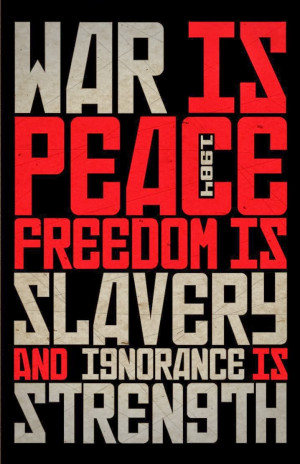
This is more or less the same point Orwell made with Newspeak in 1984. It is vital that language should always be in accord with objective reality, and not manipulated for political purposes. Otherwise you can just declare “freedom is slavery,” and start enslaving with abandon in the name of liberty. All manner of evil can thus be justified. Perhaps this is why, in turn the Devil himself is called the “Father of Lies.” Tinkering with the language itself is a kind of primordial meta-lie.

Jesus declares in the New Testament that “blasphemy against the Holy Spirit” is the one unforgivable sin. It is the same sin cited here:

“Then one possessed by a demon, blind and mute, was brought to him; and he healed him, so that the blind and mute man both spoke and saw. All the multitudes were amazed, and said, “Can this be the son of David?” But when the Pharisees heard it, they said, “This man does not cast out demons except by Beelzebul, the prince of the demons.”

Knowing their thoughts, Jesus said to them, “Every kingdom divided against itself is brought to desolation, and every city or house divided against itself will not stand. If Satan casts out Satan, he is divided against himself. How then will his kingdom stand? If I by Beelzebul cast out demons, by whom do your children cast them out? Therefore they will be your judges. But if I by the Spirit of God cast out demons, then God’s Kingdom has come upon you. Or how can one enter into the house of the strong man and plunder his goods, unless he first bind the strong man? Then he will plunder his house.

“He who is not with me is against me, and he who doesn’t gather with me, scatters. Therefore I tell you, every sin and blasphemy will be forgiven men, but the blasphemy against the Spirit will not be forgiven men. Whoever speaks a word against the Son of Man, it will be forgiven him; but whoever speaks against the Holy Spirit, it will not be forgiven him, either in this age, or in that which is to come.”

The sin itself is illustrated by the passage: the Pharisees, knowing that Jesus had exorcised by the power of the Holy Spirit, said it was done by the demon Beelzebul. They were, in effect, calling the Holy Spirit the Devil. They were taking the name of the Lord in vain. 

Jesus exorcises the man both blind and mute.

There is another subtext here: what opens the eyes and allows us communication is from God; what closes the eyes and prevents effective speech is from Satan. Correct use of terms and concepts allows things to be seen clearly, and allows dialogue to occur.

Again, Jesus gathers together; Satan scatters. Devil, “dia-bol,” literally means “to scatter.” And an obvious instance of scattering is to separate the word from the object.

For every word is a “sym-bol,” a drawing of things together: most fundamentally, word and referent. The sound or visual character, and the thing it represents.

The image of the strong man being bound also seems relevant. Given the context, an exorcism, the plunderer would be the possessing demon. The demon gains possession of the will by first binding the self with the misapplication of terms.

This may be why, in turn, an essential act, perhaps the essential act, in any Christian or Muslim exorcism is getting the demon to clearly state his name. Rectify terms, and the possession must end.

Perhaps this is also why John the Baptist came before Jesus: in order to make the Truth apparent, we must first “make the ways straight for the Lord,” and this is a speech act. For that is what the Baptist does: he speaks. He is a herald.

This tendency to falsify language is, sadly, becoming endemic in our society. It is the driving force behind political correctness. Abortion is called “choice.” Government expenditures are “investments.” We are now required to assert that, if a man says he is a woman, he is a woman. And we must say he is, despite all appearances to the contrary, or face serious consequences. The list is growing faster than it can be enumerated. It is all, to quote Orwell, to “make lies sound truthful, murder respectful and to give an appearance of solidity to pure wind.”

There is another curious part of the passage. So curious it must hold some special meaning:

“If I by Beelzebul cast out demons, by whom do your children cast them out? Therefore they will be your judges. But if I by the Spirit of God cast out demons, then God’s Kingdom has come upon you.”

Why this reference to children? Would it not be more natural to say, “by whom did your fathers cast them out”? Wouldn’t that have made his point stronger, showing that this was established usage? Wouldn’t it be more natural to warn that their forefathers, not their children, would judge them for such a sin? Do children commonly judge the acts of parents?

It seems there is something peculiar about this sin that inverts this more natural order.

It sounds like Hans Christian Andersen’s fable of “The Emperor’s New Clothes.” 


The sincerity of a child is a threat to any corrupt social order based on a shared falsification of terms. Given such a situation, in which fundamental concepts are being falsified, it is children who are going to be best able to spot it. Because they are looking at it all with fresh eyes, without preconceptions—in this case, falsified preconceptions.

This may be why “a child shall lead us,” as the New Testament says. This may be why Jesus says “suffer to come unto me the little children; for of such is the Kingdom of God.”

This may explain in turn why, as Freud and many others have observed, it is the brightest and most perceptive children who come to be abused in any dysfunctional family.


Friday, April 03, 2015

Churchill and Truth


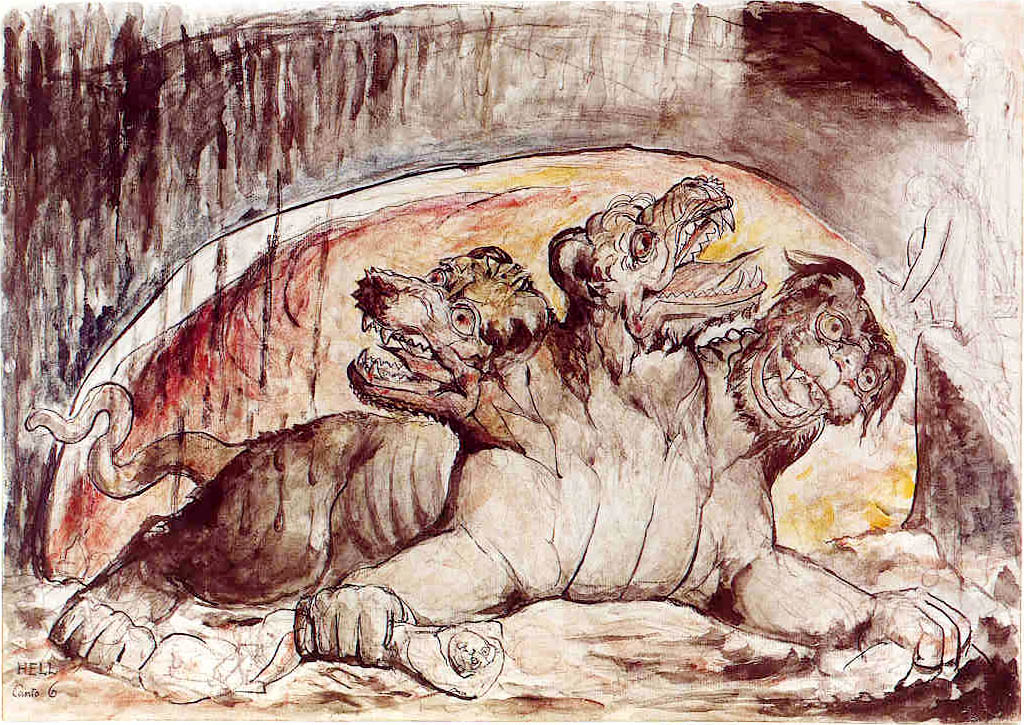
William Blake's vision of Cerberus, the black dog that guards the entrance of Hades.

Churchill once said “most people, if they happen to stumble upon the truth, quickly pick themselves up, dust themselves off, and walk away.”

Churchill, we know, suffered his entire life from what we now call bipolar disorder type II—depression interspersed with periods of mild euphoria. He himself credited his “black dog” with the insight to see and comprehend the danger of Adolf Hitler, when no one else in authority in Europe did, nor would listen when he did. Later, it allowed him to be the one to first raise the alarm about the postwar Soviet Union and the “iron curtain falling over Europe.” It was, in effect, a gift of prophecy.

William Blake, also a known sufferer from depression, had the same gift. Prophecy, he said, was simply the ability of some men to see with special clarity the forces at work, and therefore to see where they were heading.

It seems that the experience of repeated abuse, and/or the resultant depression, gives some people this ability. It gives them a special spiritual insight. Recent studies show, for example, that the depressed are better than the rest of us at empathy. Nothing occult about this: it is largely a commitment to truth, a question of recognizing true evil or true suffering when you see it (and phony suffering when you see that, too). But it explains why the depressed or melancholic or “mentally ill” were once fully employed by their societies as shamans, or as prophets, and why we might do very well to employ them for this purpose once again.

I have noted in this blog before the near-universal tendency among us to deny the very existence of evil. In the 1930s, nobody wanted to believe for a moment that Hitler was evil. No, poor chap, it must be all a misunderstanding. I'm sure that, if we can just look each other in the eye around the table in Munich, we can work something out. Hitler is a man we can do business with.

The abused at least have been disabused of that pollyanish superstition. They have known evil, and they know it to be real. They can smell it when they again encounter it. They are the natural authorities. They have a special expertise, which a wise society ought to exploit for its own protection. They can predict what it will do next, and they can predict how things are likely to end.

In the same way, having known true suffering, the abused and depressed can recognize it in others. They are less likely to pass by the wounded man on the road, pretending that they did not see. They can also better recognize when suffering is faked, when it is simply a case of the princess and the pea, the squeak of a selfish wheel. A caring society ought to exploit this talent as well.

Keep calm and carry on.
George Orwell gives a clear account of childhood abuse in his essay “Such, Such Were the Joys,” held back to be published only posthumously. This may have given him what he himself considered his special talent as a writer: to look the truth, however unpleasant, resolutely in the eye and not flinch in telling it. Animal Farm, 1984, and his expose of the villainy of Stalinism, despite being himself a socialist, were the results. 1984, in particular, can be taken as a detailed analysis of social evil in itself. The dynamics he examines there could be applied just as well to an abusive family as to an abusive government.

We can have little doubt from the historical record that Abraham Lincoln also suffered from major depression. He was far from the only person to see the evil of slavery in his day, and far from its strongest opponent. But his experience of depression, and presumably abuse, may have steeled him to the awful necessity of civil war to end it. William Tecumseh Sherman reacted similarly. When the war began, he was struck with a fit of depression that struck others as madness; it may, on the other hand, simply have been a realistic appraisal of what this war would involve. He himself says it was brought on by an understanding of the terrible prospect before him. Because the US was a democracy, in order to end the war, it would no longer be enough, as in European wars of the past, to defeat the opposing army in the field. Any defeat would have to be far more decisive, a destruction of the South's ability to support itself in independence: the first total war. Without this, it would be war without end.

Nobody else saw this; most in the North foresaw a victory by blockade, with little blood shed. Most in the South foresaw a victory by a short display of military valour and determination, convincing the European powers to recognize them. Sherman saw his march through Georgia, burning everything as he went. Sherman was right.

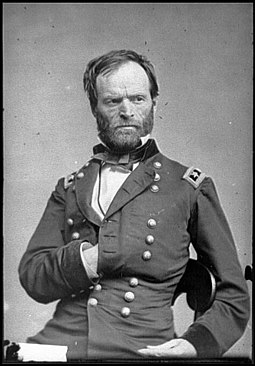
William Tecumseh Sherman.
The abused and the “depressed” apparently have a more intimate relationship with truth than do the rest of us. The rest of us are usually hiding from truth and from the moral good, imagining or pretending that we are free to believe and do whatever seems convenient for us to believe and do. The depressed and abused, on the other hand, whether this is cause or effect of their abuse, or both, uniquely have the strength to insist on truth, accept the truth, and to act accordingly.

This, I think, fully justifies their special citation by Jesus in the Beatitudes as “the blessed.”