|
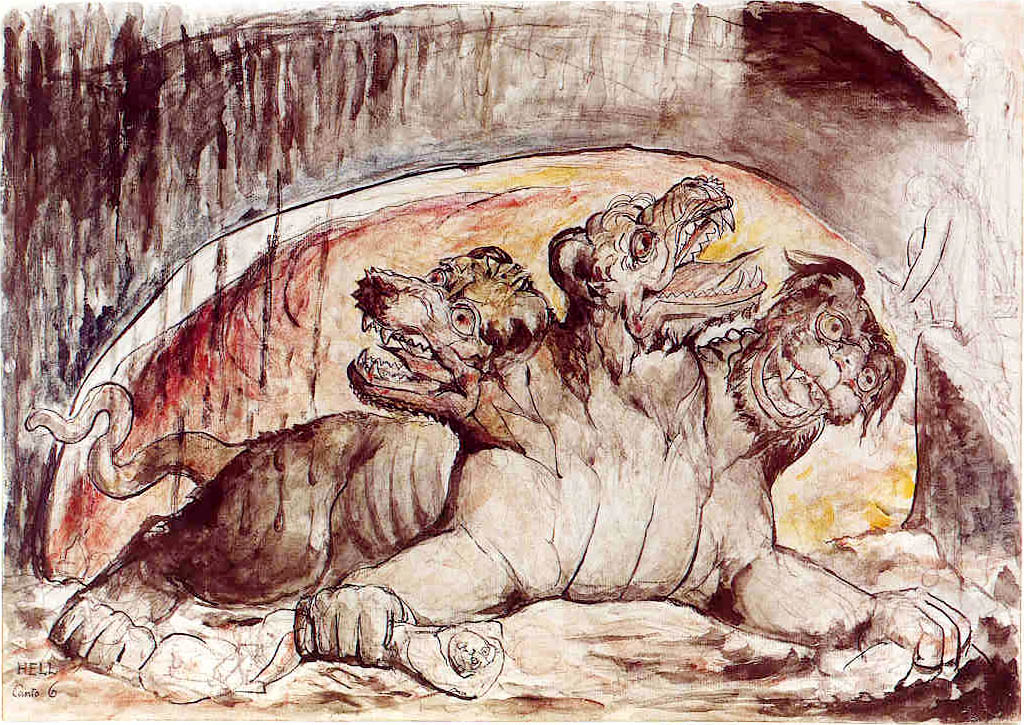
| William Blake's vision of Cerberus, the black dog that guards the entrance of Hades. |
Churchill once said “most people, if they happen to stumble upon the truth, quickly pick themselves up, dust themselves off, and walk away.”
Churchill, we know, suffered his entire life from what we now call bipolar disorder type II—depression interspersed with periods of mild euphoria. He himself credited his “black dog” with the insight to see and comprehend the danger of Adolf Hitler, when no one else in authority in Europe did, nor would listen when he did. Later, it allowed him to be the one to first raise the alarm about the postwar Soviet Union and the “iron curtain falling over Europe.” It was, in effect, a gift of prophecy.
William Blake, also a known sufferer from depression, had the same gift. Prophecy, he said, was simply the ability of some men to see with special clarity the forces at work, and therefore to see where they were heading.
It seems that the experience of repeated abuse, and/or the resultant depression, gives some people this ability. It gives them a special spiritual insight. Recent studies show, for example, that the depressed are better than the rest of us at empathy. Nothing occult about this: it is largely a commitment to truth, a question of recognizing true evil or true suffering when you see it (and phony suffering when you see that, too). But it explains why the depressed or melancholic or “mentally ill” were once fully employed by their societies as shamans, or as prophets, and why we might do very well to employ them for this purpose once again.
I have noted in this blog before the near-universal tendency among us to deny the very existence of evil. In the 1930s, nobody wanted to believe for a moment that Hitler was evil. No, poor chap, it must be all a misunderstanding. I'm sure that, if we can just look each other in the eye around the table in Munich, we can work something out. Hitler is a man we can do business with.
The abused at least have been disabused of that pollyanish superstition. They have known evil, and they know it to be real. They can smell it when they again encounter it. They are the natural authorities. They have a special expertise, which a wise society ought to exploit for its own protection. They can predict what it will do next, and they can predict how things are likely to end.
In the same way, having known true suffering, the abused and depressed can recognize it in others. They are less likely to pass by the wounded man on the road, pretending that they did not see. They can also better recognize when suffering is faked, when it is simply a case of the princess and the pea, the squeak of a selfish wheel. A caring society ought to exploit this talent as well.
 |
| Keep calm and carry on. |
George Orwell gives a clear account of childhood abuse in his essay “Such, Such Were the Joys,” held back to be published only posthumously. This may have given him what he himself considered his special talent as a writer: to look the truth, however unpleasant, resolutely in the eye and not flinch in telling it. Animal Farm, 1984, and his expose of the villainy of Stalinism, despite being himself a socialist, were the results. 1984, in particular, can be taken as a detailed analysis of social evil in itself. The dynamics he examines there could be applied just as well to an abusive family as to an abusive government.
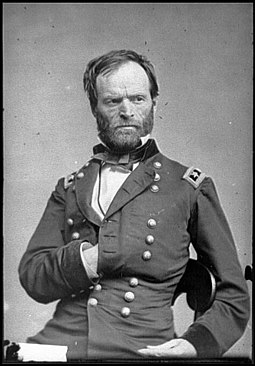
We can have little doubt from the historical record that Abraham Lincoln also suffered from major depression. He was far from the only person to see the evil of slavery in his day, and far from its strongest opponent. But his experience of depression, and presumably abuse, may have steeled him to the awful necessity of civil war to end it. William Tecumseh Sherman reacted similarly. When the war began, he was struck with a fit of depression that struck others as madness; it may, on the other hand, simply have been a realistic appraisal of what this war would involve. He himself says it was brought on by an understanding of the terrible prospect before him. Because the US was a democracy, in order to end the war, it would no longer be enough, as in European wars of the past, to defeat the opposing army in the field. Any defeat would have to be far more decisive, a destruction of the South's ability to support itself in independence: the first total war. Without this, it would be war without end.
Nobody else saw this; most in the North foresaw a victory by blockade, with little blood shed. Most in the South foresaw a victory by a short display of military valour and determination, convincing the European powers to recognize them. Sherman saw his march through Georgia, burning everything as he went. Sherman was right.
 |
| William Tecumseh Sherman. |
The abused and the “depressed” apparently have a more intimate relationship with truth than do the rest of us. The rest of us are usually hiding from truth and from the moral good, imagining or pretending that we are free to believe and do whatever seems convenient for us to believe and do. The depressed and abused, on the other hand, whether this is cause or effect of their abuse, or both, uniquely have the strength to insist on truth, accept the truth, and to act accordingly.
This, I think, fully justifies their special citation by Jesus in the Beatitudes as “the blessed.”





 Posts