

 Posts


Or, "Mainly Because of the Meat."
Or, "Bite Me!"
 |
| Cannibals in the New World. German woodcut of 1509, illustrating a work by Amerigo Vespucci |
It seems like piling on to mention that many Canadian Indian groups were cannibals. This is not, after all, like torture and killing of captives, a matter of objective morality. Torturing and killing are certainly not proper. But, once you have done this much, are you adding much of anything more by eating the body rather than letting good meat go to waste?
Indignities to a corpse are, of course, an offense in Canadian law. Do not, I urge you, try this at home. Anyone who “improperly or indecently interferes with or offers any indignity to a dead human body or human remains, whether buried or not, is guilty of an indictable offence and liable to imprisonment for a term not exceeding five years.” But the Canadian law is presumably based largely on the Christian belief in the resurrection—the victim is going to need that body again one day. It should not be expected to be binding on other cultures. As an Algonquin patiently explained to a Jesuit who objected to sharing in the unspeakable feast, "You have French taste, I have Indian. This is good meat for me." (Francis Parkman, Montcalm and Wolfe, vol. 1, p 497). It does not take a sophomore's expensive college education to hit upon the concept of cultural relativism.
So dwelling on Indian cannibalism looks only like trying to unfairly prejudice the reader against native Canadians, simply because their customs are not ours. Sauce for the goose may not be sauce for the gander.
It becomes a legitimate matter to discuss, however, because the defenders of traditional Indian ways of life have denied it. If they find it important enough to deny, then we must as well—if only to dispell false information. If you want to revive traditional Indian culture, this is one thing you are buying in to.
William Arens famously argued, back in 1979 (The Man-Eating Myth), that there were no first-hand accounts of flesh eating among American Indians, or indeed any other hunter-gatherers worldwide. There was, in other words, no solid proof, just rural legend. Accordingly, it could and should be understood as a slander against the native American “other” by chauvinistic Europeans; a justification for taking native land and pressing them as individuals into slavery. Neil Whitehead calls the cannnibal allegation “imperial propaganda” (Neil Whitehead, “Carib Cannibalism: The Historical Evidence,” Journal de la Societe des Americanistes, 70:1, 1984).
This position became widely popular among academics, and, perhaps even more, in the mainstream media. I know I heard it, stated authoritatively and often, not that long ago.
 |
| 1592 depiction of New World cannibals. |
As anyone who has read up to this point must realize, it was always an odd claim. We have already seen first-hand accounts of cannibalism after torture from the early Jesuit missionaries. Columbus, as soon as he arrived in America, heard of such dining habits among nearby tribes—the very word “cannibal” is a corruption of the term used for themselves by the Carib Indians of the West Indies. Cortes reports similar tales. Bernardo Diaz, who as a footsoldier accompanied Cortes into Mexico, writes of the Aztecs “eating human meat, just like we take cows from the butcher’s shops, and they have in all towns thick wooden jail-houses, like cages, and in them they put many Indian men, women and boys to fatten, and being fattened they sacrificed and ate them” (Díaz del Castillo, The Conquest of New Spain [Historia verdadera de la conquista de Nueva España ] [c.1568] 1992 edition, p.579). This assertion is corroborated by other chroniclers, including Diego Munoz Carmago, who describes in Mexico “public butcher's shops of human flesh, as if it were of cow or sheep.” (Excerpt translated from Muñoz Camargo, Historia de Tlaxcala [c.1585] 1947 edition, p.153, Wikipedia translation).
These certainly claim to be first-hand accounts. Are all Europeans liars?
Arens and others retort that in 1503, Queen Isabella of Spain declared that slavery could only be practiced on peoples who were arguably better off as slaves—for example, those who practiced cannibalism among themselves. Spain, after all, was a Christian country; it otherwise respected the Christian prohibition on slavery. The main emphasis of Isabella's proclamation, therefore, was to prohibit enslavement of native Americans as a general principle.
This, however, unfortunately gave European newcomers arriving in Spanish-dominated lands a vested interest in uncovering cannibalism everywhere. As a result, Arens feels justified in ignoring such accounts.
However, he seems to ignore that similar accounts are given by French sources, although the French at this time had no notable involvement in any slave trade. Etienne Brulé, the first European to view Lake Ontario, Lake Huron, and Lake Superior, was dissected and devoured by Huron colleagues in 1632, according to the Indians themselves (Consul Willshire Butterfield, History of Brule's Discoveries and Explorations, Cleveland, 1898, p. 120. Original source Recollet Friar Gabriel Sagard, Histoire du Canada, 1636). In 1528, his crew watched helplessly just beyond gunshot range as Giovanni Verrazzano, celebrated discoverer of most of the East Coast of America, was offed and eaten on Guadalupe, during what, for obvious reasons, became his last voyage.
There are many more first-hand accounts in the Jesuit Relations. Among our witnesses is Saint Isaac Jogues, who reports, of a time when his Iroquois captors were about to kill him in revenge for one of their warriors who had gone missing, “Happily ... a messenger arrived, who brought news that that warrior and his comrades about whom they were anxious were returning victorious, bringing twenty Abnaquiois prisoners, ... Behold them all joyful; they leave the poor Father; they burn, they flay, they roast, they eat those poor victims, with public rejoicings” (Jesuit Relations 31, p. 83). Later during his captivity, “A Huron, desiring to reconnoitre them [the Iroquois], was killed by an arquebus shot, and eaten by those Cannibals” (Jesuit Relations 31, p. 173).
If the word of a saint were not enough, Francis Parkman notes that Jogues's account of Mohawk practices is corroborated in detail by the Dutch Reformed minister, Johannes Megapolensis, who lived in Fort Orange on the border of Mohawk territory at the time. He is, Parkman notes, “very explicit as to cannibalism.” Everyone in the village, Megopolensis explains, eats the arms, buttocks, and trunk of the victim, but the head and heart, as special delicacies, are reserved for chiefs (Parkman, The Jesuits in North America in the Seventeenth Century, p. 199; his source is Megapolensis, A Short Account of the Mohawk Indians, 1644). To Megapolensis, note, the Mohawks were allies; Jogues was the nominal enemy. The Protestant minister had no motive to condemn the Indians, or to make Jogues's sufferings look worse than they were.
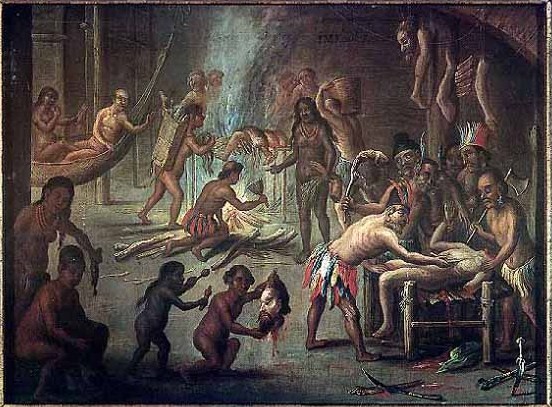 |
| Carib Indians dining. "Barbecue" is an Indian term |
Jesuit Father Francesco-Giuseppe Bressani was also later captured and tortured by the Iroquois, and reports the same practices Father Jogues saw. He describes a night of agony inflicted on a captive Algonquin. “The following morning they roasted him alive. Then, because I had baptized him, they brought all his members, one by one, into the cabin where I was. Before my eyes they skinned and ate the feet and hands. The husband of the mistress of the lodge threw at my feet the dead man's head, and left it there a long while” (Father Bressani, second letter, August 31, 1644; in Horace Kephart, Captives Among the Indians, New York, 1915).
An Algonquin woman, taken by the Iroquois with her children in 1641, gives an especially wrenching account: “They took our little children, placed them on spits, held them to a fire, and roasted them before our eyes. .... They looked at us, and cried with all their might. Our hearts were broken when we saw them roasting, all naked, before a slow fire. .. After they had put the poor little babes to death by fire, they drew them off the spit to which they were fastened, threw them into their kettles, boiled them, and ate them in our presence” (Fr. Vimont, Relations 22, p. 253).
Nor was cannibalism a practice only of the Iroquois. It seems to have been indulged in by any given Indian group. When Father Jean de Brebeuf and associates visited Neutral territory to scout the evangelical possibilities, they were welcomed by one Indian with the observation "I’ve had enough of the dark-colored flesh of our enemies…I wish to know the taste of white meat, and I will eat yours" (Parkman, The Jesuits in North America in the Seventeenth Century, p. 147). Champlain reported the practice among the Algonquins: returning from a raid on the Iroquois, he says, “They attached to sticks in the prows of their canoes ... a dead body cut into quarters, to eat in revenge, as they said” (Champlain, Voyages, p. 184).
Of the Hurons, their special charges, the Jesuit priests who knew them best wrote “ere the faith had given them more light than they possessed in infidelity, [they] would not have considered that they committed any sin in eating their enemies, any more than in killing them” (Jesuit Relations 35, p. 87). Father Brebeuf and his colleague Lalemant report the painfully protracted torture of an Iroquois prisoner in their village. In the final denoument, “one cut off a foot, another a hand, and almost at the same time a third severed the head from the shoulders, throwing it into the crowd, where some one caught it to carry it to the Captain Ondessone, for whom it had been reserved, in order to make a feast therewith. As for the trunk, it remained at Arontaen, where a feast was made of it the same day” (Jesuit Relations 13, pp. 43-77).
Francis Parkman notes similar culinary customs among the Ottawa at the siege of Fort William Henry during the Seven Years War. “... [T]he missionary met troops of Indians conducting several bands of English prisoners along the road that led through the forest from the camp of Levis. Each of the captives was held by a cord made fast about the neck; and the sweat was starting from their brows in the extremity of their horror and distress. … He presently saw a large number of them [the Ottawa] squatted about a fire, before which meat was roasting on sticks stuck in the ground; and, approaching, he saw that it was the flesh of an Englishman, other parts of which were boiling in a kettle, while near by sat eight or ten of the prisoners, forced to see their comrade devoured” (Parkman, Montcalm and Wolfe, vol. 1, p. 482-3). Parkman gives his own source as Bougainville, Journal de l'Expedition contre le Fort George. Since this is a French author of some authority, and the incident reflects badly on the French and their allies, indeed on the correspondent who is unable to stop it, it is worthy of credence.
 |
| Aztecs dining. |
In a later incident during the same action, English prisoners are taken from a boat. “Three of the bodies were eaten on the spot” (Montcalm and Wolfe, vol. 1, p. 484).
At the seige of Fort Detroit, during Pontiac's rebellion, according to Parkman, the Ottawas tortured and killed forty-six British soldiers, after which they “fell upon their bodies, cut them in pieces, cooked, and ate them” (Parkman, The Conspiracy of Pontiac, p. 202, note).
LaSalle, exploring the West, returned with similar tales of man-eating. He describes a case in which the Cenis Indians had taken a captive, a woman from a neighbouring tribe. After elaborate torture, “At last, one of them gave her a stroke with a heavy club on the head, and another ran her stake several times into her body, with which she fell down dead on the spot. Then they cut that miserable victim into morsels, and obliged some slaves of that nation they had been long possessed of, to eat them” (French, B. F., Historical Collections of Louisiana, NY: Wiley and Putnam, 1846. p. 160). Wasn't that a dainty dish to set before a king?
The “Nez Percé” (not the Pacific Northwest tribe commonly identified by this name, but the Amikwa, of Lake Nipissing, later wiped out by the Iroquois) reported similar practices. “On the eighth of June, the Captain of the Naiz percez, or Nation of the Beaver, which is three days journey from us, came to request one of our Frenchmen to spend the Summer with them, in a fort they had made from fear of the Aweatsiwaenrrhonon, or stinking tribe [the Winnebago—this is a typical example of an unflattering name used for a nearby tribe], who have broken the treaty of peace, and have killed two of their men, of whom they made a feast“ (Father Brebeuf, Jesuit Relations 10, p. 81).
Among the Kwakiutl of the Pacific Northwest, there was a secret society known as the “Hamatsa”-- a word that literally means “cannibals.”
Did they use it literally?
According to early missionaries, they did. Garry Hogg, who collects a variety of such missionary reports in his 1958 book Cannibalism and Human Sacrifice, includes two accounts. One was near Fort Rupert, a Hudson's Bay Company post on the northern tip of Vancouver Island. Two missionary witnesses report. “A Kwakiutl shot and wounded a slave,” they relate, “who ran away and collapsed on the beach at the water’s edge. He was pursued by the tribesmen, including a group of the ‘Bear Dancers’ and Hamatsas. The slave’s body was cut to pieces with knives while the Hamatsas squatted in a circle round them crying out their terrible cry: ‘Hap! Hap! Hap! Hap!’” The two Europeans then “watched the Bear Dancers snatch up the flesh, warm and quivering, and growling like the Grizzly they represented, offer it to the Hamatsas in order of seniority” (Hogg, pp. 70-2). On another occasion, “A Hamatsa demanded that [a] ... slave – this time a female – should dance for him. She stood a moment looking at him in terror, and said: ‘I will dance. But do not get hungry. Do not eat me!’ She had hardly finished speaking when her master, a fellow member of the tribe, split her skull open with an axe, and the Hamatsa thereupon began to eat her flesh”(Hogg, pp. 70-72).
 |
| Caribs, the original cannibals |
Some Inuit also practiced people cooking. Akpatok Island in Ungava Bay was notorious for the practice, until its inhabitants vacated the site and melded into the mainland population in 1900. Rather like Hannibal Lecter.
Note that most of our eyewitness reports are from missionaries. Besides those being in closest contact with the Indians in their home territory, I submit that this is a source presumably of good moral character, and therefore worthy of belief.
James White, in his Handbook of Indians of Canada (1913), writing before the days of political correctness, gives some idea of how widespread the practice was. “Among the tribes which practised [cannibalism], in one or another of these forms, may be mentioned the Montagnais, and some of the tribes of Maine; the Algonkin, Armouchiquois, Micmac, and Iroquois; farther west the Assiniboine, Cree, Foxes, Miami, Ottawa, Chippewa, Illinois, Kickapoo, Sioux, and Winnebago; in the south the people who built the mounds in Florida, and the Tonkawa, Attacapa, Karankawa, Kiowa, Caddo, and Comanche (?); in the northwest and west portions of the continent, the Thlingchadinneh and other Athapascan tribes, the Tlingit, Heiltsuk, Kwakiutl, Tsimshian, Nootka, Siksika, some of the Californian tribes, and the Ute. There is also a tradition of the practice among the Hopi, and allusions to the custom among other tribes of Arizona and New Mexico. The Mohawk, and the Attacapa, Tonkawa, and other Texas tribes were known to their neighbours as 'man-eaters.' “ (James White, ed., Handbook of Indians of Canada, published as an appendix to the Tenth Report of the Geographic Board of Canada, Ottawa, 1913, 632p., pp. 77-78).
Quite the guest list. Is anyone left?
Given the weight of evidence, denial of the practice is remarkable evidence of how powerful the appeal of the Noble Savage archetype is: mighty enough to make grown anthropologists wilfully ignore the record.
Granted, written texts are not often the stuff of anthropology; it generally depends either on interviews with living people, or the archeological record. Which is to say, digging through other people's garbage. Living Indians are adamant that none of their ancestors was ever a cannibal. And, as we all know, Indian accounts of Indian tradition never lie.
It was, however, the archeological record that eventually did this academic orthodoxy in. In September 2000, Nature published a new study which had done a chemical analysis on human feces found in an Anasazi Indian site from around 1250 AD. Feces--the sort of thing serious anthropologists could really sink their teeth into. This was real, physical, scientific stuff.
The analysis turned up myoglobin, a human protein which apparently could only come to be there from eating human meat.
The test, mind, was done in the first place because archeological sites across the American Southwest featured human bones from which the flesh seemed to have been cut off.
 |
| This is not a cannibal. This is a cannon ball. |
What is demonstrably true of the one site is probably, as per Occam's razor, true of the others generally.
It appears this was not some religious ritual for interring the dead. It was food preparation.
How common, then, was cannibalism? Rare, or well done? The Noble Savage lobby now resorts to claiming it was an uncommon practice with religious significance. God made them do it.
Uncommon, no doubt; human flesh is usually dearly bought. Moose are not nearly so good at fighting back. But just how uncommon?
Common enough that the Jesuit Father Ragueneau estimated offhand of the prominent Algonquin convert Le Berger that “he had eaten his share of more than fifty men” (Jesuit Relations 1650, pp. 43-48, quoted by Parkman, The Jesuits in North America, p. 244).
His first confession must have been interesting.
Father Lalemant observes of the Hurons, “they eat human flesh with as much appetite and more relish than hunters eat the meat of deer” (Jesuit Relations, p. 166). Father Vimont makes an almost identical comment: “When the supper was cooked, these wolves devoured their prey; one seized a thigh, another a breast; some sucked the marrow from the bones; others broke open the skulls, to extract the brains. In a word, they ate the flesh of men with as much appetite as, and with more pleasure than, hunters eat that of a Boar or of a Stag” (Jesuit Relations 22, p. 251-3).
Not exactly a steady diet; but not a religious ritual in which the act of eating is itself minimal, like swallowing the host at Mass. Something for special occassions.
Like turkey.