Playing the Indian Card

Sunday, March 22, 2015

Okay, Make That the Dymphna Complex


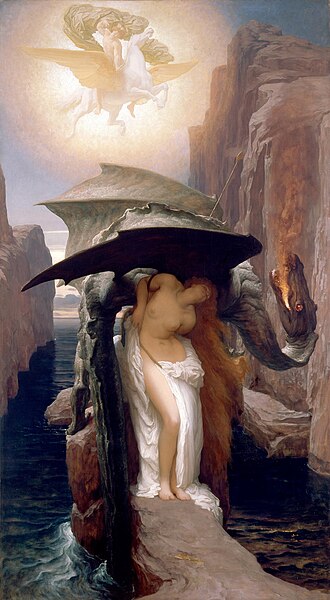
Psyche being led to the mountainside, where she will be exposed to her demon lover.
I have written of the “Damon Complex.” Perhaps, in the end, it is better to call it the “Dymphna complex”; for Saint Dymphna is the protagonist of the tale, and is far better known than her father. Now let me try to break it down into its essential elements. I believe it may tell us something important, as a superior substitute for the Oedipus Complex, about the true origins of much or all mental illness.

A: a parent (or other operating in loco parentis) wishes to or tries to do a child harm. The common fairy tale motif of the “wicked step parent” may be introduced to soften the blow, or perhaps to convey the concept of a discrepancy between presumed love and actual hate: what is apparent is not real. The apparent parent is not a true parent.

In the Dymphna story, her father King Damon beheads her. That is, shall we say, pretty clear-cut. In the Oedipus story, his father tries to kill him twice, once by exposure as an infant, once at the crossroads. Oedipus's lack of knowledge of his own parents serves the same purpose as the “wicked step-parent” motif, inverting it: the apparent parents are not the real parents. That is, they do not act as parents are supposed to act.

B: a parent (or other operating in loco parentis) wishes to or tries to own a child completely, denying them an independent life—the Rapunzel Complex. Theoretically, we should not expect to see this happening along with A in the same story, because the two are generally incompatible. But they are symptoms and products of the same root cause, a selfish parent who does not see the child as an independent soul with his or her own rights.

In the Dymphna story, her father King Damon demands marriage, then tracks her down when she flees—the ultimate helicopter parent.

In the Oedipus story, both mother and father seek to kill Oedipus; it is Jocasta who actually hands him over to be exposed. And it is Jocasta who mates with him. One might, fairly, argue that at least this latter is unintentional. On the other hand, Oedipus bears the scars of his laming by his parents. While he would know nothing about this, it is reasonable to expect Jocasta, seeing this scar, to at least have suspicions about his true identity. The Oedipus story manages the trick of having the same parent both seek to kill and seek to totally possess the same child.

The Judgement of Solomon: Rubens.
There is another obvious example of this in the Bible. In context, it is presented as the Bible's definition of bad parenting. This is the story of the two women who come to Solomon to determine who is the mother of a child. One of the two had smothered her own child in sleep—a perfect image of an overweening, possessive parent, combining in the one action both elements A and B. Then she was happy to have the child killed as a resolution of the conflicting claims,so that she could possess the half—both A and B again. The good, “true” parent, as Solomon judged the matter, was the one who was prepared to give up all claims to the child for the child's best interests. A perfect summary.

C: the child is exceptional in some way: surpassingly beautiful, strong, or intelligent. In a sense, this goes without saying: to make a story worth telling, the hero or heroine is commonly represented as someone special. On the other hand, in many versions of the story—as in Snow White--the motive of jealousy is important to the plot. And this is psychologically important: a child who seems destined to surpass the parent in some way is the sort of child most likely to upset a narcissistic parent who considers him or herself the rightful centre of the universe. Freud too noticed that “the neurosis rides the strongest horse in the stable”--that is, a neurotic is likely to be the most impressive of his or her siblings—even though his own theory could not account for this. Ours can.

Dymphna is understood to be exceptionally beautiful. This figures in the desire of Damon to completely own and control his child. She is also exceptionally moral, as her sainthood attests. Oedipus, as his solution of the Sphinx's riddle illustrates, is exceptionally intelligent. He is also exceptionally dutiful, and relentless in his commitment to knowing the truth.

D: the child leaves the parent and the family situation. Either he or she flees, or, alternatively, the child is forced or driven out. This can be combined with A—abandoning a child to die.

Dymphna flees by sea to Belgium. Oedipus is abandoned on the mountainside, and then again chooses to leave his foster family in Corinth in order to prevent the oracle from being fulfilled.

This is the obvious solution to being in a dysfunctional, abusive situation, and so surely must be dealt with in the story.

Snow White being rescued by ... OMG, isn't that Keith Richards in the foreground?!
God help you, Snow White!

E: this obvious solution, of getting away from the abusive situation, although it may be necessary, seems never to finally resolve the situation. This could be measnt to identify the nature of mental illness as what we now call PTSD—the residual effects of abuse. As with PTSD, this sort of permanently disabling stress can occur in situations other than one's family upbringing. It is just especially powerful in that context. Although the abuse itself may have stopped, it is internalized as the “mental illness.”

Dymphna is tracked down by her father in Belgium. The idea that Oedipus cannot, despite his best efforts, avoid returning to his family and his fate, is the crucial concept driving the action of Sophocles's play

F: as a result of the experience, the child becomes a healer of others, a spiritual celebrity, a spiritual hero.

Dymphna founds a hospice. Posthumously, she becomes a Christian saint and is understood to have special healing powers for the “mentally ill.” Oedipus's death at Colonus is understood to be a blessing for Athens. His grave becomes a shrine.


Together, I take these six to be the crucial elements of the Dymphna story. We see that they also fit the Oedipus story very well. Now let’s see how commonly they pop up elsewhere in the world's literary and spiritual inheritance. In theory, if it speaks of some near-universal experience, and an experience so deeply consequential, it should show up all over the place—as Freud’s Oedipus complex really does not.

We should, I think, especially expect to find them in fairy tales, creation stories, and hero legends. Fairy tales are, I suggest, designed as advice primarly for young girls, and so advise of the perils of childhood. Hero legends perform the same function for young boys; like super-hero comics did when I was young. Creation myths, because they speak of the origins of things, also probably often speak of our psychic origins in early childhood.
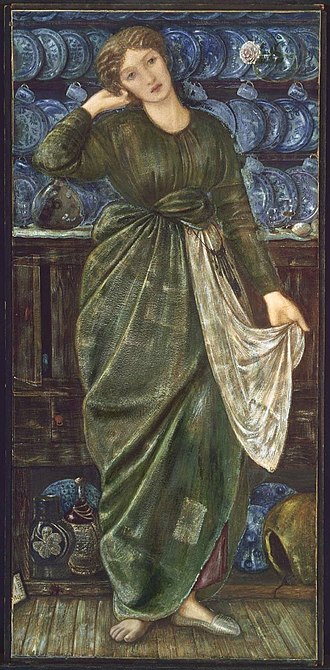
Cinderella: Burne-Jones.

The story of Cinderella has (A) the wicked stepmother, who also (B) does not allow her out, even though in theory this would be a way to get rid of her. Cinderella nevertheless manages to escape to the ball (D), disguised so that her sisters cannot recognize her. The escape is only temporary; she is obliged to return each night by the stroke of midnight (E). Cinderella is both entrancingly beautiful and exceptionally patient and even-tempered (C).

The story of Snow White: (A), her wicked stepmother has a huntsman take the child out to the woods to cut out her lungs and liver. Snow White escapes the huntsman by promising to “run into the forest and never come back” (D). The huntsman substitutes the lungs and liver of a boar, which the queen then cooks and devours (an image of B, devouring love?). This does not work, however, because the queen has a magic mirror that informs her of Snow White's continued existence (E). She then tries to suffocate her with a bodice given as a gift (another image of B, smothering love?), then gives her the gift of a poisoned comb, then the poisoned apple. All Snow White's troubles are caused by her great beauty, which provoke the wicked queen’s envy (C). At her apparent death, the seven dwarfs put her in a glass coffin, like a saint's shrine (F); although they believe her dead, this presumes that her body will be incorruptible, like those of some saints.

The British legend of King Lear, most famous from Shakespeare, and a traditional image of a family gone wrong, reads like a muted version of the Dymphna story. Cordelia is more beautiful, more moral, and more dutiful than her two sisters (C). King Lear demands that each of his children pay him homage beyond what is due to a father; this may be a toned-down version of Damon's demand for sexual favours (B). When Cordelia, out of moral scruple, refuses, she is disinherited (A). She flees to France (D). Later, when her two sisters prove as dishonest as their father should have expected, she returns to defend him, but is killed in the battle (E). In Geoffrey of Monmouth's version, she survives to overthrow her sisters, but later, as one might expect of a chronic depressive, commits suicide. In either version, however, her death restores Lear to the kingship and the kingdom to rightful order (F).

Psyche and What's-his-name.
We might also expect to find the motif in the tale of Cupid and Psyche, both because it is considered the world's oldest written fairy tale (oral traditions are probably much older), and because the name of its protagonist seems to suggest a psychological meaning: literally, this is the story of Soul. It is also the story of Eros—the Greek for “Cupid.” Since Freud held that Eros was the root of mental illness, here in particular his Oedipus complex ought to appear.

Psyche is exceptionally beautiful—so beautiful that she provokes the envy of Aphrodite (C). Her parents expose her as a young woman on a mountainside, understanding that she is being given as a bride to some monster (A, D). The “monster” turns out to be Cupid (Eros), the son of Aphrodite. He has indeed been sent to make her fall in love with some monster, Aphrodite's revenge, but instead falls in love with her himself. They couple, but he remains disguised. When she discovers his true identity, she is banished (D). To recover the relationship, she is obliged to put herself under Aphrodite's control, to be abused (E), like Cinderella. She is given a series of impossible labours she must perform—the sort of double-binds typical, as R D Lang points out, of a dysfunctional family situation. As a result, she shows all the signs of what we would call depression: twice she tries to kill herself. Nevertheless, eventually, having accomplished her labours with supernatural aid, she is reunited with Cupid. Her influence over her new husband, it is said, ensures that he will no longer torment married men and women with urges to infidelity (F).

Guan Yin, Chinese, eleventh century.
For comparison, consider the Chinese story of Guan Yin, known by various names throughout East Asia as the Bodhisattva of Infinite Compassion. She was born as the daughter of a cruel king who demanded that she marry a man of his choice whom she despised (an element of control, surely; a faint B). She flees to a temple convent (D). Her father's control follows her, however (E); he orders the nuns to give her the hardest work, and to allow her no rest, like Cinderella (A). Nevertheless, her goodness is so great that the animals help her with her chores (C ). Her father then tries to burn down the temple (A), and orders her to be put to death (A). She descends to the underworld, but her influence releases those already there from their suffering (F). Her father then falls ill, and can only be cured by a medicine made from the arm and eye of someone without anger. Guan Yin, hearing this, volunteers her own arm and eye for his benefit (F). She becomes the model of the helper figure, one who has vowed to never rest until she has ended all suffering in the universe.

The story of Gaia, Uranus, and Kronos, the Greek creation myth: Gaia creates Uranus “to cover her on every side,” then mates with him (B). Uranus then seeks to prevent his children with Gaia from being born (A). Kronos is the cleverest and strongest of Gaia’s and Uranus’s children (C). He castrates Uranus with a sickle in order to escape (D).

Kronos himself then devours each of his children as they emerge from the womb (A). Zeus, later the king of the gods (C) is spirited away to a distant cave by his mother and grandmother (D), and a stone is substituted to trick the father.

The Babylonian creation story, told in the Enuma Elish: Apsu and Tiamat, the primordial couple, mate and produce children, who are trapped in Tiamat’s womb. Apsu wants to kill them (A). Tiamat warns Ea, the most powerful of her children (C). Ea kills Apsu and becomes king of the gods. Tiamat then takes her son Kingu as her new mate (B). Together they raise an army of monsters to destroy her other children (A), but are defeated by her grandson, Marduk.

Brahma and daughter-consort Saraswati. Don't try this at home.
The Hindu creator, Brahma, chooses his own daughter, Saraswati, as consort, against her will (B). This transgression is why Brahma is not generally worshipped in India. Saraswati is so beautiful that Brahma sprouts four heads to ensure that she is constantly visible to him (C ). Saraswati flees him, first disguised as a cow, then as a mare, then as a succession of different creatures (D). Nevertheless, Brahma always remains in pursuit (E). Trying to rescue Saraswati, Siva is driven mad by Brahma; but Saraswati is able to heal him with a touch (F). She assumes a position in Indian culture similar to that of the Muses in Greece: she is the patroness of the arts and of all knowledge (F).

The story of Heracles (Hercules), the classic Greek hero myth: Heracles is the illegitimate son of Zeus, making Hera, as his name implies, his step-mother. She, however, hates him as living evidence of her husband's infidelity (A). She first tries to prevent his birth (A), then his birth mother exposes him (A). Like Oedipus, however, or Moses, Heracles is rescued and inadvertently adopted and nursed by Hera, not aware of his identity (A). This parentage leaves him with superhuman strength (C). Later, Hera sends snakes to kill him in his cradle (A).

Psyche's second labour.

As an adult, driven mad by Hera, Heracles kills his own children (A). It is to expiate this deed that he is forced to undergo his famous twelve labours. These require him to go to the very end of the earth, to collect the apples of the Hesperides (D). He is also one of the Argonauts who reach the opposite end of the Greek world, Colchis (D). This, however, is not the end of his troubles; Hera is still able to make him go mad (E), so that he kills his best friend. Ultimately, Heracles is credited with freeing Prometheus from his long torment on the Caucasus mountains, and Theseus from Hades (F). His death is an apotheosis, and he is worshipped as an Olympian.

The Theseus story has the same basic elements. Theseus, the strongest of men (C), is raised apart from his father, the king Aegeus. When he arrives, a young man, in Athens, his father's new wife is Medea, who has already killed all of her own children with Jason (A). She feels similarly toward Theseus, and tries repeatedly to off him (A), first by making him capture the Marathonian Bull, then by giving him poison. Theseus then volunteers to be one of the young sent as tribute each nine years to Crete to be fed to the Minotaur (A, D). He falls in love with Ariadne, princess of Crete, who helps him kill the Minotaur. However, Athena forces him to leave Ariadne behind, a loss they both suffer from for the rest of their days (E). The ship with which he returned to Athens is preserved from that time on by the Athenians as a sacred shrine (F).

Later, Theseus's wife Phaedra falls in love with his son Hippolytus (B). Phaedra falsely accuses Hippolytus of raping her (A) before hanging herself. Theseus then, misled, depending on the version, either kills Hippolytus with his own hands, or curses him, causing his death. Hippolytus becomes the object of a cult, in which young girls about to be married offer up at his grave locks of their hair (F).

Perseus and Andromeda: Burne-Jones.

Then there is Perseus. His father, unable to prevent his birth (A), casts him into the sea in a wooden chest (A, D). He is found and raised by a fisherman. The fisherman's brother falls in love with Perseus's mother Danae, and takes a hate to his prospective step-son (A, E). He sends Perseus off to kill Medusa, an impossible task, a double-bind. The lad nevertheless succeeds, and on his return, comes across Andromeda, left out by her parents a a human sacrifice (A). Perseus is supernaturally strong; Andromeda has provoked the envy of the goddesses with her beauty (C).

In fairness, it should be noted that both Theseus and Perseus can be said in a sense to have killed their fathers, as Freud would expect. Theseus, distracted by grief, forgets to raise a white sail on his returning ship. His father Aegeus, seeing this sign of a failed mission, kills himself in grief before he can learn the truth. And Acrisius, Perseus's birth father, steps into the trajectory of a quoit thrown by his son in a demonstration of the sport, and dies. But both these acts, like those of Oedipus himself, are unintentional on the part of the son, and the fault of the parent, if anyone's. The point, I presume, of the motif is that children really do “kill” their parents in a symbolic sense: they will survive their parents, and their existence is a reminder and a proof that the parent is not immortal. The main point the myths seem to want to make in mentioning this is that the children are completely innocent and cannot be blamed for this. Nor can the parent escape this truth by harming the child.

Let's compare the great Indian hero tale, the Ramayana. Rama, being an incarnation of Vishnu, excels in all branches of learning and all the martial arts; he is “the perfect man” (C). Although he is the oldest son of King Dasharatha, his stepmother Kaikeyi connives to have him cut from the succession and banished for fourteen years (A, D). During this exile, the demon king Ravana abducts his wife, Sita; he is obliged to travel the length of India, to Sri Lanka, in order to defeat the demon and rescue her. He then returns to his home, Ayodhya, and becomes a king who rules in perfect justice, presiding over a golden age (F). His reign is not happy for him personally, however: the population suspects the purity of Sita, his queen, because of her abduction, and so he is obliged to live apart from her for the remainder of their lives (E). A sad ending to a love story.

The infant Krishna being carried to safety across the swollen Yamuna River.
Krishna, the other great Indian hero, is persecuted by his uncle, King Kansa (A), who had killed all his older brothers as they emerged from the womb. To protect the infant, Krishna is smuggled away and given to a family of cowherds to be raised (D). Kansa sends a succession of demons to kill him (A, E), but he defeats them all, demonstrating his superhuman powers (C). He goes on to become the counsellor of Arjuna in the Bhagavad Gita, stilling his doubts over participation in a fratricidal war (F). The Bhagavad Gita is also considered the essential stsatement of Hindu faith.


What do you think? Have I made my point? I could go on …

At a minimum, the motif of the bad parent seeking the total control or destruction of his or her children is everywhere in world mythology. I am inclined to believe that this is a conscious and intentional thing, that mythology and fairy tale was and is psychology. It was created and preserved as medicine for souls. But, at a minimum, there is obviously a motif here that has resonated with readers and audiences everywhere and at all times, suggesting a common and deeply affecting experience.

Friday, March 20, 2015

Why Pearl Harbor Never Happened


December 7, Hawaii: a nip in the air.

I have more than once heard the complaint made against Japan that they have never taken responsibility for their aggression in World War II. Instead, bizarrely, it is said, they see themselves as a victim.

They are never going to take responsibility. This is because, by their own rules, they really were the victim.

Newcomers to Korea are commonly warned by old hands of what they must do if they ever get into a fight. The rules are not what a European or a North American would expect. If there is any kind of altercation, and the police are called, they are not interested in who started it. That is not relevant. The victim is whoever is most bloodied, and whoever gets out of the fight in better shape will be convicted as the aggressor, as a matter of course.

This makes good sense. It is often impossible to determine who really "started it." Is it the person who took the first blow? But then, what if they were provoked verbally? What if they were seeking revenge for their brother's beating a year ago? Why is there any special significance to the first physical blow? It is a very difficult thing to justly decide.

On the other hand, nobody gets into a fight in order to get beaten up.

Demonstrably, this works pretty well to prevent fights in the street: you cannot win in such a fight. There is a reason why the overal level of violence in Far Eastern societies is low.

So, as a point of Far Eastern law and common moral perception, whoever wins a fight is the guilty party, their guilt increasing with the decisiveness with which they win.

This of course runs counter to the Calvinist, and to some extent the Christian, assumptions on which the West and the US operate, which hold that, God intervening on the side of right, the good guys will normally win any fight.

Remove that assumption, and it is easy to see it all through Oriental eyes.


Monday, March 16, 2015

The Damon Complex


A statue of Saint Dymphna in the Netherlands. Note the chained demon at her feet.

In the seventh century, in what is now County Tyrone, Ireland, a small kingdom named Oriel was ruled by a king named Damon. Himself a pagan, Damon had a beautiful Christian wife, and together they had an equally beautiful daughter, the princess Dymphna.

When she was only fourteen, Dymphna’s mother died. King Damon decided that he would take his daughter as his new wife. Dymphna, horrified, fled with her confessor Father Gerebernus, two servants, and the court jester. They ended up in the town of Gheel, near Antwerp in Belgium. There, having taken with them a fair amount of the king’s treasure, Dymphna and Gerebernus set up a local hospice and developed a reputation for their devoutnesss and charity. Unfortunately, however, their spending left a trail of distinctive Irish gold coins that Dymphna’s father was eventually able to follow. He showed up one day with his military retinue, again demanded marriage, and was again refused. So he beheaded his daughter on the spot, as well as the venerable Gerebernus. She was fifteen years old.

Over the many years since, Saint Dymphna has been widely venerated as the undisputed patron saint of the mentally ill. She is known and honoured not just in the Catholic West, but even in the Orthodox countries.

A Saint Dymphna medal.

Why? It is not immediately obvious that Dymphna’s story, whether historical or legendary, has anything in particular to do with mental illness. Certainly, there is no hint anywhere that Dymphna herself experienced anything we would identify as mental illness. Other popular saints have—one thinks immediately, for example, of Saint Christina the Astonishing.

Often, the association is explained by suggesting that her father was mentally ill—so that she was a victim of mental illness.

But this—like the similar suggestion that Hitler was mad--is nonsense. In the real world, people do not follow a leader for very long once they believe he has gone mad. There are, it is true, stories of early Roman emperors who behaved bizarrely yet retained the throne for short periods; but these are quite likely coloured by later propagandists. In times for which we have good sources, going mad on the throne immediately ends one’s authority. All government depends to some extent on the consent of the governed to at least that extent. When George III of England went mad, a regent was appointed. When Charles VI of France went mad, effective power passed to two princes of the blood. When King Ludwig II of Bavaria went mad, he was deposed. 

A Medieval image of Dypmhna's martyrdom. Note the chained demon again.

King Damon remained king. Indeed, the story makes clear that he needed to doggedly pursue his purportedly mad plan for some time, and enlist many agents, in order to make it succeed. This demonstrates plainly that his contemporaries did not think he was insane. Evil, yes; mad, no. Moreover, it is a cruel slander against the insane to suppose that the two are similar.

Strikingly, however, the story of Saint Dymphna repeats all the essential features of the real Sophoclean legend of Oedipus. Dymphna is Oedipus. Damon seeks to kill her just as Laius and Jocasta seek to kill their son. Damon seeks to mate with her just as Jocasta mates with Oedipus.

Whether the Dymphna story is historical or invented to fit, it surely shows some ancient wisdom that an experience comparable to this is the standard source of “mental illness.” Having experienced an abusive childhood to the logical extreme of incest and murder, Dymphna was perfectly situated to identify with and help the mentally ill.

It shows how close Freud really was with the Oedipus complex—if only he had not reversed the motives, parent to child.

To be clear, Damon, like Laius, was a type of the abusive parent. This abuse can go two ways, and the Dymphna story shows both: it can seek to harm the child, to scapegoat him or her; or it can seek to assimilate the child, to see him or her as a mere possession, a trophy child. The physical expression or objective correlative of the former is murder; the physical expression or objective correlative of the latter is incest.

A votive card showing Dymphna with the sword that beheaded her.

Freud, being hopelessly literal minded, rejected the true significance of the Oedipus legend because he could not accept that so many children were really being sexually molested. They probably weren’t, and aren’t. But he did not understand that incest and murder in dreams or childhood memories could be symbols for a spiritual and emotional rather than a physical experience.

For our part, we would do better, and matters would be clearer, if we understood mental illness as most commonly developing not from an Oedipus complex, nor even from a Laius complex, but from a Damon complex—the story of Saint Dymphna should be our guide.

And, in that respect, the two companions who helped her escape from her father are worth notice: the old priest, Saint Gerebernus, and the court jester. Assuming this detail is fictional, these may show the two great refuges of those in abusive situations, proposed cures for “mental illness”: religion, and art.

Saint Dymphna on a Belgian stamp.

Friday, March 13, 2015

The Laius Complex


Saturn's concept of child-rearing: Goya.

In the 1890s, a revival of Sophocles's ancient play Oedipus Rex held a record-breaking run in Imperial Vienna. Among the many who came to see was a young Dr. Sigmund Freud.

Freud was impressed that a play written over two thousand years earlier could still engross audiences in fin du siecle Europe. He concluded it must speak to something primeval, something hidden in everyone's experience. The rest is history: he coined the term “Oedipus Complex” to refer to the claim that we all, as boys, want to kill our father and sleep with our Mum; or, if we are girls, kill our mother and sleep with Dad. Children are polymorphous perverse about that.

One wonders how the history of the world might have been different if the fashionable play that season had instead been Prometheus Bound, or The Birds.

Lucky Freud did not have to make his living as a literary critic. It is not just that he seized upon a relatively minor and arbitrary bit of Greek mythos, one that never inspired its own cult. He also got the plot wrong. (One therefore wonders how accurate he ever was at dream interpretation). Oedipus himself never had an Oedipus complex. In the play, the last thing he wants to do is kill his father, even abandoning home in hopes that this could thus never happen. When he discovers that he has, despite his best intentions, indeed offed his Pa and slept with Ma, he atones by putting out his own eyes and abandoning his kingship for vagrancy.

To be fair, Freud did realize this. He argued that it did not matter, because although Oedipus did not know he was killing his father, the audience did. Still, he makes a lousy poster boy for the psychological complex as Freud conceives it.

And this is only the half of it. Freud also overlooks the fact that Oedipus's father, Laius, tries hard twice to kill Oedipus. As an infant, long before sweet little Swell-Foot himself is capable of wanting to be guilty of anything, his father pierces his ankles, then binds them together so he cannot crawl away. His mother then abandons him on a mountainside to be devoured by wild beasts. Oddly, this does not seem to Freud worthy of notice—even though the incident defines his hero's very identity: “Oedipus” means “Swell-Foot.”

It is most striking, given this, that Oedipus nevertheless apparently bears no ill will whatsoever to this man who permanently maimed and tried to kill him. Like Freud, he seems to simply not notice the matter, and to draw absolutely no conclusions from it. Sure looks like a case of repression.

Then, when Oedipus kills the unknown Laius at the crossroads, it is in self-defense: Laius strikes the first blow, and Oedipus is outnumbered five to one.

It is, therefore, entirely Laius's actions, in abandoning his child and in picking a fight at the crossroads, that lead to his own death. Oedipus is guilty of nothing.

This is problematic in a Greek tragedy: the downfall of the hero, to be meaningful, is supposed to spring directly from his own actions. He is supposed to have a tragic flaw. There is no apparent tragic flaw in Oedipus, unless an uncompromising commitment to truth and justice is such.

By the rules of classical dramaturgy, this seems to point an accusing finger directly at Laius. He is the real, invisible, protagonist of the play, and Oedipus is simply his victim: the family and the realm, themselves innocent, traditionally fall with the king. After all, Thebes is already under a curse even before Oedipus kills Laius—the curse of the Sphinx. Somebody else has to have brought that on.

Oedipus walking on two legs at midday: Moreau.

To make the matter plain, by the evidence of the Oedipus myth itself, the essential human experience is not the child seeking to kill the parent, but the parent seeking to kill the child. (Or, in the case of the child of the opposite sex, seeking to sleep with him/her). For whatever reason, Freud was standing it all on its head.

Indeed, although there are others, it is not so easy to find examples, in either Greek or in world folklore, of parricide. It is apparently impossible to find examples of unprovoked parricide. If Freud were right, it ought to be everywhere, slipping winkingly out of the subconscious at every chance. Instead, it is the motif of the parent killing the child that is everywhere.

It is, for example, present at the very creation in Greek myth. The cosmos begins with Uranus and Gaea, earth and sky, the primordial pair, doing what grownups do. Gaea becomes pregnant. But Uranus refuses to allow the children to be born. They are trapped in the womb until he is finally castrated, allowing them to emerge.

In the next generation, Uranus's son Cronus/Saturn, more liberal in his views, simply devours each of his children as they emerge from the womb.

The cycle is finally broken with Zeus, for whom a stone is substituted in the Saturnine breakfast, while junior is hidden in a cave.

Surely there is a pattern forming here: if myth is the expression of the subconscious as Freud says it is, then the first, repressed, primordial urge of the parent is to prevent children from being born; or, if they are born, to devour them.

Other Greek myths of child killing include Tantalus, who cooks his son Pelops in a stew to sacrifice to the gods, founding the House of Atreus; Agamemnon, who apparently kills his daughter Iphigenia as a sacrifice to kick off the expedition to Troy, as well as the Oresteian cycle; Theseus, founder of Athens, fed by his father to the labyrinth and minotaur on Crete in the original version of the Hunger Games; Andromeda, left on a rock by her parents as a meal for a sea monster, saved by the archetypal hero Perseus; Medea, who slaughters her own children for revenge. Note that these events are usually placed, as in the case of Oedipus, at the beginnings of myth or story cycles. It is as if they are to be understood as the underlying cause of what follows. Primeval indeed.

Andromeda bound: Leighton.

Nor is the motif uniquely Greek. Rome was founded by the twins Romulus and Remus, abandoned by their parents but raised instead of eaten by wolves. The Bible offers the troubling story of Abraham, the founder of monotheism, planning to kill his son Isaac. According to the Qur'an, Abraham also abandoned his other son, Ishmael, leaving him in the desert to die. Fortunately, in both cases, God himself intervenes. Isaac instead goes on to found Israel; Ishmael goes on to found Mecca. Moses, giver of the Jewish law, barely escapes infanticide at birth, abandoned by his original parents and raised by a family that seeks the extermination of his entire race. He goes on to lead his people in seizing the land of the Canaanites. And the underlying, unpardonable sin of the Canaanites, which warrants their conquest and annihilation by the Israelites? Their custom of sacrificing their children to Moloch.

Anthropologists agree: infanticide and child murder was par for the course throughout the world before the coming of the great ethical monotheisms, Judaism, Islam, and Christianity. Anthropologist Laila Williamson, as quoted by Wikipedia: “Infanticide has been practiced on every continent and by people on every level of cultural complexity, from hunter-gatherers to high civilizations, including our own ancestors. Rather than being an exception, ... it has been the rule.” The Phoenicians and Carthaginians sacrificed children by throwing them into a fire. The Greeks and Romans practiced “exposure,” as in the case of Oedipus, abandoning children on the roadside or mountainside. The Germans left them in the forest. In India, they were thrown into the river. In pre-Christian Russia, they were cast to the dogs. In China, they were drowned in a bucket of water. In Japan, they were smothered with damp paper. The various New World cultures sacrificed the young in various ways. In post-Christian times, we abort.

It was the ethical monotheisms that ended the practice; all three prohibit it. In Europe, infanticide was made illegal in the fourth century, right after the Roman Empire became officially Christian. The ban spread from there where and when Christianity spread. Outside Europe and the Near East, it took European colonialism to end it, in many places as recently as the 19th century.

Remarkably enough, Freud himself discovered the same thing, in his clinical practice. He first found that every single one of his neurotic patients had memories of being sexually molested as young children—the other, opposite-sex half of the Laius complex. Finding the implications of this revelation personally intolerable, he decided it was all false memories and wish fulfillment, reflecting instead a desire by the children to have sex with the parent. Perhaps it was indeed false memory and wish fulfillment: but it still might work either way. Might it not reflect, not the child's own wishes, but their vague impressions of the primordial parental wish to smother or devour?

For this all makes obvious emotional sense. All grownups like sex, and lots of it. Children are to their mind usually a byproduct, and an often unwelcome byproduct. They are not commonly the thing uppermost in one’s mind as one performs the act that produces them. While any Pollyanna might fervently hope that parental instincts will preserve all the little ones in perfect love, this is not spectacularly likely to be the case. Allowed to do so, a significant portion of the population are going to kill their kids outright. We know this: we see the prevalence of abortion today. In the US, abortions are about one quarter of live births, and one quarter of all women have had them.

Among the rest, a significant portion of parents are still going to resent the brat, and might well do what they can, as a result, to make their little life hell.

It is not just that children can cost serenity, time and money. There is a further, perhaps more significant, psychological issue. Children are intimations of our own mortality. Children imply change, change implies death. If we lived forever, there would be no question of children. Looking at them, we also realize our children will probably watch us die, and will live on when we are dead. It is obviously unfair, but not terribly improbable, to resent and envy this fact. This is why, in the Greek myths, the birth of the son is so often made an omen of the father's death: because, by its nature, it is.

Yes, there is a counter-force, a parental instinct in us that seeks to give ourselves for the child. This is likely to be less strong in egos that see themselves as kingly or, like the classical gods, immortal.

Hansel and Gretel abandoned: Kozhin.

While actual child murder presumably grew less frequent once it was outlawed in Christianized Europe, the motif continues in fairy tales. Hansel and Gretel are exposed, Greek style, by their parents. When the first attempt fails, they are exposed again. Out of the envy of the aged for the young, Snow White's wicked “stepmother” repeatedly tries to kill her. Cinderella is cruelly abused by hers. Rapunzel's locks her in a tower. Little Red Riding Hood is almost devoured by some beast claiming to be her grandmother. “The Juniper Tree” highlights both infanticide and cannibalism; as does the original version of “Sleeping Beauty.”

Granted, the perp in these cases is generally not a parent, but a step-parent. That ought to impress the resolutely literal-minded. I suggest this is a polite fiction to keep from frightening little listeners too greatly: as Cinderella's story demonstrated, if the shoe fits, let the parent wear it.

In the meantime, those children who needed to hear it were being warned by these stories of a real danger: that the parent or grandparent who pretends to love you may very well not, in fact, have your interests at heart.

For those who had already experienced consistent abuse, the tales would give hope for a better future, reassure them that their experience did not mean that they themselves were at fault or by nature unlovable, and offer a safer world of the imagination to which to retreat when necessary.

The very fact that the tales have been preserved so lovingly in the popular imagination is good evidence that the experience of child abuse is both common and deeply affecting--just as Freud supposed of the tale of Oedipus Rex.

One might well object that a truly abusive parent would probably not tell their kids these stories. First, they might perceive the implied criticism of themselves; second, even if they did not, why do anything nice for the little monster? But there are in fact subtle hints that the person telling the tale is not a parent, but some “fairy godmother,” who takes an interest in them. Aesop, the original and archetypal children's storyteller, is said to have been a slave—a household servant with access to the children of the great family. So, it seems, are the fictitious “Mother Goose” and “Uncle Remus.” The French upper class tradition that delighted in fairy tales held that the stories were preserved primarily by the servant class; hence in Germany seen by the Brothers Grimm as the “folk tradition.”

In other words, fairy tales were usually veiled warnings from kind outsiders to those trapped in a dysfunctional family. If that dysfunctional family was most often a wealthy one likely to have servants, or little girls who see themselves as princesses, this fits too. Such families are most likely to be led by egos who think of themselves as kingly, godlike, or immortal. These are the egos most likely to resent children.

In all this, Freud was just close enough to the mark to be dangerous. He was right that the origins of “mental illness” usually lie in childhood, and in the family. But they come from a universal repressed desire in parents to harm or have sex with their children, not a repressed desire in children to harm or have sex with the parent. “Mental illnesses” are all forms of what we now call PTSD: children's attempts to survive emotionally and deal with the horror of being for many years under the total control of parents who did not love them and quite possibly wished them dead. And were sometimes prepared to act this out, at least in little ways.

By reversing the valences, Freud told us to do all the wrong things about this. He taught us that we needed to have lots of sex for the sake of our mental health. So much for the welfare of children. He railed against the ethical monotheisms and conventional morality, which kept us from infanticide for so long. He implicitly told us that any hatred for children was justified: they were perverse. They were just as much sexual beings as we were. And they wanted to kill us themselves.

It was the ultimate projection. It was widely embraced in popular culture, because for many if not most of us, it was liberating. It permitted us to ignore our consciences and do whatever we wanted to do instead.

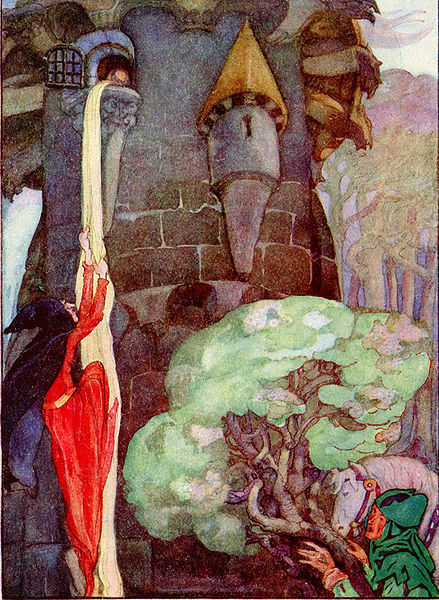
Rapunzel, the original "helicopter child": Anderson.


Things are probably getting worse for the young as a result. Besides abortion, consider, for example, the growing phenomenon of the “helicopter parent.” This is simply the Rapunzel story: the child is allowed no independent existence, but becomes an extension of the parent. With our growing requirements for education, children are also trapped in abusive families for far longer than they once were.

Allen Ginsberg kicked off the phenomenon of the “teenager,” and the Beat Generation, in the Fifties with the poem “Howl,” the central insight of which is that the sacrifice of children to Moloch has been resumed. Vietnam and the draft sharpened that impression. It has not dissipated since. Harry Potter, with its reboot of the motif of the evil step-parents, and Hunger Games, with its reboot of the motif of child sacrifice, have more recently struck that old archetypal chord in the young. Perhaps too, all those zombies and vampires, parts of very old folk tradition, but popular again currently, represent elders who see themselves as immortal. To remain immortal, a vampire must feed on the lifeblood of the young. A zombie simply refuses to die. But if he gets close, he will eat you, just like Saturn would.

And no, government is not a solution. Bad as some parents may be, setting up a government alternative is simply providing enjoyable civil service sinecures for all the worst zombies and vampires.


Sunday, March 08, 2015

Never Have So Many Owed So Much to Such a Fib


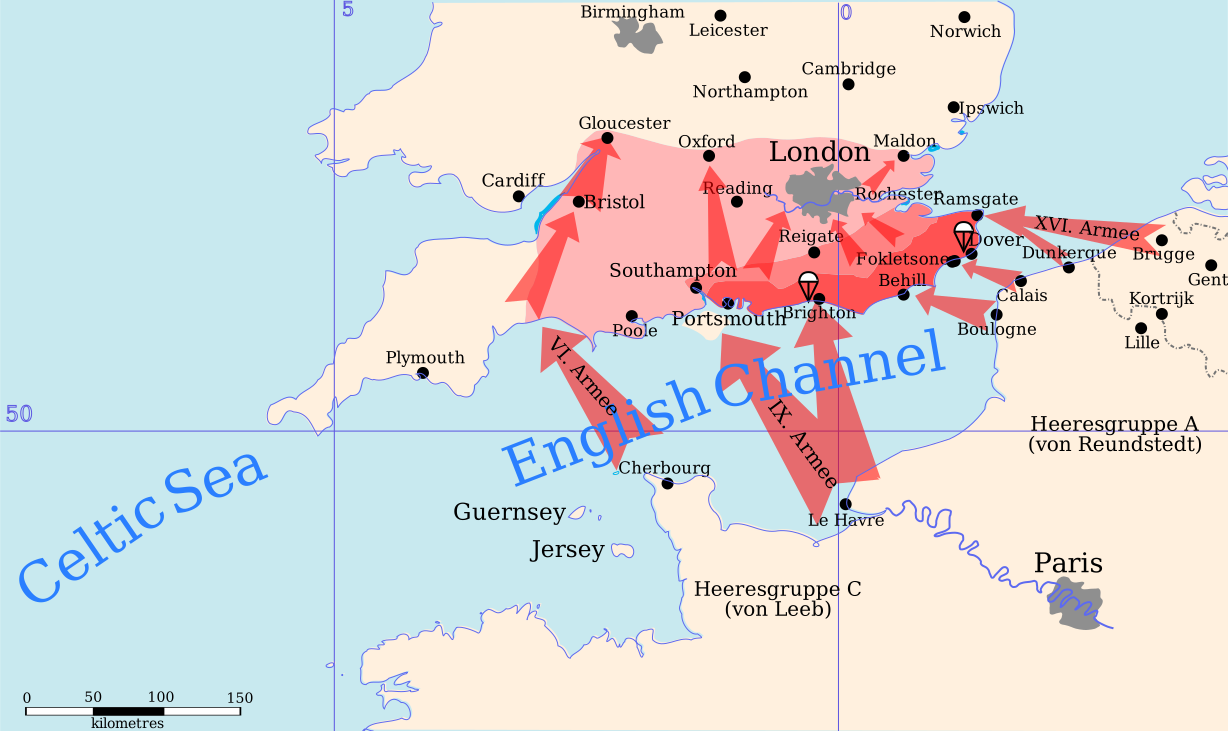
Map with scary-looking red arrows. Wikipedia.
I would have thought I knew just about all there was to know about the Second World War, from the grand strategic perspective. To my generation, the Baby Boom, it was the foundation myth, and so we devoured all we could about it.

But William Manchester and Paul Reid, in the recent final volume of their comprehensive biography of Winston Churchill, told me something I did not know.

It turns out that the Battle of Britain was not the big deal we thought it was. Win or lose, there was little practical possibility that the Nazis were going to land on British beaches at any point during the war.

It was the Royal Navy, not the RAF, that was crucial. The catastrophic blunder of Hitler in shifting to terror bombing was perfectly reasonable after all. The catastrophic failure of Goering to take out the RAF was no great failure after all; it hardly mattered. There was no real chance of the British government evacuating to Canada to carry on the fight.

The problem for the Germans was that they had virtually no surface fleet. Pile their troops into their quite limited sea transport, and they would in all probability have been blown out of the water by the vast strength of the Royal Navy as they bobbed in the Channel. Sure, air superiority would have helped, but it probably would not have helped enough. It was not a militarily viable option, and Churchill always understood this. His own notes referred to it all as the “invasion scare.”

The real danger was British complacency. Knowing they were secure behind their great moat, a right little, tight little island, the general population might have been happy to let the continent go hang, to avoid the bitter costs and suffering of a long war, and so to seek peace with the Nazis after the fall of France. Churchill, probably quite rightly, felt this would be a disastrous as well as an ignoble policy in the long run, a Munich writ larger by a factor of ten.

And so he spun a good story. One so good we have hung on to it ever since.

Friday, March 06, 2015

Leonard Cohen and the Death of Anglophone Montreal

Last Canadian Standing

An interesting piece in the New Yorker. I am probably reading this into it; but the article makes me think that the true impetus for Quebec's "Quiet Revolution" was envy of the vitality of English-speaking Montreal culture, back in the days of Cohen, Layton, Klein, Richler, Scott, MacLennan and Moore. Having nothing to compare with it, the Francophone elite sought to destroy it.

In doing so, they destroyed the best hope for a native English-Canadian culture, in the city of its ideological founder, D'Arcy McGee. Since then, we have had nothing but multiculturalism.

All your bases are belong to us, maudits Anglais!
The author of the New Yorker piece, a Montreal Jew, points out that the Montreal Jewish community never really fit in to the "two solitudes," being neither English nor French. He does not notice that the same was true, to an even greater extent, of the Montreal Irish, mostly English by language but Catholic by religion. Together, these two groups probably constituted the majority of "English Montreal" during this century, and they were certainly the perpetrators of the Montreal literary renaissance. The "Two Solitudes" were a myth.

It was not the English the Francos crushed in the Sixties and Seventies. It was the Canadians, trying to forge a new Canadian culture which combined the best of all the many local traditions.

Saturday, February 28, 2015

People of the Lie


Eve's temptation, as imagined by Gaugin.

We don't like to admit the very existence of human evil. We want to deny that hell exists, that the devil exists, or that anyone is bad to the marrowbone. We even hate those, like the Catholic Church, who remind us of the possibility of evil. This is strange, because the twentieth century can best be understood as a massive eruption of human evil: Hitler, Stalin, Mao, and their many imitators. There were no doubt genocides before the twentieth century, but they were rather rare. Now they are commonplace.

But we even have trouble accepting this overwhelmingly obvious fact. Just about everyone agrees that Hitler was evil; but probably only because he lost that big war, and got himself safely killed. In his day, he had a lot of ordinary Germans on his side. Stalin and Mao still have their admirers; Mao still has many. Feminism and abortion have killed and crushed more than either, yet it is highly controversial to say that they are evil. Someone has rightly said, that no bad government ever gets overthrown because it is evil; governments only get overthrown because they are incompetent.

The principal reason for this is an unspoken pact among us. If we deny the existence of evil, we get a free pass on our own actions. We need no longer worry about whether we have done right or wrong.

This is the verdict: Light has come into the world, but people loved darkness instead of light because their deeds were evil. Everyone who does evil hates the light, and will not come into the light for fear that their deeds will be exposed. -- John 3:19-20.
War in heaven: Bosch.
Some of this too, no doubt, is a natural fear reaction: speak of the devil, and he may appear. You don't want him to notice you, so you pretend not to notice him. It may not be terribly logical, but it is a typical human gambit: whistling past the graveyard.


Some too is the much less creditable hope that, by remaining silent, or even by cooperating, the evil will pass you by and turn their glance on someone else.

The man looked frantically round at the other prisoners, as though with some idea that he could put another victim in his own place. His eyes settled on the smashed face of the chinless man. He flung out a lean arm. 
‘That's the one you ought to be taking, not me!’ he shouted. ‘You didn't hear what he was saying after they bashed his face. Give me a chance and I'll tell you every word of it.He's the one that's against the Party, not me.’ The guards stepped forward. The man's voice rose to a shriek. ‘You didn't hear him!’ he repeated. ‘Something went wrong with the telescreen. He's the one you want. Take him, not me!’ - George Orwell, 1984.

Hence the Stockholm syndrome, the trusty kapo of the camps, the Uncle Tom. The now-famous Milgram experiment seems to prove that, confronted with a case of clear evil, most ordinary folks will willingly cooperate. Sixty-five percent of us, in fact, given the chance, will obey to the point of apparent murder. In other words, society is no protection against evil.

Adolf Hitler as the messiah.

Another discreditable but routine human reaction to evil is victim blaming. It is unfortunately reassuring to convince ourselves, whenever we see another suffering, that in some way they brought it upon themselves. This relieves us of the stress of fearing that the same thing might happen to us; and it relieves us of the moral responsibility of either helping them or risking standing up to evil. This is no doubt extremely helpful to the evil among us. It is also the underpinning of the doctrine of reincarnation endorsed throughout the east: if some poor wretch is being stabbed at your feet, it is no doubt because he tortured spiders in some past life. No call nor point in helping him out now.

So far, so bad. But then too, I suspect some of the problem with recognizing evil for evil comes from the fact that evil is by its very nature ambiguous. God created all things in this world. He created all things essentially good. Evil is therefore not a thing in itself, but only a relative absence of good: evil occurs when a greater good is sacrificed to a lesser (privatio boni). This so, it is always possible to point to some good in any evil. Without a decent sense of proportion, therefore, the very distinction between good and evil can casually be lost. This is what we see in “moral equivalence,” for example. Every evil person can give some sort of justification, some superficially plausible rationalization, for every evil deed, to himself or herself or to others.

Another complicating issue is the Christian belief in the universal availability of salvation. God also created every person. He created no one evil, and no one to be damned. Salvation is available to everyone, even the utterly wickedest of us, given that we repent. So in this sense it is wrong to characterize anyone as “evil.” Their nature is good, for they were created good, and may still return to goodness. Their deeds are evil.

Still, the Bible does speak of sheep and goats. Hell is there for someone. At least at the point of death, some of us will have indeed become irredeemable, and there will no longer be any walking anything back. In fact, understanding evil seems to be one of the keys to the New Testament. There, Jesus and John the Baptist don't appear to hold back much in describing the scribes and Pharisees as evil in so many words. They are called “full of hypocrisy and wickedness,” and asked “How will you escape being condemned to hell?” Jesus blames them for “All the righteous blood that has been shed on earth,” and tells them “you do not enter the kingdom of heaven.” They are introduced as “children of hell” (Matthew 23:13). Not a sterling example of “gentle Jesus, meek and mild.” Denying evil, despite much propaganda by non-Christians and anti-Christians, is not a Christian virtue.

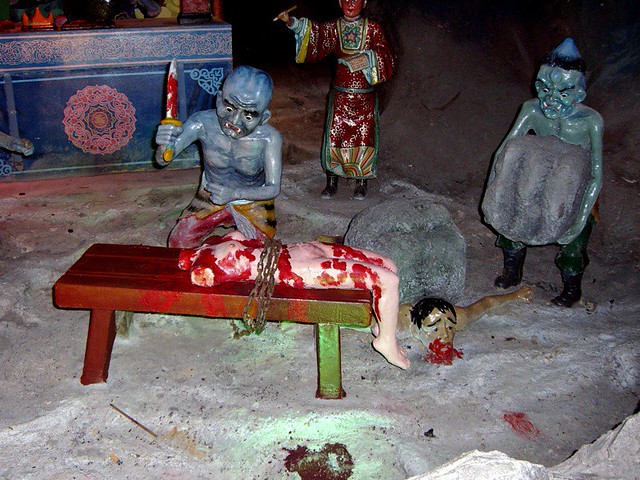
One of the Buddhist hells, in which the permanently evil torture mere ordinary sinners. Tiger Balm Gardens, Singapore.

So, God's truth, there does seem to be an identifiable group or class of people in the world who are rightly described as the bad guys. And it may only be cowardice or duplicity that keeps us from plainly seeing and saying it.

I have recently been reading the book People of the Lie, by M. Scott Peck. Peck, a psychiatrist and a Christian, argues that we need to accept the psychiatric reality of evil, as we do with other psychiatric diagnoses, so that we can study it. So someone can be diagnosed as “evil” in the same sense someone else can be “schizophrenic” or “depressed.”

I have problems with this approach, but that would, at present, be a tangent. The point is that he, as a psychiatrist, claims to encounter genuine evil regularly. If it is not a psychiatric diagnosis, it is the cause of many psychiatric diagnoses in others—its victims.

Mao Zedong as centre of the universe.

Peck does not give his own clear diagnostic criteria, so far as I can see, but he does make a distinction between those who are evil and those who are merely sinners. We are all, of course, sinners. He says that “evil people,” “people of the lie,” are distinct in the consistency of their evil. It is as if they have at some point, like Faust of legend, made a pact with the devil. They have made up their mind, whenever there is a conflict, to follow their own self-interest in preference to their conscience.

This does not, according to Peck, usually produce obvious and dramatic results. We are not talking here about serial killers. Perhaps the only person who consistently sees such cases, and sees them clearly, is the psychiatrist, through meeting their victims. Because the truly evil rarely end up in prison.

Most folks behind bars, Peck says, are merely mentally ill; while the truly evil are seen by others on the whole as good, upstanding citizens. This surely stands to reason. An evil person is a person who puts his or her own self-interest or personal desires above all else. It is in nobody's obvious self-interest to go to prison, or to be identified publicly as a criminal. Accordingly, anyone who is both evil and in prison must be significantly incompetent at being evil—of quite low intelligence. Most will have ended up there not because they are evil, but either because they are self-destructive or have been put in some desperate situation.

And should it be any surprise that this is just what the New Testament suggests as well? Without saying that their crimes are okay, the New Testament, and Jesus, make a point of never condemning criminals as criminals, as Jesus refuses to condemn the woman taken in adultery. Indeed, Jesus himself is executed as a common criminal; what could be a clearer statement of solidarity than that? The thief crucified next to him is also pointedly identified as good, indeed a saint, ready for heaven instantly, with time served, with no intermediate stop in purgatory. As if the point were not already made, at the very moment that Jesus insists that some people are good, sheep, and some people are bad, goats, he implies that those in prison are not among the goats. Jesus says that any man we might visit in prison is in some sense Jesus himself; and it is by visiting them that we show ourselves to be of his flock of sheep (Matthew 25).

Instead, according to both the Bible and Dr. Peck, the truly evil are to be found among the most “respectable” classes, those who are generally thought well of by society as a whole. The leaders, the city fathers. And this stands to reason. Thinking only of what is best for themselves, and holding that they are intrinsically wonderful, the truly evil are going to do what they can to amass both prestige and power over others. The devil, as they say, is a gentleman.

Jesus makes this point by describing them, as a class, as “hypocrites,” a term used in the original Greek to refer, among other things, to actors. They are people playing a social role, who are the opposite of the way they appear, “whited sepulchers.” Peck makes the same point by calling them “people of the lie.” They are probably not going to break any laws, and they are not going to attack anyone from the front. It will be the knife in the back, the sly manipulation, the short-of-criminal con. It will be hate disguised as love, evil disguised as righteousness, selfishness disguised as selflessness, black disguised as white. The lie must be their basic tool; this no doubt is why Satan is called “the father of lies.”

Satan's own sin, the fundamental sin of all sins, was to imagine himself as God. This is the archetype of evil: the ego elevates itself to godhood, imagines itself the true and proper centre of the universe. It is Adam and Eve's sin in turn: they ate the apple not just in disobedience to God and their conscience, but that “they might become as gods” themselves. Every evil person is a little self-proclaimed idol. (In this context, it is both telling and frightening that it is commonplace now for women of the feminist persuasion to refer to themselves as “goddesses”). This distinguishes him or her from the general run of sinners, who often will go against their conscience for their own self-interest, but will tacitly recognize the wrongfullness of this, later surrender to their guilt, and repent. In the end, most of us accept that other people have the same abstract rights as we do. The evil do not accept this to be so. Other people are things, put there for their benefit.

Atheists will here object that they are perfectly capable of being moral people without believing in
God, much less bowing the knee to him. And that is true, if by this they mean the traditional depiction of the Judeo-Christian God specifically. But in philosophical terms, bowing to God is the equivalent to bowing to the reality of objective truth and objective justice, objective right and wrong—which even the pagan Greeks would have recognized, as Dike. God is this personified: the Good, the True, and the Beautiful. As AA puts it, “A power greater than ourselves, however we might conceive it.”

Faust plays chess with Mephistopheles.


The next point is that this violation of the first great commandment, to love God (or justice) with your whole heart, leads automatically to the violation of the second, to love your neighbour as yourself. Satan's rebellion against God led him to seek harm to Eve and her children as well. Adam and Eve's transgression led in turn to the second great sin of Genesis, Cain's killing of his brother. When you reject God, or truth, you reject your fellow man as well. You begin to actively do harm. This is because truth as moral centre is automatically replaced by ego as moral centre.

Peck explains this as a need to scapegoat. In an effort to quell the voice of their own conscience, the actively evil need to project their sins onto someone else, and punish them, in order to feel righteous. So Satan stands in as “the accuser,” in for instance the Book of Job, justifying himself as a kind of prosecuting attorney ferreting out evil in us mortals, and supposedly punishing it in hell. This is also ther type of the scribe or Pharisee in the New Testament, who stand as judges over the people, laying additional burdens on them and making no effort to help. This is the universal bully. In practice, it can become sadism, deliberate cruelty.

We see this in history. It is said that those who sought to avoid the evil attentions of Vlad the Impaler were obliged to praise him as the “scourge of God,” doing God's work in ferreting out and punishing evildoers. That was how he wanted to see himself; and, since we all have some tendencies to evil, this ruse can always work. Idi Amin's system was to have one prisoner beat another to death, and then to ask a third prisoner to beat the second prisoner to death for this crime, and so on. By doing so, he kept his own conscience, presumably, clear. Each man was being executed justly in turn, for he had given in to temptation in hopes of saving his own life. As the evildoer's conscience becomes more and more insistent in telling him that he has done somthing wrong, he becomes more and more active in seeking and punishing scapegoats to alleviate his own guilt. Put him or in a position of supreme power, and the result will be a holocaust.

But this notion of scapegoating is not the whole story, surely. It is not clearly what happens in the story of Cain and Abel, which suggests that it is not the true, primordial genesis of brother-on-brother evil. Here, the problem is simply and clearly that Cain perceives God as liking his brother more. 

The scapegoat.

This too makes good sense. If an individual ego has made up its mind that it is and ought to be sovereign, any demonstration of any kind of attention given to or superiority shown by another being, however inadvertent, is a direct challenge to and attack on that sovereignty. It is, within this distorted view, itself satanic; it is an act of rebellion against the rightful God, who is, of course, John Doe. So the evil person can feel justified in doing any act of harm to another whom he or she considers a threat to his cosmic supremacy.

This is indeed what led to the crucifixion of Jesus the Christ. The keepers of the law could not tolerate the direct appearance of God himself, for it threatened their own authority. God himself was rebelling against them. He had to and in some twisted sense deserved to be put to death.

So too in Cain's deed, he is demanding that God, not just Abel, submit to his will. 

Cain and Abel, by Durer.

As with the Nazis and the Jews. Let's be honest: the real source of the Jews' problems was (and is) that they were too genuinely impressive in their accomplishments. There was certainly scapegoating too, but this original sin led to their choice as a scapegoat.

Put these two factors together, scapegoating and envy of the good, and you have a truly demonic force. You have a human wrecking machine.

You have the people of the lie. And we need to understand that they walk among us. We are sheep among ravening wolves, as Jesus said.

Saturday, January 31, 2015

The State of the US Race for 2016


It may not be too soon to say that Jeb Bush will be the Republican nominee in 2016. I'd say he is now the odds-on favourite.

Romney has pulled out. He saw little breathing room for his candidacy. That means the Republican establishment is closing ranks. They have made their choice, on the traditional basis: it's Bush's turn. Romney has “had his chance,” and Bush is old enough that he is unlikely to get another. Other candidates are young enough that they will.

The Republican establishment, the professionals, almost always get their way in the end.

Christie will probably stay in as an establishment backup in case Bush stumbles. Huckabee will probably hold down the Christian right, Ted Cruz or perhaps Rick Perry the Tea Party, Rand Paul the Libertarian wing, assuming they all go in, all able to make good showings. But with the planned big bang in the South very early on, there probably will not be time for the rest of the field to shake out quickly enough to leave a clear alternative to Bush, until the nomination is all but locked up.

In the meantime, word is that Hillary Clinton's numbers are starting to fall rapidly. This was predictable. In fact, I predicted it here. She was riding high on sheer name recognition, with people not yet focused on the race. Now that the race has tentatively begun, with Jeb Bush virtually in, people are beginning to pay attention and to look around.

Monday, January 19, 2015

A Christian Revival in Europe?


A writer living in Paris claims he sees early signs of a Christian revival: the churches in that city are now, he says, SRO.

Purely anecdotal, but I would not be surprised. In fact, I am surprised it has not happened already.

A lot of commentators, especially on the left, argue that with increasing prosperity and development, religious faith inevitably wanes. And there is something, no doubt, to that: blessed are the poor. But America has for a long time shown itself to be much more religious than Europe, and America is also more developed and prosperous, on the whole, that Europe; so that cannot be the only factor.

Christianity is currently under attack, in direct religious terms: on the one side from militant Islamism, massacring the Christians of the Middle East, and on the other from militant atheists, questioning traditional religious rights. It would be very strange if there were not, in response, a large-scale rallying to the cross.

And if this giant wakes—its current attackers would be dwarfed by it. It would immediately become the single most significant factor. There are simply a lot more Christians in the world than either atheists or Muslims.

It is quite likely to happen.

It would be a very good thing. It would be the revival of Europe and the West; it would be a matter of rediscovering their raison d'etre, their meaning and purpose. Christianity is the rock upon which Western civilization is built. Anything not built on the slopes or on the pinnacle of that rock is built only to be washed away.

Sunday, January 18, 2015

At the Post

Mr. Charisma.
Things are happening early and fast in the US Republican 2016 field. A number of hands seem to have been forced by Jeb Bush's pretty definite signs he is in. Others now need to move to prevent him from locking up an insurmountable lead among donors and operatives.

As previously noted in this space, Mike Huckabee and Mitt Romney promptly signalled they are in. Both are, as is the way, immediately being attacked as entirely unsuitable candidates. This is an indication of just what strong candidates they really are. If they were not genuinely potential nominees, nobody would care this early. Now we've seen Bobby Jindal signal that he is in, and Paul Ryan that he is out.

Ryan: It makes sense for Ryan to stay out this time. He would have been a second-bet establishment candidate, in case first-bet Bush bumbled. With Romney in, that position is now filled. He has no regional base if Scott Walker, from his own home state, comes in. Most importantly, he is young; establishment donors would feel int is “not his turn,” and he can indeed afford to wait. A weak third-string bid this time would only damage his future chances.

Jindal: Jindal has a snowball's chance in Louisiana of winning. He has been an extremely good governor, and deserves the exposure. But he has first call on no obvious party constituency. Nor does he have the sort of charisma that might allow a dark-horse candidacy to catch fire. My guess is that he will get funding and backing from Republicans who want to see a display of the party's diversity in the race. He will be given enough to make a decent show, but is really running for vice president or the cabinet. That is why his recent foreign policy speech sounded tough: that is the role of the bottom of the ticket, to talk tough and rally the base. To speak loudly and carry a small stick.

Friday, January 16, 2015

Charlie Hebdo or the Terrorists: Choose One

Trust me: this Kool-Aid, you don't want to drink.

Most of the discussion of the recent Charlie Hebdo massacre seems to be caught inside a particularly terrible fallacy of the false alternative: either Charlie Hebdo is in the right, in publishing their satiric cartoons, or the Islamist terrorists were, in shooting them all dead. The Pope's recent remarks, that insulting someone's religion is like insulting someone's mother, ought to have been helpful. But it seems the Vatican had to follow up by patiently explaining that this did not mean he was endorsing murder as the proper response to bad manners.

Is that clear enough? It was pure evil to shoot the cartoonists of Charlie Hebdo, let lone the random customers of a kosher supermarket. On the other hand, Charlie Hebdo was and is a disreputalbe publication nobody should want to glorify. I say that even as someone who despises Canada's “hate laws” as an intolerable intrusion on freedom of speech. If the French government, or any government, sought to ban cartoons showing the dangly bits of a prophet who shall not be named, say, or art showing Jesus in a jar of urine, this could probably be justified as a matter of public peace, and could easily be done without infringing on freedom of speech. The matter is parallel to laws against pornography: this too is not a free speech issue. In fact, such things are barriers to freedom of speech, which perhaps are in the public interest to remove.

The classic defense of freedom of speech in its most extreme form is John Stuart Mill's On Liberty. And he does not shy away from the topic of religion specifically. In fact, he takes it as his example, to show that religious beliefs are not exempt. We cannot know the truth of anything without full presentation of all relevant arguments and evidence. To have all the evidence is most especially important in the case of the most especially important truths, which would be religious truths. Therefore, there must be open and unrestricted religious discussion, without any censorship of anyone's arguments or opinions.

And I agee absolutely with John Stuart Mill. This makes me a radical advocate of freedom of speech, a libertarian on this issue in current political parlance. But note that Mill is speaking of “arguments,” “evidence,” and “opinions.” Pornography, for example, is none of these; no democratic discussion is curtailed, no possible truth is suppressed, no freedom of speech is impeded, if a government passes laws against public indecency. Contrary to common current belief.

Surely simple insults against others' religions or religious opinions fall into a similar category. They are not in themselves arguments, evidence, or opinions. They are just provocations, as the Pope says, like saying "your mother wear army boots."

Unfortunately, Charlie Hebdo seems generally to fall into this latter category. Just provocations; just insults.

Personal insults do not advance a good debate. Instead, they tend to poison the well, so that any real debate gets derailed and forgotten. You might have seen this yourself online: the notorious “flame war” phenomenon. As a result, all the world's parliamentary systems, with the apparent (and perhaps here significant) exception of some in La francophonie, have the established tradition of prohibiting “unparliamentary language,” words one is not permitted to say in a debate. These things are generally personal insults, and they are considered beyond the pale even though the regular laws or libel and slander are suspended.

In Westminster, for example, you cannot call your opponent a blackguard, a coward, a git, a guttersnipe, or a hooligan. You cannot say he is a sod, or slimy, or a wart. In Wales, you may not refer to the Queen as “Mrs. Windsor.” In Dublin, you may not call another honourable member a brat, a buffoon, a corner boy, a scurrilous speaker, or a yahoo. In New Delhi, you must not say he is a bad man, a bandicoot, a goonda, or a rat. In Hong Kong, you must not tell him to “stumble in the street,” or call his speech “foul grass growing out of a foul ditch.” In Ottawa, where we are especially sensitive to such things, you must not call him a parliamentary pugilist, say he is inspired by forty-rod whiskey, that he has come into the world by accident, is a dim-witted saboteur, a trained seal, or "the political sewer pipe from Carleton County." "Fuddle duddle," whatever it means, is also not allowed. In New Zealand, where they are less sensitive, you will nevertheless be ejected from the chamber for calling your worthy opponent's last comment “the idle vapourings of a mind diseased,” noting that “his brains could revolve inside a peanut shell for a thousand years without touching the sides,” or observing that he seems to have “the energy of a tired snail returning home from a funeral.”

It is easy to see, I think, that deliberate insults slung at someone revered by others for religious reasons could and perhaps should be treated in the same way in the public square, and could be prohibited without in any way interfering with honest debate, including debate over the truth of religions. An insult to Mohammed is not a legitimate comment on the teachings of Islam. It is ad hominem, irrelevant, and unworthy of the right honourable member.

It should go without saying that any such law or rule should apply equally in the case of all recognized religions.

Does saying this mean I believe you have the right to kill people who insult you or your religion?

Er, no. I'm also against killings in the House of Commons, actually.

Neither does it justify the hateful Canadian “Hate Laws,” which do indeed criminalize the statement of specific opinions or the mention of well-known facts. Nor does it justify European laws against “Holocaust denial,” and similar matters, like the current mad case that it is illegal in Turkey to say that the killings of Armenians in Turkey in the early 20th century was a genocide, and it is illegal in France to say it wasn't. These laws, by contrast, clearly violate John Stuart Mill's concept of freedom of speech. 

But an insult is not an opinion, and established parliamentary practice makes it fairly clear that the distinction can be made consistently.

Sunday, January 11, 2015

Mother Theresa As You've Never Seen Her


At age 18.

Funny thing about saints. They seem invariably to be quite good-looking people.

Curses My Grandfather Taught Me


Gerald Vanluven Roney

My grandfather died when I was 11 or 12. I wish I could have known him better.

He had the Irish reverence for words and wordplay. His specialty was making up colourful mock curses. Here are the ones I remember:

"Wouldn't that just rot your socks!"

"Hell's bells and panther tracks! Dirty old man with a busted crutch!"

"A pox on you!"

"Liars, cheats and thieves!"

My father reminds me that whenever asked where something was, it was "down cellar behind the axe."

He also had his own wise sayings. One was "God hates a quitter."

I cherish these words; they give such a picture of the man. He was one of nature's poets.

Thursday, January 08, 2015

Who Shot Charlie Hebdo?


With the current attacks in Paris, perhaps it is time again to make clear what exactly “religious fundamentalism” is all about. It is not the same as “religious extremism.” In fact, it is the opposite. The Christian religious extremists are all in monasteries. In Judaism, they are opposed to the existence of the State of Israel. In Islam, they are in the mosques, not in the streets.

“Religious fundamentalism” is real enough, and it is identifiable currently in Christianity, Islam, Judaism, and Hinduism. But it is a rather new thing. The term originally refers to a movement in US Protestantism that arose only in the early 20th century, which insisted on a strictly literal reading of the Bible. Precursors can be traced as far back as the late 19th century. Before that, importantly, nobody ever thought to read the Bible literally.

The term has since been applied as well to Islamic movements. I think fairly—the salient feature, a strictly literalist treading of the Quran and Hadith, is again the font from which all else flows. Including a strictly literal reading of the term “jihad.” Again, this movement appeared in the late 19th century, not before, and has grown in influence especially in recent decades.

In Hinduism, the same approach can be traced back to 1923. Roughly the same time. And it too is growing in recent years.

Now, why did this movement/these movements suddenly appear? What changed? What else has been growing at the same time? Simple answer: social science and scientism, i.e., the idea that the principles and techniques of science can be applied to all aspects of human life. Not coincidentally, Nazism and Communism arose at this same time and from this same concept: the application of scientific principles to human society and government.

Religious fundamentalism is, quite simply, the attempted application of the principles and techniques of science to religious texts and beliefs. It has, therefore, more to do with science than it does with religion. There is a reason why so many of the known terrorists and suicide bombers, notably including Osama Bin Laden, trained as engineers or medical personnel. And had not formally studied religion, or  been known previously to be devout. They weren't, and they aren't. Science is unrelentingly literalist in its approach to the world: what appears is what is, and there is nothing more behind it. Read the Bible or the Quran as if it were a science text, and you get fundamentalism.

This is less of a problem in Christianity than it is in Islam (or in Judaism), because even the literal reading of the specifically Christian texts is pretty non-violent. But it is important to understand what is happening.

The worst possible thing to do to end the current troubles with terrorism would be to blame it on “Islam” or on “religion.” It would make more sense to blame it on science, but that is not particularly helpful either. "Scientism," the elevation of science to the status of a religion, is the problem ,and should be aggressively fought. Next to that, the best solution is to ensure that everyone is better grounded in their given religious tradition.

Wednesday, January 07, 2015

Six Reasons Religion May Do More Harm Than Good


Notorious troublemaker.

An atheist friend has linked the following piece to his Facebook feed:

http://www.salon.com/2014/11/17/6_reasons_why_religion_does_more_harm_than_good_partner/

I'd like to respond, point by point.

1. Religion promotes tribalism.

Anything designed to bring people together—families, neighbourhoods, languages, telephones, governments, religions, Rotary Clubs—also, as a secondary effect, drives them apart. That is, those who are not part of the group are by its very existence more distinctly separate. But this is a secondary effect. Would the world be better if all such organizations were abolished? Pretty obviously not. Nasty, brutish, and short are the words that come to mind. And it makes no sense to single out religion here, except that it is the one organization that most reliably promotes the idea of the brotherhood of all.

Arguably, the presence of this undesirable secondary effect means we should strive to belong to the largest possible such organizations, since the larger they are, the more people they include and the fewer they exclude. We should have larger families, promote international organizations, and so forth. So, welcome to the Catholic Church, by most measures the world’s largest organization of any kind.

2. Religion anchors believers to the Iron Age.

This unchanging element of religion would be a concern if either truth or morality changed over time. But a truth that changes over time is never really true, and cannot ever be relied or built upon. If tomorrow, one plus one should suddenly equal seven, a lot of things would fall apart. Science, for one; bridges, for another. In the same way, morality that changes over time is no morality: if it is possible that tomorrow, murder may become the most moral of acts, then murder is not really immoral even now.

Of course, while truth cannot change, circumstances do. Religions understand this. This is why lending money at interest is no longer considered usury: because falling into unpayable debt no longer results in slavery or life in prison. And this is why to Catholics capital punishment is no longer justified: prison systems and better policing are now capable of dissuading and preventing further murders.

That religions retain some elements from as far back as the Iron Age is not a problem. God forbid we should respect our ancestors? Should we really assume they were wrong about everything? But it would be absolutely discrediting if religions retained nothing in terms of faith or morals from even as recently as the Iron Age. If that were so, we would have to presume that everything they teach now would similarly be obsolete a couple of millennia from now. Leaving no known truth.

Gullible believer.


3. Religion makes a virtue out of faith.

The piece acknowledges that “faith” in the religious sense means “trust.” It is troublesome, therefore, that it nevertheless holds that trust is a bad thing. It may not be cunning to trust; it may not always be in one’s self-interest. But if morality was always in one’s own self-interest, there would be no morality to it. If we did not trust one another to a reasonable extent, society would collapse. The more we trust one another, the more peaceful and prosperous society becomes. We therefore owe it to the general welfare to trust one another. Let alone God, who is self-evidently worthy of it.

4. Religion diverts generous impulses and good intentions.

This claim is tautological, because it makes sense only if you assume that religion itself is worthless; which is what it purports to demonstrate. If religion has value, contributions to religion have value. But it also relies on the fallacy of the false alternative: that people must give either to religion or to secular charities, and cannot give to both. In fact, studies show that the religious give more to both religions and to other charities than the non-religious. This is no doubt due to the fact that religions preach charity.

5. Religion teaches helplessness.

This is tautological in the same way: it can only be maintained on the assumption that God does not exist. If he does exist, it is only rational to rely on him. Only if he does not exist is the point arguable.

But even if he does not, the case for human self-reliance does not look all that good in practice. This rap against religion is the classic Marxist one, and the various Marxist attempts to improve the human condition by main force do not make a good impression. So too in personal life: one is reminded of the first three of AA’s twelve steps:

  1. We admitted we were powerless over alcohol—that our lives had become unmanageable.
  2. We came to believe that a power greater than ourselves could restore us to sanity.
  3. We made a decision to turn our will and our lives over to the care of God as we understood Him.
Power-mad tyrant.

6. Religions seek power.

What sort of power? The power of persuasion? Religions are voluntary associations; they cannot legally compel their members, much less anyone else, to do anything. You don’t like what you hear, you are always free to walk out that door. Nobody can stop you.

If you are worried about organizations seeking power, limit them all to the same rules religions live by.


Sunday, January 04, 2015

The State of the Race


Okay, now Mike Huckabee is in. Should be formidable. He has the strongest claim on the evangelical right, with growth potential because of his geniality and charisma. Kills Santorum’s chances, though.

Strongest candidates based on my idea that you need a faction behind you:

Jeb Bush has the establishment/party pros behind him.

Rand Paul has the libertarians.

Ted Cruz has the best claim on the Tea Party populists.

Mike Huckabee should pull the religious right.

There is room for one or two more establishment candidates, in case Jeb stumbles: Chris Christie, Mitt Romney if he decides to come in. Romney would have a real shot at it, running to the right of Bush. Paul Ryan or Scott Walker could probably mount a credible challenge in Iowa, and hope to snowball from there.

Carly Fiorina looks like she is going to come in on the strength of being a female, and Ben Carson on the strength of being black. People will bankroll them just to keep this diversity in the race, and there is always the possibility of lightning striking.

Can't see an opening for Rick Perry, Marco Rubio, or Bobby Jindal. Cruz takes Perry's oxygen, Bush and Cruz take Rubio's. Jindal has no natural constituency.

Edge to Jeb Bush, because the Republican establishment almost always gets its way, but there's many a slip.

None of it matters much. Some people follow baseball. I follow US politics.

Perhaps the more interesting race is on the Democratic side. In their hearts, I believe Democrats do not want to vote for Hillary Clinton. It would be just too boring. On the other hand, no plausible and motivating alternative has emerged yet.

Elizabeth Warren? She looks and sounds too much like Hillary to galvanize, even if her politics are different.

My best guess so far is Al Franken. He has some gimmick appeal: he would be the first Jewish president, after all.