Playing the Indian Card

Showing posts with label World War II. Show all posts

Friday, April 05, 2019

Alternative Histories of the Awful 20th Century


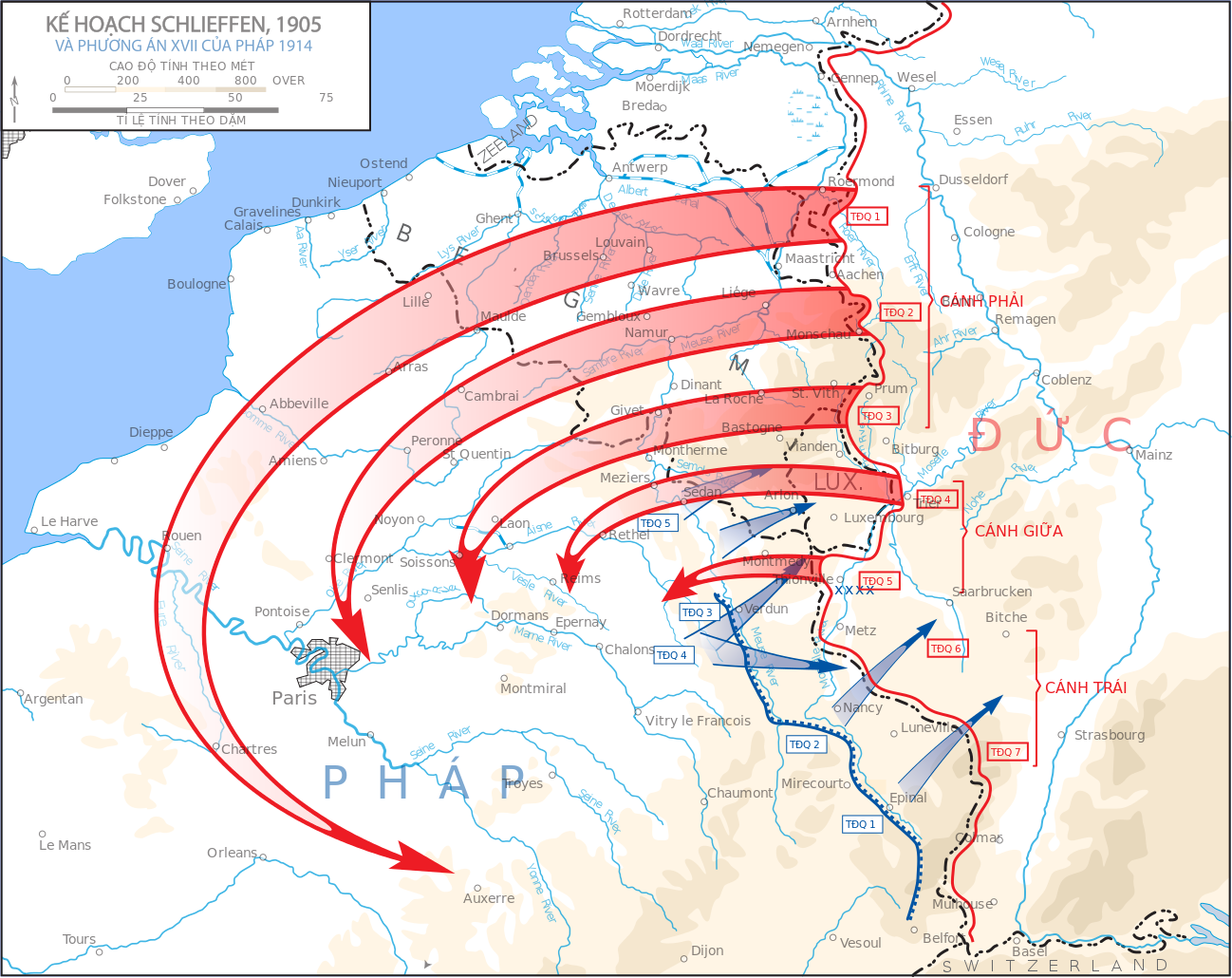
The way the German war plan looked on paper.

Germany really might have won the First World War.

Looking back on events of world history, we get a sense of inevitability. We forget they were not inevitable at the time.

This is important because, had Germany won, it would have been disastrous for civilization. That they did not suggests the awful hand of God.

Note first that, unambiguously, despite attempts at revisionism, Germany provoked the war.

Countries and governments do not start wars they think they are going to lose.

Germany had good prospects, on paper, of winning.

They failed primarily because of one miscalculation. Nobody understood how the current battlefield technology favoured the defense.

Had they seen this, Germany’s grand strategy for war probably should have been the opposite of what it was.

Their plan, the famous Schlieffen Plan, was to quickly overrun France before Russia could fully mobilize, then pivot and take on Russia.

Were it not for the advantages held by defense, they would have quickly been in Paris, and it would have gone as foreseen. As it was, it was a close-run thing. And even with the failure of this initial drive, even up to mid-1918, it looked as though Germany might win anyway.

They should instead have set up a defensive screen on the French border, and concentrated their main forces quickly against Russia, taking as much ground as they could before the latter could fully mobilize. 

The French war plan: Plan 17.

Given the advantages on defense, such a relatively thin grey line in the West could probably have held. Let France beat its head against this Western Wall, and they only grow weaker as Germany grows stronger, taking the higher casualties with a smaller population. By not invading Belgium to bypass the French defenses, Germany could well have avoided getting both Belgium and Britain into the war, and, with Britain, Canada, Australia, India, South Africa, and Britain’s allies Portugal and Japan, all significant factors. They would not have had to pursue unrestricted submarine warfare, and so the US would also probably have stayed out. Bundle that together, and they would have faced, throughout the war, less than half the forces and less than a third the industrial capacity that they did in the event. That alone sounds like enough for a win. Without Britain in, it seems dubious, in turn, that Italy would have come in on the Entente side. They would more likely have seen an opportunity in joining their treaty allies, Austria and Germany, and seeking their spoils in French North Africa, Nice, Savoy, and Corsica.

Germany would also have avoided the British blockade, which may have done more than anything else to hand them defeat.

Moving east instead of west, Germany would have had the advantage of fighting through lands and peoples unhappily subject to Russia, Poland, the Ukraine, Byelorussia, the Baltic States, who would probably welcome them as liberators. Set them up as friendly governments as they passed through, and Germany would have been able to marshal their populations and industries in their war effort against the rest of the Russian Empire—and perhaps, later, France. Subsequent events have shown us that the Russian regime’s hold on power was fatally shaky; with a good sharp knock at the very start, the Russian Revolution might have come years earlier, taking Russia out of the war.

In the meantime, an early focus on Russia would have taken pressure off Germany’s weaker Austrian chum. Without England in, the Ottomans could have concentrated on the Caucasus, increasing the pressure on the Czar. Serbia might have been cordoned off at the start, relying again on the supremacy of defense. With Russia out, Italy not in, and belligerent Bulgaria joining the Central Powers for their main chance, Serbia could be taken out at leisure later.

With Russia and with Serbia erased, France might have seen the inevitable and sued for peace. If not, Germany might have wrought more havoc by teaming with Italy in North Africa, and blowing out all the French African colonies. And a later full bore frontal assault on the French border should have worked too, given the single front, if they felt it was worth the cost.

I think there was an outside chance Hitler could have won the Second World War as well. Just an outside chance, if things had fallen out differently, and just right, or, better put, just wrong. The critical issue was oil; Germany didn’t have it.

But consider if Franco’s Spain and Ataturk’s Turkey had come in on the Axis side at the start. It would have made ideological sense; Franco was in power thanks to the Fascists, and Ataturk was a model for them. Franco, they say, was afraid of British naval power staging a landing on his coast. Fair enough; but then, the same concern should have applied to Vichy Morocco and North Africa. Did not happen, until the Americans joined the war.

With Franco in, to begin, the Germans get to grab Gibraltar. They seal the Mediterranean at that end. Malta starves, Rommel and Italy get a free hand in North Africa, with which they might well take the other end of that inland sea, the Suez Canal. That sucks if you’re England and need to keep up communications with India, Australia, and the East.

In the meantime, with Turkey in, the Axis is already at the threshold of the oilfields of the Caucasus—they already have the stretch of terrain they fought so hard over two years to Stalingrad to get. Their new jumping-off point is their previous endgame. And the oil fields of Iraq are even closer, just to the south over low, tank-friendly terrain. Germany not only easily takes them, but thus takes them away from the Royal Navy. Without ever even having to attack Russia.

I think Germany would have been doomed anyway. The US was not going to just sit there for all of this, and I think the Nazi economic model was a Ponzi scheme that had to collapse without constant conquest. But it could have been so much worse than it was.


Friday, March 20, 2015

Why Pearl Harbor Never Happened


December 7, Hawaii: a nip in the air.

I have more than once heard the complaint made against Japan that they have never taken responsibility for their aggression in World War II. Instead, bizarrely, it is said, they see themselves as a victim.

They are never going to take responsibility. This is because, by their own rules, they really were the victim.

Newcomers to Korea are commonly warned by old hands of what they must do if they ever get into a fight. The rules are not what a European or a North American would expect. If there is any kind of altercation, and the police are called, they are not interested in who started it. That is not relevant. The victim is whoever is most bloodied, and whoever gets out of the fight in better shape will be convicted as the aggressor, as a matter of course.

This makes good sense. It is often impossible to determine who really "started it." Is it the person who took the first blow? But then, what if they were provoked verbally? What if they were seeking revenge for their brother's beating a year ago? Why is there any special significance to the first physical blow? It is a very difficult thing to justly decide.

On the other hand, nobody gets into a fight in order to get beaten up.

Demonstrably, this works pretty well to prevent fights in the street: you cannot win in such a fight. There is a reason why the overal level of violence in Far Eastern societies is low.

So, as a point of Far Eastern law and common moral perception, whoever wins a fight is the guilty party, their guilt increasing with the decisiveness with which they win.

This of course runs counter to the Calvinist, and to some extent the Christian, assumptions on which the West and the US operate, which hold that, God intervening on the side of right, the good guys will normally win any fight.

Remove that assumption, and it is easy to see it all through Oriental eyes.


Wednesday, June 27, 2012

How Hitler Lost the War


You will forgive me, I hope, for yet another post on the Second Word War. Yes, I know it's over. But for my generation, the Baby Boomers, the Second Word War was like a creation myth. With Hitler as Satan and Churchill as St. Michael the Archangel.

This blog has argued in the past that Hitler could not, as some have suggested, have won the war had he concentrated his forces in North Africa to take out the British Empire—grabbing the Suez Canal and the British oilfields in Iraq by land. This would have left Hitler's supply lines too long and too exposed to attack by a sea power. He never could have made it.

Unless... with diplomacy, there could have been a way. Briefly, after the blitzkrieg had taken out France in the Spring of 1940. Imagine if Hitler had persuaded Spain and Turkey to join the Axis at that point, as he had persuaded Italy. Why not? Both had governments that were ideologically at least semi-Fascist. Turkey had been at Germany's side in the first war, had historic German sympathies and a desire for a counterbalance to neighbouring Russia. Spain wanted Gibraltar; Turkey had every reason to seek recovery of those Iraqi oilfields, taken from her in the first war.

Hypothetical map of Axis in 1940. Red: full Axis members. Pink: Axis influence or control.


Suez is gravy. If, on its own or with the help of German troops, Spain had managed to take Gibraltar by land or air, the British Navy would have been cut off from the Mediterranean on the west side. Malta would then have been a bit of a sitting duck in its turn. This might have been enough, combined with Italian naval strength, to have made it feasible to supply German troops from Libya as far as the Suez canal—cutting off Britain's other entrance, and turning the Mediterranean into a safe, sealed Axis lake. No danger to Axis supply lines running though it. In the meantime, a problem for Britain maintaining its supply lines east of Aden. Had Hitler been able to convince Petain too to join the fight, the weight of the Vichy French Navy, along with Italy's and Spain's, could have made the matter certain. The Med could have become a wolf pen for forays into the Atlantic. No North African landings.

In the meantime, with Turkey in the war, there would not even be a need for Germany to throw long supply lines along the North African coast in order to capture the Royal Navy's oil supply, and take it for itself. Iraq could be taken from Turkey by land, coming down from the north. With an important German presence there, Iran could probably also have been held in the Axis camp.

It seems to me this could very well have knocked Britain out of the war. If not, it would have weakened her so much she might no longer have been a major military factor.

And not just Britain. If Hitler had still felt it necessary to invade Russia, he would then have had a considerable advantage—instead of having to drive thousands of miles into Russia to reach the Russian oilfields in the Caucasus, Germany and Turkey would have had to fight a much shorter distance north—the Turkish-Russian border is already almost on the Caucasus. In fact, with Iran in the equation, the Axis lines start out already well to the east of Stalingrad. Turkey, stripped in the past of a good deal of territory by Russia, would probably be delighted to cooperate. Together with a drive east from the German border, this could have been a pincer movement, as if Hitler's first year and second-year Russian offensives occurred together. Meantime, with Iran holding for the Axis, Russia would have been cut off from much of its supply from the Western Allies, if they still counted.

Add to that the potential for Japan to attack from the East, far more tempting to Japan in this scenario—it seems an incredible failure of German diplomacy that Japan did not join in the attack on Russia. Surely there is a good chance this would have made the difference in that campaign, and sealed Stalin's fate.

Why did this not happen? I have heard it suggested that Hitler did not really try hard to gain more support from Spain or Japan or Vichy—though he did try. The theory is that he was confident Germany could do it on its own, and did not want to strengthen any other powers on Germany's dime. But if so, this seems to be a departure from his attitude up to this point: he showed a deep concern for diplomatic manoeuvre in gaining Italy's support, and in achieving the pact with Stalin.

It may have been overconfidence; it may have been chickens coming home to roost. How reliable was a pact with Hitler going to seem after Munich?

Thursday, December 22, 2011


During an air raid.


Here is the peroration of one of Churchill's most celebrated speeches, made in 1940:

“What General Weygand called the Battle of France is over. I expect that the Battle of Britain is about to begin. Upon this battle depends the survival of Christian civilization. Upon it depends our own British life, and the long continuity of our institutions and our Empire. The whole fury and might of the enemy must very soon be turned on us. Hitler knows that he will have to break us in this Island or lose the war. If we can stand up to him, all Europe may be free and the life of the world may move forward into broad, sunlit uplands. But if we fail, then the whole world, including the United States, including all that we have known and cared for, will sink into the abyss of a new Dark Age made more sinister, and perhaps more protracted, by the lights of perverted science. Let us therefore brace ourselves to our duties, and so bear ourselves that, if the British Empire and its Commonwealth last for a thousand years, men will still say, 'This was their finest hour.'”

I quote it because it makes clear what was understood as the two sides to the conflict at the time: on one side, the Allied side, “Christian civilization.” On the Nazi/Fascist side, “perverted science.” I think this is worth pointing out and remembering, because in recent years this has been falsified. Many fashionable writers have tried instead to claim that “Christian civilization,” (viz John Ralston Saul), or even, absurdly, the Catholic Church (viz Christopher Hitchens), was responsible for Nazism. But Nazism was openly anti-Christian, as Churchill notes.

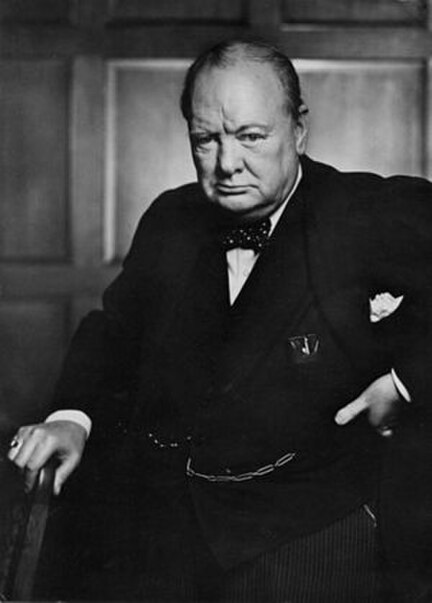
The Karsh portrait


Nor was Fascism, as I have seen claimed, anti-science. No, science, or rather, scientism, as Churchill says, was at its core: Darwin and the theory of evolution was obviously and directly appealed to by Hitler as the essence of human life, and Einstein's Theory of Relativity was used by Mussolini to claim that all values were culturally relative. Nazism was not a conservative movement, in any sense, but a “progressive” creed. It appealed to science for its justification, and held, like the “progressives” of today, that science had superceded old moralities.

Those who do not study history are condemned to relive it. And not as the guys on top.

Friday, November 21, 2008

Good Neighbour Hitler

There is a new tendency towards revisionism over the Second World War—arguing that it was not, in fact, the “Good War” we have for so long understood it to be.

Sucg revisionism is, at the same time, both necessary and appalling. We must forever challenge received wisdom, certainly. Our freedom depends on it. On the other hand, though, failing to see WWII as a definitive battle of good against evil seems to me to be the worst sort of moral relativism. If we cannot see even this as a plain case of right and wrong, we have smashed our moral compass and put out every star in ths sky that might show us our way in the dark.

Eric Margolis treads the recent footprints of Pat Buchanan (Hitler, Churchill and the Unnecessary War) in a recent Ottawa Sun column.

Let's examine this argument point by point.


Margolis argues first, far less controversially, that World War I was wrong—for Britain and America. That they should both have stayed out.


“Britain,” he says, “could have halted the war, or let the continental powers fight until they came to a truce. But Churchill and his fellow imperialists determined to destroy Germany, a new rival to Britain's wealth and power.”


Right. And how might Britain have halted the war—other than by treatening to come in one one side or the other? That's what they did—and their participation in the war was the result. They had a treaty obligation, and a moral obligation, to defend neutral Belgium. While it is possible to argue that other nations entered the war foolishly or for ignoble motives, it is hard to single out Britain, as Margoilis does, for special criticism.

As to sitting out the war, what grounds does Margolis have to imagine the result without Britain would have been a stalemate? Even with Britain, France was very nearly lost in 1914, as it had been in 1871, and Russia really was lost in 1917. Without Britain’s involvement, it is far more likely that the result would have been a continent united against Britain under German leadership, as it was under Nepoleon a century before. This is an insane risk to expect the leaders of Britain to take.


“The war should have ended in 1917 when both sides were exhausted and stalemated. America's entry into the war resulted in Germany's defeat and ensuing post-war suffering.”


Both sides were not exhausted and stalemated in 1917. Russia was in full collapse. The armistice with Germany was signed in December, freeing a vast new contingent of German arms for a new offensive in the West. At best, without America's involvement at the crucial time, and the promise of much larger American armies arriving soon, the war might have dragged on much longer.


“The German, Habsburg and Ottoman Empires were torn apart by the lupine victors and reduced to ruin, creating today's unstable Balkans and Mideast.”


To suggest that the Balkans were stable until the fall of the Habsburgs and Ottomans is bizarre. It was the chronic instability of the “Balkan tinderbox” that led to the Great War in the first place.

It is also odd to lament that the Habsburg and Ottoman Empires were dismantled. Are empires such a good thing? Both were dismantled while paying close attention to, and very much in accord with, the wishes of their inhabitants, following the Wilsonian principle of the self-determination of peoples. The Arabs were actually not perticularly overjoyed to be ruled by Turks, nor the Czechs to be ordered around by Austrian Germans.


“...had a Carthaginian peace not been imposed upon them at Versailles and Trianon, there might never have been a Hitler, Communist Russia or Second World War.”


Communist Russia could hardly have been avoided but for Versailles and Trianon. Versailles was signed in summer, 1919, Trianon in 1920. Communist Russia was already in existence, since 1917.

As to the Peace of Versailles being particularly harsh on Germany, it is worth pointing out that is was much less harsh than the peace imposed on Germany after World War II—which has oddly not produced the rise of another Hitler-like figure. It was also less harsh than the peace Germany herself had just imposed on Russia at Brest-Litovsk, in 1917.

Perhaps Hitler could have been prevented had it been harsher?


“Churchill made the fatal error in the Second World War of backing Poland's hold on Danzig even though Britain could do nothing to defend Poland...”


If this was a mistake, it was not Churchill's. Chamberlain was still Prime Minister.
It is true that England could do nothing directly to defend Poland. It could equally have done nothing at Munich to directly defend Czechoslovakia, or later, to defend the Soviet Union. But it is quite novel to see this as a legitimate excuse to do nothing in the face of aggression. Indeed, it would have automatically ceded Hitler the right to fight on only one front at a time, and removed from the table Germany's greatest strategic fear, the two-front war.

Margolis comments almost offhandedly—as if he hopes by this to avoid close inspection of the claim-- that Hitler was interested only in “attempts to reunite millions of Germans stranded in these new nations by the dreadful Versailles Treaty.” That was Hitler's own claim, but it might not be wise to syetematically believe his propaganda. By the time of the Polish crisis, this claim had already been disproved: he had already invaded and annexed non-German Bohemia and Moravia, the present Czech Republic. He would later, of course, annex much of Poland and enslave its populace.

Sacrifice Poland, and Chamberlain would almost of a certainty only have had to face Hitler later, with Hitler stronger, and Britain weaker.


“[T]he western democracies should have let Hitler expand his Reich eastward until it inevitably went to war with the even more dangerous Soviet Union. Once these despotisms had exhausted themselves, the western democracies would have been left dominating Europe.”


When Britain declared war on Germany, Germany and the Soviet Union were allies. There was no reason to assume Germany and Russia would turn on each other out in the near future. They were more likely to continue, together, arms locked at the elbows, to trample down all the Western democracies.

Even had Britain had the luxury of staying out while the two went at each other, what would have been gained? Instead of being able to take them down one after another, the West would have had to face the victor, with the combined assets of the two, in some future Armageddon.


“In the end, Churchill and U.S. President Franklin Roosevelt were so obsessed with crushing Germany, and so seduced by 'Uncle Joe' Stalin, they handed half of Europe to the Soviet Union...”


Not exactly. Nothing was handed to the Soviet Union. The final lines, the runners for the Iron Curtain, were more or less where the armies met. The Soviet Union had taken half of Europe by force of arms, not been handed it, and Churchill and Roosevelt would surely have had to fight them for it if they had any objections. It is understandable if they did not want to put their peoples through that.


“...the Soviet Union, a far more murderous and dangerous tyranny than Hitler's Germany.”


I don't think that claim is justifiable either. Granted, Stalin killed more people than Hitler—he had more time in power to do it. But there is still something very special about deliberately launching a world war and deliberately trying to annihilate a race. The difference between Hitler and Stalin was the difference between a slow cancer and a cocked gun against your ear. You deal with the gun first.


“[Western leaders are] idolizing the arch imperialist, Churchill.”


Wait a minute. I thought imperialism was now a good thing. Or is it good only when not done by Anglo-Saxons?

All I can think is that it is a damned good thing for human civilization that Pat Buchanan was not advising the British government in the months after Munich.