Playing the Indian Card

Showing posts with label World War I. Show all posts

Monday, November 10, 2025

Sea Power, Land Power and the Fall of Empires


The British First and Second Empires combined.

I heard recently an interesting analysis of why the sun did set on the British Empire. It all came down to the First World War. Britain’s great strength was always been being an island. This meant it need not fear a land war. It did not need to support a standing army, or to rebuild from the devastation of wars. It could pour its resources into having a strong navy, focus on industry, and choose its fights.

It then made the fatal mistake in the First World War of deciding to fight a huge land war—throwing away its natural advantage. While it won, it broke the bank. It lost leadership at that point to the USA.

What might have happened had Britain restricted its land participation in the First World War? At worst, it would merely have lost its leadership to Germany instead of to the USA. 

But quite possibly, its naval blockade could still have been decisive against Germany. 

I think it likely Germany’s Schlieffen Plan would still not have worked. During those first few weeks, the British presence in France was nominal in any case. From that point on, with trench warfare favouring the defense, it was hard for either side to advance. It was stalemate on the ground while the British blockade slowly strangled of German production. The eventual entry of the US was caused by events at sea, and so should have happened anyway, giving France that final punch against an exhausted Germany.

Meanwhile, Britain might have had more resources available to intervene in the Russian Revolution and keep Russia in the war—or at least, following the war, ensure that the Whites won. That could have made quite a difference in subsequent history.

During World War II, the UK was compelled by circumstances to follow a more logical policy—France fell swiftly.  But they might have been in much better shape had they not sent a large land force to France, which then had to be evacuated without its equipment at Dunkirk. The Channel remained Britain’s protection, and they were able to rebuild. Had Russia not been attacked, Britain would have slowly starved Hitler out anyway—that’s why he had to attack. The British Navy cut him off from oil.

Again Britain won—but at such a cost that they could not sustain any longer the cost of their great navy, and so their empire.

Imperial Japan made the same mistake. They had the same advantage as the UK, of being an island. Their natural course was to be a sea power. Instead, they got themselves bogged down in a vast land campaign in China. 

Germany, rising quickly towards the turn of the 20th century, made the same mistake in the opposite direction. A land power, needing always to defend their borders, they diverted resources into trying to become a sea power; turning the UK from a natural ally to a deadly enemy. They became too ambitious and overextended.

The USA, like the UK, is a natural sea power. Protected by oceans, it does not need a large standing army defending its borders. It can build up and support a large land army if necessary for short periods. But it must avoid becoming involved in land wars. Trump’s idea of withdrawing from Europe and letting the Europeans pay for their own defense is wise. In Asia, the best idea is to maintain an island perimeter. Vietnam was a mistake for this reason: America must avoid land wars in densely-populated Asia.

In other words, if it keeps its powder dry, China has no reason to fear the USA. Its invincible defense is its huge population, as Russia’s invincible defense is its vast land area. Time and again, this defeats possible invaders, and allows it, or Russia, to develop into a great regional power.

But not global powers—a land power almost by definition cannot extend its reach overseas, as a sea power can.

China now wants, like Germany towards the close of the 19th century, to become as well a great sea power. It wants to seize the island of Taiwan, control the trade route through the South China Sea, and project its power globally.

There is a reason why China has never been a sea power. Geography. This is a fatal mistake.

China must always maintain its large standing army. Russia, to the north, is also a great land power. India, to the south, is also a great land power. Like Germany having to worry about Russia, Austria, and France, there is always the danger of a two-front war.

So it must maintain parity on land with Russia and India combined, while also, if it wants to challenge at sea, developing and sustaining parity as well with the USA and Japan combined, two natural great sea powers.

Not to mention significant peripheral players like Vietnam and Korea.

The lessons of history suggest this is too tall an order for any nation. China does not have the natural advantages to make this possible. It may, like Germany or Japan, make a lunge, but unless the other power make a series of catastrophic errors, China is going down. Even when the UK made fatal errors, Germany still lost two wars.



Tuesday, November 09, 2021

Many Ingenious Lovely Things Are Gone


Pop!

Remembrance Day is coming in two days. Remembrance Day, and the First World War, have always been special to me. The First World War is when the dream of inevitable progress died, when civilization lost its way. It has not recovered. 

W.B. Yeats, for me, captures it best, in his poem “Nineteen Hundred and Nineteen”:


We too had many pretty toys when young: 

A law indifferent to blame or praise, 

To bribe or threat; habits that made old wrong 

Melt down, as it were wax in the sun's rays; 

Public opinion ripening for so long 

We thought it would outlive all future days. 

O what fine thought we had because we thought 

That the worst rogues and rascals had died out.


All teeth were drawn, all ancient tricks unlearned, 

And a great army but a showy thing; 

What matter that no cannon had been turned 

Into a ploughshare? Parliament and king 

Thought that unless a little powder burned 

The trumpeters might burst with trumpeting 

And yet it lack all glory; and perchance 

The guardsmen's drowsy chargers would not prance.


Yet by 1919 this confidence was shattered:


[We] planned to bring the world under a rule, 

Who are but weasels fighting in a hole….

Learn that we were crack−pated when we dreamed.


We, who seven years ago 

Talked of honour and of truth, 

Shriek with pleasure if we show 

The weasel's twist, the weasel's tooth.


T.S. Eliot’s “The Waste-Land,” from the same time, covers the same ground. Hell had broken loose.

Although I never knew it personally, I yearn for the beauty and sense of honour and order of the old Austro-Hungarian culture, or the Ottoman, or the Imperial Russian, or the Britain of the huge pink maps. Of course they had their own deep flaws, but the foundation was sound. Since then we have lost our civilizational anchors and our pole star.

I gather I am not alone; this seems to be the attraction to “steampunk.” 

It might have meant something, the terrible sacrifice and the cataclysm of the First World War, if it had indeed been “the war to end all wars.” That last hope was seemingly shattered by World War II.

But perhaps, in the end, it was the war that ended wars. Since 1945, we have not had another big one. If we take the Second World War as the continuation of the first, left unfinished, after a truce of twenty years, the prolonged holocaust ended with the atom bomb. And since then, terrified as we all are of the atom bomb, it has kept us on our best behaviour. Because any war between nuclear powers would now be mutual assured destruction, nobody has since started a big, total, war, and nobody is going to start one with another nuclear power. Although there is a risk of miscalculation, if more countries had nuclear weapons, we might have fewer wars. We seem to be replacing war with technological and economic competition: first with the “space race.”

If only we could now bring back what we have lost….


Friday, April 05, 2019

Alternative Histories of the Awful 20th Century


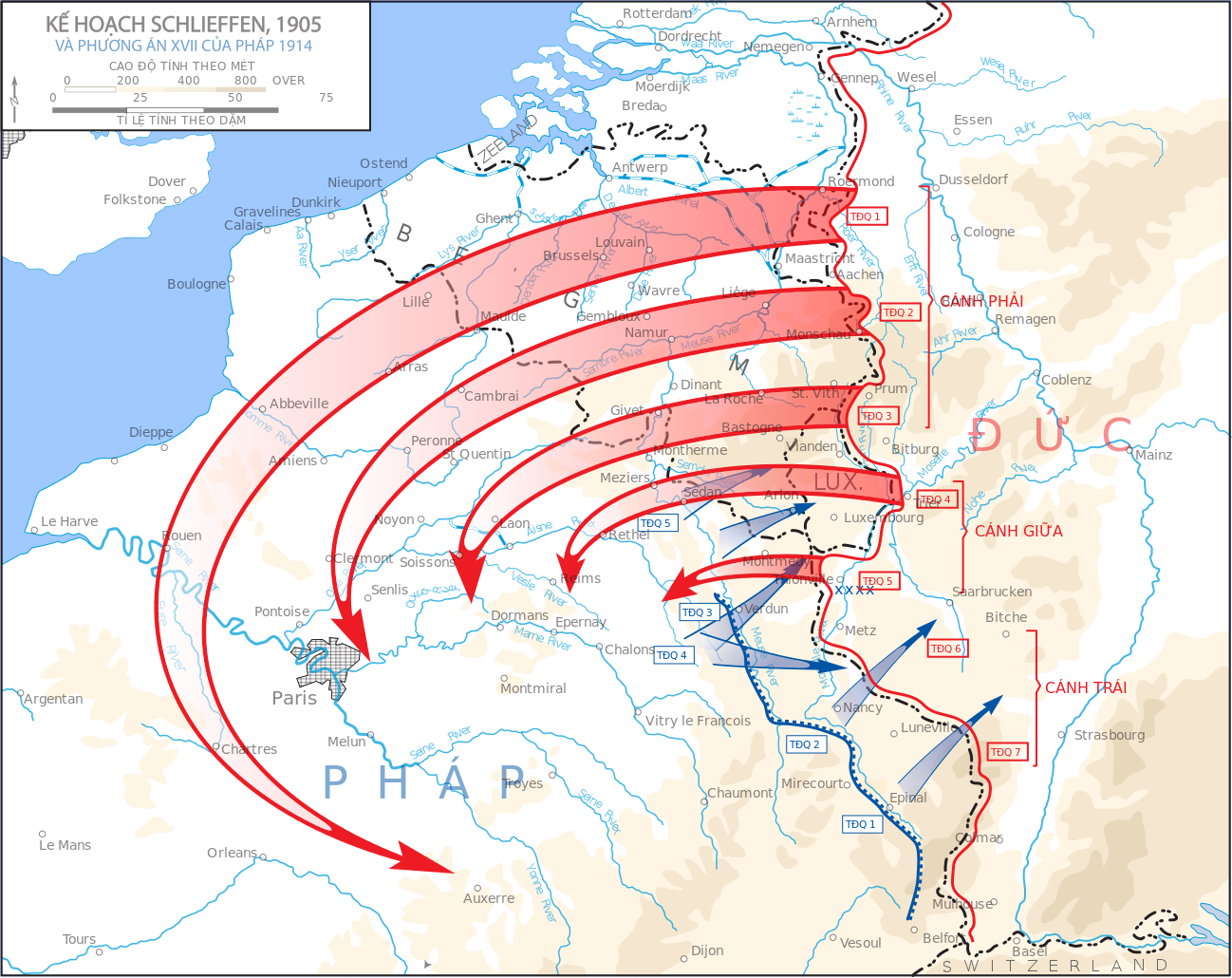
The way the German war plan looked on paper.

Germany really might have won the First World War.

Looking back on events of world history, we get a sense of inevitability. We forget they were not inevitable at the time.

This is important because, had Germany won, it would have been disastrous for civilization. That they did not suggests the awful hand of God.

Note first that, unambiguously, despite attempts at revisionism, Germany provoked the war.

Countries and governments do not start wars they think they are going to lose.

Germany had good prospects, on paper, of winning.

They failed primarily because of one miscalculation. Nobody understood how the current battlefield technology favoured the defense.

Had they seen this, Germany’s grand strategy for war probably should have been the opposite of what it was.

Their plan, the famous Schlieffen Plan, was to quickly overrun France before Russia could fully mobilize, then pivot and take on Russia.

Were it not for the advantages held by defense, they would have quickly been in Paris, and it would have gone as foreseen. As it was, it was a close-run thing. And even with the failure of this initial drive, even up to mid-1918, it looked as though Germany might win anyway.

They should instead have set up a defensive screen on the French border, and concentrated their main forces quickly against Russia, taking as much ground as they could before the latter could fully mobilize. 

The French war plan: Plan 17.

Given the advantages on defense, such a relatively thin grey line in the West could probably have held. Let France beat its head against this Western Wall, and they only grow weaker as Germany grows stronger, taking the higher casualties with a smaller population. By not invading Belgium to bypass the French defenses, Germany could well have avoided getting both Belgium and Britain into the war, and, with Britain, Canada, Australia, India, South Africa, and Britain’s allies Portugal and Japan, all significant factors. They would not have had to pursue unrestricted submarine warfare, and so the US would also probably have stayed out. Bundle that together, and they would have faced, throughout the war, less than half the forces and less than a third the industrial capacity that they did in the event. That alone sounds like enough for a win. Without Britain in, it seems dubious, in turn, that Italy would have come in on the Entente side. They would more likely have seen an opportunity in joining their treaty allies, Austria and Germany, and seeking their spoils in French North Africa, Nice, Savoy, and Corsica.

Germany would also have avoided the British blockade, which may have done more than anything else to hand them defeat.

Moving east instead of west, Germany would have had the advantage of fighting through lands and peoples unhappily subject to Russia, Poland, the Ukraine, Byelorussia, the Baltic States, who would probably welcome them as liberators. Set them up as friendly governments as they passed through, and Germany would have been able to marshal their populations and industries in their war effort against the rest of the Russian Empire—and perhaps, later, France. Subsequent events have shown us that the Russian regime’s hold on power was fatally shaky; with a good sharp knock at the very start, the Russian Revolution might have come years earlier, taking Russia out of the war.

In the meantime, an early focus on Russia would have taken pressure off Germany’s weaker Austrian chum. Without England in, the Ottomans could have concentrated on the Caucasus, increasing the pressure on the Czar. Serbia might have been cordoned off at the start, relying again on the supremacy of defense. With Russia out, Italy not in, and belligerent Bulgaria joining the Central Powers for their main chance, Serbia could be taken out at leisure later.

With Russia and with Serbia erased, France might have seen the inevitable and sued for peace. If not, Germany might have wrought more havoc by teaming with Italy in North Africa, and blowing out all the French African colonies. And a later full bore frontal assault on the French border should have worked too, given the single front, if they felt it was worth the cost.

I think there was an outside chance Hitler could have won the Second World War as well. Just an outside chance, if things had fallen out differently, and just right, or, better put, just wrong. The critical issue was oil; Germany didn’t have it.

But consider if Franco’s Spain and Ataturk’s Turkey had come in on the Axis side at the start. It would have made ideological sense; Franco was in power thanks to the Fascists, and Ataturk was a model for them. Franco, they say, was afraid of British naval power staging a landing on his coast. Fair enough; but then, the same concern should have applied to Vichy Morocco and North Africa. Did not happen, until the Americans joined the war.

With Franco in, to begin, the Germans get to grab Gibraltar. They seal the Mediterranean at that end. Malta starves, Rommel and Italy get a free hand in North Africa, with which they might well take the other end of that inland sea, the Suez Canal. That sucks if you’re England and need to keep up communications with India, Australia, and the East.

In the meantime, with Turkey in, the Axis is already at the threshold of the oilfields of the Caucasus—they already have the stretch of terrain they fought so hard over two years to Stalingrad to get. Their new jumping-off point is their previous endgame. And the oil fields of Iraq are even closer, just to the south over low, tank-friendly terrain. Germany not only easily takes them, but thus takes them away from the Royal Navy. Without ever even having to attack Russia.

I think Germany would have been doomed anyway. The US was not going to just sit there for all of this, and I think the Nazi economic model was a Ponzi scheme that had to collapse without constant conquest. But it could have been so much worse than it was.


Friday, March 15, 2019

Silencing the Guns of August


A lesser breed.

What would have happened if the First World War had not?

A fascinating speculation, because the First World War seems to have wrecked so much. All the magical princesses and dukes in their satin finery; Yeats’s “ceremony of innocence.” One can imagine that all was well in Western civ until it happened, and Western civ has never recovered. Beauty itself seems to have died then. Our confidence in the good and the true.

Fascinating as well because there is a general sense that it was far from inevitable, that it broke out more or less by blunder.

So what would have happened?

I find that in the end I cannot imagine anything being much different. Or rather, I really cannot imagine it never happening. It actually was, I suspect, no blunder, no mistake, and  not evitable. The problem began with Charles Darwin, back in 1859.

The war was started by Germany, make no mistake, and if it had not come to war this time, Germany was going to make a war within a few years somehow. I see no peaceful trajectory for a prewar Germany; barring what God did to Sodom and Gomorrah. Germany had done very well for itself with a series of European wars in the later nineteenth century, with Denmark, then Austria, then France, and they were cocked and ready to try for the big one: hegemony. They had rattled sabres to the verge of general war several times in the years leading up to 1914. They were going to keep doing so until it came to that.

It is fashionable these days to insist that it was all started blindly by the system of rival alliances. Nobody wanted it, but nobody could stop it once this machinery was set in motion.

Not believable. The intent and value of alliances was to prevent war, to make it less likely, not to make it more likely. Even the Triple Alliance, the stronger of the two, was purely defensive in nature.

Literally, treaty obligations did not cause the war. There was nothing mechanical about it. Russia had no treaty obligation to defend Serbia in case of war. Even if they had, Germany declared war on Russia, not the other way around. Treaty obligations did not require Germany to do this. Russia had not attacked Austria-Hungary, and had not declared war.

Once Germany and Austria had declared war on Russia, treaty obligations still did not oblige France to go to war on Russia’s behalf. The Entente between them was not a formal defensive treaty. Even had it secretly required action by the French, this was a moot point--since it was Germany who declared war on France, not vice versa. And this was obviously not required by any treaty signed by Germany with anyone. This was a conscious strategic decision.


Germany did, on the other hand, go to war with Belgium in open violation of treaty obligations.

The only major power that actually did declare war because of treaty obligations was Great Britain, based on the old (1839) defensive treaty with Belgium. The same one Germany had violated.

In other words, the system of mutual defense treaties did not cause the war. Instead, a stronger set of public alliances before the war, a clearer deterrent, might have prevented it. Would Austria have gone in to Serbia had they known this would draw in Russia and France? Almost surely not. Would Germany have invaded Belgium if they knew this would bring in the UK?

When Austria-Hungary sent its ultimatum after the assassination of Archduke Franz Ferdinand, Serbia, far from being belligerent, acceded to all but one of a set of outrageous demands. They went as far as they could this side of surrendering their sovereignty. Austria was plainly set on war regardless. Given how militarily shaky Austria was on its own, this demonstrates the powerful influence of Germany in the background.

Kaiser Wilhelm reputedly expressed disappointment at Serbia's response to t he Austrian ultimatum. “A great moral victory for Vienna," he wrote. "But with it every pretext for war falls to the ground.” Austria got what they wanted; he did not. He wanted a big war. 

By his own evaluation, moreover, this means Austria and Germany went to war without a decent pretext. One might want to put the blame on Austria—but Austria might have expected only a local war. And Austria had what it wanted without war. It was still Germany that made it general, by declaring war on Russia.

And this seems to have been preordained. When the German ambassador visited the Russian Foreign Ministry to present the declaration of war, he actually gave two separate written memos. The first declared war because Russia had not responded to the German ultimatum to immediately demobilize. The second declared war because the Russian response was deemed inadequate.

In other words, the declaration of war seems to have been decided in advance, regardless of the Russian response.

"The Crucified Canadian"; a famous German war atrocity of the time, now often disputed. Here features in a poster from the Philippines.

Social Darwinism was no doubt a factor across Europe. But this was especially so in Germany. This was pointed to by Rudyard Kipling in 1897. In his poem “The Recessional.” He wrote:

If, drunk with sight of power, we loose
Wild tongues that have not Thee in awe,
Such boastings as the Gentiles use,
Or lesser breeds without the Law—
Lord God of Hosts, be with us yet,
Lest we forget—lest we forget! 
For heathen heart that puts her trust
In reeking tube and iron shard,
All valiant dust that builds on dust,
And guarding calls not Thee to guard,
For frantic boast and foolish word—
Thy Mercy on Thy People, Lord!
Kipling was apparently referring to the Germans, and their atheistic pseudo-scientific “master race” ideology. “Reeking tube and iron shard” as resident idols rules out just about anyone else. It was probably generally understood at the time. Hitler and the Nazis did not suddenly invent this stuff in the 1930s. How could they? It goes back clearly at least to Nietzsche and his ideas about a “master morality” and a “slave morality.”

When war began, there was considerable popular resistance in the UK to getting involved. Witness later events in Ireland. This was also obviously true of the US. Notoriously in Canadian terms, this was so in Quebec. No jingoism, no militarism, no notions of a master race, no Social Darwinism, among the democracies.

In France, it was the same story. As the Serbian crisis unfolded, pacifist demonstrations against war easily outnumbered nationalist demonstrations against Austria or Germany.

Visible support for war was stronger in the monarchies of Austria and Russia. This might only have had to do with a relative lack of free speech and of the right to protest. But neither could match Germany here. In Germany, contemporary witnesses reported real popular enthusiasm for a fight. Hermann Hesse, from Switzerland, wrote in the German press expressing alarm over the warmongering and anti-foreign attitude that he witnessed: “Friends, not in these tones!” 

German execution of leading civilians of Blegny, Belgium.


There were many reports of German atrocities in Belgium at the start of the war. These are often now dismissed as mostly British propaganda. But Vernon Kellogg, neutral American present during the German invasion—presumably a detached observer—was alarmed by the Social Darwinist philosophy he heard espoused by Germans he encountered.

“Initially a pacifist, Kellogg dined with the officers of the German Supreme Command. He became shocked by the grotesque Social Darwinist motivation for the German war machine - the creed of survival of the fittest based on violent and fatal competitive struggle is the Gospel of the German intellectuals.” (Wikipedia).

Kellogg sounded the general alarm in his book Headquarters Nights.

It is commonly said that the Treaty of Versailles assigned full war guilt to Germany; and that this was a major cause of the Second World War in turn. This is not quite true. The treaty spoke of German “aggression,” but not war guilt per se. And this was diplomatic boilerplate. Almost identical phrasing was put in the peace treaties with Austria or the Ottomans or Bulgaria. It was required to justify reparations.

Interestingly, in no other nation did the general population make much of it, or read it as assigning overall guilt. Everyone else indeed took it as boilerplate. Why the difference in Germany?

A clear case of “methinks the lady doth protest too much.” The extreme German reaction betrayed awareness of being in the wrong. This is typical of someone with a guilty conscience, when they are not prepared to reform. They tend to react hysterically when someone points out their guilt.

Italy had an alliance with both Germany and Austria, requiring them to come to their aid if they were attacked by Russia. Italy did not come to their aid. In taking this position, Italy declared their opinion that Germany and Austria were the aggressors.

Britain and the US, both neutrals at the start of the war, both also separately concluded that Germany was the aggressor, and chose sides accordingly. 

US enlistment poster

That looks close to a consensus by neutral parties.

One can be cynical and suppose that this charge of German aggression was a cover for simply acting in their own best interest. But Britain, the US, and Italy were all functioning democracies, to a far greater extent than Germany, Austria-Hungary and the Ottoman Empire. There was a limit to the amount of deceit they could get away with; they needed to worry about public opinion. Their general public had to buy it as well.

Why, in the face of the evidence, does everybody seem so keen to deny German war guilt?

I think it is a typical case of a general human tendency to deny the existence of evil. We want, absurdly, to insist that, if Hitler was evil, he was uniquely evil, and single-handedly responsible for everything in Nazi Germany. He was, we are told, a “madman.”

That is obviously ridiculous. Were he at any point clearly mad, those around him would have stopped obeying his orders. Nor did the vast majority of what happened in Nazi Germany depend on any kind of explicit orders from Hitler.

Perhaps it is too frightening for us to admit that a large proportion of any population, even a majority, can indeed choose to be evil. Perhaps it is frightening because it requires us to examine our own motives and acts—might we, too, be doing evil? Much safer to keep whistling past that graveyard.


Sunday, May 24, 2015

An Old Hope


Cry havoc! And let slip the dogs of war!

I am no expert on economics. It fascinates me, but it is, in the end, a social science. Which means to me that its data are unreliable. So I am not qualified to comment on this recent piece. But I include it because of its possible relevance to my own point that Western Civ died in the First World War.

Despite the title, its thesis seems to me to be hopeful. It argues that free trade and globalization make war increasingly unlikely. The century of relative peace between Waterloo in 1815 and Sarajevo in 1914, sometimes called “Pax Britannica,” was, it holds, no lucky accident. The First World War was a desperate rear-guard action by the traditional old landed elites, seeing their powers slip away. And, if we can ever shake off the last vestiges of socialism and Keynesianism, we may yet get back on track.

The argument seems to me to make some sense. After all, more land or even more resources means nothing in an industrial economy and given free trade. Let alone that, in modern democracies, you have to give any conquered people the vote. The one group to whom it would matter is the old landed warrior class, committed both to land and to war, who would see an expanding empire as an opportunity for their younger sons. Moreover, going to war would magnify their political power back home.

Germany was clearly more worried about Russia than France...

I note that the nations most responsible for the war’s outbreak were those in which the old landed warrior class were a) most dominant, and b) most threatened; yet also the nations that c) as nations, had the most to lose. The initial culprit was Austria: a terribly rickety aristocratic government already clearly in decline. Next to break the peace was Czarist Russia, by mobilizing in response: still run by aristocrats, but developing quickly. After that, industrialized but autocratic Germany. It was the ancien regime’s last throw of the dice, driven to desperation by their declining importance in the modern world.

Wednesday, September 17, 2014

Did Darwin Destroy Western Civilization?


Western civ has been acting suicidal for some time. It is vital to figure out why this is so, so it can be stopped. As of a few years ago, I thought I knew: it was the sense of futility brought on by the mass dyings of the First World War.

But in this centenary year, the First World War has been getting more attention, and I realize now I was wrong. The First World War, first, was not futile: Kaiser Willie's Germany was well on the way to Nazism already. And, second, the sense of civilizational death began before the war. Not just in Germany's racist notions, but in the arts: Marinetti's nihilist/fascist Futurist Manifesto appeared in 1909; Stravinsky's modernist Rites of Spring was first performed in 1913; Picasso had gone all cubist by 1907. The trauma that felled Europe must have come before the war. Virginia Woolf apparently felt it already in December 1910.

A facinating article in The New Criterion argues that it came with the aesthetic sensibility that gave us kitsch. Nazism, for example, was all kitsch; and kitsch is immoral art. Sounds right. Kitsch is not just aesthetically, but morally offensive: kitsch is art that lies. It denies the realities of the world in favour of an escapist vision that seems more pleasant: puppies with big velvet eyes, sad-faced clowns, smoke from happy chimneys, trees full of pink and blue flowers. This is, not coincidentally, the people's lot as presented by any totalitarian state.

Kitsch also denies real emotion in favour of sentimentality. And, as Carl Jung once said, awkwardly but accurately, sentimentality is a superstructure concealing brutality. Sentimentality masks a lack of real emotion. Hitler was great with animals and children.

And where did kitsch come from? Seems obvious: the movement called “aestheticism” at the turn of the century. This movement, originally in the high arts, wanted to divorce art from any other considerations: “art for art's sake.” So art had nothing to do with either morality or reality. Or real emotions.

By the way, that sounds a lot like New Age, doesn't it? It also sounds like most "religious" art, sadly: the plaster saints without a blemish.

Could all the horrible consequences of the 20th century, the slow and horrible suicide of Western civiloization, really have come from an artistic movement?

I think it could, and maybe it did. Art is that important.

But where did aestheticism in turn come from? Where did the urge come from to turn away from the real world, shut down our real emotions, and ignore morality? I think the timing fits: it was Darwin. Just as Darwin was the obvious and direct progenitor of the German Imperial/Nazi race theories. Darwin's view of the world was and still is too horrible to look at directly; yet people accepted it in their hearts as true. It is a world of devour or be devoured, where everything else is random.

Unfortunate for us all if Darwin was right.

In the meantime, for all our sakes, we need to reconnect religion with art, and art with religion.