Playing the Indian Card

Showing posts with label depression. Show all posts

Monday, October 20, 2025

The Duty to be Cheerful


A new study has found that depression is contagious. As of course it is; nobody needed a study to know that.

This being true, it is our moral duty to those around us, and especially our intimate partners and our children, to try to keep a stiff upper lip, even if we do not really feel it.

This is perhaps the gravest failing in a wife and mother: to be always complaining. This is the stereotype of the nagging wife, or of the “Jewish mother.” They become a terrible burden on those around them.

It is equally important for the husband and father to stay stoic and not be forever complaining. But men are raised to be stoic, and shunned in society if they whine. Women are indulged. The legend of the Princess and the Pea tells the story. 

Indeed, feminism has legitimized and institutionalized constant female complaining. 


Saturday, June 28, 2025

Narcissism Is Not Depression


Psychiatry generally—and a friend of mine—tend to classify narcissistic traits as “compensation” for low self-esteem, and so classify them as “depressed.” And the preferred therapy is to flatter them and boost their ego.

Einstein is supposed to have said that the definition of insanity is doing the same thing repeatedly and expecting to get different results. This is the same delusion: expecting the same thing to get opposite results.

Someone with low self-esteem is ashamed of their self. They think they are not up to par. The last thing they will want to do is to draw attention; people will see their inadequacy. These are the wallflowers; the ones who will not readily talk about themselves. They will indeed compensate for their low self-esteem, but they will compensate by working hard at whatever they are asked to do, to prove themselves. They will be scrupulously moral, and always want the structure of rules. Rules will reassure them they are doing all right.

Conversely, someone who wants to draw attention to themself is suffering from too much self-esteem, not too little self-esteem. They are proud of themselves. They are suffering from low “other-esteem,” in two senses. That is, in their perception, others are not giving them the admiration they deserve. And they never thought much of others in comparison to themselves. So they are annoyed with the world around them, which had better learn to shape up. The world is not measuring up to their standards.

They will dislike moral standards and rules. They might, after all, be used against them.

You will hear much complaining from those with high self-esteem. You will hear much less from those with low self-esteem. They will not want to show their head above the parapets, for fear of being shot at.

Someone with low self esteem, feeling disappointed, will blame themselves and want to harm or kill themselves. Someone with high self-esteem, feeling disappointed, will want to harm or kill everyone else.

Most narcissists will not go that far, but watch out. They naturally want to destroy anything around them that is good or true or beautiful, that they cannot claim as their own.

And this is where the school shooters and assassins come from.


Sunday, June 15, 2025

Amazing Grace


A sentence catches my eye from Margaret Visser’s book The Geometry of Love. She is speaking of the unicursal labyrinths that grace Medieval churches; the kind that have no wrong turns, and only require patience to walk through. “The road symbolizes a human life with all its difficulties and failures, and the common feeling of being lost; the message is that mental agility is not the most important gift for the spiritual life.”

I believe being lost is indeed a common feeling. It is the true essence of what psychiatrists call “depression.” Not sorrow, not anxiety, but a sense of not knowing which way to turn, how to proceed. This is the worst of all feelings.

And I think this is an important message: “mental agility is not the most important gift for the spiritual life.” That is, for life itself. 

I long ago noticed, in my studies of legends and fairy tales, that this message is conveyed not only by unicursal labyrinths. Whenever a tale does involve a maze or labyrinth of the kind with wrong turns and dead ends, the hero does not escape by their own cleverness. Theseus escapes the Minoan labyrinth not through his own quick wit, as Oedipus escapes the Sphinx, but rather anticlimactically because Ariadne gives him a cheat sheet: the thread, and advice to always take the left (or was it right?) turn. In the Grimm tale, Hansel cleverly lays a path of white stones when his parents seem to abandon him and his sister in the forest. But his parents discover the trick, and try again, after preventing him from collecting stones a second time. So, still ingenious, he resorts to dropping breadcrumbs. And this does not work—the birds eat the breadcrumbs, and he and Gretel are truly lost. Having worked it all out brilliantly, it is still of no use. In the end, it is Gretel, not Hansel, who saves the day. 

And so forth, for every example I can find.

There is a consistent message being whispered in our ear. Ultimately, for our direction and our salvation, we must not rely on our own cleverness. We cannot pull ourselves up by our bootstraps. It must be faith, and love.

It must be so: some people are much smarter than others. Yet God made us all, and made us as we are. A good God would not give advantage to the most intelligent, and condemn others simply for stupidity.

As Aquinas said, all his subtle philosophy was, in the end, a sideshow. If we rely on our own intelligence, we are doomed.

The answers are written in our heart.


Sunday, June 01, 2025

The Death Wish


Memento Mori

I still recall vividly a discussion I had one evening in first year university with a guy from Alberta, blonde, bearded, with granny glasses. I said that everyone had both a life wish and a death wish. He scoffed—preposterous. Nobody wants to die. And I was shocked, because I thought it was obviously true.

If my claim sounds Freudian, I did not get it from Freud. At the time, I knew little of Freud.

I meant simply that everyone secretly wants to die. There is an instinct that makes us fear death—easily explained by evolution. But there is another instinct that comes from somewhere else. 

I say the evidence is everywhere.

Everyone craves a beach vacation, a cottage on the beach, with the vast ocean before them. Why? Because they can feel apart from the world, only steps from eternity. There is a deep calm to being near the ocean.

It is the same calm one feels when walking through a cemetery.

Why do others crave a vacation or a cabin in the mountains? So they can look down on the world from above, be above all that, away from it all. Life looks small and insignificant and far away.

Why do people, for that matter, want to read novels, or watch movies? To escape, at least for a few hours, from their lives and from themselves. To forget they are there and just watch life go by, as God does. As saints in heaven would.

And why do young men actually seek risk, and danger? Why do they often eagerly sign up for war? 

The secret thrill is that they might die.

Each of us has an intuition that there is a somewhere else, a more perfect world. Each of us has an intimation that daily life is not our home. We yearn. We feel a nostalgia without knowing what for.

This, not incidentally, is behind many modern diagnoses of depression. The good doctors will always assume a desire to kill oneself or die to self is pathological, a “mental illness.” They will consider a general disappointment with the world a "mental illness."

This because they want to deny the existence of the spiritual. They act as materialist inquisitors against the heresy of idealism.

But the heart knows what it knows. Those who lack a secret death wish lack a soul.


Friday, November 22, 2024

Disillusionment


 At mass a couple of Sundays ago, the sermon lamented a general sense of “disillusionment” in society. All the drug use; the rising rate of suicide; of mental illness; of cynicism; crime. He might have mentioned bad art.

But if people are generally disillusioned, the next question is: what was the illusion? And the question after that: Is it better to live in an illusion, or to be disillusioned and see things as they are? Surely disillusionment, if painful, is better than illusionment, and is a step toward the light.

It also occurs to me that “disillusionment” might be the better formulation for what we call “depression.” The depressed generally have a better grip on reality than the rest of us.

Most people most of the time live their delusions. They believe what seems most pleasing to them, and ignore the real situation.

The broad general illusion of our time, I would say, is materialism. I don’t mean the pursuit of wealth: I mean the philosophical position that only the physical is real. And with this as a cosmology and religion comes scientism, the notion that science explains the universe, and anything labelled “the science” must be true.

Eyes are opening, and further revelations may come.


Monday, May 13, 2024

Depresssion and Its Cure


It seems plausible that the reason for the rapid rise in depression and other mental illness has been the growing use of seed oils. 

But this relies on the premise that depression is a “chemical imbalance in the brain.” That looks like a categorization error, mistaking something spiritual for something physical, the menu for the meal. It is like supposing that doing a dance wearing a false face will scare away cancer. It actually can work—witness the placebo effect—because mind and body do interact. But it is going about it the long way around.

What is depression really? It is not particularly related to feeling sad. “Depression” is a misleading term. The older word, “melancholia,” is better. Often more like an emotional numbness, and as often anxiety.

It is best described, perhaps, to those who have not experienced it, as like being in a maze. And in that maze, there is a minotaur. Any way you turn is probably wrong. But staying put is also wrong.

The obvious way to understand that, is that you have lost your moral compass. You have lost your sense of right and wrong.

Not in the way psychopaths are supposed to. Psychopaths seem to have the opposite experience, that nothing is wrong, and you are free to do what you want. The depressed feel instead that nothing is right; which paralyses them.

Most likely either is the result of an immoral upbringing, an upbringing by a parent who themselves had no moral sense; a parent who is either a psychopath, or chronically depressed.

The more dramatic experience we call schizophrenia seems adjacent in kind. Here the problem is not just what is right or wrong, but what is real. Probably produced most often by a parent who chronically “gaslit,” to use the currently popular term. And here, too, there are logically two opposite forms: either anything I want to be real is probably real; or anything I don’t want to be real is probably real. The former produces what we call narcissism. The latter produces what we call schizophrenia. 

So what is the proper or probable cure?

Where do we go to discover what is genuinely right and wrong, and what is genuinely real? Where do we go to reprogram our minds out of this trap?

Obviously, to philosophy and to religion.


Sunday, May 12, 2024

Seed Oils


Mikhaila Peterson, Jordan’s daughter, says she and her father cured themselves of chronic depression by going to an all-meat diet.

I’m sceptical. For one thing, rates of depression have skyrocketed since the post-war years. Were our diets more meat-oriented before the war, and have they become less so since? I would think the opposite: with growing wealth, especially nouveau wealth, people tend to add more meat to their diet. I have also read many studies that claim the “Mediterranean diet,” or the traditional Japanese diet, cure depression. These diets are the opposite: little or no red meat, only vegetables and seafood.

So the data seems all over the place, and inconclusive.

But wait--the real problem might be seed oils: corn oil, canola oil, “vegetable oil” generally. Going carnivore eliminates the use of seed oils, in favour of animal fats.  So does going Mediterranean; you use only olive oil. Traditional Japanese cooking relies primarily on sesame oil. This is indeed a seed oil, but it may have unique properties. Some studies show it has anti-depressant effects. 

“Seed oils” have become far more common postwar. Everyone switched from bacon fat to oils in frying. Everyone switched from lard to Crisco in baking. Everyone switched from butter to margarine, and, influenced by concerns over cholesterol, specifically to vegetable-oil based margarine. 

The chart shows the rapid growth in the use of seed oils. It associates this with the increased incidence of diabetes. But what else has skyrocketed over the same time period? Auto-immune diseases, allergies, obesity, and mental illness.

Yikes. Seems possible.


Thursday, January 04, 2024

Madness and Civilization


A recent article somewhere listed famous people who were depressive or bipolar (‘manic depressive”). 

They could have saved time and energy by simply noting “all famous writers and artists, all famous war leaders, and all famous philosophers.” No mystery, no news: Aristotle pointed this out over two thousand years ago. Problemats XXX:  “Why is it that all those men who have become extraordinary in philosophy, politics, poetry, or the arts are obviously melancholic?”

I fear, however, that moderns grab the stick at the wrong end. The assumption seems to be that they did great stuff despite being mentally ill. “High functioning depressives.” Which is absurd, when the highest functioning of us all turn out to be depressives.

“Considered by many to be the greatest English writer in history, Charles Dickens, like many great writers, battled depression for his entire life. It was said that he went through long periods of insomnia whenever he started a new novel.

“To deal with his sleeplessness, Dickens would wander aimlessly around London, once covering 30 miles (48 km) in a single night. On the bright side, it’s been reported that his spirits would lift bit by bit as he made more and more progress on his stories.”

The real story is that Dickens would be driven to write a new novel by the chronic anxiety that caused his insomnia. The act of writing soothed the anxiety and depression.

I am reminded too of Socrates’s comment: “By all means marry. If you marry well, you will have a happy life. If you marry poorly, you will become a philosopher.”

An intolerable home situation, being abused, causes what we call depression.

Depression is principally a sense of loss of purpose and meaning to one’s life. This is the permanently damaging effect of abuse. It can be expressed as sadness or as anxiety, but these are just symptoms: the problem is a lack of meaning and direction. “What is the point of me?”

Art, or philosophy, is an effort to create meaning. One is reaching for the transcendental values, the things that bestow meaning. The artist is reaching for beauty; the philosopher is reaching for truth. And the lawgiver or military leader is reaching for justice, the moral good. With desperation, in such a case, and so with the greatest concentration and energy.

This is salvation for the mentally ill: to stop being "mentally ill" and become an artist, or a teacher, or a shaman.

But don’t many artists end up losing the battle, and committing suicide? Don’t many philosophers?

They do; because art or philosophy is the path, and only the initial path, and not the goal. The quest for meaning begins to yield solid results once it generates and confirms a religious conviction.

Artists who become religious do not commit suicide. Instead, the depression eases and recedes. Religion happens when art or religion achieve their goal.


Sunday, December 10, 2023

The Pool at Bethesda


5 Some time later, Jesus went up to Jerusalem for one of the Jewish festivals. 2 Now there is in Jerusalem near the Sheep Gate a pool, which in Aramaic is called Bethesda and which is surrounded by five covered colonnades. 3 Here a great number of disabled people used to lie—the blind, the lame, the paralyzed. 5 One who was there had been an invalid for thirty-eight years. 6 When Jesus saw him lying there and learned that he had been in this condition for a long time, he asked him, “Do you want to get well?”

7 “Sir,” the invalid replied, “I have no one to help me into the pool when the water is stirred. While I am trying to get in, someone else goes down ahead of me.”

8 Then Jesus said to him, “Get up! Pick up your mat and walk.” 9 At once the man was cured; he picked up his mat and walked.

The day on which this took place was a Sabbath, 10 and so the Jewish leaders said to the man who had been healed, “It is the Sabbath; the law forbids you to carry your mat.”

11 But he replied, “The man who made me well said to me, ‘Pick up your mat and walk.’ ”

12 So they asked him, “Who is this fellow who told you to pick it up and walk?”

13 The man who was healed had no idea who it was, for Jesus had slipped away into the crowd that was there.

14 Later Jesus found him at the temple and said to him, “See, you are well again. Stop sinning or something worse may happen to you.” 15 The man went away and told the Jewish leaders that it was Jesus who had made him well.


A dramatization of this passage from John came up in an episode of “The Chosen” I viewed recently.

Something stands out that tells us this is a parable.

Jesus asks, “Do you want to get well?”

In the literal world, this question makes no sense. Of course anyone ill or lame wants to get well. Anyone coming to the Pool of Bethesda comes in an attempt to get well.

This anomaly tells us the man’s lameless is symbolic; an objective correlative of a spiritual condition, which cannot be otherwise represented.

And his physical paralysis is an apt representation of spiritual paralysis, of dispiritedness, which primitive tribes in Africa call loss of soul,” and the modern psychologists call “depression.” How often is depression experienced as “not being able to get out of bed?” 

The parable diagnoses the immediate cause: the victim is caught in a bind, a Catch-22. He is lame because he cannot make it into the Pool of Bethesda when the water is stirring. He cannot make it to the Pool of Bethesda when the water is stirring because he is lame. And he has been trapped in this bind for 38 years.

Such binds are always the cause of depression. They tend to arise, as in the book Catch-22, due to some oppressive or malicious authority, in order to exert a more perfect control. This too is implied clearly enough in the passage; in the absurd accusation by the “Jewish leaders” that the man is committing a sin by being healed on the Sabbath. He is morally required, they insist, to keep lying there. By implication, their demands are the real, ultimate source of his spiritual paralysis. They are keeping him from the “living waters” of true spirit.

This paralysis is a paralysis of the will. Their will is paralysing his will. This is why Jesus’s question is important: does the man want to get well?

The answer might well be no—for he is trapped where he is by guilt, if a false sense of guilt imposed by impossible demands. Most of the depressed are depressed to punish themselves for imagined crimes. And therefore he deserves to be lame, and does not deserve to be healed. And so he fears being healed.

Is the man is cured by Jesus and by faith in Jesus? So it would seem, and so one might say the solution is faith in our Lord and Savior Jesus Christ. But that is too simple; that does not really fit the parable. The parable makes clear that, until some time after he is cured, he has no idea who Jesus is. This is just some random guy telling him to get up and walk. Why should he put his faith in some random guy? Is this wise, or admirable?

But making the attempt is an assertion of the will.

But why does he now have that courage?

He is apparently primed for this simply by describing his situation at the pool clearly. By formulating and thereby seeing things as they really are. Doing so presumably makes the absurdity of his situation apparent to himself: he is lame because he is lame because he is lame. All such double-binds are necessarily, by definition, illogical. It follows that, by looking at it closely, the illogic should be revealed, and the problem evaporate. “And the truth shall set you free.”

This all sounds simple; but it is immensely difficult emotionally. One has been groomed to be wracked with guilt. That is how the malicious exert control. Therefore one is terrified to look at one’s own situation too closely, for fear that one’s supposed guilt be fully revealed, and one is sure that it is horrible. One must be prepared, in effect, to throw oneself on the mercy of God, expecting the worst possible consequences. 

Which is what this man does, by speaking frankly to a stranger; apparently trying to explain why he deserves his own lameness. He does not answer, “yes, I want to be healed.” He seems instead to try to explain why he is lame. That breaks the spell. He sees it is nonsense. It is not his fault. Then, immediately challenged again by the oppressive authority about breaking the Sabbath, he is now able to appeal to a higher authority. He lets Jesus, whom he now identifies, take responsibility. Which is as much as to say, objective morality and logic. Jesus is the Logos.

This is why the parable ends with Jesus telling the paralytic not to sin. Not that he was necessarily a great sinner before; we are all sinners. But keeping a commitment to the straight and moral path, to truth and the good, inoculates one from being endlessly left bleeding in ditches. Guilt is the weapon the malicious use to control. The devil can use any sin against you.

Now get up and walk.


Wednesday, July 12, 2023

PTSD: What It Really Is


The experts currently trace all depression back to PTSD, and PTSD usually developed from abuse in childhood. Not just depression, either, but also chronic anxiety, obesity, high blood pressure, allergies, and so forth.

The concept of PTSD comes from war—it used to be called “Shell shock.” And because of this, it has been falsely associated with fear of getting hurt. Soldiers suffering PTSD used to be suspected of cowardice.

But PTSD is not caused by fear, or physical abuse, or for that matter sexual abuse.

When Tim Ballard, whose story is told in the new film “The Sound of Freedom,” began the work of rescuing trafficked children, he suffered PTSD. When three helicopter crewmen tried to save some of the civilians being massacred at My Lai, they suffered severe PTSD. None of these people were in significant danger of being harmed themselves. Nor is PTSD a reaction to guilt over anything they had done; none of the soldiers who actually massacred civilians at My Lai are reported to have developed PTSD.

PTSD is a healthy moral reaction to an encounter with evil.

Evil is so disturbing that most of us deny it even exists; we whistle past the graveyard. If we encounter someone genuinely evil, we tend to idolize rather than condemn them—the Stockholm syndrome. Their perspective must be right, and we must somehow have it wrong. They must then be beings with superior knowledge. I remember in China seeing an older woman bowing and praying to a picture of Chairman Mao in a Buddhist temple. She must have lived through the Great Leap Forward and the Cultural Revolution herself. And in fiction, there is the clownish Russian neighbour who extolls to Marlow the exceptional wisdom of his neighbour Kurtz; he knows Kurtz is massacring the native people.

This is a reason psychopaths and narcissists often rise to the top in society. Knowing no moral restraint looks like leadership.

War is of course intrinsically evil. It is intrinsically evil to try to kill other humans, who as far as you can know have done no wrong; yet that is what war requires. A decent, moral human is liable to be deeply traumatized. (This is not to say that it is evil to go to war, or to be a soldier; fighting a war is often the best way to prevent war. But war is at best a necessary evil.)

So too of one’s experience in a family, as a child. If a parent is immoral, a morally sensitive child will be deeply traumatized, apart from any physical or sexual abuse. This moral abuse is more permanently damaging than either of those other two forms of abuse. Although, in the natural course of things, the parent who abuses morally will probably also abuse physically and sexually; if they are not smart. If they are not smart: someone who abuses their child physically or sexually is likely to be found out; an intelligent narcissist will not commonly risk it.

They can enjoy destroying their morally sensitive child mentally instead.


Monday, May 22, 2023

Depopulation and Its Causes: A Thought for Victoria Day


I’ve been warning about population decline since the nineties. I remember a piece I wrote for the Western Standard in around 2002. It has taken an astonishing time for the media to notice what the demographic projections have been saying for generations.

Canada is delaying the reckoning through mass immigration; as are most European countries. This brings its own problems; but even so, soon, immigration from where? Numbers will be falling everywhere.

I think the cause i a general loss of meaning. In The Descent of Man, Darwin, writing back in the mid 19th century, observed the curious fact that, whenever Europeans encountered some remote tribe, of the sort we used to refer to as “primitive,” the latter’s numbers entered a steep decline. Not due to contagious diseases brought by the Europeans; die-offs from epidemics are part of a normal cycle in remote tribes. Because of low population density, these tribes cannot harbour natural immunity past a couple of generations. Every new disease decimates them.

Rather, women just stopped having babies. 

The encounter with another culture that was so much more advanced (politically incorrect to say this now, but obviously true) shattered all their notions about life and the universe. Life lost its meaning; “loss of soul,” some African tribesmen called it when speaking with Carl Jung. Compare the English term “dispirited.” On the individual level, this is what we call “depression.” We get a taste of it when our own cherished assumptions about the world, or about a close relationship, are shattered. The cosmic egg cracks. 

The whole world is now dispirited, depressed. Our world view no longer holds up. We do not see a direction to human development, a sense of mission, a point to human life other than, perhaps, gaining transitory pleasures and avoiding pains. We no longer have religious faith. The arts are moribund, and what we have from the past is being pulled down or censored. Making it meaningless to create art, in other ages a place where meaning can be generated and a life justified. Family relationships are breaking down. We are merely living for pleasure from day to day, and trying not to think about our death.

So why have children? It’ll just be the same damned thing all over again. A child’s birth is an expression of hope in the future.


The last time we had a strong shared sense of mission, was the time we now tend to scorn as the Victorian age. The days of the social gospel, prohibition, abolition, and the European civilizing mission: we imagined then our efforts were making the world a better place. Yeats captures it in Nineteen Hundred and Nineteen:

We too had many pretty toys when young:
A law indifferent to blame or praise,
To bribe or threat; habits that made old wrong
Melt down, as it were wax in the sun's rays;
Public opinion ripening for so long
We thought it would outlive all future days.
O what fine thought we had because we thought
That the worst rogues and rascals had died out.
All teeth were drawn, all ancient tricks unlearned,
And a great army but a showy thing;


The First World War killed that optimism. It revealed, said Yeats,
 
We pieced our thoughts into philosophy,
And planned to bring the world under a rule,
Who are but weasels fighting in a hole.


The fight against Nazism, and then the fight against the Soviet Bloc, kept us duck-taped together for a time. It even brought back a wave of religious faith, in the US, in about the 1950s. And we had the baby boom. But things were coming unravelled spiritually and intellectually underneath the fine veneer—Nazism and Communism were themselves unravelling strands, tin idolatries. All the old verities were being replaced by scientism, materialism, existentialism, postmodernism, dadaism, all improvisations on the one theme of meaninglessness. None of them have been able to justify human existence. They were only blind guides wandering into walls.


In past ages, when a civilization became decadent, some new tribe, motivated by some new vision and robust from hardship, would charge out of the desert, sea, or steppes and take command. Ibn Khaldun analysed this grand historical process back in about the 14th century. But now there are no more unexamined seas or steppes or deserts from which they might come.

What is the escape from this collapse? Only God’s intervention. Only some infusion of the Spirit.


Thursday, May 18, 2023

A Bug's Life


A man, not an insect.

Everybody thinks that Kafka’s Metamorphosis is about a man who turns into a giant insect. This is a good example of how everyone misreads parables. I suspect denial.

To begin with, people do not turn into giant insects. When an author describes something impossible as happening, this tells us we must understand the thing as symbolic, not literal. Not a complicated principle.

Second, Kafka never says that Gregor Samsa turns into a giant insect. What he actually says, in German, is “monstrous vermin.” A “monstrous impure, unholy, and/or defective and undesirable animal or human,” to work out all the connotations of the original German. 

Kafka always forbade any illustration of Gregor. Any drawing would be an immediate falsehood.

Artists usually show Gregor as a cockroach. But cockroaches have six, not “many” legs. Gregor makes frequent reference to “many” legs, all moving independently. Nor is he a centipede or caterpillar; centipedes and caterpillars do not have rounded shells, as Gregor does; they would not need to struggle, as he does, to turn or to roll over. Kafka has deliberately given Gregor features that do not correspond to any real physical insect or other bug.

And then there is the apple. Gregor’s father bombards him with apples. One lodges in his back.

This Is not realistic. Why apples, of all things? And how could one lodge permanently in his back, and cause him great suffering?

The apple too must be symbolic.

The need to resort to symbols is usually to express some emotion. As T.S. Eliot pointed out, one cannot convey an emotion to a reader by simply stating it. The experience of an emotion is purely subjective; you therefore cannot know whether what I call “love” is the same thing you feel as “love.” Ask any anxious fiancée.

Therefore, in order to convey an emotion to a reader, you must find and describe some object that evokes that emotion; what Eliot calls an “objective correlative.” Hope, Emily Dickenson wrote, is “that thing with feathers.” Love, Robbie Burns wrote, “Is like a red, red rose that’s newly sprung in June.”

And depression is like thinking of yourself as a “monstrous vermin.”

Gregor shows all the symptoms of depression. Before the transformation, he has been, according to the office manager, lax at his job, and has not been bringing in any sales. For everything that happens, he blames himself. He blames himself for missing work, even if sick. He takes it upon himself entirely to make up for his family’s misfortune over the past five years. He blames himself for his family’s disgust at his appearance. He is more upset at his mother’s fainting than at his own slow death by starvation. He loses interest in food—this is not explained, but is a common depressive symptom. He is unable to get out of bed. Towards the end of the tale, he cannot move out of sheer disappointment.

The apple? Like any great author, Kafka is a great psychologist, and is able to tell us exactly where depression comes from. It comes from a narcissistic parent. This apple is as old as Eden, and it always hits you in the back, comes from the person you most trust, your parent. It is the apple of original sin, which passes down, generation by generation. A parent given over to vice inflicts depression on a child. Samsa Senior, we discover if we read attentively, is wholly given over to sloth, greed, gluttony, and wrath.

The next important and mysterious story element is Gregor’s sister Grete. Having been his lone ally, having taken care of him, why does she lose interest and then turn on him? Why is she in the end the one who wants him dead?

Because, in an abusive family, if one child is driven to depression by persecution, another will be favoured and trained into narcissism; and so the apple of sin is passed on, generation to generation. There will be an Abel, and there will be a Cain. Like Grete, the spoiled child will usually be of the sex opposite to that of the dominant narcissistic parent. Because narcissists are also into lust, along with the other vices. And narcissists do not respect family responsibilities. They may not act out their sexual fantasies—unless they are stupid—but they will favour their little trophy child, just as Gregor adores the woman in the picture on is wall. A caveat: this will occasionally vary if the dominant narcissistic parent has homosexual tendencies. Which is intrinsically common among narcissists. But that is a sidebar here.

Grete is the golden child, allowed to lounge around, go out for entertainments, devote herself to the violin. Nothing is asked of her, in stark contrast to Gregor. She is being groomed for narcissism. She even craves a little responsibility, and so is fiercely possessive of Gregor.

Another sidebar, but shown in the story: when one parent is a dominant narcissist, the other parent will inevitably be conspicuously passive, submissive. This is the only pairing that works with a dominant narcissist. But the submissive parent will be narcissistic too, in his or her way, like Echo in the original legend of narcissus, or like the oddly absent fathers of Snow White or Cinderella in the fairy tales. Their submissiveness is a strategy to avoid responsibility for their acts—a licence for self-indulgence without guilt.

The spoiled child will generally choose the path of narcissism at adolescence. In the end, whatever grooming is done, one must still choose to be a narcissist, because it is a moral issue. Just as, whatever the grooming, one still chooses at adolescence whether to be promiscuous, and are still responsible for that choice. Grete succumbs at adolescence to both lust and narcissism, and this is why she turns on Gregor. He has interfered with her chance to get something going with one of the bearded lodgers. 

Kafka leaves us with her parents thinking of a marriage for Grete. The original sin thereby reproduces itself, like one of Richard Dawkins’s selfish genes.

Kafka offers no escape, no solution. Gregor finds respite in art, in the violin music, or in the picture on his wall, as Kafka did in writing; but this aesthetic escape, real as it is, is only transitory. The only solution is religion Kafka does not get that far here. As, perhaps, he did not in life.


Friday, April 14, 2023

The Real Meaning of Spiegelman's Maus


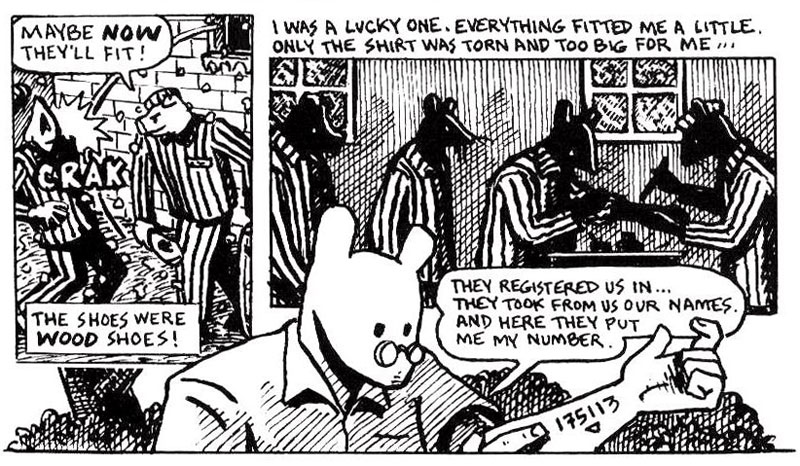
Maus and Maus II are not about the Holocaust. This is a good example of how most people miss the point of creative writing as of parables. John Lewis and his publishers sought to cash in on Maus, and did, with a cheap imitation, March and March II, giving Lewis’s personal account of the civil rights movement. But it was missing the essence of Maus. They had no idea.

Maus is a character study of Vladek Spiegelman.

Anything we hear about the Holocaust is entirely through his eyes. And he is not driven, like Elie Wiesel in Night, by a sense of mission to tell us about the Holocaust. He is resistant to talking about it. He would rather talk about his romantic conquests. And he burns his wife’s painstaking accounts of it. This is not the action of a truth-teller.

Vladek is a peculiar character. Most obviously, he is parsimonious to a comic extent. One might imagine this came from his experience in the camps.

But he is not consistently parsimonious. He scolds his second wife, Mala, for using a wire coat hanger, the parsimonious choice, instead of a wooden one, to hang up his son’s coat.

Then he secretly throws his son’s coat in the garbage. Hardly parsimonious.

Granted, in the first instance, it is his son’s loss, not his own. But then he must give his son his own old coat.

The real motive behind his parsimony is not to save money or conserve; it is to keep those around him constantly on edge, and subject to criticism whatever they do. If not being parsimonious works better every now and then, parsimony must be sacrificed to the higher objective. The point was to give Mala or Art that acid feeling in the pit of their stomach, and to delight in awareness that he is making them feel bad.

Spiegelman’s Vladek is a perceptive portrait of just what someone who has given in to the vice of pride, aka hubris, aka narcissism, is like. Vladek is the type of Hitler; and a study of the type.

One characteristic of the narcissist or vice-bound is a comically two-dimensional predictability. They form the humours of the comic stage. Narcissists act like NPCs. Vladek’s general frugality is of that order.

Vladek appears first in the tale to warn his son as a child that there is no such thing as a friend. Hitler’s starting point in Mein Kampf: it is the natural Darwinian order that everyone just looks out for themselves. For individuals and for races, it is survival of the fittest. And this is the creed of the narcissist: it is them against the world.

Moving to the present, Artie goes to visit his father, and his father’s first two sentences on seeing him after two years are complaints: first, that he is late, and second, that he did not being his wife. Whatever Artie does, Vladek will find reason to complain.

And he is the same with second wife Mala, complaining about the wooden hanger. Or the chicken is too dry.

The hanger complaint has a second function: it is meant to sow division between mother and child. The narcissist will always foment conflict within the family. It is a control thing.

When Artie asks Vladek to “start with Mom. Tell me how you met,” Vladek tells him instead about how all the women chased him, and he had another girlfriend who desperately wanted to marry him and was better looking than Artie’s mother. Anja, Artie’s mother, was nothing to look at, and supposedly had a nervous disorder. She was, as far as he is concerned, lucky to have him.

This is not the way a father should talk about his child’s mother. Again, he is sowing division within the family.

He then obliquely criticizes Anja as a communist, who betrayed a friend to a three-month prison term. It might be true; but even if so why tell it unprompted? The point of this story seem to be to belittle the other parent in the eyes of the child.

Artie catches his father then in a lie at least of omission—a warning to us as audience that he is an unreliable narrator.  Doing the math, Artie realizes that Anja, his mother, must have already been pregnant when they married. This raises the possibility that it was a forced marriage; his father may have been playing around, heedless of the women’s interests, and gotten caught.

Those who give in to the sin of pride are also likely to give in to the sin of lust. As well as that of avarice, and so forth.

Caught out on this, Vladek tried to distract by throwing shade on Artie. He accuses him of being premature: this looks like an ad hoc projection, not a truth. Then he claims the doctor had to break his arm to extract him, and that, as a child, that he often raised his arm in a “Heil Hitler” salute.

This does not sound plausible. Does a diffuclut birth ever require the breaking of an arm? Does the breaking of an arm ever cause involuntary movements for months or years after? Narcissists when caught out can say almost anything. They can seem to be momentarily delusional, as M. Scott Peck has observed.

That Vladek is rattled at this moment is demonstrated by his spilling all the pills he has been counting carefully.

He credits himself with bringing Anja back from post-partum depression with his gentle and loving care for her in a Czechoslovakia sanitarium.

Does this sound like the Vladek we can ourselves observe?

More likely, seeing how he behaves with his second wife and his son, he drove Anja to the nervous breakdown. Then, rather than let her escape his grip, and possibly have pleasant experiences without him, he grabbed the opportunity to go with her to the posh sanitarium instead of tending to his work. As a result, by his own account, he never got his new factory insured; it was robbed, and they lost everything.

It is surely actually unusual for sanitarium patients to be accompanied by “Someone they trust.” Few can afford such a thing; and it is surely considered bad for their recovery. The idea of the sanatoriums was to get away from their daily life, which is apparently troubling them, not to bring some of it with them.

He tells about the factory being robbed, presumably, because he thinks it reflects badly on Anja. Look at the trouble her mental illness caused! Look at how I suffered because of her!

And though he probably believes it himself—narcissists are expert at self-delusion-- “I did not have time to have it insured before we left” does not sound plausible. Had time been the issue, he could have had his father-in-law insure it for him while he was away. He was simply irresponsible; too irresponsible to think of such things. And, as narcissists always do, he finds a scapegoat.

There is much more, but this post is eating up too much time. I may continue later.

But the predictable effect of having a hubristic spouse or parent is, of course, to drive the rest of the family, especially his designated scapegoats, into depression. In Vladek’s case, his first wife commits suicide, soon after his son is released from a psychiatric hospital.

And, of course, he blames his son to all the relatives for this; while his son blames his mother for this. For whatever perverse psychological reason, nobody ever dares blame the narcissist. That feels too dangerous.

On top of it all, his mother having just committed suicide, and his father blaming him, Artie at twenty is also expected to console his father, who makes himself again the centre of attention with his dramatic expressions of grief.

The narcissist, when distraught, must take it out on his scapegoat. If not venting his anger on them, he will be venting his sorrow. It amounts to the same thing: the emotions of the narcissist become the family’s problem. It is up to them to do something about it.

This is the root of all “depression” and much, perhaps most “mental illness”: victimization by a narcissist in the family.

Maus lays it out plainly, and most people refuse to see it.


Thursday, January 05, 2023

Mass Shooters and SSRIs


Can't vouch for any of this, but it is interesting.

I think antidepressants are dangerous when they're given, as they commonly are, to narcissists. 

They reduce inhibitions. That is their main effect.

This is somewhat helpful for the truly depressed if only a bandaid solution: like alcohol. It dulls down without dealing with the problem.

It is lethal for narcissists, who often have symptoms indistinguishable from depression for the DSM and so to mainstream psychiatry. Like alcohol, it can lead in narcissists to violence and greater cruelty. But without incapacitating them, as alcohol will.


Saturday, November 12, 2022

Depression Truths


Kurelek, "The Maze"

A middle school student I tutor has done a competent job of detailing the cause of depression as popularly understood. It is worth going through it to identify the major errors in the popular understanding of depression. This includes the understanding not just of most people but of most psychiatrists and psychologists, although the more honest ones will admit that they are just thrashing about in the dark, and “nobody knows.”

The essay:

“Depression is a mood disorder that can make people feel sadness, hopelessness and loss of interest. It can make you feel, think and behave differently and can lead to serious emotional and physical problems. It is basically a type of mental illness that can make people start not interacting with other people and feel hopelessness and become sensitive. … Depression comes from 3 major reasons, genetic vulnerability, severe life stressors, substances you may take (some medications, drugs and alcohol) and medical conditions. 

We need to be nice and friendly to people who have depression. They can get in bigger trouble if you say some sensitive words to them. Lasty, depression is an illness to take seriously. We need to find correct solutions to cure depression. We need to help people that have depression, instead of hurting them with words we say.”

Let’s take these points in turn.

“Depression is a mood disorder.” No, the mood, sadness, is a symptom. This is like saying cancer is a pain disorder. 

Why would we imagine there is no cause for the sadness? That is like supposing there is no cause for pain. Sadness is a warning that something is wrong. To only treat the mood is to leave the problem to fester and grow.

Depression is a loss of meaning, direction, and clear values. One cannot discern right from wrong, good from bad, and so does not know what to do. It is a loss of esprit, or, in Africa, “loss of soul.”

“that can make people feel sadness, hopelessness and loss of interest,”

Anxiety is at least as common as these, but ignored or treated as a separate problem.

“It is basically a type of mental illness that can make people start not interacting with other people.”

This is perhaps the most harmful misconception: that wanting to be alone is a part of the disease. It is the proper and instinctive cure. When one has lost one’s sense of values, of meaning, the urgent need is to retreat and meditate.  To seek company at such a time is no better than to seek alcohol or drugs.

Unfortunately, the treatment most commonly recommended is to get back into one’s social life as quickly as possible. Perpetuating the problem, probably making it worse.

“Depression comes from 3 major reasons, genetic vulnerability, severe life stressors, substances you may take (some medications, drugs and alcohol) and medical conditions.”

That’s four major reasons; but there is really only one.

Symptoms mimicking depression can be caused by drugs or physical illness; sure. The symptom is not the disease. 

The idea that depression is genetic was fashionable back in the eighties or nineties. Back then, the structure of DNA had been relatively recently discovered, and the big rush was on to decode the human genome. Because it was the latest thing in science, genetics was thought of as miraculous. This is always the way with science: each new discovery is first thought of as the answer to everything. When electricity was discovered, it was supposed to be the essence of life. See the story of Frankenstein and his monster. When computers came in, “running it through the computer” was thought to be a sure proof of anything—a delusion that survives in climate science. So too with genetics: it was the cause of everything for a while, of criminality, of alcoholism, of homosexuality, of depression, of schizophrenia.

Further evidence that depression was genetic was that it tended to run in families.

Over the intervening years, however, as we have isolated the entire genome, and multiple genomes, we have found no gene for alcoholism, no gene for homosexuality, no gene for schizophrenia, and no gene for depression. Wrong tree, dog.

Something other than genes runs in families. Politics does too; religion, world view, culture, values, personal habits, and parenting styles.

Depression comes from bad parenting and miseducation. “Abusive” parenting, if you like; but that term as commonly used is misleading. The issue is not blows to the body, or sexual exploitation as such, but blows to the mind, soul, and conscience. Confusing children as to values, right and wrong, the rights of self and of others, the point of existence.

“If anyone causes one of these little ones—those who believe in me—to stumble, it would be better for them if a large millstone were hung around their neck and they were thrown into the sea.” 

This is also what original sin is all about; it is these distorted values that are visited by the father to the son unto the fourth generation.

Severe life stressors can come into play once the distortion of values has been instilled. But only stressors of a specific kind: if issues of right and wrong again become ambiguous. Some people, and not others, are vulnerable to breakdown in such cases, because their moral roots are not as firmly planted.

“We need to be nice and friendly to people who have depression. They can get in bigger trouble if you say some sensitive words to them.”

Notwithstanding this vulnerability to life stressors, this idea that the depressed are more emotionally fragile than the rest of us seems to be the opposite of the truth. Aristotle pointed out that great war leaders and heroes are commonly depressive. Grant, Sherman, Lincoln, Churchill… Yet the prime requirement to be a great war leader is to keep your head under intense stress—to the extent that someone is trying to kill you.

Because the abused grow up under constant threat and stress, they generally learn to bear stress better than the rest of us. So long as right and wrong are clear, they tend to have great personal courage. A situation of open war can bring renewed energy: now the sides are clear. This, however, is more true of a military commander than of a soldier in the trenches; who lacks the strategic view and only sees the moral dilemma of being asked to kill people he sees no reason to kill.

At a minimum, the depressed are particularly able to bear any level of insult without flinching. This is just what they are used to, and, sadly, they can be drawn to a similar such abusive situation like moths to the flame.


Monday, October 24, 2022

What Was Her Name?


Had a bad night awake brooding last night. Probably mostly just Monday blahs. Another week begins, and no sense of progress; just treading water. Just the same damned thing over and over. I began thinking, “What’s the point of a world in which the Holocaust happened?” And I truly believe it could happen again, is happening again. There are several holocausts ongoing: abortion, “mental illness.” We see the growing scapegoating and persecution of “whites,” males, Christians, Catholics, Asians, Jews.

I look at the present Canadian government: to my mind, obviously corrupt, incompetent, and plain evil, and yet voted in three times as if everything is fine…

When we were young, or at least when I was, we imagined we could make the world better. We haven’t. Or if we have, here and there, the incremental change does not seem to justify a life. 

So what’s it all about? Having kids, doing your best for them, and passing on the flame of life? Cockroaches do as much.

Feeling somewhat cheerier by this afternoon. Two conclusions. 

First, this word is not supposed to be a nice place. This is the valley of tears. Our principal job is to just forge on, trying to do what is right. Anybody who is cheerful in this world has no heart.

Second, for some reason I thought of a girl I went to high school with. I probably haven’t thought of her for forty years. Not my girlfriend; the girlfriend of a friend of mine. But he went off to sea for a year, joined the merchant marine, and she started to make a play for me. Then my family moved to Gananoque, and that ended that.

I never loved her then. As I said, I have barely thought of her since. I backed off, not wanting to betray my friend. And yet now she comes to mind, and thinking of her is oddly consoling.

She was not good looking. Her politics were nuts; she thought the ideal form of government would be a benevolent dictatorship. It would be, too, if there were any way to get a benevolent dictator into power, but there isn’t. Her politics were dangerously unrealistic. But she was a brilliant artist.

And thinking of her consoled me. Why? I was not sure at first. But I conclude that she was an example of a worthwhile life and a worthwhile attitude. Regardless of anything else, relentlessly, we can, do, should, and must find our meaning in the creation of beauty. In any way we can. 

Moreover, these two thoughts twine together. Beauty comes from sorrow. Beauty justifies sorrow.


Wednesday, October 19, 2022

Hang Me, Oh Hang Me


I recently ran across two longish documentaries on YouTube about the American Folk Revival of the early 1960s, in Greenwich Village. Great nostalgia for me.

I love that stuff. That was always my music. I loved it back in the 60s, when everybody else did. In the 1980s, I used to haunt used record stores picking up discarded folk LPs from that era. Everyone else was throwing them out. I have fantasies that one day, they will be valued again, just like Harry Smith’s Anthology of American Folk Music back in the 1950s. It is in the nature of folk music that it ebbs and flows. We’re due for another revival. So much of what we listen to now is junk.

For some, folk music is a political thing.   Back at Athabasca U, there was an active folk culture, but it was all the sociology and poli sci types; and they were all socialists. In fact, the 1940s and 50s folk revival was directly connected to the socialists and communists. This was supposedly, after all, the music of the working class.

This is not what speaks to me. It never did. My politics then as now were liberal; that is, libertarian. I could get behind the civil rights movement; I thought the war in Vietnam was ill-advised, but not immoral. I wanted nothing to do with Marxism. And the real music of the working class is rock and roll, in the city, and country and western, in the small towns. Partly, I suspect, because these middle class socialists went and politicized folk.

A big part of what did appeal to me is the emphasis on the lyrics, certainly. The folk boom segued in on the receding waves of the beatnik poetry era; and took over the same coffee houses. 


Someone has described the movie Inside Llewyn Davis as a portrait of depression. That may be the real key. Folk music is almost always sad. Not just the songs composed during the 60s folk boom. Go back to the Child Ballads. Go back to the blues. When there is a rare exception, that is the folk music I do not like. Can’t abide Melanie; can’t abide John Denver. I was always rubbed the wrong way by Pete Seeger’s chipmunk cheerfulness and “sing along with me” shtick. 

Many can’t abide my very favourite singer-songwriter of them all, Leonard Cohen, because he is supposedly too gloomy.

But it works for me. As Aristotle pointed out so many years ago: art purges the excess of some emotion. If you have an excess of fear and pity, tragedy soothes you. If you have an excess of sorrow, if you are oppressed, folk music is the cure. If you have an excess of energy, try rock and roll. And so forth. You are what you listen to. Folk music is a treatment for depression.

This comes, of course, from it being originally the music of the downtrodden. Downtrodden in a way the modern working class is not. 


Monday, August 29, 2022

Behold Man without God


Canadian artist William Kurelek suffered severe depression throughout life—ameliorated, in later years, perhaps cured, by embracing Catholicism. 

This was due to childhood abuse by his father.

The experience influences much of his work.

This is a detail from his 1957 painting “Behold Man without God,” done at about the time of his conversion. The figure at the top left is recognizable as his father. His father appears again at the bottom right.

Together, they are a portrait of childhood abuse in the real world. Like most great artists, Kurelek is an astute psychologist.

First, the form of abuse that is featured most prominently in visual terms is verbal, not physical—at the bottom right. He is scourged by his father’s tongue. This is far worse than physical abuse. And worse still, it is not simply criticism or insult: it is bait and switch. A reward is dangled in front of him, here a loaf of bread, but one he will never receive. This is the standard technique of the true abuser, false promises and misdirection. This is worst of all, because it corrodes the sense of what is real and not real, true or untrue, right or wrong.

This produces the sense of disorientation and meaninglessness that is the core experience we call depression.

Kurelek is also shown here pulling his father seated. He is carrying him emotionally. This is the general experience of the family of a narcissist, even when the narcissist himself is mild mannered or favours them: the narcissist will lean on them emotionally. If the narcissist has a bad feeling, it is always the child or spouse’s responsibility to do something about it. The narcissist is emotionally weak, unable to walk on their own.

In the centre of the detail shown, a ring of people are trapped by the head or neck, under a sign that reads “Home Sweet Home.” A commentator on the museum site says this is a “group of abused children.” Not quite; not all are obviously children. As the sign tells us, it is an image of the dysfunctional family. They are all trapped by the head or neck by the shared family dynamic or delusion emanating from the narcissistic parent, even if the narcissistic parent is not present. They are all feebly biting each other and hitting one another with maces, wherever they can. 

This is the family situation the abusive parent will set up: they will deliberately foster enmity among all other members of the family. This increases their power and control. By, for example, promising this child or that child special favour, often in return for turning against a sibling.

Kurelek, the scapegoat, beaten at the top left, seems also to be one of the figures trapped at the neck by the revolving table. He seems to be the figure in the foreground.

That it is revolving is also important: no progress is ever made. It is all set up this way by the narcissist, who fears breaking out of a severely constrained orbit. The outside world, and progress itself, threatens his delusions of his own importance and his control. Any outside contacts or friendships will be discouraged in a dysfunctional family; they will be notably clannish. Any feints towards outside success will be discouraged. Any signs of originality of thought will be punished. One must conform to the family pattern. 

Hence the sense of meaninglessness and an inability to progress that most characterizes what we call “depression.” A sense of being trapped in a horribly banal world, like Dorothy at the outset of The Wizard of Oz. A sense that you, or those around you, are robotic. Because narcissists are.

Happily, Kurelek also points the way to break out of this horror: Through art, that sees the transcendent, and through religion, that takes us there.


Tuesday, August 23, 2022

"New" Treatments for Depression


With the collapse of popular trust in the SSRI antidepressants, Dr. John Campbell, who has himself suffered from the black dog, reviews the recent literature suggesting that small doses of hallucinogenic drugs like psilocybin may be an effective treatment.


This should be no surprise. But it has nothing to do with chemical interactions or the lack of certain chemicals in the brain. It has to do with consciousness.

Depression and chronic anxiety are caused by having been indoctrinated with a false world view and false self-image. In the natural course, this is most likely to have been by a malicious or narcissistic parent. It can also afflict an entire society. This is why mental illness is increasing rapidly in our own.

More directly, depression, which is really to say, a sense of meaninglessness, and chronic, omnidirectional anxiety, is caused by a dissonance between the world view and one’s own sense experience, conscience, and common sense. This is deeply disorienting.

Second premise: what we call the imagination is an organ of perception that reveals, if only in small part, the world of universals, of ideal forms as defined by Plato. That is, what we perceive through imagination is not random or “made up,” but universal truths. Jung called them “archetypes.” But he falsely thought they represented something else, something physical. They are simply the real world.

Therefore, the proper and necessary cure for the distorted world view that causes depression and anxiety is the exercise of the imagination. This can and ideally will restore a sound basis to our thought.

Shakespeare, great psychologist that he was, presented this as a “green world” in which his characters’ problems, generally caused by an error in self-image, were resolved.

Traditionally, this reorientation or reprogramming is done through the arts, through prayer, and through meditation, “mindfulness.” Pagan societies might treat mental illness with a masked dance. It has also long been noted that mental distress can be soothed by travel, by “getting away from it all.” As a result, “ships of fools” reputedly used to sail constantly up and down the Rhine.

All these are ways to develop the imagination and open channels to the eternal world.

This also happens spontaneously through psychosis. Rather than a disease, psychosis, like a fever, is a healthy corrective response to some critical bit of false programming. Tragically, we no longer let it run its course, making mental illness incurable.

The same effect can also be stimulated artificially by psychotropics. We have known this well enough since the 60s. They can force open the inner eye. People often claim to “see God,” and so forth.

Therefore they can cure depression.

The problem is that psychotropics are undirected. There are more things in heaven and earth than are dreamed of in your philosophy. There are demons and new darknesses as well as fairies and rainbows. Using psychotropics is like letting psychosis run its course. Most often, it will cure; but some will only get more deeply trapped. Just as some psychotics stay psychotic indefinitely.

One needs a spiritual guide, who will reliably direct towards the light.

Some materialist in a white coat has no idea how or where to spiritually guide.


The best treatment for depression and anxiety remains the best of the arts, meditation, and prayer. For these are guided, tested and reliable. Small doses of psilocybin or other chemical substances might assist in this process.

Sunday, July 31, 2022

Everything I Need to Know I Learned in Fairy Tales


Snow White


W.C. Fields used to say “you can’t cheat an honest man.” I always took this for an alibi: an attempt by the con artist to deflect blame. Indeed, a clear case of blaming the victim.

But I have recently heard the same thing from a more reliable source; I think Jordan Peterson. Con artists count on the mark consenting to the con. The mark wants to believe something; the con man just gives them what they want. Anyone with a commitment to reality would have seen through the con, and the mark probably does too. Drink this, and all your troubles will go away. Take this gamble, and you can win a million dollars. Rub this on your head, and your hair will grow back. They are buying a pleasant fantasy, if for a few hours or a few years.

The words of Dr. Martin Luther King also come to mind: that nobody can oppress you without your consent. That sounds harsh, but maybe it is true. Con black men into the notion that they are incapable of doing things for themselves, and need to be taken care of. That requires consent. George Orwell saw a large number of black men taking orders from a white overseer in colonial Africa, and wondered in print, “How are they being fooled? How long are these people going to accept this?” But it appeals to indolence. Don’t we all more or less wish we could be taken care of, like a child?

This is not to underestimate the great difficulty for any individual to buck an oppressive system. It never pays to be an “uppity nigger.” But the greatest resistance is likely to come from the fellow oppressed. A black man trying to get ahead is liable to be accused of “acting white.” He’s a sellout.

Or their fellows will turn kapo. It was his fellow black slaves who beat Uncle Tom to death in the famous novel, at the slavemaster’s bidding. (Yet, and tellingly, it is “Uncle Tom” who is remembered as a supposed sellout. Precisely because he wasn’t.)

The truth is, the black man we does right and works hard is making his neighbours look bad. They want their oppression. It absolves them from effort and from moral responsibility.

The same dynamic is at work among the aboriginals/”First Nations.”

Now apply this to mental illness. Because it is all most obvious, and most extreme, here. Early on, Freud realized that mental illness was the result of childhood abuse. However, he, and every analyst before or after who has realized this, found that the patients themselves would resist. They might not deny it, they might agree, they might even point it out, but they would stop coming to analysis. Not a paying proposition. Freud invented the “Oedipus complex” as a more marketable con. The patients did not want reality, and they did not want cure. Freud grew, on these grounds, to feel contempt for his patients. A con man must harden his heart.

Mental illness is in most cases the result of abuse by a narcissistic parent. But the critical form of abuse is not sexual, or physical, but moral. It is being conned into a false sense of reality and morality. The narcissist, by nature, sees themselves as their own god. By extension, they will set themselves up as their children’s god. They will con their children into embracing various falsehoods and immoralities, as con artists do. This is what gods are supposed to be able to do. This asserts their godhood. The children become accomplices, and idolaters.

If anyone tries to break out of this, they become the scapegoat of the others. Being accomplices in their own abuse, all in the family fear the cold light of the real. They cling to the fantasy—to the point of violence or self-harm if necessary.

Fairy tales are our best source on “mental illness”; they were created to advise children on life. Consider Snow White. She is the victim of abuse by a malicious parent. She escapes with her life. The dwarfs, her spiritual guides, warn her not to commune with “strangers.” Three times her abusive mother, “in disguise,” is able to abuse her again, by appealing to her vanity and her sense of being special. By conning her. This models the actions of an abusive parent; and the tendency of the abused child to keep returning to be abused again. Like a misguided moth, drawn back in to the initial fantasy, imagining the parent has “changed.”

Cinderella doesn’t immediately seem to be complicit in her abuse. But read carefully. When she goes to the prince’s ball, dressed to the nines, her sisters do not recognize her. Yet she does not reveal herself to them. Later, at home, she pretends she was not at the ball. Why? What is she hiding, and who is she protecting?

She is protecting the family fantasy, and her own abuse. She must remain Cinderwench, and they are the better daughters. She is more comfortable in this delusion, and so complicit in it. Only later does she gather the courage to reveal herself.

In Rapunzel, her state of abuse is symbolized by being locked in a tower. Yet she could actually leave at any time. The witch, and then the handsome prince, come and go by climbing her tresses. Why could she not escape herself, by cutting her hair, tying it to the windowsill, and climbing down? This is indeed just what the witch does later.

She is complicit in her own captivity, because to give it up she would have to give up the sesnse, cultivated by the witch, her narcissistic parent, that she is special.

Here we see both the cause of, and the cure for, “mental illness.” It must be a wholehearted embrace of objective truth and objective morality. This will require, as Alcoholics Anonymous rightly point out, an examination of conscience and a Frank confrontation with our own guilt.

Mental illness is ultimately a moral issue.

Psychiatry cannot help, because psychiatry rejects morality.


Rapunzel