Playing the Indian Card

Showing posts with label psychology. Show all posts

Wednesday, January 07, 2026

The Fatal Flaw in Meaning-Centred Therapy


I believe that the growing epidemic of “mental illness,” drug abuse, self-mutilation, and suicides in North America is all due to a loss of any sense of meaning in life. Resisting the call to religion, a psychology-oriented friend suggests instead the value of “Meaning-Centred Therapy,” based on Viktor Frankl’s “logotherapy,” based on the postwar philosophy of existentialism. It “helps people find purpose and meaning in life, even amidst suffering, by focusing on creating, experiencing, and sustaining meaning, often through structured exercises to connect with sources like values, relationships, and creativity.”

Can you see the problem? This approach has two premises: first, you are depressed because you feel there is no meaning to life. Second, you are right, there is no meaning to life. You need to make something up. That will be $80. Thanks.

You cannot “create” meaning. You cannot pull yourself up by your own bootstraps.

Religion tells you what the meaning of life is.

“Meaning-Centred Therapy” should lead to despair.


Wednesday, December 31, 2025

On Dichotomous Thinking


The present, postmodern spirit is that one must not be “judgmental.” The term I hear from a psychologist friend is that one must avoid “dichotomous thinking.”

However, all thought is dichotomous. Aristotle’s Law of Non-Contradiction: “either A or not A” is the basis of all logic. And the truth of this is reconfirmed by every computer program. Thought is binary. Yes or no, either/or.

Therefore, avoiding dichotomous thinking, avoiding judgements, is avoiding thinking. Is this a good thing?

It is at least arguable that it is not. “Ignorance is bliss.” “Don’t eat of the tree of the knowledge of good and evil.”

However, if you accept Plato’s contention, and Christianity’s contention, that all value comes from the three transcendentals, the Good, the True, and the Beautiful, refusing to think is evil. Seeking truth is why we are here, along with seeking justice and beauty. God himself is the perfection of these transcendentals: the perfectly real, the perfect good, and perfect beauty. Not to think is to turn away from God. Making postmodernism or modern psychology soul-destroying.

Why do we suppose truth matters? To Plato, the value of truth is self-evident, inherent, and incontrovertible: nobody genuinely believes falsehood or illusion is more valuable than truth or reality. 

Moreover, if you do, you are insane.

It seems obvious that anything and everything we class as “mental illness” is definitionally a failure to engage in “dichotomous thinking,” a failure to make clear judgements. Psychosis is an inability to distinguish what is real from what is not real. Depression or “neurosis”: is a sense of lack of direction—a lack of certainty about what has value, what is real, what is good, what is right or wrong. This is also the source of chronic anxiety. Clear direction, clarity of thought, heals all that.

Religion is the obvious antidote, and psychology is therefore harmful to mental health. Firstly in serving as a distraction. Consider if someone has cancer, and goes to a homeopath or a snake-oil salesman instead of a certified doctor. Wouldn’t you say that homeopathy or snake-oil here is causing harm by not working?

But worse: in condemning “dichotomous thinking” or “judgementalism,” psychology is actively causing and promoting mental illness. 

See too psychology’s concept of “mindfulness”: which to psychology means “being present in the moment.” You should empty your mind and concentrate only on immediate sensations.

Mindfulness is originally a Buddhist concept. But psychology, in appropriating the term, got it upside down. The original Pali term is actually cognate to “memory.” So it is very much not about being in the present moment. That would be the absence of mind, mindlessness. Surely it is odd, if the idea is to be alert to what is around you, that you should shut your eyes to meditate. This inversion of te practice is what psychology promotes. almost necessarily, because it denies the psyche.

To be fair, not thinking about things can indeed bring temporary relief to people with mental conflicts. But this is like getting good and drunk to forget your troubles. Not a cure, and sure to make matters worse over the longer term.


Sunday, December 28, 2025

Why Psychology Is a Bad Idea


Psychology emerged towards the end of the nineteenth century as an attempt to apply the principles of empirical science to the study of the psyche-- that is, the soul. Say “mind” if you prefer, but “psyche” translates literally as “soul.”

It was, therefore, a replacement for religion, which is the traditional practice of care of souls, and the body of knowledge about the soul. 

The question is, therefore, has psychology done a better job than religion at the care and nurturing of the human soul?

Conceptually, unfortunately, an empirical study of the soul or mind is nonsense. The methods of empirical science cannot be applied to the soul, because the soul is not a material object. It cannot be directly observed, cannot be seen, touched, tasted or touched. Science is learning by observation, and the soul cannot be observed. 

All of the “clinical evidence” from psychology is hearsay, and would not be acceptable in a court of law.  Nor would it be acceptable to real science—it is all anecdotal and second or third hand. 

As for experiment—psychology faces an insurmountable observer paradox. As Labov pointed out, in this case, the act of observation alters the object observed—or opinion expressed. As a result, psychology has no valid findings, and the currently fashionable theories simply change every twenty years or so, with no progress. Mathematician Stanislaw Ulam issued the challenge, “Name me one proposition in all of the social sciences which is both true and non-trivial." The only response so far has been the economic theory of comparative advantage. Perhaps.

It is worth noting as well that all psychological experiments, such as they are, are unethical. They violate Kant’s categorical imperative, that our fellow men must be treated as ends, never as means.

A friend of mine wrote a book about his grandfather. His grandfather was a prominent psychiatrist, once chief medical officer of the Queen Street Asylum in Toronto. Confined to a bed on suicide watch, said grandfather laboriously severed an artery in his leg with a butter knife.  My friend gave a presentation to the assembled staff of the Clarke Institute, Toronto’s second asylum, hoping for answers. Silence. At the end, one came up and said to him, “you realize, none of us has any idea what we are doing.”

Before “scientific” psychology took over in the mid-nineteenth century, cure rates reported for serious mental illnesses were quite high—often 80 or 90 percent. And mental illness was rare—perhaps a hundred patients in the Bedlam Asylum, the only one in the UK, in pre-modern Britain. As the culture has gradually turned from religion and towards psychological explanations and treatments, the incidence of what we call mental illness has grown year over year—one might almost say exploded. And all major forms of “mental illness,” once commonly cured, are now considered incurable. 

This is not a record of success. 

A world-wide WHO study in the seventies found that reported cure rates for serious mental illness are still far higher in the Third World than in the developed world. Which certainly seems to suggest that less psychology leads to better mental health.

Why does psychology persist? Too many wealthy vested interests with political power, often with the coercive power of the state behind them. And an irrational veneration of anything called “science” among the general public. 

But things are reaching a crisis point: not just with mental illness, but also drug addiction, mass shootings, suicide, self-harm, and general social dysfunction. 

It is urgent that we turn back to God.


Monday, December 22, 2025

Healthy Religion


psychiatric restraints

A friend recently expressed his support for “healthy religion.”

This seems to me a backhanded criticism of religion, damning with faint praise. The implication is that religion is often unhealthy.

Pharisaism, I would agree, is unhealthy. But that is not religion, is it? It is feigning religion--by definition.

I Grokked the term “healthy religion,” and find it is a concept in psychology:

“Key Differences Between Healthy and Unhealthy Religion

The distinction between healthy and unhealthy religion often boils down to how faith impacts individual well-being, relationships, critical thinking, and society. Psychological research and expert analyses (e.g., from psychologists like Kenneth Pargament and studies in journals like Psychology of Religion and Spirituality) define healthy religion as one that promotes positive mental health outcomes—such as reduced anxiety, greater life satisfaction, empathy, and personal growth—while being flexible and intrinsically motivated. In contrast, unhealthy religion (sometimes called toxic, fundamentalist, or cult-like) leads to negative outcomes like fear, isolation, intolerance, and psychological harm through rigidity, control, and coercion.”

So the concept of “healthy religion” is a psychological one. It is judging religion from the viewpoint of psychology. In other words, it assumes modern psychology is the standard by which religion is to be judged.

That is backwards. Religion deals with absolute truth and absolute value: “worth-ship.” Accordingly, religion is the standard by which psychology must be judged, not vice versa. You have to determine what you want to do before you decide what tool will do it.

I agree that religion promotes positive mental health outcomes, reduced anxiety, greater life satisfaction, empathy, and personal growth. I think this is true of all religion, at some level. But that is not the purpose of religion. You do not worship God for your health.

Are there indeed forms of religion that produce fear, isolation, intolerance, rigidity, control, and coercion? I do not think so. Religion is perhaps unique among human concerns in that it does not and cannot control or coerce: one’s religion is always voluntary. One can always walk away. One can be forced by a government or one’s family to pretend to belong to a given religion; but not to actually believe it. And such coercion is from the government or the family, not the religion. 

This is not true, for example, of psychology, which can at times be coercive: involuntary confinement, electroshock therapy, lobotomy, shackles, straightjackets, and so forth.

Does religion produce intolerance? Belonging to a religion can cause one to be intolerant of people not members of that religion; but this is true of all groups. To form an in-group of any kind is automatically to form an “out-group.” And surely one does not want to discourage all community on these grounds. Conversely, it is from religion that we get the concept of human equality and human rights—that all men are brothers and you are to do unto others. So if intolerance is your concern, religion is your solution, not your problem.

Does religion produce isolation? Yes, if one seeks to withdraw from the world, perhaps as a monk, anchorite, or sannyasin. One grave problem with psychology is that it discourages and tries to prevent this often healthy and life-giving option. True, others may also shun you because you are religious—but to blame religion for that is like blaming Jews for the Holocaust.

In conclusion—for now—I’d like to endorse healthy psychology.


Sunday, October 26, 2025

Psychology and Religion


I am disturbed by a recent casual conversation with two guys who are both certified clinical psychologists. Between them, they seemed to believe every mass delusion and “conspiracy theory” currently on the market. I may not know much, but as a writer and a student of world mythologies, I can generally spot an urban legend when I hear one. They seemed to have no such ability. They believe whatever they hear on YouTube, generated by algorithms designed to feed them what they want to hear. I thought of the phrase, “the blind leading the blind.”

How are these people qualified to give advice to others on life, on what is real, on values? When they are so suggestible and easily misled themselves? Why do we think they have any such qualifications? 

To advise others on what is real, or good, or advantageous, we need a firm grip on some objective standard. We need to know what is real, or good, or advantageous; we cannot teach what we do not know. Psychology does not know.

This is the task of religion, or religion and philosophy. 

Whether any one religion is true or false, if any life advice is to be found, this is the only place it is to be found. By definition. “Worship” means “worth-ship,” determining the value and reality of things. “What is real?” is a religious question. “What is good?” is a religious question. “What is the good life?” is a religious question.

The great universal faiths agree on most things; psychology is an outlier. One could do better relying on any one of them.


Thursday, July 10, 2025

How to Feel Good


A friend who is himself a therapist sent me a link to a brief summary by David D. Burns, promoting his book Feeling Good. Reading it, Burns himself acknowledges that no known form of psychotherapy actually can be shown to be effective. Including his own.

“For example, in one large, well-controlled outcome study, CBT [Cognitive Behaviour Therapy, essentially his own approach] was found to be comparable to the popular antidepressant medication paroxetine (Paxil) in the short-term, and slightly more effective in the long run, when patients were contacted a year or more after treatment (DeRubeis et al., 2005; Hollon et al., 2005). Most researchers and clinicians have concluded that if CBT is at least as good as treatment with antidepressants, then it must be effective.”

Wait. The problem is, the SSRI inhibitors have not been shown to be effective. So if CBT is no better, it does not work. I had thought it was at least one therapy that did have scientific backing.

Burns confirms this further on:

“if you examine the data closely, and understand the rating scales the investigators used, it becomes clear that neither CBT nor antidepressants (nor any form of psychotherapy) appears to be much better than treatment with placebos. In fact, many recent research studies indicate that the so-called ‘anti-depressant’ medications may have few or no significant anti-depressant effect above and beyond their placebo effects.” One study I saw found them no more effective against depression than sleeping pills. “In order for any treatment to be truly deemed ‘effective’ it must provide an effect significantly superior to placebo. Sadly, this is not the case for any of the currently prescribed antidepressant medications or any currently practiced forms of psychotherapy.”

There you go—little to no scientific backing for any form of psychotherapy. You might as well just put on a mask and do a rain dance.

Burns cites no stats for his own “TEAM” approach, only anecdotes. But he does make the following claim for using his book:

“Results indicate that bibliotherapy [meaning his book specifically] can be almost as good, if not better, than the results obtained with antidepressant medications or psychotherapy in controlled outcome studies (Ackerson, Scogin, Lyman, & Smith, 1998;…)”

In other words, his book too does just about as well as a sugar pill.

Now you might rightly ask, what are you supposed to do if you are a therapist, and someone comes to you with a problem? You want to help; you do not want to send them away; you must give them something. Isn’t it better to give them a placebo than to give them nothing?

Yes, so long as you are not charging more than the cost of a sugar pill for it.

And only if there are no alternative treatments available that do work. To say that no forms of psychotherapy work is not to say that nothing works for depression or mental illness or the problems of life. There is an obvious alternative treatment for the problems of life, or for those who struggle with meaning or the nature of reality; it is almost too obvious. That is what religion is about.

Psychotherapy and psychology began as an attempt to replace religion. This is plain in Freud. Jung admits this. It is a failed replacement. Religion works, and materialist psychotherapies do not.

You can see the rates of depression, mental illness, drug addiction and suicide rise as church attendance falls. Correlation does not prove causation, but it is a clear correlation. Looking further back, the reason Christianity spread so quickly across the Roman Empire, then Northern Europe, then the Americas, then Africa, according to the chroniclers of that day, was its ability to cast out demons—in modern terms, to cure severe mental illness. That’s a lot of empirical evidence that it works. 

In the Seventies, the World Health Organization did an international study, and found the recovery rate for mental illness was dramatically higher in the “Third World” than in the developed West. The obvious variable is that the developed West relies on scientific psychology, and the poor South relies more commonly on religion.

You might argue that there is in turn no proper scientific proof for the effectiveness of religion. I believe there is, but this is not that relevant. Science is a tool to study nature, not mankind; it does not work on subjects, only objects. Mankind is studied through history, philosophy, and the arts—the humanities. We deduce from first principles, from the lessons of history, and the advice of great minds.


Sunday, March 16, 2025

The Subconscious


Freud shows us his imaginary phallus


I have lost two of my best friends to psychiatry. 

The first, whom I had known since first year university, through think and thin, unfriended me emphatically in insult and anger when I questioned psychotherapy. To be clear, these were the words which he apparently found unforgivable:

“You believe you have been helped by psychotherapy. I admit that this is possible. Some people were helped by joining Jim Jones’s People’s Temple, too. But overall… not such a good idea. This may be an extreme example, but it makes the point. And I am not sure it is extreme, actually.”

My being concerned with his welfare was not held in my favour.

Another friend, whom I had cherished and admired for a good thirty years, unfriended me and declared me immoral for scoffing at Maslow and existentialist psychiatry. My argument was that they claimed depression was caused by a sense of meaninglessness, and then affirmed that there was indeed no meaning in life. So going to an existentialist therapist could not be helpful.

I cannot imagine any religious person having a similar reaction over a similar criticism of religion. Certainly not cutting off such longstanding friendships. Among the religious, it is the reverse: they are eager to discuss the issue. They will even knock on the doors of strangers in hopes of doing so.

So I must conclude that the average person who believes in psychiatry holds to his faith more fervently than if it were a religion.

This does not speak well of psychiatry, given that it claims to be scientific. It is obviously something else. Not religion; more like a cult.

As a general principle, if one believes one has the better argument, one enjoys an argument. If one suspects one’s beliefs are untenable, one will refuse to discuss them. Especially if there is something personal at stake.

I think this “true believer” phenomenon is a symptom of the incoherence of materialism. It is our dominant world view: we believe in “science.” But scientific materialism fails to account for the larger portion of human experience. If one is not a total zombie, one discovers this. And then what? Then depression or mental illness occurs: one is out of step with what “everyone knows” is true. At best, one is alienated. At worst, one concludes one is incurably insane. One is experiencing impossible things, things that do not exist.

Psychiatry rushes in as the attempt to reconcile one’s experience with materialism. And partly as Inquisition, rooting out heresies by declaring insanity. 

People then cling in desperation to their chosen psychology, because from their perspective, if they doubt the therapist, they go mad. 

In objective terms, however, it is the psychiatry that is making and keeping them mad.

My first friend accepted that Freud, the founder of psychiatry, was mostly wrong. Of course; he has, after all, been disproven in detail in scientific terms. However, Freud must still be honoured as the man who discovered the subconscious. The subconscious explains everything.

But the subconscious, or Jung’s similar “unconscious,” is actually nonsensical. It is a self that is not ourself, a will that is our will yet not our will, a consciousness of which we are not conscious. 

These are all contradictions in terms.

The obvious truth is that these strange messages or intimations or urges or images are not coming from us. Indeed, they are not by definition. There is a spiritual world. And it is no more a part of us than is the physical world.


Sunday, July 07, 2024

The Only Sane People in the World


I have lived in a number of countries around the world. One thing I have learned from that—the main thing—is that everyone is insane.

This should not be surprising. Every religion tells us so. Truth, enlightenment, is revealed only to a few. It might come as a surprise only if you buy into modern “scientific” psychology. Lacking any standard for truth or reality, it merely defines “sane” as “having the majority opinion.” That obviously does not work. It is a recognized logical fallacy: ad populum.

We all live on delusions. Francis Bacon classified the common sources centuries ago, and founded empirical science as a way to break through. It has not worked. Churchill once said something like, “Most people, if they stumble upon the truth, will just pick themselves up and dust themselves off.” Bertrand Russel once said, “Most of us would sooner die than know the truth. And most of us do.”

One of the standard sources of delusion, as Bacon shrewdly classifies them, is “idols of the tribe.” These are delusions shared by a social group, the members of which can easily mutually reinforce each other in the delusion. It is hard in isolation to persist in a delusion.  When everyone around you is agreeing with you, it is far easier. These delusions of the tribe are actually encouraged by psychology. Shared delusions tend to define a nation.

Living in another country, especially one with a significantly different culture, reveals these delusions. If unreflective, an expat will after a few months come to the conclusion that they are all mad here. If he is more thoughtful, and more self-reflective, he may conclude instead that he is mad. If more reflective still, he will realize that both are—or at least, he too had been, on this or that matter, before now. 

All that is a lead-in to this: not all nationalities are equally mad. In my still limited experience, North Americans, at least in these times, are profoundly mad. Madder than hatters. Thank me for sharing. The Chinese can always be counted on to be mad. The French are certainly mad. We all know about the Germans and their fits of madness. The Japanese are mad, Koreans are mad. These are beautiful cultures, perhaps the most impressive cultures, cultures in which education is highly valued. And one would expect education to be a cure for madness. Yet it can as easily be the reverse: it can be an education into the shared delusions. And great art can be the individual’s desperate attempt to break through the matrix of thyeir culture. Like the sand in the oyster’s shell that forms the pearl of great price.

 Italians are far less prone to be mad. Greeks are less prone to group madness. This despite their impressive cultures. But perhaps too, it explains why they are not as creative as they once were.

I probably can’t be objective about the Irish, but I think they are uncommonly sane.

But the sanest group of people I have ever had to deal with—and I have dealt with them quite a bit, largely for this reason—are the Filipinos. They are on the whole profoundly sensible, always with their two flat feet on the ground. Among other things, this makes them, contrary to what seems the stereotype, quite unromantic. They are, on the other hand, religious, and take seriously the other world. Being practical and non-delusional means you do take account of the spiritual world. 

Materialism is the greatest of our North American delusions.


Sunday, June 02, 2024

Twelve Rules for Life


I have not read Peterson’s Twelve Rules for Life. I do not intend to read it. So it is no doubt iunfair of me to criticise it. But its subtitle to my mind tells the story: “An Antidote to Chaos.” This is why I will not read it, and surely I can criticize the assumptions implicit in that subtitle.

It is, in the end, a book on ethics—that’s what “rules for life” means. It therefore seeks to replace traditional ethical codes, like the Ten Commandments.

This already sinister, and this is the problem with psychology in general: it substitutes random thoughts for religion. This is dangerous. “Psyche” means soul; the real, tried and true, wisdom concerning the soul, developed and preserved over millennia, is religion. “Scientific” psychology, by contrast, is never going to be as reliable. It claims to be superior as “science,” yet it has no scientific basis. The soul cannot be seen through a microscope. It is always only one guy expressing his opinions. Religion, by contrast, is the accumulated wisdom of the best minds over many generations.

And the real attraction of psychology to those who subscribe to it is not that it is “scientific” or more reliable. No serious student of the matter could think so. Its attraction is that it promises to dodge the traditional ethical demands. It is not “judgemental.” It accepts and promotes free sex, for just one example, and considers any guilt feelings bad. So those with a guilty conscience will cling to it, and with a fierce devotion never seen among the religious defending their faith. 

The subtitle makes it clear that Peterson is doing this here. The goal of his rules, of his proposed ethics, is avoiding chaos rather than doing good or avoiding evil.

Avoiding chaos is not a worthy goal. It sounds good, but sometimes order is not desirable. New ideas emerge from and create chaos. Have you ever seen a photograph of Einstein’s desk at Princeton? Push order as prime directive, and everything comes to a dead stop. The garden dies.

Reputedly, Peterson also identifies chaos with the feminine, and order with the masculine. He refers to chaos as “the eternal feminine.” He claims, apparently, that this is not his idea; it is a consistent association in world myth.

But it is not. Peterson has apparently not studied world myth that deeply. As is typically the case with psychologists; their knowledge is superficial, and they latch on to one or two motifs that seem to them to confirm their pre-existing ideas. Freud’s complete inversion of the story of Oedipus for his “Oedipus Complex” being the most famous example. 

In China, the dragon, lung, masculine, represents the Emperor. The phoenix, feng, feminine, represents the Empress. The dragon is the unbridled forces of nature. The phoenix is the bridle: grace and order. The feminine civilizes the masculine energy.

The very personification of order, and the moral order, in Greek mythology, is Dike, and she is feminine. Conversely, Zeus, the principle male deity in the Greek pantheon, is the storm god: an image of chaos. Who, not incidentally, cannot keep his fly zipped.

In the legend of Gilgamesh, the world’s first known epic, Enkidu, the wild man, is civilized by his first encounter with a woman.

In the Jewish and Christian tradition, Logos, order itself, is identified with Sophia, wisdom—and Sophia is always personified as feminine. As she is in the Hindu tradition as well—as the goddess Sarasvati.

Reading psychology is generally a way to get lost in the weeds. It is perhaps the leading cause of mental illness. Arguably, mental illness is entirely a product of psychology. Peterson, although he seems to be taking baby steps towards a more religious view, is still a false prophet.

The tragic thing is that the popularity of the book, and of Peterson, shows there is a tremendous thirst for spiritual guidance. And Peterson and his book are leading these poor vulnerable souls astray.


Monday, May 13, 2024

Depresssion and Its Cure


It seems plausible that the reason for the rapid rise in depression and other mental illness has been the growing use of seed oils. 

But this relies on the premise that depression is a “chemical imbalance in the brain.” That looks like a categorization error, mistaking something spiritual for something physical, the menu for the meal. It is like supposing that doing a dance wearing a false face will scare away cancer. It actually can work—witness the placebo effect—because mind and body do interact. But it is going about it the long way around.

What is depression really? It is not particularly related to feeling sad. “Depression” is a misleading term. The older word, “melancholia,” is better. Often more like an emotional numbness, and as often anxiety.

It is best described, perhaps, to those who have not experienced it, as like being in a maze. And in that maze, there is a minotaur. Any way you turn is probably wrong. But staying put is also wrong.

The obvious way to understand that, is that you have lost your moral compass. You have lost your sense of right and wrong.

Not in the way psychopaths are supposed to. Psychopaths seem to have the opposite experience, that nothing is wrong, and you are free to do what you want. The depressed feel instead that nothing is right; which paralyses them.

Most likely either is the result of an immoral upbringing, an upbringing by a parent who themselves had no moral sense; a parent who is either a psychopath, or chronically depressed.

The more dramatic experience we call schizophrenia seems adjacent in kind. Here the problem is not just what is right or wrong, but what is real. Probably produced most often by a parent who chronically “gaslit,” to use the currently popular term. And here, too, there are logically two opposite forms: either anything I want to be real is probably real; or anything I don’t want to be real is probably real. The former produces what we call narcissism. The latter produces what we call schizophrenia. 

So what is the proper or probable cure?

Where do we go to discover what is genuinely right and wrong, and what is genuinely real? Where do we go to reprogram our minds out of this trap?

Obviously, to philosophy and to religion.


Wednesday, January 11, 2023

How Many Souls Fit under a Microscope?


I think psychiatry and psychology do enormous harm. “Psyche” is soul. You cannot have a materialist psychology, that does not even believe in the existence of the soul. 

That blanket statement includes Jordan Peterson. While I generally agree with his politics, all he has managed to do in his thinking on psychology, in his rules for life and related videos, is to struggle his own way through a corn maze of miseducation to the unlocked front door of the stable. He is perhaps ready to acknowledge the existence of God. That puts him in the position of a baby about to be baptized; not a leader.

More regrettably, psychology suffuses our culture. We treat it like a religion; except that people seem to cling to their preferred psychological theories more fiercely and with less logic or evidence than anyone ever clings to a religion. Marking it as an idolatry, or, in psychological language, a delusion.

A sample text in a current textbook—in English, not Psychology--is all about the problem of bullying. And it explains, as psychology does, that people become bullies because they have themselves been bullied; or because they have been neglected by their parents, and do it to get attention.

One vital thing is immediately missing in this analysis: free will. As we see here, psychology reduces everyone to NPCs—except the psychologist. You stick in this pin, and you get that response.

The tremendous advantage of this viewpoint is that it eliminates right and wrong. With no moral choices, there is no morality. This is a great boon to those who want to do wrong, of course. Accordingly, psychology promotes evil.

That is actually the perfect philosophy to create bullies. It exonerates them. And it makes it unnecessary, indeed impossible, for them to change their behaviour, to improve themselves—because, after all, they have no free will. At the same time, the psychologists see themselves as gods, having agency over their patients when their patients do not—attracting bullies to the profession. And of course being logically inconsistent, and denying the essential moral principle, that of human equality: do unto others.

All this would be utterly damning even if it were true that bullies are tempted (albeit not compelled) to bully because they have themselves been bullied. But this too is improbable. Being bullied is painful. Experiencing pain, does the average person really want to impose it on someone else? If, for example, you put your hand on a hot stove, and get burned, are you motivated to encourage others to put their hands on hot stoves?

For most people, the reverse. Being bullied would convict you not to bully another. You would develop empathy and a fierce sense of justice. 

And this is just what you find in those who have been abused. Elon Musk is one example. He apparently bought Twitter to end the bullying.

Why do psychologists believe the opposite? 

First, because they simply ask bullies why they bully, and accept the answer. No bully is going to voluntarily take the blame. The obvious dodge is to insist they are actually the victim. 

And, being bullies themselves, the psychologists embrace the explanation.

As for bullying coming from a lack of attention from parents, this is nonsensical, because as a child, in order to get away with bullying, you generally do not want adult witnesses. So it is not what you are going to do if you want attention from your parents. It is the opposite of what you would do.

THis too probably comes from bullies refusing to take responsibility for their actions. So they will shift the blame to their parents: "I wouldn't have been able to do it if they had kept a closer eye on me."

The best approach to psychology is to assume that everything it says will be the opposite of the truth.

I think we all secretly know this. It is more or less the basic principle Freud propounded, when he claimed that everything our subconscious says to us means its opposite. He was actually revealing that tendency in himself.


Sunday, July 31, 2022

Everything I Need to Know I Learned in Fairy Tales


Snow White


W.C. Fields used to say “you can’t cheat an honest man.” I always took this for an alibi: an attempt by the con artist to deflect blame. Indeed, a clear case of blaming the victim.

But I have recently heard the same thing from a more reliable source; I think Jordan Peterson. Con artists count on the mark consenting to the con. The mark wants to believe something; the con man just gives them what they want. Anyone with a commitment to reality would have seen through the con, and the mark probably does too. Drink this, and all your troubles will go away. Take this gamble, and you can win a million dollars. Rub this on your head, and your hair will grow back. They are buying a pleasant fantasy, if for a few hours or a few years.

The words of Dr. Martin Luther King also come to mind: that nobody can oppress you without your consent. That sounds harsh, but maybe it is true. Con black men into the notion that they are incapable of doing things for themselves, and need to be taken care of. That requires consent. George Orwell saw a large number of black men taking orders from a white overseer in colonial Africa, and wondered in print, “How are they being fooled? How long are these people going to accept this?” But it appeals to indolence. Don’t we all more or less wish we could be taken care of, like a child?

This is not to underestimate the great difficulty for any individual to buck an oppressive system. It never pays to be an “uppity nigger.” But the greatest resistance is likely to come from the fellow oppressed. A black man trying to get ahead is liable to be accused of “acting white.” He’s a sellout.

Or their fellows will turn kapo. It was his fellow black slaves who beat Uncle Tom to death in the famous novel, at the slavemaster’s bidding. (Yet, and tellingly, it is “Uncle Tom” who is remembered as a supposed sellout. Precisely because he wasn’t.)

The truth is, the black man we does right and works hard is making his neighbours look bad. They want their oppression. It absolves them from effort and from moral responsibility.

The same dynamic is at work among the aboriginals/”First Nations.”

Now apply this to mental illness. Because it is all most obvious, and most extreme, here. Early on, Freud realized that mental illness was the result of childhood abuse. However, he, and every analyst before or after who has realized this, found that the patients themselves would resist. They might not deny it, they might agree, they might even point it out, but they would stop coming to analysis. Not a paying proposition. Freud invented the “Oedipus complex” as a more marketable con. The patients did not want reality, and they did not want cure. Freud grew, on these grounds, to feel contempt for his patients. A con man must harden his heart.

Mental illness is in most cases the result of abuse by a narcissistic parent. But the critical form of abuse is not sexual, or physical, but moral. It is being conned into a false sense of reality and morality. The narcissist, by nature, sees themselves as their own god. By extension, they will set themselves up as their children’s god. They will con their children into embracing various falsehoods and immoralities, as con artists do. This is what gods are supposed to be able to do. This asserts their godhood. The children become accomplices, and idolaters.

If anyone tries to break out of this, they become the scapegoat of the others. Being accomplices in their own abuse, all in the family fear the cold light of the real. They cling to the fantasy—to the point of violence or self-harm if necessary.

Fairy tales are our best source on “mental illness”; they were created to advise children on life. Consider Snow White. She is the victim of abuse by a malicious parent. She escapes with her life. The dwarfs, her spiritual guides, warn her not to commune with “strangers.” Three times her abusive mother, “in disguise,” is able to abuse her again, by appealing to her vanity and her sense of being special. By conning her. This models the actions of an abusive parent; and the tendency of the abused child to keep returning to be abused again. Like a misguided moth, drawn back in to the initial fantasy, imagining the parent has “changed.”

Cinderella doesn’t immediately seem to be complicit in her abuse. But read carefully. When she goes to the prince’s ball, dressed to the nines, her sisters do not recognize her. Yet she does not reveal herself to them. Later, at home, she pretends she was not at the ball. Why? What is she hiding, and who is she protecting?

She is protecting the family fantasy, and her own abuse. She must remain Cinderwench, and they are the better daughters. She is more comfortable in this delusion, and so complicit in it. Only later does she gather the courage to reveal herself.

In Rapunzel, her state of abuse is symbolized by being locked in a tower. Yet she could actually leave at any time. The witch, and then the handsome prince, come and go by climbing her tresses. Why could she not escape herself, by cutting her hair, tying it to the windowsill, and climbing down? This is indeed just what the witch does later.

She is complicit in her own captivity, because to give it up she would have to give up the sesnse, cultivated by the witch, her narcissistic parent, that she is special.

Here we see both the cause of, and the cure for, “mental illness.” It must be a wholehearted embrace of objective truth and objective morality. This will require, as Alcoholics Anonymous rightly point out, an examination of conscience and a Frank confrontation with our own guilt.

Mental illness is ultimately a moral issue.

Psychiatry cannot help, because psychiatry rejects morality.


Rapunzel


Tuesday, July 12, 2022

The Uses of Enchantment


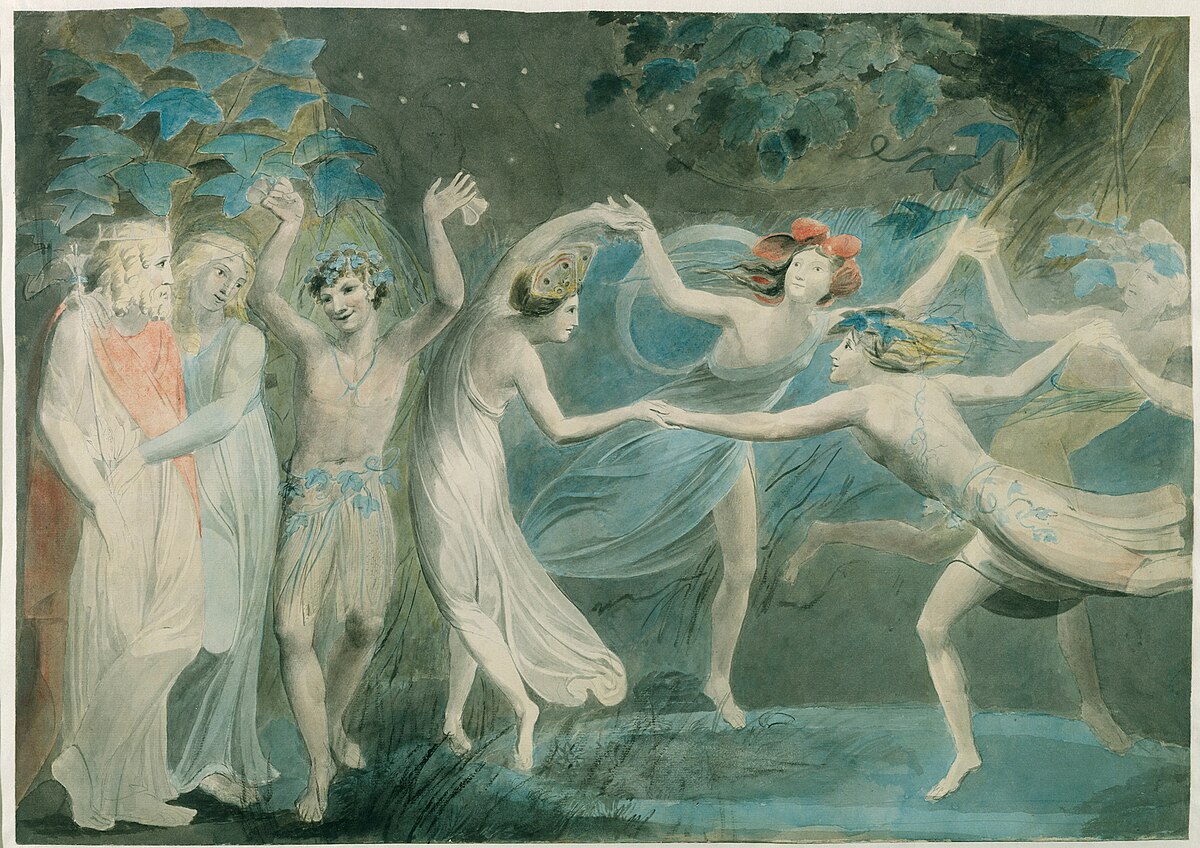
William Blake's illustration to "A Midsummer Night's Dream"

Northrop Frye realized that Shakespeare’s comedies and romances always featured a “green world,” in which the hero finds himself, one way or another, in about Act Three. In it the protagonist’s problems all are solved, to produce the play’s happy ending. It should not be necessary here to enumerate all the examples; Frye has cited them for us.

A valuable insight, but Frye was not all that smart. He then identified this “green world” with nature and with fertility rituals.

But the “green world” is never natural. Sometimes it is forested; but it can as well be Belmont, Portia’s castle. It is, rather, supernatural, which is the very opposite of natural. Think of Prospero’s island in The Tempest. The one consistent feature is that magic happens there. It is generally populated by fairies. It is fairyland.

Where is fairyland? Not out in the physical woods or wilds; in the imagination, in the forests of the night. It is the place where dreams and stories come from.

Shakespeare is the world’s greatest psychologist. His ability to see and express the motivations of his various characters is legendary; only Dostoyevsky comes close. And he is saying here that the cure for spiritual problems or for life problems—for “mental” problems—is the land of story, of art, of “play,” of the imagination.

He explains in Hamlet that art “holds the mirror up to nature.” But he does not mean nature in the sense of the physical world where man is absent. He means human nature. Read the full quotation:

“playing, whose end, both at the first and now, was and is, to hold as 'twere the mirror up to nature: to show virtue her feature, scorn her own image, and the very age and body of the time his form and pressure.”

Art shows virtue, scorn, and the zeitgeist; not bugs or trees.

Beyond his own plays with their “green world,” Shakespeare is pointing here to the value of fairy tales as a cure for spiritual disorders.

“The play’s the thing/With which to catch the conscience of the king.”

We ought to listen to him. 


Sunday, June 26, 2022

What Are Guilt and Shame?


Xerxes and his readers have spent the last week trying to decide what the words “guilt” and “shame” mean.

This is superficially odd, of course, because both words occur in the dictionary.

The obvious reason is that they do not like the dictionary definitions. Because they imply the existence of good and evil.

From the Oxford English Dictionary, the ultimate authority:

Guilt:

The fact of having committed, or of being guilty of, some specified or implied offence; guiltiness.

The state (meriting condemnation and reproach of conscience) of having wilfully committed crime or heinous moral offence; criminality, great culpability.

Shame:

The painful emotion arising from the consciousness of something dishonouring, ridiculous, or indecorous in one's own conduct or circumstances (or in those of others whose honour or disgrace one regards as one's own), or of being in a situation which offends one's sense of modesty or decency.

Whenever folks start tinkering with the meaning of words, you know they are up to no good.

The worst culprit here is psychology, the main intent of which is to strip modern life of moral considerations. Thereby actually generating rather than healing most of what we call mental illness.

A therapist writes to Xerxes, “Guilt is an uncomfortable feeling resulting from the commission or contemplation of a specific act contrary to one's internalized standards of conduct."

By this definition, a Nazi who kills Jews is guilty of nothing. Indeed, we must all strive to be psychopaths.

And the issue with shame, according to her, is not that we have done something wrong, but that it might cause us to withdraw from others. We ought to be more shameless.

And a parent must never say to a child, “shame on you.”

A perfect recipe for breeding psychopaths. We are now beginning to see the results of this sort of parenting in society at large. It has been forty years—two generations—since the publication of The Drama of the Gifted Child. Narcissism is everywhere, and social norms are breaking down.

A Christian—presumably Protestant—respondent writes: “We are assured in our absolution each Sunday that God removes both our guilt and shame.”

No he doesn’t. He removes the consequences. The eternal punishment for sins is waived, and only if you feel shame. We are still obliged to do penance, in this world and the next. 

Anyone who declares themself righteous, who ignores the mote in their own eye, is a Pharisee. This is the high road to Hell.

It seems that many people are now on it.


Sunday, June 19, 2022

Jordan Peterson on Transgenderism


It is a new form of child sacrifice.

Whether we see it or not, our modern society is in the business of wholesale genocide against the young. And this is no new thing--it is an eternal temptation throughout human history.

To too many, children are resented as damned inconvenient; an unfortunate byproduct of the sex act.


Monday, January 03, 2022

Jordan Peterson on God


I am not a fan of Jordan Peterson. I respect his political stands, but as a thinker I find him incoherent.

Whenever he makes a statement, he tags on the phrase “in a sense.” And then does not explain further. Without defining the sense in which he means the statement, this just makes everything both irrefutable and trivial. There is a sense, after all, in which the earth is flat, and the moon is made of green cheese. It breaks Aristotle’s Law of Non-Contradiction: either a thing is so, or it is not so. Since this is the foundation of all logical thought, no conclusions can now be drawn. All we know is what Peterson, personally, is feeling. This is not of any intrinsic interest, unless Peterson is otherwise special in some way. Maybe you feel the same, maybe you don’t.

I fear this might even be the kernel of some bizarre personality cult, like the Nazi leadership principle. It makes Peterson the centre of the universe.

As for his “Twelve Rules for Life,” to be fair, I have not been inspired to read it. But it seems obvious to me that he has no authority to lay down rules for life. No doubt he claims it is based on his experience with patients in clinical psychology. But any such clinical evidence is necessarily third hand, involves far too small a sample to be meaningful, and too may possible variables to draw any conclusions. All we are really getting, in Peterson’s case or in that of any other clinical psychologist, is his personal opinions and the conclusions he has drawn from his personal experience. This necessarily being so, on what grounds can we value his perspective on life over that of the next man we meet on a street corner?

More disturbingly, what sort of personality feels justified in setting down general rules for life based on their own experience? He might be leading anyone down a primrose path, and must know this.

He is, in other words, necessarily a narcissist. And the eagerness with which so many follow his commentary on every conceivable issue is an illustration of how co-dependency works. Too many want someone else to think for them.

Consider now his responses to the question whether he believes in God.

He asks, “Does saying I believe in God mean that I believe in God?” One might lie, but this is true of any response to any legitimate question. Why raise some special difficulty here? He is doing exactly what he insists he is not doing, and transparently: he is dodging the question. And he thinks he insulated himself from the charge simply be denying he is doing it. A typical narcissistic stance. “I’m not lying.”

The underlying problem is that Peterson thinks that if he admits God exists, this implies moral obligations. He says, incoherently, “what you believe is what you act out.” It is not. These are two separate issues. But it implies the incoherent thought that, so long as he does not consent to God’s existence, he can avoid these obligations.

This is a childlike error, like the baby playing peekaboo who thinks you cannot see him if he closes his eyes. If God exists, you cannot escape the implications by telling yourself he does not. Any more than you can fly by telling yourself that gravity does not exist.

Nevertheless, this is just how denial works. It is how narcissism works, and why you cannot ever get through to them, even with obvious facts and truths. They will not accept what they find it inconvenient to believe.

Peterson is not the man to listen to.


Friday, September 17, 2021

The Interpretation of Dreams


Freud, apparently homosexual without knowing it, fingers somebody's penis.

It is unwise to listen to the psychologists about dreams. Most of what we think we know from psychology is from Freud. Freudianism has no scientific basis. He just made stuff up. 

Are his notions right? All we can do, since we have no evidence for them, is, first, to decide whether they make sense; whether they are at least internally consistent. Second, we can ask whether they conform to previous beliefs about dreams, which, while we equally may not know what evidence or reasoning they are based on, at least reflect the wisdom of the ages.  

On both counts, the answer has to be no. Freud is nonsense.

To begin with, Freud’s concept of a “subconscious” of repressed memories or urges has been debunked. Troubling memories are not repressed; if troubling or alarming, they are far more likely to be conscious. We have known this at least since Aristotle. Everybody remembers where they were on 9/11, for example, precisely because the experience was traumatic. Repression of urges, in turn, is not subconscious. It requires a conscious effort to fight urges. We have known this at least since Moses. That’s why we have the Ten Commandments.

One common idea about dreams is that all the characters in a dream are aspects of oneself. That is from Jung more than Freud, but Jung too has no scientific basis. When it is not based on Freud, Jung’s ideas come from old gnostic texts, which he apparently misunderstood. Even if he did not, there is a reason why Gnosticism is not a living school of thought—it did not survive the test of time.

You could say the same of the characters in Shakespeare—that they are all aspects of Shakespeare’s own mind. True, but only trivially true; Shakespeare is not trying to explain or understand himself, but the world. It makes more sense to see dreams as the working out in symbolic and narrative form of the problems we face during the day. Some of our problems may be with our selves; but some with other people, or God, or nature, or fate, or the post office. Think of the seven conflicts: man vs. man, man vs, self, etc. Dreams are stories, and all stories are based on these seven conflicts.

Perhaps the craziest idea about dream interpretation that we inherit from Freud is that things in dreams mean the opposite of what they say. This notion, absurd on its face, has become “common knowledge.” Freud seems to have invented the principle so that he could make anything mean anything he wished. For example, there is no trace of Freud’s “Oedipus complex” in the actual legend of Oedipus. Oedipus has no desire to kill his father or have sex with his mother. His father, on the other hand, wants to kill him, and his mother wants to have sex with him. Yet Freud cites this as his main literary evidence for the “Oedipus complex.” A cigar can be a cigar, if Freud wants it to be a cigar; or if he prefers, it can mean anything else.

Unfortunately, Freud has poisoned pretty much everything we think of as psychology, even if real psychology has mostly disavowed him, or thinks it has.

Best to assume that whatever you have heard from “psychology” is wrong.


Sunday, February 21, 2021

Mirrors


Scott Adams, in his daily podcasts, has pronounced himself puzzled by the apparent truth of an insight from Tucker Carlson: that whatever the left accuses the right of doing seems to be just what they have been doing themselves.

They accuse Trump’s followers of trying to stage an insurrection; they use this as an excuse to try to stage an insurrection. A second or third insurrection, following the Russia hoax and the Ukraine impeachment. They accuse Trump of encouraging rioting; after a year of encouraging rioting. They accuse Trump of authoritarianism, for considering calling in the National Guard to protect the White House under siege, or for considering calling in the Guard to cities torn by rioting. As soon as they are in power, they call in the National Guard to protect Washington, and keep them there. And plan to impose COVID regulations on the states. They accuse Trump of colluding with Russia; Hillary Clinton was colluding with Russia, Joe Biden was colluding with Russia, not to mention China and the Ukraine. They impeach Trump for supposedly, perhaps, interfering in Ukrainian legal affairs and demanding a quid pro quo for aid. Yet Biden is on video boasting about interfering in Ukrainian legal affairs and demanding a quid pro quo for aid. They have called Republicans Nazis and Fascists for years; that’s the entire “Antifa” thing. Then when Gina Carano tweets a comparison of the left to the early Nazis, this is intolerable. She must lose her livelihood for it. They declare the right “anti-Semitic” while being anti-Semitic. They accuse the right of being racist, while making everything about race. They actually declare not being racist, racist. They claim the Republicans are for the rich and against the poor, while openly expressing contempt for the poor.  It is only too obvious there is a pattern here.

The principle is simple, and known since ancient times. When someone commits consciously to evil, to something they know is wrong, the truth becomes their enemy. They feel the need to get as far away from truth as possible. They will come to consistently say the opposite of the truth, and accuse the innocent of their sins.