Playing the Indian Card

Showing posts with label Holocaust. Show all posts

Saturday, December 13, 2025

Who Killed the Jews?

The synagogue on St. Andrew's Street

Perhaps it is just the algorithm, or perhaps it is the culture, but suddenly Nick Fuentes is everywhere in my YouTube feed. So I listened to a bit more of him.

He claims that Jews blame “white people,” by which I presume he means Christians, for the Holocaust. And we “white people” should stop feeling guilty about it.

That hit me out of left field. It had never occurred to me to feel guilty about the Holocaust. I had always considered myself one of the group targeted by Hitler, someone who might have been in the death camps—along with St. Maximilian Kolbe, St. Edith Stein, Corrie Ten Boom, Dietrich Bonhoeffer, Claus von Stauffenberg, and many Polish priests. We Canadians, we Christians, were the ones who stood up to Hitler, and liberated the camps. Why would I feel guilt?

Of course, it is equally nonsensical for “white” Canadians to feel guilt over slavery...

Now that Fuentes has pointed it out, however, it does seem true that Jews feel differently: that they do, wrongly, blame Christians for the Holocaust. I recall a Jewish fellow grad student informing me solemnly, as a Catholic, that all Catholic children are taught that the Jews killed Christ. I assured her she was wrong; I had never heard this in Catholic schools. Her response was that I must have gone to a particularly progressive school. Invincible prejudice--on her part.

Another Jewish friend once pointed out as a dark irony that the old synagogue in Kensington Market was on St. Andrew’s Street. I admit that is mildly amusing, but why not? Is this any darker than a synagogue being on Ulster Street?

And I recall Jewish protests over a Catholic convent being located near Auschwitz. As though it were offensive to pray for or acknowledge the Christian victims of the Holocaust.

I may feel at one with my Jewish brothers and sisters. But that is only half the equation. Do they feel at one with me?

This is more or less what Scott Adams concluded about blacks: there was no point trying for solidarity, so long as blacks were determined to hate whites.

I think this is the essential point being made by Fuentes. While his views might sound reprehensible, all he is doing is applying the same standards across the board. If it is reprehensible for “whites” to talk like this, it must be equally reprehensible for blacks or Muslims or Somalis or Jews to talk like this. If it is reprehensible for men to talk like this, it must be equally reprehensible for women to talk like this about men. That is now the only possible equality. If blacks and Jews and Muslims and everybody else are tribalist, segregationist, and openly racist, then whites have to be the same, or face extinction. Fuentes uses the term “genocide” here, which is outrageous; but he is using it just the way all other groups are now using it. On the same logic, if women are entitled to special privileges, men must demand the same, or be steamrolled.

It is an ugly world, but it is not a world Fuentes made. Churchill was not the warmonger. One cannot unilaterally declare peace. 


Saturday, March 09, 2024

The Politics of Envy


I see, in a recent Facebook post, the flag of Palestine flying over Grant Hall, at my old Alma Mater, Queen’s University. 

At the same time, the Canadian government is announcing the resumption of support to UNWRA, which as been implicated in the planning and execution of the October 6 attack on Israel. This means there has not even been an interruption of funding from Canada.

Back in more innocent days, it used to be a common classroom question: had you been around in the day, would you have stood up against Hitler’s holocaust? Or would you have done nothing?

Now we know. Had the bulk of those in apparent charge in Canada been around then, they would have supported Hitler.

But we already knew that; we already had the holocaust of abortion, bigger than Hitler’s holocaust. We already had postmodernism, essentially the fascist concept. We already had “Medical Assistance in Dying.” We were already scapegoating “cis white males” and “whites” generally for all conceivable ills, in the same way Hitler scapegoated Jews, and for the same reason. Jews are simply “ultra-white.” It was bound again to come around to them. They work too hard, are too smart, and are too successful. Envy is the game.

We’re the baddies.


Friday, April 14, 2023

The Real Meaning of Spiegelman's Maus


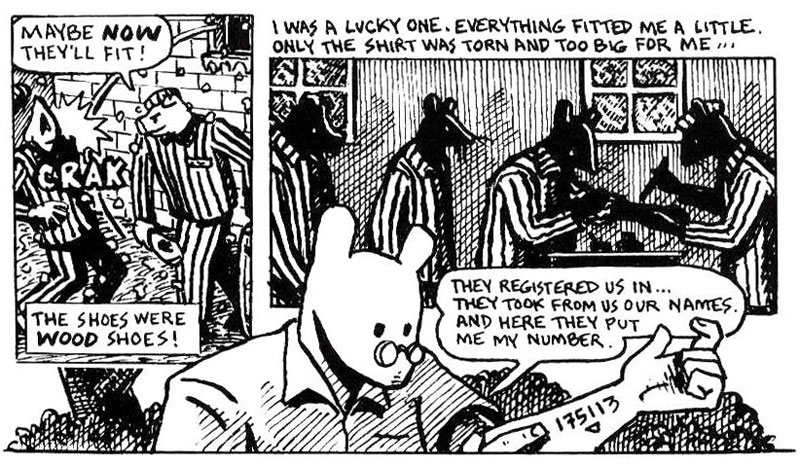
Maus and Maus II are not about the Holocaust. This is a good example of how most people miss the point of creative writing as of parables. John Lewis and his publishers sought to cash in on Maus, and did, with a cheap imitation, March and March II, giving Lewis’s personal account of the civil rights movement. But it was missing the essence of Maus. They had no idea.

Maus is a character study of Vladek Spiegelman.

Anything we hear about the Holocaust is entirely through his eyes. And he is not driven, like Elie Wiesel in Night, by a sense of mission to tell us about the Holocaust. He is resistant to talking about it. He would rather talk about his romantic conquests. And he burns his wife’s painstaking accounts of it. This is not the action of a truth-teller.

Vladek is a peculiar character. Most obviously, he is parsimonious to a comic extent. One might imagine this came from his experience in the camps.

But he is not consistently parsimonious. He scolds his second wife, Mala, for using a wire coat hanger, the parsimonious choice, instead of a wooden one, to hang up his son’s coat.

Then he secretly throws his son’s coat in the garbage. Hardly parsimonious.

Granted, in the first instance, it is his son’s loss, not his own. But then he must give his son his own old coat.

The real motive behind his parsimony is not to save money or conserve; it is to keep those around him constantly on edge, and subject to criticism whatever they do. If not being parsimonious works better every now and then, parsimony must be sacrificed to the higher objective. The point was to give Mala or Art that acid feeling in the pit of their stomach, and to delight in awareness that he is making them feel bad.

Spiegelman’s Vladek is a perceptive portrait of just what someone who has given in to the vice of pride, aka hubris, aka narcissism, is like. Vladek is the type of Hitler; and a study of the type.

One characteristic of the narcissist or vice-bound is a comically two-dimensional predictability. They form the humours of the comic stage. Narcissists act like NPCs. Vladek’s general frugality is of that order.

Vladek appears first in the tale to warn his son as a child that there is no such thing as a friend. Hitler’s starting point in Mein Kampf: it is the natural Darwinian order that everyone just looks out for themselves. For individuals and for races, it is survival of the fittest. And this is the creed of the narcissist: it is them against the world.

Moving to the present, Artie goes to visit his father, and his father’s first two sentences on seeing him after two years are complaints: first, that he is late, and second, that he did not being his wife. Whatever Artie does, Vladek will find reason to complain.

And he is the same with second wife Mala, complaining about the wooden hanger. Or the chicken is too dry.

The hanger complaint has a second function: it is meant to sow division between mother and child. The narcissist will always foment conflict within the family. It is a control thing.

When Artie asks Vladek to “start with Mom. Tell me how you met,” Vladek tells him instead about how all the women chased him, and he had another girlfriend who desperately wanted to marry him and was better looking than Artie’s mother. Anja, Artie’s mother, was nothing to look at, and supposedly had a nervous disorder. She was, as far as he is concerned, lucky to have him.

This is not the way a father should talk about his child’s mother. Again, he is sowing division within the family.

He then obliquely criticizes Anja as a communist, who betrayed a friend to a three-month prison term. It might be true; but even if so why tell it unprompted? The point of this story seem to be to belittle the other parent in the eyes of the child.

Artie catches his father then in a lie at least of omission—a warning to us as audience that he is an unreliable narrator.  Doing the math, Artie realizes that Anja, his mother, must have already been pregnant when they married. This raises the possibility that it was a forced marriage; his father may have been playing around, heedless of the women’s interests, and gotten caught.

Those who give in to the sin of pride are also likely to give in to the sin of lust. As well as that of avarice, and so forth.

Caught out on this, Vladek tried to distract by throwing shade on Artie. He accuses him of being premature: this looks like an ad hoc projection, not a truth. Then he claims the doctor had to break his arm to extract him, and that, as a child, that he often raised his arm in a “Heil Hitler” salute.

This does not sound plausible. Does a diffuclut birth ever require the breaking of an arm? Does the breaking of an arm ever cause involuntary movements for months or years after? Narcissists when caught out can say almost anything. They can seem to be momentarily delusional, as M. Scott Peck has observed.

That Vladek is rattled at this moment is demonstrated by his spilling all the pills he has been counting carefully.

He credits himself with bringing Anja back from post-partum depression with his gentle and loving care for her in a Czechoslovakia sanitarium.

Does this sound like the Vladek we can ourselves observe?

More likely, seeing how he behaves with his second wife and his son, he drove Anja to the nervous breakdown. Then, rather than let her escape his grip, and possibly have pleasant experiences without him, he grabbed the opportunity to go with her to the posh sanitarium instead of tending to his work. As a result, by his own account, he never got his new factory insured; it was robbed, and they lost everything.

It is surely actually unusual for sanitarium patients to be accompanied by “Someone they trust.” Few can afford such a thing; and it is surely considered bad for their recovery. The idea of the sanatoriums was to get away from their daily life, which is apparently troubling them, not to bring some of it with them.

He tells about the factory being robbed, presumably, because he thinks it reflects badly on Anja. Look at the trouble her mental illness caused! Look at how I suffered because of her!

And though he probably believes it himself—narcissists are expert at self-delusion-- “I did not have time to have it insured before we left” does not sound plausible. Had time been the issue, he could have had his father-in-law insure it for him while he was away. He was simply irresponsible; too irresponsible to think of such things. And, as narcissists always do, he finds a scapegoat.

There is much more, but this post is eating up too much time. I may continue later.

But the predictable effect of having a hubristic spouse or parent is, of course, to drive the rest of the family, especially his designated scapegoats, into depression. In Vladek’s case, his first wife commits suicide, soon after his son is released from a psychiatric hospital.

And, of course, he blames his son to all the relatives for this; while his son blames his mother for this. For whatever perverse psychological reason, nobody ever dares blame the narcissist. That feels too dangerous.

On top of it all, his mother having just committed suicide, and his father blaming him, Artie at twenty is also expected to console his father, who makes himself again the centre of attention with his dramatic expressions of grief.

The narcissist, when distraught, must take it out on his scapegoat. If not venting his anger on them, he will be venting his sorrow. It amounts to the same thing: the emotions of the narcissist become the family’s problem. It is up to them to do something about it.

This is the root of all “depression” and much, perhaps most “mental illness”: victimization by a narcissist in the family.

Maus lays it out plainly, and most people refuse to see it.


Tuesday, February 01, 2022

Whoopi Goldberg and Holocaust Denial


Whoopi Goldberg’s comments on the Holocaust are kind of dumb, but not scandalous. There is an old scientific classification of mankind into three or four distinct races: Mongoloid, Caucasoid, Negroid, and Australoid. If Whoopi learned this definition in some science class, it would be right for her to say that Jews were not a different race from the Aryan Germans, and so the Holocaust was not about race, but ethnicity.

It’s a little weird, because the Nazis certainly did consider Semites a separate race from Aryans, so their motivations, even if scientifically mistaken, were racist. But that argument is semantic, and it seems foolish to assume Goldberg was saying something shocking or offensive. Perhaps she intended to, but it cannot be assumed from this.


Monday, February 06, 2017

The Post in Which I Apparently Deny the Holocaust


One complaint going around against Trump is that he did not mention the Jews in his official message on Holocaust Memorial Day. This has even been called “Holocaust denial.”

But this is why Trump was elected: no special interest politics. No preference for one group over another. No racism, in short.

If he had mentioned the Jews, to be fair, unless the point was to give them some special privilege over others, he should have also mentioned the Roma (gypsies), and the Freemasons, and the Jehovah’s Witnesses, and the Poles, and the Serbs, and the disabled, … It might, indeed, have been a useful reminder to have done so. I fear much of the current controversy is based on an ignorant belief that the Holocaust targeted only Jews.

But it is hard to do this kind of a list without inadvertently leaving someone out. And without distracting from the main point. Should one mention the various specific political persuasions murdered? The gays? But then there is controversy: some top Nazis were gay. Being gay was illegal before the Nazis showed up. Some say the gay law was applied only to political opponents. So was it gays who were targeted, or political opponents? It all becomes a tangle.

The only intelligent and fair thing is to lament and commemorate the deaths of all who were persecuted by the Nazis, without any special consideration for any one group of victims. All lives matter. Even if Jews were the single largest group.


Calling this “Holocaust Denial” makes it hard for any decent and moral person not to deny the Holocaust.

Is that the plan?


Wednesday, March 23, 2016

Nazis and Neo-Nazis


Ernst Zundel
A Jewish friend once worked with Ernst Zundel. Zundel is the most famous Canadian “neo-Nazi.” Aside from prison time in Canada for "spreading false news," he spent five years in German prison for Holocause denial, and time in detention in Canada for supposedly being a threat to national security. Zundel was a professional graphic designer before his notoriety, and a successful one until his politics were discovered. My friend, an editor, was shaken that Zundel once refused, for a client, to airbrush effluent coming out of a pipe from a photograph, on the grounds that this was misleading and hence immoral.

From this, my friend concluded, uncomfortably, that Hitler and the Nazis might have been entirely upright by their own lights. They were just working from different assumptions.

This is, to my mind, necessarily false. Begin with the example that gives him pause, the photograph showing pollution. If morality were really up for grabs, he would not know that Zundel was exhibiting morality in this instance. Instead, he, my friend, instantly recognized morality when he saw it, and was moved by it. Immorality should be just as recognizable in principle. Either killing Jews is wrong, or it is not.

The idea of crimes against humanity affirms the same idea. Right is right regardless of the local laws of the country, or such a category of crime could not exist. Slavery does not become okay because the laws of the US once supported it; killing Jews was not moral because the laws allowed it. If this is not so, we have no business condemning Hitler or Himmler, the Nuremberg Trials were illegitimate, and it was all just a case of the victors imposing their will. If Hitler had won, it would have been as proper and objectively moral to hang the followers of de Gaulle or Churchill.

One wonders why anyone gave their lives for the difference.

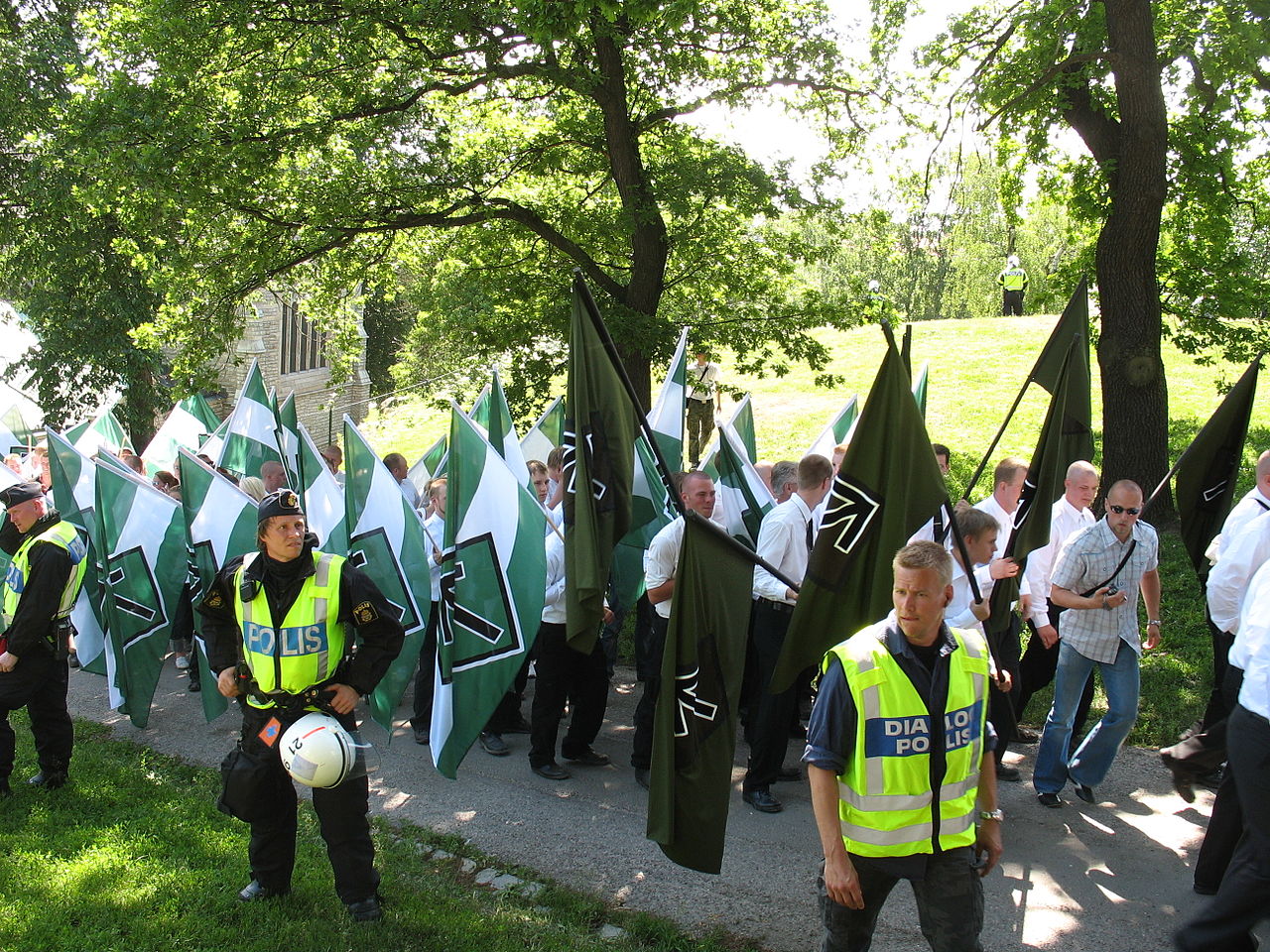
Swedish neo-Nazis march

No; morality is objective. We all have a conscience, an internal compass that tells us what is right and wrong. We do, of course, have the choice not to follow it. Sometimes it is not in our own best interests to do so. That does not mean it is not there.

Hitler therefore cannot have been sincere. Nor does the evidence suggest that he was. Nazi ideology was philosophically incoherent. Was it a doctrine of the left, right, or centre? The debate continues. Did the Nazis intend to abolish private property? Nobody was or is sure. Did they intend to abolish Christianity? The same. The Nazi programme was highly adaptable and ambiguous depending, it seemed, on what Hitler thought would gain public support, or the support of the group he was currently addressing. This was his great talent as an orator, as William L. Shirer has pointed out. Hitler's standard technique in diplomatic negotiations was to make promises of any sort, then immediately break them when it was in his interest to do so. This is not a man of principle. Mein Kampf devotes itself almost entirely to tactics, not bothering much with principles. The principle, such as it is, is simple: personal and group power. Far from being some kind of ideologue, fanatic, or true believer, Hitler was the ultimate opportunist.

This leads to some uncomfortable conclusions. Hitler came to power democratically. He tailored his policies to what was popular and politically expedient. This means he would not have attempted the Holocaust if he did not believe the majority of Germans supported it. Granted, there was a financial reason as well: Nazi budgets were a Ponzi scheme, and the Jews were rich. Confiscating their property delayed the day af reckoning, at least perhaps until the next nation could be conquered and looted. It is doubtful whether Hitler ever allowed himself the emotional indulgence of hating Jews; the point is that the average German did.

Certainly Hitler was a very bad man, the worst of men, but he has also been made a scapegoat to avoid assigning due blame to Germans (not to say this could not have happened elsewhere; people are people) generally. He is referred to as a “madman.” This is nonsense. People do not take orders from madmen. Nor could a madman be nearly so calculating. Hitler, with his cunning, was spectacularly sane. He was a bad man, not a mad man, and to pretend the latter is a terrible slander against the insane.

Bad, not mad.

The second uncomfortable conclusion to be drawn here is that those we call "neo-Nazis," like Zundel, are really the opposite of Nazis. They are certainly not opportunists. There is no personal advantage to be gained anywhere by claiming to be a fan of Hitler. Zundel himself lost his career, his freedom, his residency in Canada; vandals did $400,000 worth of damage to his home, and were not prosecuted. He has to have been motivated by a strong sense of principle. He believed, and believes, that Hitler has been scapegoated, and in part he is indeed certainly right. Nor does he endorse the killing of Jews, which would be objectively immoral; instead, he believes that Jews were not killed, which is a quite different matter.

We do nothing to prevent the rise of another Hitler by persecuting the neo-Nazis. We certainly do nothing to prevent it, and indeed give Hitler a kind of legitimacy, with laws against "hate" or "Holocaust denial." It makes the intelligent and morally sensitive suspect we have something to hide. Which of course we do--our own guilt, not, as they suppose, Hitler's innocence. Instead, by such laws and such prosecutions we are harassing the very people most likely to stand up and resist should another figure like Hitler arise. At the same time, we are training the great bulk of the population to stay good Germans in any eventuality.

Cat. After all, this is the Internet.


Thursday, February 18, 2016

The Milgram Experiment and the Schools


It seeem to me telling that in the notorious Milgram experiment in the early Sixties, that demonstrated that average people would cheerfully engage in torture is told to do so by an authority figure, the torturers were identified as "teachers" and the victims as students who had failed it their lessons.

This shows perhaps how conditioned we are to accept brutality as pernissible in the school setting.


Saturday, August 24, 2013

Israel: Just a Bigger Ghetto


Sofia's Grand Synagogue

I was walking along a street in downtown Sofia one Friday evening several years ago. Gradually, through the dusk, I realized I was surrounded by a small gang of elderly people. All the men were wearing yarmulkes. I had stumbled upon the last remnants of Sofia's Jewish community heading for synagogue for the beginning of the Sabbath. Perhaps a score of aged men and women.

In 1944, Jews made up one quarter of the city's population.

What happened to them all? No, they were not sent to Hitler's death camps. Bulgaria never permitted that. Instead, they all emigrated to Israel after the war.

Sofia synagogue interior
I am not at all sure this was a good idea. I am not at all sure that Israel is a good idea. And I do not mean that it is bad for the Arabs, although no doubt it is. I mean it is bad for the Jews.

In fact, it has done Hitler's work for him: it has achieved his vision. Early plans and directives suggest that Hitler had no special interest in killing Jews. His original idea was to exile them—he thought to Madagascar, or somewhere else in Africa. This was also, not coincidentally, the original plan of Theodor Herzl, the founder of Zionism. Palestine would have done nicely had the British allowed it. Hitler just wanted them out of Europe, so that they could not contaminate Europe's Aryan purity. Just as Herzl wanted an independent state to prevent Jewish assimilation.

Theodor Herzl

Hitler, in other words, was a Zionist. Israel has done exactly what he sought to do, but was unable to do. Is this a good thing?

And is it a wise strategy in terms of Jewry's ultimate survival to huddle into one small nation state? Isn't this a case of putting all one's eggs in one basket? Wasn't Jewry's previous strategy, of dispersion throughout the nations, in fact an unusually successful one? Where, by contrast, are the Assyrians, the Carthaginians, or the Visigoths today? It allowed them an escape hatch in all circumstances: suppress them in Spain, and they had connections and relations in Turkey; in the Netherlands, and they had contacts in Poland. Hitler, though he controlled all of Europe, was unable to eliminate them. In ten years, he managed to kill six million. By contrast, now two well-placed Iranian bombs could wipe out seven million Jews in an instant.

A passionate Zionist


Just as keeping all the Jews of a city in one ghetto made it easier to find them when a pogrom started, so concentrating all the Jews of the world into one twelve-mile-wide country seems on the face of it like herding them all into one big cattle train.

And it is, of course, apartheid, segregation. This has not always turned out well elsewhere. Nor did we ultimately find shipping all the blacks of America back to Liberia an entirely satisfactory solution for that minority group.

Moreover, if the Jews are really determined to set up shop permanently in one location, Israel is actually a remarkably bad choice. There is a reason why the Israelites have, historically, kept being thrown off this land. As have the Canaanites, the Philistines, and the crusading Franks. It is a natural thoroughfare, the only land route between Africa and Asia, the carrying point between the Mediterranean and the Persian Gulf, wedged in between the two larger entities of Egypt and Mesopotamia. Trying to establish and hold an independent nation in this little corridor is rather like building your house in the middle of a highway, and hoping nobody will trespass. Not to mention, of course, that the place is a desert, a natural wasteland. The Zionists could have done far better by settling Argentina, Oklahoma, or the interior of BC. All of which were still more or less available.

A sheep among wolves.


At the same time, the loss of so much of its Jewish population, I suspect, has greatly impoverished Europe. I had this sense in Sofia, and it seems, on reflection, self-evidently so. Jews are responsible for a staggering proportion of European, as well as American, culture. It is the mission of the Jews, after all, according to the covenant, to be a light unto the nations. By retreating to Israel, they are abandoning this mission, and this religious duty. Is it any wonder that European culture now seems moribund and listless? The light has departed from it. If American culture seems still more vital, it is perhaps because fewer of its Jews have been tempted to leave for Israel. And abandoning their historic mission is likely to have the same enervating effect on Judaism.

Now, of course, as a result of Israel's existence, the Jewish witness has been stripped from the Muslim world as well. Distinct communities and subcultures all over the world, with their millennia of traditions, are being wiped out, as in Sofia, in a generation. Bahrain's synagogue stands idle. The Jewish community of Cochin, of over two thousand years' duration, older than France or England, is no more.

The abandoned Manama synagogue.

One suspects that, when the histories are written a hundred years from now, the State of Israel will be seen as a greater calamity for the Jewish people than the Holocaust itself.

Interior of Cochin synagogue.

Wednesday, January 16, 2013

Righteous Among the Nations


St. Maximilian Kolbe.

Wikipedia features a page listing those "righteous gentiles" recognized for helping Jews persecuted during the Nazi years. One subcategory is for "Religious figures." Here it is, in total:
  • Metropolitan Chrysostomos of Zakynthos,[49] who, when ordered by the Axis occupying forces to submit a list of all Jews on the island, submitted a document bearing just two names: his own and the Mayor's. Consequently all 275 Zante Jews were saved.
  • Archbishop Damaskinos - Archbishop of Athens during the German occupation. He formally protested the deportation of Jews and quietly ordered churches under his jurisdiction to issue fake Christian baptismal certificates to Jews fleeing the Nazis. Thousands of Greek Jews in and around Athens were thus able to claim that they were Christian and were thus saved.
  • Archbishop Johannes de Jong, later Cardinal, of Utrecht, Netherlands, who drew up together with Titus Brandsma O.Carm. († Dachau, 1942) a letter in which he called for all Catholics to assist persecuted Jews, and in which he openly condemned the Nazi German "deportation of our Jewish fellow citizens" (From: Herderlijk Schrijven, read from all pulpits on Sunday 26 January 1942).
  • Alfred Delp S.J., a Jesuit priest who helped Jews escape to Switzerland while rector of St. Georg Church in suburban Munich; also involved with the Kreisau Circle. Executed February 2, 1945 in Berlin.
  • Rufino Niccacci, a Franciscan friar and priest who sheltered Jewish refugees in Assisi, Italy, from September 1943 through June 1944.
Archbishop Damaskenos of Athens.

Monsignor Hugh O'Flaherty.
Now, isn't it troubling that there is only one member of the Protestant clergy on that list? It is just possible that the author of the Wikipedia post is deliberately suppressing actions of the Protestant clergy, of course. But this may say something about the Protestant clergy, too.

The world is too much with them. They tend to go along with whatever the popular or politically advantageous line is at the time, as opposed to standing firm for the eternal verities.

As they have generally done, in recent years, on subjects like abortion, or the ordination of women.

This may be because, unlike the Catholic or Orthodox clergy, they are entirely dependent on local popular approval for their livelihoods.

An argument against democracy in religion.