Playing the Indian Card

Showing posts with label education. Show all posts

Thursday, June 19, 2025

Lies My Teachers Told Me


The falsification of the past, Orwell’s memory hole, is everywhere in history classes. Palestinian children ae apparently taught that  Palestine was until recently always Muslim. Palestinian Christian children, whose ancestors were there long before Islam, are taught they come from Europe. And Canadian children are taught they burned down the White House. 

But not just in history classes. He who controls the past controls the future. And he who controls the present controls the past… And those in power seem never able to resist the temptation to control. They are in power largely because they crave power.

Philosophy classes neglect everything between the ancient Greeks and the Renaissance, not to mention the world beyond Europe. I had to full in thousand-year gaps on my own.

And I went all the way through grad school assuming that poets always burned out in youth. What actually happens is that poets, as they mature, like most of us of healthy interests, turn from sex and politics to religion. Eliot, Wordsworth, Coleridge, Auden, Donne, Blake … their best work is often suppressed in the modern academy, as if an embarrassment.

Also suppressed is the fact that most prominent scientists over the long run of history were religious. Copernicus who discovered heliocentrism, LeMaitre who discovered the Big Bang, Mendel who discovered genetics, Isaac Newton, Wallace, co-discoverer of evolution … actually pretty much all of them, up to perhaps the middle of the 19th century. The fact that be basic premise of science, that the material world is intelligible and follows laws, is religious, is also suppressed.

In history, the schools slander and misrepresent the Crusades, the Inquisition, the witch-burnings, the “Dark” and Middle Ages, the “patriarchy.” They invent out of nothing an age of innocence and sexual equality before the coming of the book. By emphasizing the exceptions, they give the false impression that religion over history has fostered rather than prevented conflict.

In Canadian history, they systematically misrepresent the relations between the “settler” population and the indigenous people as one of conflict. They misrepresent the intent of the early Christian missionaries; and, strikingly, the nature and intent of the residential schools.

The broad general conclusion that can be taken from all these examples is that the powers that be in our system are systematically trying to suppress and discredit Catholicism in particular; Christianity more broadly; and religion in general.

This is what comes from the secularization of the education system. Secularization is not neutral. It is necessarily anti-religious.

The solution is a return to denominational schools and denominational universities, as used to be the standard world-wide. Each may have its biases; but at least, in the wider society, they should cancel each other out.


Thursday, November 14, 2024

Dracula as Feminist Icon


I am tutoring a high school student with his regular English literature course. They are studying Bram Stoker’s Dracula. They have been asked to interpret it using three lenses: a Marxist perspective, a feminist perspective, and a psychological perspective.

What is missing?

The obvious significance of Dracula is religious: it is all too heavy-handedly about the nature of evil and the nature of the human soul. This is not even touched on.

Stoker and his audience might have been familiar with Marx. Feminism or modern psychology would have been unknown to them.

I am told all texts in the course are subject to the same three analyses.

This is not knew. It was true when I was going through college and grad school in the 1970s. Religious or ethical concerns were never whispered at in English lit classes. Even though, as a historical fact, this would have been the primary concerns of any author up to at least the beginning of the 20th century.  I often wondered why the later work of so many authors was ignored. I assumed poets must burn out. Instead, it was because with age they all tended to get too obviously religions.

We had to fill our essays and theses with Marxist, or feminist, or Freudian, or Jungian, or structuralist, readings of each text, knowing that they could not possibly be correct, and that the underlying theories had usually been discredited. A complete waste of time, made bearable only by the excuse to read the texts themselves. Much sound and fury, signifying nothing. While all the time, the meaning we were searching for was perfectly clear by reference to Christian principles.

We are deliberately avoiding religion and ethics in our education system, as though it is the proverbial third rail. Our children and youth are being deliberately directed away from any spiritual or ethical concerns.

And this has spread throughout society.

I have for almost two years been trying to set up a group of “Poets of Faith,” “who believe their craft is in service to a Supreme Being.” Yet over these two years, whenever I get a group together, and start a meeting, someone begins by objecting to the mention of a Supreme Being. The meeting dissolves in chaos, and I must start all over. Sisyphus, move over. Despite the stated purpose of the group, the premise under which it was convened and under which people agreed to attend: “who believe their craft is in service to a Supreme Being.”

I think this is the same problem, the same cancer. Even allowing others to form a group acknowledging the existence of God and some responsibility to him is not to be tolerated. 

It is the same reason churches are being burned down across Canada, and priests assaulted at the altar. And black legends are spread about mass graves near residential schools.

This is no doubt why our arts are moribund and our civilization in decline. It is decadence.


Friday, June 07, 2024

The Four R's: Reading, Riting, Rithmetic, and Relevance


Courtesy of Indeed, here is a supposedly ideal answer to the standard interview question for teachers, “What is your teaching philosophy?” In other words, this is what your teaching philosophy is supposed to be. And it is utterly wrong:

“My teaching philosophy is to make my lesson plans relatable. In many cases, when a student can’t identify with the material, it’s harder for them to gather meaning. As a literature teacher, my goal is to help students empathize with characters, places and concepts, especially when those things are different from their own life experiences. As a student, I found stories more memorable when my teachers helped me draw parallels. As a student teacher, I like to make comparisons between older texts, like Shakespeare and modern events. For example, comparing events in the plays to events in pop culture. This not only helps students understand the stories but also helps them draw their own conclusions.”

First, the need for students to “identify with the material.” They are supposed to see “their own life experiences” reflected in the material.

This is the opposite of the point of reading a book in the first place. One reads a novel to get away from one’s own everyday life, to experience the world from another’s perspective. Accordingly, the books that sell the best, that people most enjoy, are set in exotic locales and based on improbable situations: Harry Potter, James Bond, superhero comics and movies, the Da Vinci Code, Treasure Island, Peter Pan, Star Wars. The surest way to bore students, and turn them off reading altogether, is to select readings that most closely reflect their own life experience. 

Moreover, this is deliberately preventing them from learning, subverting the entire point of going to school. One already knows about one’s own life situation. 

For the same reason, it is perverse to suggest that minority voices have traditionally been underrepresented in our literature or in the bookstores. Being exotic has always been an advantage. Pauline Johnson used to perform in buckskin. Grey Owl faked his Indian identity. 

As for comparing events in the classical texts to pop culture: always done these days. For years, every text I used had a chapter on the movie “Titanic”; and I could see the students roll their eyes and hear them audibly groan. Not “Titanic” again!

The problems with this approach are many. 

First, the students already know pop culture. They are not learning anything; you’re just wasting their time. 

Second, they probably know it better than the teacher. It is insulting to presume the teacher knows more than they do about such things. Why? What makes them the authority on Taylor Swift? Just because they’re older? Must the students merely knuckle under to established authority? Is this the lesson being taught? 

Third, nothing is so dated and uncool as yesterday’s biggest pop phenomenon. It is impossible to stay current. Especially in textbooks, which take at least a year from composition to publication, and then remain in circulation for years. Pop culture references will always be dated, and wincingly uncool. 

Fourth, everyone will fix on the same obvious pop culture references, going for the biggest bang, the biggest connection with the youngsters, and the thing, like Titanic, so big that even they, uncool old people as they are, are aware of it. Students will encounter the same cultural reference again and again, boring them beyond comprehension. When they could be out learning something.

A similar problem adheres when you try to connect your classic material with “current events.” Nothing is as dead, old, and dull as yesterday’s news. Text can’t possibly keep up, not being reissued daily. To compensate, “current events” in the classroom inevitably means a handful of generic topics: ecology, the environment, or “the environmental crisis”; the issues raised by new technology, considered generically; globalization; peace versus war, and such. There is an obvious problem of ideological bias; but without ideological bias, such topics are desperately repetitious and boring. Yes, pollution is bad. Yes, there are bad things on the Internet. Yes, the world is becoming smaller. Yes, peace is better than war. Snore.

Back in the old days, to avoid these problems, modern history was not taught; only classical history. Modern history, current events? Set that up as formal debates among the students. For the same reason, current novels and recent writing were not taught. Leave those for reading clubs in the common rooms.

Our ancestors had it right.


Sunday, April 21, 2024

Culture and Civilization


Our civilization seems to be falling apart. Probably the one essential reason is that we have lost the plot. We have lost our sense of what civilization means and why it is of value. 

The term is rarely used any more, and if it is, it is misused. We absolutely must not, any longer, insist that all cultures are equally civilized. They are not.

In simplest terms, “civilization” means literally citification. For a culture, it means having fixed abodes; having a system of writing; and having a government with consistent rules and enforcement on at least the level of a functioning city and hinterland. 

By this definition, none of the indigenous people of Canada were, at first contact, civilized; they were, to use the literal meaning of the term, “savages”. This is a simple descriptive statement. We used, even in my grad school days, to use the euphemism “primitive.” That is, they had not developed socially to the civilized level.

It should further be uncontroversial that a culture that has failed to develop writing, fixed dwellings, and consistent government is inferior to a culture that has. 

Probably the finest cultures are those that first developed such things; imitation is easier. And culture is persistent. My travels and long sojourns abroad leave me with distinct opinions on what cultures are most civilized. Egyptians, Greeks, Jews, Chinese, are, to my mind, in the top rank. Interestingly, these are also the nations that have been civilized for longest. No doubt they have perfected the art of education.

But there is also something to be said for recent success. Cultures can also no doubt weaken or become diluted. I have to respect the British, with their remarkable talent for social organization: the common law, the parliamentary system. Thay have, if I may be so bold, been a civilizing influence in the world. I feel, for example, that the average immigrant from the West Indies is distinctly more civilized than an average African-American. The difference, I presume, is the education system modelled on the British.

I say that as someone without a drop of English blood in my veins. And mostly Irish blood—the one nation and culture that has least reason to love the English.

Broadly, to be civilized means to be capable of cooperating in large groups. This implies, in turn, an ability to suppress one’s immediate desires to achieve a goal. This is unnatural; it takes work. That work is the work of education, and education is the key to civilization.

But the payoff is more than that. The ability to defer gratification is also the essence of all moral behaviour. It is what makes us human, not animals. It is the secret to material success, to acquiring wealth. And it is what gives us all the higher things in life—the arts, the grace notes.

Education is the key, and the key part of that education is what we call the humanities: religion, philosophy, history, language arts, literature. They teach us to be human; beginning with Aesop’s fables and the fairy tales.  

And, alarmingly, we no longer see the point of the humanities. That marks our doom.

Lacking this education lacking civilization, is disastrous both on the cultural and the individual level. It is the reason Canada’s indigenous people remain in a deprived and desperate state, five hundred years after first contact. Compare the Jews who immigrated to these shores since the complete catastrophe and genocide of the Holocaust. Who is doing better?

The difference is in child-rearing and the education system. Indian children are essentially taught nothing; they just run about and do as they like. They do not learn deferred gratification. Jewish kids have to go to school after school and learn the Hebrew language and all the ancient legends.

There may need to be a balance. Civilization is not an unmitigated good—the conflict between the demands of society and the natural man was the topic already of the world’s first epic, the story of Gilgamesh and Enkidu. I myself prefer the relative spontaneity of American music to the rigid formalism of Asian or European styles.

Everyone dreams of being a pirate, or escaping to the wild open range and living like an Indian. Perhaps the strongest civilizations allow for some such release, to keep the system elastic. The English, or  the ancient Greeks, always had the option of going to sea; the Americans to head West. It is also the genius of the Sabbath.

But we also seem to be losing that safety hatch.

Civilized people need to be aware of the issue. You do not, as a practical matter, want uncivilized people living just across the fence from you. They might drop in at any time, break down your door, smash your things, rape your wife, and devour your children.

Consider the events of October 7.

The essence of the general mild anti-American prejudice among Canadians is that the average American, broadly speaking, is less civilized. Well-meaning, but boisterous, less polite. They will come for a visit, and look in your fridge. If they are at home, they will walk around in their underwear. They are childlike.

Of course this is a stereotype. Nevertheless, it is generally true, and it is a real thing—and that is the effect of culture.


Monday, December 18, 2023

Progressive Schools


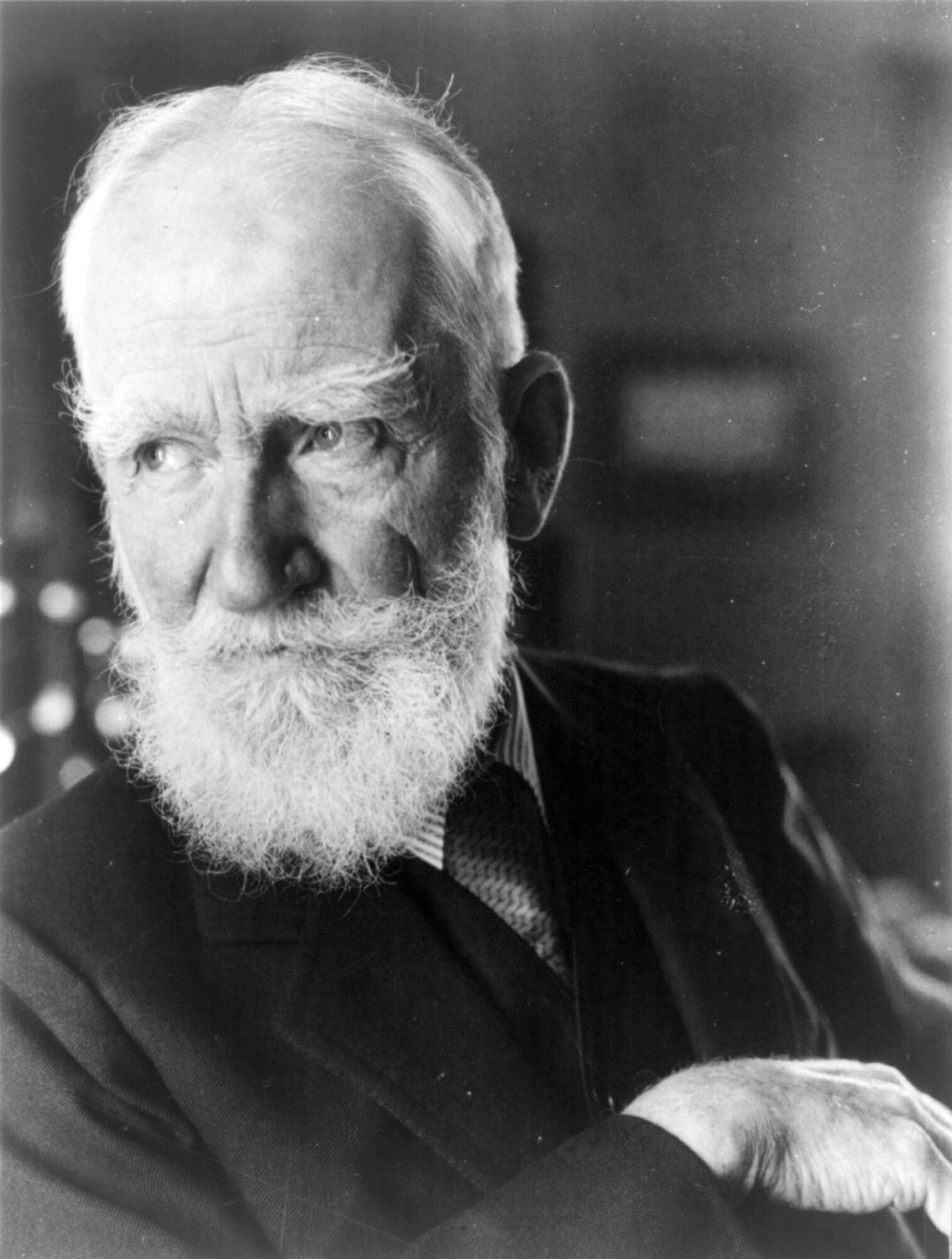
George Bernard Shaw went to a progressive "experimental" school in Dublin, and hated it.
 James Joyce went to a Jesuit school a few blocks away, and although he did not end up a faithful Catholic, always praised the classical education he got there.


Education is conservative by its nature. It is the process of passing on to each new generation the accumulated wisdom of their ancestors.

This is true through to graduate level. New Ph.D.’s and new faculty are judged by a panel of those already ensconced—a practice designed to ensure orthodoxy, and prevent innovation, comparable to and derived from the apostolic succession among the clergy. Lone must ensure the preservation of the deposit of faith.

Education establishments are designed to resist change. This is not a bug; it is a necessary feature. Change is often desirable; but the education system is not there to do it.

From whence does change come? From open communication among the very intelligent. The Internet is ideally suited for this. New art movements always arise outside the academies. Major philosophers have almost never been professors of philosophy; major poets never arise in English departments. Einstein was a patent clerk, not a physics prof; the current IT revolution began in garages. The Wright Brothers rn  bicycle shop.

Unfortunately, once science supplanted theology as our core faith, the education system went of the rails. Science is meant to experiment and innovate. Science has no core of knowledge, only eternal doubt and a technique to test beliefs.

We began, under the influence of science, to rely on the education system to experiment and innovate, instead of to educate; destroying the key mission.

This is one reason why the education system has stopped working. It often now literally has students sit in a group and decide for themselves what is real: “their truth,” “their lived experience.” Even if this makes sense, there is no reason to spend time in school. One already knows what one knows.

Having no remaining purpose, schools and universities have even taken it as their mission to destroy the civilization. Including trying to shut down free discussion so that innovation cannot take place.


Saturday, December 16, 2023

Father Knows Best


A reading in a current textbook laments that fewer Britons than forty years ago want to become secondary school teachers. By a lot: college grads entertaining the thought of teaching has dropped from over 60% to 17%. I keep seeing ads in my feed urging qualified Canadian teachers to come teach in London or in Scotland. 

\The piece goes on to say that one common reason given is the impossibility of maintaining discipline in classes, compared to forty years ago. And I hear this same lament from my friends in the US. And in China.

So the next question has to be, what has changed, and changed in all these countries? Why are students more rebellious, less disciplined, than in the past? Or, how have these systems of education changed so that they can no longer effectively discipline?

My Chinese student, not bound by North American shibboleths, has an immediate insight: one reason is that so many teachers are now women.

“In the old days,” he explains, “students saw the teacher as a second father.”

And then I got it. There is an obvious and immediate difference in tone between calling someone a “second father” and a “second mother.” Seeing a teacher as a “second mother” is not going to help with discipline.

We must accept what we have been perversely denying for generations: the role of father and mother is different. The mother sees to your physical needs, that you are scrubbed and fed. The father sees to your spiritual needs, to your education, especially your education in values. To discipline.

This is not a role arbitrarily assigned by society. It is built in to the male and female soul, just as we plainly see females are physically designed to nurture the young. As little Maryanne once remarked, “Men are not mammals. They can’t feed their young with milk.”

Why would it not be? How could it not be? Maternal instinct is real. So is paternal instinct. And so are filial instincts.

Here’s an interesting example of the difference between the male and female mind: men are far better at reading maps and giving directions. This is the paternal and the teacherly role: reading the map and giving directions. Women, left to their own devices, get lost. They must ask directions of others.

I used to do this experiment with my classes; and the result was the same whatever culture or country I was in, or wherever the students came from. I would first ask all of the women in class to point north. They invariably had no idea. It was random. Then I would ask the men. Most of them could. 

QED. It is the same in spiritual matters. Men have a better sense of direction, and so are better guides.

So we are abandoning our children, denying them an education, if we give them female teachers in high school. We are letting them down with female teachers in grade school, for that matter. It stands to reason that, not getting any guidance at school, they become disenchanted with the enterprise. It also stands to reason that, not having any natural talent for the task, schools dominated by women go off the rails.

Come to think of it, this is a more serious problem than the schools. We have denied the value of fathers in the family as well, undercut their authority, encouraged family breakups, and left children rudderless. We have denied the value of men in society generally, and tried to dismantle “the patriarchy.” Not going to end well. We have, in recent decades, put women in leadership roles in all parts of society. Note the recent congressional hearing, in which the presidents of MIT, Harvard, and UPenn all spoke. And they were all women. And they had all so lost their way that they did not consider a call for genocide of a student’s entire race a case of bullying.

If women lack, at least in comparison to men, an internal compass and sense of direction and proportion, this is a sure prescription for causing all structures to begin to swerve unpredictably and wander off in odd directions.

And is that not what we have been seeing?

It is the wisdom of the ages. In the New Testament, Jesus’s ancestry is traced back through many generations to David. But this ancestry is traced back on both sides, through Mary and Joseph; even though Joseph is not Jesus’s biological father.

This is because the true inheritance on the father’s side is spiritual, not physical. The important line on the male side is the teachings and the values handed down from David; compare the apostolic succession.

Have you ever noticed, as I have, that when there is a mixed marriage, the children identify primarily with the father’s faith, and the father’s ethnicity? This is the actual distinction, in Canada, between Indian and Metis, and was enshrined in the Indian Act: father Indian, mother European, child Indian. Father European, mother Indian, child European. Or, only on the Prairies, because the father is ethnically and religiously distinct from the European majority, Metis. Metis culture is simply French-Canadian culture.

In mixed marriages when the father defers to the mother’s religion or ethnicity in the education of the children, as is often required in Catholic-Protestant marriages—the children simply grow up without a sound grounding in values or sense of their identity. 

We have been ignoring these male-female differences at our peril—or rather, to the peril of our children.


Friday, September 08, 2023

The Wisdom of the Nursery


"Those who do not laugh have bad consciences."

- Brothers Grimm, "The Twelve Brothers."


Wise words from the nursery. Fairy tales and fables are the source of accumulated wisdom over the centuries—that is why they exist and persist. It is parental malpractice not to teach them to our children. They are the furniture of a healthy mind.

This one sentence is of tremendous value as a life lesson. It is invaluable for judging character, and it is a valuable lesson not to go down the path of dishonesty yourself—you will never laugh freely again.

Other essential lessons, too easily never learned, hard to convey otherwise, are told by Andersen’s “The Princess and the Pea,” “The Emperor’s New Clothes,” Aesop’s “The Frogs Who Wanted a King,” “The Boy Who Cried Wolf.”

Longer fairy tales like Cinderella, Sleeping Beauty, Beauty and the Beast, The Little Mermaid, have been obscured because too easily adapted by those with no interest in the original moral. Disney had a tendency in its animated versions to make them all about finding romantic love. “One Day My Prince Will Come.” Not in the mind of the original Snow White. 

Everyone thinks that the story of the princess and the frog is that the princess overcomes some initial revulsion to kiss the frog, and this turns the frog into a handsome prince. So don’t judge by appearances in seeking a life partner, right? But that is not in the original: the princess never kisses the frog. She throws him against the wall. Don’t judge by appearances, yes, but there are other things also going on. This is not about romantic love.

The first failure of our education system is that fairy tales and fables, in the original, are rarely any longer taught.


Saturday, August 26, 2023

Abortion Unwound


The young adult novel Unwind is being used to teach our children. Resolutely woke, it argues the case for abortion. This hinges, apparently, on when a human being gets a soul. It gives four positions, presumably spanning the field:

  • At conception
  • At quickening—"when the baby kicks”
  • At birth
  • When someone loves it.

And then the novel gives its own conclusion: that we really do not know. 

Therefore, no one has a right to impose their own views on the next person.

“If more people could admit they really don’t know, maybe there never would have been a Heartland War.”

Therefore, unrestricted abortion.

It is indeed true that we do not know whether a child at any given age has a soul. We also do not know whether Jews have souls. We do not know whether blacks have souls. Or women. We actually do not know whether anyone other than ourself has a soul, is conscious and self-conscious. We cannot see or hear the soul, or consciousness, or thoughts, other than our own. Everyone else might be imagined, or simulations, or alien lizard people.

Accordingly, this argument for unrestricted abortion is just as serviceable as an argument for unrestricted murder, or genocide. 

“Hey, nobody likes the Jews. That mean they don’t have souls. Let’s kill them and take their stuff.”

Why is it morally necessary to assume all other humans have souls? Because of the golden rule: do unto others as you would have them do unto you. If you are not prepared to accept that these lizard people or simulations have the right to kill you on a whim, you must not claim for yourself the same right over them. You cannot honourably take to yourself a right you would not want everyone else to have.

The question, therefore, is when the foetus is alive, and when it becomes human. 

It is identifiably human at conception, and it is identifiably alive.

Any other position ends in holocaust.


Saturday, August 05, 2023

Merit and Class


Kathy Shaidle

David Brooks’s NYT essay “What If We’re the Bad Guys Here?” is stirring much attention. Link was posted here yesterday. This seems to mark an inflection point in the ongoing collapse of the ancien regime. Members of the Second Estate are starting to move over, to acknowledge that the Third Estate has legitimate grievances. They are not just deplorables, bitter clingers, rednecks, racists, unwashed peasants,

However, Brooks does not fully get it. He argues that the problem is the “modern meritocracy,” “that sorts and excludes people on the basis of the quality that we [sic] possess most: academic achievement. Highly educated parents go to elite schools, marry each other, work at high-paying professional jobs and pour enormous resources into our children, who get into the same elite schools, marry each other and pass their exclusive class privileges down from generation to generation.”

To describe this system as a “meritocracy” is to add insult to injury. A system that preserves class privileges generation to generation is the opposite of a meritocracy: it means success is by birth rather than merit.

Arguably, one reason why things do not seem to work as well as they used to, in Canada or in the US, is that we have in recent decades abandoned merit in favour of inherited privilege. Some of this privilege is enforced by “affirmative action,” discrimination on the basis of race or sex rather than merit. But most of it comes from the growing emphasis on, as Brooks says, “academic achievement.”

Academic achievement is not merit, and is not necessarily related to it. Merit means being the best at doing the given job. Free markets tend to do that. Credentialism (“academic achievement”) and such similar regulations and restraints on trade work against that.

Journalism is a case in point. As Brooks points out:

“When I began my journalism career in Chicago in the 1980s, there were still some old crusty working-class guys around the newsroom. Now we’re not only a college-dominated profession, we’re an elite-college-dominated profession. Only 0.8 percent of all college students graduate from the super elite 12 schools (the Ivy League colleges, plus Stanford, M.I.T., Duke and the University of Chicago). A 2018 study found that more than 50 percent of the staff writers at the beloved New York Times and The Wall Street Journal attended one of the 29 most elite universities in the nation.”

This parallels a clear decline in the quality of North American journalism, which surely everybody who loves the smell of wet ink can see, and which is reflected in the subscription numbers. And the rising competition that is eating this legacy media’s lunch is, just as in the glory days of journalism, most often card-carrying members of the working class who never attended university, let alone journalism school: Kate MacMillan, Kathy Shaidle, Matt Drudge, “Clyde Do Something,” “the Pleb,” and the like.

Journalism is a highly-skilled occupation: perhaps the most highly skilled. Language is itself mankind’s most sophisticated invention, underlying and comprehending everything else we have accomplished. A journalist must be master of it: able to write both well and fast, on any topic, on demand. Moreover, he must know how to become an instant expert on any topic.

Being able to do it well is the acid test. On the whole, more members of the “working class” can than members of the professional class. This is a strong indication that the professional class collectively is not more intelligent than the working class. The magnificent organization of the recent “Freedom Convoy” to Ottawa, all done on the fly, is another.

Our growing demand over recent decades for formal academic credentials has worked to weed out the people who can do journalism well. It weeds out the best and brightest, no doubt, in other fields too. 

It works against merit in a number of ways. 

First, one’s family must have a good bit of money, and be prepared to invest it in you, for you to be able to stay out of the workforce for four, six, or nine years gathering some academic credential. This would be true even if higher education were free. This favours established wealth over ability.

Second, higher education is of course not free. Brooks notes that the journalists at the top newspapers come not just from universities, but from the top 29 most elite universities. He cites the Ivy League, MIT, Stanford, Duke, and the University of Chicago. These are all private universities, with astronomical tuition—tuition growing ever higher, vastly faster than the rate of inflation. Your parents must be wealthy to afford you this entry ticket—even leaving aside the common “legacy” preferences. The rich thus stay rich, and the poor, poor.

Third, even if higher education were free, and students could earn money while attending, the skills required to succeed in a classroom are usually different from the skills needed to succeed in a given job. And this is true not just in the trades. As a sometime teacher of language, I am acutely aware that a classroom is about the worst place possible to teach someone to speak a language. The best place, obviously, is out in the street, where one has a chance at actual conversation. A classroom is designed for lectures. As a sometime teacher of writing, I am acutely aware that writing is the same. It cannot be taught by rote and rule, because once any rule is commonly followed, breaking it is desirable: it makes the reading more interesting. Moreover, since writing is the hardest brain exercise available to mankind, doing anything else but sitting down and starting to write is less effective at learning the craft than the craft itself.

Good students, overly devoted to rote and rule, are almost automatically going to be bad writers, and bad journalists. They will be bad, or not particularly good, at any number of other things. They are inclined, to speak bluntly, to be drudges.

Fourth, as any intelligent teacher must realize, or any intelligent person prepared to think about it, in a classroom, some students are always left behind. Because students will always vary in their abilities, and in their prior knowledge, a teacher must pitch the lesson to some, and ignore the needs of others. A classroom ends up working best for those of average intelligence and ability. The less intelligent or less well prepared get left behind, and either fail out, or keep moving up the queue without ever learning the material—because the class has moved on before they have had time to grasp it. The more intelligent are left bored and with nothing to do—the time spent in class actually hinders their learning and holds them back. They learn to be lazy, or begin to rebel. As often as not, they too fail out, or drop out.

While there is much public sympathy and concern for less intelligent or less prepared students, and programs to supposedly help them, there is virtually nothing for the most intelligent—if anything, they are resented. Worse, if teachers or administrators, exercising their exquisite social conscience, insist on pitching the lesson or curriculum lower to make sure the slow students get it, necessarily, more students towards the top of the spectrum get left behind.

Therefore, beyond a certain point, a little above average intelligence, academic achievement weeds out not just the lower end of the intellectual spectrum, but the higher end, and produces mediocrity.

Journalism used to be an opportunity for those brightest students who could not tolerate high school, or were too poor to get to college. That is now lost, and journalism is in crisis as a result. So too with a number of other occupations, that are just not getting done what they once could do. Teaching is another example. I am sure readers know others, based on their own professional experience.

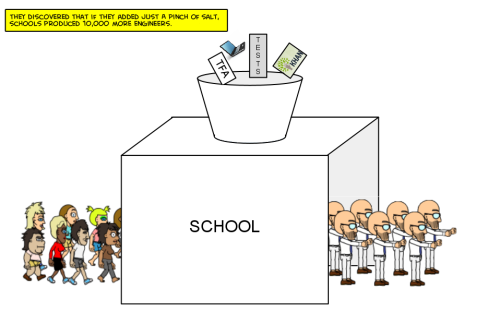
Fifth, our public schools are actually designed, since the beginning of the 20th century, to turn out factory workers. They are designed to produce conformity and submission, not to educate as such, and certainly not for leadership or initiative. Those who succeed in this system will be good soldiers, but too easily led. 

The original plan was that expensive private schools would teach leadership, keeping the ruling elite in power. This was bad enough; but, over time, the same philosophy has seeped into the private schools, through the ed schools and legal requirements for private schools to hire only “qualified” teachers, so that now everybody is trained for obedient conformity.

It is not, as Brooks blithely assumes, the educated elite that “invent new technologies that privilege superskilled workers.” Steve Jobs and Bill Gates were college dropouts. Orville and Wilbur Wright were bicycle mechanics. Albert Einstein was a patent clerk. New inventions and new ideas are more likely to come outside than inside the established academic institutions. Academic institutions are innately conservative—not necessarily or always a bad thing; they are supposed to be there to preserve and to pass on established wisdom. A task at which they are now failing.

I’m not sure Brooks quite understands why “it’s not the entrepreneurs who seem most threatening to workers; it’s the professional class.” They see Trump, a rich entrepreneur, as their champion. This confuses the professional elite. Based on their Marxist ideology, the working class should see such a “rich capitalist” as the enemy, keeping them down. While the socialist professional elite should be seen as the allies of the working class. Even if they would not be caught dead in their vicinity

But, while Trump may not have started from the bottom, the thing about entrepreneurship is that it is indeed a pure meritocracy. 

It is not any lack of merit that is keeping the working class down.


Wednesday, April 19, 2023

Coming of Age in Canada


Last week, I helped a student edit a poem for his high school English class. It was required to be on the theme of “coming of age.” He thought of the metaphor of a ship casting off the lines and leaving the pier for the open sea. I thought it was quite beautiful.

But the teacher was unhappy with it, and without revision threatened a low mark. To begin with, she took the word “tack,” referring to directing a ship, for an error. She was sure enough of herself not to look it up in the dictionary. So he lost marks.

Perhaps to her dictionaries are oppressive, lest they contradict her “lived experience.”

But the bigger problem was that the poem gave no “cause” for “coming of age.” At last we puzzled out that she was expecting some rebellion against parents and society. It was not permissible to see growing up just as striking off on your own. It had to involve rejecting whatever your parents had taught you.

This was a special problem for my student, because he is Chinese. Not Chinese-Canadian. Chinese, attending a Canadian high school. To him, the thought was shocking. Filial piety and respect for your ancestors is among the deepest of Confucian values.

I found it admirable that, on figuring out this is what his teacher wanted, he declared that, rather than accede he would take a lower mark.

But it illustrates how harmful our schools may have become. The agenda of this teacher at least—and she is not alone—is not to educate, but to de-educate, to dismantle anything the student might already know.


Thursday, January 26, 2023

Deligion in the Schools


Due to the Canadian government’s current inability to perform such simple tasks as issuing citizenship certificates and passports, I have been forced for years to homeschool my kids by distance.

I have considered this an extreme hardship; and have been horrified at the thought of how much they are missing in their education. 

But perhaps not. 

After all, if government cannot manage simple paperwork, how well are they going to do education?

It recently occurred to me that I ought to be teaching my two geography and science. 

I went online to look for a geography and a science text.

I could find nothing suitable. All available texts seem not to be about geography or science at all. They are about global warming, environmentalism, and the depletion of natural resources. With a lot of pointless make-work projects assigned. They are teaching nothing, and in the most inefficient way imaginable. 

Or rather, worse than nothing. In the first place, students will have a misconception of what science and geography are about. In the second, they will have been indoctrinated into a bizarre cult with no scientific or empirical basis, nor philosophical foundation. They will think these dubious assertions are established truth. In the third, this nature cult seems tailored to replace religion and conventional morality. It is paganism.

I am not claiming that the teaching of science was any good when I went to high school.

But this is much worse. And at least geography used to make sense.


Sunday, September 18, 2022

The State of the Academy in Indiana


How to speak good English...

One of my Korean students has just started classes at the University of Indiana. He is confused that all international students from countries in which English is not the official majority language must take an extra course in English as a Second Language. He accepts the need in his own case, but notes that some of these students speak impeccable English; some seem, to his ear, to have better English than the professor. And no entrance test was administered: all must take the course, depending only on their place of origin.

This seems to be discriminatory, and to make no sense.

But it makes more sense when we see the topic for his first homework assignment. It is to summarize and compare two short essays. One is by a Chinese-American lamenting that her father is foolishly proud to have lost his Chinese accent. She considers that he has thereby lost part of his ethnic identity, and it is due to cruel social pressure from the majority population. The cruel social pressure being, in part, his being complemented on speaking English well. The other is by a woman of Ojibwe ancestry, who laments that her ancestors had the language taken from them, by having learned English. None of her relatives speak to her in Ojibwe; it has been reserved for prayers. As a result, she must learn it as a second language, in order, in her mind, to reconnect with the thinking of her ancestors.

So the point of the course is apparently not to improve the students’ English. It is to discourage them from improving their English. English, although the course is given entirely in English, is the enemy.

Political indoctrination is plainly the point of this course. But this is actually secondary. The problem in the academy actually goes beyond political indoctrination. To justify their existence, many academic fields and many academics must spend their time in teaching nonsense. If they stuck to the sensible and true, there would be nothing to teach in many fields. Everyone knows, for example, that learning something new is a good thing, to the student’s benefit. If you spend a year simply teaching that it is useful to learn English, you have no course, and no job. 

So why not teach actual content? Why not teach how to write better?

To quote a certain plastic doll, “math is hard.” This requires that the field actually knows anything; and that the professor has learned it. The expansion of the academy into new fields has meant the creation of many new fields without substantial actual content. And in many other fields, the academy is not the proper venue.

In homeschooling my own kids in Canadian history, I read them a sequence of reports from the Kingston Standard of 1832, on the arrival of cholera from Europe. I thought it was especially interesting to compare it with our own recent experience of covid. But the comparison prompted a different response from them:

“How come the writing in newspapers then was so much better?”

This for what was a small-town newspaper, by modern standards.

It is because in those days, people were hired to write for newspapers because they could write well. In our day, people are hired to write for newspapers because they have graduated from journalism school.

Writing cannot be taught in the classroom. This is equally true of other fields: the arts in general, and even teaching itself.

At the same time, teaching correct English, at this level, it is only too likely that students will know more than the professor. That is a frightening prospect for a professor. Best to steer clear of that subject.

So you have to invent something to teach that nobody is likely to know. It therefore has to be something so absurd nobody would have thought it.

And so we get so many of our lunatic “woke” ideas, generated in the academy.

It is wrong to point to a problem without pointing to a solution. The solution is probably already spontaneously in progress. The conventional academy must die, and be replaced by open competition among online courses. The Harvards and McGills may survive by offering comprehensive testing to certify knowledge in a field.


Sunday, May 15, 2022

The Joy of Learning


Further remarks from the Beaches-East York All-Candidates Meeting on May 12:


I have spent my life in and around education. You’d think by now I would have learned something.

More than that, I’m a father. Education matters to me deeply. 

Simply spending more money on schools is not much help.

As of 2022, Ontario spends $14,821 per pupil. That’s in line with other provinces, more than the US, more than Finland or Korea or Singapore, all of which do better on the OECD’s measures of student success. 

Yet the schools are in crisis.

Why do the rich send their children to private schools? Why do private schools consistently get better results with less money? Why do homeschoolers get better results?

The most urgent matter is to get Critical Theory out of the schools, and keep it out. 

New Blue has been the leader in alerting us to this issue. Every other party endorsed Bill 67 on second reading, and Bill 67 would actually mandate Critical Theory in our schools and colleges at every level.

Aside from destroying civil society, Critical Theory makes education itself meaningless. If you believe there is no objective truth, there is nothing to teach, and nothing to learn. Everyone just makes up whatever they want to believe, and tries to impose it on others. 

Or their students.

This is the emergency. But over the longer term, the way to improve education is to introduce competition.

New Blue wants tax credits to allow more parents to choose their children’s education. 

Since at least the early 20th century, our public schools have not been designed to produce excellence. They have been designed to produce workers for industry. The rich can sent their kids to private schools that teach leadership, and this perpetuates class divisions.

Most of the work of my own online academy is teaching students the skills the public schools will not teach.

We need to level this playing field. 

Could we not fix the public system? To some extent, no doubt; but this will take more time, tears, and sweat. The forces against this are entrenched and powerful. In the meantime, too many young minds will be wasted. 

And even if we can, school choice is needed in a pluralistic society. 

Our founders and our constitution understood this. Diversity is our strength. So we have the separate school system, originally one system for Catholics, and another for Protestants. 

But two systems are hardly adequate any longer. They are laughably inadequate. We need to extend equal rights to other faiths and life philosophies. Values are the core of education, and parents must be able to pass their values on to the next generation. This is what parenting is about.

Let’s bring the joy of true learning to the schools.


Sunday, December 05, 2021

The Way We Weren't


Marguerite de Bourgeouys sculpture, downtown Montreal

I am currently forced to homeschool my daughter. It is just as well. We’ve been going through the prescribed text for Canadian history together. It’s alarmingly bad.

Most recently, it includes a chapter of detail about everyday life in New France. This is, to begin with, not a proper subject for history. We have apparently forgotten why we study history in the first place: to learn the lessons of the past. People’s everyday lives do not, on the whole, provide such lessons, for they had little chance to make choices that might alter the course of history. History properly has to do with matters of government policy, for the most part. Life lessons are important too, no doubt, but these we get from tales of saints and heroes and villains; not the lives of average persons in aggregate.

As to government policy, the book asserts, several times, that the French government saw their North American colony as something to exploit “to make the home country rich.” They did this through the mercantile system, forcing the colony to trade with the motherland. This seems a distortion of history. It should go without saying that a colony needed to pay for itself—that the cost of defending and administering it must not be higher than it returned in taxes. But there is every evidence that the French government saw themselves as also being in North America for the benefit of the natives: in order to convert them to Catholic Christianity and teach them how to improve their lives. And the mercantile system equally committed the mother country to trade with the colonies; trade is not exploitation.

As to the lives of ordinary people, the book goes on at some length over just how exploitative the seigneurial system was, whether there was class mobility, and how large was the pre-conquest middle class. Such class analysis tends to presuppose Marxism; otherwise it is of little interest. In any case, the written records are not sufficient to draw any conclusions. It is all conjecture tainted by political agendas. And such an excursus kills any narrative flow; it is the narrative flow that makes history interesting.

The text also diverts from any narrative continuity to point out that torture was used in the Quebec courts—30 times over a century. It goes into the methods in some detail. This may entertain adolescent boys, but it is not relevant to history. It seems little more than an opportunity to gossip unfavourably about our ancestors.

As is the two pages spent on slavery in New France. This seems disproportionate for a practice that was more common almost everywhere else except continental Europe, and which had no economic impact in New France. It seems mostly, again, a chance to find fault with our ancestors.

The book is openly hostile to Catholicism. It suggests that the average habitant was really more pagan than Christian, because “Canadian children heard tales of flying canoes, werewolves, and encounters with the devil.” Even though the same could be said of Canadian children today, or children at any time or place. 

Most disturbing to me is that the book spends only a half a page on women in New France, under the segregated subhead “Women in the Workplace.” It is not just that this ignores the work of women in the home, despite the concentration on ordinary people and ordinary lives. It also omits much of the history I read and heard as a student in Quebec half a century ago. Then, we knew of Madeleine de Vercheres, who defended almost single-handed against an Iroquois attack; of Marie de l’Incarnation, who founded the first school on the continent; Margeurite de Bourgeouys, who co-founded Montreal, built the first church, and started the first school; Jeanne Mance, who started the first hospital, which grew to a string of hospitals across Eastern Canada; Marie-Marguerite d'Youville, who built the first orphanage and hospice, the origins of the Canadian social security system; and St. Kateri Tekakwitha. 

Now all we get is brief sentences about some woman running a mill, or continuing their husband’s business after his death.

Why this radical devaluation of women? In part, I imagine, because it is now politically incorrect to say anything that sounds good about Catholics or the religious; and most of these women were nuns. In part, I imagine, because it is politically incorrect to admit that women had important roles before Betty Friedan. They were supposed, after all, to be oppressed.

It would all have been a terrible miseducation for my daughter.


Thursday, November 25, 2021

Shut Up and Think for Yourself


Christina Wyman has written a piece for NBC decrying parents who want to interfere with their children’s education. She laments that “parents think they have the right to control teaching and learning because their children are the ones being educated.” “It’s sort of like entering a surgical unit thinking you can interfere with an operation simply because the patient is your child.” After all, “Teaching, too, is a science. Unless they’re licensed and certified, parents aren’t qualified to make decisions about curricula.”

This is eleven different kinds of wrong. It is wrong on every point. And not list a little wrong on them. 

To begin with, overseeing their children’s education is the primary duty of parents.

"The role of parents in education is of such importance that it is almost impossible to provide an adequate substitute." The right and the duty of parents to educate their children are primordial and inalienable. – Catechism of the Catholic Church

Wyman cites the analogy of medicine. Fine. Here the patient has the right to choose their own doctor, and then to refuse any given treatment—for themselves and for their child. Let it be so in education. Let parents choose the school and curriculum.

And make the teachers liable to be sued for malpractice, as doctors can be.

I’m good with that.

But unlike medicine, teaching is not a science. It is not evidence-based. There is no empirical—which is to say, scientific—evidence that certified teachers teach better than a random person off the street. In fact, the evidence shows the opposite. Those who are homeschooled do better than those who come up through the public schools on standardized tests and in university—literally, then, a random member of the public can do better. Those who attend private schools, where teachers do not have to hold professional qualifications, also do better. Sending your child to a “qualified teacher” is the worst available option.

Wyman goes on to assert that “An educator’s primary goal is to teach students to think.” This is an odd thing to say to justify refusing parents the right to think about their children’s schooling. The public schools deliberately repress this, and were designed to do so in the early 20th century. One of the great attractions to private schools is that they, unlike the public schools, do teach students how to think. That means teaching them philosophy, logic, rhetoric, formal debating. Subjects definitive of the private schools, and rarely seen in public schools. It would mean teaching using the Socratic Method. What public school does?

The question: is Wyman that stupid, or that corrupt?

And how stupid or corrupt are our politicians if they accept this?


Thursday, November 04, 2021

Root and STEM


When I taught in China back in the early 90s, I was appalled to learn that the university had no Department of Humanities. Purely a mechanistic view of the cosmos and of human life, it seemed. When the Berlin Wall fell, the countries of Eastern Europe understood the problem: their scholars rushed to the West to get a grounding in the Humanities. Unfortunately, they were disappointed.

I am alarmed to see that Humanities is now also no longer taught in high schools in Tennessee. A list of subject areas ESL students must be prepared for gives Language Arts, Math, Science, and Social Science. 

A disease is spreading, and it is deadly. It is deadly not just to democracy, but to civilization itself.

If our culture were sane, Humanities would be the entire high school curriculum.

After the basic skills of Reading, Writing, and Arithmetic, taught to mastery in elementary school, the Humanities is the one thing everyone needs to study. It is the reason and grounding for everything else. If you do not pass it on, individuals despair and civilization dies.

Today, we waste our students’ time for four to six years, years when they are full of energy and desperate to learn. Many turn off at just this point. 

Math? It is a common observation, a truism, that we never use our high school algebra, trigonometry, or calculus again. So what is the justification for teaching it? Geometry would be useful—to teach logic. But it is never presented in those terms; just as a set of axioms that obviously do not relate to the real world.

Science as taught in the schools is the antithesis of science. It is taught as a body of knowledge; stuff to memorize. This specific knowledge, taught as certain in high school, is probably false and will probably be shown by science to be false in time. Much of it is already known to be false while the textbook is still in circulation. The essence of science is to doubt you know anything, and to test everything; it is the scientific method. That is not taught. If experiments are done, the result is always predetermined. Anyone genuinely likely to excel in science is only likely to be turned off it in high school.

Language Arts? The grammar of English should have already been learned in elementary school. As to other languages, if it is a matter of learning to speak them—our current emphasis—the classroom is the worst place to do so. The place to learn a language is by speaking it regularly, something the classroom is designed to prevent. Language, when taught as a Humanity, is an exercise in logic: the old grammar-translation method. It is no longer taught in such terms.

Social Science? A mathematician back in the fifties made the observation that anything that has ever been discovered by the Social Sciences is either trivial, or it is wrong. This is still true, and will forever be true. Rather than adding to our knowledge, the social sciences have subtracted from it, by introducing serious errors to the popular mind. Human beings are not objects, and cannot be studied as objects. Even if this were possible, it would be morally offensive. And teaching Social Science is therefore teaching immorality.

The wealthy and the upper classes pay huge sums to educate their own children at private schools that do concentrate on the Humanities: on logic, philosophy, rhetoric, debate, history, classical literature. They know what they are doing. The British Empire was built on the quality of its private schools. The modern public school systems of North America were intentionally designed, in the early twentieth century, to produce cogs for the industrial machine. What they teach is submission and acceptance. The Humanities teach leadership; for they teach how to think. As Confucius said, “a superior man is not a tool.” Without the Humanities, the schools are turning out workers, meant as a means, not an end.

The world may need more STEM. But the problem with STEM is that whatever is taught today is obsolete tomorrow. To teach it at the high school level is a waste of time. Even to teach it later, at university, when specialization is possible, is probably too soon. It needs to be taught continually, over one’s professional career. Something now entirely possible, with distance education.

But what is needed even more than STEM, and all the more so in times of rapid change,  is minds that are adaptable, have initiative, and know the ultimate goal.