|
| Eve's temptation, as imagined by Gaugin. |
We don't like to admit the very existence of human evil. We want to deny that hell exists, that the devil exists, or that anyone is bad to the marrowbone. We even hate those, like the Catholic Church, who remind us of the possibility of evil. This is strange, because the twentieth century can best be understood as a massive eruption of human evil: Hitler, Stalin, Mao, and their many imitators. There were no doubt genocides before the twentieth century, but they were rather rare. Now they are commonplace.
But we even have trouble accepting this overwhelmingly obvious fact. Just about everyone agrees that Hitler was evil; but probably only because he lost that big war, and got himself safely killed. In his day, he had a lot of ordinary Germans on his side. Stalin and Mao still have their admirers; Mao still has many. Feminism and abortion have killed and crushed more than either, yet it is highly controversial to say that they are evil. Someone has rightly said, that no bad government ever gets overthrown because it is evil; governments only get overthrown because they are incompetent.
The principal reason for this is an unspoken pact among us. If we deny the existence of evil, we get a free pass on our own actions. We need no longer worry about whether we have done right or wrong.
This is the verdict: Light has come into the world, but people loved darkness instead of light because their deeds were evil. Everyone who does evil hates the light, and will not come into the light for fear that their deeds will be exposed. -- John 3:19-20.
 |
| War in heaven: Bosch. |
Some of this too, no doubt, is a natural fear reaction: speak of the devil, and he may appear. You don't want him to notice you, so you pretend not to notice him. It may not be terribly logical, but it is a typical human gambit: whistling past the graveyard.
Some too is the much less creditable hope that, by remaining silent, or even by cooperating, the evil will pass you by and turn their glance on someone else.
The man looked frantically round at the other prisoners, as though with some idea that he could put another victim in his own place. His eyes settled on the smashed face of the chinless man. He flung out a lean arm.
‘That's the one you ought to be taking, not me!’ he shouted. ‘You didn't hear what he was saying after they bashed his face. Give me a chance and I'll tell you every word of it.He's the one that's against the Party, not me.’ The guards stepped forward. The man's voice rose to a shriek. ‘You didn't hear him!’ he repeated. ‘Something went wrong with the telescreen. He's the one you want. Take him, not me!’ - George Orwell, 1984.
Hence the Stockholm syndrome, the trusty kapo of the camps, the Uncle Tom. The now-famous
Milgram experiment seems to prove that, confronted with a case of clear evil, most ordinary folks will willingly cooperate. Sixty-five percent of us, in fact, given the chance, will obey to the point of apparent murder. In other words, society is no protection against evil.
 |
| Adolf Hitler as the messiah. |
Another discreditable but routine human reaction to evil is victim blaming. It is unfortunately reassuring to convince ourselves, whenever we see another suffering, that in some way they brought it upon themselves. This relieves us of the stress of fearing that the same thing might happen to us; and it relieves us of the moral responsibility of either helping them or risking standing up to evil. This is no doubt extremely helpful to the evil among us. It is also the underpinning of the doctrine of reincarnation endorsed throughout the east: if some poor wretch is being stabbed at your feet, it is no doubt because he tortured spiders in some past life. No call nor point in helping him out now.
So far, so bad. But then too, I suspect some of the problem with recognizing evil for evil comes from the fact that evil is by its very nature ambiguous. God created all things in this world. He created all things essentially good. Evil is therefore not a thing in itself, but only a relative absence of good: evil occurs when a greater good is sacrificed to a lesser (privatio boni). This so, it is always possible to point to some good in any evil. Without a decent sense of proportion, therefore, the very distinction between good and evil can casually be lost. This is what we see in “moral equivalence,” for example. Every evil person can give some sort of justification, some superficially plausible rationalization, for every evil deed, to himself or herself or to others.
Another complicating issue is the Christian belief in the universal availability of salvation. God also created every person. He created no one evil, and no one to be damned. Salvation is available to everyone, even the utterly wickedest of us, given that we repent. So in this sense it is wrong to characterize anyone as “evil.” Their nature is good, for they were created good, and may still return to goodness. Their deeds are evil.
Still, the Bible does speak of sheep and goats. Hell is there for someone. At least at the point of death, some of us will have indeed become irredeemable, and there will no longer be any walking anything back. In fact, understanding evil seems to be one of the keys to the New Testament. There, Jesus and John the Baptist don't appear to hold back much in describing the scribes and Pharisees as evil in so many words. They are called “full of hypocrisy and wickedness,” and asked “How will you escape being condemned to hell?” Jesus blames them for “All the righteous blood that has been shed on earth,” and tells them “you do not enter the kingdom of heaven.” They are introduced as “children of hell” (Matthew 23:13). Not a sterling example of “gentle Jesus, meek and mild.” Denying evil, despite much propaganda by non-Christians and anti-Christians, is not a Christian virtue.
 |
| One of the Buddhist hells, in which the permanently evil torture mere ordinary sinners. Tiger Balm Gardens, Singapore. |
So, God's truth, there does seem to be an identifiable group or class of people in the world who are rightly described as the bad guys. And it may only be cowardice or duplicity that keeps us from plainly seeing and saying it.
I have recently been reading the book People of the Lie, by M. Scott Peck. Peck, a psychiatrist and a Christian, argues that we need to accept the psychiatric reality of evil, as we do with other psychiatric diagnoses, so that we can study it. So someone can be diagnosed as “evil” in the same sense someone else can be “schizophrenic” or “depressed.”
I have problems with this approach, but that would, at present, be a tangent. The point is that he, as a psychiatrist, claims to encounter genuine evil regularly. If it is not a psychiatric diagnosis, it is the cause of many psychiatric diagnoses in others—its victims.
 |
| Mao Zedong as centre of the universe. |
Peck does not give his own clear diagnostic criteria, so far as I can see, but he does make a distinction between those who are evil and those who are merely sinners. We are all, of course, sinners. He says that “evil people,” “people of the lie,” are distinct in the consistency of their evil. It is as if they have at some point, like Faust of legend, made a pact with the devil. They have made up their mind, whenever there is a conflict, to follow their own self-interest in preference to their conscience.
This does not, according to Peck, usually produce obvious and dramatic results. We are not talking here about serial killers. Perhaps the only person who consistently sees such cases, and sees them clearly, is the psychiatrist, through meeting their victims. Because the truly evil rarely end up in prison.
Most folks behind bars, Peck says, are merely mentally ill; while the truly evil are seen by others on the whole as good, upstanding citizens. This surely stands to reason. An evil person is a person who puts his or her own self-interest or personal desires above all else. It is in nobody's obvious self-interest to go to prison, or to be identified publicly as a criminal. Accordingly, anyone who is both evil and in prison must be significantly incompetent at being evil—of quite low intelligence. Most will have ended up there not because they are evil, but either because they are self-destructive or have been put in some desperate situation.
And should it be any surprise that this is just what the New Testament suggests as well? Without saying that their crimes are okay, the New Testament, and Jesus, make a point of never condemning criminals as criminals, as Jesus refuses to condemn the woman taken in adultery. Indeed, Jesus himself is executed as a common criminal; what could be a clearer statement of solidarity than that? The thief crucified next to him is also pointedly identified as good, indeed a saint, ready for heaven instantly, with time served, with no intermediate stop in purgatory. As if the point were not already made, at the very moment that Jesus insists that some people are good, sheep, and some people are bad, goats, he implies that those in prison are not among the goats. Jesus says that any man we might visit in prison is in some sense Jesus himself; and it is by visiting them that we show ourselves to be of his flock of sheep (Matthew 25).
Instead, according to both the Bible and Dr. Peck, the truly evil are to be found among the most “respectable” classes, those who are generally thought well of by society as a whole. The leaders, the city fathers. And this stands to reason. Thinking only of what is best for themselves, and holding that they are intrinsically wonderful, the truly evil are going to do what they can to amass both prestige and power over others. The devil, as they say, is a gentleman.
Jesus makes this point by describing them, as a class, as “hypocrites,” a term used in the original Greek to refer, among other things, to actors. They are people playing a social role, who are the opposite of the way they appear, “whited sepulchers.” Peck makes the same point by calling them “people of the lie.” They are probably not going to break any laws, and they are not going to attack anyone from the front. It will be the knife in the back, the sly manipulation, the short-of-criminal con. It will be hate disguised as love, evil disguised as righteousness, selfishness disguised as selflessness, black disguised as white. The lie must be their basic tool; this no doubt is why Satan is called “the father of lies.”
Satan's own sin, the fundamental sin of all sins, was to imagine himself as God. This is the archetype of evil: the ego elevates itself to godhood, imagines itself the true and proper centre of the universe. It is Adam and Eve's sin in turn: they ate the apple not just in disobedience to God and their conscience, but that “they might become as gods” themselves. Every evil person is a little self-proclaimed idol. (In this context, it is both telling and frightening that it is commonplace now for women of the feminist persuasion to refer to themselves as “goddesses”). This distinguishes him or her from the general run of sinners, who often will go against their conscience for their own self-interest, but will tacitly recognize the wrongfullness of this, later surrender to their guilt, and repent. In the end, most of us accept that other people have the same abstract rights as we do. The evil do not accept this to be so. Other people are things, put there for their benefit.
Atheists will here object that they are perfectly capable of being moral people without believing in
God, much less bowing the knee to him. And that is true, if by this they mean the traditional depiction of the Judeo-Christian God specifically. But in philosophical terms, bowing to God is the equivalent to bowing to the reality of objective truth and objective justice, objective right and wrong—which even the pagan Greeks would have recognized, as Dike. God is this personified: the Good, the True, and the Beautiful. As AA puts it, “A power greater than ourselves, however we might conceive it.”
 |
| Faust plays chess with Mephistopheles. |
The next point is that this violation of the first great commandment, to love God (or justice) with your whole heart, leads automatically to the violation of the second, to love your neighbour as yourself. Satan's rebellion against God led him to seek harm to Eve and her children as well. Adam and Eve's transgression led in turn to the second great sin of Genesis, Cain's killing of his brother. When you reject God, or truth, you reject your fellow man as well. You begin to actively do harm. This is because truth as moral centre is automatically replaced by ego as moral centre.
Peck explains this as a need to scapegoat. In an effort to quell the voice of their own conscience, the actively evil need to project their sins onto someone else, and punish them, in order to feel righteous. So Satan stands in as “the accuser,” in for instance the Book of Job, justifying himself as a kind of prosecuting attorney ferreting out evil in us mortals, and supposedly punishing it in hell. This is also ther type of the scribe or Pharisee in the New Testament, who stand as judges over the people, laying additional burdens on them and making no effort to help. This is the universal bully. In practice, it can become sadism, deliberate cruelty.
We see this in history. It is said that those who sought to avoid the evil attentions of Vlad the Impaler were obliged to praise him as the “scourge of God,” doing God's work in ferreting out and punishing evildoers. That was how he wanted to see himself; and, since we all have some tendencies to evil, this ruse can always work. Idi Amin's system was to have one prisoner beat another to death, and then to ask a third prisoner to beat the second prisoner to death for this crime, and so on. By doing so, he kept his own conscience, presumably, clear. Each man was being executed justly in turn, for he had given in to temptation in hopes of saving his own life. As the evildoer's conscience becomes more and more insistent in telling him that he has done somthing wrong, he becomes more and more active in seeking and punishing scapegoats to alleviate his own guilt. Put him or in a position of supreme power, and the result will be a holocaust.
But this notion of scapegoating is not the whole story, surely. It is not clearly what happens in the story of Cain and Abel, which suggests that it is not the true, primordial genesis of brother-on-brother evil. Here, the problem is simply and clearly that Cain perceives God as liking his brother more.
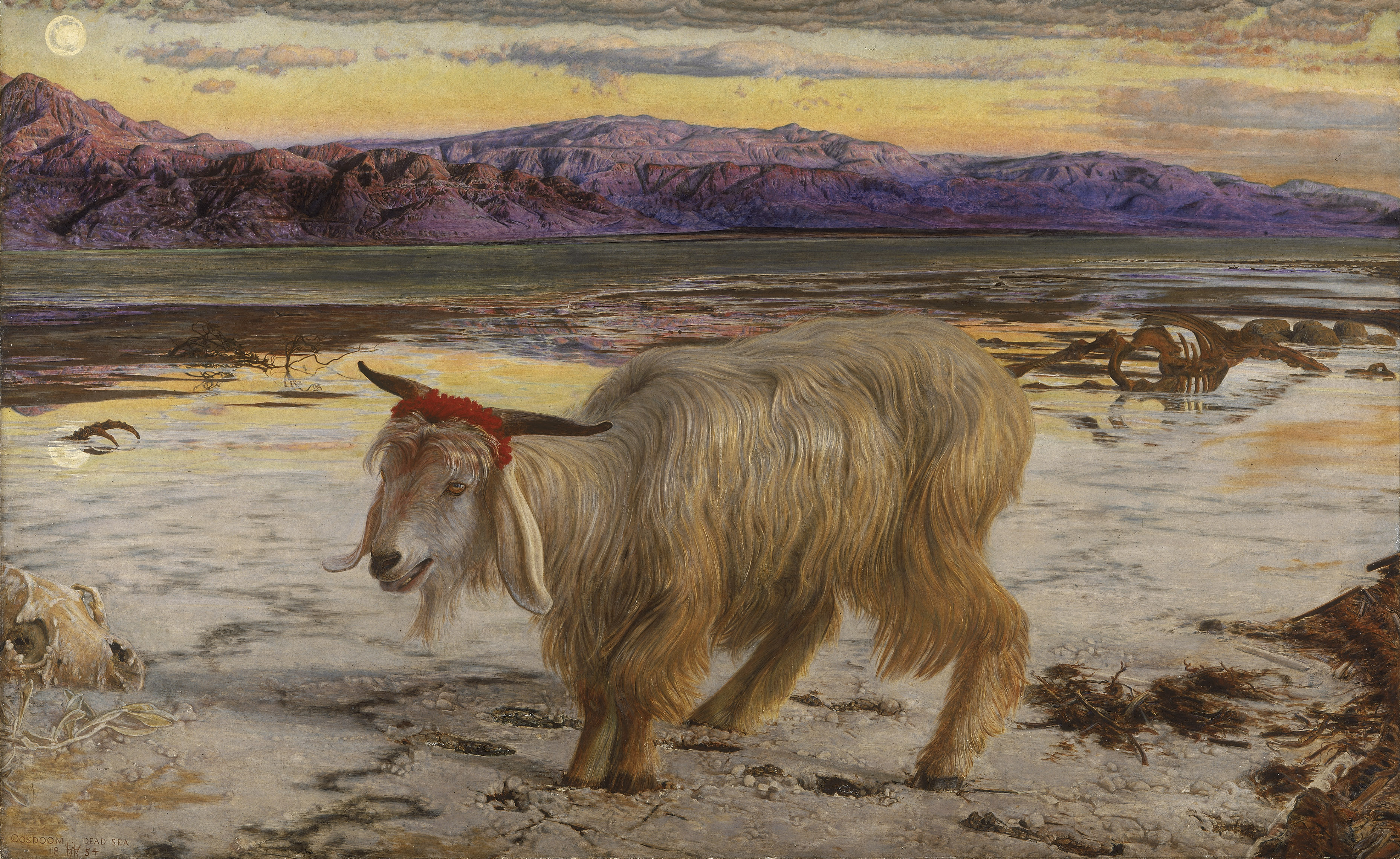 |
| The scapegoat. |
This too makes good sense. If an individual ego has made up its mind that it is and ought to be sovereign, any demonstration of any kind of attention given to or superiority shown by another being, however inadvertent, is a direct challenge to and attack on that sovereignty. It is, within this distorted view, itself satanic; it is an act of rebellion against the rightful God, who is, of course, John Doe. So the evil person can feel justified in doing any act of harm to another whom he or she considers a threat to his cosmic supremacy.
This is indeed what led to the crucifixion of Jesus the Christ. The keepers of the law could not tolerate the direct appearance of God himself, for it threatened their own authority. God himself was rebelling against them. He had to and in some twisted sense deserved to be put to death.
So too in Cain's deed, he is demanding that God, not just Abel, submit to his will.
.jpg) |
| Cain and Abel, by Durer. |
As with the Nazis and the Jews. Let's be honest: the real source of the Jews' problems was (and is) that they were too genuinely impressive in their accomplishments. There was certainly scapegoating too, but this original sin led to their choice as a scapegoat.
Put these two factors together, scapegoating and envy of the good, and you have a truly demonic force. You have a human wrecking machine.
You have the people of the lie. And we need to understand that they walk among us. We are sheep among ravening wolves, as Jesus said.





 Posts
Posts