Playing the Indian Card

Showing posts with label science. Show all posts

Tuesday, October 12, 2021

Men of Science


Scienceman

Dr. Fauci likes to say “I am a man of science.” He has also said “when they attack me, they are not attacking me, they are attacking science.”

This is unsettling. He is wrapping himself in science as though it bestows sanctity, as though it makes him a higher form of being. And he is evoking science as though it is a body of incontrovertible truths. The closest parallel I can come up with is “I am a man of the cloth,” among ministers. But it would be considered bad form to say that of yourself, and it actually does not carry as much weight. You will say, so what? What denomination? Nobody gets away with much by it.

One does not hear anyone say “I am a man of double-entry bookkeeping,” or “I am a man of actuarial tables.” Yet all are on the same intellectual plane as science. They are all no more nor less than tools. 

It is an indication of how badly we have fallen into “scientism,” the worship of science as our religion and our God.

Besides the idolatry, we need to realize the obvious truth that having training in the scientific method does not make one a moral person. Anyone evokes “science,” and we act as though this is proof of good moral character. And of a truth beyond challenge—the very opposite of the scientific method.  Charlatans and scoundrels—not here referring specifically to Dr. Fauci—can make good use of this naïveté. Freud, Hitler, and Marx are obvious examples.


Saturday, February 29, 2020

No, You Are Not a Child of Nature


Pachamama. Note that she is actually made of stones.
My friend Xerxes weighs in against the growing current tendency to anthropomorphize inanimate objects. 

And it is a growing tendency. We see it not just in talk of the planet Earth as “Gaia”; but of “harming Mother Nature,” of Nature having specific preferences and interests, or seeking revenge, or maintaining a “balance”; of Science “knowing” this or that; of this species being “more evolved” or “more highly evolved” than that, as though Evolution per se could have a plan or a direction. Or of “harming” or “damaging” as opposed to the climate simply changing. None of these are sentient beings.

Fine to use these things as convenient or poetic metaphors, as when Carl Sandberg says the fog “comes in on little cat feet.” But no, fog is not a cat. Fine to suggest that God, or even some other supernatural being separate from the object, demon or angel, has interests here. Fine, that is, if you know what you are doing, and can produce a coherent theology. But not the inanimate object itself.

I do not think actual pagans made this mistake. This is childish thinking. I think at least some pagans had to be too smart to do this. They presumed a god who had jurisdiction over the river; they did not suppose this was the physical river itself. That would be absurd. That would simply be an error, a logical fallacy, mistaking a physical for a spiritual thing.


Saturday, April 08, 2017

Science Denial


It's really not that complicated.


It is fashionable these days on the left bank of the river to claim that those on the right are “science deniers.”

Which I deny.

This is an odd charge coming from the pot.

It is based, it seems on the fact that folks on the right tend not to accept the concept of global warming as popularly framed: a need for governments to act urgently to stop the planet from warming. Yet it is fraudulent to call this an attack on science. Nobody who opposes the climate change agenda denies science. Their objection is that the science does not justify the panic—that, in sum, the position of the left is unscientific.

It is at least some people on the left, on the other hand, who have indeed dismissed science itself. When you argue relativism, and cultural relativism, that is a denial of science, for science is a part of culture and is therefore relative. Its claims to truth, like all claims to truth, must be false and purely relative. Science, to the postmodernists, is a “social construct.” To the feminists, it is a “tool of the patriarchy,” maliciously designed not to work for women. Nobody on the right is making such claims. Nobody on the right has entered Time’s “post-truth” society. It is only on the left.

And in detail:

The left in general denies that human life begins at conception, and insists that a human embryo is “just a clump of cells.” This is scientifically nonsense. The science is clear; a human life begins at conception. From that point on, you have a genetically distinct human being, with all the programming present to become whatever he or she will become. And he is not going to turn into a cancer or a kangaroo.

Which means, not incidentally, that human beings are not programmed by Microsoft.

The left denies that average IQ can differ by sex or race. It objects to anyone even hinting at this as “racism.” Affirmative action programs are based on a denial of this fact. But of course, as a scientific fact, it can and does. That you do not want it to cannot change the science, here or anywhere else. Caucasians are smarter on average than Africans, East Asians are smarter than Caucasians. Jews are smarter than other Caucasians. And the Katzes are smarter than other Jews. Except maybe the Liebermans. A pure meritocracy is going to mean men, Jews, Asians, and Caucasians dominate at the higher levels. Anything else is unjust to individuals and to races, and against the common good.

The problem in this instance is that, because the left wants to deny the existence of God, they cannot accept the real doctrine of human equality. It means that God created all men as equal in moral value, equal in his eyes. They have to pretend that “equality” is a scientific issue, or they feel that it does not exist.

So they falsify science to suit their politics.

Feminism is guilty of ignoring the real differences between men and women in insisting that they have a right to do all the same jobs in equal numbers. Some of these differences are physical, and so plain to science. Men are taller on average than women, and this can be a legitimate job requirement. Men are physically stronger than women. Women have physical advantages too, but it does not come up, because nobody protests if women dominate a profession. Relaxing requirements so that more women can be soldiers, or police, or fire fighters, is not equity. It is science denial, fair to no one, and a danger to the general public.

The left denies science when they insist that gender is independent of sex. The science is clear: if you have an X and a Y chromosome in the 23rd pair, you are a man. If you have an X and an X, you are a woman. The left denies this, and denies the right of anyone else to say or believe this, and holds that you can be whatever sex you want to be, regardless of any physical evidence. Not just that men can be women if they want, and women can be men: New York City now officially recognizes 31 genders. Australia recognizes 33. Facebook allows for 58.

Ladies and gentlemen, if I might be so bold: gender is a grammatical concept, and really cannot change your dangly bits. English, happily, has not just two, but three genders for your use: he, she, or it.

It’s your choice.

Go for it.


Tuesday, April 19, 2016

Most Science Now Isn't


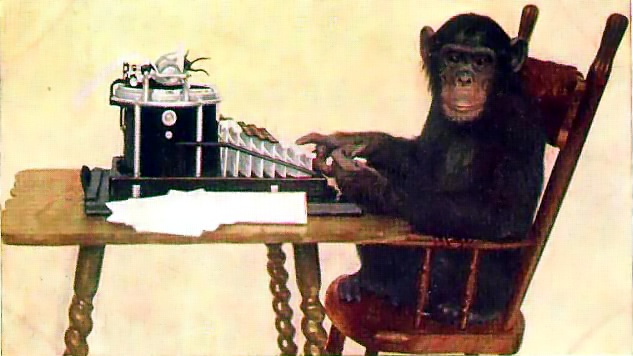
Social scientist at work.
Science began as a theological exercise. It is based on the assumption that there is a designer of the universe. Without an invisible legislator, we would not be able to find “laws” of nature. Mathematics would not work, nor would logic. We would simply have chaos.

This being so, science began as a way to understand God's nature, and his intentions. Ask Francis Bacon.

No,  not that Francis Bacon

There is a reason, after all, why empirical science arose in Christian Europe, not elsewhere. Unlike most other religions, Christianity holds that the material world is real and made by God. To Buddhism or Hinduism, for example, it is simply “illusion.” To Gnosticism and many pagan philosophies, it is the creation of the devil. The success of science proves the Christian assumption, and disproves the Buddhist or shamanist idea that the material world is “chaos.”

This is also why, popular romanticism and Disney's Pocahontas to the contrary, it is only in the Christian world that you see a real concern for “ecology” or “environmentalism.”

Not a real Indian. Trust us: it's a cartoon.
Unfortunately, over the last few centuries, we have mostly forgotten this, and come to raise “Science” itself to the status of religion. From being a useful tool, we have made it a cosmology. Whereas Philosophy used to be the “queen of sciences” (which is why the highest degree is still, even in a scientific field, “Doctor of Philosophy”) now Physics is more often cited. The social sciences are the worst example of this new “scientism,” and perhaps the fount and origin of most of the problem. They contradict some of the basic assumptions of science, but let's leave that point aside for now. For now, let's just note that social scientists almost inevitably put themselves in direct competition with religion: seeking to explain without it what religion is meant to explain, seeking to fill the human needs that clergy used to fill. Chesterton once described Freudian analysis as “confession without absolution.” That's about right. Marx and Freud, the two great founders of the social sciences, were open opponents of religion. There is good reason for this: religion was their direct competitor. It still is. 

Is that a cigar, or are you just glad to see me?

Both have also been comprehensively debunked as science. Nevertheless, their mooncalf, “social science,” lives and grows. Feminism, postmodernism, “progressivism” not only continue to dominate, but seem to grow annually in their influence, even though they are based ultimately on Marx and Freud, and this philosophical underpinning has long ago been disproven.

Unfortunately, trying to elevate science to a religion is not just destructive of religion. It is destructive to human life. Humans are reduced to the status of physical objects. It is also destructive, ultimately, to science. We are now seeing this raven wing home to roost.

"He goes on Sunday to the church." We used to care.

Let's leave aside the point that any sort of social science presupposes radical human inequality: the scientific observer must be seen as having a consciousness at an entirely different level from the observed, or else you have an insurmountable observer paradox. Even if that were not so, from science by itself one cannot derive any moral code, or any sense of the value of anything. It has, of course, been tried: Nazism sought to derive morality from Darwin and the principle of survival of the fittest. This did not look to most of us, in the end, like morality. Freud's morality was more or less the same: survival of the individual, and survival of the species. But in practice, it was only sexual license, and another kind of mass murder, abortion, inevitably followed. Marxism tried to derive morality from material progress and a need to be on “the right side of history,” even though it held that history was going there anyway. Besides failing in practice, and leading to moral abominations as awful as those of Fascism and Freud, this was always philosophically incoherent.

So far, so bad for humanity. But also for science. Science itself (like more or less any human activity) cannot work unless you can count on its practitioners being themselves moral. Yes, you can police them, but then who polices the police? Who polices the police of the police? You can have peer review, you can expect results be reproducible, but in the end, someone somewhere is only on their honour to do this honesty. Yet science itself provides no moral code, and no reason to be moral. This was fine so long as we could count on scientists to also have a religious foundation. Now that we have dispensed with religion to the extent that we have, ancient chaos returns.


Sunday, March 27, 2016

Saturday, March 05, 2016

The Hand of God?


Next, I think I'll write Hamlet.

Apparently there is a big scandal going on in the academic word, involving a paper published in a minor scientific journal, PLOS One. The problem is that the paper, by three Chinese and one American scientists, refers to the Creator as the reason for the remarkable abilities of the human hand.

The comments were pretty scathing. One, a fellow editor with the same journal, wrote “The article should be retracted and the handling editor should be dismissed.” An Associate professor at Duke wrote: “This is outrageous. If PLOS ONE does not do something about it, i.e., ask the authors to retract the paper, and in any case, if the paper isn't retracted, my students, collaborators and I will have no choice but to refrain from considering (i..e, reading, reviewing and citing) papers published in PLOS ONE.” Another reader writes “I find the use of religious language in a scietific [sic] paper totally unacceptable.” The authors have backed down, claiming it was all a problem in translation, that they meant to say not “Creator” but “Nature.” Nevertheless, the scandal was such that the paper has since been retracted by the journal. And the authors have not been allowed the chance to resubmit the paper in any amended form.

The journal's retraction notice reads, in part:

“... [T]he PLOS ONE editors ... apologize to readers for the inappropriate language in the article and the errors during the evaluation process.”
To a reader comment, they responded: “A number of readers have concerns about sentences in the article that make references to a 'Creator'. The PLOS ONE editors apologize that this language was not addressed internally or by the Academic Editor during the evaluation of the manuscript.”

For a time, the paper was pulled from the website. Now they have put it back up, without their imprimatur, no doubt by popular demand. They are clearly scrambling, and things are changing minute by minute.

Something is very wrong here. Anyone who is religious believes, as a matter of logical necessity, that the human hand was designed by God. Moreover, the argument from design is a time-honoured means of proving God's existence. The reaction of the scientific community and the journal seems to imply that this sort of statement, regardless of the evidence, is not permitted. This is simple religious discrimination, at the expense not just of religion but of science, which ought to be an open inquiry.

The authors' explanation that they meant “Nature” is bogus. The conclusion makes it clear that they are referring to an entity separate from and guiding natural selection: “the proper design by the Creator for dexterous performance of numerous functions following the evolutionary remodeling of the ancestral hand for millions of years.” The authors' response to one of the first comments objecting to the paper also made this clear. Interestingly, this comment seems to have been deleted. It essentially used the “watchmaker” analogy, pointing out that no human device has yet matched the dexterity of the human hand.

In any case, changing “Creator” to “Nature” does not change anything substantial. If you are going to attribute a design and a will to “Nature,” “Nature” is simply the word you use for God. Interestingly, almost everyone who speaks of the biological sphere without using the term “God” in fact does this. When we speak of evolution moving from simple to complex, or to greater consciousness, or of “the balance of nature,” we are assuming a deity and a design. It is almost impossible not to. The only difference is that if you use the term “Nature,” (or “Earth,” or “Gaea,” or “science”), you are appealing to a pagan formulation of God. You are, specifically, excluding Christ and the concept of redemption. And as an article of faith.

Some argue that the Creator has no part in a scientific argument because God's existence is not itself a matter that is scientifically testable. But it is—the point of the reference in the present article is precisely that the evidence weighs in favour of the existence of God. Moreover, elements of the opposing Darwinian theory are genuinely untestable. How do you demonstrate that something (e.g., “random mutation”) is truly “random.”

William of Okham (i.e., Occam)
Of course, the answer is that neither Darwin nor Wallace meant “random” to be taken in this sense, in the sense that modern anti-religious bigotry seems to take it. They meant, specifically, random with regard to the survival value of the mutation. They did not mean that there was no larger or divine design involved. Wallace expressly believed that there was.

Intelligent design really ought to be a no-brainer. Is a giraffe, say, plausibly, a random collection of molecules? Would Occam accept that shave?


Tuesday, September 15, 2015

Most Science Isn't


Science only works if you can assume a highly principled class of scientific priests. We no longer can, if we ever could.


Tuesday, February 18, 2014

Conservatives Are Anti-Science?


The progressive world view.

 In recent times, it has been fashionable for liberals in the US and Canada to accuse conservatives of being “anti-science,” mostly for opposing initiatives to prevent the dread global warming. Also cited are their opposition to contraception (?), and, of course, the dispute over Darwinian evolution versus creationism and intelligent design.

However, this recent survey seems to belie the claim. Which seems weird to begin with to any of us familiar with postmodernism, feminism, and post-colonialism, important elements of the left who promote the belief that science varies with sex, race, and personal preference. Not to mention the left's seemingly instinctive opposition to all material progress. Now it turns out that liberals are far more likely than conservatives to believe that astrology is scientific, and far less likely to know that the earth goes around the sun. Pretty basic stuff.

Here’s the distinction: liberals are more respectful of scientific authorities. This is because, to them, science is something magical and mysterious. Conservatives are more informed about science. For this very reason, they are less inclined to rely upon scientific authorities.

Authority and science are competing sources of knowledge; the concept of "scientific authority" is a bit of an oxymoron.

Tuesday, January 28, 2014

Political Climate Change


... we have at least to consider the possibility that the scientific establishment behind the global warming issue has been drawn into the trap of seriously overstating the climate problem--or, what is much the same thing, of seriously understating the uncertainties associated with the climate problem--in its effort to promote the cause. It is a particularly nasty trap in the context of science, because it risks destroying, perhaps for centuries to come, the unique and hard-won reputation for honesty which is the basis of society's respect for scientific endeavour. 
 --Garth Paltridge, former chief research scientist with the CSIRO Division of Atmospheric Research

I think he is right about the stakes involved: science's current prestige rests on an unshakeable public faith that scientists are utterly honest. Because scientific papers and scientific results can easily be falsified, and non-scientists would usually never know the difference.

That unshakeable public faith is very much at risk now, and a large ivory castle could come suddenly crashing down.

Wednesday, August 31, 2011

"Pro-science" and "Anti-science"

Why does the Left get to pick which issues are the benchmarks for “science”? Why can’t the measure of being pro-science be the question of heritability of intelligence? Or the existence of fetal pain? Or the distribution of cognitive abilities among the sexes at the extreme right tail of the bell curve? Or if that’s too upsetting, how about dividing the line between those who are pro- and anti-science along the lines of support for geoengineering? Or — coming soon — the role cosmic rays play in cloud formation? Why not make it about support for nuclear power? Or Yucca Mountain? Why not deride the idiots who oppose genetically modified crops, even when they might prevent blindness in children?

--from NRO's The Corner