Playing the Indian Card

Showing posts with label right-wing politics. Show all posts

Tuesday, March 11, 2025

Collateral Damage in the Trump Wars


Why are things suddenly going badly for the Poilievre Conservatives in Canada, and Farage’s Reform in the UK? The polls are dropping in Canada; in the UK, there is much dissent in the ranks.

It is the Trump effect. Trump is sucking up all the oxygen on the right. The local heroes, Farage and Poilievre, no longer seem exciting and radical by comparison. Inevitably, not being in power, Poilievre and Farage are all talk and no action. Unless they can propose policies significantly more radical-sounding than what Trump is actually doing, they begin to look like weak tea.

This is how and why revolutions devour their children. Once the movement begins, it is hard to stay in front of it. It is easy to start to look like yesterday’s man.


Saturday, December 25, 2021

RIP Ted Byfield


A persistent of reason in Canada.

The death of Ted Byfield is another reminder that so many of the voices of moral clarity are gone.

This seems a useful way to define the difference between left and right in both politics and culture. The right is for moral clarity; the left is for ambiguity, for blurring the edges. This seems to me to have been true at least since the 1960s. It was obvious in a debate I recall between Robert Kennedy and Ronald Reagan circa 1967. It was obvious in the contrast between Goldwater and Johnson in 1964. Perhaps it is the most consistent definition of the two tendencies. 

Another way to look at it is that the left sees man’s natural tendencies as unambiguously good. The right sees man’s natural tendencies as tending at least at times toward evil. The right therefore wants checks and balances, boundaries. The left wants to tear them down; it wants spontaneity.

On this definition, I am on the right. I crave moral clarity—I hunger and thirst after righteousness. And I believe deeply in original sin.


Tuesday, December 24, 2019

Shuffling Right?


As we look back on an ending decade, a couple of commentators make the case that overall, it was a story of the left is dying, and the right rising. Witness the recent historic election in the UK. Following Brexit, following the surprise election of Trump.

And in Europe. When I was young, the contest was always between the right and the socialists or even communists. The communists were a significant factor in Italy and France. Europe was seen as well to the left of the US, and leftists generally saw America as simply lagging behind the parade.

This no longer seems to be clearly so. The social democrats are slipping to third-party status or worse in Germany, the socialists are down to sixth in France. The contest now is often between the centre or centre-right and a party farther right. This means that policies in general are being pulled rightward rather than leftward in the civic debate.

Back in America, Trump’s breakthrough into the upper Midwest last election, like the Tories’ success in the north of England, seems portentous. The old industrial working class is moving over to the right.

There is less movement visible in Canada; but it seems significant that a right-wing party recently won in Quebec, where all major parties had been left-wing for the past fifty years. It all speaks well in strategic terms for Maxime Bernier’s notion of launching a new right-wing alternative. If Canada has not been following the same trajectory as the UK, US, and Europe recently, it may be for lack of electoral alternatives.

Michael Knowles makes the case that in the last ten years, the right in the US has won elections pretty consistently. If you track the number of seats changing hands at the federal and state level combined, there seems to be a definite and strong shift right. What look like continuing major defeats in the culture wars have come, he points out, at the hands of judges. They have been imposed by courts; even if, after the fact, the rest of the country seems to have accepted them. If we are seeing a revolt of the general population against the views of the elites, the courts are going to be a lagging indicator: here we get the views of a small professional elite.

And even this is likely to change, as Trump gets to appoint more judges.

Saturday, October 12, 2019

Book Burning in Georgia


If this report is accurate, the actions of the students in burning books deserves our condemnation.

But it may also be evidence that the tide is turning. Straight white men in academics are perhaps no longer happy to sit still for being lectured on how evil they are.


Sunday, June 09, 2019

The True Meaning of the Adpocalypse


Half-Canadian homophobic white supremacist Nazi Steve Crowder

In the current and ongoing crisis that has been dubbed the “Vox Ad Apocalypse,” following immediately after milkshakegate, I think many are missing the key significance.

It means the left is in free fall. The right has won.

The violent urge to shout “shut up” comes when you realize you have lost the argument.

Recall the words attributed to Gandhi: “First they ignore you. Then they mock you. Then they fight you. Then you’ve won.”

It is not people holding “extremist” views—that is, uncommon views—who are being silenced. Nothing Crowder, or MacInnis, or Robinson, or Benjamin, or Yiannopoulos, say, would sound out of place in a pub. It would have been pretty much self-evident truth anywhere in North America as recently as a decade ago. When these views are put to a popular vote, as in the recent UK EU elections, or the election of Trump, they often turn out to represent a plurality or a majority of the public.

The demands to censor fall not on “extremists,” but on those more broadly on the “right” (which is to say, more accurately, not on the culturally Marxist left) who are scoring debating points most effectively against the leftist dogmas.

The silencing of Crowder is an example of this. The demands to deplatform came directly from Vox, and from the guy who made their videos, Carlos Maza, immediately after Crowder posted a devastating takedown of one video.

And Maza and Vox have still not calmed down. They are demanding more. They are, in a word, hysterical. They have lost the argument, and they know it.

YouTube, Facebook, and the rest, have been tragically foolish to go along with this public pressure so far. They probably just wanted to avoid any bad pr, and got caught in the crossfire. Neither human psychology nor jurisprudence are their forte. But it is now at a point where no matter what they do, someone is enraged. And specifically, nothing they do can ever satisfy the Mazas, who are hysterical. The silicon brigade ought to have realized this by now.

Meantime, as a result of such demands, it is their best and most popular content that is being targeted. YouTube has turned against both their suppliers, their content providers, and their customers. Which amounts to suicide for the platform. At the same time, they are drawing attention to their power, provoking anti-trust investigations.

As some economist once said, things that cannot go on forever, won’t.

Either YouTube, Google, Facebook, Patreon, Twitter, et al, are about to reverse themselves, and turn on the left, or they are going to die, and be replaced; not a difficult matter to accomplish in cyberspace. They could all easily be gone in six months.

As I have previously noticed, their odd apparent inability to foresee this suggests they may think they will all be gone in six months anyway, due to technological improvements. Tim Berners-Lee is about to give us a new Internet.

Either way, the left as we know it is going down in flames before our eyes. They have lost all moral legitimacy.

There may be some new left to replace them; perhaps the Greens and a program that sticks mostly to environmentalism.

But the identity politics left is a dead cisgender male walking.


Monday, October 06, 2014

Progressivism


One of the strongest myths of our times is the “Whig view of history.” Unconsciously, it seems to have been generally accepted on both the left and the right. In brief, at least as I would describe it, this is a general understanding that it is possible to foresee the political future, that one side in the current debate is for the future, and the other is for the past; and that the left is the party of the future. Hence those on the left commonly call themselves “progressives,” while William F. Buckley Jr. Once said that his stance was “standing athwart history, yelling 'stop.'”

It is not the same thing as believing in human progress. It is believing that human progress is predictable and moves in a straight line, corresponding to a particular political programme.

It might be convenient if this were true, at least for opportunists. For they could then simply ally themselves with the left, and expect to always eventually come out on top. Indeed, this may explain why many people support the left.

But it is obviously silly. No one can really foresee the future, and human beings are far too complex to be predictable in what they are going to think in twenty or fifty years. Or rather, they are going to be no less complex than the mind trying to figure this out.

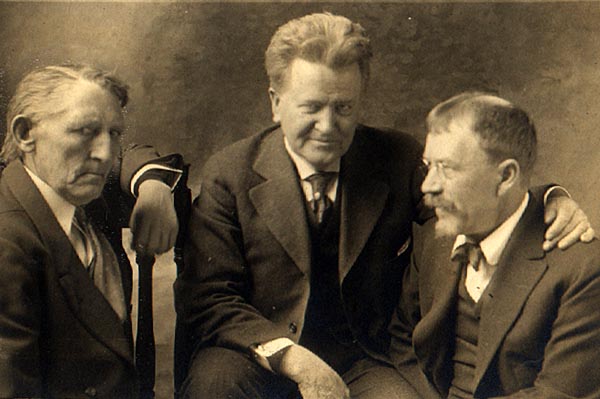
Left to right: Labour leader Andrew Furuseth, Seantor Robert LaFollette, Lincoln Steffens.

In the real world, it would be easy to enumerate many visions of the political future, “progressive” causes, that have turned out to be dead ends. One thinks immediately of Lincoln Steffens's comment on visiting the Soviet Union in 1919: “I have seen the future, and it works.” Even as late as the 1970s, most Western intellectuals were talking of the inevitability of “convergence,” of the West becoming more like the Communist Bloc as well as the reverse—if not of the inevitability of the Communist Bloc taking over. That future, or those futures, are now ashes.

So is the future of the 1980s in which Japan was to dominate world commerce. 

Boccioni, "Unique Forms of Continuity in Space": probably the best-known example of Futurist sculpture.


Fascism, too, was, in its day, the way of the future. It was the political application of the latest scientific insights, those of Darwin and of Einstein. The aesthetic movement associated with Fascism called itself “futurism.” Nevertheless, a recent piece in Time magazine had so completely bought the Whig view that it actually defined Fascism as “the rejection of modernity.” One ought to be able to expect better of an organ like Time, but that's how pervasive the myth is.

There's more—lots more. Nothing was a more progressive idea at the turn of the 20th century than good old prohibition. It was during Woodrow Wilson's “progressive” administration that the worst of Jim Crow was enacted in the US South. Most “progressives” up to the Second World War were also active advocates of eugenics, until Hitler so thoroughly urinated in that pool.

In the Victorian period, cultural and moral progress was generally measured by the modesty of women: early missionaries to Korea considered that country relatively advanced because their women did not go abroad during the day. Indeed, one of the great accomplishments of Victorian progressivism was legislation limiting the work of women outside the home.

Stepping back a little further in time, England's “Glorious Revolution” of 1688 established the supremacy of parliament over the crown, produced the English Bill of Rights, and led directly to the American and French Revolutions and to much of what we now call liberal democracy and the doctrine of human rights. All “progressive” causes of the time, and still considered core “progressive” values today. But the immediate cause of the Glorious Revolution was the desire to prevent a Catholic from taking the throne. Anti-Catholicism and the open repression of Catholics was an essential element of “progressive” thinking in both England and the US for perhaps two hundred years. There was certainly no concept that any of these rights were to extend to non-Protestants—as there was no concept later that they should extend to Africans. The whole original idea of the “right to bear arms” was in order to protect oneself from Catholics out in the boondocks of Ireland.

I'd guess that the left is right about the future about fifty percent of the time, and the right gets it right the other fifty percent of the time.

But that should be irrelevant in any case, unless you are an opportunist. One's politics should be formed on principle, not as if a bet.

Wednesday, April 30, 2014

On the Drift Right with Age


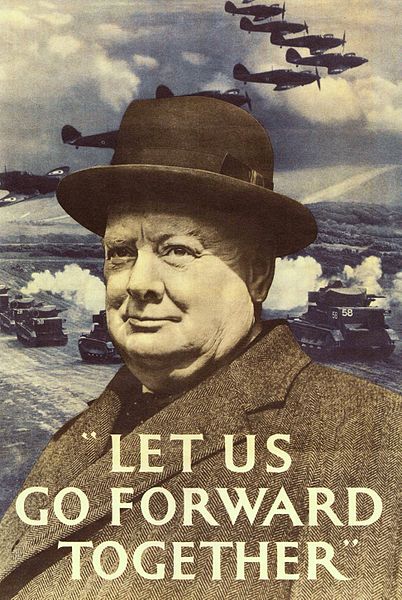
A man of heart and mind.

It is a commonplace that people grow more politically conservative as they get older.

Some say this is the result of growing wisdom. This quote is often falsely attributed to Churchill: "If you're not a liberal when you're 25, you have no heart. If you're not a conservative by the time you're 35, you have no brain." Or, as Irving Kristol really did say, “A conservative is a liberal who has been mugged by reality.”

This is one reason why right-wingers do not hate leftists the way leftists have right-wingers. Leftists assume rightists are either stupid or immoral. Rightists assume leftists are simply naïve.

However, it occurs to me that there may be another explanation for this rightward drift with age. The CEO of Mozilla, Brendan Eich, was recently forced to resign for holding a position on gay marriage, six years ago, that the President of the United States still held two years ago, without any visible consequences.

"The Radicals' Coat of Arms," Cruikshank, 1819.

It seems to me that this illustrates the great difficulty of remaining a leftist over time. The revolution devours its own children. Many of the same views that were considered vaguely leftist in, say, the 1960s would now be considered so right wing as to be well beyond the pale of polite society. Conversely, many ideas that are now accepted left-wing positions would have, in the 1960s, been considered flatly insane. Accordingly, in order to remain on the left, you must have no abiding principles. If you have any abiding principles whatsoever, and are, moreover, sane, you inevitably end up on the right over time.