Playing the Indian Card

Showing posts with label modern art. Show all posts

Friday, January 10, 2025

Why Nothing Rhymes Anymore


Newman's "Voice of Fire," in the National Gallery of Canada: your tax dollars at work.

 Bought for $1.76 million in 1990.

At a recent meeting of a poetry group, the moderator warned a new participant against using rhyme. She had warned me too some time ago, although I ignored it. She did not give any reason why rhyme is bad; she just knew you weren’t supposed to do it. She explained that rhyme is frowned upon by those who have been through any MFA programme, and by journal editors. So you won’t get published. 

I believe this is why Leonard Cohen left poetry for songwriting. He had been publicly pilloried by fellow poet Louisa Dudek on the grounds that his poetry was not experimental enough; it was too conventional. He figured he had no future in poetry then. Writing song lyrics permitted him to rhyme.

Joni Mitchell’s path to songwriting was eerily similar. She had started out wanting to be a painter. She dropped out of art school because they would not tolerate representational painting; everything had to be abstract.

The key to understanding poetry is that its proper medium is memory, just as the proper medium for prose is the printed page, and of plays the human voice. Rhyme, as a mnemonic, is therefore of value; a rhymed poem is in principle better than an unrhymed poem. It gives another hook to the memory, and another reason for that word to be there.

The lack of rhyme in modern poetry, and the lack of representation in modern art, probably explains why both have lost their popular audience. Nobody buys or reads poetry anymore; it used to be the most popular form of writing. And nobody really appreciates abstract art; people buy it as an investment, and praise it because they think it makes them sophisticated.

Representation is also rejected now in poetry: narrative poetry is discouraged. I had a poem rejected as an entry in one poetry contest, on the grounds that it was not really a poem, but a story, because it had a narrative line. The same poem later won the Mensa World Poetry Prize.

So why are rhyme and representation rejected? The obvious reason is because they are hard to do. It is always easier to write an unrhymed poem than a rhymed poem; to paint an abstraction than to paint a representation. So long as the element of needing to appeal to an audience is removed, it is in the self-interest of artists to discourage both. Even those who are capable of decent rhyme or representation: take away that requirement, and they can crank out product. It works best or artists who are in it as a career, instead of a vocation.

And that is what academics and credentialism does: it removes market forces, removes the customer, and frees practitioners to pursue pure self-interest.

And this seems to have destroyed not just contemporary art, but many other fields. The quality of teaching has collapsed since the emergence of schools of education. The quality of journalism has collapsed since the emergence of schools of journalism. 

Academic departments generally develop a contempt for whatever subject they are supposedly there to advance. It looks like work. Nothing compels them to work. They will find a way to toss it off, and do something else instead. Often politics.

And they will try to ruin anyone who wants to do a good job. They are scabs.

For the sake of civilization, it may be necessary to shut down the universities. Kill credentialism. Now that we have infinite access to information through the internet, there is no justification for them.


Thursday, May 21, 2015

The Waste Land


Dali, "The Persistence of Memory"

Western civilization has never recovered from World War I. It has PTSD and has been trying to commit suicide ever since.

We saw Yeats’ prophecy of this in “The Second Coming,” first published in 1920. But there was another great poem published just two years later, in 1922: T.S. Eliot’s “The Waste Land.” Many consider it the first great trumpet blast of Modernism. Which is to say, the general nervous breakdown of the arts in the West.

Yep.

It was written by Eliot when he was himself suffering from what we now would call depression: "nervous exhaustion," they called it then. The poem is a profoundly accurate depiction of the experience of depression. If we really want to understand depression, we ought to be studying it carefully. It is hard to see spiritual things. We need someone with Eliot's talent to show them to us clearly.

Thomas Stearns Eliot. "T.S." to you.

The most notable aspect of the poem, of course , is that it is all frustratingly incoherent. That is the point; that is the essence of depression. There is no protagonist, no consistent sense of self: "depersonalization," the shrinks call it. Instead, a seemingly random parade of narrators take up seemingly random threads, as if an invisible hand were turning a radio dial. Sensible narratives carry on for a while, then are interrupted by something else. Shrinks call this "inability to concentrate." Most notably to my mind, there is a sense of meaninglessness: things seem to mean something, but the meaning always remains just beyond reach, ephemeral, like a will-o-the-wisp. A lot of dead-end allusions. "A lack of interest in anything," the good doctors will conclude. There is certainly a pervasive sense of anxiety: something bad is always coming. Sorrow? Perhaps there is sorrow; you decide, reading through. I do not see anything resembling ordinary sorrow. A sense of loss, agreed. But sorrow is not, in fact, the defining element of "depression."

It is, in sum, a "Waste Land." A barren landscape. It is the desert sands of Yeats' prior poem. But Yeats was foreseeing this state; Eliot is living in it. The image is so apt, for what Western civilization has been struggling through, that we have been writing about it ever since. Becket's Vladimir and Estragon inhabit the same landscape. So does Orwell's Winston Smith. Dali paints it in "The Persistence of Memory." Ginsberg's angelheaded hipsters prowl it in the predawn of "Howl." Steinbeck's Okies experience it as the Dust Bowl. More recently, it has appeared as Mad Max's Australia, Dylan's "Desolation Row," Blade Runner's decaying LA, Luke Skywalker's Tatooine, Katniss Everdeen's Panem, and the Georgia of The Walking Dead. Not to mention ten dozen other zombie matinees. Steppenwolf secretly lived there. The Waste Land, perhaps originally inspired by the No Man's Land of the World War I trenches, has become the ruling metaphor for the modernist era, and for modern life. It is also sometimes known as "the rat race." 

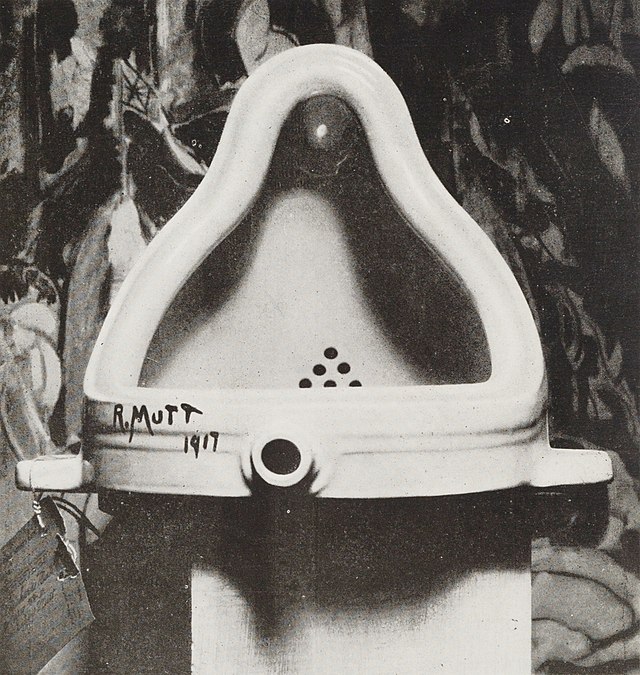
Duchamp's "Fountain," 1917.

We have been wandering these barrens for the past hundred years. Our art is at a dead stall; we cannot find our way out of this maze; we have never yet managed to discover a new centre for our cultural mandala, a new cosmic organization of truth, goodness, and beauty. There was a brief period of optimism, true, in the 20's, and a longer one after the Second World War, but things soon settled back into permanent twilight. We have been doing nothing but repeating Eliot's Waste Land and Duchamp's "Fountain" ever since.