Playing the Indian Card

Showing posts with label meaning of life. Show all posts

Tuesday, August 30, 2022

The Way of the Pilgrim


Why are we here?

Many people plainly suppose we are here to seek pleasure. A high school friend used to say “we’re just two ends of a gastrointestinal tract.” A hotel co-worker said sex was what made life worthwhile. 

This is the perspective of an animal or a robot. It is also a will-o-the-wisp. Without hunger, food does not satisfy. Without abstinence, sex is just work. It all becomes addiction, and pleasure is gone.

Some people think life is about achieving “success.” Success here means power and social authority over other people. This is actively active evil. And it certainly does not lead to contentment. “Uneasy is the head that wears the crown.” 

Some people say that life is about having children, and giving them a start in life. This is the Darwinian perspective; the Bible too does say “go forth and multiply.” Kids are part of our job, at least. But it does not entirely satisfy. If your life is meaningless, so are your children’s lives. 

Some people say life is about sacrifice of self to the collective: one owes ultimate allegiance to one’s parents, one’s community, and one’s homeland. “Dulce et decorum est pro patria mori.” But this is idolatry: one’s nation, one’s government, or one’s parents can be either good or bad. This leads to “good Germans,” Fascism, racism, and nepotism.

Some say that life is about going about doing good to others. And it is, in detail: we are to clothe the naked and feed the hungry, when we encounter them. But this can easily become a form of ego-worship. The Bible warns that if we do good and are seen to do good, we already have our reward; we are acting in self-interest. God does not need you to save the world; realistically, things are already going as he intends. I suspect figures like Mother Teresa. 

The meaning of life is to seek the true, the good, and the beautiful. 

This is necessarily so, because truth, beauty, and good are the only things of value in themselves. They do not derive their value from anything else, and everything else is valuable only to the extent that it is true, good, or beautiful.

These values can be falsified and misunderstood. People often confuse beauty with sexual allure, for example. People misconstrue fact as truth, truth as fact. Facts are only one form of truth, and a trivial form. And people misrepresent goodness in many ways.

It is not public charity. It is also not being “nice,” and getting along with everyone. That requires having no principles, and giving everyone what they want. This is, at best, moral cowardice, at worst devious self-interest. It requires aiding and abetting evil whenever it appears.

True good is justice. Not to be confused with the current leftist concept of “social justice,” a euphemism for injustice. Justice means giving everyone what they deserve on their merits.

How does one, in practical terms, do this?

First, in art. Good art manifests beauty. Art is adding beauty to the world. This is an intrinsic good, even if no other mortal sees this beauty. God does, and with him you are building the New Jerusalem, which the Bible describes to us as a vast work of art. But if possible, the Bible also tells us to “let your light shine,” and be a leaven to those around you.

Good art must also be true. As Keats said, “truth is beauty, beauty truth; that is all ye know, and all ye need to know.” One may speak truth outside of art, but inside of art, you must. And speaking truth outside of art can be dangerous. Jesus warned: “Do not give dogs what is sacred; do not throw your pearls to pigs. If you do, they may trample them under their feet, and turn and tear you to pieces.” So he spoke in parables. Art is intended, as Emily Dickenson said, to “tell all the truth, but tell it slant. Success in circuit lies.” Those who have eyes to see, will see.

Good art must also serve justice. We are aware of this when, for example, we read or watch a play. We will rebel, intellectually and emotionally, whether watching tragedy or comedy, if the resolution does not serve justice. Karma must come around. No cheap happy endings, and no gratuitous deaths.

Beyond art is something more: the practice of a religion. To bind yourself to a religion is, in effect, to make your life a work of art. Art shows the way; religion IS the way.

But there is no just going through the motions here, no “church on Sunday,” no hypocrisy. We are talking of full commitment, of “prayer without ceasing.” That is the ultimate. That is sainthood.


Friday, July 06, 2018

The Meaning of Life: Not 42


Not all religions are equal. Why would they be? How could they be? All religions may and must include all that is needful, but if they are different, they cannot be equal. I have studied all the major world religions, and, while I love them all, I frankly do have favourites.

Traditionally in Western thought, starting with Plato, with traces back to Parmenides, there are three transcendentals: the Good, the True, and the Beautiful. These are the three qualities that abide in all things, and to the degree that they subsist in something, give a thing its value. In other words, they are the measures of all value. Put another way, they are the proper goals or objectives of human life.

Is this an arbitrary list? I cannot feel so. It seems to me that the proposition is self-evident once proposed. One cannot seem to superimpose some other, external standard by which goodness or truth can be measured and determined to have or not have value. Other, that is, than in terms of one of the other transcendentals. And so as well with beauty. These seem to be genuine a prioris. There may be others, and others have been proposed, but at a minimum, these three.

Now, given that these three are what they appear to be, the goals of existence, a religion can be evaluated on the basis of how well it recognizes and accommodates all three in its concept of God or the sacred, and of righteous human life.

On this score, I think Catholic Christianity has to ge the highest score, objectively. It is the one, to my eye, that most fully emphasizes all three aspects of life and of the divine: the faith, the morals and the ceremonials and sacramentals. I felt this in a deep, intuitive way before I thought to apply the doctrine of the universals, but the doctrine of the universals confirms it.

Take Islam first, as a comparison, since it is so much in the news. I find it bereft of a proper appreciation for Beauty. It is deeply suspicious of the arts: of painting, music, dance. Walk into a mosque, and there is very little there but bare walls. To me, this makes it feel barren and lifeless. 

Radha, image of the devotee, with Krishna.

Now take Buddhism or Hinduism. They seem to avoid the issue of the Good. They lack a strong moral dimension. Buddhist seems stronger on the Truth, Hinduism on Beauty, but both are relatively lacking in moral emphasis. To me, this makes them feel ultimately unserious, ephemeral. For East Asian culture in general, this lack is made up for by Confucianism, which emphasizes the Good without touching much on the True or the Beautiful. A relative lack of emphasis on Beauty in Buddhism is made up for in East Asia by Taoism. Bundled together, they work well. On the other hand, transporting Buddhism to the West without the other two does not work out well.

Judaism seems to me pretty solid. In theory, it should resemble Calvinism or Islam in discounting Beauty, since it shares their iconoclasm. But this does not seem to be the case, at all. Within Judaism, this seems to remain a prohibition against images of God, not against the arts. Which is, indeed, a separate and unrelated position. Judaism has a rich tradition of sacred storytelling. To the extent that a minority culture can, it also has a rich tradition of sacred music, sacred dance, and so forth. The only problem with Judaism in this regard, perhaps, is that it is ethnically and culturally based, and not easily available to us non-Jews.

Calvinism, within Christianity, seems to me to sadly lack both the Good and the Beautiful. No art, anything that smacks of art is of the devil; and no free will, so no moral issues. It seems to me only marginally religious. The Episcopalians, with their doctrinal looseness, seem to me weak on the Truth issue; it seems as though to them Truth does not matter, as long as you have Beauty. In Canada, the United Church as it now exists is similar, but without the Beauty. Good is all that matters. And so forth for other denominations.

To be fair, I can think of one area in which I find Catholic Christianity relatively lacking, and one or two other traditions stronger: humour. There is, within Christianity, a sense of scandal at laughter in a religious context. It feels blasphemous. I think this is wrong; Christianity is uptight here. It deprive God of some of his true personhood. Buddhism, by comparison, is full of jokes. Judaism enjoys a good knock-down argument with God, which seems to me healthy. Islam has the comic figure of Nasruddin. Hinduism has its “theology of play.”

Perhaps humour counts as a fourth transcendental: the Good, the True, the Beautiful, and the Funny.

And I feel there is a fifth transcendental, on which Christianity excels: Love. Or perhaps love is better defined as the proper response to the transcendentals, that of absolute attraction, of seeking them with your whole heart and your whole mind, to the neglect, if necessary, of everything else. I think it is fair to say that love is an important element in all religions: in Buddhism, in the doctrine of the Bodhisattva, in the figure of Guan Yin. In Hinduism, in the figure of Krishna, in the doctrine of bhakti yoga. In Islam, in Sufism and the Sufi poets. In Judaism, in the concept of the Shekhinah; you see it in Song of Songs.

But you can't beat the Christian formulation: God is Love.


Monday, August 31, 2015

The Meaning of Life


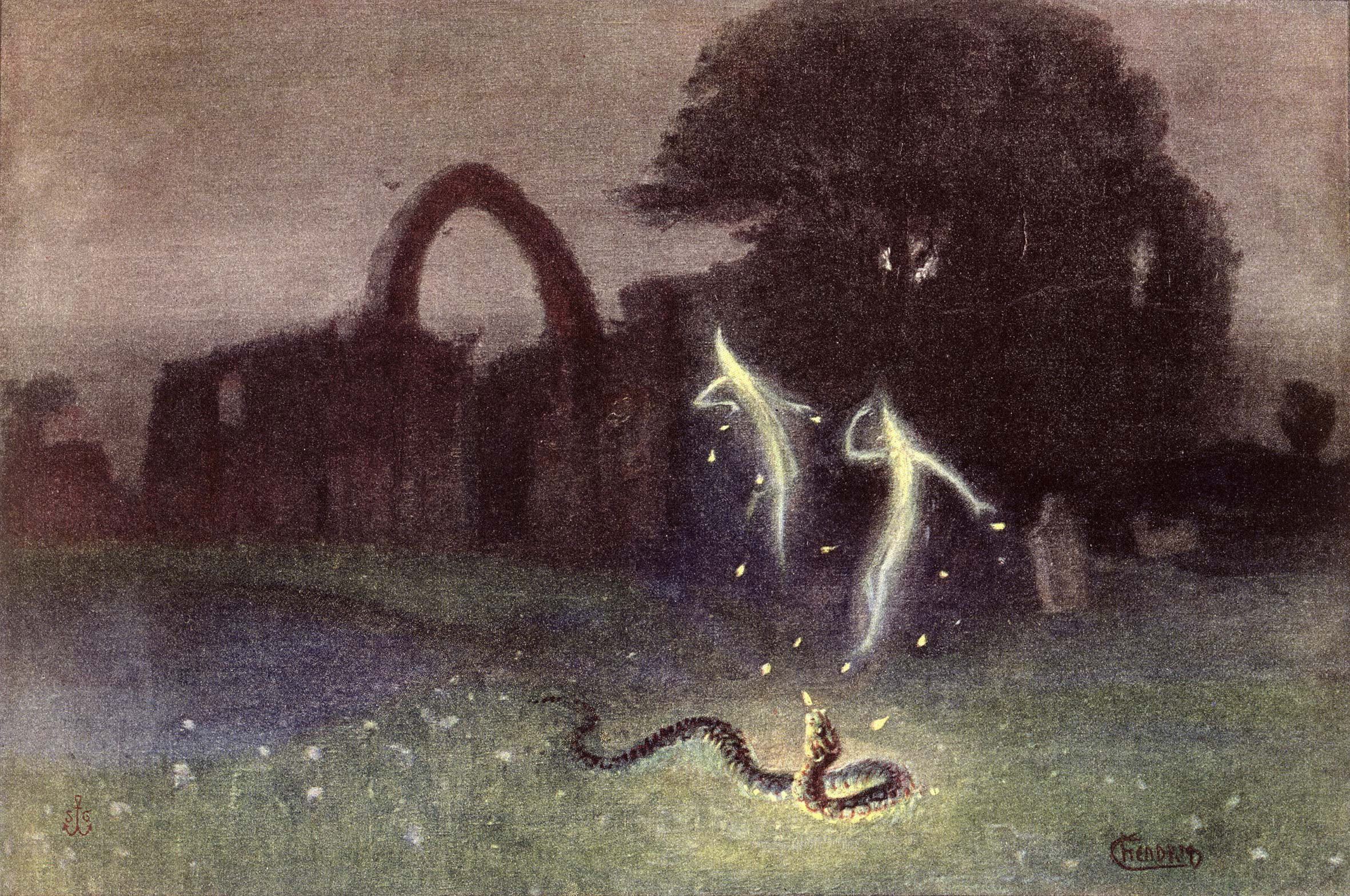
Still life with will-o-the-wisp and snake: Heindrich.

We were speaking of the meaning of life. It is not 42.

We looked at the quest for power or leadership, and saw that it was a chimera. It must always end in frustration and disappointment. So too with wealth, fame, and the pursuit of knowledge of the academic sort.

But we have not exhausted all possibilities yet.

Many seek fulfillment in marrying and raising children—the family values bit. “That must be what it’s all about,” as Bob Dylan once sang. Interestingly, though, the Bible does not validate this; and the Bible is right. If your own life is meaningless except for producing a new life or lives, then those lives in turn must also be meaningless—one has simply created an infinite regression. 

Chimera, Ukraine

Others seek meaning in art and the creation of art. I do believe art can lead to meaning or the recovery of meaning on a personal level. It has this great value. But there is still, it seems, something vain about devoting one’s life to the creation of art. The truth is that there is more fine art in the world than any person can possibly fully appreciate in one lifetime. There is therefore no objective value in creating more unless, by chance, you can do it better than anyone who has come before. This is not likely. One should create or appreciate art for personal benefit, as a kind of spiritual medicine, but it is off track to make aesthetics the essence of one’s life.

So—should one devote one’s life to works of charity? Not a bad thing, surely, but again, not the core value. If all you are doing with your life is making another life more pleasant, you run into the same infinite regression as with having children. If your life is otherwise meaningless, then so is that life. Nor does an omnipotent and compassionate God, assuming you believe, really need someone like you to fix his creation for him.

The meaning of life must, if only by elimination, by elimination, be this: establishing a relationship with that God.

Still life with carrot and jackass.